
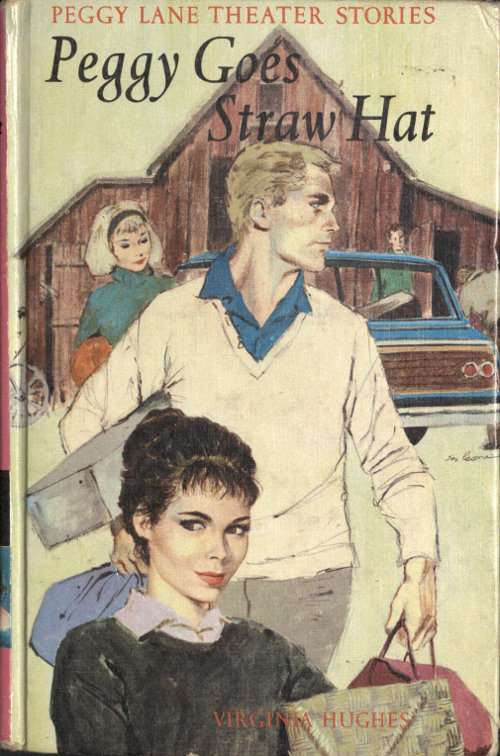
The Project Gutenberg eBook of Peggy Goes Straw Hat
Title: Peggy Goes Straw Hat
Author: Virginia Hughes
Illustrator: Sergio Leone
Release date: October 27, 2017 [eBook #55826]
Most recently updated: October 23, 2024
Language: English
Credits: Produced by Stephen Hutcheson and the Online Distributed
Proofreading Team at http://www.pgdp.net
“I’ve wanted to tell you, Peggy,” said Chris, “what fun it is working with you.”
PEGGY LANE THEATER STORIES
Peggy Goes Straw Hat
By VIRGINIA HUGHES
Illustrated by Sergio Leone
GROSSET & DUNLAP Publishers
NEW YORK
© GROSSET & DUNLAP, INC., 1963
ALL RIGHTS RESERVED
MANUFACTURED IN THE UNITED STATES OF AMERICA
CONTENTS
- 1 The Arrival 1
- 2 A Serious Complication 15
- 3 A Broadcast 27
- 4 A Favorable Decision 41
- 5 Opening Night 48
- 6 Chance Encounter 58
- 7 Unfair Play 74
- 8 An Explanation 85
- 9 A Lifeline 96
- 10 Friends—New and Old 108
- 11 Quick Thinking 121
- 12 Varied Explosions 131
- 13 Double Trouble 143
- 14 Ups and Downs 156
- 15 Summer Stock 168
PEGGY GOES STRAW HAT
I
The Arrival
Eight hours after leaving New York City, the rickety old Pathways Bus lurched to a bouncing halt in a small Adirondack mountain town. Peggy Lane rose from her seat and somewhat shakily managed to collect her handbag, a small suitcase, a hatbox, two coats, and her precious tin make-up kit.
“I wonder if I really look like an actress or more like a walking luggage rack?” she thought excitedly as she stepped down from the bus. The scene that greeted her was breath-taking; Peggy gasped aloud with delight. Before her, Lake Kenabeek lay gleaming like a jewel in the afternoon sun. Pine trees rose everywhere and although it was summer there was a delicious nip and tang in the air. Peggy’s heart raced with eagerness and the familiar nervous anticipation she always felt when approaching something new. She had been hired as resident ingénue for eight wonderful weeks with her first summer stock company. Each week she would be playing a different part, gaining invaluable experience, and learning new phases of life backstage.
“And I got the job all on my own!” Peggy thought exultantly. “Just by reading for the producers! That must mean something—at least, it means that I’m really a professional actress now and don’t have to depend on friends and ‘contacts’ for my work!” She smiled happily, taking a deep breath of the fragrant, pine-scented air.
“Miss Lane?” A voice interrupted Peggy’s thoughts. She turned and saw a spectacled, studious-looking boy about seventeen who was wearing dungarees and a paint-smeared shirt. Offering her a slightly stained hand, he grinned shyly. “Scene paint,” he explained, “but it’s clean.”
Peggy could hardly shake his hand, laden down as she was, and the boy stammered with embarrassment. “Oh, I’m so sorry—I was so busy looking at you, I didn’t notice.” He relieved her of some of her bags, giving her a frankly admiring stare. “You sure look like a good ingénue!”
“I do?” Peggy beamed.
“Just what I had in mind.” He smiled, taking in Peggy’s trim little figure, dark chestnut hair and fresh, mobile face. “I’m Michael Miller, and I have the jeep waiting to take you to your hotel.”
The jeep had been painted bright blue with an eye-catching sign on the hood. Kenabeek Summer Theater, it proclaimed in large white letters.
“Good advertising,” Michael confided as they deposited Peggy’s bags in the rear. “But then, you’re not bad advertising either!” He nodded in the direction of a few bystanders who were casting curious glances at Peggy. Peggy smiled back at the townspeople, and as she climbed into the front seat, her nervousness unexpectedly dropped away. She was really here at last, she realized, an actress with a season’s contract—and suddenly she felt very professional.
As they drove carefully up the winding mountain road, Peggy discovered that Michael was one of three local boys who were to work as apprentices—helping the scene designer, doing odd chores, and playing small parts when needed. Michael’s father was Howard Miller, a retired theater man, who was to do all the older character parts during the season.
“Oh, I’ve heard of him!” Peggy exclaimed. “He’s supposed to be a wonderful actor, and we’re lucky to have him. You know how hard it is to get good character men for stock. Michael,” she went on eagerly, “do you think the theater will be a success?”
Michael considered a moment. “I don’t honestly know,” he replied thoughtfully. “This is a very small town, and actually we don’t have a large enough population to carry a summer theater all on our own. But one of the ideas behind this venture is to bring in more summer resort business.”
Peggy nodded. She knew that Richard Wallace, one of the two young producers, was a resident of Lake Kenabeek, and wanted to help improve his town—both culturally and financially.
“Of course Richard’s Aunt Hetty is vice-president of the Chamber of Commerce,” Michael continued, “and the Chamber of Commerce put up half the financial backing for the theater. So we do have solid support there. But some people here resisted the idea of a group of actors—you know, they think that actors are a strange, Bohemian breed—” He glanced at Peggy and laughed. “Bohemian, huh! All they need is to take one look at you, or any of the other actors who have come up from New York.”
Peggy smiled gratefully. She knew that a lot of people didn’t realize what honest, hard work the theater could be. But obviously this intelligent young boy had a deep feeling for the profession and knew that an actress’ life wasn’t only curtain calls and bouquets after the performance.
“Yes, we do have a lovely group of people,” Peggy agreed earnestly. She had met most of them in New York during the tryouts and been impressed, not only by their acting ability, but by their responsible and intelligent attitude. “And we have a really good director, wonderful plays, and at least half the town is behind us. That should be enough if we work hard!” she concluded with a twinkle.
Michael turned from the twisting, ribbonlike shore line and drew up in front of a large, old-fashioned, rustic building. “Here we are,” he announced grandly, “Kenabeek Inn! But you’re not in the main building; your company is staying in the annex.”
Peggy followed him around the side of the inn, down a little path fringed with fir trees. In a small clearing, well away from the kitchen noises issuing from the rear of the inn, Peggy saw a tiny, two-story building. There was a roofed-over patio outside with two sofas, some chairs, and a table on which stood a hot plate and stacked cups and saucers. Peggy smiled to herself, recognizing the sure sign of an actors’ residence—coffee, coffee, and more coffee.
Rita Stevens came bursting out of the door, a radiant smile transforming her rather plain features. “Margaret, ‘Peggy’ Lane—Star of Stage, Screen, Radio, Television, and Summer Stock! Welcome!” she cried, running up and giving Peggy a hug.
They grinned at each other happily. “Oh, I’m so glad to see you!” Rita bubbled. “I’ve been positively frantic for some female company around here. We’ve been up for three days and Gus has spent every single minute at the theater—”
Rita was married to Gus Stevens, the scene designer—a lucky combination for the company. Although young, Rita had one of those ageless faces and a maturity which made her a perfect character woman. Peggy had liked her the instant they met at the readings in New York.
“No women?” Peggy asked, “Hasn’t Alison Lord arrived yet?”
“Oh, no, my deah,” Rita intoned in a stagy accent. “No, our leading lady is being flown up in someone’s private plane and isn’t expected until tomorrow morning.” She waved a hand airily, imitating perfectly a prima donna.
“Oh, no!” Michael grimaced in disgust. “Is she really like that?”
“No, Mike,” Peggy said with a laugh, “she’s really quite friendly and nice—and a very good actress. Just a little theatrical, but I’m sure you’ll like her.”
“Well, I hope so,” Michael said, obviously still doubtful. “Look, I’ve got to scoot back to the theater. May I leave your things here, Peggy?”
“Oh, I’ll take them, Mike.” Rita grabbed some of Peggy’s luggage and started up the stairs of the little house. “See you later, Mike.”
“And thanks for the ride and everything,” Peggy called after him.
“He’s such a sweet kid,” Rita commented as they climbed. “A wonderful help to Gus—I have a feeling Michael may make this business his life work. Here’s where you live, Peggy!”
They stepped into a tiny white room, sparsely furnished with only a day bed, a large bureau, a folding screen, straight chair, and a bedside table.
“The manager of the inn must know something about summer stock companies,” Rita observed ruefully. “Obviously he has a good idea of just how much time we’ll be spending in our rooms.”
Peggy looked at her questioningly and Rita laughed. “It’s your first season, I know—but just you wait and see!”
“My trunk!” Peggy interrupted with a sudden disturbing thought. “I sent it ahead by Railway Express. Hasn’t it come?”
“Right here, madame.” Rita folded back the screen and revealed Peggy’s large, black wardrobe trunk, which was somewhat dented and worn, parts of old labels still sticking to it here and there. “You know, for a girl who hasn’t done stock before, or been on the road, this trunk is really strange. What did you do?” she asked with a teasing smile. “Stick on labels, and tear them off, and then jump up and down on it wielding a hammer?”
Peggy hooted. “Rita Stevens, you have a very suspicious mind! I want you to know that this trunk belonged to a friend of my father’s—a wonderful woman who was in the theater years ago.” Peggy’s face softened wistfully. “And I imagine that this battered old trunk has seen more drama—on stage and off—than we can even imagine.”
The girls looked at it thoughtfully, a picture of the old, romantic days of the theater—great plays, great producers, great stars—all the golden history of the stage firing their imagination.
Peggy broke the spell, “Well, anyway, May Berriman gave it to me. She runs the rooming house where I live in New York, you know. And believe me, I’m grateful! Besides needing a trunk, I think of it as a symbol of good luck. Some time soon, Rita, would you mind taking a look at my wardrobe? I think I brought enough, but I’d like to be sure.”
“I’d love to,” Rita said. “But now let me show you where everything is in our little annex, and then you’d better rest awhile. I’m sure you’re tired, and we have a company call tonight.”
Alison Lord would be in the room across the hall from Peggy. Rita and Gus were also upstairs, on the opposite side of the house. Danny Dunn, Chris Hill and Chuck Crosby, the director, were all downstairs. The patio was community property for coffee, line rehearsals, and just plain relaxation. It seemed like a good arrangement. Rita showed Peggy where she could shower and freshen up and said she would call her in time for dinner.
But Peggy was too keyed up to take a real nap. She sat on the edge of her bed, thinking of all the steps that had led her here, to this place, at this time. Her love of acting, the school plays, the productions in college, coming to New York, the long, hard work at the Dramatic Academy and in the Penthouse Theater. She was grateful for a private room where she could be quiet and think.
She remembered her home town of Rockport, Wisconsin, and suddenly had a vision of that other gay little bedroom where she had often sat quietly and thought—much as she was doing now. She remembered her mother’s kind, attractive face and her encouragement and understanding. Her father, too, would be glad to hear of this job, Peggy thought, and would probably run an article about her in his paper, the Rockport Eagle. She smiled, visualizing the headline—Local Girl Signed in New York—or something like that. Thomas Lane was a good newspaper man and would try to “hook” them with the headline. Nothing so simple as Local Girl Makes Good.
Peggy promised herself to write them good long letters as soon as possible. And she should write to May Berriman, and to her housemate in New York, Amy Preston. Well, there was a lot to do—and a lot ahead. Peggy sighed and opened a suitcase to change into something fresh for the evening.
After dinner, Peggy, Rita, and her young husband, Gus, walked up the road to the theater. Gus had joined them for dinner in the little roadside restaurant where the cast had made arrangements for meals at a percentage off the regular cost.
“Mrs. Brady, who runs the place, is anxious to do all she can for the theater,” Rita explained.
“To say nothing of the extra customers she hopes to attract by having real actors in her dining room,” Gus added. “Not that I’m a candidate for glamour, you understand—”
The girls laughed. Gus had hastily donned a clean shirt and a fresh pair of blue jeans, but the unmistakable signs of sheer hard work still showed on his pleasant, tanned face.
Rita squeezed his hand affectionately as they hurried up the road. “I do wish you’d let up a little,” she said. “After all, we do have nine days before opening.”
“And it’s going to take every minute!” Gus nodded emphatically. “You haven’t seen the auditorium yet, have you, Peggy?”
“No, I haven’t. You know,” Peggy confessed, “I was really disappointed when I learned that we were playing in the high school. I had visions of a rustic barn with candlelight, bats in the wings and mice for rehearsals—”
“There is one.” Gus chuckled warmly. “Aunt Hetty has a barn that we can remodel next summer if this season is a success. But we couldn’t afford to do it this year. It’s better to rent the school and see what happens. If it bothers you, Peggy,” he added, looking at her with amusement, “hold on to the thought that we’re helping education! We are, too. The school needs the money.”
The front doors of the school auditorium faced the highway. A large sign for the theater gleamed brightly under the floodlights that played on it. “It’s never too early to advertise,” Gus observed as they walked to the back of the building.
Entering the stage door, they came through the wings and walked out on a dark stage, only a single worklight throwing a white circle on the bare boards. The heavy drapes were pulled back, framing the empty house, the vacant seats ghostlike in the silence.
“Well, where is everybody?” Peggy gasped in the eerie quiet.
Gus and Rita roared. “We just thought you’d like to see the stage, Peggy,” Gus laughed.
“You didn’t think we were going to rehearse tonight, did you?” Rita teased, and then took Peggy’s hand. “Come on, dear, we’re only kidding. Everybody’s down here.”
They crossed the stage, descended some stairs, and entered a door that led directly into the school gym. “Here’s our ingénue,” Rita called as she ushered Peggy in, “ready to work!”
Peggy blinked, coming into the sudden light and busy scene. The gym was bright as daytime. A huge canvas ground cloth covered the floor and several people knelt, beside cans, buckets, and paintbrushes, over the scenery flats that were strewn from one end of the gym to the other. Peggy had difficulty recognizing anyone. They were all spotted and paint-smeared, in a variety of strange work clothes.
“Hi!” someone called, raising a hand with a dripping brush. Peggy peered intently at the slight figure and dark hair, and recognized Chuck Crosby, their intense young director. “Get to work,” he ordered with a smile and went back to his painting.
A well-built young man with a heavy mass of light-brown hair rose with his can and beckoned to her. Peggy picked her way through buckets and flats, following him.
“Danny Dunn!” she said with a shock of surprise. “How on earth am I supposed to know you under that disguise?” Danny was to do juvenile and some character parts for the company. Now he looked like a clown as he smiled at her with a paint-dotted mouth.
“Tomorrow is another day!” he quoted dramatically. “Tomorrow and tomorrow—I can hardly wait! By the way, sorry I couldn’t join you all for dinner, but I just had a sandwich here. Tell me everything tomorrow—if I’m still alive.” He made a face, “Here, ingénue, fill a can.”
In a clear corner near the wall, Michael Miller sat hunched over a hot plate with a bubbling pot of melting glue. He looked like an ancient alchemist as he stirred and poured, mixing paint, whiting, and glue into large buckets.
“The white cliffs of Dover,” Michael muttered romantically, taking a bag of powdered chalk and measuring it into his caldron.
“Sure, double, double, and all that,” Danny replied, nodding kindly. “Well, just keep steady, old chap, we’re all a little tired tonight.”
“It really is the white cliffs of Dover,” Michael protested as Danny walked away. “For the ground coat,” he added, peering up at Peggy through his steaming glasses. “Here, have fun.” He waved her away.
For the next four hours Peggy knelt on her hands and knees, laboriously painting flats. These were frames of white pine, over which was stretched unbleached muslin, like a painter’s canvas. They had already been sized with a solution of glue and water until they were drum-tight. Over the ground coat that Peggy was painting, Gus would design wallpaper for interiors, fireplaces, outdoor scenes. Peggy’s back ached as she worked silently. No one said a word.
“A funny way to begin,” thought Peggy, sighing. She had expected a line reading, even some work on stage. “And Chuck hardly said how-do-you-do, and I don’t know half the people here.” She glanced around, guessing that the young boys must be Michael Miller’s friends, and that older man by the other wall his father, Howard Miller. He noticed Peggy looking at him and smiled.
“Well,” Peggy decided, acknowledging him with a sigh, “if a man his age thinks nothing of working like this until all hours of the night, I guess I can do it too!” She worked on with renewed energy. By the time all the flats were finished, it was after midnight.
“Rehearsal promptly at nine o’clock in the morning,” Chuck announced crisply as they cleaned up and prepared to go home.
“Heavens to Betsy!” Peggy thought wearily as she lay in her bed, her back aching, muscles jumping from the unaccustomed effort. “Now I know why everyone was so quiet. They’d been at it all day—and I feel like this after only a few hours!” Her head spun dizzily as she closed her eyes. “Well, I’m part of a company,” she mused dreamily, “and that’s what counts. Even if I don’t like the parts I’m given—even if I have to do other things than act.” Plays and parts and costumes danced before her like a mirage. “I guess this is summer stock, all right!” she thought as she fell asleep.
II
A Serious Complication
“Not quite so serious, Peggy.” Chuck Crosby pulled on a lock of his straight, black hair as he listened to her read. “If you don’t have a slight tongue-in-cheek attitude, it’s not going to be funny. She is an earnest young girl, but it’s got to be exaggerated in a comic way.”
Peggy tried again. “Dad, I’m disappointed in you,” she read. “The world’s on fire and you’re occupied with a cigarette lighter!”
“Thank you,” Howard Miller answered dryly. He was reading the part of Peggy’s father in their opening show, Dear Ruth.
The cast was having its first line rehearsal on the sunny patio of the annex. Peggy had awakened excitedly with the expectation of working on stage, only to find that the company would be at the annex all day. She had wondered, in a resigned way, if she would ever see the stage at all. But now, as they progressed to the second scene of Act One, her disappointment was forgotten. She was concentrating on her part of Miriam, “Dear Ruth’s” younger sister.
“We can use you,” Peggy read on, addressing her father. “We can use anybody we can get!” She read the last line in a hopeless, adolescent fashion, timing it carefully, and the cast spontaneously laughed.
“That’s it,” Chuck cried. “That’s the quality I want.”
A pretty local girl, Mary Hopkins, who was playing the part of the maid, Dora, didn’t come in on her cue. Everyone looked at her as she nervously rattled her papers, looking quite lost.
“That’s your cue, Mary,” Chuck said patiently. “Miriam says, ‘We can use anybody we can get,’ and you enter.”
“I don’t see it,” Mary replied helplessly.
“Right here.” Rita was sitting beside her and pointed it out. “Anybody we can get.”
“But that’s not the whole line—oh, I see.” Mary blushed.
“We’re using sides, Mary,” Chuck said kindly. They were half sheets of paper bound like a small pamphlet. “I have the master script here with the whole play, but you’ll find only about four or five words of the preceding speech printed on your sides. You can fill in the other words if you find it easier.”
Peggy gave Mary an understanding smile. She had been busy writing in speeches herself, as she found the short sides difficult to work from. Peggy liked to think of the play as a whole, but she knew that some actors worked better from short cue lines, and that for stock, with so many different parts to learn each week, sides were often faster.
Rita read the part of the mother with assurance and humor. She made a perfect partner for Howard Miller, and one could tell that she was used to this type of part. Miriam made her exit, and then Ruth appeared for a short scene with her father and mother. Before her next cue, Peggy had time to examine, with a certain fascination, their leading lady.
Alison Lord had arrived that morning, making a grand and breathless entrance at exactly nine A.M. Her luggage was still stacked in the patio, and peering at it, Peggy raised her eyebrows. “And I thought I had a lot!” She wondered how many costumes Alison expected to wear on stage, but judging by the stunning outfit she was wearing for rehearsal, Alison must intend to dress as glamorously off stage as on. Her bright auburn hair was caught up under an eye-catching sun hat of fringed red straw. The color exactly matched the sleeveless blouse she wore over a beautiful pair of beige, basket-weave slacks. With her enormous straw bag, gay sandals, and dark glasses, she looked like a visiting star. And a really beautiful girl underneath all that, Peggy thought, noticing the careful make-up that enhanced Alison’s features.
Peggy glanced down at her simple, peasant skirt and blouse. It was pretty, but hardly spectacular like Alison’s attire. For a moment she wished that she had thought of bringing more colorful everyday clothes—was it good advertising for the theater perhaps?—but then she laughed at herself. “You’re just a little bit envious, Peggy Lane, and you know it! Now just forget about clothes, and tend to your knitting!”
Her cue came, and she jumped back into her part with gusto, really enjoying it now that she had caught the flavor of Miriam. She found that playing with Alison was fun. She was even better than Peggy remembered. She had a certain awareness of herself, a special “here I am” quality that would make an audience notice her. She wasn’t a very deep actress, but she had poise and presence and moved the play along.
Chuck was pleased with the reading. He looked at his watch and called a break. “Take five. Chris ought to be here any minute, and there’s no point in going on now without him.”
The cast paused for coffee, waiting for their leading man to arrive. Chris Hill, who was to play the part of Bill opposite Alison in Dear Ruth, was the only cast member Peggy hadn’t met. He had been held up in New York with a last-minute television show, and was due on the ten-thirty bus.
“What’s he like?” Peggy asked Rita as she broke off a piece of doughnut to share with her. The cast kept snacks in an old-fashioned icebox on the patio.
“Oh, he’s lovely!” Rita grinned mischievously. “He’s quite tall and very blond, tanned and terribly handsome, blue eyes, a great smile, romantic—”
“Really! He’s all that, hm?” Peggy teased back. “Well, all I want to know is, can he act?”
“He certainly can. I’ve worked with him before—” Rita looked at Peggy curiously. “It will be very interesting to see your reaction to Chris. It’s a shame that you didn’t have a chance to meet him before and more or less prepare yourself.”
“Oh, Rita!” Peggy exclaimed, shaking her head in protest. She didn’t know what a picture she was with the sunlight striking her dark hair and framing her pretty face. Rita watched her, noticing the fine, high cheekbones, straight nose, and soft, wide mouth.
“You really have a captivating quality, Peggy,” Rita said thoughtfully. “I wouldn’t be surprised if Chris Hill is quite taken with you.”
“With me?” Peggy blurted in astonishment. “Oh, Rita, I haven’t even met him yet, and anyway,” she added, “I’m not really interested in anyone.” She was remembering Randy Brewster in New York, and all the fun they’d had together in dramatic school and in the off-Broadway production they’d been involved in. Kind, steady Randy, with the marvelous sense of humor. It would have to be somebody quite wonderful to share the special place that Randy occupied in Peggy’s thoughts. “Why, there’s no time for romance here, Rita,” she said. “We’re all too busy. And besides, I should think Alison would be more his type.”
“Um-hm. Maybe,” Rita interrupted rather mysteriously and nudged Peggy. “You’ll soon have a chance to find out.”
Following her glance, Peggy looked up the little path and saw Chris Hill, a duffel bag slung over one shoulder, hurrying down with long, energetic strides. His appearance was certainly everything Rita had said and more. She glanced at Rita, her eyes wide, and Rita returned a bland “I-told-you-so” expression.
Chris ran the last few yards, dumped his bag carelessly on the patio, and with a wide, completely engaging smile, announced, “Reporting for duty—on the dot, I hope!” He shook Chuck’s hand. “Svengali, how are you? You picked a beautiful spot—it’s just great. Alison!” He leaned over her chair, planting an audible kiss on her cheek. Peggy’s eyes popped.
“Doesn’t mean a thing,” Rita whispered to Peggy. “Watch.”
“Darling!” Alison replied extravagantly. “What kept you so long? Did you come up by dogcart?”
Chris noticed Rita and ran over, swooping her up in a big bear hug and giving her a kiss, too. “My favorite actress!” he laughed, standing back and looking at her with delight. “And where’s her favorite husband? Don’t tell me—he’s up to his ears in flats! When do I see him? Don’t tell me—probably never!”
Rita laughed. “Such energy, Chris! How do you do it after all night on a bus? Chris, here’s someone you haven’t met—our ingénue, Peggy Lane. Star of Stage, Screen, Radio—”
“Television and Summer Stock!” Chris finished for her. “Don’t mind us, Peggy, it’s an old joke from another summer company. Well!”
He stopped and Peggy couldn’t tell whether he was pausing for breath or from the interest in her which his look seemed to indicate.
“Well!” he said again, and there was something in his voice that caused an unexpected flurry in Peggy’s emotions.
“Hello,” Peggy said tremulously. She would never know what his next words might have been, because just then Chuck interrupted with a call to resume the reading.
The company sat down again, and Peggy forgot Chris Hill, the young man, as she listened to Chris Hill, the actor. He read the part of Bill with so much energy and interest one would think he had just returned from a long vacation instead of a grueling bus trip. He was a good actor, Peggy thought. He brought a special kind of magic to the play, and as they finished the first act, Peggy had a sudden feeling that Dear Ruth would be a hit. Chuck couldn’t have chosen a better opening bill for the cast. It was perfect for their company, and she looked at him with renewed respect.
After lunch the furniture was rearranged on the patio as it would be on stage. Chuck wanted to block the first act. Pencils in hand, they busily scribbled on their sides, marking movements as Chuck directed them. He had blocked the play in advance, but it was still a long process, as, with the actors in front of him, he saw many necessary changes.
Mary Hopkins had to be told that Stage Right was her right, and not the right of the audience. She caught on quickly, though, and very soon Peggy noticed that she was lightly penciling in initials—C.U.L. and D.R., instead of writing out “Cross Up Left” and “Down Right.”
Danny Dunn was enjoying himself enormously. He had the part of Albert, a stuffy, amusing character who is engaged to Ruth before Bill captures her heart. Peggy was struck by this boy’s amazing versatility. She had read with him in New York and knew how well he did juvenile parts. Yet, here he was, playing a slightly older man and doing a perfectly wonderful job. Danny had a face almost like putty; he could do anything with it he wished, and Peggy realized that here was a true actor—who would never be typed, who could play anything he was given.
“Hello, Mother. Hello, Dad.” Danny made his entrance, and Peggy stifled a laugh. He was really very funny.
They finished the second scene of Act One and Chuck called, “Curtain!” There was a sound of hands clapping, and a voice said, “Bravo!” Peggy looked around. She had been so engrossed in her work that she hadn’t noticed Richard Wallace standing near the patio, looking on. Beside him stood a tall, white-haired woman with strong, craggy features, and sparkling blue eyes framed by a network of tiny lines.
“What a wonderful face!” Peggy exclaimed to herself, realizing that this must be the famous Aunt Hetty.
“Bravo!” Richard repeated in a deep voice. He was a large young man, mature for his age, with the same observant blue eyes as his aunt.
“It’s a pity to think that all this work may go to waste,” he said bitterly, coming on to their outdoor stage.
There was a stunned silence. Peggy didn’t know what to think—was this Richard’s way of kidding? Chuck got up to give Aunt Hetty a seat, and plunking herself down heavily, she stated matter-of-factly, “You’re all so good—so much better than I expected—I’ll hate to see you go!”
The cast looked blank. Chuck was struck dumb for a moment, and then he suddenly exploded. “What are you talking about? We’re having a rehearsal here and this is not the time for idiotic jokes!” He looked at Aunt Hetty and controlled himself. “Excuse me, but really, Richard knows better than to interrupt us like this.”
“It’s no joke, young man,” Aunt Hetty said bluntly. “Richard, tell them all about it.” She peered closely at Chuck. “And you ought to know better, Mr. Crosby, than to think we’d intrude for anything less than a very good reason!”
“My!” Peggy thought. “It certainly isn’t wise to cross Aunt Hetty. She’s a stubborn old girl. No wonder she got all that backing from the Chamber of Commerce—they could hardly say no.”
“I imagine you haven’t seen this,” Richard said, holding up a newspaper so the cast could see the front page.
The Kenabeek Gazette, Peggy read on the masthead, and right underneath was a headline: Theater In School Illegal.
“I hate to bring you bad news,” Richard said as the cast gathered around, “but the man who was responsible for this may be right.”
Peggy looked at the bottom of the column and saw that it was signed “Ford Birmingham.”
“No, that’s just the man who wrote it,” Richard said, noticing Peggy’s glance. “Ford Birmingham covers art, music, theater, and local features for the paper—he’s supposed to write our reviews, too. But the man behind this article is either Max Slade or his brother William—or both. The Slade brothers run the local movie house and they’ve opposed this theater from the beginning, thinking it will affect their business—”
“But it shouldn’t.” Peggy couldn’t help interrupting, and Richard agreed with her.
“No, of course, it shouldn’t. Our theater could even help their business by exposing more people to entertainment and thereby drawing them to the movies, too. However, the Slade brothers don’t see it that way.”
“The Slade brothers don’t see much of anything at all,” commented Aunt Hetty brusquely. “Not even their own movies, from what I gather. If they used better judgment in selecting films, they might have better business.”
“Why, I’ve known Max Slade for years,” said Howard Miller, coming over to Aunt Hetty. “I realized that he didn’t exactly approve of the summer theater, but what’s all this about our not being legal?” He ran a hand through his handsome, graying hair, frowning.
“Read it and weep, Howard,” Aunt Hetty responded. “Apparently they’ve found a loophole.”
“The article claims that a high school cannot legally be used by a profit-making organization such as a summer theater,” Richard explained.
“But we’re helping the school by paying rent to them,” Chuck protested.
“Sure, but the Slade brothers aren’t concerned about the school,” Richard continued. “They’re thinking of themselves and are willing to use any means to get us out of town. This article says that we will be taken to court if we don’t suspend our operation.”
“Can they?” asked Chris Hill. “I mean, wouldn’t the case be thrown out?”
“No,” Richard answered seriously, “I don’t think it would be thrown out, because there’s a chance—a good chance—that they’re right!”
“Marvelous!” Alison Lord exclaimed ironically. “Just wonderful! And I guess we’re just supposed to sit here and take it!”
“No, why should we?” Peggy rushed in with a sudden thought. “Why can’t we stop the case before it even gets to court?”
“Right!” Richard smiled at her. “That’s exactly what I’m going to do, Peggy. I’m flying up to Albany tonight to see the commissioner of education. But,” he said earnestly, “his decision may go against us, and you’ll all have to be prepared for that. That’s really why I’m here. If we can’t play in the school, we can’t play at all this year. I want to know if you’re willing to go on rehearsing on the slight chance that we’ll be able to open. I’ll probably be gone for several days, and you may be working for nothing. It’s up to you.”
A determined chorus of voices responded.
“Of course, we’ll work.”
“I want to go on.”
“We’ll open or else—”
“I’d like to meet this Max Slade—”
Mary Hopkins’ little voice trailed on after everyone else’s, “... and besides all the boxes of crackerjack, I see that the script calls for dozens of bunches of lilacs. I may be able to make them for you”—she faltered, a little embarrassed—“I—I’m kind of good with my hands.”
Everyone applauded, and Aunt Hetty came over to give her a hug. “Good girl, Mary. You sound like the other professionals.” She beamed at the cast, displaying an unexpected warmth, and then, as if remembering a role, barked gruffly, “Back to work, then!”
“Why, she’s really soft and sentimental under that brusque exterior,” Peggy thought, watching Aunt Hetty walk stiffly away. “She’s in love with this theater and it would break her heart to see it fold.”
Everyone wished Richard luck in the state capital as he walked away toward the interview that meant everything to this little group of actors.
Chuck Crosby turned to face them, and with a resolute look that reflected the feelings of all, he firmly called, “Places!”
III
A Broadcast
The next few days were almost a mirage of feverish activity. Never had Peggy worked so hard! Rehearsals morning and afternoon, helping Gus with the scenery at night, and always, in back of everyone’s mind, the big question—would the theater open at all?
“What do you think, Rita?” Peggy asked late one night when the two exhausted girls returned to her room. They had stayed late at the theater helping Gus, for tomorrow with the set finally up, the cast would have its first rehearsal on stage.
“I think we’re going to open!” Rita answered hopefully. “At least I’m working with that idea. It is disturbing not to hear from Richard again, though.”
Richard had wired the company from Albany the disquieting news that the commissioner of education was off on a fishing trip and could not be reached. Now, on top of everything else, a new problem—would the commissioner return in time? And if he did, would Richard be able to persuade him to come to a favorable decision? It was already Sunday, and Dear Ruth was scheduled to open Thursday.