
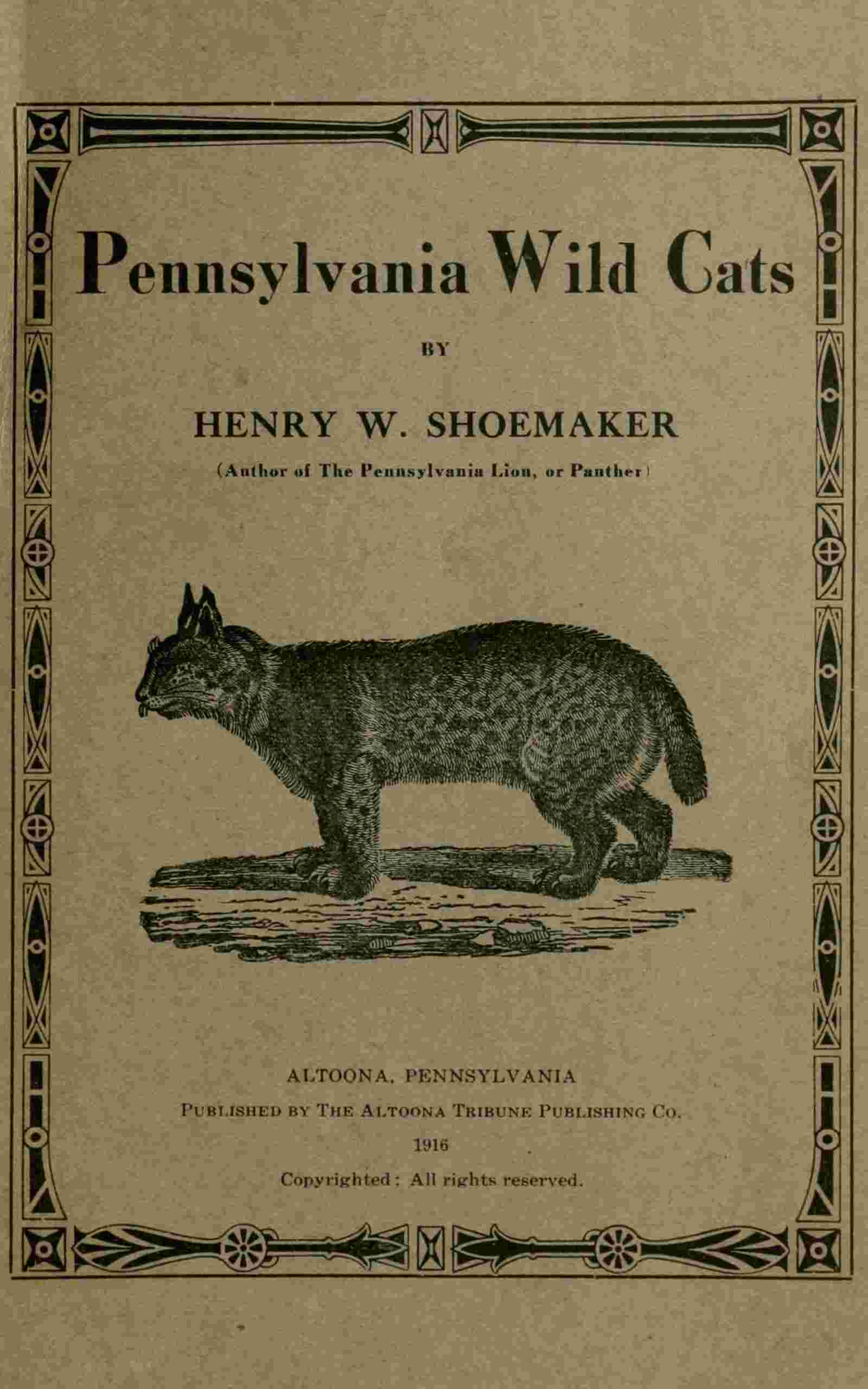
II. THE WILD CAT.
When, as a young boy, in 1897, the writer first paid a visit to Loganton, “the hunting capital” of Sugar Valley, Clinton County, and was invited to inspect the barber-shop trophy room of that prince of Pennsylvania wild cat hunters, Clem. F. Herlacher, the most noticeable object in the collection was a long-tailed, cat-like specimen which occupied the place of honor over the central mirror. “That is,” said Herlacher, pointing to the trophy, “what the first settlers called a ‘wild cat’; in reality it is the cub of the panther, felis couguar. The old-timers ofter ran across these huge kittens in the woods; they were always blundering into the traps, or their dogs were killing them, and they did resemble ‘cats,’ with their fluffy fur, broad faces, and long tails. But gradually the truth dawned on them when they found these ‘wild cats’ trailing along with mature pantheresses, or smaller-sized ones were taken from panther nests on rocky ledges. They were not wild cats at all, but half-grown or cub panthers. During the time when our forefathers were calling the cub panthers ‘wild cats,’ they were calling the true, stump-tailed wild cats ‘catamounts,’ making in that designation another absurd mistake. The true wild cat is the bay lynx, whereas the catamount is really the Northern or Canada lynx, always a rare animal in Pennsylvania, and unknown in most of the counties except in the ‘Northern Tier.’” At the close of this dissertation, the words of which became indelibly? impressed on the writer’s mind, Herlacher pointed to a second stuffed animal, on a shelf above another of the mirrors. “There,” he said, “is a true wild cat—Lynx Rufus—a fine specimen; it weighed thirty-five pounds when I killed it two years ago near ‘Captain Green’s Trench,’ in Green Gap, down the valley. See, it has a short tail, about six inches, is more distinctly mottled than the panther cub, its fur is shorter and smoother.” The writer then inquired where the panther cub had been obtained. Herlacher replied that he had on two successive years—1892 and 1893—secured panther cubs from a nest in the Panther Rocks, in Black Wolf or Treaster Valley, Mifflin County. He had trailed the old panthers on their regular crossing from Sugar Valley. It was in Treaster Valley that the noble Pennsylvania lion or panther made its last permanent abode in Pennsylvania, the cubs taken by Herlacher being, as far as known, the last panthers born in a wild state in the Keystone Commonwealth. As curios they were in great demand, but he regretted not having taken them alive. The great hunter had given away all but the one adorning the shelf above the central mirror. Later it became moth-eaten and was thrown away. Alas! for a priceless natural history specimen. And from the above it will be plain to the readers of these pages that the original “wild cat” was the panther cub, the wild cat of today is the bay lynx, the real catamount is the Canada lynx. But the next few chapters will go into these matters more in detail. Emmanuel Harman, of Mt. Zion, Clinton County, aged 84 years, and many others, have regaled the writer with the story of the wild-cat panther-cub blunder of the “pioneer naturalists.”
“CLEM” HERLACHER, Loganton, Clinton County,
Greatest living Pennsylvania wild cat hunter