
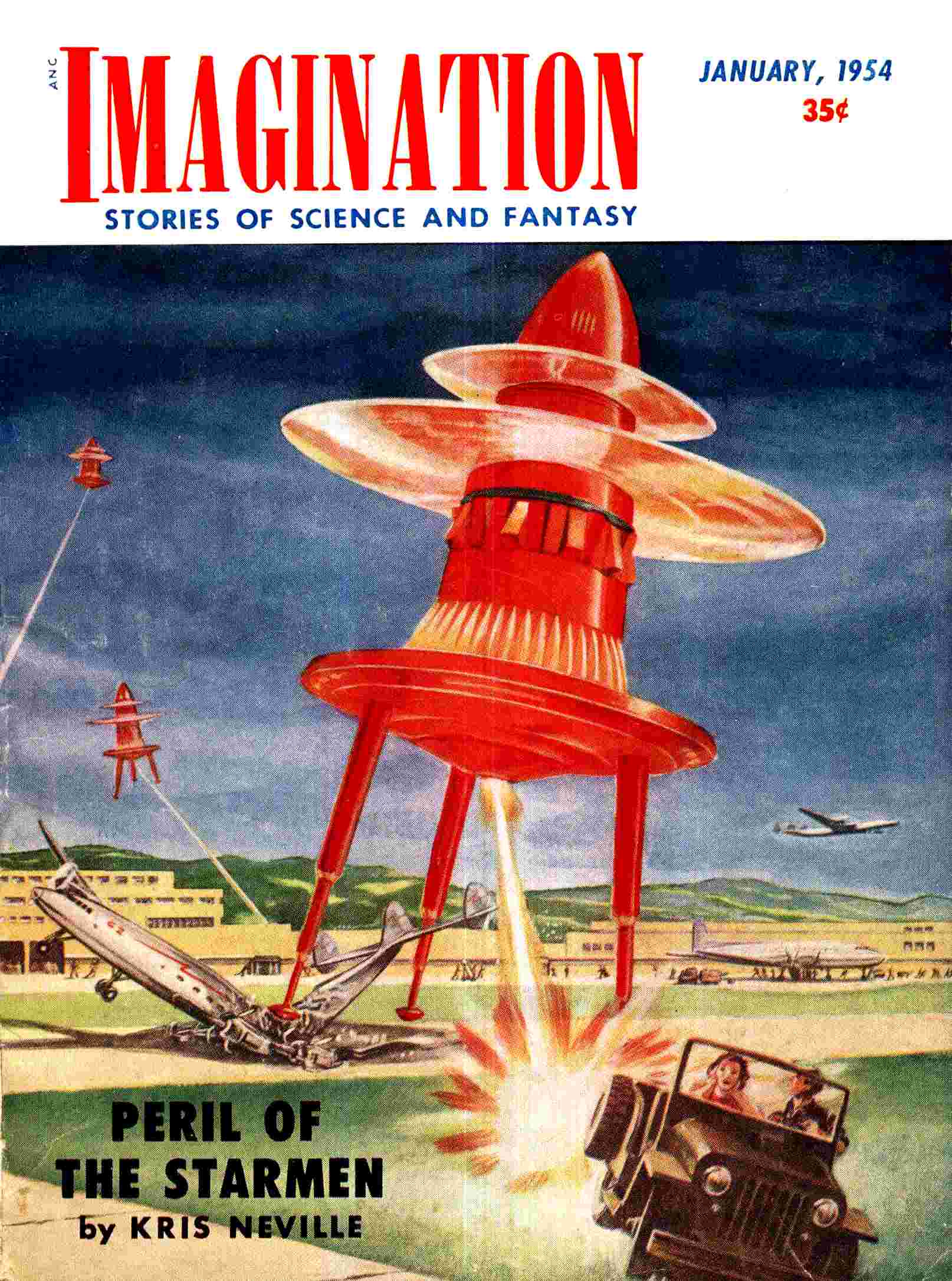
The Project Gutenberg eBook of Peril of the Starmen
Title: Peril of the Starmen
Author: Kris Neville
Illustrator: W. E. Terry
Release date: September 13, 2021 [eBook #66293]
Most recently updated: October 18, 2024
Language: English
Credits: Greg Weeks, Mary Meehan and the Online Distributed Proofreading Team at http://www.pgdp.net
Peril Of The Starmen
By Kris Neville
Their space ships landed near Washington, and
they met Earthmen with friendly smiles. It
was a great day—and quite possibly, our last!
[Transcriber's Note: This etext was produced from
Imagination Stories of Science and Fantasy
January 1954
Extensive research did not uncover any evidence that
the U.S. copyright on this publication was renewed.]
"I called you three in," the Oligarch said, "because I have some very important news."
Herb—he would later be assigned that name—was one of the three. He hated the Oligarch, and he had no doubt that the Oligarch knew it.
"There are," the Oligarch said, "people on the planet. Unfortunately."
Dull rage and frustration and despair and helplessness bubbled up in Herb. His face remained calm.
"We'll have to keep them from interfering with us," the Oligarch said.
Herb wanted to cry: Find another! Not this one! Not the only one we've ever found with people on it!
But he said nothing. His anguished thoughts whirled like a dust storm, handling and rejecting ideas like bits of paper. The remote and inaccessible Scientists were beyond accounting. Perhaps only this planet would serve. Perhaps there was insufficient time to locate another of suitable mass. Perhaps.... But one could not know. One could only submit to authority. The storm died away, and Herb acknowledged bitter reality with helplessness. There even seemed a nightmare inevitability about the selection.
"It would be dangerous to try to work secretly," the Oligarch said. "If they were to discover us in the midst of planting the explosive, it would be fatal. We'll go down and ask their permission."
No one protested.
"To that end," the Oligarch said, "I have selected you three competent, trustworthy men. You will learn their language and when we land, lull their natural suspicions. It will be your responsibility to see that we blow up the planet on schedule."
The crush of the responsibility was terrifying. "I don't need to tell you," the Oligarch said, "that you can't fail."
And it was true. Herb believed.
Unless the planet Earth were exploded, the ever-unstable Universe, itself, would collapse. Already the binding force was dangerously diminished. If new energy were not released within a month, disintegration would begin. The Universe would alter and flow and contract and after the collapse, slowly build itself into a new form—that form itself containing the inherent stresses of change and mutability. Only the arrival of starmen to space flight at the critical time—only their continued vigilance—prevented disaster beyond accounting for.
Herb believed.
CHAPTER II
Well inside the solar system the huge space ship plunged on, released from the warp drive and slowly braking to establish an orbit around the third planet.
Herb came up from the deep stupor of the drugs. He had been under their influence for the last twenty hours while the sleep tapes hammered information into his unconscious brain.
"All right," said Wezen, their private custodian, "time for exercise. Two hours of work-outs, and then you eat."
Herb sat up and felt his head. It ached dully. "Give me a minute. Time to think, Wezen. I'm—"
The other two starmen were also recovering.
"None of that! No time to think! Get up! Get up!"
Herb got reluctantly to his feet. Cold air washed over his nude body, and he trembled. He wanted to return to sleep, not the drugged sleep of the sleep tapes, but the genuine, untroubled sleep. Something frightening and alien was taking place in his mind.
He looked around for a dream form. It was a subconscious response. He realized with relief that it was not necessary to fill one in. Technically, he had not been asleep.
The Oligarch came to witness the first awakening. "How goes it, Wezen?"
"Fine."
"I don't know," Herb said. "My mind, it's ... I can't think...."
One of the others said, "There's all kinds of information, but I can't get at it. I ... can't ... get ... at ... it." He looked around desperately. "Every time I try, something new comes up. It's like a volcano. I can't control it. I think, the name of a river is Mississi—and then I know that leaves are green, and...."
"The sun is 93 million miles away...."
"The day is divided into twenty-four equal periods of sixty minutes...."
"The largest ocean is the Pacific...."
"The Federal Government of the United States of America is composed of three independent branches...."
They were all talking at once.
"It's awful. Not to be able to control...."
"Good, good," said the Oligarch. He was satisfied with the progress. By the time they landed, they would be little more than mechanisms designed to answer questions; they would not be able to think at all: they would respond. Stimuli-response.
"Freedom," said the Oligarch.
"Is," Herb found himself saying, "is the basis of any government that governs justly."
Wezen made a little intake of air that was loud in the shocked silence.
"I said that," Herb said unbelievingly.
"Excellent," said the Oligarch. "The proper reaction."
Wezen relaxed, but he was visibly shaken. He had heard the heresy. What might happen to him later, when this job was done?
"The indoctrination is beginning nicely." The Oligarch nodded. They would be able to soothe suspicion and dispel fear when they arrived on Earth. They would speak of love and assistance when the time came. "But you still have much to learn."
"You have a lot of information about them," Herb said. "Their history ... their.... You got it just in the last few days from their radio and television shows? I don't see how...."
"We extrapolate; there are machines," the Oligarch said. He regarded Herb narrowly. "I believe we better step up the pace." He was not going to give Herb time to rest, to think, to understand, to correlate the mind staggering mass of information he was receiving. "Let's hurry to the recreation room for calisthenics."
In the corridor, Herb glanced around for microphones and saw he was in an unwired stretch. He turned to the starman beside him. Their eyes met. Identical information had been fed simultaneously to both of them. "You heard what I said?"
"Yes."
"What kind of a place is this, this Earth?"
The other strained to think. "It's.... It's.... I don't believe it."
"All men are created equal," Herb said.
"And they hold these truths to be self evident...."
"Nor make any laws abridging...."
"Shhhhh!" the third starman whispered. "Microphones up here." They fell silent.
The Oligarch went to his stateroom and ordered a meal. He had been indoctrinated by the sleep tapes about Earth well over a Brionimanian year previously. The tapes had been brought back by an extensive scouting expedition composed solely of Oligarchs.
He found them a naive race. Weakness, of course, was their short coming. As was often the case. He imagined his hand touching the lever that would trigger the explosive. He saw, in imagination, the planet fly asunder.
He had destroyed before. Five races had died beneath his hands. And now—
Perhaps, he thought, I am growing old. Why is it I do not want to destroy this race myself? Am I becoming weak?
He was angry with himself. Weakness! he thought. I'm acting like a subject, he thought. I'm an Oligarch.
Oligarch, he thought.
Five races, and now the sixth....
Where will it end? he thought.
It will never end.
Slowly the smile came. We are supreme, he thought, the lords and masters, and it will never end.
His scalp prickled with destiny.
Five races. He saw his hand reach out for the sixth.
He shuddered. Weeks ago he had reached his decision.
Bleakly he thought: I can't do it.
Perspiration crept down his spine. If a planet were not blown up, the whole fabric of his society would collapse. Brionimar must never learn.
But Brionimar would learn. Earth was on the verge of space flight. Within a generation they would be listening for radio and television extension-waves in hyperspace that would indicate the existence of another civilization. In two generations they would be in the skies of Brionimar. And then the subjects would see salvation: here (they would reason) is another race capable of preserving the Universe. And there would be no appeasing their blind and mindless wrath until the last Oligarch was dismembered and bloodless.
His hand reached out and curled around an imaginary lever. It must be done, he thought. But not by me. Not by me. Not this hand. He looked down at his hands: white and immaculate and always clean. He washed them frequently.
Someone else must pull the lever.
I must leave a man behind at the bomb site to do it, he thought.
Psychology was a science on Brionimar; and he was a scientist. There was only one man he could be sure of out of all the crew. There were several fanatics, but he distrusted them. There was one idealist who would, of a psychological certainty, pull that lever and blow himself up along with Earth in the belief that his action was necessary to preserve the Universe.
Herb.
CHAPTER III
When the starmen came, they made headlines in the newspapers all over the world.
They sat down on the east-west runway of the Washington National Airport.
MEN FROM STARS LAND!
And shortly:
FIRST CONTACT REVEALS STARMEN HUMANOID!
GENERAL SAYS ARMY READY IF STARMEN MENACE!
EARTH WARNS VISITORS!
And on the heels of these:
UNEASINESS SPREADS!
STARMEN SAY PEACE THEIR MISSION!
NO INVASION, SAYS WILKERSON!
PEACE, SAY STARMEN!
And a few hours later:
CONGRESS TO MEET!
CONGRESS FORMS COMMITTEE: WILL REPORT FINDINGS TO AMERICAN PEOPLE!
STARMEN SAY PEACE BETWEEN WORLDS!
Fear and faith combined; courage and cowardice; hatred and optimism. The great ground swell of popular approval was to come much later. At first there was naked uncertainty. Could the starmen be trusted?
And suppose they could be trusted?
Suppose that.
What then?
What?
Many were afraid.
Bud Council, freshman senator from the state of Missouri, was one of them. In the course of events he was to be assigned to the Committee to investigate the starmen. A weak man, a fearful man, and as such, a dangerous man....
CHAPTER IV
From his initial statement it was obvious that Bud sided with the group determined to oppose all contact with the starmen. His reaction was more frantic than most. He awoke at night from a soggy dream of terror. Let us alone, he sobbed, trembling. Let us alone. The future, once so secure, was now a veiled menace. Go away, he whispered into the night, let us alone. We don't want you. Go away.
He appeared sleepless for the first hearing. The three starmen filed in. He hated them.
They testified.
Herb, in the witness stand, peered out at the swarm of white faces; his head turned automatically from interrogator to interrogator.
"Our government is a modified democracy, much as your own, containing strong safe guards for individual liberty and civil rights," Herb said. One would need to look deeply into his eyes to detect the dullness and the depersonalization that was the true index to the words.
His thoughts were fuzzy, floating upon the periphery of his immediate existence. A detached part of himself seemed to observe and record the proceedings without understanding them; there was a fever of information inside of him.
"We believe in the mutual exchange of knowledge. As proof of our good will, we will be glad to send in a team of scientists...." And later: "Our aim is mutually profitable trade."
He rested. One of the starmen took the stand. The drone and whine of voices lulled Herb. He wanted to relax, to sleep, to recover, to become master of himself once again.
After a recess, he found himself once more on the stand. Senator Rawlins, a thin, nervous mid-Westerner, began a line of inquiry. Herb tested his fingers, feeling the comforting reality of the hard chair arm. He explored the surface with childish wonder while his voice responded and waited and responded. Dimly, persistently, doggedly, stubbornly the ego, the self—that small spark of assertiveness and awareness—struggled to arrange and order, to reason and make sense of—to unify and master—the knowledge it possessed. The consistency with which his spoken lies appealed to human prejudice should have made him realize the extent to which the Oligarchy was experienced in dealing with alien civilizations and the extent to which they had prepared specifically to confront this one. But he was aware only of the sound of his voice. The words fell away into some lost abyss of confusion.
"But the theory behind this, now?" Senator Rawlins said.
"I'm sorry, sir. We are technicians aboard this expedition. We have very little to do with the theoretical aspects. That's up to the Scientists."
"Well, you are, sir, familiar with the idea that—we'll say—that light has limited velocity?"
"Yes, sir, that is correct. It wouldn't make sense for it to have infinite velocity, to be instantaneously everywhere." A tiny sense of urgency formed in his mind.
"Are you familiar with the fact that the speed of light is a limiting factor? Nothing in the natural Universe goes faster than light."
"I couldn't say, sir, I really don't know. At an extremely high speed our space ship makes a, a transition, but ... I guess, sir, yes, sir." The answers weren't coming now. The Oligarch had not dared permit him scientific knowledge. There was a little vacuum where there should be information.
"You'll pardon me, but aren't you unusually ignorant, for a technician, about physical theory: about the action of gases that we were talking about a moment ago—in fact, even about astronomy?"
Herb did not say that such pursuits were the exclusive prerogatives of the Oligarchs. He did not say: I am inferior in mental capacity to an Oligarch; I can never become a Scientist. That was not to be mentioned. "I am a technician, sir."
Senator Rawlins shook his head and made a few notes.
There was fear somewhere inside of him. What more could he say? Suppose ... suppose.... Had he answered wrong? It was as if his knowledge were a river rushing his ego toward the great waterfall of defeat, and he was powerless to control anything. He must not fail. Must not, must not, must not fail.
The imminence of collapse made the very sky terrifying, to know that this apparent order could crumble, and planets fly from suns, and suns themselves spin blindly nowhere. Every word before the Committee was vital. The whole wheeling order of existence turned upon it.
He felt the wood beneath his finger tips, smooth and cool and solid.
The second day of the open hearing, Norma flew down from Vermont to reason with Bud.
Bud was gracious. Years in politics had taught him to mask his real feelings; taught him so well that he was no longer at all sure what his real feelings were.
The outbursts of anger and suppressed sadism he unleashed on those closest to him always the morning after confused him and left him feeling that the person of the previous day had been someone distinct and separate from his genuine self.
"It's good to see you," he said. A warm, brotherly and artificial love flattered his sense of rectitude. He considered her the baby of the family. He remembered her as a gawky, frightened girl giving a last long glance at the security of the living room before venturing into the night of her first date. "I've been meaning to get up your way." His hands signaled the extent of his confinement to Washington. "There's so much to do, you can't imagine. I have to take work home with me. I'm sometimes up half the night with it.... I've been hearing about you. Very fine, Norma, very fine."
Norma was tense and uncomfortable and, Bud thought, a little over-awed to be sitting across the desk from her own brother in the rebuilt Senate Office Building.
She blinked nervously. "Frank will be in this afternoon."
"Yes. Yes?" A trace of petulance haunted Bud's voice. "Terribly busy just now, but...." Hollow enthusiasm conquered. "That's just fine. I can always find time to see Frank."
"He thinks it's important that he see you," Norma said.
"Has something happened?" Bud always sought ways to escape from the anticipated responsibility of sharing a family crisis.
"We want to talk to you."
"I don't quite understand, Norma. What are you talking about?"
"These hearings, Bud."
Instantly the Senator felt the crush of the whole family arrayed against him, and he wanted to snarl at her in shame and anger and shout, "Leave me alone! Leave me alone! Leave me alone, for Chrissake!"
"They've got space flight. We can't even begin to guess what else they've got. What does Senator Stilson do? And you're there on his side, right with him!"
Bud puffed his cheeks and his skin grew hot and prickly. It's none of your damned business, he thought viciously.
"They have space flight," she repeated doggedly. "Think what that would mean to us."
"I haven't time to discuss it right now, Sis. We'll have to talk this out later." He stood up, anger pounding in his temples.
She stood with him. "Tonight. You and I and Frank."
"I don't quite see how...." His voice was weary, and he let the sentence hang short of blunt refusal.
"Tonight, Bud. We've got to see you tonight. He's flying in."
"Well ..." he sighed resignedly. "My place, then. I'll see you at, nine o'clock there."
"That will be fine."
"Nine, then. I've got to rush. My place at nine."
"Goodby, Bud."
Less than an hour later flash bulbs popped from all corners of the room as the starmen entered for their second session of questioning.
Chairman Stilson, in a peevishly thin voice, limited the photographers to ten minutes and ruled against pictures during the questioning. After nearly half an hour, the hearing got under way.
Herb was first on the stand. He continued in the same fashion as yesterday. His answers were polite and informative. Senator Stilson's attempt to get him to contradict himself proved unfruitful. Herb surrendered the chair to one of the others and returned to his seat at the long table reserved for the starmen.
The hearing droned on. He no longer listened. He wanted to sleep.
"Yes," said the starman who was testifying, "that is correct. One of our main reasons for making this expedition is to offer you technological information: space flight, medicine...."
"... eventually trade...."
"Initiate a cultural exchange at the first practical moment...."
Herb heard someone say: "But we have limited facilities on this expedition. A larger one, with your permission, will be dispatched for Earth within a year." He was not even sure whether it was he who was speaking. "In the meantime, we would like permission to conduct certain scientific tests on the surface.... A mineral analysis, sir, primarily. But we are interested in geological evidence...."
"... whether or not," someone said, "the physical similarity of our two races is due to parallel evolution or to a forgotten, prehistoric cycle of colonization by a common ancestor...."
"... These tests can be completed within a few days...."
"In return, sir, we offer...."
"... We must leave within a week. We must have an answer before then."
They described their own planet and their own civilization. They made an excellent impression.
When it was Bud's turn to question, he asked Herb: "How do we know—here, you've learned the language, so much about us and all—how do we know that this isn't a fabrication, a tissue of prevarications you're telling the American people here today? We have to take everything on faith. Now, you know so much about us, you have studied us...."
"We have only a week ..." Herb replied.
They were waiting for Bud at nine o'clock. He was late.
"I'm sorry," Bud said. "Came as quickly as I could. I was at a secret session.... But for a brother and sister, well, I just had to leave...."
"We appreciate it, Bud," Norma said.
"Drink, anybody?"
"No, thanks," Frank said.
Norma shook her head.
"Mind if I have one? I'm rather upset today—the hearings and all, the meeting tonight...."
He went to his bar.
Frank was on the sofa. His gaunt, heavy boned body waited motionless. His blunt fingered, surgeon's hands lay unmoving. His skin was tanned from the Oklahoma sun. Norma sat stiffly erect in the overstuffed chair.
"I guess you know what we want to see you about," Frank said.
Bud poured carefully without looking around. "Norma said something about the starmen. Terrifying thing, terrifying thing. You think they'll really leave when we tell them to?"
"I don't see there's much we can do about it if they make up their minds to stay," Frank said.
"Look, Bud," Norma said, "think how far ahead of us they are. They must be friendly, they must be sincere in their offer to help us."
Bud shook his head. "My deep and sincere conviction on this is that it's a matter of our pride and our independence and our freedom. They're all at stake. I mean—" He waved helplessly. "You know how I feel. I mean, my views are in all the papers, in the Record. With me it's a matter of principle. I don't see how we can accept that sort of offer. It's degrading."
"If we tell them to leave, to go away, to leave us alone, we've lost the greatest opportunity in history." Norma insisted.
"Norma," Bud said. "You know how I feel about you. You know I'd do anything in the world for either of you. Anything within my power. All you need do is ask. Money, anything. But this ... this.... We're proud. Mankind is proud." His heart swelled with the beauty of renunciation and righteousness. "We're too proud, too independent, too free. I would not be willing to sacrifice those great, eternal truths, those historic principles that are the foundation of our way of life, that have made America great: dignity, pride, self reliance...."
"I think they have about the same metabolism as humans," Frank said. "Speaking as a medical man, I believe if they'd give us their medical knowledge, we could conquer disease on Earth. And with their technology—"
"We are a proud race," Bud said. "We must cling to that. That is more precious than gold."
When Frank spoke, there was a mixture of contempt and terror in his voice. "Bud, you're a monument to the basic anarchy of the American people."
"Frank!" Norma cried.
"He is. If the people paid any attention to what they were doing, do you think they'd elect a man like that?"
Bud's mind darted frantically. What was happening here? What was behind this? Why was Frank, his own brother, out to get him? What sinister motive—?
"You underestimate them, though," Frank said. "There's a little trickle of maturity in this country. For every aberration like you it gains a drop of experience and knowledge. The war is over. We've had our emotional jag. We're about to go into one of our rational periods. We're about to wake up to our responsibilities. Your day is passing. I don't know if there's enough of you left to keep out the starmen. The people are coming around. But—I—do—know—this. I know...."
"Stop!" Norma cried. "You don't understand Bud! You're trying to make him into something dishonest and cynical!"
"I've watched him come up. I've watched him for years. I've seen all the rotten deals he's pulled. I've seen him smear innocent people—ruin their careers—and all not for patriotism but for himself. To advance his career. Keep his name before the public. He doesn't care for anything but Bud. Bud, and any means to the end that he moves up, gets power—power for power's sake—power to create and destroy—power to change and control. I've watched him: I know him. I'm talking the only language he understands."
Bud was trembling. The sense of indignation, horror, and innocence was blunted by the shallow dryness of his breathing.
"Frank! Stop this! You're out of your mind!"
"I'm going to see you defeated in the next election, Bud. I'm going to dig up dirt, I'm going to find out who your mistresses are. I'm your brother. I'm going to hound you, disgrace you, drive you from office. You know me. You know I mean what I say. You know I will do it."
"What do you want? My, my God, Frank, what are you after?"
Frank's hands were shaking. His mouth worked nervously. "For once in my life, for once in my life I've got something all-the-way decent to fight for, and I mean to fight just as dirty as I have to get it. Bud, you're coming over to my side on this starmen hearing. You're going to vote for co-operation with them. Do you hear me? Do you hear what I say?"
Bud, his eyes bulging with shock and disbelief, shook his head dumbly. His own brother—this terror raging before him—impossible, his own brother.... His heart pounded. His will was gone. "What do you want?" he repeated dryly.
"I told you."
"I—I—I'll have to think. I—I—"
"No, you won't," Frank said. He stood before him now. "No, you won't."
Norma jumped between them. "Leave him alone!"
Bud snaked from behind her and fled to the bar. His unprotected back a crawling mass of chill, he poured himself a drink. "You're ... you're upset, Frank. You've been, been overworked." He drank the drink in a feverish gulp. "Now ..." his voice fluttered nervously. "I'll forget what you've said here tonight. I understand." His breathing was still tight and frightened. "About the starmen. I haven't, I haven't really given the matter too, too much ... attention. I still have an ... I was just today thinking of...."
Frank started to speak.
"I can see both sides of the argument," Bud said rapidly. In the depth of his stomach he lived with the cold knowledge that Frank would stoop to anything—any lie, any distortion—to—defeat him. Frank could defeat him. It wasn't as if Frank were a stranger. It wasn't as if Bud had been in the Senate for years. No, he was a vulnerable freshman, and unscrupulous politicians back home were already.... This was terrible. All his dreams of the future trembled on his words. He was physically afraid.
"Frank is upset!" Norma said frantically.
"Yes, yes," Bud murmured.
"Frank, you apologize! You hear me! Apologize!"
Frank and Bud found their eyes locked in a moment of silent communication, and seeing victory in the dull defeat inside of Bud, Frank said hoarsely, "I apologize, Bud. I'm sorry. I shouldn't have said those things. I lost my head. I'm sorry."
They both knew it was no apology. The threat was still very much there.
CHAPTER V
The spider ships towered above the surrounding aircraft. Their construction was utilitarian; their living quarters were cramped; entrance was achieved from the ground by means of a retractable ladder from the base platform.
The underbelly dome contained the cutting ray. It could strike deep into the Earth, burning through shale and granite with equal efficiency. The portable casing could be sunk almost simultaneously; it would seem to contain the ray as a hose contains water. While like a giant rig, the ship would poise on its triple legs above the operation. As rapidly as the crew could section the casing, the drilling would proceed.
The three ships would form a triangle. Like insects sending down stingers they would, when the time came, lance three deep shafts into the Earth. Then down the casings would plunge the identical charges. Technicians could compute the point where the three shock waves would meet. A fourth ray would enter the Earth to the proper depth; and at that point would be buried the deadly atomic seed. At the proper time, the charges would be detonated. And where their waves met, under incredible heat and pressure, there the chain reaction would begin, to explode, in an instant, the whole of the Earth.
The Oligarch summoned Herb. "You may sit at my table," he said.
Sleep ladened, Herb sank down across from the Oligarch.
"The necessity for rushing them into a hasty decision is unfortunate," the Oligarch said.
Herb sat hating. The words scarcely penetrated into his confused being. The turmoil was worse than ever.
"... I have been studying the reports. Three members of the Committee, as it stands now, oppose us. And listen...."
"Yes."
"They will be sure to try to end the hearings tomorrow."
"Yes," Herb repeated dully.
"It will go to the full Senate. We have requested a decision within a week. That may not be sufficient time for the popular sentiment of the country to crystallize in our favor. A few determined men may be able to defeat us."
Herb felt a little shudder crawl along his mind. Then his thoughts whirled away.
"It will be infinitely more difficult to win the crucial support of Senators Klein, Stilson and Council after the Committee hearings end. We must bring them to our side. They have become the focal point of the opposition. We must prolong the Committee hearings until we have convinced them. If we can convince them, the full Senate will go along. We'll have ripped the heart out of the opposition."
Herb tried to concentrate on the reasoning. "Yes," he said.
"They will press for an immediate vote. They have known, even if they don't realize it consciously, that the longer they delay, the surer they are of being defeated."
"If we don't ... can't...."
I don't know, the Oligarch thought. I don't know. Threats? Try to plant the charges secretly? "We'll have to convince them. And we've got to do it within a week—maybe a little more, a day or two more."
"What do we do? How? I mean, what do we tell them?" Herb's thoughts were like fog. He wished he could go back to sleep.
The Oligarch knew he was wasting his time explaining to Herb. He wished that he could go before the Committee, himself, but he dared not. Automatic reactions were far more consistent and convincing than his calculating deceit would be. He could conceivably be caught in a lie. Not Herb.
"I'll ... I'll try...."
The Oligarch analyzed Herb's potential. Ten days. Ten days. If he becomes unreliable, where shall I find another?
"We have almost three weeks," Herb said. "We could give them fifteen or sixteen days.... We could plant the charges in one day...."
"You may as well go back to sleep, Herb."
"Yes."
Herb stood up and stumbled away.
The Oligarch returned to his cabin, washed his hands, and went to his desk.
He fumbled at the newspapers. He saw an editorial: "Council Makes Starmen Hearing Political Football." The people were slowly coming to the starmen's support, but how long, how long...? He saw another headline: STARMEN POSSIBLE MENACE TO EARTH SOCIETY.
The first thing Herb did upon arising the morning of the third hearing was to fill in his dream form. He had filled in thousands of them during his life, and yet it was always a frightening experience.
A chill of the Unknown confronted him.
Watchful eyes were, in a way, reassuring; planted microphones could be circumvented; spies could be recognized. But the dream form could not be cheated.
What awful secrets did it reveal? Life and death hung in the balance. Somehow they could tell from the fantasy fiction of a dream how you felt about the reality around you: about the Oligarchy, about your job, about your family.
And they could tell when you lied.
And if you said you didn't dream.
Everyone on Brionimar dreamed.
If they didn't like your dreams, they shot you....
Even into his numb and information filled mind, terror crept as his pencil moved across the dream form.
He breakfasted in the messhall and then left for the hearing. As usual, there was a group of humans standing outside the guard lines, marveling at the three starships, standing upon spider legs, looking ready to whirl skyward at any sign of hostility. Far above, the interstellar ship waited in the coldness of space for the shuttle ships to complete their mission and return.
There was an unexpected buzz in the Committee Room when Herb and his two companions arrived.
An ugly television camera squatted across from the Chairman's desk.
Bud had changed his vote on televising the hearings.
Herb watched Bud cross to Senator Stilson. Until this morning the two had seemed very friendly.
"Let's get together later," Bud was saying. "I'll explain my position. I'm sure you'll understand."
Senator Stilson refused to acknowledge that Bud was there.
"Look, Eddy, boy, don't act like that. Listen, I was thinking this over last night, and I think it's only right...."
"The Socialists have gotten to you, Bud. That's all there is to say."
Bud swallowed in shocked disbelief. "Oh, now...." More than anything else in the world Bud wanted to refute this slander. Desperation gripped him: the socialists have gotten to you! No! God damn you! Take that back, you son of a bitch! His hands clenched.
He swallowed again, stiffly, with difficulty. Relax. For the love of God, relax. "Oh, now...."
Senator Stilson walked away.
Bud sat down weakly. I'll show him, he thought. I'll.... I'll.... It was frightening to have Senator Stilson call you a Socialist.
Bud tried not to think about Frank's face ... Frank's threats had nothing to do with him changing his mind. A man can change his mind. That he had changed his mind seemed to Bud a measure of his honesty and fairness. It was nothing less than that.
One of the other starmen whispered to Herb: "That one's changed sides."
Herb nodded. The Senators were beginning to respond to pressure from their constituents. But even as the tension was sinking, even as elation rose, a second emotion swept through him. It was not enough to deceive those in this room. Now he must also lie to innocent watching millions all over the planet. His fists clenched. He hated Bud.
Early in his testimony he noticed a girl in the audience. There was something in her face that made his eyes return to it time after time. Gradually he came to concentrate exclusively on her and try to explain everything to her alone. He smiled uncertainly, and she smiled back encouragement.
And Norma—this situation suddenly became immediate and personal to her. She watched Herb, listening intently, wanting desperately to communicate her encouragement to him and her belief in him.
Bud caught a taxi to attend the executive session of the hearings that had been set for eight o'clock that evening. The starmen would not be present.
Bud was ill at ease. "Hurry up, damn it!" he snapped at his driver.
Telegrams from all over the country had been pouring into his office. They had awakened him to certain possibilities. His changed vote on television had brought him unprecedented publicity, even from normally hostile newspapers. He realized that the longer the hearings continued the more familiar his name would become.
He was convinced by now that the majority of the people (even as himself) were inclined to approve an agreement with the starmen.
Surely they weren't thinking of ending the hearings and taking the matter to the full Senate? They wouldn't dare flush headlines down the drain like that.
Would they?
He grumbled to himself. Of course they wouldn't. Here was a fulcrum, a lever.... Look at the publicity.... After all, another Missourian had made it from a Congressional Committee. Perhaps the starmen hearings had really seized the imagination of the American people ... Harry S. Truman had made it....
He experienced a moral awakening, a sharp clear call to duty that transcended morality. All things changed. The world was suddenly portentious and thrilling, and secret enemies lurked and unseen disasters hovered.
His mind was humming with the exultation. He thought of himself dying at the end of his ... sixth ... eighth ... tenth ... term of office. He pictured the universal sorrow. He wanted to cry. They would mourn for a year: for two years. They would build huge monuments to his memory. Monuments bigger than any monuments ever built.
The taxi stopped.
Perhaps after forty years in office, he would be assassinated. The public wrath....
"Here we are," the driver said.
Getting out, he knew that he would fight to see the hearings continued.
He was late. Already the other four Senators were seated. Bud nodded to them and took his place. He put his brief case (it gave him a sense of importance to carry one) on the table before him and unzipped it as if to be ready to delve into its contents to document his every statement.
The atmosphere was tense. Bud looked from face to face. Senator Stilson was granite hostility. Senator Gutenleigh avoided his eyes. Senator Klein glared at him truculently.
"It was called for eight," Senator Stilson said icily.
"Good evening, gentlemen," he said. "Sorry I'm late."
"Good evening," Senator Rawlins said. "These gentlemen here," he included everyone but Bud in his gesture, "intend to dispense with a report and merely issue the Committee's recommendation. They've already decided to close the hearings and present the matter to the Senate tomorrow."
Bud was stunned. This was unbelievable. That meant ... that.... The friends! Somehow they had gotten to Gutenleigh, the Senator from Hawaii. Bud had counted on him—on the basis of his television vote—to oppose Klein and Stilson. What outrageous, Un-American pressure had been exerted to cause him to surrender?
"But ... but ... Senator Guten—"
"Has," Senator Stilson said in his thin, peevish tenor, "reconsidered."
Enmity and hostility flared silently from the Chairman. An almost baffled look crossed his face as if the implications had finally arrived in his consciousness: here was a Senator, Senator Council, a member of—as he thought of it—his team, who had had the temerity to transgress his leadership. One would expect opposition from a radical like Rawlins. But from a Council...! He had always felt that Bud was one of his. The insult was compounded by heresy.
"I feel," Senator Rawlins said, "that two questions require further exploration: how is it that the starmen are so ignorant of basic scientific principles; and for what reason do they insist that we reach such a momentous decision in such a limited time? To ask the Senate to vote now would force an honest man to perhaps a hasty decision. For myself, until these points are clarified, I would be very reluctant to reach any sort of an agreement with them. I want to ask this Committee to reconsider its decision, and I hope the Honorable Senator from Missouri will join with me, and that between us we can prevail upon the other gentlemen."
A sincere democrat, he spoke with quiet desperation, "In order to expect the people to choose wisely, we must be sure that they are given an opportunity to receive all the pertinent facts."
Bud was howling inwardly with the fury of a thwarted child. Headlines were flying away from him. His stand in the full Senate would command only one one-hundredth of the attention it would receive here. He arose, trembling with rage.
Shaking a quivering finger at Senator Stilson he cried, "You have bribed Gutenleigh!"
Gutenleigh looked uncomfortable.
"What did they promise you, Sam?" he thundered, wondering wildly what counter promises he could make.
Even Senator Stilson was shocked by Bud's violent outburst. Bud was famous for his rabid thundering against subversives, but no one had expected him to have the courage to open such hysterical fire on his Senate colleagues. Senator Stilson said, "I resent your attitude, sir!"
"Gentlemen, Gentlemen," Senator Rawlins said. "A little moderation, please."
"I'm for them, damn you!" Bud cried. "You're all in a conspiracy—a filthy conspiracy—against me!"
"If you don't sit down, I will summon an officer and have you removed bodily from this Chamber," Senator Stilson said.
They were all looking at Bud. With a great display of reluctance, he sank to his seat. He refused to look at Senator Stilson. He sulked and plotted revenge. And remembered Frank and hated everybody.
The vote proceeded routinely. Three members voted to recommend that the Senate reject the starmen's offer. Senator Rawlins abstained, and Bud voted that the Senate accept it.
The committee meeting broke up. Senators Klein and Stilson went out to gather up opposition Senators. They lobbied far into the night.
Nor was Bud to be outdone.
CHAPTER VI
The three spider ships waited in the late evening darkness. Only a few spectators loitered. The television cameras were quiet. Army sentries patroled the area to keep the starmen inside and the curious out. Norma's heels clicked sharply on the runway as she approached. At the ropes she stopped and showed the guard the entry permit her brother had obtained for her.
"Come under," the guard said, lifting the rope.
"The one called Herb?"
"He's in that one over there."
She moved in the indicated direction. A moment before, the night had been warm. Now an uncomfortably chill breeze whispered around her as she moved into the starship's shadow. The thought of the distance it had come, the countless millions of miles of space its hull had shed, was enough to dwarf her into less than insignificance. She wanted to run back to the guard, and to the protection of the familiar.
The ladder was down, and when she reached it, the door above opened and a starman looked out.
"I'd like to come up."
The starman went away. In a moment, he was back with one of the three who could speak English.
"I'd like to come up," Norma repeated.
"We've already given the official tour for today."
"I have an authorization from our government. I'd like to talk to Herb. You tell him I'm from Senator Council. It's about the report."
"Just a moment." He disappeared inside. Norma teetered nervously back and forth. Wonderingly she put out her hand to touch the hard, icy metal of the ladder.
"Come up."
She began to climb toward the opening. Looking behind her, she saw Washington, real and solid and reassuring.
The starman at the top helped her inside.
Herb was coming down the narrow corridor. She smiled at him. "Hello."
"Hello...."
"I want to talk to you a moment."
He gestured her inside.
In the first room off the main corridor, Herb stopped. Several starmen hovered nearby to listen.
"Can I talk to you for just a couple of seconds alone?"
"Why—why, yes, I guess." He looked around for permission.
The Oligarch, towering imperiously on the fringe of the group, said, "Why don't you interview her in my office, Herb?"
"Come along," Herb said.
In contrast to the Spartan plainness of the rest of the ship, the Oligarch's office was richly furnished. Its private corridor led past the messhall and opened upon the main corridor that led forward to the second level: it was strategically located; from its doorway, one could interdict entrance and escape.
It was the first time Herb had been in the room. Automatically his eyes searched the walls.
"Senator Council asked me to talk to you," Norma said. "He wants you to understand about the report. You've heard? It's going to the full Senate tomorrow. We'd like you to...."
"I'm only a technician, Miss."
"My name is Norma."
"Norma." His emotions were tangled beyond solution. He wanted to say, 'I'll stay behind when the others leave, will that make everything all right, you won't blame me, you won't blame me for it if I stay behind, will you?' His mind hurt with the confusion.
"We thought, if you'd go away, if the people thought we'd actually lost you...."
"It's not for me to make any kind of decision. I'll have to ask. Would that be all right, sir?"
Norma blinked. She did not understand to whom the question was addressed. Her eyes followed his to the wall, a concealed microphone? She felt a little prickle of fear.
The Oligarch stood in the doorway behind her. "That will be agreeable with us."
She whirled guiltily.
"Bud wanted to, to see Herb tonight...." Norma felt resentment against this man in the doorway. "I was told to bring Herb."
"I will be able to speak for my government."
"I was told to bring Herb," Norma said stubbornly. Bud had not specified, but she told herself that she would not yield to a stranger. She did not consider Herb a stranger. "Isn't it all right to take him?"
"He may come, too, if you wish." He smiled. "Whatever you wish."
His voice was not reassuring. "Thank you." She modified her tone. Some of the iciness went out of it. "I'll leave now. Bud will send two C.I.D. men over for you."
Sitting at his desk in his Georgetown apartment, Bud looked through a stack of letters.
Norma, waiting, tried to become interested in a Saturday Evening Post story and failed. She put the magazine aside.
The knock they were waiting for came.
Bud rose and crossed quickly to the door.
"Ah, hello," he said with a genial smile. "If you gentlemen will wait downstairs, I'll call you when they are ready to leave." The C.I.D. men withdrew. "Hello, young fellow. Herb, I believe? And?"
"George.... How would George be?"
"George," the Senator said, pumping the Oligarch's hand and drawing him across the threshold. "I like your people's way of using first names. Very democratic. Just call me Bud."
They arranged themselves around the room.
"I don't suppose you'd care for a drink?"
"I'd be delighted," George said.
Bud, solemn faced, mixed the drinks, talking over his shoulder. "I hope you haven't taken our Committee report as a rejection of your generous offer.... You understand? I want to explain my position—what we, you and I, can do.... There we are." He turned from his labors and handed the drinks around.
"Norma, Herb. I wonder if you'd mind if George and I stepped in there?"
"It's all right with us," Norma said.
Bud and the Oligarch went into the study. Bud closed the door.
"Now," he said. Ambition was a sickness in him. This is the boy I've got to sell, he thought. That's all I've got to do: sell him. Once he's sold, the rest will follow. Ambition was like a hunger, and success hung in the air like smoke. "We can have a nice, private talk. I'm sure you'll appreciate my rather delicate position."
George swirled ice and smiled.
"Norma tells me you can speak for your government?"
George nodded.
"Let's sit down."
"Thank you."
"Now here's the way I feel about it. I'm on your team. We're both on the same team. I want to help you all I can, and I know you'll want to help me."
George nodded.
"I was thinking: if you would leave. Not tell anybody. Leave tonight. I don't mean for good, but make it look that way. You see?"
"Our leaving would serve as an emotional shock?"
"Yes, exactly. Your leaving might be just what the people need to wake them up and get them on our team. I don't need to tell you that the Senate is likely to reject your offer. I mean, right now. The way things stand now. My first mail is coming in. It's predominantly unfavorable. But some telegrams I've gotten, I think the people are coming around. But they're still not around yet. We need a couple of weeks. My idea is, I'd like to be the one that—more or less—handles it."
"You want us to work through you?"
"You have put your finger on it, George. If there's just one Earthman you can trust and work through, who knows the ropes...."
"I believe I understand."
"And when you come back, you make it plain that it was Bud Council who brought you back—it was Bud Council who really convinced you to return."
"You and I," George said, "will probably be able to work out a deal."
Jubilation rang in Bud's ears. This was it. The talk of working out a deal was an assurance of victory. President Bud—no, perhaps it would be better, more dignified, to be President Phil. He would write it out and see which looked best: President Philip Council or President Bud Council.... History lay heavily upon his thoughts.... For the first time he actually felt at home with a starman.
"Perhaps you would do something for us?" George said.
Bud found himself looking deep into George's eyes. Instinctively he knew that George knew him better than he knew himself, and that George had carefully studied him according to no one could tell what alien science.
"Why, why, yes, yes, of course."
"Well," George said, rising and going to Bud and dropping a hand across his shoulder, "just to be sure that you really are on our team, perhaps you could give us a little token of loyalty."
Bud grew cold in anticipation. But the crowds cheering and the banners waving.... No! Not now, they couldn't snatch it away now! What was it George wanted? Money? A signed agreement? Patronage? "Why, yes, naturally."
George's hand tightened in friendly reassurance. He knew that he had found his man. "Your brother's head. I believe his name is Frank. His head. We'll expect you to have it for us when we return in two weeks. Two weeks from tomorrow."
He no longer needed to count on Herb.
CHAPTER VII
The starmen had vanished into the night that is deepest just before dawn, when the sky is black and most mysterious. They had ordered the guards away, their lifts had whirled, they rose, and far above the Earth there were ruby tongues of jets and the volcanic roar of power.
The airport lay desolate.
... In his ship, Herb could not sleep. He kept reviewing the time he had spent alone with Norma. It was difficult to remember clearly. What few things he could remember would, he was afraid, be lost forever in the jungle of confusion that was his mind unless he went over them again and again and planted them firmly and deeply into his being.
What an alien and lovely name, Norma. Something about her was so quiet and reassuring. He wanted to bury his head against her breasts and whisper, "I wish I could save your planet, but I can't." He had wanted to confess to her, but he could not. If she had discovered.... But now, in the darkness, on the narrow cot, he thought about her and buried his head against her soft breasts, and he smelled the cool darkness of the perfume, and he spoke to her and told her the truth, and she understood his hurt and knew the necessity and forgave him....
The trouble began one week after the take off. The Oligarch read well the signals of its arrival, but he did nothing. A scene would be bad for the crew's morale. He thought it would be a tonic to his own. It would prove the validity of his conclusion: that the indoctrinated starman called Leslie would crack up on the seventh day.
It happened, as he imagined it would, shortly after Leslie had filled out his dream form.
It was in the messhall.
Without warning Leslie kicked over his chair. His face twisted. His hands whitened at the knuckles. There was an insane expression in his eyes. He looked slowly around the table.
With his first movement there came silence; it was instantaneous; it was as though the clock had stopped in a parlor of corpses. No one moved.
He screamed a great, searing curse. The word was English.
The crew waited. No one breathed.
Leslie began to break things with mounting fury. He shattered his plate by slamming it savagely to the table. He threw his cup against the far wall.
They waited. Many of them cried inward encouragement to insanity.
"Lies!" he screamed in English. "Lies! There is no Universe!"
He fell to his hands and knees and growled and snapped like an animal.
The Oligarch felt his detachment shatter. Hurriedly he left his table and went to Leslie and killed him.
Breathing with difficulty, he arose and addressed the crew. "This is what happens to a man who lies on his dream form." They rustled uneasily. "Go back to your meal."
One by one they resumed eating. Slowly conversation grew and expanded from whispers to abnormal loudness and then back to whispers again. The ubiquitous microphones peered up eagerly from the tables, and the hungry record tapes consumed the sounds.
The food lodged in Herb's throat. There seemed no moisture anywhere in his body. He fought down an irrational impulse to get to his own feet and scream forever.
Once again at his private table, the Oligarch was amazed to find that the complete justification of his own logic left him feeling empty and unsatisfied and disappointed. The matter was behind him. In the future could he expect equal success? Insatiable doubt grew.
He stood up. The compulsion to wash his hands was irresistible. He left the mess hall hurriedly.
As he watched the cool cleanness of the water flow over his hands, he felt at peace.
He was a god, playing with men, knowing them as they would never know themselves, seeing into their inmost souls, moving them to his will.
He was tempted to greater accomplishment. Could he—could he—? Unsure of himself, he was doomed to seek endless reassurance.
Herb. Now Herb. There was a dangerous man. At least, he would become one, in another three days. It would be like playing with fire to play with Herb. It would be exciting, too.
He dried his hands. His heart was beating faster.
Herb would soon begin to doubt. William was already doubting. He should have done something about them both before now. About Leslie before now....
I will see that Herb ... that Herb ... what?
His mouth was dry. Excitement swelled and made his breath catch. His throat ached.
He would help William to doubt. None of them must return to Brionimar.
It was intensely rewarding to play God, if you could get your hands clean.
The Oligarch rang the buzzer. He would leave the mike tapes and the dream forms until this afternoon.
He would interview William now.
He was washing his hands when William entered.
After the interview, William came in and sat on Herb's cot.
In recent days, their common knowledge had drawn them together; before, they had scarcely spoken. Whenever they talked now, they used English, partly as a recognition of their kindred uniqueness, partly as a futile subconscious attempt to outwit the spy tapes.
"It's a ridiculous planet," Herb said.
"Yes, a ridiculous planet," William agreed.
"Freedom," Herb said. "That is nonsense."
"Equality," William said. "Equality. They are down right silly."
"You wouldn't think a place like that could exist, a silly place like that, where a man can actually say whatever silly idea pops into his mind."
"Yes," William said. "They should be destroyed—even if it wasn't necessary, they should be destroyed."
Herb was silent for a moment. The microphones listened. Then: "Imagine how awful it would be to live down there, with no one to do your thinking for you."
"The natural leaders aren't even recognized. You can't tell an Oligarch from a Subject."
"I'd never like to live in a place like that," Herb said. I dreamed of it, he wanted to say, and I dreamed that Brionimar had been changed into Earth, and there was no Oligarchy, and a man was free. "It's like a nightmare," he said.
They fell silent.
William wanted to say: If only we could take that dream back with us, if only our people could see.
"Yes," Herb said suddenly. "God, yes, yes."
"Eh?"
"... nothing."
"He called me in today," William said.
"Oh?"
"We talked."
"What did you talk about?"
"Not much ... I don't see what he was trying to get at." William stood up. He looked at the microphone. He felt courage grow in him. "I've been ... thinking...."
Herb nodded. He dared not speak.
"You know what I mean?"
Herb nodded.
"We'll talk later."
After the fourth daily meal, William came once more. He took Herb's arm and gestured with his head that Herb should follow. Herb arose; his heart stood wildly beating in the cage of his chest; his blood ran with conspiracy and excitement.
They walked down the corridor until they were in a section free of microphones. It was, although they did not know it, intentionally unwired. It provided the crew a harmless escape valve for their emotions. It was not (as any Oligarch could have told you) necessary to watch a Subject all the time. Most of the spy tapes, as a matter of fact, were never even inspected.
William was sweating. Herb could not account for the intensity of emotional strain he seemed to be under. Herb imagined they would talk briefly—and plan vaguely—about ways to carry some of the idea and the feel of freedom back to Brionimar. They would bear a message of hope, they would tell that Earth had not been destroyed in vain, that a civilization could function in freedom without chaos. And perhaps, someday, not in their time, but someday....
"It's not perfect," Herb said. "We dream of perfection, do you understand, but even Earth is not perfect. I think we ought to remember that. I can feel it, I can tell it. I.... We want to take that back with us, too."
William was scarcely listening. His muscles were tense and crawling with danger. He had to speak, to confide, to know that he was not alone. To have Herb help him. Herb, too, must know.
"Listen," he hissed. "You know what I meant when I said I've been thinking?"
"Yes," Herb said. "So have I."
William licked his lips. His heart seemed to stop. He took a deep breath.
"How can we stop him from blowing it up?"
The Universe wheeled. Herb could not believe what he had heard. A Destructionist!
"He dropped some hints, he didn't mean to, but he did," William said. "I finally realized. You must have known longer than I have. It's all a lie. He as good as told me so."
Herb took half a step backward. His skin crawled with horror.
William, oblivious to everything but his own words, said, "We've got to stop and plan carefully. I will kill him myself, and then you get to the control room.... We'll have to hold the crew off. They might not believe us. Not at first. That will be the big trouble...."
Herb continued to back away. All the training of a lifetime surged into his mind. There is scarcely a way to express the detestation a starman, properly conditioned, felt toward a Destructionist. His reason was destroyed. He wanted to leap at William and tear at his face with his naked hands.
I've got to warn him! Herb thought.
He turned and ran. The Oligarch! I've got to warn him! Breath sobbed in his throat.
William watched the fleeing figure. He reached out a hand to stay him. He could not believe his own miscalculation. He stood, limp and defeated. There was no will left in him. Bleak betrayal was a heavy winged vampire.
There was no place to go.
He sat down.
It was all very logical for the first time in his life. Some where in time the Oligarchy had invented the menace as a device to gain (or to retain) power. They had saturated the people with ignorance, ridiculed thought, and eliminated freedom until the menace could not be challenged. They had established a closed and consistent system that could justify anything. And now that he had gotten outside, stepped beyond it, by denying its ultimate premise, the immensity of the fraud was mind staggering. There was no combating it as long as one lived inside. There have, he thought, been other Earths. Nothing outside the system must be permitted to intrude.
He put his head in his arms and began to cry.
That was how they found him when they came to kill him.
Herb did not watch the kill. He went straight to his cot and lay down and waited for the news to come. He heard the rustle of voices in the corridor as the hunt was being organized.
He was still trembling with disgust: a Destructionist! The very word sent a shudder through his body. To think that William, of them all, that William, would have been one seemed impossible. Still, you could never tell. A neighbor, a friend.... You could never tell who might be.