
WeRead Powered by ReaderPub
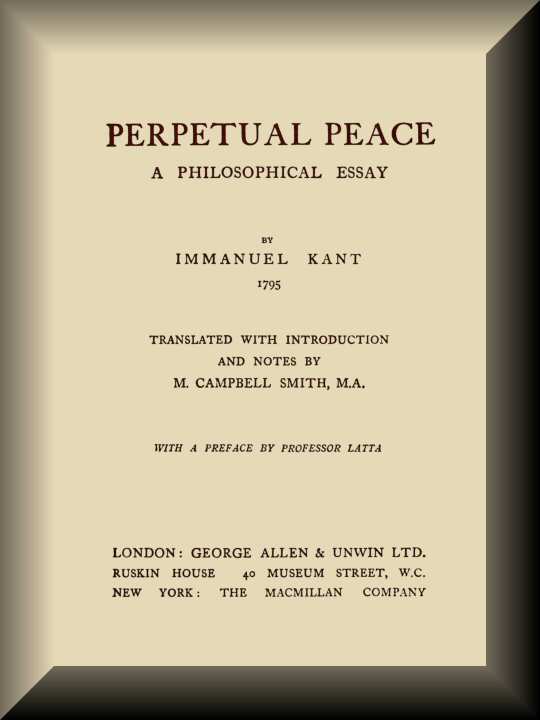
Perpetual Peace: A Philosophical Essay cover

Perpetual Peace: A Philosophical Essay

Chapter 11: INDEX
Open in WeRead

About This Book

The essay presents lasting peace as a practicable moral objective and lays out specific political and legal conditions to achieve it: republican constitutions, a federation of free states to adjudicate disputes, limits on standing armies and secret treaties, prohibitions on territorial conquest, and a form of cosmopolitan law guaranteeing basic hospitality. It treats peace as a duty grounded in practical reason, distinguishes teleological from mechanical perspectives on political development, and contrasts moral statesmanship with mere expediency. Structured as preliminary and definitive articles with supplements, the work analyzes political realities and prescribes constitutional and international reforms to make enduring peace progressively attainable.

INDEX

A

  • Absolutism; of Hobbes, 43, 44;
    • of Schopenhauer, 43;
    • according to Kant, 43, 44, 125-128;
    • to Locke, 44.
  • Alexander I. of Russia; 80.
  • Alexander the Great; 31, 103.
  • Alsace-Lorraine; annexation of, 90, 92, 95.
  • Ambrose, Saint; 15.
  • Amphictyonic League; 16, 22.
  • Aquinas, Thomas; on fighting clergy, 18;
  • Arbitration; as a substitute for war, 79, 81, 87;
    • difficulties settled by, 80;
    • where it is useless, 82, 83, 86.
  • Aristotle; on war, 7, 8;
    • and rights of an enemy, ib., 31;
    • on the relation between politics and ethics, 162.
  • Assyrians; war among the, 9.
  • Augustine, Saint; 16.

B

  • Balance of power; 26, 95.
  • Bentham, Jeremy; 26, 79, 92.

C

  • Caird, Edward; 3, 51.
  • Calvin, John; 19.
  • Carnegie, Andrew; 100.
  • Cicero; on the conduct of war, 22, 41.
  • Clement of Alexandria; 15.
  • Clergy, fighting; Origen on, 14, 15;
    • Wycliffe, 18;
    • Erasmus, ib.;
    • Aquinas, ib.
  • Cobden, Richard; 64.
  • Corvinus, Matthias; 109.
  • Cowper, William; 5, 38, 123.
  • Crusades, wars of the; 16, 103.

D

  • Dante, Alighieri; on mediation, 46;
    • on universal monarchy, 68, 69.
  • Disarmament; 88-93;
    • Czar’s proposal of, 90;
    • practicability of, 90-93.
  • Dubois, Cardinal; 36.

E

  • Empire; of Rome, 9, 20, 68;
    • world-, spiritual, 23, 32, 69;
    • of Alexander the Great, 31, 68;
    • Frankish, 69;
    • Holy Roman 69;
    • of Napoleon I., 69.
  • Erasmus, Desiderius; and European peace, 17;
    • on war, 18, 19;
    • on fighting clergy, 18, 32.

F

  • Farrar, J. A.; 18.
  • Fichte, J. G.; 69, 99.
  • Fischer, Kuno; 62, 67.
  • Fleury, Cardinal; 55.
  • Frederick the Great; 66, 126.

G

  • Gentilis, Albericus; 21, 32.
  • Golden Age; 3, 41.
  • Greeks; their attitude to other nations, 7;
    • to an enemy, ib.;
    • their Sacred Wars, 16;
    • the Amphictyonic League, 16.
  • Grotius, Hugo; his De Jure Belli et Pacis, 24-27;
    • and the Jus Gentium, 24, 25;
    • and the Law of Nature, 25;
    • on peace, 27, 32, 40, 131.

H

  • Hague Conference (1899); 86, 90.
  • Hegel, G. W. F.; 57;
  • Hobbes, Thomas; his theory of the state of nature and origin of government, 4, 40-42, 51, 118, 119, 133; 6, 26, 27, 28, 37;
    • his influence on Kant, 40, 46;
    • his views on revolution, 41, 188;
    • of the relations between states, 43-46, 128, 131;
    • on the conduct of war, 45, 89, 120, 124, 159.
  • Holls, Fred. W.; 86.
  • Hooker, Richard; 52;
    • on the depravity of man, 173.
  • Hume, David; on the origin of government, 5, 52;
    • on the state of nature, 40, 41;
    • on the original contract, 52, 108, 109, 162.

I

  • International Law; the development of, 20-24;
    • its connection with the Reformation, 21, 24;
    • in Greece and Rome, 22, 23.

J

  • Jews; war among the, 9-11;
    • their dream of peace, 32.
  • Justin; 15.

K

  • Kant, Immanuel; 26, 37;
    • his indebtedness to earlier political writers, 40, 46;
    • his theory of human development, 47-49;
      • and how this is possible, 49-51, 54;
    • on the foundation of the state, 51-54, 152-154;
    • the relations between states and individuals, 54, 55, 117-120, 128, 173, 174;
    • the necessity for reform within the state, 55, 56, 168;
    • the political and social conditions of his time, 57-59;
    • his attitude to war, 58, 133, 135, 136, 137, 149-151;
    • on the growing power of commerce, 59, 65, 142, 157;
    • his idea of federation, 60, 68, 69, 128-137, 192;
      • and ideal of perpetual peace, 61, 129, 196;
    • the conditions of its realization, 62-69;
    • on representative and other constitutions, 65-68, 120-128, 152, 153, 167;
    • his opinion of the English constitution, 66;
    • his disapproval of universal monarchy, 68, 69, 155, 156; 79, 83, 89, 100, 105;
    • on the right of way, 137-142;
    • on nature’s guarantee of a perpetual peace, 143-157;
    • on the relation between politics and morals, 161-196;
    • on revolution, 167, 168, 186-188.

L

  • Laveleye, Émile de; 81.
  • Lawrence, T. J.; 9, 78, 81.
  • Leibniz, Gottfried W.; 36;
    • his criticism of St. Pierre, 37, 38, 58, 106.
  • Locke, John; and the golden age, 3, 4;
    • on the original contract, 53;
    • on revolution, 53, 188; 67, 133.
  • Lorimer, James; 34, 80.
  • Louis Philippe; 76.
  • Luther, Martin; on war, 19.

M

  • Machiavelli, Nicolo; 162.
  • Maine, Henry; on Grotius and the Jus Gentium, 24, 25.
  • Maistre, Joseph de; 71.
  • Martineau, James; 102.
  • Mennonites; and war, 14.
  • Military service; of Christians, 14, 16, 18, 19;
    • compulsory, 89;
    • voluntary, 111.
  • Mill, John Stuart; 80.
  • Moltke, Graf von; 71, 73-75.
  • Monarchy, universal; the ideal of Dante, 68, 69;
  • Montesquieu, Baron de; on self-preservation, 83;
    • on armed peace, 88, 159.
  • More, Thomas; 32.
  • Morley, John; 3.

N

  • Napoleon Bonaparte; Empire of, 69, 71, 72, 76, 77.
  • Napoleon, Louis; 80.

O

  • Origen; on military service, 14, 15.
  • Original Contract; 40;
    • as understood by Rousseau, 52;
    • by Hobbes, 52, 53;
    • by Hooker, 52;
    • by Hume, ib.;
    • by Kant, ib.;
    • by Locke, 53.

P

  • Paris Congress (1856); 86.
  • Penn, William; 30.
  • Plato; on the origin of the state, 5;
    • on war, 8, 41;
    • on the relation between ethics and politics, 162.
  • Politics; and morals, according to Kant, 161-196;
    • to Plato, 162;
    • to Aristotle, ib.;
    • to Hume, ib.;
    • sophistical maxims of, 170-172.
  • Pope, Alexander; 4, 127.
  • Puffendorf, Samuel; 27;
    • on intervention, 64, 131.

Q

  • Quakers; and war, 14.

R

  • Reformation; and military service, 18;
    • and international law, 21, 24.
  • Religion; Roman, and war, 9;
    • Jewish, 9-11;
    • Mohammedan, 10;
    • Buddhist, and conversion, 12;
    • Christian, and war, 12-20.
  • Revolution, right of; according to Hobbes, 41, 53;
    • and Spinoza, 41;
    • according to Locke, 53;
    • to Rousseau, ib.;
    • to Kant, 167, 186-188.
  • Ritchie, D. G.; on Rousseau, 3;
    • on Locke and the golden age, ib., 52, 85, 98.
  • Robertson, William; 6, 17, 18, 19.
  • Romans; and war, 7, 8, 9, 22, 23;
    • and international law, 22, 23.
  • Rousseau, J. J.; and the state of nature, 2, 3, 52; 26, 28;
    • his criticism of St. Pierre, 38-40;
    • his views on militarism, 39;
    • on the original contract, 52;
    • on revolution, 53, 188; 61, 67, 100, 132, 134;
    • on democratic and republican governments, 153;
    • on the depravity of man, 173.
  • Russia; Alexander I. of, 80;
    • the Czar of, 90;
    • the backward civilization of, 92, 93, 94, 95.

S

  • Schiller, Friedrich von; on war and peace, 71, 72, 73, 75.
  • Schopenhauer, Arthur; 43.
  • Spencer, Herbert; 76.
  • Spinoza, Benedict; on the state of nature, 41;
    • and revolution, ib.
  • State of nature; according to Rousseau, 2, 3;
    • and the golden age, 3;
    • Hobbes’ theory of, 4, 40, 41, 118;
    • according to Hume a philosophical fiction, 41;
    • according to Kant, 117-120.
  • States; transference of, 63, 108, 109;
    • marriage between, 109.

T

  • Tennyson, Lord; 73, 74.
  • Tertullian; 14, 15.
  • Treitschke, H. von; 75.
  • Trendelenburg, F. A.; 75.

V

  • Vattel, Emerich; his Droit des Gens, 28, 29;
    • on intervention, 64, 113, 114;
    • on the right of way, 65;
    • of self-preservation, 83, 89, 103;
    • on treaties, 108; 131.
  • Voltaire, François de; 33, 37, 38.

W

  • Wycliffe, John; and fighting clergy, 18.