
The Project Gutenberg eBook of Peru as It Is, Volume 2 (of 2)
Title: Peru as It Is, Volume 2 (of 2)
Author: Archibald Smith
Release date: March 15, 2019 [eBook #59063]
Language: English
Credits: E-text prepared by Melissa McDaniel and the Online Distributed Proofreading Team (http://www.pgdp.net) from page images generously made available by HathiTrust Digital Library (https://www.hathitrust.org/)
E-text prepared by Melissa McDaniel
and the Online Distributed Proofreading Team
(http://www.pgdp.net)
from page images generously made available by
HathiTrust Digital Library
(https://www.hathitrust.org/)
| Note: |
Images of the original pages are available through
HathiTrust Digital Library. See
https://babel.hathitrust.org/cgi/pt?id=yale.39002088372710 Project Gutenberg has the other volume of this work. Volume I: see http://www.gutenberg.org/files/59062/59062-h/59062-h.htm |
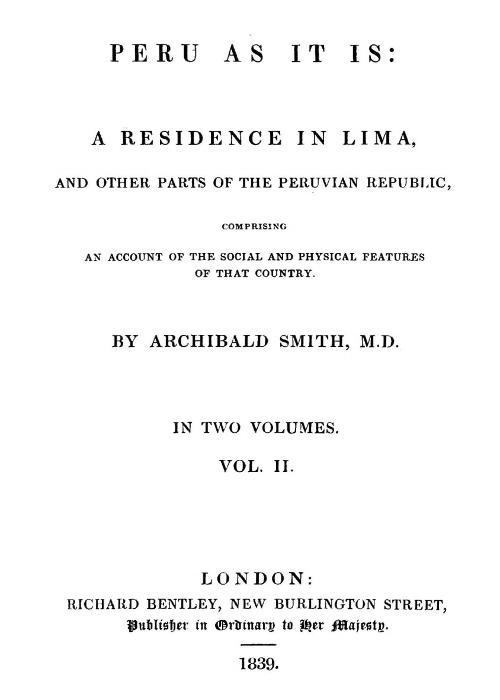
PERU AS IT IS:
A RESIDENCE IN LIMA,
AND OTHER PARTS OF THE PERUVIAN REPUBLIC,
COMPRISING
AN ACCOUNT OF THE SOCIAL AND PHYSICAL FEATURES OF THAT COUNTRY.
BY ARCHIBALD SMITH, M.D.
IN TWO VOLUMES.
VOL. II.
LONDON:
RICHARD BENTLEY, NEW BURLINGTON STREET,
Publisher in Ordinary to Her Majesty.
1839.
LONDON:
PRINTED BY SAMUEL BENTLEY,
Dorset Street, Fleet Street.
CONTENTS OF THE SECOND VOLUME.
| CHAPTER I. | |
| Site, population, and climate of Cerro Pasco.—Houses.—Coal, and other kinds of fuel.—Timber for use of the mines, &c.—Where brought from.—Fruit and provisions.—Mines.—Mantadas.—Boliches.—Habilitador.—Mint.—Returns of the mines.—Banks of Rescate.—Pasco foundery. | Page 1 |
| CHAPTER II. | |
| Descent from Pasco to Huanuco.—Succession of works for grinding and amalgamating silver ore.—Quinoa.—Cajamarquilla.—Huariaca.—San Rafael.—Ambo.—Vale of Huanuco; its beauties and advantages.—State of agriculture in this vale, and traffic with Pasco.—The College named La Virtud Peruana.—Steam navigation on the river Huallaga, and civilization of the wild Indians of the Montaña.—Natural productions of the Montaña. | 28 |
| CHAPTER III. | |
| The Department of Junin.—The river Marañon.—General sketch of the form of internal Government of Peru.—Particular account of the Prefectorate or Department of Junin.—Mines.—Agriculture.—Manufactures.—Public Instruction.—Hospitals and Charitable Asylums.—Vaccination.—Junta of Health.—Public Baths.—Police.—Pantheons.—Roads.—Posts.—Public Treasury at Pasco.—Administration of Justice.—National Militia. | 65 |
| CHAPTER IV. | |
| Missionary College of Ocopa.—Its foundation, utility, downfall, and decree for its restoration.—Introduction of Christianity along the rivers Marañon, Huallaga, and Ucayali, &c. by the Jesuits and Franciscans.—Letter from Friar Manuel Plaza, the last great missionary of Ocopa, to the prefect of Junin. | 113 |
| CHAPTER V. | |
| Christianized Indians of the Interior.—Their condition and character.—Hardships imposed on them.—Desire of revenge. | 143 |
| CHAPTER VI. | |
| War of Independence.—Unsettled state of the country at the close of 1835 and early in 1836.—Gamarra’s Government.—Insurrections.—Guerilla and Freebooters.—Foreign Marines.—Lima invaded from the castles of Callao, under command of Solar.—Orbegoso enters Lima.—Castles of Callao taken by assault.—Battle of Socabaya.—Salaverry taken prisoner.—Execution.—Public tranquillity hoped for under the protection of Santa-Cruz. | 169 |
| CHAPTER VII. | |
| On Climate and Disease.—Panama, Guayaquil, Peru, and Chile. | 196 |
| APPENDIX. | |
| On the Zoology of Western Peru | 237 |
| Geognostic description of the country in the environs of Arequipa, with an Analysis of the Mineral Waters in the vicinity of the same city | 266 |
| Steam Navigation | 286 |
| Ecclesiastical Jubilee | 291 |
| Adieu to Lima | 303 |
ERRATA.
| Page | 13, | line | 9, | for polverilla and massisa read polvorilla and maciza. |
| 128, | ” | 17, | and in all other instances, for Pozuro read Pozuzo. | |
| 187, | ” | 2, | for realise read realize. | |
| 239, | ” | 6, | for the aborigines read those. |
Transcriber’s Note: The errata have been corrected but otherwise the original spelling (in both English and Spanish) has been preserved.