
About This Book
The text develops mathematical principles for natural philosophy, formulating laws that relate forces and motion and deriving consequences for terrestrial and celestial bodies. It presents a geometrical mechanics built from definitions, axioms, and propositions that establish inertia, how forces change motion, and mutual attractive effects, then applies these tools to free fall, oscillations, projectile paths, motion in resisting media, and fluid resistance. In a culminating section the principles are used to derive the motions of planets, the Moon, comets, tides, and orbital perturbations, with systematic demonstrations and corollaries linking observation to theory.
About the Author

More Books by This Author
4 picks
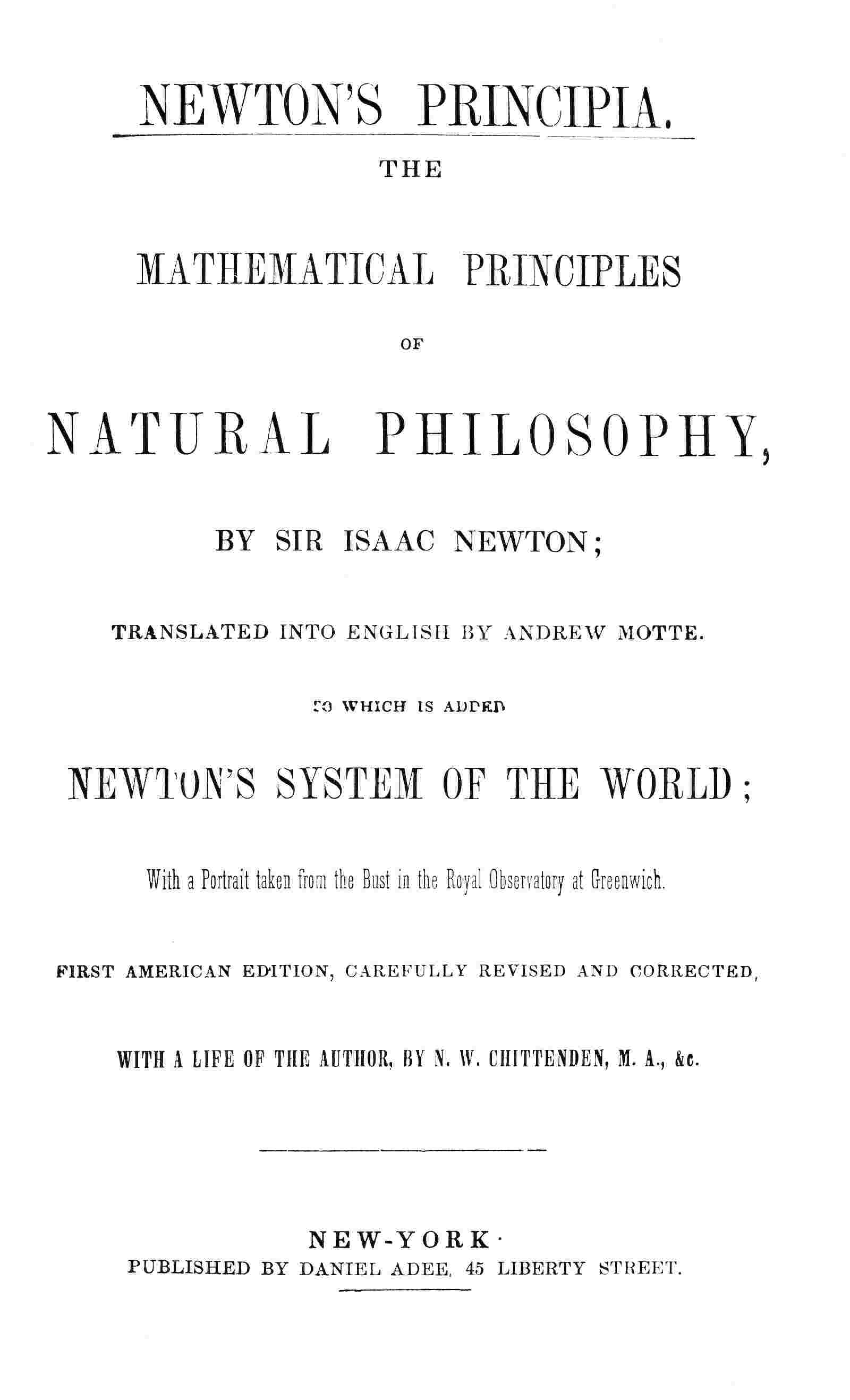 Newton's Principia
by Isaac Newton
Newton's Principia
by Isaac Newton
 Observations upon the Prophecies of Daniel, and the Apocalypse of St. John
by Isaac Newton
Observations upon the Prophecies of Daniel, and the Apocalypse of St. John
by Isaac Newton
 Opticks
by Isaac Newton
Opticks
by Isaac Newton
 The Chronology of Ancient Kingdoms Amended / To which is Prefix'd, A Short Chronicle from the First Memory of Things in Europe, to the Conquest of Persia by Alexander the Great
by Isaac Newton
The Chronology of Ancient Kingdoms Amended / To which is Prefix'd, A Short Chronicle from the First Memory of Things in Europe, to the Conquest of Persia by Alexander the Great
by Isaac Newton
You May Also Like
6 picks
 1001 задача для умственного счета
by Sergei Aleksandrovich Rachinskii
1001 задача для умственного счета
by Sergei Aleksandrovich Rachinskii
 A Budget of Paradoxes, Volume II
by Augustus De Morgan
A Budget of Paradoxes, Volume II
by Augustus De Morgan
 A Possible Solution of the Number Series on Pages 51 to 58 of the Dresden Codex
by Carl E. Guthe
A Possible Solution of the Number Series on Pages 51 to 58 of the Dresden Codex
by Carl E. Guthe
 A Review of Algebra
by Romeyn Henry Rivenburg
A Review of Algebra
by Romeyn Henry Rivenburg
 A Tangled Tale
by Lewis Carroll
A Tangled Tale
by Lewis Carroll
 Amusements in Mathematics
by Henry Ernest Dudeney
Amusements in Mathematics
by Henry Ernest Dudeney