
WeRead Powered by ReaderPub
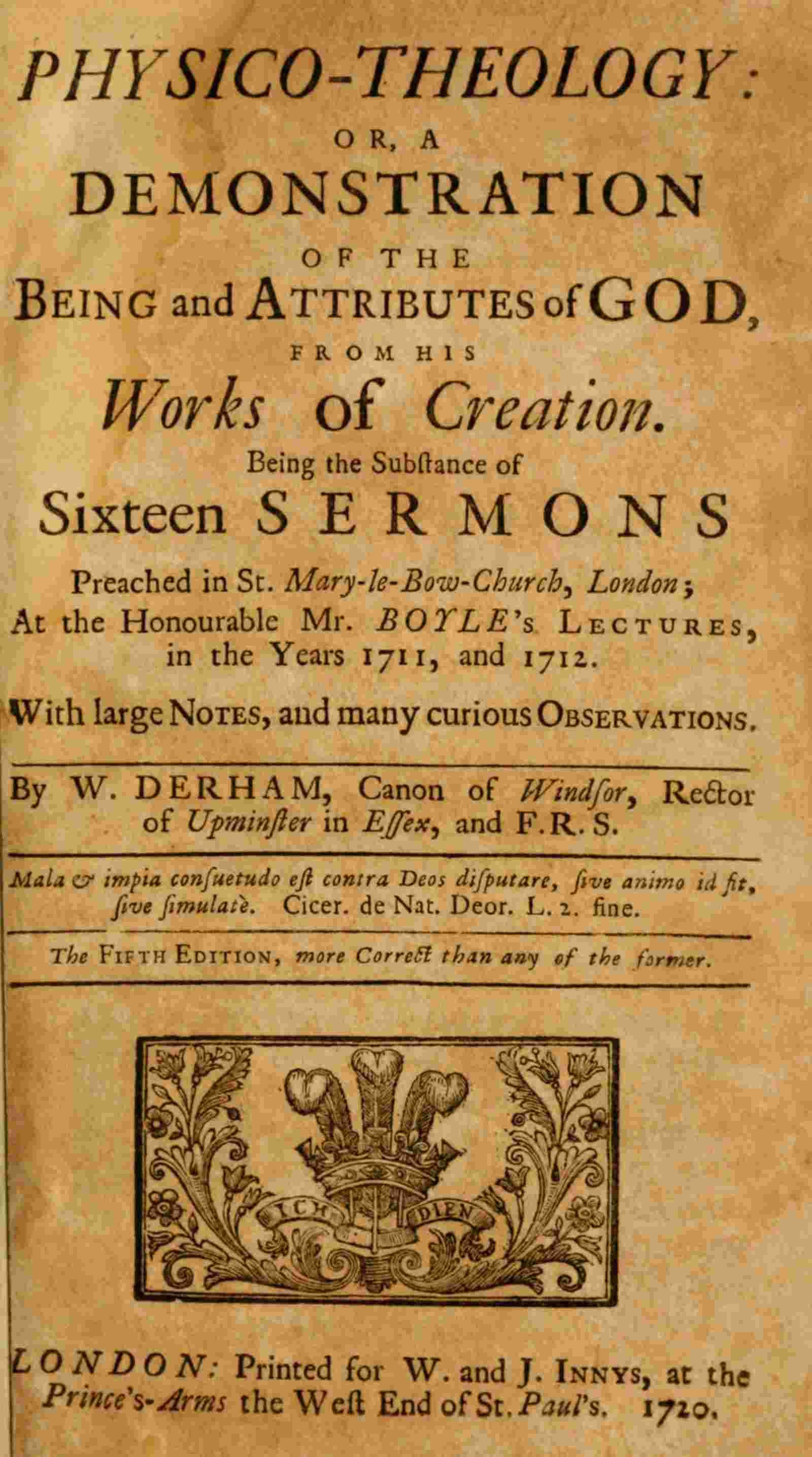
Physico-theology cover

Physico-theology

Chapter 28: BOOK IV.
Open in WeRead

Explore more books like this:

About This Book

A series of sixteen sermons presents a physico-theological demonstration of God's existence and attributes by examining natural phenomena. The author combines natural-history observations, microscopy, and philosophical argument to infer design and divine qualities from created order, addressing objections and drawing on earlier naturalists' findings. Sermon text is interwoven with extended notes and curious observations on plants, animals, geological forms, and the mechanics of living structures. The work aims to make empirical knowledge serve theological ends by showing how observable features of nature support claims about a creator's power, wisdom, and benevolence.

BOOK IV.

Of Animals in general.

In the last Book, having survey’d the Earth it self in Particular, I shall next take a View of the Inhabitants thereof; or the several Kinds of Creatures[a], that have their Habitation, Growth, or Subsistence thereon.

These Creatures are either Sensitive, or Insensitive Creatures.

In speaking of those endow’d with Sense, I shall consider:

I. Some Things common to them all.

II. Things peculiar to their Tribes.

I. The Things in common, which I intend to take Notice of, are these Ten:

1. The five Senses, and their Organs.

2. The great Instrument of Vitality, Respiration.

3. The Motion, or Loco-motive Faculty of Animals.

4. The Place, in which they live and act.

5. The Balance of their Numbers.

6. Their Food.

7. Their Cloathing.

8. Their Houses, Nests or Habitations.

9. Their Methods of Self-Preservation.

10. Their Generation, and Conservation of their Species by that Means.

FOOTNOTES:

[a]

Principio cœlum, ac terras, camposque liquentes,
Lucentemque globum Lunæ, Titaniaque astra
Spiritus intùs alit, totamque infusa per artus
Mens agitat molem, & magno se corpore miscet.
Inde hominem, pecudumque genus, vitæque volantum,
Et quæ marmoreo fert monstra sub æquore pontus.
Igneus est illis vigor, & cœlestis origo
Seminibus.
Virgil. Æneid. L. 6. Carm. 724.