
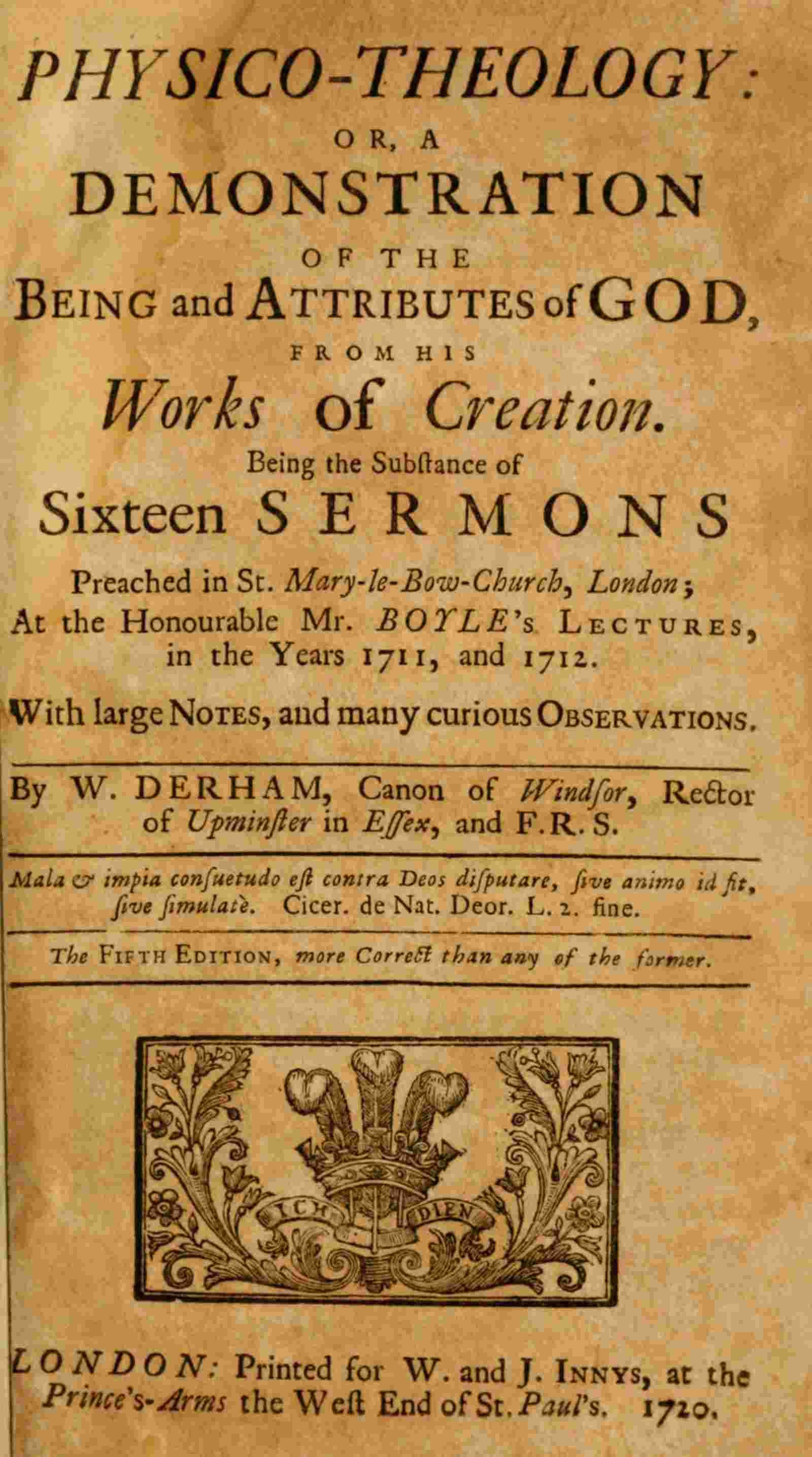
CHAP. X.
Of the Balance of Animals, or the due Proportion in which the World is flocked with them.
The whole Surface of our Globe can afford Room and Support only to such a Number of all Sorts of Creatures. And if by their doubling, trebling, or any other Multiplication of their Kind, they should encrease to double or treble that Number, they must starve, or devour one another. The keeping therefore the Balance even, is manifestly a Work of the divine Wisdom and Providence. To which end, the great Author of Life hath determined the Life of all Creatures to such a Length, and their Increase to such a Number, proportional to their Use in the World. The Life of some Creatures is long, and their Increase but small, and by that means they do not over-stock the World. And the same Benefit is effected, where the Increase is great, by the Brevity of such Creatures Lives, by their great Use, and the frequent Occasions there are of them for Food to Man, or other Animals. It is a very remarkable Act of the Divine Providence, that useful Creatures are produced in great Plenty[a], and others in less. The prodigious and frequent Increase of Insects, both in and out of the Waters, may exemplify the one; and ’tis observable in the other, that Creatures less useful, or by their Voracity pernicious, have commonly fewer Young, or do seldomer bring forth: Of which many Instances might be given in the voracious Beasts and Birds. But there is one so peculiar an Animal, as if made for a particular Instance in our present Case, and that is the Cuntur of Peru[b]: A Fowl of that Magnitude, Strength and Appetite, as to seize not only on the Sheep, and lesser Cattle, but even the larger Beasts, yea, the very Children too. Now these, as they are the most pernicious of Birds, so are they the most rare, being seldom seen, or only one, or a few in large Countries; enough to keep up the Species; but not to over-charge the World.
Thus the Balance of the animal World, is, throughout all Ages, kept even; and by a curious Harmony, and just Proportion between the Increase of all Animals, and the Length of their Lives, the World is through all Ages well; but not over-stored: One Generation passeth away, and another Generation cometh[c]; so equally in its Room, to balance the Stock of the terraqueous Globe in all Ages, and Places, and among all Creatures; that it is an actual Demonstration of our Saviour’s Assertion, Mat. x. 29. that the most inconsiderable, common Creature, Even a Sparrow (two of which are sold for a Farthing) doth not fall on the Ground without our heavenly Father.
This Providence of God is remarkable in every Species of living Creatures: But that especial Management of the Recruits and Decays of Mankind, so equally all the World over, deserves our especial Observation. In the Beginning of the World, and so after Noah’s Flood, the Longævity of Men, as it was of absolute Necessity to the more speedy peopling of the new World; so is a special Instance of the divine Providence in this Matter[d]. And the same Providence appears in the following Ages, when the World was pretty well peopled, in reducing the common Age of Man then to 120 Years, (Gen. vi. 3.) in Proportion to the Occasions of the World at that Time. And lastly, when the World was fully peopled after the Flood, (as it was in the Age of Moses, and so down to our present Time) the lessening the common Age of Man to 70 or 80 Years[e], (the Age mentioned by Moses, Psal. xc. 10. this, I say,) is manifestly an Appointment of the same infinite Lord that ruleth the World: For, by this Means, the peopled World is kept at a convenient Stay; neither too full, nor too empty. For if Men (the Generality of them, I mean) were to live now to Methusalah’s Age of 969 Years, or only to Abraham’s, long after the Flood, of 175 Years, the World would be too much over-run; or if the Age of Man was limited to that of divers other Animals, to ten, twenty, or thirty Years only; the Decays then of Mankind would be too fast: But at the middle Rate mentioned, the Balance is nearly even, and Life and Death keep an equal Pace. Which Equality is so great and harmonious, and so manifest an Instance of the divine Management, that I shall spend some Remarks upon it.
It appears from our best Accounts of these Matters, that in our European Parts[f], and I believe the same is throughout the World; that, I say, there is a certain Rate and Proportion in the Propagation of Mankind: Such a Number marry[g], so many are born, such a Number die; in Proportion to the Number of Persons in every Nation, County, or Parish. And as to Births, two Things are very considerable: One is the Proportion of Males and Females[h], not in a wide Proportion, not an uncertain, accidental Number at all Adventures; but nearly equal. Another Thing is, that a few more are born than appear to die, in any certain Place[i]. Which is an admirable Provision for the extraordinary Emergencies and Occasions of the World; to supply unhealthful Places, where Death out-runs Life; to make up the Ravages of great Plagues, and Diseases, and the Depredations of War, and the Seas; and to afford a sufficient Number for Colonies in the unpeopled Parts of the Earth. Or on the other Hand, we may say, that sometimes those extraordinary Expences of Mankind, may be not only a just Punishment of the Sins of Men; but also a wise Means to keep the Balance of Mankind even; as one would be ready to conclude, by considering the Asiatick, and other the more fertile Countries, where prodigious Multitudes are yearly swept away with great Plagues, and sometimes War; and yet those Countries are so far from being wasted, that they remain full of People.
And now upon the whole Matter, What is all this but admirable and plain Management? What can the maintaining throughout all Ages, and Places, these Proportions of Mankind, and all other Creatures; this Harmony in the Generations of Men be, but the Work of one that ruleth the World? Is it possible that every Species of Animals should so evenly be preserved, proportionate to the Occasions of the World? That they should be so well balanced in all Ages and Places, without the Help of almighty Wisdom and Power? How is it possible by the bare Rules, and blind Acts of Nature, that there should be any tolerable Proportion; for Instance, between Males and Females, either of Mankind, or of any other Creature[k]; especially such as are of a ferine, not of a domestick Nature, and consequently out of the Command and Management of Man? How could Life and Death keep such an even Pace through all the animal World? If we should take it for granted, that, according to the Scripture History, the World had a Beginning, (as who can deny it[l]; or if we should suppose the Destruction thereof by Noah’s Flood: How is it possible, after the World was replenished,) that in a certain Number of Years, by the greater Increases and Doublings of each Species of Animals; that, I say, this Rate of Doubling[m] should cease; or that it should be compensated by some other Means? That the World should be as well, or better stocked than now it is, in 1656 Years (the Time between the Creation and the Flood; this) we will suppose may be done by the natural Methods of each Species Doubling or Increase: But in double that Number of Years, or at this Distance from the Flood, of 4000 Years, that the World should not be over stock’d, can never be made out, without allowing an infinite Providence.
I conclude then this Observation with the Psalmist’s Words, Psal. civ. 29, 30. Thou hidest thy Face, all Creatures are troubled; thou takest away their Breath, they die, and return to their Dust. Thou sendest forth thy Spirit, they are created; and thou renewest the Face of the Earth.
FOOTNOTES:
[a] Benigna circa hoc Natura, innocua & esculenta animalia fœcunda generavit. Plin. Nat. Hist. l. 8. c. 55.
[b] Captain J. Strong gave me this Account, together with a Quill-Feather of the Cuntur or Condor of Peru. On the Coast of Chili, they met with this Bird in about 33° S. Lat. not far from Mocha, an Island in the South-Sea,——they shot it sitting on a Cliff, by the Sea-side; that it was 16 Feet from Wing to Wing extended; that the Spanish Inhabitants told them they were afraid of these Birds, lest they should prey upon their Children. And the Feather he gave me (saith the Doctor) is 2 Feet, 4 Inches long; the Quill-part 5¾ Inches long, and 1½ Inch about in the largest Part. It weighed 3 dr. 17½ gr. and is of a dark brown Colour. Dr. Sloane in Phil. Trans. Nᵒ. 208.
To this Account, the Doctor, (in a Letter to Mr. Ray, March 31, 1694, with other Papers of Mr. Ray’s, in my Hands,) adds the Testimony of Jos. Acosta, l. 4. c. 7. and Garcilass. de la Vega, who l. 8. c. 19. saith, There are other Fowls, call’d Cuntur, and by the Spaniards corruptly Condor. Many of these Fowls having been kill’d by the Spaniards, had their Proportion taken, and from End to End of their Wings measured 15 or 16 Feet.——Nature, to temper and allay their Fierceness, deny’d them the Talons which are given to the Eagle; their Feet being tipp’d with Claws like a Hen: However, their Beak is strong enough to tear off the Hide, and rip up the Bowels of an Ox. Two of them will attempt a Cow or Bull, and devour him: And it hath often happened, that one of then alone hath assaulted Boys of ten or twelve Years of Age, and eaten them. Their Colour is black and white, like a Magpie. It is well there are but few of them; for if they were many, they would very much destroy the Cattle. They have on the forepart of their Heads, a Comb, not pointed like that of a Cock; but rather even, in the Form of a Razor. When they come to alight from the Air, they make such an humming Noise, with the fluttering of their Wings, as is enough to astonish, or make a Man deaf.
[c] Eccles. i. 4.
[d] The Divine Providence doth not only appear in the Longævity of Man, immediately after the Creation and Flood; but also in their different Longævity at those two Times. Immediately after the Creation, when the World was to be peopled by one Man, and one Woman, the Age of the greatest Part of those on Record, was 900 Years, and upwards. But after the Flood, when there were three Persons by whom the World was to be peopled, none of those Patriarchs, except Shem, arriv’d to the Age of 500; and only the three first of Shem’s Line, viz. Arphaxad, Salah, and Eber, came near that Age; which was in the first Century after the Flood. But in the second Century, we do not find any reached the Age of 240. And in the third Century, (about the latter End of which Abraham was born,) none, except Terah, arriv’d to 200 Years: By which Time the World was so well peopled, (that Part of it, at least where Abraham dwelt,) that they had built Cities, and began to be cantoned into distinct Nations and Societies, under their respective Kings; so that they were able to wage War, four Kings against five, Gen. xiv. Nay, if the Accounts of Anian, Berosus, Manetho, and others, yea, Africanus be to be credited; the World was so well peopled, even before the Times we speak of, as to afford sufficient Numbers for the great Kingdoms of Assyria, Ægypt, Persia, &c. But learned Men generally, with great Reason, reject these as legendary Accounts. If the Reader hath a Mind to see a Computation of the Increase of Mankind, in the three first Centuries after the Flood, he may find two different Ones of the most learned Archbishop Usher, and Petavius; together with a Refutation of the so early Beginning of the Assyrian Monarchy; as also Reasons for placing Abraham near 1000 Years after the Flood, in our most learned Bishop Stillingfleet’s Orig. Sacr. Book III. Chap. 4. §. 9.
[e] That the common Age of Man hath been the same in all Ages since the World was peopled, is manifest from prophane, as well as sacred History. To pass by others: Plato lived to the Age of 81, and was accounted an old Man. And those which Pliny reckons up, l. 7. c. 48. as rare Examples of long Life, may for the most Part be match’d by our modern Histories; especially such as Pliny himself gave Credit unto. Dr. Plot hath given us divers Instances in his History of Oxfordshire, c. 2. §. 3. and c. 8. §. 54. and History of Staffordshire, c. 8. §. 91, &c. Among others, one is of twelve Tenants of Mr. Biddulph’s, that together made 1000 Years of Age. But the most considerable Examples of aged Persons among us, is of old Parre of Shropshire, who lived 152 Years 9 Months, according to the learned Dr. Harvey’s Account; and Henry Jenkins of Yorkshire, who lived 169 Years, according to the Account of my learned and ingenious Friend Dr. Tancred Robinson; of both which, with others, see Lowth. Abridg. Phil. Trans. V. 3. p. 306. The great Age of Parre of Shropshire, minds me of an Observation of the Reverend Mr. Plaxton, that in his two Parishes of Kinardsey and Donington in Shropshire, every sixth Soul was 60 Years of Age, or upwards, Phil. Trans. Nᵒ. 310.
And if we step farther North into Scotland, we shall find divers recorded for their great Age: Of which I shall present the Reader with only one modern Example of one Laurence, who married a Wife after he was 100 Years of Age, and would go out to Sea a Fishing in his little Boat, when he was 140 Years old; and is lately dead of no other Distemper but mere old Age, saith Sir Rob. Sibbald, Prodr. Hist. Nat. Scot. p. 44. and l. 3. p. 4.
As for Foreigners, the Examples would be endless; and therefore that of Joh. Ottele shall suffice, who was as famous for his Beard, as for being 115 Years of Age. He was but two Brabant Ells ³⁄₉ high; and his long grey Beard was one Ell ¼ long. His Picture and Account may be seen in Ephem. Germ. T. 3. Obs. 163.
As for the Story Roger Bacon tells, of one that lived 900 Years by the Help of a certain Medicine, and many other such Stories, I look upon them as fabulous. And no better is that of the Wandring Jew, named Joh. Buttadæus, said to have been present at our Saviour’s Crucifixion; although very serious Stories are told of his being seen at Antwerp, and in France, about the Middle of the last Century but one; and before in Ann. 1542, conversed with by Paul of Eitsen, Bishop of Sleswick; and before that, viz. in 1228, seen and convers’d with by an Armenian Archbishop’s Gentleman; and by others at other Times.
If the Reader hath a Mind to see more Examples, he may meet with some of all Ages, in the learned Hakewill’s Apol. p. 181. where he will also find that learned Author’s Opinion of the Causes of the Brevity and Length of humane Life. The Brevity thereof he attributeth to a too tender Education, sucking strange Nurses, too hasty Marriages; but above all, to Luxury, high Sauces, strong Liquors, &c. The Longævity of the Ancients he ascribes to Temperance in Meat and Drink, anointing the Body, the Use of Saffron and Honey, warm Clothes, lesser Doors and Windows, less Physick and more Exercise.
[f] The Proportions which Marriages bear to Births, and Births to Burials, in divers Parts of Europe, may be seen at an easy View in this Table:
| Names of the Places. | Marriages to Births: As |
Births to Burials: as |
||||
|---|---|---|---|---|---|---|
| England in general. | 1 | to | 4.63 | 1.12 | to | 1 |
| London. | 1 | to | 4. | 1 | to | 1.1 |
| Hantshire, from 1569, to 1658. | 1 | to | 4. | 1.2 | to | 1 |
| Tiverton in Devon, 1560, to 1649. | 1 | to | 3.7 | 1.26 | to | 1 |
| Cranbrook in Kent, 1560, to 1649. | 1 | to | 3.9 | 1.6 | to | 1 |
| Aynho in Northamptonshire for 118 Y. | 1 | to | 6 | 1.6 | to | 1 |
| Leeds in Yorkshire for 122 Years. | 1 | to | 3.7 | 1.07 | to | 1 |
| Harwood in Yorkshire 57 Years. | 1 | to | 3.4 | 1.23 | to | 1 |
| Upminster in Essex 100 Years. | 1 | to | 4.6 | 1.08 | to | 1 |
| Frankfort on the Main in 1695. | 1 | to | 3.7 | 1.2 | to | 1 |
| Old middle and lower Marck in 1698. | 1 | to | 3.7 | 1.9 | to | 1 |
| Domin. of the K. of Prussia in 1698. | 1 | to | 3.7 | 1.5 | to | 1 |
| Breslaw in Silesia from 1687 to 1691. | 1.6 | to | 1 | |||
| Paris in 1670, 1671, 1672. | 1 | to | 4.7 | 1 | to | 1.6 |
Which Table I made from Major Graunt’s Observations on the Bills of Mortality; Mr. King’s Observations in the first of Dr. Davenant’s Essays; and what I find put together by my ingenious Friend Mr. Lowthorp, in his Abridgment, Vol. 3. p. 668. and my own Register of Upminster. That from Aynho Register in Northamptonshire, I had from the present Rector, the learned and ingenious Mr. Wasse: And I was promised some Accounts from the North, and divers others Parts of this Kingdom; but have not yet received them: Only those of Leeds and Harwood in Yorkshire, from my curious and ingenious friend Mr. Thoresby.
[g] The preceding Table shews, that Marriages, one with another, do each of them produce about four Births; not only in England, but in other Parts of Europe also.
And by Mr. King’s Estimate, (the best Computations I imagine of any, being derived from the best Accounts; such as the Marriage, Birth, Burial-Act, the Poll Books, &c. by his Estimate, I say,) about 1 in 104 marry. For he judgeth the Number of the People in England, to be about five Millions and a half; of which about 41000 annually marry. As to what might be farther remarked concerning Marriages, in regard of the Rights and Customs of several Nations, the Age to which divers Nations limited Marriage, &c. it would be Endless, and too much out of the Way to mention them: I shall only therefore, for the Reader’s Diversion, take Notice of the Jeer of Lactantias, Quare apud Poetas salacissimus Jupiter desiit liberos tollere? Utrum sexagenarius factus, & ei Lex Papia fibulam imposuit? Lactant. Instit. l. 1. c. 16. By which Lex Papia, Men were prohibited to marry after 60, and Women after 50 Years of Age.
[h] Major Graunt, (whose Conclusions seem to be well-grounded,) and Mr. King, disagree in the Proportions they assign to Males and Females. This latter makes in London, 10 Males to be to 13 Females; in other Cities and Market-Towns, 8 to 9; and in the Villages and Hamlets, 100 Males to 99 Females. But Major Graunt, both from the London, and Country Bills, saith, there are 14 Males to 13 Females: From whence he justly infers, That Christian Religion, prohibiting Polygamy, is more agreeable to the Law of Nature than Mahumetism, and others that allow it, Chap. 8.
This Proportion of 14 to 13, I imagine is nearly just, it being agreeable to the Bills I have met with, as well as those in Mr. Graunt. In the 100 Years, for Example, of my own Parish-Register, although the Burials of Males and Females were nearly equal, being 636 Males, and 623 Females in all that Time; yet there were baptized 709 Males, and but 675 Females, which is 13 Females to 13.7 Males. Which Inequality shews, not only, that one Man ought to have but one Wife; but also that every Woman may, without Polygamy, have an Husband, if she doth not bar her self by the want of Virtue, by Denial, &c. Also this Surplusage of Males is very useful for the Supplies of War, the Seas, and other such Expences of the Men above the Women.
That this is a Work of the Divine Providence, and not a Matter of Chance, is well made out by the very Laws of Chance, by a Person able to do it, the ingenious and learned Dr. Arbuthnot. He supposeth Thomas to lay against John, that for eighty two Years running, more Males shall be born than Females; and giving all Allowances in the Computation to Thomas’s side, he makes the Odds against Thomas, that it doth not happen so, to be near five Millions of Millions, of Millions, of Millions to one; but for Ages of Ages (according to the World’s Age) to be near an infinite Number to one against Thomas. Vid. Phil. Trans. Nᵒ. 328.
[i] The foregoing Table shews, that in England in general fewer die than are born, there being but 1 Death to 1¹²⁄₁₀₀ Births. But in London more die than are born. So by Dr. Davenant’s Table, the Cities likewise and Market-Towns bury ⁷⁄₁₀₀ to one Birth. But in Paris they out-do London, their Deaths being 1½ to one Birth: The Reason of which I conceive is, because their Houses are more crowded than in London. But in the Villages of England, there are fewer die than are born, there being but 1 Death to 1¹⁷⁄₁₀₀ Births. And yet Major Graunt, and Dr. Davenant, both observe, that there are more Breeders in London, and the Cities and Market-Towns, than are in the Country, notwithstanding the London-Births are fewer than the Country; the Reason of which see in Graunt, Chap. 7. and Davenant ubi supr. p. 21.
The last Remark I shall make from the foregoing Table, shall be, that we may from thence judge of the Healthfulness of the Places there mentioned. If the Year 1698 was the mean Account of the three Marcks, those Places bid the fairest for being most healthful; and next to them, Aynho and Cranbrook for English Towns.
[k] Quid loquar, quanta ratio in bestiis ad perpetuam conservationem earum generis appareat? Nam primum aliæ Mares, aliæ Fœminæ sunt, quod perpetuitatis causâ machinata natura est. Cic. de Nat. Deor. l. 2. c. 51.
[l] Altho’ Aristotle held the Eternity of the World, yet he seems to have retracted that Opinion, or to have had a different Opinion when he wrote his Metaphysicks; for in his first Book he affirms, that God is the Cause and Beginning of all Things; and in his Book de Mundo he saith, There is no doubt, but God is the Maker and Conservator of all Things in the World. And the Stoicks Opinion is well known, who strenuously contended that the Contrivance and Beauty of the Heavens and Earth, and all Creatures was owing to a wise, intelligent Agent. Of which Tully gives a large Account in his second Book de Nat. Deor. in the Person of Balbus.
[m] I have before in Note (g), observed, that the ordinary rate of the Doubling or Increase of Mankind is, that every Marriage, one with another, produces about four Births; but some have much exceeded that. Babo, Earl of Abensperg, had thirty two Sons and eight Daughters, and being invited to hunt with the Emperor Henry II. and bring but few Servants, brought only one Servant, and his thirty two Sons. To these many others might be added; but one of the most remarkable Instances I have any where met with, is that of Mrs. Honywood, mentioned by Hakewill, Camden, and other Authors; but having now before me the Names, with some Remarks (which I received from a pious neighbouring Descendant of the same Mrs. Honywood) I shall give a more particular Account than they. Mrs. Mary Honywood was Daughter, and one of the Co-Heiresses of Robert Atwaters, Esq; of Lenham in Kent. She was born in 1527, married in February 1543, at sixteen Years of Age, to her only Husband Robert Honywood, of Charing in Kent, Esq; She died in the ninety third Year of her Age, in May 1620. She had sixteen Children of her own Body, seven Sons and nine Daughters; of which one had no issue, three died young, and the youngest was slain at Newport Battle, June 20, 1600. Her Grand-Children in the second Generation, were one hundred and fourteen; in the third two hundred and twenty eight; and nine in the fourth Generation. So that she could say the same that the Distick doth, made of one of the Dalburg’s Family of Basil:
Mrs. Honywood was a very pious Woman, afflicted, in her declining Age, with Despair, in some measure; concerning which, some Divines once discoursing with her, she in a Passion said, She was as certainly damned as this Glass is broken, throwing a Venice-Glass against the Ground, which she had then in her Hand. But the Glass escaped breaking, as credible Witnesses attested.