
TRIBAL HISTORY.
It is very difficult, if not impossible, to distinguish in pictographs, or, indeed, orally, between historical and traditional accounts obtained from Indians, so that this heading may be connected with one before presented, having relation to Traditions as mnemonically pictured. See page 84.
The Walum-Olum, or Bark Record of the Lenni-Lenapè, before mentioned, as also some of Schoolcraft’s pictographic illustrations, may be, in accordance with the judgment of the reader, more or less properly connected with history. The Dakota Winter Counts, including the Corbusier Winter Counts, in the present paper, while having their chief value as calendars, contain some material that is absolute and veritable tribal history, though seldom of more than local and transient interest. An example from Battiste Good’s count for the year 1862-’63, is given in addition, explaining the origin of the title “Brulé” Dakota.
He calls the year “The-people-were-burnt winter,” and adds:
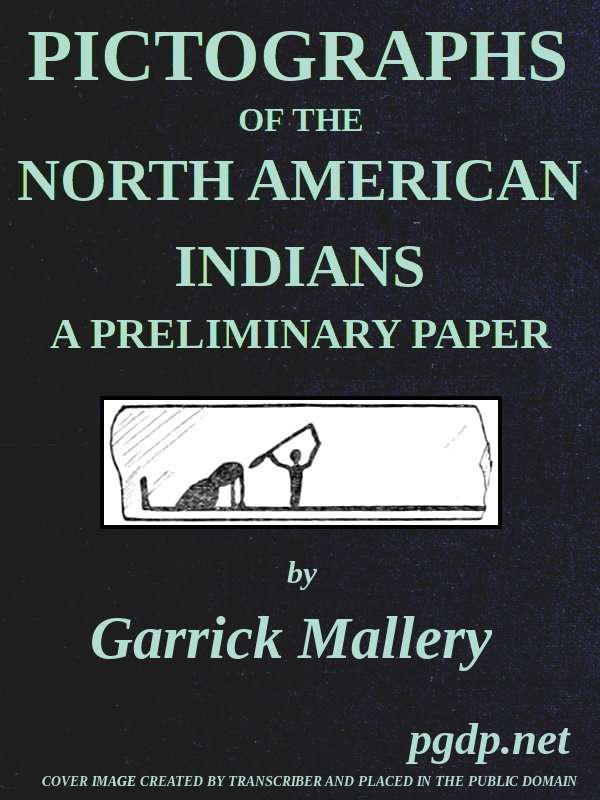
They were living somewhere east of their present country, when a prairie fire destroyed their entire village. Many of their children and a man and his wife, who were on foot some distance away from the village, were burned to death. Many of their horses were also burned to death. All the people that could get to a long lake which was near by saved themselves by jumping into it. Many of these were badly burned about the thighs and legs, and this circumstance gave rise to the name, si-can gu, translated as Burnt Thigh, and Brulé, by which they have since been known. Battiste Good’s character for the year is here given as Figure 123.
Fig. 123.—Origin of Brulé. Dakota.
This is of later date than the mythical times, even among Indians, and, being verified as it is, must be accepted as historical.