
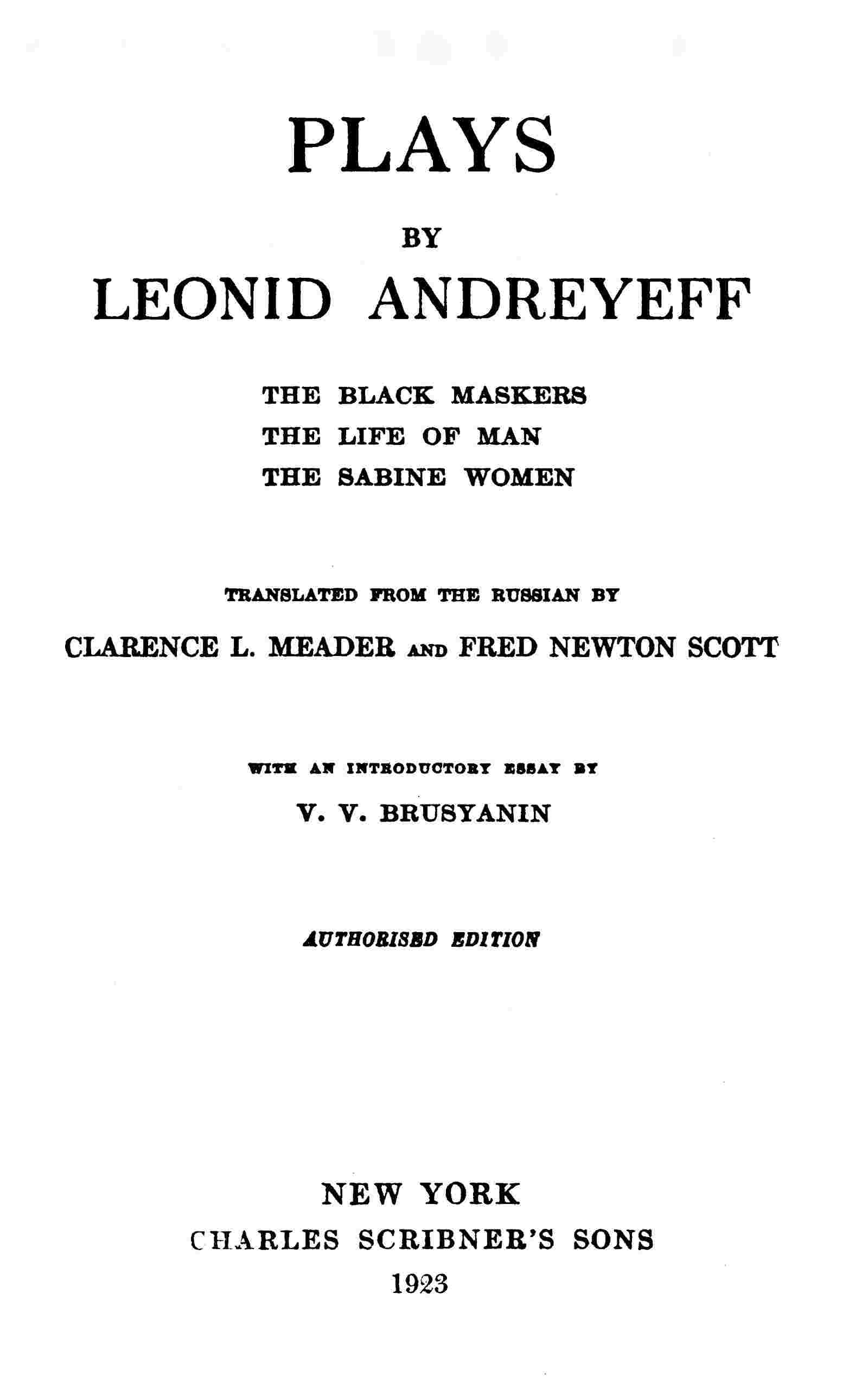
Leonid Andreyeff, as a dramatist, is the most interesting product of contemporary Russian literature. Abandoning the older traditions that prevailed from Ostrovski[2] to Tolstoi, and passing by the school of Tchekoff,[3] he brought to the theatre a unique form of art, the rich possibilities of which he is still developing. In 1913 Andreyeff published in the theatrical journal Maski a “Letter on the Theatre.”[4] This is a “confession of faith,” and describes in detail its author’s conception not only of the theatre of the past but also of the theatre of the future, to the latter of which he gives the new name “panpsyche.”[5] Let us see what this theatre panpsyche is, and how Andreyeff applies his theory to his dramatic productions.
With that spirit of independence which has characterised all great Russian writers, Andreyeff, disregarding long-accepted traditions even now generally regarded as essential, asks point-blank the heretical question: “Is action, in the accepted sense of movements and visible achievements on the stage, necessary to the theatre?” In his opinion it is not necessary, inasmuch as modern life itself in its most tragic aspects tends to withdraw farther and farther from external activities and deeper and deeper into the recesses of the soul, into the silence and outward calm that characterises mental life. From this answer to his question one may see how far the theatre panpsyche will depart from the older theatre of Shakespeare, Sardou, Dumas, and other foreign dramatists, and even from the Russian schools that developed out of Ostrovski’s art.[6] In this respect Andreyeff is closely akin to Maeterlinck, in whose plays dramatic collisions are not marked by external action, but the problems that characterise the life of the soul, with its premonitions, its yearnings, and searchings, are brought in concrete form before the footlights.
To illustrate his views, Andreyeff draws an interesting contrast between the lives of two men of widely different ages and widely divergent ethical views, Benvenuto Cellini and Friedrich Nietzsche. In reading the memoirs of Cellini, Andreyeff was struck by the large number of events in the life of the mediæval artist and adventurer. “How many escapes, murders, surprises, losses and unexpected discoveries, loves and enmities!” exclaims Andreyeff. “Cellini encounters more events in a short walk from his home to the outskirts of the city than the average modern man does in his entire life. Cellini’s life was a counterpart of the life of his day, with its brigands, monks, dukes, swords, and mandolins. In those days interest attached only to a life that was full of events, continually active and achieving, whereas a life of inactivity was like a clod lying by the roadside, of which there is nothing notable to be said. Cellini’s life is a personification of the older theatre. Read any of the older dramatists, observe any contemporary actor of the older school, and you will realise how much there is of Cellini in them.”
In contrast with this, Andreyeff conceives the new theatre as the place for the bodying forth of such intensely dramatic experiences as those of Nietzsche. “Where in Nietzsche’s life,” asks Andreyeff, “are there events, activities, physical achievements? In his early manhood, while he was a Prussian soldier, and was still to a certain extent a man of action, he was in the least degree a dramatist. The real drama of his life begins just at the time when his life withdraws into the silence and inactivity of the study. It is there that we find the painful re-evaluation of all values, the tragical struggle, the break with Wagner, and the charming Zarathustra!”
The contemporary drama, says Andreyeff, has shown itself powerless to represent the drama of Nietzsche. In the presence of the spiritual and intellectual conflict it is speechless. “Humbly bowing before the immutable law of action, the contemporary drama declines to represent—indeed, cannot represent for us—a Nietzsche, who is so near, so important, so essential to our lives, but continues to offer us in profusion empty, antiquated, and unnecessary Cellinis, with their paraphernalia of tin swords, etc.” Andreyeff explains the crisis of the obsolete theatre of to-day by the fact that life itself has withdrawn into the inner recesses of the soul, whereas the theatre has paused at the threshold of these new and profound psychological experiences and intellectual strivings—the struggle of man’s thoughts with man—and has never thrown open the door that leads to them.
In anticipation of the objections of his critics, Andreyeff asserts that he does not in the least mean that events have ceased to occur, that people have ceased to act, or that history has ceased its forward movement. The chronicle of current events is still sufficiently replete with suicides, strife, and war, but all these events in their outward aspects have fallen in dramatic value. Life has become more psychological. In the place of the older passions and the traditional heroes of the drama, love and hunger, there has arisen a new protagonist, the intellect. Not love, nor hunger, nor ambition, but thought in its sufferings, joys, and struggles, is the true hero of the life of to-day. To it therefore is due the first place in the drama. Indeed, Andreyeff has gone so far as to entitle his last drama “Thought”; and if we examine into the plays which he wrote at the beginning of his dramatic career, “The Life of Man,” and “The Black Maskers,” we shall find in them the same content.
Man, who is the hero of “The Life of Man,” and Lorenzo, the principal character in “The Black Maskers,” are both victims of the tragedy of their intellect, of their obstinate questionings in the realm of thought, and their disenchantments in the sphere of the emotions—the love of life, the love of people, the love of themselves. In “The Life of Man” some fate, embodied in the Being in Grey, held in his hands the candle, the emblem of life, and directed the thoughts of Man from behind his mysterious veil. Herein lies the whole tragedy of Man and Lorenzo. From poverty and sorrow Man rises to wealth and happiness, and it would appear that with such powerful spiritual weapons as the intellect and the soul he might easily fortify his position. However, the Being in Grey turns out to be stronger than Man, with his intellect and soul, with his thoughts and his conduct of life. Herein lies the drama of Man, whose life has become an “inner” life, while the outward events become non-essential, mere unavoidable details. Duke Lorenzo was also strong as far as the external factors of wealth and power were concerned. Yet his restless thoughts, and in particular the one persistently recurring thought that he was not Duke Lorenzo, but only the son of his mother and a stable-man, gave rise to an inner, spiritual drama, which overwhelmed the man Lorenzo who is hidden behind the duke Lorenzo. Lorenzo thus slew his double, but he did not come out victorious over the Being in Grey. Nothing in his life was changed for the better. In his mind people took on the appearance of maskers, of being other than they really were; all objects in the world were masked and false; even his own thoughts became disguised in masks. The whole world was merely the delusion of Duke Lorenzo, who moved about the earth in an eternal mask. Both Man and Lorenzo are the victims not of outward conditions, but of their own inner experiences.
It is only on the basis of this general theory of the modern theatre that we can understand either “The Life of Man” or “The Black Maskers.” But once having accepted this theory we see how baseless are the contentions of Andreyeff’s critics. They condemn the external form of such plays as “The Life of Man,” which Russian society had universally understood, appreciated, and approved. In framing a play with a new kind of content, Andreyeff instinctively selected new outer forms to correspond. These forms, though intelligible to the public, were incomprehensible to the critics, reared, as they have been for decades, on the dramatic forms of Ostrovski’s school.
Consistent with the alterations that have taken place in the drama, Andreyeff calls the old theatre the theatre of “make-believe,” as distinguished from the theatre panpsyche, which he calls the theatre of the truth. He goes even farther and affirms that the motto of all future art will be “truth in art.” When the modern “psychological” novelist or dramatist brings his heroes on the stage, are they the product of the “play of his fancy”? asks Andreyeff. “No,” he replies, “he experiences them, lives them, creates them, fashions them, any word you choose; only do not use the word ‘play.’” For play is something entirely different and distinct from the artistic process of creating new beings, which is the basis of the dramatist-psychologist’s art. Play is pretence; and the more refined, cunning, and beautiful, the better it is as play: but psychological creating is truth; and the plainer, the more sincere, the more severe it is, and the farther it is removed from pretence, so much greater will be its artistic value.
“The Life of Man,”[7] when staged, was condemned by the critics on the ground of excessive symbolism and allegory.[8] The author, paying as he did scant heed to the details of daily life that surround the hero of the play and his wife, concentrated all his attention on the conception of Man and the life of Man. The symbolism employed is very old and familiar—patent, in fact—and is a minor element in the drama. As a matter of fact, this method of picturing human life has long been current among the masses of the Russian people. They picture life either as a candle which blazes up through some mysterious power and finally goes out, or in the form of steps, represented in a crudely drawn picture, in which man is depicted from birth till death. In the first half of life—till middle age—he mounts to the summit, then begins to descend the stairs, and finally he reaches old age and his predestined end—death. It is this crude popular conception that Andreyeff takes as the basis of his symbolism; and this selection of a basal motive from the life of the common people is that very truth in art of which Andreyeff speaks, for behind this picture lies the deeply rooted faith of the people in life, and in Fate as the guide of life.
The Man whom Andreyeff depicts is an extreme individualist whose whole life is centred upon himself and his own interests, who judges all other persons and all things from the point of view of his own personality. He has made himself the centre of the universe. Nor in this case is fate a mere subjective principle holding sway over man. It is something entirely different. Professor Reisner, in his work entitled “Andreyeff and His Philosophy of Life,” says on this point: “Once man has become the foundation of social life, all connecting boundaries and points of contact heretofore existing between him and nature disappear. He is not merely left in isolation, but about him is formed a desert—a vast, social chasm, and the great principle called the law of life now has no means of coming into contact with the naked individual. When this stage has been reached, principles of law and order can find justification only from the point of view of the individual. As soon as the individual has become the unit of society, and the centre of all interests, the aims of this unit must be accepted by it as the aims of the universe, its reason must be accepted as the world reason, and with it the fate of the universe is born and perishes. But if the individual cannot thus establish a direct bond between his personal existence and the law of nature, there results the great tragedy: Personality renounces the world.”
Man, the hero of “The Life of Man,” failed from the very first to establish this bond. In his earlier years of poverty he found the meaning of life in the struggle for existence, in dreams of wealth, distinction, and fame. He dreamed even of becoming recognised as a genius. But his dreams all ended in selfish visions of a wonderful villa on the Norwegian coast, where on stormy winter nights he and his wife might find rest and repose in the cheery warmth of the huge fireplace “that burned whole logs.” In the ball of Man the hero reaches the summit of life. Observe the feeling of dignified self-importance with which Man enters the presence of his guests, his wife leaning upon his arm. He is rich and famous. His guests are filled with admiration for the wealth and luxury of his life, and for his wide-spread fame. But listen! The strains of the polka, hollow and empty, the insipid, soulless dance of the guests and their petty remarks reveal all the tragedy of the petty and empty life of this richest and most famous of men—the profound tragedy that lies in the solitude of Man and in the solitude of each and every one of his guests. The egoistic laws of life followed by the Friends and the Enemies of Man hang like a pall over the empty but ominous ball. Like evil forebodings on the eve of death, they reveal all the vanity of human life. In the ball of Man, which sums up the entire life of both Man and his guests, one does not feel the presence of the great cosmic bond between man and the laws of the universe; but the laws that guide the base Friends and Enemies of Man have brought together here the doomed, and among them the chief of the doomed, Man himself, proud, noted, and wealthy; while in the background, seeming to be a part even of the grey wall, is the Being in Grey (whether God, Fate, or the Devil, Man himself knows not), invisible and frightful in his coldness and indifference, following persistently every step of Man’s life—the Being in Grey, in whose hand is burning—burning out—the candle that symbolises the meaning of the life of this man who has failed to establish a bond between his personal existence and the laws of nature. The beginning and the end of his life are concealed in darkness. “Dragged on irresistibly by time, he will tread inevitably all the steps of human life, upward toward its summit and downward to its end.”[9] Still more definitely the Being in Grey speaks of the meaning of the life of Man: “Limited in vision, he will not see the step to which his unsure foot is already raising him. Limited in knowledge, he will never know what the coming day or hour or moment is bringing to him. And in his blind ignorance, worn by apprehensions, harassed by hopes and fears, he will complete submissively the iron round of destiny.”
The “iron round of destiny” is the tragedy of Man, conditioned by the strife between the intellect and the emotions, with its attendant sufferings and joys in the case of a man whose strivings toward harmony and order are doomed to clash with the primeval chaos.[10]
The tragedy of Lorenzo in “The Black Maskers” is of the same sort. “My soul is an enchanted castle. When the sun shines into the lofty windows, with its golden rays it weaves golden dreams. When the sad moon looks into the misty windows, in its silvery beams are silvery dreams,” says Lorenzo of his own inner experiences. Yet in the midst of his dreams Lorenzo continually asks the question: “Who laughs? Who laughs so gently at the sorrowful life of Lorenzo?” Such were also the dreams of Man and his wife, when their distress was soothed for a moment by prayer, and when for a time they had faith in the Being in Grey. “Man, flattered by his hopes, has fallen into a deep and grateful sleep.... He dreams that he is riding with his son in a white boat over a beautiful smooth river.... He hears the reeds rustle as they part before the boat. He is filled with joy and he fancies that he is blessed. All Man’s emotions are deceiving him. But suddenly he becomes restless. The terrible truth, penetrating the dense veil of his dreams, has seared his thought: ‘Why is your golden hair cut so short, my boy; why is it?’ ‘My head ached, father, and that is why my hair was cut so short.’ And, again deceived, man is happy, and he sees the blue sky and hears the reeds rustling as they part.”[11] At the very moment when in sleep his thoughts joyously take wing, misfortune draws close to him; while he sleeps and in his visions finds rest and respite from the iron round of destiny, his son is already dead; so awaking from his dreams he has no course left but to curse the Being in Grey. Of this Being Man begs not for mercy or for pity, but “only for justice.” To this same being Lorenzo turns with the prayer: “Who laughs? Who laughs so frightfully at the insane Lorenzo? Have pity on me, O Monarch! My soul is filled with terror! O Monarch, O Lord of the World!—Satan!” Man asks no longer for mercy, but only for justice; Lorenzo still believes in mercy, and asks for pity. Why the difference? Is not the tragedy of their lives the same? The author himself answers the question by the entire subject-matter of these similar yet different plays. The soul of Man, though tortured, still remains intact in the presence of the Being in Grey, and he perishes cursing the blind power of Fate; but the soul of Lorenzo is rent in twain and his tragedy is the more intense, because Fate, Destiny, God, or the devil is transformed from a vague primordial being into the double of the duke Lorenzo. In “The Life of Man” fate appears in the form of an objective principle, a power outside of man; in “The Black Maskers” this same fate has entered, as it were, into the flesh and blood of Lorenzo, has become a part of his essence, that is, it has become subjective in the fullest sense of the word. Lorenzo considered his life good and beautiful, but having invited his masked guests to his ball he discovered the falseness of his life. In the place of one wife he saw three; in the place of one Duke Lorenzo he suddenly encountered at the ball his double. Then appeared also the black maskers, the personification of the darkness of life and the mysterious dark instincts of man. At this point began a new life for Lorenzo, and he himself became new, that is, demented. With his doubt as to his parentage—whether he was the son of his father or of a filthy stable-man, his mother’s paramour—began the dark, insane life of Lorenzo, and he perished in darkness and was burned in his castle, which was set on fire by the jester.
In the midst of the storm of adverse criticism—including such characterisation as “unheard-of horrors,” “disregard of real life,” “excessive symbolism”—that greeted the first appearance of “The Black Maskers” at the theatre of Komisarzhevskaia, in 1908, very few critics succeeded in making any close approach to a true interpretation of the drama, either in its subject-matter or its form. Yet all were intensely interested, and throngs of “interviewers” made their way to Andreyeff, at his country home in Finland, to learn what he intended in this drama to represent. The author, of course, found it impossible to explain his own creation, but eagerly discussed the symbolic form of this and other plays. “Critics are a strange people,” said Andreyeff to one of his interviewers. “They wonder why I write certain things in a peculiar style. The explanation is very simple: every work should be written in the style which it demands. ‘King Hunger’ could not be written without symbolism; ‘The Seven who were Hanged’ could be written only in realistic tones. Tchekoff—the dear, delightful, sensitive Tchekoff, who was always so cautious and considerate in his utterances—finding himself once in a circle of intimate friends and hearing the name of Ibsen mentioned, blurted out: ‘Ibsen’s a fool!’ If Tchekoff did not understand Ibsen’s symbolism, could not grasp it, shall I be offended when the critics assail my writings? Eleven years have past since I published my first story. For ten years I have written as I felt. I am not the slave of either symbolism or realism, but they are my servants—now the one, now the other, according to my theme. In the future also I must continue to write as I am able.” Not confining himself to the elucidation of the outer forms of his dramas, Andreyeff gives a direct key to the understanding of his “Black Maskers” in “My Diary,” published in 1908, two or three months before the writing of “The Black Maskers.” The hero of that sketch, an old man who has been immured in a prison since early manhood, writes in his diary: “Every man, as I afterward came to see and understand, was like that rich and distinguished gentleman who arranged a gorgeous masquerade in his castle and illuminated his castle with lights; and thither came from far and wide strange masks, whom he welcomed with courteous greetings, though ever with the vain inquiry: ‘Who are you?’ And new masks arrived ever stranger and more horrible.” To this description the prisoner adds, as a foot-note to his diary: “The castle is the soul; the lord of the castle is man, the master of the soul; the strange, black maskers are the powers whose field of action is the soul of man, and whose mysterious nature he can never fathom.” These beings bring into the soul darkness and death, extinguishing the light of life. The “simple” maskers, the guests of Lorenzo, are ordinary people; yet even these are transformed and lose their real semblances and, like the black maskers, they become mysterious, incomprehensible, and terrifying to Lorenzo, who fails to understand them as he fails to understand his own soul. Lorenzo’s mind becomes clouded, his own soul becomes repulsive to him, he seems strange to himself. Though he longs to accept his own soul as his own, yet the ugliness, the repulsiveness, of that which he sees within it checks his resolve to do so, and his soul becomes two souls—Lorenzo becomes two Lorenzos. Before him he sees his double—his horrible, disgusting, false double—and incensed with anger he draws his sword and slays it. Recall the uncanny scene in which the servants, friends, and wife of Lorenzo come to bid farewell to the remains of the dead duke, while the duke himself—his other half—stands in the shadow at the head of the bier and observes how they greet the cold corpse of himself. The duality of soul, the duality of personality, has led to the final tragedy of the duke—insanity.
But at this point the author willed that a new transformation of Lorenzo should occur. When the castle, fired by Ecco, the jester, is in flames, Lorenzo, falling upon his knees, calls upon all present to pay homage to the being who is now revealed to his soul, darkened though it be by insanity. “Uncover, gentlemen; it is the Lord God, the Ruler of heaven and earth. On your knees, knights and ladies!” But one conclusion can logically be drawn. Lorenzo, passing through this duality of personality and slaying his double, i. e., renouncing the dark and evil elements of his soul, has attained to the knowledge of God and perishes at the moment of attainment.
And the general inference to be drawn from the two plays? Man in Andreyeff’s view is in the hands of fate; whether it appears as the effect upon him of his environment, or manifests itself in the joys, sorrows, temptations, doubts, and struggles of man with his rejoicing, sorrowing, aspiring, doubting, struggling soul. Man is, as it were, condemned to inevitable suffering, and only through suffering can he hope to attain to perfection. Such was the case of Duke Lorenzo, whose death brought him a vision of God. In this sense Andreyeff resembles Tolstoi and Dostoevski. The former called upon man to achieve perfection through suffering; the latter admonished man to reject the problems of personality for the sake of perfection. But Andreyeff differs from both Tolstoi and Dostoevski. Recall how the hero of “The Life of Man,” despairing of his personal welfare, curses the invisible Being who directs the life of man: “I know not who you are, God, the devil, Fate, or Life, but I curse you! I curse all that you have given me! I curse the day on which I was born! I curse the day on which I shall die! I curse my whole life, my joys and my grief! I curse myself! I curse my eyes, my ears, my tongue! I curse my heart, my head! And I hurl all back into your cruel face, senseless Fate! Be accursed, be accursed forever! Through my curse I rise victorious above you. What more can you do with me? Hurl me upon the ground; yes, hurl me down! I shall only laugh and cry out: ‘Be accursed!’ ... Over the head of the woman you have offended, over the body of the boy whom you have killed, I hurl upon you the curse of Man.” Duke Lorenzo, whose timid soul is rent in twain, calls upon us to worship God; Man, whose soul is still intact and unreconciled, curses him who directs both birth and death. Such are the fundamental differences between the two plays.
The third play included in the present volume differs markedly from the other two in its form, its content, and its purpose as conceived by Andreyeff. It transports the author from the field of the universal problems of life to the particular conditions of contemporary political life in Russia. It is a satire on the Constitutional-Democratic party. This party is not “legalised” in Russia, and is considered an opposition party both in the Duma and in the country at large. Notwithstanding their repute, however, the “Kadets,” as they are called for short, being composed of individuals representing both progressive and conservative elements of society, have a mixed character, which serves to distinguish them from both the socialistic and the populistic parties. Naturally this dual character is clearly reflected in their political activities.
Assuming that in general the subject-matter of the play will be clear to the reader, we will limit ourselves to a few explanations that will enable the reader to appreciate the keenness of Andreyeff’s satire. The crude Romans, the abductors of the fair Sabine women, represent the Russian administration of the period of the reaction. The Sabine women are the constitutional “promises” wrung from the government by the revolution of 1905 and 1906. The Sabine husbands represent the Constitutional-Democratic party, who strive by strictly legal methods to preserve these promised constitutional guarantees. The political programme of the Kadets is especially satirised in the second act, at the point when the injured husbands are preparing to march on Rome to liberate their wives. Ancus Martius instructs them to march by taking two steps forward and one step backward. The two forward steps are designed to indicate “the unquenchable fire of our stormy souls, the firm will, the irresistible advance. The step backward symbolises the step of reason, the step of experience and the mature mind.... In taking it we maintain a close bond with tradition, with our ancestors, with our great past.” This is the “progressive-conservative” programme of the Kadets. They failed to gain a victory over their political opponents; or, if they did win a victory, it was just such a victory as that won by the Sabines over the Romans.
In concluding, let us remind the reader that our interpretation of these three plays has been very brief, as has been also our exposition of Andreyeff’s views on the theatre. We have set forth but a small fraction of Andreyeff’s rich contributions to Russian social thought. Above all, the reader should understand that Andreyeff paints Russian life in true colours, and to know his works is to know contemporary Russia.
V. V. Brusyanin.
Petrograd,
October, 1914.
FOOTNOTES:
[1] Since Mr. Brusyanin, the author of this introductory essay, is a literary critic of note, and at the same time a personal friend of Andreyeff, the essay has the unique value of being an authoritative statement of Andreyeff’s own views.
[2] Ostrovski is regarded as the founder of the modern realistic drama in Russia. His literary career extended from 1850 to 1886.
[3] It is interesting to note that the plays of Andreyeff were staged by the same Moscow theatre which introduced Tchekoff to the public.
[4] Republished in 1914 in the Almenakh Shipovnik along with another letter on the same subject.
[5] Literally, “all soul,” or “all thought.”
[6] All the plays of Ostrovski are marked by conspicuous external action, which is often prejudicial to dramatic truth and inconsistent with the principle of realism.
[7] “The Life of Man,” published in 1906, was the first symbolic drama written in Russia. Later followed Andreyeff’s symbolic dramas, “King Hunger” (the representation of which was forbidden by the censor), “The Black Maskers,” “Anatema” (which was taken from the stage on petition of the Moscow clergy), and “The Ocean,” which, owing to technical difficulties of inscenation, was never staged.
[8] To appreciate the force of the above criticism the reader must recall that for about a century the Russian public has been accustomed to read only the most realistic form of literature.
[9] See Prologue.
[10] This definition of life is given by Andreyeff in the study published variously under the titles “My Diary” and “Our Prison.”
[11] “The Life of Man,” Act IV.