
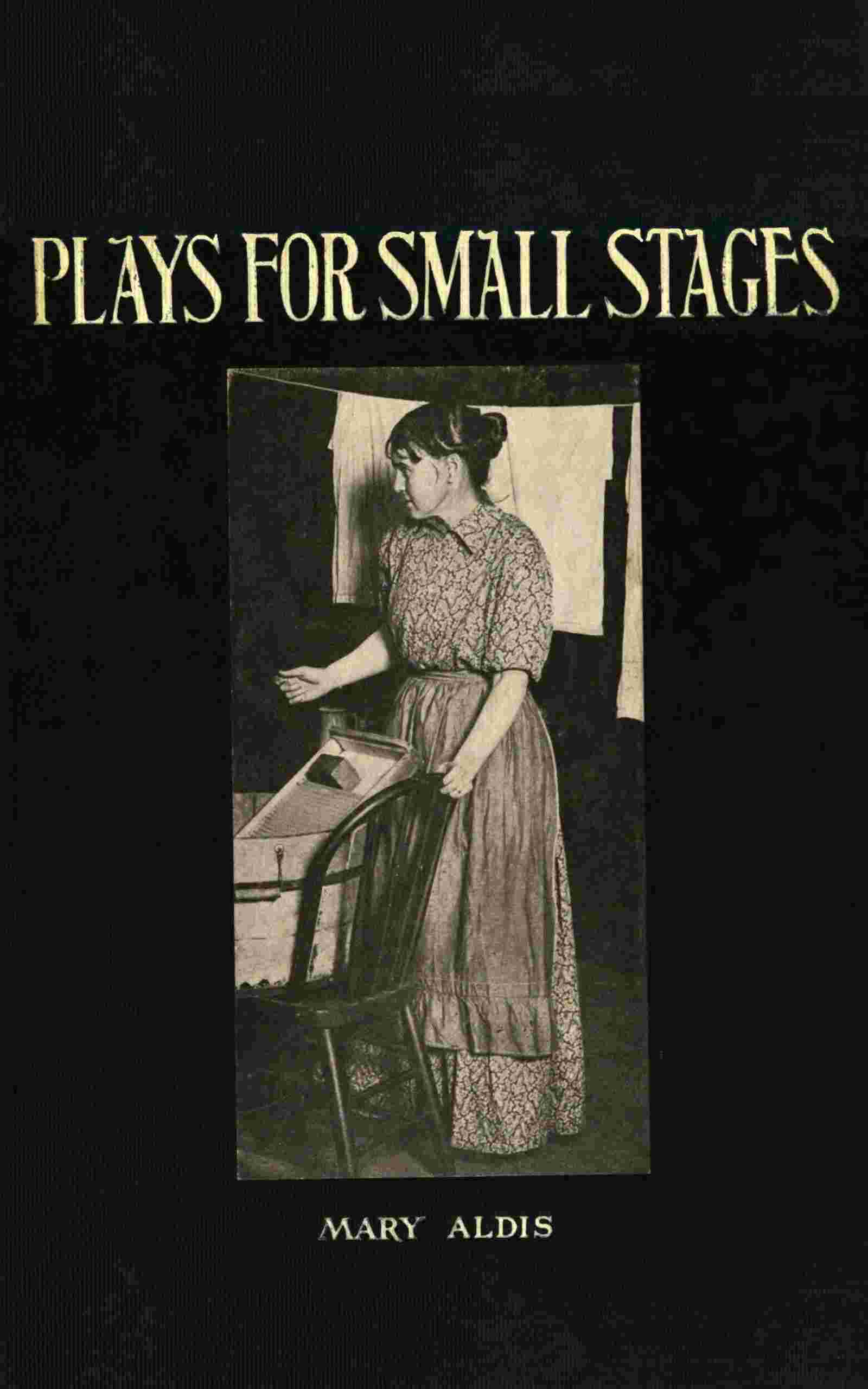
MRS. PAT AND THE LAW
Played for the first time on September 14, 1913, by Mr. Benjamin Carpenter, Mrs. Arthur Aldis, Miss Polly Chase, Miss Isabel McBirney, and Mr. Chas. Atkinson.
MRS. PAT AND THE LAW.
Characters:
- Patrick O’Flaherty.
- Nora O’Flaherty, his wife.
- Jimmie, his crippled son, aged about eight or ten years.
- Miss Carroll, the Visiting Nurse.
- John Bing, a Policeman.
Scene: A small, poor room in a tenement flat. Cook-stove, back; shabby lounge, front; at left, kitchen table with a faded flower in a bottle; a wash-tub on bench, centre left, back near door. At left, door to bedroom. At right, door to hallway.
When the curtain rises Nora O’Flaherty is discovered at the wash-tub. She is a large woman, with a worn, sweet face, across her forehead an ugly red cut. The room is untidy, and so is Nora. The stove is blazing hot. After stirring the clothes in the boiler Nora wipes her face with the back of her hand and sighs wearily as she puts a fresh lot into the tub of suds.
Jimmie.
[Speaking from bedroom.]
Maw, what time is it?
Nora.
Most tin, Jimmie-boy.
Jimmie.
Whin’ll Miss Carroll come?
Nora.
Well, now, I shouldn’t wonder if she’d be comin’ along the shtreet and oup the shtairs and right in at that door about the time the clock gits ’round to half past tin, or maybe it’s sooner she’ll be. Do you think it’s a flower she’ll be bringin’ today, Jimmie-boy?
Jimmie.
To-day’s Tuesday, ain’t it?
Nora.
Shure!
Jimmie.
There’s no tellin’. Sometimes she says there ain’t enough to go ’round.
[A pause.]
Nora.
[Sorting out clothes.]
Sakes alive—the wash that’s on me! I’ll niver git through.
[A short silence.]
Jimmie.
Maw, what time is it now?
Nora.
Well, I couldn’t rightly say, the steam bein’ in me eyes like. Faith, ye must bear in mind there’s many that’s needin’ her. Maybe at this very minute it’s a new-born baby just come into the world she’s tendin’, or an ould man just goin’ out of it! She’ll be comin’ soon now, I’ll warrant ye.
Jimmie.
But, Maw, me leg hurts, and Paw takes all the room in the bed, he’s sleepin’ so noisy!
Nora.
Och, Jimmie darlin’, have a little patience! Me name’s not Nora O’Flaherty if Miss Carroll don’t bring us a flower this day, or if there ain’t enough to go ’round, shure it’s the bright happy worrd or the little joke or plan she’ll have in her mind for ye ’ull hearten the day as well as a flower.
[Another pause.]
Jimmie.
Maw! Ain’t it half past tin yit?
Nora.
Oh, laddie, an’ I hadn’t the great wash on me hands I’d dance a jig t’ amuse ye! Shure many’s the song I’ve sung an’ the jig I’ve danced whin I was a slip o’ a gurrl back in the ould counthree, afore I had the four of yiz and yer Paw to look afther! Now it’s me arrms have need to move livelier than me legs, I’m thinkin’. Listen, now, an’ I’ll see if I can call to mind a little song for ye. [Sings, keeping time with the wash-board.]
There’s a song fer ye now! Ha, Jimmie-boy, I’m thinkin’ that song ’u’d had more sense an’ it told what she did wid her rampin’, roarin’ Irishman wanst she got married to him.
[Knock on the hall door.]
Jimmie.
Ah, that’s her!
Nora.
There! Didn’t I tell ye? [Nora wipes her hands and hurries to open the door, admitting Miss Carroll.] Ah! Miss Carroll dear, it’s welcome ye are this day. Jimmie’s been watchin’ and wearyin’ for ye since the daylight dawned. How are ye?
[She has turned away as Miss Carroll enters so as to conceal her head, but Miss Carroll catches sight of it and, taking hold of her arm, turns her around.]
Miss Carroll.
Why, Mrs. O’Flaherty, what an awful cut! You look as if you had been hit with an axe!
Nora.
Oh, git along with ye!
Miss Carroll.
How did it happen?
Nora.
Shure, ’twas nothin’ at all but his boot, and he that unstiddy he couldn’t aim shtraight! It’s ’most well now. [She turns to tub.]
Miss Carroll.
[Taking off her coat and opening her satchel.]
It isn’t “’most well.” It’s a fresh wound and a bad, deep cut. As I’ve told you before, I’ve no patience with you for putting up with such treatment. Don’t you know the law would protect you? You ought to swear out a warrant for your husband’s arrest on the grounds of personal violence. That might teach him a lesson. This is the third time now in a month he’s struck you. It’s outrageous! Has he got a job yet?
Jimmie.
Ain’t you comin’, Miss Carroll? Me leg hurts awful.
Miss Carroll.
Yes, Jimmie-boy, in a minute. [She has been getting hot water from the stove, preparing cotton gauze, etc., for dressing. She stops a moment in her work and regards Mrs. O’Flaherty.] Has he got a job yet?
Nora.
He had work last week.
Miss Carroll.
For how long?
Nora.
For three days—an’ a part o’ four.
Miss Carroll.
And then he got drunk and got turned off, eh? And you gave him your wash money, too, I suppose, as usual.
Nora.
No, no, Miss Carroll dear, I didn’t do that at all. I only give him the half of it, and niver any of it would he have had but—well—knowin’ it was in the house, it was coaxin’ me mornin’ and night he was with that wheedlin’, soft way o’ him, and the silly loverin’ talk till the heart just ran melty within me. [Miss Carroll regards her with her lips pursed.] I know it’s an ould fool you’re thinkin’ me, but jest let you be listenin’ to his talk wanst and see what you’d do, and him tellin’ stories to Jimmie the while so kind and lovely.
Miss Carroll.
[Stopping at entrance to bedroom, basin in hand.]
“Kind and lovely” indeed! When he takes your wages and hurts and abuses you, and Jimmie hasn’t a decent place to live in because his father’s a lazy—[She stops in amazement on the threshold as she sees Pat asleep in the room within.] Well, I never! [Comes back into the room.] Mrs. O’Flaherty, you must make Pat get up and get out of there while I take care of Jimmie.
[Mrs. O’Flaherty looks injured, but wipes her hands and does as she is bid. Miss Carroll stands watching at the door.]
Nora.
[Within bedroom.]
Pat! Pat! Wake up, will ye! [Pat groans.] My, but you’re sleepin’ hard! Pat! Miss Carroll says ye’re to git oup and git out o’ here while she takes care o’ Jimmie. Come along, now! That’s right, Jimmie-boy, give him a good thump! Are ye oup on yer legs now? Mind what yer doin’. There ye are!
Pat.
[Entering, yawning.]
Wha’ for Miss Carroll says git oup and git out?
[Miss Carroll glares at Pat. Pat, turning, catches her eye and smiles sweetly ere she vanishes into the bedroom.]
Nora.
Well, Pat O’Flaherty, I’m thinkin’ Miss Carroll ain’t so awful admirin’ o’ your ways! Sometimes I’m thinkin’ she sees ’em clearer nor your lovin’ wife does!
[Pat picks up one of his shoes, sits down on the sofa and looks around for the other; pays no heed to Nora’s talk.]
Pat.
Where’s me other shoe? [Gets down on hands and knees and looks under the sofa.] Shure I had the two of ’em on me feet yesterday. [Laughs gaily.] Maybe I wore wan on ’em out lookin’ for that job that I didn’t git!
[Nora watches him a moment, then hands him the shoe she has picked up near the stove.]
Nora.
Here’s your shoe.
Pat.
Ah! That’s the darlin’; thank ye kindly. I’d be losin’ me head some day if ’twern’t for you, Nora gurrl.
Nora.
[At tub while Pat slowly puts on shoes.]
Oh, Pat, ye will thry and git some worrk today, won’t ye, man? Thry harrd. If they don’t take ye on at the first place, go on an’ don’t git discouraged. Ye know ye’re the grand workman whin ye thry, and ye must git a stiddy job soon. Ye really must, Pat. I’m shtrong; I don’t mind the washin’ fer me own sake. I’d do anythin’ fer you and the childer, but whin Jimmie frets at me to play with him, an’ the others come rushin’ in from school a-wantin’ thur maw to do this and that fer ’em, shure it comes harrd an’ I dassn’t take me arrms from the suds to ’tend on ’em and comfort ’em and cook ’em thur meals nice like that visitin’ housekeepin’ lady told me to.
[Pat has not been listening very attentively, but has taken in the drift of Nora’s plea.]
Pat.
[Pulling himself together and putting on hat and coat.]
Ah, Nora gurrl, I’ll be gettin’ a good job today shure. [Suddenly catches sight of her forehead.] Wha’s that on your head?
Nora.
[Startled.]
Me head, is it? Miss Carroll was sayin’ just now it was “personal violence and breakin’ the law.” I was thinkin’ afore that ’twas only the heel o’ an ould boot walked around daytimes on Pat O’Flaherty, lookin’ for a job.
[Pat regards her uneasily, meditating speech, but appreciates he is too befuddled for argument, so begins to whistle as he gets himself out and down-stairs, leaving the door open. Nora goes to shut it, and stands a moment reflecting, looking after Pat, then returns to the tub near the bedroom door, evidently thinking. Short pause.]
Jimmie.
[Within bedroom.]
Say, Miss Carroll, d’ye think I’ll ever git it?
Miss Carroll.
Christmas is coming, Jimmie-boy.
Jimmie.
Huh! So’s Fourth o’ July.
Miss Carroll.
We’ll see what we can do.
Jimmie.
The other lady you told about me brung me a suit, but some cove lots bigger ’n me wore it all out first. I don’ like it. Gee! but I wisht I had a bran’-new suit just wanst.
[Nora makes a little yearning gesture towards the room.]
Miss Carroll.
Now, Jimmie-boy, come along. It won’t hurt much. When you’re all fixed up on the lounge in there I’ve got something pretty for you.
Jimmie.
Another flower? What kind is it?
Miss Carroll.
We’ll see. Now lean on me.
[They enter.]
Nora.
That’s the lad. Are ye all fixed up now? He’s gettin’ lots better, ain’t he, Miss Carroll?
[Jimmie is a pale, emaciated child with a wan little face of great sweetness of expression. His clothes are much too large for him. He holds up one bandaged leg and hobbles on crutches. Miss Carroll helps him onto the lounge, produces from a paper by her satchel two pink roses, holding them up.]
Jimmie.
Gee! ain’t they pretty! Can I keep ’em both?
Miss Carroll.
Both for you, Jimmie-boy, and we’ll see what can be done about the suit. Perhaps we can find one somewhere that’s bran’ new. [She gets a book from the shelf.] See if you can learn all the new words on this page before I come tomorrow, will you? That’s a dear old boy! Now, Mrs. O’Flaherty, let’s see about that forehead. Sit down here. [Miss Carroll places a chair, front stage.]
Nora.
[Washing.]
Oh, what’s the use botherin’ about me head? It’ll git well of itself. It always does. Don’t be mindin’ me.
Miss Carroll.
But, Mrs. O’Flaherty, you really must let me see to it. It’s a bad cut.
Nora.
[Wiping her hands.]
Oh well, you’re so good to Jimmie I’ll have to oblige you. I suppose you haven’t had many persons with holes in their heads made by boots to tind to? But you’re young, Miss Carroll dear, you’re young yit. [She seats herself with a sigh.] I’m talkin’ silly, Miss Carroll, but there’s no room for a joke in me heart this day. I’ve been thinkin’—about what you said afore you wint in to Jimmie.
Miss Carroll.
[Binding up the injured head.]
Yes?
Nora.
You were tellin’ me to git out a warrant ’gainst Pat. Do you think it would keep him from drinkin’ just for a bit till we git caught up on the rint and the furniture? Do you think it would?
Miss Carroll.
Mrs. O’Flaherty, you know it’s a shame and an outrage the way Pat’s behaving. He’s wearing you out. He’ll do you harm some day and then what will become of Jimmie? He ought to be taught a good lesson.
Nora.
Would they do any hurt to him, do you think, an’ they locked him up? Would they care for him kindly, and he maybe helpless like?
Miss Carroll.
They certainly would care for him. Now, Mrs. O’Flaherty, you go over to the Maxwell Street Station and show them your forehead, and say you want Pat “took up” for a day or so just for a lesson, do you understand?
PAT: WHAT DID THEY DO THEN? WELL, THEY LOOKED AND LOOKED FER A YEAR AN’ A DAY, IVERY MAN O’ THIM IN A DIFFERENT COUNTHREE
Nora.
Yes, I understand. Oh, it seems an awful thing to be doin’ to your own man, don’t it? After all them things I said when we got married? No, no, I niver could do it, niver! [Goes back to tub.]
Miss Carroll.
Well, then, tell Pat you may do it, anyway. It will make him respect you. But you’re such a softy, of course you’ll do nothing. I must go now. Mrs. Flaherty, you must not let Pat sleep with Jimmie. It is not good for him.
Nora.
[While Miss Carroll is packing satchel and getting on bonnet and coat.]
Shure now, Miss Carroll, you’re down on Pat for everythin’. He’s a good, lovin’ paw to Jimmie-boy he is—makin’ him happy and pleasin’ him like nobody else can. Everybody’s kind to Jimmie and nobody’s kind to Pat—and they’re just alike—two childer they are—both on ’em foolish and lovin’ and helpless like, and I love ’em both. Oh, I love ’em! If you’d hear ’em together an’ you wid your eyes shut, it’s hard set you’d be to say which was the man and which was the child. Sometimes I can’t ’tind to me washin’ fer listenin’ to the funny talk o’ the two o’ them. Wan time they’ll be settin’ on the high moon for a throne, with the little shtars to wait on ’em and shootin’-shtars to run errands; another, they’ll be swimmin’ along through the deep green sea, a-passin’ the time o’ day an’ makin’ little jokes to the fishes. Ah, ye ought to hear ’em go on!
Miss Carroll.
Well, I’m glad he amuses Jimmie when he’s at home, but he ought to be at work, a great strong man like him! He needs a good lesson, Pat does. Good-bye, Jimmie-boy. Be sure and have the new words learned. [She gives him a little pat, and with a wave of the hand goes out. Nora is unheeding Jimmie’s call of “Maw.” Jimmie has not listened to the conversation between Nora and Miss Carroll.]
Jimmie.
[Raising himself and looking around.]
Maw! She said she’d try and git me a bran’-new suit. Say, Maw, d’ye think she’ll pay out her money fer it? I don’t want her to do that. She just gets wages same as Paw. She told me how it was. Say, Maw, why don’t Paw bring home no more wages?
Nora.
[Coming to him, then taking sudden decision.]
Jimmie-boy, Maw’s goin’ out. [Hastily gets out a very queer bonnet and mantle while she speaks and arrays herself, putting bonnet on crooked to partially conceal bandage.] You just lie quiet there like a good boy, an’ a lamb’s tail couldn’t whisk itself three times till I’ll be back again. I’m not goin’ to be a fool softy no longer, and Paw’ll bring home some more wages afther that lesson he’s needin’. Are ye all right now? Ye won’t be needin’ anything? [Pats him on the head, then leans over and kisses him fiercely, protectingly.]
Jimmie.
Where you goin’?
Nora.
I’m goin’ to git the law to help us if it can. [She goes out and bangs the door.]
[Jimmie, left alone, is very bored and listless. He turns over the book, then lets it fall, twists himself wearily. Suddenly his whole face brightens happily at a step outside. Pat’s gay whistle is heard coming up-stairs.]
Pat.
[Entering.]
Hi, Jimmie-boy! There’s the great lad for ye! All shtuffed full and a-runnin’ over he is wid fine learnin’ out of books. Did ye ever see the loike o’ him? Sittin’ up dressed like folks! Faith, it’s the proud Pat I am this day! Let’s see what great thing about the wide worrld is a-hidin’ itself inside o’ this yere. [Picks up book.]
Jimmie.
I’m tired o’ that. Tell me a story.
Pat.
A shtory, is it? An’ me to be sittin’ here tellin’ a young lad shtories at the high noon of the day, and the job takin’ itself wings to fly off, I might be catchin’ and holdin’ down and I to go afther it instid! [Sitting down by Jimmie.] Where’s your Maw?
Jimmie.
I dunno. She said she wasn’t going to be no fool softy no more, and then she went out quick like. What’s a fool softy?
[Pat is very uneasy. He does not answer, then goes to the door, looks out, comes back slowly.]
Jimmie.
Paw, me leg hurts awful today. Tell me a story.
Pat.
All right, lad, I’ll tell ye a story. [Sits down near sofa.] Did I ever tell you about the king of Ireland and his siven sons? No? Once upon a time there was a great, high-up, noble king reigned over Ireland with a golden crown on his noble head an’ a rulin’ shtick in his hand—Whin’ll your Maw be back?
Jimmie.
I dunno. Go on with the story.
Pat.
Well, this grand king had siven sons, all fair and beautiful they were in armour of silver and shteel, an’ on their heads helmets covered with precious stones dug up out o’ the earth that would make your eyes blink for the shinin’. Bye-and-bye the siven lads grew up strong and mighty, and whin the king saw that they were gettin’ to man’s eshtate he got him together all of the workmen out of a job there were in the kingdom of Ireland, and he sets ’em to buildin’ siven great castles, each wan on a different high-up mountain-top, so high that the peaks and shpires of some of them made holes right through the blue sky, do ye mind? Well, whin the castles were all grand and ready he called his siven sons together, an’ he stood ’em all up in a glitterin’ row and he said to ’em, “Now, me byes, it’s no end of a foine time ye’ve been havin’ a-skylarkin’ ’round me kingdom, but it’s siven high castles I’ve built for ye now and ye’d better be gettin’ yourselves wives and some bits of furniture on the installment plan, maybe, and settlin’ down. Go forth now through all the world and find ye siven beautiful princesses, and the wan of ye that gits the beautifullest shall have the biggest castle.”
[Nora enters, grim. Pat notes her demeanor, but concludes comment is unwise. She takes off her bonnet and shawl and goes to her tub, listening to Pat.]
Jimmie.
Go on, Paw, what did they do thin?
Pat.
[Keeping a weather eye on Nora.]
What did they do thin? Well, they looked and looked fer a year and a day, ivery one o’ them in a different counthry, but whiniver one of the siven would be findin’ a princess who seemed handsome and likely, whin he looked again careful like, he’d be feared one of his brothers would be findin’ a handsomer one, so he’d let her go and move on.
Jimmie.
An’ all the beautiful princesses, weren’t there any anywhere no more?
Pat.
[Slapping his leg in the joy of a sudden inspiration.]
Faith, Jimmie-boy, it’s just comin’ into me head what was the throuble! Shure the siven grand princes must ’a’ looked in the church window the day I married your Maw, and seein’ her that wanst o’ course no princess could plaze ’em afther. It was green-eyed envy filled their siven souls that day, I’m thinkin’, for Pat O’Flaherty gettin’ such a jewell and nobody left beautiful enough for them at all!
Jimmie.
Paw, quit yer jokin’! Git along with the story.
Pat.
Jimmie darlin’, it’s not jokin’ I am. Your Maw’s a jewell, a rael beautiful jewell, and that’s the truth. I don’t deserve her, I don’t. [Suddenly breaks down and sobs.]
Jimmie.
Aw, Paw, don’t do that—don’t.
[He begins to whimper. Nora starts to comfort him when a knock is heard. Pat shakes himself together and opens the door, and John Bing, a policeman, enters.]
Pat.
[To Nora.]
A policeman!
John Bing.
[Glancing at paper in his hand.]
Does Patrick O’Flaherty live here?
Pat.
Faith, he does that, an’ what would the majestic arrm o’ the law be wantin’, if ye please, intrudin’ in a peaceful man’s house?
John Bing.
I’ve a warrant here for the arrest of Patrick O’Flaherty on the ground of repeated violence towards his wife.
Pat.
Howly Saints! An’ who shwore out that warrant?
John Bing.
[Glancing at paper.]
Nora O’Flaherty. [Looking at Nora.] I guess it’s true, all right. Come along.
Pat.
Nora! You niver did that to your own man? [Nora makes no reply but a sniffle.] Nora!
John Bing.
Well, hurry up. Better come quietly.
Jimmie.
Paw, what’s the matter? What’s he come for? Make him go ’way.
Pat.
[Taking Bing’s coat lapel confidentially.]
Mr. Officer—you see the little lad there? He’s—well—well, he’ll never walk no more. Perhaps you got childer yourself? Would you mind just waitin’ a bit of a minute, or maybe two, till I finish a shtory I was tellin’ him? He’ll let me go aisier so.
John Bing.
[Looking at his watch.]
Five minutes, then.
Pat.
Thank ye kindly. [Returns to Jimmie, giving his lounge a little push so Jimmie will not see John Bing.] Now, me lad, where were we in the shtory?
Jimmie.
About the beautiful princesses.
Pat.
Shure, I’m thinkin’ it’s mortal weary them siven princes will be lookin’ for their beautiful princesses all this time, when right here in this room with us two all so happy an’ lovin’-like is your Maw, out o’ their reach. [Jimmie suddenly laughs out merrily, the first time he has done more than smile wanly.] So what do you think they did next?
Jimmie.
I dunno.
Pat.
Guess.
[Here Nora, who has been weeping and washing harder and harder, makes a dash and throws open the door to the hall, grabbing the warrant meanwhile out of the hand of John Bing.]
Nora.
Mr. Officer, you walk right out o’ here and down them shtairs and don’t you be waitin’ no more for Patrick O’Flaherty. He ain’t goin’ with you. He’s goin’ to git a job stiddy and shtay here.
John Bing.
You withdraw the charge? I’ll have to report it at the station.
Nora.
Charge nothin’! You git out o’ here.
John Bing.
[Stopping to gaze at her a moment.]
Well, what do you think of that? The next time one of them suffragist ladies asks me what I think, I’ll tell her I think women is fools, that’s what I’ll tell her. Yep, all fools! [He goes out.]
[Pat has sat discreetly silent, twirling his thumbs rapidly and looking in front of him.]
Jimmie.
Paw! What’s Maw talkin’ about? What ’u’d he want?
Pat.
Niver you mind, Jimmie-boy. It was just payin’ the O’Flaherty family a call he was, nice and friendly like. Your Maw invited him, but when she saw how dishturbin’ his august prisence was in our happy home, she invited him out again. Ain’t that it, Nora darlin’?
[He holds out his hand to Nora. Nora weakly approaches, sniffling, then falls on his neck.]
Nora.
Oh, Pat, Pat! I niver meant to do that awful thing—I niver did. I dunno what made me. It was that nurse a-talkin’ at me. She put a spell on me, she did. Oh Pat, oh Pat!
Pat.
[Patting her.]
Niver mind, niver mind. I know ye didn’t. It’s all right. Niver mind, gurrl.
[A knock at the door. Nora pulls herself free and opens the door to Miss Carroll.]
Pat.
[Retreating.]
It’s that dam’ nurse! She’ll be the death o’ me yit.
Miss Carroll.
[Coming quickly forward towards Jimmie.]
I can’t stop a second. I just ran in to tell Jimmie-boy I’ve been telephoning and it’s all fixed. The bran’-new suit’s going to happen next Saturday. It’s my half-holiday and I’ll come for you in a taxi and we’ll go down-town and we’ll buy it all bran’ new to fit, made just for Jimmie.
Jimmie.
Aw! ’tain’t so. You’re kiddin’ me!
Miss Carroll.
’Tis so, honor bright! Cross my heart and hope to die. Well, I must run. [Suddenly appreciating Nora’s aspect.] Why, Mrs. O’Flaherty, what’s the matter?
Nora.
The matter is you’re a wicked, interferin’ woman, a-makin’ me do them awful things to me pore man there! Look at him, so sweet and gentle like! Ain’t ye ’shamed o’ yourself, a-plottin’ and workin’ to put apart them as God has j’ined together in the howly estate of matrimony? It’s a bad, wicked woman I am to be listenin’ to your terrible talk. That there horrid big officer in his shiny buttons, lookin’ so fat and so satisfied, waitin’ there at the door to grab up me pore man hasn’t a coat to his back hardly!
Miss Carroll.
What about the boot, Mrs. O’Flaherty?
Nora.
The boot, is it? Shure it’s the careless woman I am, happenin’ in the way whin he was takin’ ’em off and he with a bit of the creature in him made him excited like.
Miss Carroll.
All right, Mrs. O’Flaherty, I’m sorry. I won’t give any more advice. It’s against the rules. I shouldn’t have said anything. [She looks at Pat, who has been regarding her quizzically while Nora holds forth, and now, catching her eye, has the impertinence to wink. Miss Carroll struggles hard not to respond to his grin, but can’t quite keep her gravity.] You see, I haven’t any man of my own, so I suppose it’s hard for me to understand married life. Good-bye till tomorrow. [She waves her hand to Jimmie, accomplishes one severe look at Pat, and vanishes. Pat waves her off gaily.]
Pat.
Goo’-bye, Miss Carroll, goo’-bye! Goo’-bye! [He gets his hat and coat, chuckling to himself.]
Jimmie.
Did ye hear that, Maw? A bran’-new suit made just for me. Nobody else never wore it at all, an’ we’ll go in a taxi to buy it on Saturday. Gee! Ain’t it nice?
Pat.
[Sidling up to Nora at the tub.]
Nora darlin’, I’m thinkin’ it’s a foine job I’ll be gettin’ this day for the askin’; the heart’s that big in me for gratitude, it’ll shine right out through me two eyes and make me hopeful and stiddy-lookin’, so that some boss’ll think he’s got a grand man to work for him. I’d better be startin’ along now, I suppose, er some other chap’ll git there before me. Say, Nora, it’s only about twinty cints I do be needin’ for carfare.
Nora.
Pat, twinty cents is a lot. Where you goin’?
Pat.
Well, maybe fifteen cints would do if I walk the wan way where there ain’t no transfer. Shure it’s hard on the poor when the shtreet-car companies git mad at each other. Say, Nora, I know a place where a good job is waitin’ for Pat O’Flaherty, but the great city lies between us. Cruel long and wide it is, and hard stones all the way. It’s too weary and sad like I’d look on arrivin’, an’ I couldn’t ride on the cars to git there. Oh, come across with the fifteen cents!
[Nora dubiously gets down an old china teapot from the shelf and takes out five cents, which she gives him gravely. She then gets five cents from another secret place.]
Pat.
[As she is getting the money.]
Faith, there’s money all over the place.
[Nora then gets five pennies from the depths of her pocket and slowly counts out the fifteen cents into his hand.]
Pat.
[Kissing her.]
Oh! That’s the shweetest wife ever blessed a bad, bad spalpeen of a husband. Good-bye, gurrl! ’Bye, Jimmie-boy. Be thinkin’ what the siven princes could do, they havin’ seen your Maw through the church window, and I’ll finish the shtory tomorrow.
[Pat exits, whistling, Nora watching him at the door.]
Jimmie.
Maw, what’s a fool softy?
[Nora wilts.]