
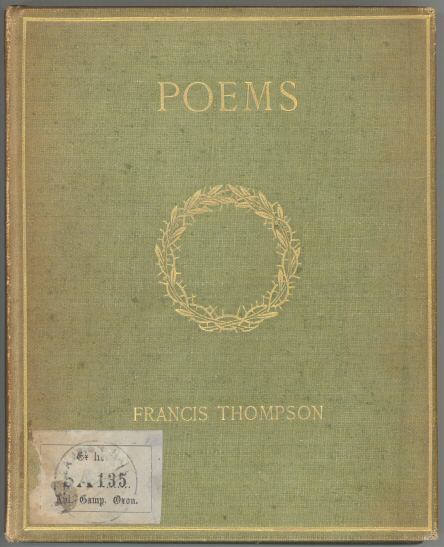
The Project Gutenberg eBook of Poems
Title: Poems
Author: Francis Thompson
Release date: September 1, 1998 [eBook #1469]
Most recently updated: February 1, 2015
Language: English
Credits: Transcribed from the September 1909 Burns and Oates edition by David Price
Transcribed from the September 1909 Burns and Oates edition by David Price, email ccx074@pglaf.org
POEMS
BY FRANCIS
THOMPSON
BURNS AND OATES
28 Orchard Street
London
W
CONTENTS.
|
PAGE |
|
Dedication |
||
Love in Dian’s Lap |
||
I. |
Before Her Portrait in Youth |
|
II. |
To a Poet Breaking Silence |
|
III. |
Manus Animam Pinxit |
|
IV. |
A Carrier-Song |
|
V. |
Scala Jacobi Portaque Eburnea |
|
VI. |
Gilded Gold |
|
VII. |
Her Portrait |
|
Miscellaneous Poems |
||
To the Dead Cardinal of Westminster |
||
A Fallen Yew |
||
Dream-Tryst |
||
A Corymbus for Autumn |
||
The Hound of Heaven |
||
A Judgment in Heaven |
||
Poems on Children |
||
Daisy |
||
The Making of Viola |
||
To My Godchild |
||
To Poppy |
||
To Monica Thought Dying |
||
DEDICATION.
TO WILFRID AND ALICE MEYNELL.
If the rose in meek
duty
May dedicate humbly
To her grower the beauty
Wherewith she is comely;
If the mine to the miner
The jewels that pined in it,
Earth to diviner
The springs he divined in it;
To the grapes the wine-pitcher
Their juice that was crushed in it,
Viol to its witcher
The music lay hushed in it;
If the lips may pay Gladness
In laughters she wakened,
And the heart to its sadness
Weeping unslakened,
If the hid and sealed coffer,
Whose having not his is,
To the
loosers may proffer
Their finding—here this is;
Their lives if all livers
To the Life of all living,—
To you, O dear givers!
I give your own giving.
Love in Dian’s Lap.
I.
BEFORE HER PORTRAIT IN YOUTH.
As lovers, banished
from their lady’s face
And hopeless of her grace,
Fashion a ghostly sweetness in its place,
Fondly adore
Some stealth-won cast attire she wore,
A kerchief or a glove:
And at the lover’s beck
Into the glove there fleets the hand,
Or at impetuous command
Up from the kerchief floats the virgin neck:
So I, in very lowlihead of love,—
Too shyly reverencing
To let one thought’s light footfall smooth
Tread near the living, consecrated thing,—
Treasure me thy cast youth.
This outworn vesture, tenantless of thee,
Hath yet my knee,
For that, with show and semblance fair
Of the past Her
Who once the beautiful, discarded raiment bare,
It cheateth me.
As gale to gale drifts breath
Of blossoms’ death,
So dropping
down the years from hour to hour
This dead youth’s scent is wafted me
to-day:
I sit, and from the fragrance dream the flower.
So, then, she looked (I say);
And so her front sunk down
Heavy beneath the poet’s iron crown:
On her mouth museful
sweet—
(Even as the twin lips meet)
Did thought and sadness greet:
Sighs
In those mournful eyes
So put on visibilities;
As viewless ether turns, in deep on deep, to dyes.
Thus, long ago,
She kept her meditative paces slow
Through maiden meads, with wavèd shadow and gleam
Of locks half-lifted on the winds of dream,
Till love up-caught her to his chariot’s glow.
Yet, voluntary, happier Proserpine!
This drooping flower of youth thou
lettest fall
I, faring in the cockshut-light,
astray,
Find on my
’lated way,
And stoop, and gather for
memorial,
And lay it on my bosom, and make it mine.
To this, the all of love the stars allow me,
I dedicate and vow me.
I reach back through the days
A trothed hand to the dead the last trump shall not raise.
The water-wraith that cries
From those eternal sorrows of thy pictured eyes
Entwines and draws me down their soundless intricacies!
II.
TO A POET BREAKING SILENCE.
Too wearily had we
and song
Been left to look and left to long,
Yea, song and we to long and look,
Since thine acquainted feet forsook
The mountain where the Muses hymn
For Sinai and the Seraphim.
Now in both the mountains’ shine
Dress thy countenance, twice divine!
From Moses and the Muses draw
The Tables of thy double Law!
His rod-born fount and Castaly
Let the one rock bring forth for thee,
Renewing so from either spring
The songs which both thy countries sing:
Or we shall fear lest, heavened thus long,
Thou should’st forget thy native song,
And mar thy mortal melodies
With broken stammer of the skies.
Ah! let the sweet birds of
the Lord
With earth’s waters make accord;
Teach how
the crucifix may be
Carven from the laurel-tree,
Fruit of the Hesperides
Burnish take on Eden-trees,
The Muses’ sacred grove be wet
With the red dew of Olivet,
And Sappho lay her burning brows
In white Cecilia’s lap of snows!
Thy childhood must have felt
the stings
Of too divine o’ershadowings;
Its odorous heart have been a blossom
That in darkness did unbosom,
Those fire-flies of God to invite,
Burning spirits, which by night
Bear upon their laden wing
To such hearts impregnating.
For flowers that night-wings fertilize
Mock down the stars’ unsteady eyes,
And with a happy, sleepless glance
Gaze the moon out of countenance.
I think thy girlhood’s watchers must
Have took thy folded songs on trust,
And felt them, as one feels the stir
Of still lightnings in the hair,
When conscious hush expects the cloud
To speak the golden secret loud
Which tacit air is privy to;
Flasked in the grape the wine they knew,
Ere thy poet-mouth was able
For its
first young starry babble.
Keep’st thou not yet that subtle grace?
Yea, in this silent interspace,
God sets His poems in thy face!
The loom which mortal verse
affords,
Out of weak and mortal words,
Wovest thou thy singing-weed in,
To a rune of thy far Eden.
Vain are all disguises! Ah,
Heavenly incognita!
Thy mien bewrayeth through that wrong
The great Uranian House of Song!
As the vintages of earth
Taste of the sun that riped their birth,
We know what never cadent Sun
Thy lampèd clusters throbbed upon,
What plumed feet the winepress trod;
Thy wine is flavorous of God.
Whatever singing-robe thou wear
Has the Paradisal air;
And some gold feather it has kept
Shows what Floor it lately swept!
III.
“MANUS ANIMAM PINXIT.”
Lady who
hold’st on me dominion!
Within your spirit’s arms I stay me fast
Against the fell
Immitigate ravening of the gates of hell;
And claim my right in you, most hardly won,
Of chaste fidelity upon the chaste:
Hold me and hold by me, lest both should fall
(O in high escalade high companion!)
Even in the breach of Heaven’s assaulted wall.
Like to a wind-sown sapling grow I from
The clift, Sweet, of your skyward-jetting soul,—
Shook by all gusts that sweep it, overcome
By all its clouds incumbent: O be true
To your soul, dearest, as my life to you!
For if that soil grow sterile, then the whole
Of me must shrivel, from the topmost shoot
Of climbing poesy, and my life, killed through,
Dry down and perish to the foodless root.
Sweet Summer! unto you this swallow drew,
By secret instincts inappeasable,
That did direct him well,
Lured from
his gelid North which wrought him wrong,
Wintered of sunning
song;—
By happy instincts inappeasable,
Ah yes! that led him well,
Lured to the untried regions and the new
Climes of auspicious you;
To twitter there, and in his singing dwell.
But ah! if you, my Summer, should
grow waste,
With grieving skies
o’ercast,
For such migration my poor wing was strong
But once; it has no power to fare again
Forth o’er the heads of
men,
Nor other Summers for its Sanctuary:
But from your mind’s chilled
sky
It needs must drop, and lie with stiffened wings
Among your soul’s forlornest
things;
A speck upon your memory, alack!
A dead fly in a dusty window-crack.
O
therefore you who are
What words, being to such
mysteries
As raiment to the body is,
Should rather
hide than tell;
Chaste and intelligential love:
Whose form is as
a grove
Hushed with the cooing of an unseen dove;
Whose spirit to my touch thrills purer far
Than is the tingling of a silver bell;
Whose body other ladies well might bear
As soul,—yea, which it profanation were
For all
but you to take as fleshly woof,
Being spirit truest proof;
Whose spirit sure is lineal to that
Which sang Magnificat:
Chastest, since
such you are,
Take this curbed
spirit of mine,
Which your own eyes invest with light divine,
For lofty love and high auxiliar
In daily exalt
emprise
Which outsoars
mortal eyes;
This soul which on your soul is
laid,
As maid’s breast against
breast of maid;
Beholding how your own I have engraved
On it, and with what purging thoughts have laved
This love of mine from all mortality
Indeed the copy is a painful one,
And with long
labour done!
O if you doubt the thing you are, lady,
Come then, and
look in me;
Your beauty, Dian, dress and contemplate
Within a pool to Dian consecrate!
Unveil this spirit, lady, when you will,
For unto all but you ’tis veilèd still:
Unveil, and fearless gaze there, you alone,
And if you love the image—’tis your own!
IV.
A CARRIER SONG.
I.
Since you have waned
from us,
Fairest of women!
I am a darkened cage
Song cannot hymn in.
My songs have followed you,
Like birds the summer;
Ah! bring them back to me,
Swiftly, dear comer!
Seraphim,
Her to hymn,
Might leave their
portals;
And at my feet learn
The harping of mortals!
II.
Where wings to rustle use,
But this poor tarrier—
Searching my spirit’s eaves—
Find I for carrier.
Ah! bring
them back to me
Swiftly, sweet comer!
Swift, swift, and bring with you
Song’s Indian summer!
Seraphim,
Her to hymn,
Might leave their
portals;
And at my feet learn
The harping of mortals!
III.
Whereso your angel is,
My angel goeth;
I am left guardianless,
Paradise knoweth!
I have no Heaven left
To weep my wrongs to;
Heaven, when you went from us;
Went with my songs too.
Seraphim,
Her to hymn,
Might leave their
portals;
And at my feet learn
The harping of mortals!
IV.
I have no angels left
Now, Sweet, to pray to:
Where you
have made your shrine
They are away to.
They have struck Heaven’s tent,
And gone to cover you:
Whereso you keep your state
Heaven is pitched over you!
Seraphim,
Her to hymn,
Might leave their
portals;
And at my feet learn
The harping of mortals!
V.
She that is Heaven’s Queen
Her title borrows,
For that she pitiful
Beareth our sorrows.
So thou, Regina mî,
Spes infirmorum;
With all our grieving crowned
Mater dolorum!
Seraphim,
Her to hymn,
Might leave their
portals;
And at my feet learn
The harping of mortals!
VI.
Yet, envious coveter
Of other’s grieving!
This
lonely longing yet
’Scapeth your reaving.
Cruel! to take from a
Sinner his Heaven!
Think you with contrite smiles
To be forgiven?
Seraphim,
Her to hymn,
Might leave their
portals;
And at my feet learn
The harping of mortals!
VII.
Penitent! give me back
Angels, and Heaven;
Render your stolen self,
And be forgiven!
How frontier Heaven from you?
For my soul prays, Sweet,
Still to your face in Heaven,
Heaven in your face, Sweet!
Seraphim,
Her to hymn,
Might leave their
portals;
And at my feet learn
The harping of mortals!
V.
SCALA JACOBI PORTAQUE EBURNEA.
Her soul from earth
to Heaven lies,
Like the ladder of the vision,
Whereon go
To and fro,
In ascension and demission,
Star-flecked feet of Paradise.
Now she is drawn up from me,
All my angels, wet-eyed, tristful,
Gaze from great
Heaven’s gate
Like pent children, very wistful,
That below a playmate see.
Dream-dispensing face of hers!
Ivory port which loosed upon me
Wings, I wist,
Whose amethyst
Trepidations have forgone me,—
Hesper’s filmy traffickers!
VI.
GILDED GOLD.
Thou dost to rich
attire a grace,
To let it deck itself with thee,
And teachest pomp strange cunning ways
To be thought simplicity.
But lilies, stolen from grassy mold,
No more curlèd state unfold
Translated to a vase of gold;
In burning throne though they keep still
Serenities unthawed and chill.
Therefore, albeit thou’rt stately so,
In statelier state thou us’dst to go.
Though jewels should phosphoric burn
Through those night-waters of thine hair,
A flower from its translucid urn
Poured silver flame more lunar-fair.
These futile trappings but recall
Degenerate worshippers who fall
In purfled kirtle and brocade
To ’parel the white Mother-Maid.
For, as her image stood arrayed
In vests of its self-substance wrought
To measure of the sculptor’s thought—
Slurred by those added braveries;
So for thy spirit did devise
Its Maker seemly garniture,
Of its own essence parcel pure,—
From grave simplicities a dress,
And reticent demurenesses,
And love encinctured with reserve;
Which the woven vesture should subserve.
For outward robes in their ostents
Should show the soul’s habiliments.
Therefore I say,—Thou’rt fair even so,
But better Fair I use to know.
The violet would thy dusk hair deck
With graces like thine own unsought.
Ah! but such place would daze and wreck
Its simple, lowly rustic thought.
For so advancèd, dear, to thee,
It would unlearn humility!
Yet do not, with an altered look,
In these weak numbers read rebuke;
Which are but jealous lest too much
God’s master-piece thou shouldst retouch.
Where a sweetness is complete,
Add not sweets unto the sweet!
Or, as thou wilt, for others so
In unfamiliar richness go;
But keep for mine acquainted eyes
The fashions of thy Paradise.
VII.
HER PORTRAIT.
Oh, but the heavenly
grammar did I hold
Of that high speech which angels’ tongues turn gold!
So should her deathless beauty take no wrong,
Praised in her own great kindred’s fit and cognate
tongue.
Or if that language yet with us abode.
Which Adam in the garden talked with God!
But our untempered speech descends—poor heirs!
Grimy and rough-cast still from Babel’s bricklayers:
Curse on the brutish jargon we inherit,
Strong but to damn, not memorise, a spirit!
A cheek, a lip, a limb, a bosom, they
Move with light ease in speech of working-day;
And women we do use to praise even so.
But here the gates we burst, and to the temple go.
Their praise were her dispraise; who dare, who dare,
Adulate the seraphim for their burning hair?
How, if with them I dared, here should I dare it?
How praise the woman, who but know the spirit?
How praise the colour of her eyes, uncaught
While they were coloured with her varying thought
How her
mouth’s shape, who only use to know
What tender shape her speech will fit it to?
Or her lips’ redness, when their joinèd veil
Song’s fervid hand has parted till it wore them pale?
If I would praise her soul
(temerarious if!),
All must be mystery and hieroglyph.
Heaven, which not oft is prodigal of its more
To singers, in their song too great before;
By which the hierarch of large poesy is
Restrained to his once sacred benefice;
Only for her the salutary awe
Relaxes and stern canon of its law;
To her alone concedes pluralities,
In her alone to reconcile agrees
The Muse, the Graces, and the Charities;
To her, who can the trust so well conduct
To her it gives the use, to us the usufruct.
What of the dear administress then may
I utter, though I spoke her own carved perfect way?
What of her daily gracious converse known,
Whose heavenly despotism must needs dethrone
And subjugate all sweetness but its own?
Deep in my heart subsides the infrequent word,
And there dies slowly throbbing like a wounded bird.
What of her silence, that outsweetens speech?
What of her thoughts, high marks for mine own thoughts to
reach?
Yet (Chaucer’s antique sentence so to turn),
Most
gladly will she teach, and gladly learn;
And teaching her, by her enchanting art,
The master threefold learns for all he can impart.
Now all is said, and all being said,—aye me!
There yet remains unsaid the very She.
Nay, to conclude (so to conclude I dare),
If of her virtues you evade the snare,
Then for her faults you’ll fall in love with her.
Alas, and I have spoken of her Muse—
Her Muse, that died with her auroral dews!
Learn, the wise cherubim from harps of gold
Seduce a trepidating music manifold;
But the superior seraphim do know
None other music but to flame and glow.
So she first lighted on our frosty earth,
A sad musician, of cherubic birth,
Playing to alien ears—which did not prize
The uncomprehended music of the skies—
The exiled airs of her far Paradise.
But soon from her own harpings taking fire,
In love and light her melodies expire.
Now Heaven affords her, for her silenced hymn,
A double portion of the seraphim.
At the rich odours from her
heart that rise,
My soul remembers its lost Paradise,
And antenatal gales blow from Heaven’s shores of spice;
I grow essential all, uncloaking me
From this encumbering virility,
And feel
the primal sex of heaven and poetry:
And parting from her, in me linger on
Vague snatches of Uranian antiphon.
How to the petty prison could
she shrink
Of femineity?—Nay, but I think
In a dear courtesy her spirit would
Woman assume, for grace to womanhood.
Or, votaress to the virgin Sanctitude
Of reticent withdrawal’s sweet, courted pale,
She took the cloistral flesh, the sexual veil,
Of her sad, aboriginal sisterhood;
The habit of cloistral flesh which founding Eve indued.
Thus do I know her: but for
what men call
Beauty—the loveliness corporeal,
Its most just praise a thing unproper were
To singer or to listener, me or her.
She wears that body but as one indues
A robe, half careless, for it is the use;
Although her soul and it so fair agree,
We sure may, unattaint of heresy,
Conceit it might the soul’s begetter be.
The immortal could we cease to contemplate,
The mortal part suggests its every trait.
God laid His fingers on the ivories
Of her pure members as on smoothèd keys,
And there out-breathed her spirit’s harmonies
I’ll speak a little proudly:—I disdain
To count the beauty worth my wish or gaze,
Which the
dull daily fool can covet or obtain.
I do confess the fairness of the spoil,
But from such rivalry it takes a soil.
For her I’ll proudlier speak:—how could it be
That I should praise the gilding on the psaltery?
’Tis not for her to hold that prize a prize,
Or praise much praise, though proudest in its wise,
To which even hopes of merely women rise.
Such strife would to the vanquished laurels yield,
Against her suffered to have lost a field.
Herself must with herself be sole compeer,
Unless the people of her distant sphere
Some gold migration send to melodise the year.
But first our hearts must burn in larger guise,
To reformate the uncharitable skies,
And so the deathless plumage to acclimatise:
Since this, their sole congener in our clime,
Droops her sad, ruffled thoughts for half the shivering time.
Yet I have felt what terrors
may consort
In women’s cheeks, the Graces’ soft resort;
My hand hath shook at gentle hands’ access,
And trembled at the waving of a tress;
My blood known panic fear, and fled dismayed,
Where ladies’ eyes have set their ambuscade.
The rustle of a robe hath been to me
The very rattle of love’s musketry;
Although my heart hath beat the loud advance,
I have recoiled before a challenging glance,
Proved gay alarms where warlike ribbons dance.
And from
it all, this knowledge have I got,—
The whole that others have, is less than they have not;
All which makes other women noted fair,
Unnoted would remain and overshone in her.
How should I gauge what beauty is her dole,
Who cannot see her countenance for her soul;
As birds see not the casement for the sky?
And as ’tis check they prove its presence by,
I know not of her body till I find
My flight debarred the heaven of her mind.
Hers is the face whence all should copied be,
Did God make replicas of such as she;
Its presence felt by what it does abate,
Because the soul shines through tempered and mitigate:
Where—as a figure labouring at night
Beside the body of a splendid light—
Dark Time works hidden by its luminousness;
And every line he labours to impress
Turns added beauty, like the veins that run
Athwart a leaf which hangs against the sun.
There regent Melancholy wide controls;
There Earth- and Heaven-Love play for aureoles;
There Sweetness out of Sadness breaks at fits,
Like bubbles on dark water, or as flits
A sudden silver fin through its deep infinites;
There amorous Thought has sucked pale Fancy’s breath,
And Tenderness sits looking toward the lands of death
There Feeling stills her breathing with her hand,
And Dream
from Melancholy part wrests the wand
And on this lady’s heart, looked you so deep,
Poor Poetry has rocked himself to sleep:
Upon the heavy blossom of her lips
Hangs the bee Musing; nigh her lids eclipse
Each half-occulted star beneath that lies;
And in the contemplation of those eyes,
Passionless passion, wild tranquillities.
EPILOGUE.
To the
Poet’s Sitter,
Wherein he excuseth himself for the manner of the
Portrait.
Alas! now wilt thou
chide, and say (I deem),
My figured descant hides the simple theme:
Or in another wise reproving, say
I ill observe thine own high reticent way.
Oh, pardon, that I testify of thee
What thou couldst never speak, nor others be!
Yet (for the book is not more innocent
Of what the gazer’s eyes makes so intent),
She will but smile, perhaps, that I find my fair
Sufficing scope in such strait theme as her.
“Bird of the sun! the stars’ wild honey-bee!
Is your
gold browsing done so thoroughly?
Or sinks a singèd wing to narrow nest in me?”
(Thus she might say: for not this lowly vein
Out-deprecates her deprecating strain.)
Oh, you mistake, dear lady, quite; nor know
Ether was strict as you, its loftiness as low!
The heavens do not advance their majesty
Over their marge; beyond his empery
The ensigns of the wind are not unfurled,
His reign is hooped in by the pale o’ the world.
’Tis not the continent, but the contained,
That pleasaunce makes or prison, loose or chained.
Too much alike or little captives me,
For all oppression is captivity.
What groweth to its height demands no higher;
The limit limits not, but the desire.
Give but my spirit its desirèd scope,—
A giant in a pismire, I not grope;
Deny it,—and an ant, with on my back
A firmament, the skiey vault will crack.
Our minds make their own Termini, nor call
The issuing circumscriptions great or small;
So high constructing Nature lessons to us all:
Who optics gives accommodate to see
Your countenance large as looks the sun to be,
And distant greatness less than near humanity.
We, therefore, with a sure instinctive mind,
An equal spaciousness of bondage find
In
confines far or near, of air or our own kind.
Our looks and longings, which affront the stars,
Most richly bruised against their golden bars,
Delighted captives of their flaming spears,
Find a restraint restrainless which appears
As that is, and so simply natural,
In you;—the fair detention freedom call,
And overscroll with fancies the loved prison-wall.
Such sweet captivity, and only such,
In you, as in those golden bars, we touch!
Our gazes for sufficing limits know
The firmament above, your face below;
Our longings are contented with the skies,
Contented with the heaven, and your eyes.
My restless wings, that beat the whole world through,
Flag on the confines of the sun and you;
And find the human pale remoter of the two.
Miscellaneous Poems.
TO THE DEAD CARDINAL OF WESTMINSTER.
I will not
perturbate
Thy Paradisal state
With praise
Of thy dead days;
To the new-heavened say,—
“Spirit, thou wert fine clay:”
This do,
Thy praise who knew.
Therefore my spirit clings
Heaven’s porter by the wings,
And holds
Its gated golds
Apart, with thee to press
A private business;—
Whence,
Deign me audience.
Anchorite, who didst dwell
With all the world for cell
My soul
Round me doth roll
A sequestration bare.
Too far alike we were,
Too far
Dissimilar.
For its burning fruitage I
Do climb the tree o’ the sky;
Do prize
Some human eyes.
You smelt the Heaven-blossoms,
And all the sweet embosoms
The dear
Uranian year.
Those Eyes my weak gaze shuns,
Which to the suns are Suns.
Did
Not affray your lid.
The carpet was let down
(With golden mouldings strown)
For you
Of the angels’ blue.
But I, ex-Paradised,
The shoulder of your Christ
Find high
To lean thereby.
So flaps my helpless sail,
Bellying with neither gale,
Of Heaven
Nor Orcus even.
Life is a coquetry
Of Death, which wearies me,
Too sure
Of the amour;
A tiring-room where I
Death’s divers garments try,
Till fit
Some fashion sit.
It seemeth me too much
I do rehearse for such
A mean
And single scene.
The sandy glass hence bear—
Antique remembrancer;
My veins
Do spare its pains.
With secret sympathy
My thoughts repeat in me
Infirm
The turn o’ the worm
Beneath my appointed sod:
The grave is in my blood;
I shake
To winds that take
Its grasses by the top;
The rains thereon that drop
Perturb
With drip acerb
My subtly answering soul;
The feet across its knoll
Do jar
Me from afar.
As sap foretastes the spring;
As Earth ere blossoming
Thrills
With far daffodils,
And feels her breast turn sweet
With the unconceivèd wheat;
So doth
My flesh foreloathe
The abhorrèd spring of Dis,
With seething presciences
Affirm
The preparate worm.
I have no thought that I,
When at the last I die,
Shall reach
To gain your speech.
But you, should that be so,
May very well, I know,
May well
To me in hell
With recognising eyes
Look from your Paradise—
“God
bless
Thy hopelessness!”
Call, holy soul, O call
The hosts angelical,
And
say,—
“See, far away
“Lies one I saw on earth;
One stricken from his birth
With curse
Of destinate verse.
“What place doth He ye serve
For such sad spirit reserve,—
Given,
In dark lieu of Heaven,
“The impitiable Dæmon,
Beauty, to adore and dream on,
To be
Perpetually
“Hers, but she never his?
He reapeth miseries,
Foreknows
His wages woes;
“He lives detachèd days;
He serveth not for praise;
For gold
He is not sold;
“Deaf is he to world’s tongue;
He scorneth for his song
The loud
Shouts of the crowd;
“He asketh not world’s eyes;
Not to world’s ears he cries;
Saith,—‘These
Shut, if ye please;’
“He measureth world’s pleasure,
World’s ease as Saints might measure;
For hire
Just love entire
“He asks, not grudging pain;
And knows his asking vain,
And
cries—
‘Love! Love!’ and dies;
“In guerdon of long duty,
Unowned by Love or Beauty;
And
goes—
Tell, tell, who knows!
“Aliens from Heaven’s worth,
Fine beasts who nose i’ the earth,
Do there
Reward prepare.
“But are his great desires
Food but for nether fires?
Ah me,
A mystery!
“Can it be his alone,
To find when all is known,
That what
He solely sought
“Is lost, and thereto lost
All that its seeking cost?
That he
Must finally,
“Through sacrificial tears,
And anchoretic years,
Tryst
With the sensualist?”
So ask; and if they tell
The secret terrible,
Good friend,
I pray thee send
Some high gold embassage
To teach my unripe age.
Tell!
Lest my feet walk hell.
A FALLEN YEW.
It seemed corrival
of the world’s great prime,
Made to un-edge the scythe of Time,
And last with stateliest
rhyme.
No tender Dryad ever did indue
That rigid chiton of rough yew,
To fret her white flesh
through:
But some god like to those grim Asgard
lords,
Who walk the fables of the hordes
From Scandinavian fjords,
Upheaved its stubborn girth, and raised
unriven,
Against the whirl-blast and the levin,
Defiant arms to Heaven.
When doom puffed out the stars, we might have
said,
It would decline its heavy head,
And see the world to bed.
For this firm yew did from the vassal leas,
And rain and air, its tributaries,
Its revenues increase,
And levy impost on the golden sun,
Take the blind years as they might run,
And no fate seek or shun.
But now our yew is strook, is
fallen—yea
Hacked like dull wood of every day
To this and that, men say.
Never!—To Hades’ shadowy shipyards
gone,
Dim barge of Dis, down Acheron
It drops, or Lethe wan.
Stirred by its fall—poor destined bark of
Dis!—
Along my soul a bruit there is
Of echoing images,
Reverberations of mortality:
Spelt backward from its death, to me
Its life reads saddenedly.
Its breast was hollowed as the tooth of eld;
And boys, their creeping unbeheld,
A laughing moment dwelled.
Yet they, within its very heart so crept,
Reached not the heart that courage kept
With winds and years beswept.
And in its boughs did close and kindly nest
The birds, as they within its breast,
By all its leaves caressed.
But bird nor child might touch by any art
Each other’s or the tree’s hid heart,
A whole God’s breadth
apart;
The breadth of God, he breadth of death and
life!
Even so, even so, in undreamed strife
With pulseless Law, the
wife,—
The sweetest wife on sweetest
marriage-day,—
Their souls at grapple in mid-way,
Sweet to her sweet may say:
“I take you to my inmost heart, my
true!”
Ah, fool! but there is one heart you
Shall never take him to!
The hold that falls not when the town is
got,
The heart’s heart, whose immurèd
plot
Hath keys yourself keep not!
Its ports you cannot burst—you are
withstood—
For him that to your listening blood
Sends precepts as he would.
Its gates are deaf to Love, high summoner;
Yea, Love’s great warrant runs not there:
You are your prisoner.
Yourself are with yourself the sole
consortress
In that unleaguerable fortress;
It knows you not for portress
Its keys are at the cincture hung of God;
Its gates are trepidant to His nod;
By Him its floors are trod.
And if His feet shall rock those floors in
wrath,
Or blest aspersion sleek His path,
Is only choice it hath.
Yea, in that ultimate heart’s occult
abode
To lie as in an oubliette of God,
Or as a bower untrod,
Built by a secret Lover for His
Spouse;—
Sole choice is this your life allows,
Sad tree, whose perishing
boughs
So few birds
house!
DREAM-TRYST.
The breaths of
kissing night and day
Were mingled in the eastern Heaven:
Throbbing with unheard melody
Shook Lyra all its star-chord seven:
When dusk shrunk cold, and light
trod shy,
And dawn’s
grey eyes were troubled grey;
And souls went palely up the
sky,
And mine to
Lucidé.
There was no change in her sweet eyes
Since last I saw those sweet eyes shine;
There was no change in her deep heart
Since last that deep heart knocked at mine.
Her eyes were clear, her eyes were
Hope’s,
Wherein did ever
come and go
The sparkle of the
fountain-drops
From her sweet
soul below.
The chambers in the house of dreams
Are fed with so divine an air,
That Time’s hoar wings grow young therein,
And they who walk there are most fair.
I joyed for me, I joyed for
her,
Who with the
Past meet girt about:
Where our last kiss still warms
the air,
Nor can her eyes go out.
A CORYMBUS FOR AUTUMN.
Hearken my chant, ’tis
As a Bacchante’s,
A grape-spurt, a vine-splash, a tossed tress, flown vaunt
’tis!
Suffer my singing,
Gipsy of Seasons, ere thou go winging;
Ere Winter throws
His slaking snows
In thy feasting-flagon’s impurpurate glows!
The sopped sun—toper as ever drank hard—
Stares foolish, hazed,
Rubicund, dazed,
Totty with thine October tankard.
Tanned maiden! with cheeks like apples russet,
And breast a brown agaric faint-flushing at tip,
And a mouth too red for the moon to buss it,
But her cheek unvow its vestalship;
Thy mists enclip
Her steel-clear circuit illuminous,
Until it crust
Rubiginous
With the glorious gules of a glowing rust.
Far other
saw we, other indeed,
The crescent moon, in the May-days
dead,
Fly up with its slender white
wings spread
Out of its nest in the sea’s waved mead!
How are the veins of thee, Autumn, laden?
Umbered juices,
And pulpèd oozes
Pappy out of the cherry-bruises,
Froth the veins of thee, wild, wild maiden!
With hair that musters
In globèd clusters,
In tumbling clusters, like swarthy grapes,
Round thy brow and thine ears o’ershaden;
With the burning darkness of eyes like pansies,
Like velvet pansies
Wherethrough escapes
The splendid might of thy conflagrate fancies;
With robe gold-tawny not hiding the shapes
Of the feet whereunto it falleth down,
Thy naked feet
unsandallèd;
With robe gold-tawny that does not veil
Feet where the
red
Is meshed in the
brown,
Like a rubied sun in a Venice-sail.
The wassailous heart of the Year is thine!
His Bacchic fingers disentwine
His coronal
At thy
festival;
His revelling fingers disentwine
Leaf, flower,
and all,
And let them
fall
Blossom and all in thy wavering wine.
The Summer looks out from her brazen tower,
Through the flashing bars of July,
Waiting thy ripened golden shower;
Whereof there cometh, with sandals fleet,
The North-west
flying viewlessly,
With a sword to sheer, and untameable feet,
And the
gorgon-head of the Winter shown
To stiffen the
gazing earth as stone.
In crystal Heaven’s
magic sphere
Poised in the
palm of thy fervid hand,
Thou seest the enchanted shows appear
That stain Favonian firmament;
Richer than ever the Occident
Gave up to
bygone Summer’s wand.
Day’s dying dragon lies drooping his crest,
Panting red pants into the West.
Or the butterfly sunset claps its wings
With flitter alit on the swinging blossom,
The gusty blossom, that tosses and swings,
Of the sea with its blown and ruffled bosom;
Its ruffled bosom wherethrough the wind sings
Till the crispèd petals are loosened and strown
Overblown, on
the sand;
Shed, curling as
dead
Rose-leaves curl, on the
fleckèd strand.
Or higher,
holier, saintlier when, as now,
All nature sacerdotal seems, and thou.
The calm hour strikes on yon
golden gong,
In tones of
floating and mellow light
A spreading summons to
even-song:
See how there
The
cowlèd night
Kneels on the Eastern
sanctuary-stair.
What is this feel of incense everywhere?
Clings it round folds of the blanch-amiced
clouds,
Upwafted by the solemn thurifer,
The mighty spirit unknown,
That swingeth the slow earth before the embannered Throne?
Or is’t the Season under all these shrouds
Of light, and sense, and silence, makes her known
A presence
everywhere,
An inarticulate
prayer,
A hand on the soothed tresses of the air?
But there is one
hour scant
Of this Titanian, primal liturgy;
As there is but
one hour for me and thee,
Autumn, for thee and thine hierophant,
Of this grave
ending chant.
Round the earth
still and stark
Heaven’s death-lights kindle, yellow spark by spark,
Beneath the dreadful catafalque of the dark.
And
I had ended there:
But a great wind blew all the stars to flare,
And cried,
“I sweep the path before the moon!
Tarry ye now the coming of the moon,
For she is
coming soon;”
Then died before the coming of the moon.
And she came forth upon the trepidant air,
In vesture
unimagined-fair,
Woven as woof of
flag-lilies;
And curdled as
of flag-lilies
The vapour at
the feet of her,
And a haze about her tinged in fainter wise.
As if she had trodden the stars in press,
Till the gold wine spurted over her dress,
Till the gold wine gushed out round her feet;
Spouted over her
stainèd wear,
And bubbled in golden froth at her feet,
And hung like a
whirlpool’s mist round her.
Still, mighty Season, do I see’t,
Thy sway is still majestical!
Thou hold’st of God, by title sure,
Thine indefeasible investiture,
And that right round thy locks are native to;
The heavens upon thy brow imperial,
This huge
terrene thy ball,
And o’er thy shoulders thrown wide air’s depending
pall.
What if thine earth be blear and bleak of hue?
Still, still the
skies are sweet!
Still, Season, still thou hast thy triumphs
there!
How have I,
unaware,
Forgetful of my strain inaugural,
Cleft the great rondure of thy reign complete,
Yielding
thee half, who hast indeed the all?
I will not think thy sovereignty
begun
But with the
shepherd sun
That washes in the sea the
stars’ gold fleeces
Or that with day
it ceases,
Who sets his burning lips to the
salt brine,
And purples it
to wine;
While I behold how ermined
Artemis
Ordainèd
weed must wear,
And toil thy
business;
Who witness am
of her,
Her too in autumn turned a
vintager;
And, laden with its lampèd
clusters bright,
The fiery-fruited vineyard of this
night.
THE HOUND OF HEAVEN.
I fled Him, down the
nights and down the days;
I fled Him, down the arches of the years;
I fled Him, down the labyrinthine ways
Of my own mind; and in the mist of tears
I hid from Him, and under running laughter.
Up vistaed hopes, I sped;
And shot, precipitated
Adown Titanic glooms of chasmed fears,
From those strong Feet that followed, followed
after.
But with unhurrying chase,
And unperturbéd pace,
Deliberate speed, majestic
instancy,
They beat—and a Voice beat
More instant than the Feet—
“All things betray thee, who
betrayest Me.”
I
pleaded, outlaw-wise,
By many a hearted casement, curtained red,
Trellised with intertwining charities;
(For, though I knew His love Who followéd,
Yet was I
sore adread
Lest, having Him, I must have naught beside)
But, if one little casement parted wide,
The gust of His approach would clash it to
Fear wist not to evade, as Love wist to pursue.
Across the margent of the world I fled,
And troubled the gold gateways of the stars,
Smiting for shelter on their changèd bars;
Fretted to dulcet jars
And silvern chatter the pale ports o’ the moon.
I said to dawn: Be sudden—to eve: Be soon;
With thy young skiey blossoms heap me over
From this tremendous Lover!
Float thy vague veil about me, lest He see!
I tempted all His servitors, but to find
My own betrayal in their constancy,
In faith to Him their fickleness to me,
Their traitorous trueness, and their loyal
deceit.
To all swift things for swiftness did I sue;
Clung to the whistling mane of every wind.
But whether they
swept, smoothly fleet,
The long savannahs of the blue;
Or whether, Thunder-driven,
They clanged his
chariot ’thwart a heaven,
Plashy with flying lightnings round the spurn o’ their
feet:—
Fear wist not to evade as Love wist to pursue.
Still with
unhurrying chase,
And
unperturbèd pace,
Deliberate speed, majestic instancy,
Came on
the following Feet,
And a Voice above their beat—
“Naught shelters thee, who
wilt not shelter Me.”
I sought no more that, after which I
strayed,
In face of man or maid;
But still within the little children’s eyes
Seems something, something that
replies,
They at least are for me, surely for me!
I turned me to them very wistfully;
But just as their young eyes grew sudden fair
With dawning answers there,
Their angel plucked them from me by the hair.
“Come then, ye other children,
Nature’s—share
With me” (said I) “your delicate fellowship;
Let me greet you lip to lip,
Let me twine with you caresses,
Wantoning
With our Lady-Mother’s
vagrant tresses,
Banqueting
With her in her wind-walled
palace,
Underneath her azured
daïs,
Quaffing, as your taintless way
is,
From a chalice
Lucent-weeping out of the dayspring.”
So it was done:
I in their delicate fellowship was one—
Drew the bolt of Nature’s secrecies.
I knew all the swift
importings
On the wilful face of skies;
I knew how the clouds arise
Spumèd of the wild
sea-snortings;
All that’s born or dies
Rose and drooped with—made
them shapers
Of mine own moods, or wailful or divine—
With them joyed and was
bereaven.
I was heavy with the even,
When she lit her glimmering
tapers
Round the day’s dead
sanctities.
I laughed in the morning’s
eyes.
I triumphed and I saddened with all weather,
Heaven and I wept together,
And its sweet tears were salt with mortal mine;
Against the red throb of its sunset-heart
I laid my own to beat,
And share commingling heat;
But not by that, by that, was eased my human smart.
In vain my tears were wet on Heaven’s grey cheek.
For ah! we know not what each other says,
These things and I; in sound
I speak—
Their sound is but their stir, they speak by silences.
Nature, poor stepdame, cannot slake my drouth;
Let her, if she would owe me,
Drop yon blue bosom-veil of sky, and show me
The breasts o’ her
tenderness:
Never did any milk of hers once bless
My thirsting mouth.
Nigh and nigh draws the chase,
With unperturbèd pace,
Deliberate speed majestic
instancy
And past
those noisèd Feet
A voice comes yet more fleet—
“Lo! naught contents thee, who
content’st not Me.”
Naked I wait Thy love’s uplifted
stroke!
My harness piece by piece Thou hast hewn from me,
And smitten me to my knee;
I am defenceless utterly,
I slept, methinks, and woke,
And, slowly gazing, find me stripped in sleep.
In the rash lustihead of my young powers,
I shook the pillaring hours
And pulled my life upon me; grimed with smears,
I stand amid the dust o’ the mounded years—
My mangled youth lies dead beneath the heap.
My days have crackled and gone up in smoke,
Have puffed and burst as sun-starts on a stream.
Yea, faileth now even dream
The dreamer, and the lute the lutanist;
Even the linked fantasies, in whose blossomy twist
I swung the earth a trinket at my wrist,
Are yielding; cords of all too weak account
For earth with heavy griefs so overplussed.
Ah! is Thy love indeed
A weed, albeit an amaranthine weed,
Suffering no flowers except its own to mount?
Ah! must—
Designer infinite!—
Ah! must Thou char the wood ere Thou canst limn with it?
My
freshness spent its wavering shower i’ the dust;
And now my heart is as a broken fount,
Wherein tear-drippings stagnate, spilt down ever
From the dank thoughts that
shiver
Upon the sighful branches of my mind.
Such is; what is to be?
The pulp so bitter, how shall taste the rind?
I dimly guess what Time in mists confounds;
Yet ever and anon a trumpet sounds
From the hid battlements of Eternity,
Those shaken mists a space unsettle, then
Round the half-glimpsèd turrets slowly wash again;
But not ere him who summoneth
I first have seen, enwound
With grooming robes purpureal, cypress-crowned;
His name I know, and what his trumpet saith.
Whether man’s heart or life it be which yields
Thee harvest, must Thy harvest
fields
Be dunged with rotten death?
Now of that long pursuit
Comes on at hand the bruit;
That Voice is round me like a
bursting sea:
“And is thy earth so marred,
Shattered in shard on shard?
Lo, all things fly thee, for thou
fliest Me!
“Strange,
piteous, futile thing!
Wherefore should any set thee love apart?
Seeing none but I makes much of naught” (He said),
“And human love needs human meriting:
How hast thou merited—
Of all man’s clotted clay the dingiest clot?
Alack, thou knowest not
How little worthy of any love thou art!
Whom wilt thou find to love ignoble thee,
Save Me, save only Me?
All which I took from thee I did but take,
Not for thy harms,
But just that thou might’st seek it in My arms.
All which thy child’s
mistake
Fancies as lost, I have stored for thee at home:
Rise, clasp My hand, and
come.”
Halts
by me that footfall:
Is my gloom, after all,
Shade of His hand, outstretched
caressingly?
“Ah, fondest, blindest, weakest,
I am He Whom thou seekest!
Thou dravest love from thee, who
dravest Me.”
A JUDGMENT IN HEAVEN. [55]
Athwart the sod
which is treading for God * the poet paced with his splendid
eyes;
Paradise-verdure he stately passes * to win to the Father of
Paradise,
Through the conscious and palpitant grasses * of inter-tangled
relucent dyes.
The angels a-play on its fields of Summer *
(their wild wings rustled his guides’ cymars)
Looked up from disport at the passing comer, * as they pelted
each other with handfuls of stars;
And the warden-spirits with startled feet rose, * hand on sword,
by their tethered cars.
With plumes night-tinctured englobed and
cinctured, * of Saints, his guided steps held on
To where on the far crystálline pale * of that transtellar
Heaven there shone
The immutable crocean dawn * effusing from the Father’s
Throne.
Through the reverberant Eden-ways * the bruit of his
great advent driven,
Back from the fulgent justle and press * with mighty echoing so
was given,
As when the surly thunder smites * upon the clangèd gates
of Heaven.
Over the bickering gonfalons, * far-ranged as
for Tartarean wars,
Went a waver of ribbèd fire *—as night-seas on
phosphoric bars
Like a flame-plumed fan shake slowly out * their ridgy reach of
crumbling stars.
At length to where on His fretted Throne * sat
in the heart of His aged dominions
The great Triune, and Mary nigh, * lit round with spears of their
hauberked minions,
The poet drew, in the thunderous blue * involvèd dread of
those mounted pinions.
As in a secret and tenebrous cloud * the
watcher from the disquiet earth
At momentary intervals * beholds from its raggèd rifts
break forth
The flash of a golden perturbation, * the travelling threat of a
witchèd birth;
Till heavily parts a sinister chasm, * a grisly jaw,
whose verges soon,
Slowly and ominously filled * by the on-coming plenilune,
Supportlessly congest with fire, * and suddenly spit forth the
moon:—
With beauty, not terror, through tangled error
* of night-dipt plumes so burned their charge;
Swayed and parted the globing clusters * so,—disclosed from
their kindling marge,
Roseal-chapleted, splendent-vestured, * the singer there where
God’s light lay large.
Hu, hu! a wonder! a wonder! see, * clasping the
singer’s glories clings
A dingy creature, even to laughter * cloaked and clad in
patchwork things,
Shrinking close from the unused glows * of the seraphs’
versicoloured wings.
A rhymer, rhyming a futile rhyme, * he had
crept for convoy through Eden-ways
Into the shade of the poet’s glory, * darkened under his
prevalent rays,
Fearfully hoping a distant welcome * as a poor kinsman of his
lays.
The angels laughed with a lovely scorning:
*—“Who has done this sorry deed in
The garden of our Father, God? * ’mid his blossoms to sow
this weed in?
Never our fingers knew this stuff: * not so fashion the looms of
Eden!”
The singer bowed his brow majestic, * searching
that patchwork through and through,
Feeling God’s lucent gazes traverse * his singing-stoling
and spirit too:
The hallowed harpers were fain to frown * on the strange thing
come ’mid their sacred crew,
Only the singer that was earth * his fellow-earth and his own
self knew.
But the poet rent off robe and wreath, * so as
a sloughing serpent doth,
Laid them at the rhymer’s feet, * shed down wreath and
raiment both,
Stood in a dim and shamèd stole, * like the tattered wing
of a musty moth.
“Thou gav’st the weed and wreath of
song, * the weed and wreath are solely Thine,
And this dishonest vesture * is the only vesture that is mine;
The life I textured, Thou the song *—my
handicraft is not divine!”
He wrested o’er the rhymer’s head * that
garmenting which wrought him wrong;
A flickering tissue argentine * down dripped its shivering
silvers long:—
“Better thou wov’st thy woof of life * than thou
didst weave thy woof of song!”
Never a chief in Saintdom was, * but turned him
from the Poet then;
Never an eye looked mild on him * ’mid all the angel
myriads ten,
Save sinless Mary, and sinful Mary *—the Mary titled
Magdalen.
“Turn yon robe,” spake Magdalen, *
“of torn bright song, and see and feel.”
They turned the raiment, saw and felt * what their turning did
reveal—
All the inner surface piled * with bloodied hairs, like hairs of
steel.
“Take, I pray, yon chaplet up, * thrown
down ruddied from his head.”
They took the roseal chaplet up, * and they stood
astonishèd:
Every leaf between their fingers, * as they bruised it, burst and
bled.
“See his torn flesh through those rents; * see the
punctures round his hair,
As if the chaplet-flowers had driven * deep roots in to nourish
there—
Lord, who gav’st him robe and wreath, * what was
this Thou gav’st for wear?”