
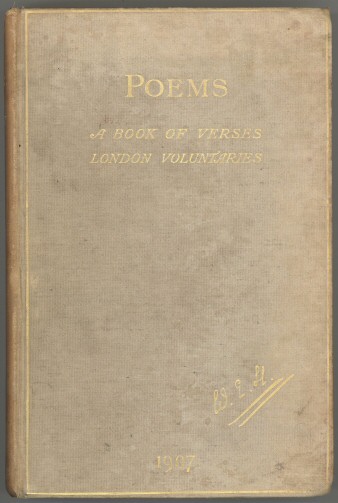
The Project Gutenberg eBook of Poems
Title: Poems
Author: William Ernest Henley
Release date: December 1, 1998 [eBook #1568]
Most recently updated: February 27, 2015
Language: English
Credits: Transcribed from the 1907 David Nutt edition by Diarmuid Pigott with some additional material and proofing by David Price
Transcribed from the 1907 David Nutt edition by Diarmuid Pigott with some additional material and proofing by David Price, email ccx074@pglaf.org
POEMS
By
WILLIAM ERNEST HENLEY
The summer’s flower is to the summer sweet,
Though to itself it only live and die.SHAKESPEARE
Tenth Impression
LONDON
Published by DAVID NUTT
at the Sign of the Phœnix
in Long Acre
1907
1898 |
|
Second Edition printed March |
1898 |
Third Edition printed September |
1898 |
Fourth Edition printed January |
1900 |
Fifth Edition printed December |
1901 |
Sixth Impression printed August |
1903 |
Seventh Impression printed February |
1904 |
Eighth Impression printed May |
1905 |
Ninth Impresion printed April |
1906 |
Tenth Impression printed Nov. |
1907 |
Edinburgh: T. and A. Constable, Printers to His Majesty
TO MY WIFE
Take, dear, my little sheaf of
songs,
For, old or new,
All that is good in them belongs
Only to you;
And, singing as when all was
young,
They will recall
Those others, lived but left unsung—
The bent of all.
W. E. H
April 1888
September 1897.
ADVERTISEMENT
My friend and publisher, Mr. Alfred Nutt, asks me to introduce this re-issue of old work in a new shape. At his request, then, I have to say that nearly all the numbers contained in the present volume are reprinted from ‘A Book of Verses’ (1888) and ‘London Voluntaries’ (1892–3). From the first of these I have removed some copies of verse which seemed to me scarce worth keeping; and I have recovered for it certain others from those publications which had made room for them. I have corrected where I could, added such dates as I might, and, by re-arrangement and revision, done my best to give my book, such as it is, its final form. If any be displeased by the result, I can but submit that my verses are my own, and that this is how I would have them read.
The work of revision has reminded me that, small as is this book of mine, it is all in the matter of verse that I have to show for the years between 1872 and 1897. A principal reason is that, after spending the better part of my life in the pursuit of poetry, I found myself (about 1877) so utterly unmarketable that I had to own myself beaten in art, and to addict myself to journalism for the next ten years. Came the production by my old friend, Mr. H. B. Donkin, in his little collection of ‘Voluntaries’ (1888), compiled for that East-End Hospital to which he has devoted so much time and energy and skill, of those unrhyming rhythms in which I had tried to quintessentialize, as (I believe) one scarce can do in rhyme, my impressions of the Old Edinburgh Infirmary. They had long since been rejected by every editor of standing in London—I had well-nigh said in the world; but as soon as Mr. Nutt had read them, he entreated me to look for more. I did as I was told; old dusty sheaves were dragged to light; the work of selection and correction was begun; I burned much; I found that, after all, the lyrical instinct had slept—not died; I ventured (in brief) ‘A Book of Verses.’ It was received with so much interest that I took heart once more, and wrote the numbers presently reprinted from ‘The National Observer’ in the collection first (1892) called ‘The Song of the Sword’ and afterwards (1893), ‘London voluntaries.’ If I have said nothing since, it is that I have nothing to say which is not, as yet, too personal—too personal and too a afflicting—for utterance.
For the matter of my book, it is there to speak for itself:—
‘Here’s a sigh to those who love me
And a smile to those who hate.’
I refer to it for the simple pleasure of reflecting that it has made me many friends and some enemies.
W. E. H.
Muswell Hill, 4th September 1897.
CONTENTS
IN HOSPITAL |
||
|
PAGE |
|
I. |
Enter Patient |
|
II. |
Waiting |
|
III. |
Interior |
|
IV. |
Before |
|
V. |
Operation |
|
VI. |
After |
|
VII. |
Vigil |
|
VIII. |
Staff-Nurse: Old Style |
|
IX. |
Lady Probationer |
|
X. |
Staff-Nurse: New Style |
|
XI. |
Clinical |
|
XII. |
Etching |
|
XIII. |
Casualty |
|
XIV. |
Ave, Caeser! |
|
XV. |
‘The Chief’ |
|
XVI. |
House-Surgeon |
|
XVII. |
Interlude |
|
XVIII. |
Children: Private Ward |
|
XIX. |
Srcubber |
|
XX. |
Visitor |
|
XXI. |
Romance |
|
XXII. |
Pastoral |
|
XXIII. |
Music |
|
Suicide |
||
XXV. |
Apparition |
|
XXVI. |
Anterotics |
|
XXVII. |
Nocturn |
|
XXVIII. |
Discharged |
|
Envoy |
||
The Song of the Sword |
||
Arabian Nights’ Entertainments |
||
BRIC-À-BRAC |
||
Ballade of the Toyokuni Colour-Print |
||
Ballade of Youth and Age |
||
Ballade of Midsummer Days and Nights |
||
Ballade of Dead Actors |
||
Ballade Made in the Hot Weather |
||
Ballade of Truisms |
||
Double Ballade of Life and Death |
||
Double Ballade of the Nothingness of Things |
||
At Queensferry |
||
Orientale |
||
In Fisherrow |
||
Back-View |
||
Croquis |
||
Attadale, West Highlands |
||
From a Window in Princes Street |
||
In the Dials |
||
The gods are dead |
||
Let us be drunk |
||
When you are old |
||
Beside the idle summer sea |
||
We shall surely die |
||
What is to come |
||
ECHOES |
||
I. |
To my mother |
|
II. |
Life is bitter |
|
III. |
O, gather me the rose |
|
IV. |
Out of the night that covers me |
|
V. |
I am the Reaper |
|
VI. |
Praise the generous gods |
|
VII. |
Fill a glass with golden wine |
|
VIII. |
We’ll go no more a-roving |
|
IX. |
Madam Life’s a piece in bloom |
|
X. |
The sea is full of wandering foam |
|
XI. |
Thick is the darkness |
|
XII. |
To me at my fifth-floor window |
|
XIII. |
Bring her again, O western wind |
|
XIV. |
The wan sun westers, faint and slow |
|
XV. |
There is a wheel inside my head |
|
XVI. |
While the west is paling |
|
XVII. |
The sands are alive with sunshine |
|
XVIII. |
The nightingale has a lyre of gold |
|
XIX. |
Your heart has trembled to my tongue |
|
XX. |
The surges gushed and sounded |
|
XXI. |
We flash across the level |
|
XXII. |
The West a glimmering lake of light |
|
XXIII. |
The skies are strown with stars |
|
XXIV. |
The full sea rolls and thunders |
|
XXV. |
In the year that’s come and gone |
|
XXVI. |
In the placid summer midnight |
|
XXVII. |
She sauntered by the swinging seas |
|
Blithe dreams arise to greet us |
||
XXIX. |
A child |
|
XXX. |
Kate-A-Whimsies, John-a-Dreams |
|
XXXI. |
O, have you blessed, behind the stars |
|
XXXII. |
O, Falmouth is a fine town |
|
XXXIII. |
The ways are green |
|
XXXIV. |
Life in her creaking shoes |
|
XXXV. |
A late lark twitters from the quiet skies |
|
XXXVI. |
I gave my heart to a woman |
|
XXXVII. |
Or ever the knightly years were gone |
|
XXXVIII. |
On the way to Kew |
|
XXXIX. |
The past was goodly once |
|
XL. |
The spring, my dear |
|
XLI. |
The Spirit of Wine |
|
XLII. |
A Wink from Hesper |
|
XLIII. |
Friends. . . old friends |
|
XLIV. |
If it should come to be |
|
XLV. |
From the brake the Nightingale |
|
XLVI. |
In the waste hour |
|
XLVII. |
Crosses and troubles |
|
LONDON VOLUNTARIES |
||
I. |
Grave |
|
II. |
Andante con Moto |
|
III. |
Scherzando |
|
IV. |
Largo e Mesto |
|
V. |
Allegro Maëstoso |
|
RHYMES AND RHYTHMS |
||
Prologue |
||
I. |
Where forlorn sunsets flare and fade |
|
II. |
We are the Choice of the Will |
|
A desolate shore |
||
IV. |
It came with the threat of a waning moon |
|
V. |
Why, my heart, do we love her so? |
|
VI. |
One with the ruined sunset |
|
VII. |
There’s a regret |
|
VIII. |
Time and the Earth |
|
IX. |
As like the Woman as you can |
|
X. |
Midsummer midnight skies |
|
XI. |
Gulls in an aery morrice |
|
XII. |
Some starlit garden grey with dew |
|
XIII. |
Under a stagnant sky |
|
XIV. |
Fresh from his fastnesses |
|
XV. |
You played and sang a snatch of song |
|
XVI. |
Space and dread and the dark |
|
XVII. |
Tree, Old Tree of the Triple Crook |
|
XVIII. |
When you wake in your crib |
|
XIX. |
O, Time and Change |
|
XX. |
The shadow of Dawn |
|
XXI. |
When the wind storms by with a shout |
|
XXII. |
Trees and the menace of night |
|
XXIII. |
Here they trysted, here they strayed |
|
XXIV. |
Not to the staring Day |
|
XXV. |
What have I done for you |
|
Epilogue |
||
IN HOSPITAL
I
ENTER PATIENT
The morning mists
still haunt the stony street;
The northern summer air is shrill and cold;
And lo, the Hospital, grey, quiet, old,
Where Life and Death like friendly chafferers meet.
Thro’ the loud spaciousness and draughty gloom
A small, strange child—so agèd yet so
young!—
Her little arm besplinted and beslung,
Precedes me gravely to the waiting-room.
I limp behind, my confidence all gone.
The grey-haired soldier-porter waves me on,
And on I crawl, and still my spirits fail:
A tragic meanness seems so to environ
These corridors and stairs of stone and iron,
Cold, naked, clean—half-workhouse and half-jail.
II
WAITING
A square, squat room
(a cellar on promotion),
Drab to the soul, drab to the very daylight;
Plasters astray in unnatural-looking tinware;
Scissors and lint and apothecary’s jars.
Here, on a bench a skeleton would writhe
from,
Angry and sore, I wait to be admitted:
Wait till my heart is lead upon my stomach,
While at their ease two dressers do their
chores.
One has a probe—it feels to me a
crowbar.
A small boy sniffs and shudders after bluestone.
A poor old tramp explains his poor old ulcers.
Life is (I think) a blunder and a shame.
III
INTERIOR
The gaunt brown walls
Look infinite in their decent meanness.
There is nothing of home in the noisy kettle,
The fulsome fire.
The
atmosphere
Suggests the trail of a ghostly druggist.
Dressings and lint on the long, lean table—
Whom are they for?
The
patients yawn,
Or lie as in training for shroud and coffin.
A nurse in the corridor scolds and wrangles.
It’s grim and strange.
Far
footfalls clank.
The bad burn waits with his head unbandaged.
My neighbour chokes in the clutch of chloral . . .
O, a gruesome world!
IV
BEFORE
Behold me
waiting—waiting for the knife.
A little while, and at a leap I storm
The thick, sweet mystery of chloroform,
The drunken dark, the little death-in-life.
The gods are good to me: I have no wife,
No innocent child, to think of as I near
The fateful minute; nothing all-too dear
Unmans me for my bout of passive strife.
Yet am I tremulous and a trifle sick,
And, face to face with chance, I shrink a little:
My hopes are strong, my will is something weak.
Here comes the basket? Thank you. I am ready.
But, gentlemen my porters, life is brittle:
You carry Cæsar and his fortunes—steady!
V
OPERATION
You are carried in a
basket,
Like a carcase from the shambles,
To the theatre, a cockpit
Where they stretch you on a table.
Then they bid you close your eyelids,
And they mask you with a napkin,
And the anæsthetic reaches
Hot and subtle through your being.
And you gasp and reel and shudder
In a rushing, swaying rapture,
While the voices at your elbow
Fade—receding—fainter—farther.
Lights about you shower and tumble,
And your blood seems crystallising—
Edged and vibrant, yet within you
Racked and hurried back and forward.
Then the lights grow fast and furious,
And you hear a noise of waters,
And you wrestle, blind and dizzy,
In an agony of effort,
Till a sudden lull accepts you,
And you sound an utter darkness . . .
And awaken . . . with a struggle . . .
On a hushed, attentive audience.
VI
AFTER
Like as a flamelet
blanketed in smoke,
So through the anæsthetic shows my life;
So flashes and so fades my thought, at strife
With the strong stupor that I heave and choke
And sicken at, it is so foully sweet.
Faces look strange from space—and disappear.
Far voices, sudden loud, offend my ear—
And hush as sudden. Then my senses fleet:
All were a blank, save for this dull, new pain
That grinds my leg and foot; and brokenly
Time and the place glimpse on to me again;
And, unsurprised, out of uncertainty,
I wake—relapsing—somewhat faint and fain,
To an immense, complacent dreamery.
VII
VIGIL
Lived on one’s
back,
In the long hours of repose,
Life is a practical nightmare—
Hideous asleep or awake.
Shoulders and loins
Ache - - - !
Ache, and the mattress,
Run into boulders and hummocks,
Glows like a kiln, while the bedclothes—
Tumbling, importunate, daft—
Ramble and roll, and the gas,
Screwed to its lowermost,
An inevitable atom of light,
Haunts, and a stertorous sleeper
Snores me to hate and despair.
All the old time
Surges malignant before me;
Old
voices, old kisses, old songs
Blossom derisive about me;
While the new days
Pass me in endless procession:
A pageant of shadows
Silently, leeringly wending
On . . . and still on . . . still on!
Far in the stillness a cat
Languishes loudly. A cinder
Falls, and the shadows
Lurch to the leap of the flame. The next man to me
Turns with a moan; and the snorer,
The drug like a rope at his throat,
Gasps, gurgles, snorts himself free, as the night-nurse,
Noiseless and strange,
Her bull’s eye half-lanterned in apron,
(Whispering me, ‘Are ye no sleepin’ yet?’),
Passes, list-slippered and peering,
Round . . . and is gone.
Sleep comes at last—
Sleep full of dreams and misgivings—
Broken
with brutal and sordid
Voices and sounds that impose on me,
Ere I can wake to it,
The unnatural, intolerable day.
VIII
STAFF-NURSE: OLD STYLE
The greater masters
of the commonplace,
Rembrandt and good Sir Walter—only these
Could paint her all to you: experienced ease
And antique liveliness and ponderous grace;
The sweet old roses of her sunken face;
The depth and malice of her sly, grey eyes;
The broad Scots tongue that flatters, scolds, defies;
The thick Scots wit that fells you like a mace.
These thirty years has she been nursing here,
Some of them under Syme, her hero
still.
Much is she worth, and even more is made of her.
Patients and students hold her very dear.
The doctors love her, tease her, use her skill.
They say ‘The Chief’ himself is half-afraid of
her.
IX
LADY-PROBATIONER
Some three, or five,
or seven, and thirty years;
A Roman nose; a dimpling double-chin;
Dark eyes and shy that, ignorant of sin,
Are yet acquainted, it would seem, with tears;
A comely shape; a slim, high-coloured hand,
Graced, rather oddly, with a signet ring;
A bashful air, becoming everything;
A well-bred silence always at command.
Her plain print gown, prim cap, and bright steel chain
Look out of place on her, and I remain
Absorbed in her, as in a pleasant mystery.
Quick, skilful, quiet, soft in speech and touch . . .
‘Do you like nursing?’ ‘Yes, Sir, very
much.’
Somehow, I rather think she has a history.
X
STAFF-NURSE: NEW STYLE
Blue-eyed and bright
of face but waning fast
Into the sere of virginal decay,
I view her as she enters, day by day,
As a sweet sunset almost overpast.
Kindly and calm, patrician to the last,
Superbly falls her gown of sober gray,
And on her chignon’s elegant array
The plainest cap is somehow touched with caste.
She talks Beethoven; frowns
disapprobation
At Balzac’s name, sighs it at
‘poor George
Sand’s’;
Knows that she has exceeding pretty hands;
Speaks Latin with a right accentuation;
And gives at need (as one who understands)
Draught, counsel, diagnosis, exhortation.
XI
CLINICAL
Hist? . . .
Through the corridor’s echoes,
Louder and nearer
Comes a great shuffling of feet.
Quick, every one of you,
Strighten your quilts, and be decent!
Here’s the Professor.
In he comes first
With the bright look we know,
From the broad, white brows the kind eyes
Soothing yet nerving you. Here at his elbow,
White-capped, white-aproned, the Nurse,
Towel on arm and her inkstand
Fretful with quills.
Here in the ruck, anyhow,
Surging
along,
Louts, duffers, exquisites, students, and prigs—
Whiskers and foreheads, scarf-pins and spectacles—
Hustles the Class! And they ring themselves
Round the first bed, where the Chief
(His dressers and clerks at attention),
Bends in inspection already.
So shows the ring
Seen from behind round a conjurer
Doing his pitch in the street.
High shoulders, low shoulders, broad shoulders, narrow ones,
Round, square, and angular, serry and shove;
While from within a voice,
Gravely and weightily fluent,
Sounds; and then ceases; and suddenly
(Look at the stress of the shoulders!)
Out of a quiver of silence,
Over the hiss of the spray,
Comes a low cry, and the sound
Of breath quick intaken through teeth
Clenched in resolve. And the Master
Breaks from the crowd, and goes,
Wiping his hands,
To the
next bed, with his pupils
Flocking and whispering behind him.
Now one can see.
Case Number One
Sits (rather pale) with his bedclothes
Stripped up, and showing his foot
(Alas for God’s Image!)
Swaddled in wet, white lint
Brilliantly hideous with red.
XII
ETCHING
Two and thirty is
the ploughman.
He’s a man of gallant inches,
And his hair is close and curly,
And his beard;
But his face is wan and sunken,
And his eyes are large and brilliant,
And his shoulder-blades are sharp,
And his knees.
He is weak of wits, religious,
Full of sentiment and yearning,
Gentle, faded—with a cough
And a snore.
When his wife (who was a widow,
And is many years his elder)
Fails to write, and that is always,
He desponds.
Let his melancholy wander,
And he’ll tell you pretty stories
Of the women that have wooed him
Long ago;
Or he’ll sing of bonnie lasses
Keeping sheep among the heather,
With a crackling, hackling click
In his voice.
XIII
CASUALTY
As with varnish red
and glistening
Dripped his hair; his feet looked rigid;
Raised, he settled stiffly sideways:
You could see his hurts were spinal.
He had fallen from an engine,
And been dragged along the metals.
It was hopeless, and they knew it;
So they covered him, and left him.
As he lay, by fits half sentient,
Inarticulately moaning,
With his stockinged soles protruded
Stark and awkward from the blankets,
To his bed there came a woman,
Stood and looked and sighed a little,
And departed without speaking,
As himself a few hours after.
I was told it was his sweetheart.
They were on the eve of marriage.
She was quiet as a statue,
But her lip was grey and writhen.
XIV
AVE CAESER!
From the
winter’s grey despair,
From the summer’s golden languor,
Death, the lover of Life,
Frees us for ever.
Inevitable, silent, unseen,
Everywhere always,
Shadow by night and as light in the day,
Signs she at last to her chosen;
And, as she waves them forth,
Sorrow and Joy
Lay by their looks and their voices,
Set down their hopes, and are made
One in the dim Forever.
Into the winter’s grey delight,
Into the summer’s golden dream,
Holy and high and impartial,
Death, the mother of Life,
Mingles all men for ever.
XV
‘THE CHIEF’
His brow spreads
large and placid, and his eye
Is deep and bright, with steady looks that still.
Soft lines of tranquil thought his face fulfill—
His face at once benign and proud and shy.
If envy scout, if ignorance deny,
His faultless patience, his unyielding will,
Beautiful gentleness and splendid skill,
Innumerable gratitudes reply.
His wise, rare smile is sweet with certainties,
And seems in all his patients to compel
Such love and faith as failure cannot quell.
We hold him for another Herakles,
Battling with custom, prejudice, disease,
As once the son of Zeus with Death and Hell.
XVI
HOUSE-SURGEON
Exceeding tall, but
built so well his height
Half-disappears in flow of chest and limb;
Moustache and whisker trooper-like in trim;
Frank-faced, frank-eyed, frank-hearted; always bright
And always punctual—morning, noon, and night;
Bland as a Jesuit, sober as a hymn;
Humorous, and yet without a touch of whim;
Gentle and amiable, yet full of fight.
His piety, though fresh and true in strain,
Has not yet whitewashed up his common mood
To the dead blank of his particular Schism.
Sweet, unaggressive, tolerant, most humane,
Wild artists like his kindly elderhood,
And cultivate his mild Philistinism.
XVII
INTERLUDE
O, the fun, the fun
and frolic
That The Wind that Shakes the Barley
Scatters through a penny-whistle
Tickled with artistic fingers!
Kate the scrubber (forty summers,
Stout but sportive) treads a measure,
Grinning, in herself a ballet,
Fixed as fate upon her audience.
Stumps are shaking, crutch-supported;
Splinted fingers tap the rhythm;
And a head all helmed with plasters
Wags a measured approbation.
Of their mattress-life oblivious,
All the patients, brisk and cheerful,
Are encouraging the dancer,
And applauding the musician.
Dim the gas-lights in the output
Of so many ardent smokers,
Full of shadow lurch the corners,
And the doctor peeps and passes.
There are, maybe, some suspicions
Of an alcoholic presence . . .
‘Tak’ a sup of this, my wumman!’ .
. .
New Year comes but once a twelvemonth.
XVIII
CHILDREN: PRIVATE WARD
Here in this dim,
dull, double-bedded room,
I play the father to a brace of boys,
Ailing but apt for every sort of noise,
Bedfast but brilliant yet with health and bloom.
Roden, the Irishman, is ‘sieven past,’
Blue-eyed, snub-nosed, chubby, and fair of face.
Willie’s but six, and seems to like the place,
A cheerful little collier to the last.
They eat, and laugh, and sing, and fight, all day;
All night they sleep like dormice. See them play
At Operations:—Roden, the Professor,
Saws, lectures, takes the artery up, and ties;
Willie, self-chloroformed, with half-shut eyes,
Holding the limb and moaning—Case and Dresser.
XIX
SCRUBBER
She’s tall and
gaunt, and in her hard, sad face
With flashes of the old fun’s animation
There lowers the fixed and peevish resignation
Bred of a past where troubles came apace.
She tells me that her husband, ere he died,
Saw seven of their children pass away,
And never knew the little lass at play
Out on the green, in whom he’s deified.
Her kin dispersed, her friends forgot and gone,
All simple faith her honest Irish mind,
Scolding her spoiled young saint, she labours on:
Telling her dreams, taking her patients’ part,
Trailing her coat sometimes: and you shall find
No rougher, quainter speech, nor kinder heart.