
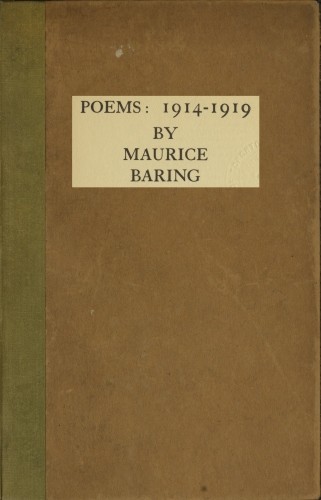
The Project Gutenberg eBook of Poems, 1914-1919
This ebook is for the use of anyone anywhere in the United States and
most other parts of the world at no cost and with almost no restrictions
whatsoever. You may copy it, give it away or re-use it under the terms
of the Project Gutenberg License included with this ebook or online
at www.gutenberg.org. If you are not located in the United States,
you will have to check the laws of the country where you are located
before using this eBook.
Title: Poems, 1914-1919
Author: Maurice Baring
Release date: June 4, 2016 [eBook #52236]
Most recently updated: October 23, 2024
Language: English
Credits: Produced by Chuck Greif, Bryan Ness and the Online
Distributed Proofreading Team at http://www.pgdp.net (This
file was produced from images available by The Internet
Archive/Canadian Libraries)
*** START OF THE PROJECT GUTENBERG EBOOK POEMS, 1914-1919 ***
POEMS: 1914-1919
OTHER WORKS BY
MAURICE BARING
WHAT I SAW IN RUSSIA
A YEAR IN RUSSIA
THE RUSSIAN PEOPLE
THE MAINSPRINGS OF RUSSIA
LANDMARKS IN RUSSIAN LITERATURE
RUSSIAN ESSAYS AND STUDIES
AN OUTLINE OF RUSSIAN LITERATURE
ORPHEUS IN MAYFAIR
DEAD LETTERS
DIMINUTIVE DRAMAS
LOST DIARIES
FORGET-ME-NOT AND LILY OF THE VALLEY
THE GLASS MENDER
THE GREY STOCKING
COLLECTED POEMS
ROUND THE WORLD IN ANY NUMBER OF DAYS
R.F.C. H.Q.
A YEAR IN RUSSIA
THE RUSSIAN PEOPLE
THE MAINSPRINGS OF RUSSIA
LANDMARKS IN RUSSIAN LITERATURE
RUSSIAN ESSAYS AND STUDIES
AN OUTLINE OF RUSSIAN LITERATURE
ORPHEUS IN MAYFAIR
DEAD LETTERS
DIMINUTIVE DRAMAS
LOST DIARIES
FORGET-ME-NOT AND LILY OF THE VALLEY
THE GLASS MENDER
THE GREY STOCKING
COLLECTED POEMS
ROUND THE WORLD IN ANY NUMBER OF DAYS
R.F.C. H.Q.
POEMS: 1914-1919
BY
MAURICE
BARING
LONDON
MARTIN SECKER
LONDON: MARTIN SECKER (LTD) 1920
To
N.L.
CONTENTS
| ERRATA. |
|
Page 19, line 13 for, read; Page 25, line 2 for latest, read last Page 43, line 13 for obedient to, read remembering |
| ———— The Sonnet on page 24 has been translated from the French. |
1915-1918
ἐν Τροίη ἀπόλοντο, ϕιλης ἀπὀ πατρίδος ἀίης
IN MEMORIAM, A.H.
(Auberon Herbert, Captain Lord Lucas, R.F.C.; killed November 3,
1916.)
Νωμᾶται δ’έν ἀτρυγέτῳ χάει
The wind had blown away the rain
That all day long had soaked the level plain.
Against the horizon’s fiery wrack,
The sheds loomed black.
And higher, in their tumultuous concourse met,
The streaming clouds, shot-riddled banners, wet
With the flickering storm,
Drifted and smouldered, warm
With flashes sent
From the lower firmament.
And they concealed—
They only here and there through rifts revealed
A hidden sanctuary of fire and light,
A city of chrysolite.
That all day long had soaked the level plain.
Against the horizon’s fiery wrack,
The sheds loomed black.
And higher, in their tumultuous concourse met,
The streaming clouds, shot-riddled banners, wet
With the flickering storm,
Drifted and smouldered, warm
With flashes sent
From the lower firmament.
And they concealed—
They only here and there through rifts revealed
A hidden sanctuary of fire and light,
A city of chrysolite.
We looked and laughed and wondered, and I said:
That orange sea, those oriflammes outspread
Were like the fanciful imaginings
That the young painter flings
Upon the canvas bold,
Such as the sage and the old
Make mock at, saying it could never be
And you assented also, laughingly.
I wondered what they meant,
That flaming firmament,
Those clouds so grey so gold, so wet so warm,
So much of glory and so much of storm,
The end of the world, or the end
Of the war—remoter still to me and you, my friend.
That orange sea, those oriflammes outspread
Were like the fanciful imaginings
That the young painter flings
Upon the canvas bold,
Such as the sage and the old
Make mock at, saying it could never be
And you assented also, laughingly.
I wondered what they meant,
That flaming firmament,
Those clouds so grey so gold, so wet so warm,
So much of glory and so much of storm,
The end of the world, or the end
Of the war—remoter still to me and you, my friend.
Alas! it meant not this, it meant not that:
It meant that now the last time you and I
Should look at the golden sky,
And the dark fields large and flat,
And smell the evening weather,
And laugh and talk and wonder both together.
It meant that now the last time you and I
Should look at the golden sky,
And the dark fields large and flat,
And smell the evening weather,
And laugh and talk and wonder both together.
The last, last time. We nevermore should meet
In France or London street,
Or fields of home. The desolated space
Of life shall nevermore
Be what it was before.
No one shall take your place.
No other face
Can fill that empty frame.
There is no answer when we call your name.
We cannot hear your step upon the stair.
We turn to speak and find a vacant chair.
Something is broken which we cannot mend.
God has done more than take away a friend
In taking you; for all that we have left
Is bruised and irremediably bereft.
There is none like you. Yet not that alone
Do we bemoan;
But this; that you were greater than the rest,
And better than the best.
In France or London street,
Or fields of home. The desolated space
Of life shall nevermore
Be what it was before.
No one shall take your place.
No other face
Can fill that empty frame.
There is no answer when we call your name.
We cannot hear your step upon the stair.
We turn to speak and find a vacant chair.
Something is broken which we cannot mend.
God has done more than take away a friend
In taking you; for all that we have left
Is bruised and irremediably bereft.
There is none like you. Yet not that alone
Do we bemoan;
But this; that you were greater than the rest,
And better than the best.
O liberal heart fast-rooted to the soil,
O lover of ancient freedom and proud toil,
Friend of the gipsies and all wandering song,
The forest’s nursling and the favoured child
Of woodlands wild—
O brother to the birds and all things free,
Captain of liberty!
Deep in your heart the restless seed was sown;
The vagrant spirit fretted in your feet;
We wondered could you tarry long,
And brook for long the cramping street,
Or would you one day sail for shores unknown,
And shake from you the dust of towns, and spurn
The crowded market-place—and not return?
You found a sterner guide;
You heard the guns. Then, to their distant fire,
Your dreams were laid aside;
And on that day, you cast your heart’s desire
Upon a burning pyre;
You gave your service to the exalted need,
Until at last from bondage freed,
At liberty to serve as you loved best,
You chose the noblest way. God did the rest.
O lover of ancient freedom and proud toil,
Friend of the gipsies and all wandering song,
The forest’s nursling and the favoured child
Of woodlands wild—
O brother to the birds and all things free,
Captain of liberty!
Deep in your heart the restless seed was sown;
The vagrant spirit fretted in your feet;
We wondered could you tarry long,
And brook for long the cramping street,
Or would you one day sail for shores unknown,
And shake from you the dust of towns, and spurn
The crowded market-place—and not return?
You found a sterner guide;
You heard the guns. Then, to their distant fire,
Your dreams were laid aside;
And on that day, you cast your heart’s desire
Upon a burning pyre;
You gave your service to the exalted need,
Until at last from bondage freed,
At liberty to serve as you loved best,
You chose the noblest way. God did the rest.
So when the spring of the world shall shrive our stain,
After the winter of war,
When the poor world awakes to peace once more,
After such night of ravage and of rain,
You shall not come again.
You shall not come to taste the old Spring weather,
To gallop through the soft untrampled heather,
To bathe and bake your body on the grass.
We shall be there, alas!
But not with you. When Spring shall wake the earth,
And quicken the scarred fields to the new birth,
Our grief shall grow. For what can Spring renew
More fiercely for us than the need of you?
After the winter of war,
When the poor world awakes to peace once more,
After such night of ravage and of rain,
You shall not come again.
You shall not come to taste the old Spring weather,
To gallop through the soft untrampled heather,
To bathe and bake your body on the grass.
We shall be there, alas!
But not with you. When Spring shall wake the earth,
And quicken the scarred fields to the new birth,
Our grief shall grow. For what can Spring renew
More fiercely for us than the need of you?
That night I dreamt they sent for me and said
That you were missing, “missing, missing—dead”:
I cried when in the morning I awoke,
And all the world seemed shrouded in a cloak;
But when I saw the sun,
And knew another day had just begun,
I brushed the dream away, and quite forgot
The nightmare’s ugly blot.
So was the dream forgot. The dream came true.
Before the night I knew
That you had flown away into the air
Forever. Then I cheated my despair.
I said
That you were safe—or wounded—but not dead.
Alas! I knew
Which was the false and true.
That you were missing, “missing, missing—dead”:
I cried when in the morning I awoke,
And all the world seemed shrouded in a cloak;
But when I saw the sun,
And knew another day had just begun,
I brushed the dream away, and quite forgot
The nightmare’s ugly blot.
So was the dream forgot. The dream came true.
Before the night I knew
That you had flown away into the air
Forever. Then I cheated my despair.
I said
That you were safe—or wounded—but not dead.
Alas! I knew
Which was the false and true.
And after days of watching, days of lead,
There came the certain news that you were dead
You had died fighting, fighting against odds,
Such as in war the gods
Æthereal dared when all the world was young;
Such fighting as blind Homer never sung,
Nor Hector nor Achilles never knew;
High in the empty blue.
There came the certain news that you were dead
You had died fighting, fighting against odds,
Such as in war the gods
Æthereal dared when all the world was young;
Such fighting as blind Homer never sung,
Nor Hector nor Achilles never knew;
High in the empty blue.
High, high, above the clouds, against the setting sun,
The fight was fought, and your great task was done.
The fight was fought, and your great task was done.
Of all your brave adventures this the last
The bravest was and best;
Meet ending to a long embattled past,
This swift, triumphant, fatal quest,
Crowned with the wreath that never perisheth,
And diadem of honourable death;
Swift Death aflame with offering supreme
And mighty sacrifice,
More than all mortal dream;
A soaring death, and near to Heaven’s gate;
Beneath the very walls of Paradise.
Surely with soul elate,
You heard the destined bullet as you flew,
And surely your prophetic spirit knew
That you had well deserved that shining fate.
The bravest was and best;
Meet ending to a long embattled past,
This swift, triumphant, fatal quest,
Crowned with the wreath that never perisheth,
And diadem of honourable death;
Swift Death aflame with offering supreme
And mighty sacrifice,
More than all mortal dream;
A soaring death, and near to Heaven’s gate;
Beneath the very walls of Paradise.
Surely with soul elate,
You heard the destined bullet as you flew,
And surely your prophetic spirit knew
That you had well deserved that shining fate.
Here is no waste,
No burning Might-have-been,
No bitter after-taste,
None to censure, none to screen,
Nothing awry, nor anything misspent;
Only content, content beyond content,
Which hath not any room for betterment.
No burning Might-have-been,
No bitter after-taste,
None to censure, none to screen,
Nothing awry, nor anything misspent;
Only content, content beyond content,
Which hath not any room for betterment.
God, Who had made you valiant, strong and swift,
And maimed you with a bullet long ago,
And cleft your riotous ardour with a rift,
And checked your youth’s tumultuous overflow,
Gave back your youth to you,
And packed in moments rare and few
Achievements manifold
And happiness untold,
And bade you spring to Death as to a bride,
In manhood’s ripeness, power and pride,
And on your sandals the strong wings of youth.
He let you leave a name
To shine on the entablatures of truth,
Forever:
To sound forever in answering halls of fame.
And maimed you with a bullet long ago,
And cleft your riotous ardour with a rift,
And checked your youth’s tumultuous overflow,
Gave back your youth to you,
And packed in moments rare and few
Achievements manifold
And happiness untold,
And bade you spring to Death as to a bride,
In manhood’s ripeness, power and pride,
And on your sandals the strong wings of youth.
He let you leave a name
To shine on the entablatures of truth,
Forever:
To sound forever in answering halls of fame.
For you soared onwards to that world which rags
Of clouds, like tattered flags,
Concealed; you reached the walls of chrysolite,
The mansions white;
And losing all, you gained the civic crown
Of that eternal town,
Wherein you passed a rightful citizen
Of the bright commonwealth ablaze beyond our ken.
Of clouds, like tattered flags,
Concealed; you reached the walls of chrysolite,
The mansions white;
And losing all, you gained the civic crown
Of that eternal town,
Wherein you passed a rightful citizen
Of the bright commonwealth ablaze beyond our ken.
Surely you found companions meet for you
In that high place;
You met there face to face
Those you had never known, but whom you knew;
Knights of the Table Round,
And all the very brave, the very true,
With chivalry crowned;
The captains rare,
Courteous and brave beyond our human air;
Those who had loved and suffered overmuch,
Now free from the world’s touch.
And with them were the friends of yesterday,
Who went before and pointed you the way;
And in that place of freshness, light and rest,
In that high place;
You met there face to face
Those you had never known, but whom you knew;
Knights of the Table Round,
And all the very brave, the very true,
With chivalry crowned;
The captains rare,
Courteous and brave beyond our human air;
Those who had loved and suffered overmuch,
Now free from the world’s touch.
And with them were the friends of yesterday,
Who went before and pointed you the way;
And in that place of freshness, light and rest,
Where Lancelot and Tristram vigil keep
Over their King’s long sleep,
Surely they made a place for you,
Their long-expected guest,
Among the chosen few,
And welcomed you, their brother and their friend,
To that companionship which hath no end.
Over their King’s long sleep,
Surely they made a place for you,
Their long-expected guest,
Among the chosen few,
And welcomed you, their brother and their friend,
To that companionship which hath no end.
And in the portals of the sacred hall
You hear the trumpet’s call,
At dawn upon the silvery battlement,
Re-echo through the deep
And bid the sons of God to rise from sleep,
And with a shout to hail
The sunrise on the city of the Grail:
The music that proud Lucifer in Hell
Missed more than all the joys that he forwent.
You hear the solemn bell
At vespers, when the oriflammes are furled;
And then you know that somewhere in the world,
That shines far-off beneath you like a gem,
They think of you, and when you think of them
You know that they will wipe away their tears,
And cast aside their fears;
That they will have it so,
And in no otherwise;
That it is well with them because they know,
With faithful eyes,
Fixed forward and turned upwards to the skies,
That it is well with you,
Among the chosen few,
Among the very brave, the very true.
You hear the trumpet’s call,
At dawn upon the silvery battlement,
Re-echo through the deep
And bid the sons of God to rise from sleep,
And with a shout to hail
The sunrise on the city of the Grail:
The music that proud Lucifer in Hell
Missed more than all the joys that he forwent.
You hear the solemn bell
At vespers, when the oriflammes are furled;
And then you know that somewhere in the world,
That shines far-off beneath you like a gem,
They think of you, and when you think of them
You know that they will wipe away their tears,
And cast aside their fears;
That they will have it so,
And in no otherwise;
That it is well with them because they know,
With faithful eyes,
Fixed forward and turned upwards to the skies,
That it is well with you,
Among the chosen few,
Among the very brave, the very true.
DIFFUGERE NIVES, 1917
To J. C. S.
The snows have fled, the hail, the lashing rain,
Before the Spring.
The grass is starred with buttercups again,
The blackbirds sing.
Before the Spring.
The grass is starred with buttercups again,
The blackbirds sing.
Now spreads the month that feast of lovely things
We loved of old.
Once more the swallow glides with darkling wings
Against the gold.
We loved of old.
Once more the swallow glides with darkling wings
Against the gold.
Now the brown bees about the peach trees boom
Upon the walls;
And far away beyond the orchard’s bloom
The cuckoo calls.
Upon the walls;
And far away beyond the orchard’s bloom
The cuckoo calls.
The season holds a festival of light,
For you, for me,
The shadows are abroad, there falls a blight
On each green tree.
For you, for me,
The shadows are abroad, there falls a blight
On each green tree.
And every leaf unfolding, every flower
Brings bitter meed;
Beauty of the morning and the evening hour
Quickens our need.
Brings bitter meed;
Beauty of the morning and the evening hour
Quickens our need.
All is reborn, but never any Spring
Can bring back this;
Nor any fullness of midsummer bring
The voice we miss.
Can bring back this;
Nor any fullness of midsummer bring
The voice we miss.
The smiling eyes shall smile on us no more;
The laughter clear,
Too far away on the forbidden shore,
We shall not hear.
The laughter clear,
Too far away on the forbidden shore,
We shall not hear.
Bereft of these until the day we die,
We both must dwell;
Alone, alone, and haunted by the cry:
“Hail and farewell!”
We both must dwell;
Alone, alone, and haunted by the cry:
“Hail and farewell!”
Yet when the scythe of Death shall near us hiss
Through the cold air,
Then on the shuddering marge of the abyss
They will be there.
Through the cold air,
Then on the shuddering marge of the abyss
They will be there.
They will be there to lift us from sheer space
And empty night;
And we shall turn and see them face to face
In the new light.
And empty night;
And we shall turn and see them face to face
In the new light.
So shall we pay the unabated price
Of their release,
And found on our consenting sacrifice
Their lasting peace.
Of their release,
And found on our consenting sacrifice
Their lasting peace.
The hopes that fall like leaves before the wind,
The baffling waste,
And every earthly joy that leaves behind
A mortal taste.
The baffling waste,
And every earthly joy that leaves behind
A mortal taste.
The uncompleted end of all things dear,
The clanging door
Of Death, forever loud with the last fear,
Haunt them no more.
The clanging door
Of Death, forever loud with the last fear,
Haunt them no more.
Without them the awakening world is dark
With dust and mire;
Yet as they went they flung to us a spark,
A thread of fire.
With dust and mire;
Yet as they went they flung to us a spark,
A thread of fire.
To guide us while beneath the sombre skies
Faltering we tread,
Until for us like morning stars shall rise
The deathless dead.
Faltering we tread,
Until for us like morning stars shall rise
The deathless dead.
JULIAN GRENFELL
Because of you we will be glad and gay,
Remembering you, we will be brave and strong;
And hail the advent of each dangerous day,
And meet the last adventure with a song.
And, as you proudly gave your jewelled gift,
We’ll give our lesser offering with a smile,
Nor falter on that path where, all too swift,
You led the way and leapt the golden stile.
Remembering you, we will be brave and strong;
And hail the advent of each dangerous day,
And meet the last adventure with a song.
And, as you proudly gave your jewelled gift,
We’ll give our lesser offering with a smile,
Nor falter on that path where, all too swift,
You led the way and leapt the golden stile.
Whether new paths, new heights to climb you find,
Or gallop through the unfooted asphodel,
We know you know we shall not lag behind,
Nor halt to waste a moment on a fear;
And you will speed us onward with a cheer,
And wave beyond the stars that all is well.
Or gallop through the unfooted asphodel,
We know you know we shall not lag behind,
Nor halt to waste a moment on a fear;
And you will speed us onward with a cheer,
And wave beyond the stars that all is well.
PIERRE
I saw you starting for another war,
The emblem of adventure and of youth,
So that men trembled, saying: “He forsooth
Has gone, has gone, and shall return no more.”
And then out there, they told me you were dead,
Taken and killed; how was it that I knew,
Whatever else was true, that was not true?
And then I saw you pale upon your bed,
The emblem of adventure and of youth,
So that men trembled, saying: “He forsooth
Has gone, has gone, and shall return no more.”
And then out there, they told me you were dead,
Taken and killed; how was it that I knew,
Whatever else was true, that was not true?
And then I saw you pale upon your bed,
Scarcely two years ago, when you were sent
Back from the margin of the dim abyss;
For Death had sealed you with a warning kiss,
And let you go to meet a nobler fate:
To serve in fellowship, O fortunate:
To die in battle with your regiment.
Back from the margin of the dim abyss;
For Death had sealed you with a warning kiss,
And let you go to meet a nobler fate:
To serve in fellowship, O fortunate:
To die in battle with your regiment.
ICARUS
Here fell the daring Icarus in his prime,
He who was brave enough to scale the skies;
And here bereft of plumes his body lies,
Leaving the valiant envious of that climb.
O rare performance of a soul sublime,
That with small loss such great advantage buys!
Happy mishap! fraught with so rich a prize,
That bids the vanquished triumph over time.
He who was brave enough to scale the skies;
And here bereft of plumes his body lies,
Leaving the valiant envious of that climb.
O rare performance of a soul sublime,
That with small loss such great advantage buys!
Happy mishap! fraught with so rich a prize,
That bids the vanquished triumph over time.
So new a path his youth did not dismay,
His wings but not his noble heart said nay;
He had the glorious sun for funeral fire;
He died upon a high adventure bent;
The sea his grave, his goal the firmament.
Great is the tomb, but greater the desire.
His wings but not his noble heart said nay;
He had the glorious sun for funeral fire;
He died upon a high adventure bent;
The sea his grave, his goal the firmament.
Great is the tomb, but greater the desire.
EPITAPH
Here murdered by the frenzied, not the free,
Lies the latest monarch of a star-crossed line;
Anointed Emperor by right divine,
From Arctic icefields to the Aral sea,
From Warsaw to the walls of Tartary.
His country’s travail claimed a high design;
Too stubborn to respond, he shrank supine
Before the large demand of destiny.
Lies the latest monarch of a star-crossed line;
Anointed Emperor by right divine,
From Arctic icefields to the Aral sea,
From Warsaw to the walls of Tartary.
His country’s travail claimed a high design;
Too stubborn to respond, he shrank supine
Before the large demand of destiny.
Bereft of crown, and throne, and hearth and name,
Grief lent him majesty, and suffering
Gave him a more than regal diadem.
His people kissed the desecrated hem
Of robes not now of splendour but of shame,
And knelt before their undiminished King.
Grief lent him majesty, and suffering
Gave him a more than regal diadem.
His people kissed the desecrated hem
Of robes not now of splendour but of shame,
And knelt before their undiminished King.
AUGUST, 1918
(In a French Village.)
I hear the tinkling of the cattle bell,
In the broad stillness of the afternoon;
High in the cloudless haze the harvest moon
Is pallid as the phantom of a shell.
A girl is drawing water from a well,
I hear the clatter of her wooden shoon;
Two mothers to their sleeping babies croon,
And the hot village feels the drowsy spell.
In the broad stillness of the afternoon;
High in the cloudless haze the harvest moon
Is pallid as the phantom of a shell.
A girl is drawing water from a well,
I hear the clatter of her wooden shoon;
Two mothers to their sleeping babies croon,
And the hot village feels the drowsy spell.
Sleep, child, the Angel of Death his wings has spread;
His engines scour the land, the sea, the sky;
And all the weapons of Hell’s armoury
Are ready for the blood that is their bread;
And many a thousand men to-night must die,
So many that they will not count the Dead.
His engines scour the land, the sea, the sky;
And all the weapons of Hell’s armoury
Are ready for the blood that is their bread;
And many a thousand men to-night must die,
So many that they will not count the Dead.
POEMS WRITTEN
BEFORE THE WAR
VITA NUOVA
I watched you in the distance tall and pale,
Like a swift swallow in a pearly sky;
Your eyelids drooped like petals wearily,
Your face was like a lily of the vale.
You had the softness of all Summer days,
The silver radiance of the twilight hour,
The mystery of bluebell-haunted ways,
The passion of the white syringa’s flower.
Like a swift swallow in a pearly sky;
Your eyelids drooped like petals wearily,
Your face was like a lily of the vale.
You had the softness of all Summer days,
The silver radiance of the twilight hour,
The mystery of bluebell-haunted ways,
The passion of the white syringa’s flower.
I watched you, and I knew that I had found
The long-delaying, long-expected Spring;
I knew my heart had found a tune to sing;
That strength to soar was in my spirit’s wing;
That life was full of a triumphant sound,
That death could only be a little thing.
The long-delaying, long-expected Spring;
I knew my heart had found a tune to sing;
That strength to soar was in my spirit’s wing;
That life was full of a triumphant sound,
That death could only be a little thing.
I saw you by the Summer candlelight:—
You put to shame the sparkle of the gems,
The lights, the flashing of the diadems,
The moon and all the stars of Summer night.
I saw you in the radiant morning hour:—
You put to shame the white rose and the red;
Your chiselled lips, your little lovely head,
Were fairer than the petals of a flower.
You put to shame the sparkle of the gems,
The lights, the flashing of the diadems,
The moon and all the stars of Summer night.
I saw you in the radiant morning hour:—
You put to shame the white rose and the red;
Your chiselled lips, your little lovely head,
Were fairer than the petals of a flower.
And on the shaven surface of the lawn,
You moved like music, and you smiled like dawn,—
The leaves, the flowers, the dragon-flies, the dew,
Beside you seemed the stuff of coarser clay;
And all the glory of the Summer day
A background for the wonder that was you.
You moved like music, and you smiled like dawn,—
The leaves, the flowers, the dragon-flies, the dew,
Beside you seemed the stuff of coarser clay;
And all the glory of the Summer day
A background for the wonder that was you.
ITALY
The almond trees of Tuscany in flower,
Narcissus and the tulip growing wild;
White oxen; and like a lily undefiled,
Beyond the misty plain, the marble tower;
The roses and the corn upon the hill,
The Judas-tree against the solid blue;
The fire-flies, and the downy owl’s too-whoo,
Thy Aziola, Shelley, plaintive still.
Narcissus and the tulip growing wild;
White oxen; and like a lily undefiled,
Beyond the misty plain, the marble tower;
The roses and the corn upon the hill,
The Judas-tree against the solid blue;
The fire-flies, and the downy owl’s too-whoo,
Thy Aziola, Shelley, plaintive still.
The lisp of Baiæ’s phosphorescent foam;
And Venice like a bubble made of dew,
A shell transfigured with the rainbow’s hue;
The Appian Way beneath a sullen sky,
(The shepherd’s pipe is like a seagull’s cry)
And in a silver rift, eternal Rome.
And Venice like a bubble made of dew,
A shell transfigured with the rainbow’s hue;
The Appian Way beneath a sullen sky,
(The shepherd’s pipe is like a seagull’s cry)
And in a silver rift, eternal Rome.
SEVILLE
The orange blossoms in the Alcazar,
Where roses and syringas are in flower;
The blinding glory of the morning hour;
The eyes that gleam behind a twisted bar;
The women on the balconies,—a smile;
The barrel-organs, and the blazing heat;
The awning hanging high across the street;
A dark mantilla in a sombre aisle.
Where roses and syringas are in flower;
The blinding glory of the morning hour;
The eyes that gleam behind a twisted bar;
The women on the balconies,—a smile;
The barrel-organs, and the blazing heat;
The awning hanging high across the street;
A dark mantilla in a sombre aisle.
A fountain tinkling in a shady court;
The gold arena of the bull-ring’s feast;
The coloured crowd acclaiming perilous sport;
The sudden silence when they hold their breath,
While the torero gently plays with death,
And flicks the horns of the tremendous beast.
The gold arena of the bull-ring’s feast;
The coloured crowd acclaiming perilous sport;
The sudden silence when they hold their breath,
While the torero gently plays with death,
And flicks the horns of the tremendous beast.
GREECE
The Spring had scattered poppies on the land,
The Spring was saying her secret to the breeze;
In the translucent shallows of green seas,
A fisherman, a trident in his hand,
Was casting shining fishes to the sand,
And wading in the water to his knees;
And still I hear the crickets and the bees,
The hidden hoofs, the ringing saraband.
The Spring was saying her secret to the breeze;
In the translucent shallows of green seas,
A fisherman, a trident in his hand,
Was casting shining fishes to the sand,
And wading in the water to his knees;
And still I hear the crickets and the bees,
The hidden hoofs, the ringing saraband.
I see the temples above the breaking foam,
The pillars pink as dawn in the silver dust;
The Parthenon at sunset large and dim,
Smouldering against the purple mountain’s crust;
And far away on the ocean’s blazing rim,
The phantom ship that brought Ulysses home.
The pillars pink as dawn in the silver dust;
The Parthenon at sunset large and dim,
Smouldering against the purple mountain’s crust;
And far away on the ocean’s blazing rim,
The phantom ship that brought Ulysses home.
RUSSIA
What can the secret link between us be?
Why does your song’s unresting ebb and flow
Speak to me in a language that I know?
Why does the burden of your mystery
Come like the message of a friend to me?
Why do I love your vasts of corn or snow,
The tears and laughter of your sleepless woe,
The murmur of your brown immensity?
Why does your song’s unresting ebb and flow
Speak to me in a language that I know?
Why does the burden of your mystery
Come like the message of a friend to me?
Why do I love your vasts of corn or snow,
The tears and laughter of your sleepless woe,
The murmur of your brown immensity?
I cannot say, I only know that when
I hear your soldiers singing in the street,
I know it is with you that I would dwell;
And when I see your peasants reaping wheat,
Your children playing on the road, your men
At prayer before a shrine, I wish them well.
I hear your soldiers singing in the street,
I know it is with you that I would dwell;
And when I see your peasants reaping wheat,
Your children playing on the road, your men
At prayer before a shrine, I wish them well.
A JUNE NIGHT IN RUSSIA
A concert. Hark to the prelude’s opening bar!
Played by the sheep bells tinkling on the hill;
Dogs bark and frogs are croaking near the mill,
The watchman’s rattle beats the time afar.
Like water bubbling in a magic jar,
The nightingale begins a liquid trill,
Another answers; and the world’s so still,
You’d think that you could hear that falling star.
Played by the sheep bells tinkling on the hill;
Dogs bark and frogs are croaking near the mill,
The watchman’s rattle beats the time afar.
Like water bubbling in a magic jar,
The nightingale begins a liquid trill,
Another answers; and the world’s so still,
You’d think that you could hear that falling star.
I scarcely see for light the stars that swim
Aloof in skies not dark but only dim.
The women’s voices echo far away.
And on the road two lovers sing a song:
They sing the joy of love that lasts a day:
The sorrow of love that lasts a whole life long.
Aloof in skies not dark but only dim.
The women’s voices echo far away.
And on the road two lovers sing a song:
They sing the joy of love that lasts a day:
The sorrow of love that lasts a whole life long.
HARVEST IN RUSSIA
The breeze has come at last. The day was long;
And in the lustrous air the dark bats fly;
And Hark! It is the reapers passing by,
I hear the burden of their peaceful song.
A voice intones; and swift the answering throng
Take up the theme and build the harmony;
The music swells and soars into the sky
And dies away intense, and clear and strong.
And in the lustrous air the dark bats fly;
And Hark! It is the reapers passing by,
I hear the burden of their peaceful song.
A voice intones; and swift the answering throng
Take up the theme and build the harmony;
The music swells and soars into the sky
And dies away intense, and clear and strong.
Now through the trees the stately shapes I see
Of women with the attributes of toil,
Calm in their sacerdotal majesty;
And backward, through the drifting mist of years,
I see the festal rites that blessed the soil,
As old as the first drop of mortal tears.
Of women with the attributes of toil,
Calm in their sacerdotal majesty;
And backward, through the drifting mist of years,
I see the festal rites that blessed the soil,
As old as the first drop of mortal tears.
DOSTOYEVSKY
You healed the sore, you made the fearful brave,
They bless you for your lasting legacy;
The balm, the tears, the fragrant charity
You sought and treasured in your living grave.
The gifts you humbly took you greatly gave,
For solace of the soul in agony,
When through the bars the brutal passions pry,
And mock the bonds of the celestial slave.
They bless you for your lasting legacy;
The balm, the tears, the fragrant charity
You sought and treasured in your living grave.
The gifts you humbly took you greatly gave,
For solace of the soul in agony,
When through the bars the brutal passions pry,
And mock the bonds of the celestial slave.