
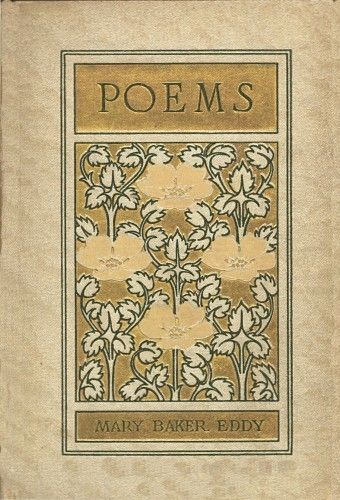
The Project Gutenberg eBook of Poems
Title: Poems
Author: Mary Baker Eddy
Release date: November 30, 2008 [eBook #27370]
Language: English
Credits: E-text prepared by Juliet Sutherland, Leonard Johnson, and the Project Gutenberg Online Distributed Proofreading Team (http://www.pgdp.net)
E-text prepared by Juliet Sutherland, Leonard Johnson,
and the Project Gutenberg Online Distributed Proofreading Team
(http://www.pgdp.net)
POEMS
BY
MARY BAKER EDDY
AUTHOR OF "SCIENCE AND HEALTH WITH KEY
TO THE SCRIPTURES"
Published by The
Trustees under the Will of Mary Baker G. Eddy
BOSTON, U.S.A.
Authorized Literature of
The First Church of Christ, Scientist
in Boston, Massachusetts
Copyright, 1910
By Mary Baker Eddy
ALL RIGHTS RESERVED
PRINTED IN THE UNITED STATES OF AMERICA
PREFACE
The poems garnered up in this little volume were written at different periods in the life of the author, dating from her early girlhood up to recent years. They were not written with a view of making a book, each poem being the spontaneous outpouring of a deeply poetic nature and called forth by some experience that claimed her attention.
The "Old Man of the Mountain," for instance, was written while the author was contemplating this lofty New Hampshire crag, whose rugged outlines resemble the profile of a human face. Inspired by the grandeur of this masterpiece of nature's handiwork, and looking "up through nature, unto nature's God," the poem began to take form in her thought, and alighting from her carriage, she seated herself by the roadside and began to write. Some tourists who were passing, and who made her acquaintance, asked her what she was writing, and she replied by reading the poem to them. They were so pleased with it that each requested a copy, which was subsequently mailed to them. Similar requests continued to reach the author for years afterward, until the poem finally found its way into print, appearing, together with "The Valley Cemetery," in a book "Gems for You," published in Manchester, N. H., in 1850, and again in Boston, in 1856.
The poem on the "Dedication of a Temperance Hall," in Lynn, Mass., in 1866, was written for that occasion, and was sung by the audience as a dedicatory hymn. "The Liberty Bells" appeared in a Lynn, Mass., newspaper, under the date of February 3, 1865. A note from the author, which was published with the poem, read as follows:
"Mr. Editor:—In 1835 a mob in Boston (although Boston has since been the pioneer of anti-slavery) dispersed a meeting of the Female Anti-Slavery Society, and assailed the person of William Lloyd Garrison with such fury that the city authorities could protect him nowhere but in the walls of a jail. To-day, by order of Governor Andrew, the bells are ringing to celebrate the passing of a resolution in Congress prohibiting slavery in the United States."
All of the author's best-known hymns are included in this collection, as well as many poems written in girlhood and during the years she resided in Lynn, Mass., and which appeared in various publications of that day. Among her earliest poems are "Upward," "Resolutions for the Day," "Autumn" (written in a maple grove), "Alphabet and Bayonet," and "The Country-Seat" (written while visiting a family friend in the beautiful suburbs of Boston); yet, even these are characterized by the same lofty trend of thought that reached its fulness in her later productions.
In May, 1910, Mrs. Eddy requested her publisher to prepare a few bound volumes of her poems, for private distribution. When this became known to her friends, they urged her to allow a popular edition to be issued, to which she assented. With grateful acknowledgment, therefore, of this permission, this little volume is presented to the public, in the hope that these gems of purest thought from this spiritually-minded author will prove a joy to the heavy laden and a balm to the weary heart.
Chestnut Hill, Mass., September 24, 1910.
CONTENTS
- PAGE
- Old Man of the Mountain 1
- Constancy 3
- Mother's Evening Prayer 4
- Love 6
- I'm Sitting Alone 8
- The United States to Great Britain 10
- Christ My Refuge 12
- "Feed My Sheep" 14
- The Valley Cemetery 15
- Upward 18
- The Oak on the Mountain's Summit 20
- Woman's Rights 21
- The New Century 22
- To My Absent Brother 23
- Signs of the Heart 24
- Flowers 25
- To the Old Year—1865 26
- Invocation for 1868 28
- Christmas Morn 29
- Easter Morn 30
- Resolutions for the Day 32
- O for Thy Wings, Sweet Bird! 34
- Come Thou 36
- Wish and Item 38
- Dedication of a Temperance Hall 39
- Lines 41
- To the Sunday School Children 43
- Hope 45
- To Etta 46
- Nevermore 47
- Meeting of My Departed Mother and Husband 48
- Isle of Wight 51
- Spring 53
- June 55
- Rondelet 57
- Autumn 58
- Alphabet and Bayonet 60
- The Country-seat 62
- To Ellen. "Sing Me That Song!" 65
- Lines, on Visiting Pine Grove Cemetery 67
- A Verse 69
- Truth 70
- "The Liberty Bells" 71
- "Memento" 73
- Communion Hymn 75
- Laus Deo 76
- Our National Thanksgiving Hymn 77
- Satisfied 79
POEMS
OLD MAN OF THE MOUNTAIN
Primeval dweller where the wild winds rest,
Beyond the ken of mortal e'er to tell
What power sustains thee in thy rock-bound cell.
And far the universal fiat ran,
"Let there be light"—from chaos dark set free,
Ye rose, a monument of Deity,
On insignificance that peoples earth,
Recalling oft the bitter draft which turns
The mind to meditate on what it learns.
Though kindred rocks, to sport at mortal clay—
Much as the chisel of the sculptor's art
"Plays round the head, but comes not to the heart."
Like a trained falcon in the Gallic van,
Guided and led, can never reach to thee
With all the strength of weakness—vanity!
Admired by all, still art thou drear and lone!
The moon looks down upon thine exiled height;
The stars, so cold, so glitteringly bright,
Yield to the sun's more genial, mighty ray;
The white waves kiss the murmuring rill—
But thy deep silence is unbroken still.
CONSTANCY
I miss thee as the flower the dew!
When noonday's length'ning shadows flee,
I think of thee, I think of thee!
I watch thy chair, and wish thee here;
Till sleep sets drooping fancy free
To dream of thee, to dream of thee!
It hath been thus; and must be so
Till bursting bonds our spirits part
And Love divine doth fill my heart.
Written many years ago.
MOTHER'S EVENING PRAYER
O Life divine, that owns each waiting hour,
Thou Love that guards the nestling's faltering flight!
Keep Thou my child on upward wing tonight.
Can I behold the snare, the pit, the fall:
His habitation high is here, and nigh,
His arm encircles me, and mine, and all.
For hope deferred, ingratitude, disdain!
Wait, and love more for every hate, and fear
No ill,—since God is good, and loss is gain.
In that sweet secret of the narrow way,
Seeking and finding, with the angels sing:
"Lo, I am with you alway,"—watch and pray.
No night drops down upon the troubled breast,
When heaven's aftersmile earth's tear-drops gain,
And mother finds her home and heav'nly rest.
LOVE
'Neath which our spirits blend
Like brother birds, that soar and sing,
And on the same branch bend.
The arrow that doth wound the dove
Darts not from those who watch and love.
By thought or word unkind,
Pray that his spirit you partake,
Who loved and healed mankind:
Seek holy thoughts and heavenly strain,
That make men one in love remain.
For faith to kiss, and know;
That greetings glorious from high heaven,
Whence joys supernal flow,
Come from that Love, divinely near,
Which chastens pride and earth-born fear,
Through God, who gave that word of might
Which swelled creation's lay:
"Let there be light, and there was light."
What chased the clouds away?
'Twas Love whose finger traced aloud
A bow of promise on the cloud.
Free us from human strife.
Fed by Thy love divine we live,
For Love alone is Life;
And life most sweet, as heart to heart
Speaks kindly when we meet and part.
I'M SITTING ALONE
In somber groups at the vesper-call,
Where tear-dews of night seek the loving rose,
Her bosom to fill with mortal woes.
Of nymph and naiad from woodland bower;
Till vestal pearls that on leaflets lay,
Ravished with beauty the eye of day.
O'er the silv'ry moon and ocean flow;
And sketching in light the heaven of my youth—
Its starry hopes and its waves of truth.
What rainbows of rapture floated by!
Of a mother's love, that no words could speak
When parting the ringlets to kiss my cheek.
The light of a home of love and pride;
How the glance of her husband's watchful eye
Turned to his star of idolatry.
Upturned to his mother's in playful grace;
And the unsealed fountains of grief and joy
That gushed at the birth of that beautiful boy.
The leaves all faded, the fruitage shed,
And wishing this earth more gifts from above,
Our reason made right and hearts all love.
Lynn, Mass., September 3, 1866.
THE UNITED STATES TO GREAT BRITAIN
To the billows and the breeze;
We proffer thee warm welcome
With our hand, though not our knees.
Thy palm, in ancient day,
Didst rock the country's cradle
That wakes thy laureate's lay.
Our eagle, like the dove,
Returns to bless a bridal
Betokened from above.
To Judah's sceptered race,—
"Thou of the self-same spirit,
Allied by nations' grace,
For Anglo-Israel, lo!
Is marching under orders;
His hand averts the blow."
Unite your battle-plan;
Victorious, all who live it,—
The love for God and man.
Boston Herald, Sunday, May 15, 1898.
CHRIST MY REFUGE
There sweeps a strain,
Low, sad, and sweet, whose measures bind
The power of pain,
Of thoughts, illumed
By faith, and breathed in raptured song,
With love perfumed.
Life's burdens light.
I kiss the cross, and wake to know
A world more bright.
I see Christ walk,
And come to me, and tenderly,
Divinely talk.
Upon Life's shore,
'Gainst which the winds and waves can shock,
Oh, nevermore!
And nearer Thee,—
Father, where Thine own children are,
I love to be.
To Thine, for Thee;
An offering pure of Love, whereto
God leadeth me.
"FEED MY SHEEP"
O'er the hillside steep,
How to gather, how to sow,—
How to feed Thy sheep;
I will listen for Thy voice,
Lest my footsteps stray;
I will follow and rejoice
All the rugged way.
Wound the callous breast,
Make self-righteousness be still,
Break earth's stupid rest.
Strangers on a barren shore,
Lab'ring long and lone,
We would enter by the door,
And Thou know'st Thine own;
Tear or triumph harms,
Lead Thy lambkins to the fold,
Take them in Thine arms;
Feed the hungry, heal the heart,
Till the morning's beam;
White as wool, ere they depart,
Shepherd, wash them clean.
THE VALLEY CEMETERY
Ye echoing moans from the footsteps of time!
Break not on the silence, unless thou canst bear
A message from heaven—"No partings are there."
And whispering voices are calling away—
Their wooings are soft as the vision more vain—
I would live in their empire, or die in their chain.
Flowers fresh as the pang in the bosom that bled,—
Yes, constant as love that outliveth the grave,
And time cannot quench in oblivion's wave.
Art constant and hopeful though winter appears.
My heart hath thy verdure, it blossoms above;
Like thee, it endureth and liveth in love.
The sequel of power, of glory, or gold;
Then rush into life, and roll on with its tide,
And bustle and toil for its pomp and its pride.
Which steepeth the trees when the day-god is low;
The voice of the night-bird must here send a thrill
To the heart of the leaves when the winds are all still.
And call to my spirit with seraphs to dwell;
They come with a breath from the verdant springtime,
And waken my joy, as in earliest prime.
O tell of their radiant home and its morn!
Then I'll think of its glory, and rest till I see
My loved ones in glory still waiting for me.
UPWARD
His soaring majestic, and feathersome fling—
Careening in liberty higher and higher—
Like genius unfolding a quenchless desire.
To gaze on the lark in her emerald bower?
When higher he soareth to compass his rest,
What vision so bright as the dream in his breast!
Whose omniscient notice the frail fledgling hath.
Though lightnings be lurid and earthquakes may shock,
He rides on the whirlwind or rests on the rock.
Celestial the breezes that waft o'er its sky!
God's eye is upon me—I am not alone
When onward and upward and heavenward borne.
Written in early years.
THE OAK ON THE MOUNTAIN'S SUMMIT
Clouds to adorn thy brow, skies clasp thy hand,—
Nature divine, in harmony profound,
With peaceful presence hath begirt thee round.
Guard'st thou the earth, asleep in night's embrace,—
And from thy lofty summit, pouring down
Thy sheltering shade, her noonday glories crown?
To my lone heart thou art a power and spell;
A lesson grave, of life, that teacheth me
To love the Hebrew figure of a tree.
As strong to wrestle with the storms of time;
As deeply rooted in a soil of love;
As grandly rising to the heavens above.
WOMAN'S RIGHTS
She won from vice, by virtue's smile,
Her dazzling crown, her sceptered throne,
Affection's wreath, a happy home;
To bless the orphan, feed the poor;
Last at the cross to mourn her Lord,
First at the tomb to hear his word;
And hover o'er the couch of woe;
To nurse the Bethlehem babe so sweet,
The right to sit at Jesus' feet;
The hoary head with joy to crown;
In short, the right to work and pray,
"To point to heaven and lead the way."
Lynn, Mass., May 6, 1876.
THE NEW CENTURY
Thine hour hath come! Eternity
Draws nigh—and, beckoning from above,
One hundred years, aflame with Love,
Again shall bid old earth good-by—
And, lo, the light! far heaven is nigh!
New themes seraphic, Life divine,
And bliss that wipes the tears of time
Away, will enter, when they may,
And bask in one eternal day.
Love hath one race, one realm, one power.
Dear God! how great, how good Thou art
To heal humanity's sore heart;
To probe the wound, then pour the balm—
A life perfected, strong and calm.
The dark domain of pain and sin
Surrenders—Love doth enter in,
And peace is won, and lost is vice:
Right reigns, and blood was not its price.
Pleasant View, Concord, N. H., January, 1901.