
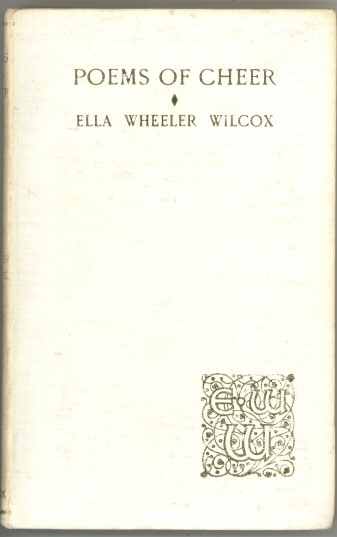
The Project Gutenberg eBook of Poems of Cheer
Title: Poems of Cheer
Author: Ella Wheeler Wilcox
Release date: May 1, 2002 [eBook #3238]
Most recently updated: July 13, 2014
Language: English
Credits: Transcribed from the 1914 Gay and Hancock edition by David Price
Transcribed from the 1914 Gay and Hancock edition by David Price, email ccx074@pglaf.org
POEMS OF CHEER
BY
ELLA WHEELER WILCOX
GAY AND HANCOCK, LTD.
12 and 13, HENRIETTA STREET, COVENT GARDEN
LONDON
1914
[All rights reserved]
This Volume contains the poems published under the title “Poems of Life,” with the exception of about half a dozen, which appear in my other volumes. I have also added a few new verses.
Any edition of my Poems published in Great Britain by any firm except Messrs. Gay and Hancock is pirated and not authentic.
Ella Wheeler Wilcox.
April 12th, 1910.
I step across the mystic border-land,
And look upon the wonder-world of Art.
How beautiful, how beautiful its hills!
And all its valleys, how surpassing fair!
The winding paths that lead up to the
heights
Are polished by the footsteps of the great.
The mountain-peaks stand very near to God:
The chosen few whose feet have trod thereon
Have talked with Him, and with the angels
walked.
Here are no sounds of discord—no
profane
Or senseless gossip of unworthy things—
Only the songs of chisels and of pens,
Of busy brushes, and ecstatic strains
Of souls surcharged with music most divine.
Here is no idle sorrow, no poor grief
For any day or object left behind—
For time is counted precious, and herein
Is such complete abandonment of Self
That tears turn into rainbows, and enhance
The beauty of the land where all is fair.
Awed and afraid, I cross the border-land.
Oh, who am I, that I dare enter here
Where the great artists of the world have trod—
The genius-crowned aristocrats of Earth?
Only the singer of a little song;
Yet loving Art with such a mighty love
I hold it greater to have won a place
Just on the fair land’s edge, to make my
grave,
Than in the outer world of greed and gain
To sit upon a royal throne and reign.
CONTENTS
|
PAGE |
Worth while |
|
The House of Life |
|
A Song of Life |
|
Prayer |
|
In the Long Run |
|
As you go through Life |
|
Two Sunsets |
|
Unrest |
|
Artist’s life |
|
Nothing but Stones |
|
Inevitable |
|
The Ocean of Song |
|
Momus, God of Laughter |
|
I Dream |
|
The Sonnet |
|
The Past |
|
A Dream |
|
Uselessness |
|
Will |
|
Winter Rain |
|
Life |
|
Burdened |
|
Let them go |
|
Five Kisses |
|
Retrospection |
|
Helena |
|
Nothing Remains |
|
Comrades |
|
What Gain? |
|
The Land of Content |
|
Warning |
|
After the Battles are over |
|
And they are dumb |
|
Night |
|
All for me |
|
Into Space |
|
Through Dim Eyes |
|
The Punished |
|
Half Fledged |
|
The Year |
|
The Unattained |
|
In the crowd |
|
Life and I |
|
Guerdon |
|
Snowed Under |
|
“Leudemanns-on-the-river” |
|
No Spring |
|
Midsummer |
|
A Reminiscence |
|
A Girl’s Faith |
|
Two |
|
Slipping Away |
|
Is it done? |
|
A Leaf |
|
Æsthetic |
|
Poems of the Week |
|
Ghosts |
|
Fleeing away |
|
All mad |
|
Hidden Gems |
|
By-and-bye |
|
Over the May Hill |
|
Foes |
|
Two sat down |
|
Bound and free |
|
Aquileia |
|
Wishes for a little girl |
|
Romney |
|
My Home |
|
To marry or not to marry? |
|
An Afternoon |
|
River and Sea |
|
What happens? |
|
Possession |
WORTH WHILE
It is easy enough to be pleasant
When life flows by like a song,
But the man worth while is the one who will smile
When everything goes dead wrong.
For the test of the heart is trouble,
And it always comes with the years,
And the smile that is worth the praises of earth
Is the smile that shines through tears.
It is easy enough to be prudent
When nothing tempts you to stray,
When without or within no voice of sin
Is luring your soul away;
But it’s only a negative virtue
Until it is tried by fire,
And the life that is worth the honour on earth
Is the one that resists desire.
By the cynic, the sad, the fallen,
Who had no strength for the strife,
The world’s highway is cumbered to-day—
They make up the sum of life;
But the virtue that conquers passion,
And the sorrow that hides in a smile—
It is these that are worth the homage on earth,
For we find them but once in a while.
THE HOUSE OF LIFE
All wondering, and eager-eyed, within her
portico
I made my plea to Hostess Life, one morning long ago.
“Pray show me this great house of thine,
nor close a single door;
But let me wander where I will, and climb from floor to
floor!
For many rooms, and curious things, and
treasures great and small
Within your spacious mansion lie, and I would see them
all.”
Then Hostess Life turned silently, her
searching gaze on me,
And with no word, she reached her hand, and offered up the
key.
It opened first the door of Hope, and long I lingered
there,
Until I spied the room of Dreams, just higher by a stair.
And then a door whereon the one word
“Happiness” was writ;
But when I tried the little key I could not make it fit.
It turned the lock of Pleasure’s room,
where first all seemed so bright—
But after I had stayed awhile it somehow lost its light.
And wandering down a lonely hall, I came upon a
room
Marked “Duty,” and I entered it—to lose myself
in gloom.
Along the shadowy halls I groped my weary way
about,
And found that from dull Duty’s room, a door of Toil led
out.
It led out to another door, whereon a crimson
stain
Made sullenly against the dark these words: “The Room of
Pain.”
But oh the light, the light, the light, that spilled down
from above
And upward wound, the stairs of Faith, right to the Tower of
Love!
And when I came forth from that place, I tried
the little key—
And lo! the door of Happiness swung open, wide and free.
A SONG OF LIFE
In the rapture of life and of living,
I lift up my heart and rejoice,
And I thank the great Giver for giving
The soul of my gladness a voice.
In the glow of the glorious weather,
In the sweet-scented, sensuous air,
My burdens seem light as a feather—
They are nothing to bear.
In the strength and the glory of power,
In the pride and the pleasure of wealth
(For who dares dispute me my dower
Of talents and youth-time and health?),
I can laugh at the world and its sages—
I am greater than seers who are sad,
For he is most wise in all ages
Who knows how to be glad.
I lift up my eyes to Apollo,
The god of the beautiful days,
And my spirit soars off like a swallow,
And is lost in the light of its rays.
Are you troubled and sad? I beseech you
Come out of the shadows of strife—
Come out in the sun while I teach you
The secret of life.
Come out of the world—come above
it—
Up over its crosses and graves,
Though the green earth is fair and I love it,
We must love it as masters, not slaves.
Come up where the dust never rises—
But only the perfume of flowers—
And your life shall be glad with surprises
Of beautiful hours.
Come up where the rare golden wine is
Apollo distills in my sight,
And your life shall be happy as mine is,
And as full of delight.
PRAYER
I do not undertake to say
That literal answers come from Heaven,
But I know this—that when I pray
A comfort, a support is given
That helps me rise o’er earthly things
As larks soar up on airy wings.
In vain the wise philosopher
Points out to me my fabric’s flaws,
In vain the scientists aver
That “all things are controlled by
laws.”
My life has taught me day by day
That it availeth much to pray.
I do not stop to reason out
The why and how. I do not care,
Since I know this, that when I doubt,
Life seems a blackness of despair,
The world a tomb; and when I trust,
Sweet blossoms spring up in the dust.
Since I know in the darkest hour,
If I lift up my soul in prayer,
Some sympathetic, loving Power
Sends hope and comfort to me there.
Since balm is sent to ease my pain,
What need to argue or explain?
Prayer has a sweet, refining grace,
It educates the soul and heart.
It lends a lustre to the face,
And by its elevating art
It gives the mind an inner sight
That brings it near the Infinite.
From our gross selves it helps us rise
To something which we yet may be.
And so I ask not to be wise,
If thus my faith is lost to me.
Faith, that with angel’s voice and touch
Says, “Pray, for prayer availeth much.”
IN THE LONG RUN
In the long run fame finds the deserving
man.
The lucky wight may prosper for a day,
But in good time true merit leads the van
And vain pretence, unnoticed, goes its way.
There is no Chance, no Destiny, no Fate,
But Fortune smiles on those who work and wait,
In the long run.
In the long run all godly sorrow pays,
There is no better thing than righteous pain,
The sleepless nights, the awful thorn-crowned days,
Bring sure reward to tortured soul and brain.
Unmeaning joys enervate in the end,
But sorrow yields a glorious dividend
In the long run.
In the long run all hidden things are known,
The eye of truth will penetrate the night,
And good or ill, thy secret shall be known,
However well ’tis guarded from the light.
All the unspoken motives of the breast
Are fathomed by the years and stand confess’d
In the long run.
In the long run all love is paid by love,
Though undervalued by the hosts of earth;
The great eternal Government above
Keeps strict account and will redeem its worth.
Give thy love freely; do not count the cost;
So beautiful a thing was never lost
In the long run.
AS YOU GO THROUGH LIFE
Don’t look for the flaws as you go
through life;
And even when you find them,
It is wise and kind to be somewhat blind,
And look for the virtue behind them;
For the cloudiest night has a hint of light
Somewhere in its shadows hiding;
It’s better by far to hunt for a star,
Than the spots on the sun abiding.
The current of life runs ever away
To the bosom of God’s great ocean.
Don’t set your force ’gainst the river’s
course,
And think to alter its motion.
Don’t waste a curse on the universe,
Remember, it lived before you;
Don’t butt at the storm with your puny form,
But bend and let it go o’er you.
The world will never adjust itself
To suit your whims to the letter,
Some things must go wrong your whole life long,
And the sooner you know it the better.
It is folly to fight with the Infinite,
And go under at last in the wrestle.
The wiser man shapes into God’s plan,
As water shapes into a vessel.
TWO SUNSETS
In the fair morning of his life,
When his pure heart lay in his breast,
Panting, with all that wild unrest
To plunge into the great world’s strife
That fills young hearts with mad desire,
He saw a sunset. Red and gold
The burning billows surged and rolled,
And upward tossed their caps of fire.
He looked. And as he looked, the sight
Sent from his soul through breast and brain
Such intense joy, it hurt like pain.
His heart seemed bursting with delight.
So near the Unknown seemed, so close
He might have grasped it with his hands
He felt his inmost soul expand,
As sunlight will expand a rose
One day he heard a singing strain—
A human voice, in bird-like trills.
He paused, and little rapture-rills
Went trickling downward through each vein.
And in his heart the whole day long,
As in a temple veiled and dim,
He kept and bore about with him
The beauty of that singer’s song.
And then? But why relate what then?
His smouldering heart flamed into fire—
He had his one supreme desire,
And plunged into the world of men.
For years queen Folly held her sway.
With pleasures of the grosser kind
She fed his flesh and drugged his mind,
Till, shamed, he sated, turned away.
He sought his boyhood’s home.
That hour Triumphant should have been, in sooth,
Since he went forth, an unknown youth,
And came back crowned with wealth and power.
The clouds made day a gorgeous bed;
He saw the splendour of the sky
With unmoved heart and stolid eye;
He only knew the West was red.
Then suddenly a fresh young voice
Rose, bird-like, from some hidden place,
He did not even turn his face—
It struck him simply as a noise.
He trod the old paths up and down.
Their rich-hued leaves by Fall winds
whirled—
How dull they were—how dull the
world—
Dull even in the pulsing town.
O! worst of punishments, that brings
A blunting of all finer sense,
A loss of feelings keen, intense,
And dulls us to the higher things.
O! penalty most dire, most sure,
Swift following after gross delights,
That we no more see beauteous sights,
Or hear as hear the good and pure.
O! shape more hideous and more dread
Than Vengeance takes in creed-taught minds,
This certain doom that blunts and blinds,
And strikes the holiest feelings dead.
UNREST
In the youth of the year, when the birds were
building,
When the green was showing on tree and hedge,
And the tenderest light of all lights was gilding
The world from zenith to outermost edge,
My soul grew sad and longingly lonely!
I sighed for the season of sun and rose,
And I said, “In the Summer and that time only
Lies sweet contentment and blest repose.”
With bee and bird for her maids of honour
Came Princess Summer in robes of green.
And the King of day smiled down upon her
And wooed her, and won her, and made her queen.
Fruit of their union and true love’s pledges,
Beautiful roses bloomed day by day,
And rambled in gardens and hid in hedges
Like royal children in sportive play.
My restless soul for a little season
Revelled in rapture of glow and bloom,
And then, like a subject who harbours treason,
Grew full of rebellion and grey with gloom.
And I said, “I am sick of the summer’s blisses,
Of warmth and beauty, and nothing more.
The full fruition my sad soul misses
That beauteous Fall-time holds in store!”
But now when the colours are almost
blinding,
Burning and blending on bush and tree,
And the rarest fruits are mine for the finding,
And the year is ripe as a year can be,
My soul complains in the same old fashion;
Crying aloud in my troubled breast
Is the same old longing, the same old passion.
O where is the treasure which men call rest?
“ARTIST’S LIFE”
Of all the waltzes the great Strauss wrote,
Mad with melody, rhythm—rife
From the very first to the final note.
Give me his “Artist’s Life!”
It stirs my blood to my finger-ends,
Thrills me and fills me with vague unrest,
And all that is sweetest and saddest blends
Together within my breast.
It brings back that night in the dim arcade,
In love’s sweet morning and life’s best
prime,
When the great brass orchestra played and played,
And set our thoughts to rhyme.
It brings back that Winter of mad delights,
Of leaping pulses and tripping feet,
And those languid moon-washed Summer nights
When we heard the band in the street.
It brings back rapture and glee and glow,
It brings back passion and pain and strife,
And so of all the waltzes I know,
Give me the “Artist’s Life.”
For it is so full of the dear old
time—
So full of the dear old friends I knew.
And under its rhythm, and lilt, and rhyme,
I am always finding—you.
NOTHING BUT STONES
I think I never passed so sad an hour,
Dear friend, as that one at the church to-night.
The edifice from basement to the tower
Was one resplendent blaze of coloured light.
Up through broad aisles the stylish crowd was thronging,
Each richly robed like some king’s bidden
guest.
“Here will I bring my sorrow and my longing,”
I said, “and here find rest.”
I heard the heavenly organ’s voice of
thunder,
It seemed to give me infinite relief.
I wept. Strange eyes looked on in well-bred wonder.
I dried my tears: their gaze profaned my grief.
Wrapt in the costly furs, and silks, and laces,
Beat alien hearts, that had no part with me.
I could not read, in all those proud cold faces,
One thought of sympathy.
I watched them bowing and devoutly kneeling,
Heard their responses like sweet waters roll
But only the glorious organ’s sacred pealing
Seemed gushing from a full and fervent soul.
I listened to the man of holy calling,
He spoke of creeds, and hailed his own as best;
Of man’s corruption and of Adam’s-falling,
But naught that gave me rest:
Nothing that helped me bear the daily
grinding
Of soul with body, heart with heated brain;
Nothing to show the purpose of this blinding
And sometimes overwhelming sense of pain.
And then, dear friend, I thought of thee, so lowly,
So unassuming, and so gently kind,
And lo! a peace, a calm serene and holy,
Settled upon my mind.
Ah, friend, my friend! one true heart, fond and
tender,
That understands our troubles and our needs,
Brings us more near to God than all the splendour
And pomp of seeming worship and vain creeds.
One glance of thy dear eyes so full of feeling,
Doth bring me closer to the Infinite
Than all that throng of worldly people kneeling
In blaze of gorgeous light.
INEVITABLE
To-day I was so weary and I lay
In that delicious state of semi-waking,
When baby, sitting with his nurse at play,
Cried loud for “mamma,” all his toys
forsaking.
I was so weary and I needed rest,
And signed to nurse to bear him from the room.
Then, sudden, rose and caught him to my breast,
And kissed the grieving mouth and cheeks of
bloom.
For swift as lightning came the thought to
me,
With pulsing heart-throes and a mist of tears,
Of days inevitable, that are to be,
If my fair darling grows to manhood’s
years;
Days when he will not call for “mamma,”
when
The world, with many a pleasure and bright joy,
Shall tempt him forth into the haunts of men
And I shall lose the first place with my boy;
When other homes and loves shall give
delight,
When younger smiles and voices will seem best.
And so I held him to my heart to-night,
Forgetting all my need of peace and rest.
THE OCEAN OF SONG
In a land beyond sight or conceiving,
In a land where no blight is, no wrong,
No darkness, no graves, and no grieving,
There lies the great ocean of song.
And its waves, oh, its waves unbeholden
By any save gods, and their kind,
Are not blue, are not green, but are golden,
Like moonlight and sunlight combined.
It was whispered to me that their waters
Were made from the gathered-up tears
That were wept by the sons and the daughters
Of long-vanished eras and spheres.
Like white sands of heaven the spray is
That falls all the happy day long,
And whoever it touches straightway is
Made glad with the spirit of song.
Up, up to the clouds where their hoary
Crowned heads melt away in the skies,
The beautiful mountains of glory
Each side of the song-ocean rise.
Here day is one splendour of sky-light—
Of God’s light with beauty replete.
Here night is not night, but is twilight,
Pervading, enfolding, and sweet.
Bright birds from all climes and all
regions,
That sing the whole glad summer long,
Are dumb, till they flock here in legions
And lave in the ocean of song.
It is here that the four winds of heaven,
The winds that do sing and rejoice,
It is here they first came and were given
The secret of sound and a voice.
Far down along beautiful beeches,
By night and by glorious day,
The throng of the gifted ones reaches,
Their foreheads made white with the spray,
And a few of the sons and the daughters
Of this kingdom, cloud-hidden from sight,
Go down in the wonderful waters,
And bathe in those billows of light.
And their souls evermore are like fountains,
And liquid and lucent and strong,
High over the tops of the mountains
Gush up the sweet billows of song.
No drouth-time of waters can dry them.
Whoever has bathed in that sea,
All dangers, all deaths, they defy them,
And are gladder than gods are, with glee.
“IT MIGHT HAVE BEEN”
We will be what we could be. Do not
say,
“It might have been, had not or that, or
this.”
No fate can keep us from the chosen way;
He only might, who is.
We will do what we could do. Do not
dream
Chance leaves a hero, all uncrowned to grieve.
I hold, all men are greatly what they seem;
He does, who could achieve.
We will climb where we could climb. Tell
me not
Of adverse storms that kept thee from the height.
What eagle ever missed the peak he sought?
He always climbs who might.
I do not like the phrase, “It might have
been!”
It lacks all force, and life’s best truths
perverts
For I believe we have, and reach, and win,
Whatever our deserts.
MOMUS, GOD OF LAUGHTER
Though with gods the world is cumbered,
Gods unnamed, and gods unnumbered,
Never god was known to be
Who had not his devotee.
So I dedicate to mine,
Here in verse, my temple-shrine.
’Tis not Ares,—mighty Mars,
Who can give success in wars.
’Tis not Morpheus, who doth keep
Guard above us while we sleep,
’Tis not Venus, she whose duty
’Tis to give us love and beauty;
Hail to these, and others, after
Momus, gleesome god of laughter.
Quirinus would guard my health,
Plutus would insure me wealth;
Mercury looks after trade,
Hera smiles on youth and maid.
All are kind, I own their worth,
After Momus, god of mirth.
Though Apollo, out of spite,
Hides away his face of light,
Though Minerva looks askance,
Deigning me no smiling glance,
Kings and queens may envy me
While I claim the god of glee.
Wisdom wearies, Love has wings—
Wealth makes burdens, Pleasure stings,
Glory proves a thorny crown—
So all gifts the gods throw down
Bring their pains and troubles after;
All save Momus, god of laughter.
He alone gives constant joy.
Hail to Momus, happy boy.
I DREAM
Oh, I have dreams. I sometimes dream of
Life
In the full meaning of that splendid word.
Its subtle music which few men have heard,
Though all may hear it, sounding through earth’s strife.
Its mountain heights by mystic breezes kissed
Lifting their lovely peaks above the dust;
Its treasures which no touch of time can rust,
Its emerald seas, its dawns of amethyst,
Its certain purpose, its serene repose,
Its usefulness, that finds no hour for woes,
This is my dream of Life.
Yes, I have dreams. I ofttimes dream of
Love
As radiant and brilliant as a star.
As changeless, too, as that fixed light afar
Which glorifies vast worlds of space above.
Strong as
the tempest when it holds its breath,
Before it bursts in fury; and as deep
As the unfathomed seas, where lost worlds sleep,
And sad as birth, and beautiful as death.
As fervent as the fondest soul could crave,
Yet holy as the moonlight on a grave.
This is my dream of Love.
Yes, yes, I dream. One oft-recurring
dream
Is beautiful and comforting and blest,
Complete with certain promises of rest,
Divine content, and ecstasy supreme.
When that strange essence, author of all faith,
That subtle something, which cries for the light,
Like a lost child who wanders in the night,
Shall solve the mighty mystery of Death,
Shall find eternal progress, or sublime
And satisfying slumber for all time.
This is my dream of Death.
THE SONNET
Alone it stands in Poesy’s fair land,
A temple by the muses set apart;
A perfect structure of consummate art,
By artists builded and by genius planned,
Beyond the reach of the apprentice hand,
Beyond the ken of the untutored heart,
Like a fine carving in a common mart,
Only the favoured few will understand.
A chef-d’œvre toiled over with great care,
Yet which the unseeing careless crowd goes by,
A plainly set, but well-cut solitaire,
An ancient bit of pottery, too rare
To please or hold aught save the special eye,
These only with the sonnet can compare.
THE PAST
Fling my past behind me, like a robe
Worn threadbare in the seams, and out of date.
I have outgrown it. Wherefore should I weep
And dwell up on its beauty, and its dyes
Of Oriental splendour, or complain
That I must needs discard it? I can weave
Upon the shuttles of the future years
A fabric far more durable. Subdued,
It may be, in the blending of its hues,
Where sombre shades commingle, yet the gleam
Of golden warp shall shoot it through and through,
While over all a fadeless lustre lies,
And starred with gems made out of crystalled tears,
My new robe shall be richer than the old.
A DREAM
That was a curious dream; I thought the
three
Great planets that are drawing near the sun
With such unerring certainty begun
To talk together in a mighty glee.
They spoke of vast convulsions which would be
Throughout the solar system—the rare fun
Of watching haughty stars drop, one by one,
And vanish in a seething vapour sea.
I thought I heard them comment on the
earth—
That small dark object—doomed beyond a
doubt.
They wondered if live creatures moved about
Its tiny surface, deeming it of worth.
And then they laughed—’twas such a
singing shout
That I awoke and joined too in their mirth.
USELESSNESS
Let mine not be that saddest fate of all
To live beyond my greater self; to see
My faculties decaying, as the tree
Stands stark and helpless while its green leaves fall.
Let me hear rather the imperious call,
Which all men dread, in my glad morning time,
And follow death ere I have reached my prime,
Or drunk the strengthening cordial of life’s gall.
The lightning’s stroke or the fierce tempest blast
Which fells the green tree to the earth to-day
Is kinder than the calm that lets it last,
Unhappy witness of its own decay.
May no man ever look on me and say,
“She lives, but all her usefulness is past.”
WILL
There is no chance, no destiny, no fate,
Can circumvent or hinder or control
The firm resolve of a determined soul.
Gifts count for nothing; will alone is great;
All things give way before it, soon or late.
What obstacle can stay the mighty force
Of the sea-seeking river in its course,
Or cause the ascending orb of day to wait?
Each well-born soul must win what it
deserves.
Let the fool prate of luck. The fortunate
Is he whose earnest purpose never swerves,
Whose slightest action or inaction serve.
The one great aim.
Why, even Death
stands still,
And waits an hour sometimes for such a will.
WINTER RAIN
Falling upon the frozen world last
I heard the slow beat of the Winter rain—
Poor foolish drops, down-dripping all in vain;
The ice-bound Earth but mocked their puny might,
Far better had the fixedness of white
And uncomplaining snows—which make no sign,
But coldly smile, when pitying moonbeams shine—
Concealed its sorrow from all human sight.
Long, long ago, in blurred and burdened years,
I learned the uselessness of uttered woe.
Though sinewy Fate deals her most skilful blow,
I do not waste the gall now of my tears,
But feed my pride upon its bitter, while
I look straight in the world’s bold eyes, and smile.
LIFE
Life, like a romping schoolboy, full of
glee,
Doth bear us on his shoulder for a time.
There is no path too steep for him to climb.
With strong, lithe limbs, as agile and as free,
As some young roe, he speeds by vale and sea,
By flowery mead, by mountain peak sublime,
And all the world seems motion set to rhyme,
Till, tired out, he cries, “Now carry me!”
In vain we murmur; “Come,” Life says,
“Fair play!”
And seizes on us. God! he goads us so!
He does not let us sit down all the day.
At each new step we feel the burden grow,
Till our bent backs seem breaking as we go,
Watching for Death to meet us on the way.
BURDENED
“Genius, a man’s weapon, a woman’s burden.”—Lamartine.
Dear God! there is no sadder fate in life
Than to be burdened so that you can not
Sit down contented with the common lot
Of happy mother and devoted wife.
To feel your brain wild and your bosom rife
With all the sea’s commotion; to be fraught
With fires and frenzies which you have not
sought,
And weighed down with the wild world’s weary strife;
To feel a fever always in your breast;
To lean and hear, half in affright, half shame,
A loud-voiced public boldly mouth your name;
To reap your hard-sown harvest in unrest,
And know, however great your meed of fame,
You are but a weak woman at the best.
LET THEM GO
Let the dream go. Are there not other
dreams
In vastness of clouds hid from thy sight
That yet shall gild with beautiful gold gleams,
And shoot the shadows through and through with
light?
What matters one lost vision of the night?
Let the dream
go!!
Let the hope set. Are there not other
hopes
That yet shall rise like new stars in thy sky?
Not long a soul in sullen darkness gropes
Before some light is lent it from on high;
What folly to think happiness gone by!
Let the hope
set!
Let the joy fade. Are there not other
joys,
Like frost-bound bulbs, that yet shall start and
bloom?
Severe must be the winter that destroys
The hardy roots locked in their silent tomb.
What cares the earth for her brief time of gloom
Let the joy
fade!
Let the love die. Are there not other loves
As beautiful and full of sweet unrest,
Flying through space like snowy-pinioned doves?
They yet shall come and nestle in thy breast,
And thou shalt say of each, “Lo, this is best!”
Let the love
die!
FIVE KISSES
The Mother’s Kiss
I
Love breathed a secret to her listening
heart,
And said “Be silent.” Though she
guarded it,
And dwelt as one within a world apart,
Yet sun and star seemed by that secret lit.
And where she passed, each whispering wind ablow,
And every little blossom in the sod,
Called joyously to her, “We know, we know,
For are we not the intimates of God?”
Life grew so radiant, and so opulent,
That when her fragile body and her brain
By mortal throes of agony were rent,
She felt a curious rapture in her pain.
Then, after anguish, came the supreme bliss—
They brought the little baby, for her kiss!
The Betrothal
II
There was a little pause between the dances;
Without, somewhere, a tinkling fountain played.
The dusky path was lit by ardent glances
As forth they fared, a lover and a maid.
He chose a nook, from curious eyes well hidden—
All redolent with sweet midsummer charm,
And by the great primeval instinct bidden,
He drew her in the shelter of his arm.
The words that long deep in his heart had trembled
Found sudden utterance; she at first dissembled,
Refused her lips, and half withdrew her hand,
Then murmured “Yes,” and yielded, woman fashion,
Her virgin mouth to young love’s kiss of passion.
The Bridal Kiss
III
As fleecy clouds trail back across the
skies,
Showing the sweet young moon in azure space,
The lifted veil revealed her shining face—
A sudden wonder to his eager eyes.
In that
familiar beauty lurked surprise:
For now the wife stood in the maiden’s
place—
With conscious dignity, and woman’s grace,
And love’s large pride grown trebly fair and wise.
The world receded, leaving them alone.
The universe was theirs, from sphere to sphere,
And life assumed new meaning, and new worth.
Love held no privilege they did not own,
And when they kissed each other without fear,
They understood why God had made the earth.
Domestic Bliss
IV
Sequestered in their calm domestic bower,
They sat together. He in manhood’s
prime
And she a matron in her fullest flower.
The mantel clock gave forth a warning chime.
She put her work aside; his bright cigar
Grew pale, and crumbled in an ashen heap.
The lights went out, save one remaining star
That watched beside the children in their sleep.
She hummed a little song and nestled near,
As side by side they went to their repose.
His arm
about her waist, he whispered “Dear,”
And pressed his lips upon her mouth’s full
rose—
The sacred sweetness of their wedded life
Breathed in that kiss of husband and of wife.
Old Age
V
The young see heaven—but to the old who
wait
The final call, the hills of youth arise
More beautiful than shores of Paradise.
Beside a glowing and voracious grate
A dozing couple dream of yesterday;
The islands of a vanished past appear,
Bringing forgotten names and faces near;
While lost in mist, the present fades away.
The fragrant winds of tender memories blow
Across the gardens of the
“Used-to-be!”
They smile into each other’s eyes, and see
The bride and bridegroom of the long ago.
And tremulous lips, pressed close to faded cheek
Love’s silent tale of deathless passion
speak.