
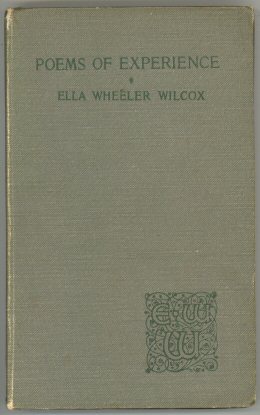
The Project Gutenberg eBook of Poems of Experience
Title: Poems of Experience
Author: Ella Wheeler Wilcox
Release date: February 1, 2004 [eBook #5170]
Most recently updated: May 7, 2025
Language: English
Credits: Transcribed from the 1917 Gay and Hancock edition by David Price
POEMS OF EXPERIENCE
BY
ELLA WHEELER WILCOX
GAY AND HANCOCK, LTD.
12 AND 13 HENRIETTA STREET, COVENT GARDEN
LONDON
1917
[All rights reserved]
Reprinted 1911, 1912, 1913, 1915, 1916, 1917
Any edition of my poems published in England by any firm except Messrs. Gay and Hancock is pirated and not authentic.
ELLA WHEELER WILCOX.
April 12, 1910.
CONTENTS
|
PAGE |
The Empty Bowl |
|
Keep Going |
|
A Prayer |
|
The London ‘Bobby’ |
|
Read at the Benefit of Clara Morris |
|
Two Ghosts |
|
Woman |
|
Battle Hymn of the Women |
|
Memories |
|
See? |
|
The Purpose |
|
The White Man |
|
A Moorish Maid |
|
Lincoln |
|
I know not |
|
Resurrection |
|
The Voices of the City |
|
If Christ came Questioning |
|
England, Awake! |
|
Be not attached |
|
An Episode |
|
The Voice of the Voiceless |
|
Time’s Defeat |
|
The Hymn of the Republic |
|
The Radiant Christ |
|
At Bay |
|
The Birth of Jealousy |
|
Summer’s Farewell |
|
The Goal |
|
Christ Crucified |
|
The Trip to Mars |
|
Fiction and Fact |
|
Progress |
|
How the White Rose Came |
|
I look to Science |
|
The Awakening |
|
Most blest is he |
|
Nirvana |
|
Life |
|
Two men |
|
Only be still |
|
Pardoned Out |
|
The Tides |
|
Progression |
|
Acquaintance |
|
Attainment |
|
The tower-room |
|
Father |
|
The new Hawaiian girl |
THE EMPTY BOWL
I held the golden vessel of my soul
And prayed that God would fill it from on high.
Day after day the importuning cry
Grew stronger—grew, a heaven-accusing dole
Because no sacred waters laved my bowl.
‘So full the fountain, Lord, wouldst Thou deny
The little needed for a soul’s supply?
I ask but this small portion of Thy whole.’
Then from the vast invisible Somewhere,
A voice, as one love-authorised by Him,
Spake, and the tumult of my heart was stilled.
‘Who wants the waters must the bowl prepare;
Pour out the self, that chokes it to the brim,
But emptied vessels, from the source are filled.’
KEEP GOING
Is the goal distant, and troubled the road,
And the way long?
And heavy your load?
Then gird up your courage, and say ‘I am strong,’
And keep going.
Is the work weary, and endless the grind
And petty the pay?
Then brace up your mind
And say ‘Something better is coming my way,’
And keep doing.
Is the drink bitter life pours in your
cup—
Is the taste gall?
Then smile and look up
And say ‘God is with me whatever befall,’
And keep trusting.
Is the heart heavy with hope long deferred,
And with prayers that seem vain?
Keep saying the word—
And that which you strive for you yet shall attain.
Keep praying.
A PRAYER
Just as I shape the purport of my thought,
Lord of the Universe, shape Thou my lot.
Let each ill thought that in my heart may be,
Mould circumstance and bring ill luck to me.
Until I weed the garden of my mind
From all that is unworthy and unkind,
Am I not master of my mind, dear Lord?
Then as I think, so must be my reward.
Who sows in weakness, cannot reap in
strength,
That which we plant, we gather in at length.
Great God of Justice, be Thou just to me,
And as my thoughts, so let my future be.
THE
LONDON ‘BOBBY’
A TRIBUTE TO THE
POLICEMEN OF ENGLAND’S
CAPITAL
Here in my cosy corner,
Before a blazing log,
I’m thinking of cold London
Wrapped in its killing fog;
And, like a shining beacon
Above the picture grim,
I see the London ‘Bobby,’
And sing my song for him.
I see his stalwart figure,
I see his kindly face,
I hear his helpful answer
At any hour or place.
For, though you seek some by-way
Long miles from his own beat,
He tells you all about it,
And how to find the street.
He looks like some bold Viking,
This king of earth’s police—
Yet in his voice lies feeling,
And in his eye lies peace;
He knows and does his duty—
(What higher praise is there?)
And London’s lords and paupers
Alike receive his care.
He has a regal bearing,
Yet one that breathes repose;
It is the look and manner
Of one who thinks and knows.
Oh, men who govern nations,
In old worlds or in new,
Turn to the London ‘Bobby’
And learn a thing or two.
READ AT
THE BENEFIT
OF CLARA MORRIS
(AMERICA’S GREAT EMOTIONAL ACTRESS)
The Radiant Rulers of Mystic Regions
Where souls of artists are fitted for birth
Gathered together their lovely legions
And fashioned a woman to shine on earth.
They bathed her in splendour,
They made her tender,
They gave her a nature both sweet and wild;
They gave her emotions like storm-stirred oceans,
And they gave her the heart of a little child.
These Radiant Rulers (who are not human
Nor yet divine like the gods above)
Poured all their gifts in the soul of woman,
That fragile vessel meant only for love.
Still more they taught her,
Still more they brought her,
Till they
gave her the world for a harp one day:
And they bade her string it,
They bade her ring it,
While the stars all wondered to hear her play.
She touched the strings in a master fashion,
She uttered the cry of a world’s despair:
Its long hid secret, its pent-up passion,
She gave to the winds in a vibrant air.
For oh! the heart of her,
That was the art of her.
Great with the feeling that makes men kin.
Art unapproachable,
Art all uncoachable,
Fragrance and flame from the spirit within.
The earth turns ever an ear unheeding
To the sorrows of art, as it cries ‘encore.’
And she played on the harp till her hands were bleeding,
And her brow was bruised by the laurels she wore.
She knew the trend of it,
She knew the end of it—
Men heard
the music and men felt the thrill.
Bound to the altar
Of art, could she falter?
Then came a silence—the music was still.
And yet in the echoes we seem to hear it;
In waves unbroken it circles the earth:
And we catch in the light of her dauntless spirit
A gleam from the centre that gave her birth.
Still is the fame of her
Felt in the name of her—
But low lies the harp that once thrilled to her strain;
No hand has taken it,
No hand can waken it—
For the soul of her art was her secret of pain.
TWO GHOSTS
Two dead men boarded a spectral ship
In the astral Port of Space;
On that ghost-filled barque, they met in the dark,
And halted, face to face.
‘Now whither away’—called one
of the ghosts,
‘This ship sets sail for Earth.
On the astral plane you must remain,
Where the newly dead have birth.’
‘But I could not stay and I would not
stay,’
The other ghost replied;
‘I must hurry back to the old Earth track
And stand at my loved one’s side.
‘She weeps for me in her lonely room,
In the land from whence I came;
Oh! stow me away in this ship, I pray,
For I hear her call my name.’
‘You must not go, and you shall not go,’
The first ghost cried in wrath.
‘Your work is planned, in the astral land,
And a guide will show you the path.’
‘But the one I love’—‘I
loved her too,’
The first ghost stood and cried;
‘And year on year I waited here,
Yea, waited till you died.
‘For I would not come between you two,
Nor shadow her joy with fear,
But mine is the right, I claim this night
To visit the earthly sphere.
‘For you are dead, and I am dead,
And you had her long—so long.
And to look on the grace of her worshipped face,
Ah! now it can do no wrong.
‘I am fettered to Earth by love of
her,
And hers is the spell divine,
That can help me rise, to the realm that lies
Just over the astral line.
‘I have kept to the laws of God and man,
I have suffered and made no moan;
Now my little share of joy, I swear
I will have—and have it alone.’
A skeleton crew the anchor drew,
And the ship from the port swung free;
With a muffled clang the ghost bell rang,
And the boat sailed out to sea.
And one ghost stood on the deck and laughed,
As only a glad ghost can;
While a swooning soul was dragged to his goal,
To work out the astral span.
And a woman wept, and prayed ere she slept,
For a dream to ease her pain;
But she dreamed instead of a man long dead,
Who had loved her all in vain.
WOMAN
Strange are the ways that her feet have trod
Since first she was set in the path of duty,
Finished and fair by the hand of God,
To carry her message of love and beauty.
Delicate creature of light and shade,
She gleamed like an opal, on wide worlds under:
And earth looked up to her half afraid,
While heaven looked down at her, full of wonder.
Flame of the comet and mist of the moon,
And ray of the sun all mingled in her.
And the heart of her asked but a single boon—
That love should seek her, and find her, and win
her.
She grasped the scope of the First Intent
That made her kingdom for her, no other,
And joyfully into her place she went—
The primal mate, and the primal mother.
Large was that kingdom and vast her sphere,
And lightly she lifted and bore each burden.
Lightly she laughed in the eyes of fear,
For love was her recompense, love her guerdon.
And never in camp, or in cave, or in home,
Rose voice of mother or mate complaining.
And never the foot of her sought to roam,
Till love in the heart of the man seemed waning.
In the broad rich furrows by woman turned
Man, unwitting, set plough and harrow.
For worlds to conquer she had not yearned,
Till he spoke of her feminine sphere as
‘narrow.’
The lullaby changed to a martial strain—
When he took her travail, and song for
granted—
And forth she forged in his own domain—
Till the strange ‘new woman,’ the old
supplanted.
‘Strange’ with the glow of a
wakened soul,
And ‘new’ with the purpose of large
endeavour,
She turned her face to the higher goal—
To the higher goal it is turned for ever.
Trade and
science and craft and art,
Have opened their doors to the call of woman;
And greater she grows in her greater part,
More tenderly wise, and more sweetly human.
Brave foremothers of freedom’s birth
Smile through space on your splendid daughters.
At one with liberty lighting the earth,
Their torches flame o’er the darkest
waters.
They lend a lustre to sea and land:
They sweeten the world with their wholesome
graces:
As out in the harbour of life they stand
To cheer and welcome the coming races.
Brave forefathers and heroes who fought
Under the flag of the Revolution,
War was the price of the freedom you bought,
But peace is the watchword of Evolution.
The progress of woman means progress of peace,
She wars on war, and its hosts alarming;
And her great love battle will never cease,
Till the glory is seen of a world disarming.
The woman wonder with heart of flame,
The coming man of the race will find her.
For petty purpose and narrow aim,
And fault and flaw she will leave behind her.
He grown tender, and she grown wise,
They shall enter the Eden by both created;
The broadened kingdom of Paradise,
And love, and mate, as the first pair mated.
BATTLE HYMN OF THE WOMEN
They are waking, they are waking,
In the east, and in the west;
They are throwing wide their windows to the sun;
And they see the dawn is breaking,
And they quiver with unrest,
For they know their work is waiting to be done.
They are waking in the city,
They are waking on the farm;
They are waking in the boudoir, and the mill;
And their hearts are full of pity
As they sound the loud alarm,
For the sleepers, who in darkness, slumber, still.
In the guarded harem prison,
Where they smother under veils,
And all echoes of the world are walled away;
Though the sun has not yet risen,
Yet the ancient darkness pales,
And the sleepers, in their slumber, dream of day.
And their dream shall grow in splendour
Till each sleeper wakes, and stirs;
Till she breaks from old traditions, and is free;
And the world shall rise, and render
Unto woman what is hers,
As it welcomes in the race that is to be.
Unto woman, God the Maker
Gave the secret of His plan;
It is written out in cipher, on her soul;
From the darkness, you must take her,
To the light of day, O man!
Would you know the mighty meaning of the scroll.
MEMORIES [19]
I am thinking of the Springtime
On the farm out in the West,
When my world held nothing for me that I wanted,
(Save a courage all undaunted),
And my foolish little rhymes,
Were but heart beats, rung in chimes,
That I sounded, just to ease my life’s unrest.
Yes, I sang them, and I rang them,
Just to ease my youth’s unrest.
When I heard the name of London,
In that early day, afar,
In that Springtime of my Country over yonder,
Then I used to sit and wonder
If the day would come to me,
When my ship should cross the sea,
To the land that seemed as distant as a star.
In my
dreaming, ever gleaming
Like a distant unknown star.
Now in London in the Springtime,
I am sitting here, your guest.
Nay—I think it is a vision, or a fancy—
Part of dreamland Necromancy;
And I question: is it true
That the great warm hearts of you,
Heard the winging of that singing in the West,
Heard the chiming of my rhyming
From the farmhouse in the West?
Let me linger in the fancy,
For the soul of me is stirred
As I dream that I am sitting here among you;
And the songs that I have sung you
Shall grow stronger through the art
Of heart speaking unto heart,
Through the gladness of the singer who is heard
Lo! my songs have crossed the ocean
But the voice of my emotion finds no word.
SEE?
If one proves weak who you fancied strong,
Or false who you fancied true,
Just ease the smart of your wounded heart
By the thought that it is not you!
If many forget a promise made,
And your faith falls into the dust,
Then look meanwhile in your mirror and smile,
And say, ‘I am one to trust!’
If you search in vain for an ageing face
Unharrowed by fretful fears,
Then make right now (and keep) a vow
To grow in grace with the years.
If you lose your faith in the word of man
As you go from the port of youth,
Just say as you sail, ‘I will not fail
To keep to the course of truth!’
For this is the way, and the only way—
At least so it seems to me.
It is up to you, to be, and do,
What you look for in others.
See?
THE PURPOSE
Over and over the task was set,
Over and over I slighted the work,
But ever and alway I knew that yet
I must face and finish the toil I shirk.
Over and over the whip of pain
Has spurred and punished with blow on blow;
As ever and alway I tried in vain
To shun the labour I hated so.
Over and over I came this way
For just one purpose: O stubborn soul!
Turn with a will to your work to-day,
And learn the lesson of Self-Control.
THE WHITE MAN
Wherever the white man’s feet have
trod
(Oh far does the white man stray)
A bold road rifles the virginal sod,
And the forest wakes out of its dream of God,
To yield him the right of way.
For this is the law: By the power of thought,
For worse, or for better, are miracles
wrought.
Wherever the white man’s pathway
leads,
(Far, far has that pathway gone)
The Earth is littered with broken creeds—
And alway the dark man’s tent recedes,
And the white man pushes on.
For this is the law: Be it good or ill,
All things must yield to the stronger will.
Wherever the white man’s light is
shed,
(Oh far has that light been thrown)
Though
Nature has suffered and beauty bled,
Yet the goal of the race has been thrust ahead,
And the might of the race has grown.
For this is the law: Be it cruel or kind,
The Universe sways to the power of mind.
A MOORISH MAID
Above her veil a shrouded Moorish maid
Showed melting eyes, as limpid as a lake;
A brow untouched by care; a band of jetty hair,
And nothing more. The all-concealing haik
Fell to her high arched instep. At her side
An old duenna walked; her withered face
Half covered only, since no lingering grace
Bespoke the beauty once her master’s pride.
Above her veil, the Moorish maid beheld
The modern world, in Paris-decked Algiers;
Saw happy lad and lass, in love’s contentment pass,
Or in sweet wholesome friendship, free from
fears.
She saw fair matrons, walking arm-in-arm
With life-long lovers, time-endeared, and then
She saw the ardent look in eyes of men,
And thrilled and trembled with a vague alarm.
Above her veil she saw the stuccoed court
That led to dim secluded rooms within.
She followed, dutiful, the dame unbeautiful,
Who told her that the Christian world means sin.
Some day, full soon, she would go forth a bride—
Of one whose face she never had beheld.
Something within her, wakened, and rebelled;
She flung aside her veil, and cried, and cried.
LINCOLN
When God created this good world
A few stupendous peaks were hurled
From His strong hand, and they remain
The wonder of the level plain.
But these colossal heights are rare,
While shifting sands are everywhere.
So with the race. The centuries pass
And nations fall like leaves of grass.
They die, forgotten and unsung;
While straight from God some souls are flung,
To live immortal and sublime.
So lives great Lincoln for all time.
I KNOW NOT
Death! I know not what room you are
abiding in,
But I will go my way,
Rejoicing day by day,
Nor will I flee or stay
For fear I tread the path you may be hiding in.
Death! I know not, if my small barque be
nearing you;
But if you are at sea,
Still there my sails float free;
‘What is to be will be.’
Nor will I mar the happy voyage by fearing you.
Death! I know not, what hour or spot you
wait for me;
My days untroubled flow,
Just trusting on, I go,
For oh, I know, I know,
Death is but Life that holds some glad new fate for me.
INTERLUDE
The days grow shorter, the nights grow
longer;
The headstones thicken along the way,
And life grows sadder, but love grows stronger,
For those who walk with us day by day.
The tear comes quicker, the laugh comes
slower;
The courage is lesser to do and dare;
And the tide of joy in the heart falls lower,
And seldom covers the reefs of care.
But all true things in the world seem truer;
And the better things of earth seem best,
And friends are dearer, as friends are fewer,
And love is all as our sun dips west.
Then let us clasp hands as we walk together,
And let us speak softly in love’s sweet
tone;
For no man knows on the morrow whether
We two pass on—or but one alone.
RESURRECTION
Pausing a moment ere the day was done,
While yet the earth was scintillant with light,
I backward glanced. From valley, plain, and height,
At intervals, where my life-path had run,
Rose cross on cross; and nailed upon each one
Was my dead self. And yet that gruesome sight
Lent sudden splendour to the falling night,
Showing the conquests that my soul had won.
Up to the rising stars I looked and cried,
‘There is no death! for year on year, re-born
I wake to larger life: to joy more great,
So many times have I been crucified,
So often seen the resurrection morn,
I go triumphant, though new Calvaries wait.
THE VOICES OF THE CITY
The voices of the city—merged and
swelled
Into a mighty dissonance of sound,
And from the medley rose these broken strains
In changing time and ever-changing keys.
I
Pleasure seekers, silken clad,
Led by cherub Day,
Ours the duty to be glad,
Ours the toil of play.
Sleep has bound the commonplace,
Pleasure rules the dawn.
Small hours set the merry pace
And we follow on.
We must use the joys of earth,
All its cares we’ll keep;
Night was made for youth and mirth,
Day was made for sleep.
Time has cut his beard, and lo!
He is but a boy,
Singing, on with him we go,
Ah! but life is joy.
II
We are the vendors of beauty,
We the purveyors for hell;
The carnal bliss of a purchased kiss
And the pleasures that blight, we sell.
God pity us; God pity the world.
We are the sad race-victims
Of the misused force in man,
Of the great white flame burned black with shame
And lost to the primal plan.
God pity us; God pity the world.
We are the Purpose of Being
Gone wrong in the thought of the world.
The torch for its hand made a danger brand
And into the darkness hurled.
God pity us; God pity the world.
III
We are the toilers in the realm of night
(Long, long the hours of night),
We are the human lever, wheel, and bolt,
That keeps the civic vehicle from jolt,
And jar upon the shining track of day
(The unremembered day).
We sleep away the sunlit hours of life
(Unsatisfied, sad life),
We wake in shadow and we rise in gloom.
False as a wanton’s artificial bloom
Is that made light we labour in till dawn
(The lonely, laggard dawn).
Like visions half remembered in a dream
(A strange and broken dream)
Our children’s faces, seen but while they sleep,
Within our hearts these weary hours we keep.
We are the toilers in the realm of night
(Long, long the hours of night).
CHORUS
We are hope and faith and sorrow,
We are peace and pain and passion,
We are
ardent lovers kissing,
We are happy mothers crooning,
We are rosy children dreaming,
We are honest labour sleeping,
We are wholesome pleasure laughing,
We are wakeful riches feasting,
We are lifted spirits praying,
We the voices of the city.
Out of the medley rose these broken strains,
In changing time and ever-changing keys.
IF CHRIST CAME QUESTIONING
If Christ came questioning His world to-day,
(If Christ came questioning,)
‘What hast thou done to glorify thy God,
Since last My feet this lower earth plane trod?’
How could I answer Him; and in what way
One evidence of my allegiance bring;
If Christ came questioning.
If Christ came questioning, to me alone,
(If Christ came questioning,)
I could not point to any church or shrine
And say, ‘I helped build up this house of Thine;
Behold the altar, and the corner stone’;
I could not show one proof of such a thing;
If Christ came questioning.
If Christ came questioning, on His demand,
(If Christ came questioning,)
No pagan soul converted to His creed
Could I proclaim; or say, that word or deed
Of mine,
had spread the faith in any land;
Or sent it forth, to fly on stronger wing;
If Christ came questioning.
If Christ came questioning the soul of me,
(If Christ came questioning,)
I could but answer, ‘Lord, my little part
Has been to beat the metal of my heart,
Into the shape I thought most fit for Thee;
And at Thy feet, to cast the offering;
Shouldst Thou come questioning.
‘From out the earth-fed furnaces of
desire,
(Ere Thou cam’st questioning,)
This formless and unfinished gift I brought,
And on life’s anvil flung it down, white hot:
A glowing thing, of selfishness and fire,
With blow on blow, I made the anvil ring;
(Ere Thou cam’st questioning).
‘The hammer, Self-Control, beat hard on
it;
(Ere Thou cam’st questioning,)
And with each blow, rose fiery sparks of pain;
I bear their scars, on body, soul, and brain.
Long, long I toiled; and yet, dear Lord, unfit,
And all unworthy, is the heart I bring,
To meet Thy questioning.’
ENGLAND, AWAKE!
A beautiful great lady, past her prime,
Behold her dreaming in her easy chair;
Gray robed, and veiled; in laces old and rare,
Her smiling eyes see but the vanished time,
Of splendid prowess, and of deeds sublime.
Self satisfied she sits, all unaware
That peace has flown before encroaching care,
And through her halls stalks hunger, linked with crime.
England, awake! from dreams of what has
been,
Look on what is, and put the past away.
Speak to your sons, until they understand.
England, awake! for dreaming now is sin;
In all your ancient wisdom, rise to-day,
And save the glory of your menaced land.
BE NOT ATTACHED
‘Be not attached.’ So runs
the great command
For those who seek to ‘know’ and
‘understand.’
Who sounds the waters of the deeper sea
Must first draw up his anchor and go free.
But not for me, that knowledge. I must
wait
Until again I enter through life’s gate.
I am not brave enough to sail away
To farther seas, and leave this beauteous bay.
Love barnacled, my anchor lies; and oh!
I would not lift it if I could, and go
All unattached, to find those truths which lie
Far out at sea, beneath a lonely sky.
Though peace of heart, and happiness of
soul,
Await the seeker at that farther goal,
With love
and all its rapture and its pain,
Close to the shores of earth I must remain.
Nor yet would I relinquish my sweet dream
To gain possession of the Fact supreme.
I am attached, and well content to stay,
Learning such truths as love may send my way.
AN EPISODE
Along the narrow Moorish street
A blue-eyed soldier strode.
(Ah, well-a-day)
Veiled from her lashes to her feet
She stepped from her abode,
(Ah, lack-a-day).
Now love may guard a favoured wife
Who leaves the harem door;
(Ah, well-a-day)
But hungry hearted is her life
When she is one of four.
(Ah, lack-a-day.)
If black eyes glow with sudden fire
And meet warm eyes of blue—
(Ah, well-a-day).
The old, old story of desire
Repeats itself anew.
(Ah, lack-a-day.)
When bugles blow the soldier flies—
Though bitter tears may fall
(Ah, lack-a-day).
A Moorish child with blue, blue eyes
Plays in the harem hall.
(Ah, well-a-day.)
THE VOICE OF THE VOICELESS
I am the voice of the voiceless;
Through me the dumb shall speak;
Till the deaf world’s ear be made to hear
The cry of the wordless weak.
From street, from cage, and from kennel,
From jungle and stall, the wail
Of my tortured kin proclaims the sin
Of the mighty against the frail.
I am a ray from the centre;
And I will feed God’s spark,
Till a great light glows in the night and shows
The dark deeds done in the dark.
And full on the thoughtless sleeper
Shall flash its glaring flame,
Till he wakens to see what crimes may be
Cloaked under an honoured name.
The same Force formed the sparrow
That fashioned man, the king;
The God of
the Whole gave a spark of soul
To furred and to feathered thing.
And I am my brother’s keeper,
And I will fight his fight,
And speak the word for beast and bird,
Till the world shall set things right.
Let no voice cavil at Science—
The strong torch-bearer of God;
For brave are his deeds, though dying creeds,
Must fall where his feet have trod.
But he who would trample kindness
And mercy into the dust—
He has missed the trail, and his quest will fail:
He is not the guide to trust.
For love is the true religion,
And love is the law sublime;
And all that is wrought, where love is not,
Will die at the touch of time.
And Science, the great revealer,
Must flame his torch at the Source;
And keep it bright with that holy light,
Or his feet shall fail on the course.
Oh, never a brute in the forest,
And never a snake in the fen,
Or ravening bird, starvation stirred,
Has hunted its prey like men.
For hunger, and fear, and passion
Alone drive beasts to slay,
But wonderful man, the crown of the plan,
Tortures, and kills, for play.
He goes well fed from his table;
He kisses his child and wife;
Then he haunts a wood, till he orphans a brood,
Or robs a deer of its life.
He aims at a speck in the azure;
Winged love, that has flown at a call;
It reels down to die, and he lets it lie;
His pleasure was seeing it fall.
And one there was, weary of laurels,
Of burdens and troubles of State;
So the jungle he sought, with the beautiful thought
Of shooting a she lion’s mate.
And one came down from the pulpit,
In the pride of a duty done,
And his cloth sufficed, as his emblem of Christ,
While murder smoked out of his gun.
One strays from the haunts of fashion
With an indolent, unused brain;
But his sluggish heart feels a sudden start
In the purpose of giving pain.
And the fluttering flock of pigeons,
As they rise on eager wings,
From prison to death, bring a catch in his breath:
Oh, the rapture of killing things!
Now, this is the race as we find it,
Where love, in the creed, spells hate;
And where bird and beast meet a foe in the priest
And in rulers of fashion and State.
But up to the Kingdom of Thinkers
Has risen the cry of our kin;
And the weapons of thought are burnished and brought
To clash with the bludgeons of sin.
Far Christ, of a million churches,
Come near to the earth again;
Be more than a Name; be a living Flame;
‘Make Good’ in the hearts of men.
Shine full on the path of Science,
And show it the heights above,
Where vast truths lie for the searching eye
That shall follow the torch of love.
TIME’S DEFEAT
Time has made conquest of so many things
That once were mine. Swift-footed, eager youth
That ran to meet the years; bold brigand health,
That broke all laws of reason unafraid,
And laughed at talk of punishment.
Close ties of blood and friendship, joy of
life,
Which reads its music in the major key
And will not listen to a minor strain—
These things and many more are spoils of time.
Yet as a conqueror who only storms
The outposts of a town, and finds the fort
Too strong to be assailed, so time retreats
And knows his impotence. He cannot take
My three great jewels from the crown of life:
Love, sympathy, and faith; and year on year
He sees them grow in lustre and in worth,
And glowers by me, plucking at his beard,
And dragging, as he goes, a useless scythe.
Once in the dark he plotted with his friend
Grim Death, to steal my treasures. Death replied:
‘They are immortal, and beyond thy reach,
I could but set them in another sphere,
To shine with greater lustre.’
Time and Death
Passed on together, knowing their defeat;
And I am singing by the road of life.
THE HYMN OF THE REPUBLIC
I have listened to the sighing of the burdened
and the bound,
I have heard it change to crying, with a menace in the sound;
I have seen the money-getters pass unheeding on the way,
As they went to forge new fetters for the people day by day.
Then the voice of Labour thundered forth its
purpose and its need,
And I marvelled, and I wondered, at the cold dull ear of
greed;
For as chimes, in some great steeple, tell the passing of the
hour,
So the voices of the people tell the death of purchased
power.
All the gathered dust of ages, God is brushing from His
book;
He is opening up its pages, and He bids His children look;
And in shock and conflagration, and in pestilence and strife,
He is speaking to the nations, of the brevity of life.
Mother Earth herself is shaken by our sorrows
and our crimes;
And she bids her sons awaken to the portent of the times;
With her travail pains upon her, she is hurling from their
place
All the minions of dishonour, to admit the Coming Race.
By the voice of Justice bidden, she has torn
the mask from might;
All the shameful secrets hidden, she is dragging into light;
And whoever wrongs his neighbour must be brought to judgment
now,
Though he wear the badge of Labour, or a crown upon his brow.
There is growth in Revolution, if the word is
understood;
It is one with Evolution, up from self, to brotherhood;
He who utters it unheeding, bent on self, or selfish gain,
His own day of doom is speeding, though he toil, or though he
reign.
God is calling to the masses, to the peasant,
and the peer;
He is calling to all classes, that the crucial hour is near;
For each rotting throne must tremble, and fall broken in the
dust,
With the leaders who dissemble, and betray a people’s
trust.
Still the voice of God is calling; and above
the wreck I see,
And beyond the gloom appalling, the great Government-to-Be.
From the ruins it has risen, and my soul is
overjoyed,
For the school supplants the prison, and there are no
‘unemployed.’
And there are no children’s faces at the spindle
or the loom;
They are out in sunny places, where the other sweet things
bloom;
God has purified the alleys, He has set the white slaves free,
And they own the hills and valleys in this Government to-Be.
THE RADIANT CHRIST
I
Arise, O master artist of the age,
And paint the picture which at once shall be
Immortal art and bless’d prophecy.
The bruiséd vision of the world assuage;
To earth’s dark book add one illumined page,
So scintillant with truth, that all who see
Shall break from superstition and stand free.
Now let this wondrous work thy hand engage.
The mortal sorrow of the Nazarene,
Too long has been faith’s symbol and its sign;
Too long a dying Saviour has sufficed.
Give us the glowing emblem which shall mean
Mankind awakened to the Self Divine;
The living emblem of the Radiant Christ.
II
Too long the crucifix on Calvary’s
height
Has cast its shadow on the human heart.
Let now Religion’s great co-worker Art,
Limn on the background of departing night,
The shining Face all palpitant with light,
And God’s true message to the world impart.
Go tell each toiler in the home and mart,
‘Lo, Christ is with ye, if ye seek aright.’
The world forgets the vital word Christ taught;
The only word the world has need to know:
The answer to creation’s problem—Love.
The world remembers what the Christ forgot;
His cross of anguish and His death of woe;
Release the martyr, and the Cross remove!
III
For now the former things have passed away,
And man, forgetting that which lies behind,
And ever pressing forward, seeks to find
The prize of his high calling. Send a ray
From art’s bright sun to fortify the day,
And blaze the trail to every mortal mind.
The new
religion lies in being kind;
Faith stands and works, where once it knelt to pray;
Faith counts its gain, where once it reckoned loss;
Ascending paths its patient feet have trod;
Man looks within, and finds salvation there.
Release the suffering Saviour from the Cross,
And give the waiting world its Radiant God.
AT BAY
Wife
Reach out your arms, and hold me close and
fast.
Tell me there are no memories of your past
That mar this love of ours, so great, so vast.
Husband
Some truths are cheapened when too oft
averred.
Does not the deed speak louder than the word?
(Dear God, that old dream woke again and stirred.)
Wife
As you love me, you never loved before?
Though oft you say it, say it yet once more.
My heart is jealous of those days of yore.
Husband
Sweet wife, dear comrade, mother of my
child,
My life is yours by memory undefiled.
(It stirs again, that passion brief and wild.)
You never knew a happier hour than this?
We two alone, our hearts surcharged with bliss,
Nor other kisses, sweet as my own kiss?
Husband
I was a thirsty field, long parched with
drouth;
You were the warm rain, blowing from the south.
(But, ah, the crimson madness of her mouth!)
Wife
You would not, if you could, go down
life’s track
For just one little moment and bring back
Some vanished rapture that you miss or lack?
Husband
I am content. You are my life, my all.
(One burning hour, but one, could I recall;
God, how men lie when driven to the wall!)
THE BIRTH OF JEALOUSY
With brooding mien and sultry eyes,
Outside the gates of Paradise
Eve sat, and fed the faggot flame
That lit the path whence Adam came.
(Strange are the workings of a woman’s mind.)
His giant shade preceded him,
Along the pathway green, and dim;
She heard his swift approaching tread,
But still she sat with drooping head.
(Dark are the jungles of unhappy thought.)
He kissed her mouth, and gazed within
Her troubled eyes; for since their sin,
His love had grown a thousand fold.
But Eve drew back; her face was cold.
(Oh, who can read the cipher of a soul.)
‘Now art thou mourning still, sweet
wife?’
Spake Adam tenderly, ‘the life
Of our lost Eden? Why, in thee
All Paradise remains for me.’
(Deep, deep the currents in a strong man’s heart.)
Thus Eve: ‘Nay, not lost Eden’s
bliss
I mourn; for heavier woe than this
Wears on me with one thought accursed.
In Adam’s life I am not first.
(O woman’s mind! what hells are fashioned there.)
‘The serpent whispered Lilith’s
name:
(’Twas thus he drove me to my shame)
Pluck yonder fruit, he said, and know,
How Adam loved her, long ago.
(Fools, fools, who wander searching after pain.)
‘I ate; and like an ancient scroll,
I saw that other life unroll;
I saw thee, Adam, far from here
With Lilith on a wondrous sphere.
(Bold, bold, the daring of a jealous heart.)
‘Nay, tell me not I dreamed it all;
Last night in sleep thou didst let fall
Her name in tenderness; I bowed
My stricken head and cried aloud.
(Vast, vast the torment of a self-made woe.)
‘And it was then, and not before,
That Eden shut and barred its door.
Alone in God’s great world I seemed,
Whilst thou of thy lost Lilith dreamed.
(Oh, who can measure such wide loneliness.)
‘Now every little breeze that sings,
Sighs Lilith, like thy whisperings.
Oh, where can sorrow hide its face,
When Lilith, Lilith, fills all space?’
(And Adam in the darkness spake no word.)