
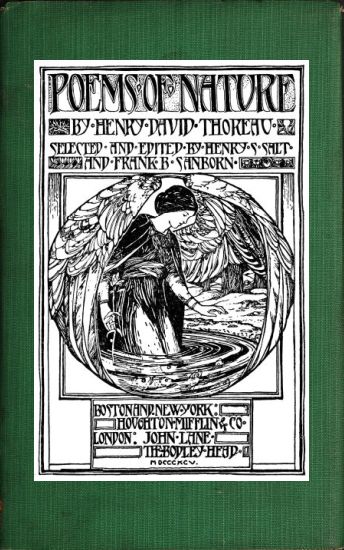
The Project Gutenberg eBook of Poems of Nature
Title: Poems of Nature
Author: Henry David Thoreau
Editor: Henry S. Salt
F. B. Sanborn
Release date: July 27, 2019 [eBook #59988]
Most recently updated: January 24, 2021
Language: English
Credits: Produced by Tim Lindell, Chuck Greif and the Online
Distributed Proofreading Team at http://www.pgdp.net (This
file was produced from images generously made available
by The Internet Archive/American Libraries.)
POEMS OF NATURE
CONTENTS
INTRODUCTION
The fifty poems here brought together under the title ‘Poems of Nature’ are perhaps two-thirds of those which Thoreau preserved. Many of them were printed by him, in whole or in part, among his early contributions to Emerson’s Dial, or in his own two volumes, The Week and Walden, which were all that were issued in his lifetime. Others were given to Mr. Sanborn for publication, by Sophia Thoreau, the year after her brother’s death (several appeared in the Boston Commonwealth in 1863); or have been furnished from time to time by Mr. Blake, his literary executor.
Most of Thoreau’s poems were composed early in his life, before his twenty-sixth year, ‘Just now’ he wrote in the autumn of 1841, ‘I am in the mid-sea of verses, and they actually rustle round me, as the leaves would round the head of Autumnus himself, should he thrust it up through some vales which I know; but, alas! many of them are but crisped and yellow leaves like his, I fear, and will deserve no better fate than to make mould for new harvests.’ After 1843 he seems to have written but few poems, and had destroyed perhaps as many as he had retained, because they did not meet the exacting requirements of his friend Emerson, upon whose opinion at that time he placed great reliance. This loss was regretted by Thoreau in after years, when the poetical habit had left him, for he fancied that some of the verses were better than his friend had supposed. But Emerson, who seldom changed his mind, adhered to his verdict, and while praising some of the poems highly, perhaps extravagantly, would admit but a small number of them to the slight selection which he appended to the posthumous edition of Thoreau’s Letters, edited by him in 1865; and even these were printed, in some instances, in an abbreviated and imperfect form.[1] A few other poems, with some translations from the Greek, have lately been included by Thoreau’s Boston publishers in their volume of Miscellanies (vol. x. of the Riverside Edition, 1894). But no collection so full as the present one has ever been offered to the public.
It has not been attempted to make this a complete collection of Thoreau’s poems, because, as has been well said, ‘many of them seem to be merely pendants to his prose discourse, dropped in as forcible epigrams where they are brief, and in other instances made ancillary to the idea just expressed, or to perpetuate a distinct conception that has some vital connection with the point from which it was poured forth. It is, therefore, almost an injustice to treat them separately at all.’[2] After the discontinuance of The Dial, Thoreau ceased to publish his verses as separate poems, but interpolated them, in the manner described, in his prose essays, where they form a sort of accompaniment to the thought, and from which it is in many cases impossible to detach them. That he himself set some value on them in this connection may be gathered from a sentence in the last of his published letters, in which he writes to a correspondent: ‘I am pleased when you say that in The Week you like especially those little snatches of poetry interspersed through the book, for these I suppose are the least attractive to most readers.’
Everything that concerns a great writer has its special interest; and Thoreau’s poetry, whatever its intrinsic value may be, is full of personal significance; in fact, as Emerson remarked, ‘his biography is in his verses.’ Thus, many of these poems will be found to throw light on certain passages of his life. ‘Inspiration,’ for example, is the record of his soul’s awakening to the new impulse of transcendentalism; the stanzas on ‘Sympathy’ perhaps contain in a thinly disguised form the story of his youthful love, and the sacrifice which he imposed on himself to avoid rivalry with his brother; the lines ‘To my Brother’ refer to the sudden and tragic death of John Thoreau in 1842; and ‘The Departure’ is believed to be the poem in which Henry Thoreau, when leaving in 1843 the home of Emerson, where he had lived for two years, took farewell of his friends. The numerous other allusions to the life and scenery of Concord, with which Thoreau’s own life was so closely blended, require no comment or explanation.
Thoreau’s view of the poetic character, as stated by him in The Week, is illustrative of his own position. ‘A true poem,’ he says, ‘is distinguished not so much by a felicitous expression, or any thought it suggests, as by the atmosphere which surrounds it. There are two classes of men called poets. The one cultivates life, the other art: one seeks food for nutriment, the other for flavor; one satisfies hunger, the other gratifies the palate.’ There can be no doubt to which of these classes Thoreau himself belongs. If metrical skill be insisted on as an indispensable condition of poetry, he can hardly be ranked among the poets; nor, where this criterion was dominant, was it surprising that, as one of his contemporaries tells us,[3] with reference to his verses in The Dial, ‘an unquenchable laughter, like that of the gods at Vulcan’s limping, went up over his ragged and halting lines.’ But in the appreciation of poetry there is a good deal more to be considered than this; and, as the same writer has remarked, there is ‘a frank and unpretending nobleness’ in many of Thoreau’s verses, distinguished as they are, at their best, by their ripe fulness of thought, quiet gravity of tone, and epigrammatic terseness of expression. The title of poet could hardly be withheld from the author of such truly powerful pieces as ‘The Fall of the Leaf,’ ‘Winter Memories,’ ‘Smoke in Winter,’ or ‘Inspiration.’
Nor should it be forgotten that Thoreau was always regarded as a poet by those who were associated with him. ‘Poet-Naturalist’ was the suggestive title which Ellery Channing applied to him; and Hawthorne remarked that ‘his thoughts seem to measure and attune themselves into spontaneous verse, as they rightfully may, since there is real poetry in them.’ Even Emerson’s final estimate was far from unappreciative. ‘His poetry,’ he wrote in his biographical sketch, ‘might be bad or good; he no doubt wanted a lyric facility and technical skill, but he had the source of poetry in his spiritual perception. His own verses are often rude and defective. The gold does not yet run pure—is drossy and crude. The thyme and marjoram are not yet honey. But if he want lyric fineness and technical merits, if he have not the poetic temperament, he never lacks the causal thought, showing that his genius was better than his talent.’
Perhaps what Thoreau said of Quarles, one of that school of gnomic poets of which he was a student, might be aptly applied to himself: ‘It is rare to find one who was so much of a poet and so little of an artist. Hopelessly quaint, he never doubts his genius; it is only he and his God in all the world. He uses language sometimes as greatly as Shakespeare; and though there is not much straight grain in him, there is plenty of rough, crooked timber.’ The affinity of Thoreau’s style to that of Herbert, Donne, Cowley, and other minor Elizabethans, has often been remarked; and it has been truly said that the stanzas ‘Sic Vita’ might almost have a niche in Herbert’s Temple.
It must be granted, then, that Thoreau, whatever his limitations, had the poet’s vision, and sometimes the poet’s divine faculty; and if this was manifested more frequently in his masterly prose, it was neither absent from his verse nor from the whole tenor of his character. It was his destiny to be one of the greatest prose writers whom America has produced, and he had a strong, perhaps an exaggerated, sense of the dignity of this calling. ‘Great prose,’ he thinks, ‘of equal elevation, commands our respect more than great verse, since it implies a more permanent and level height, a life more pervaded with the grandeur of the thought. The poet only makes an irruption, like a Parthian, and is off again, shooting while he retreats; but the prose writer has conquered, like a Roman, and settled colonies.’
If, therefore, we cannot unreservedly place Thoreau among the poetical brotherhood, we may at least recognise that he was a poet in the larger sense in which his friends so regarded him—he felt, thought, acted, and lived as a poet, though he did not always write as one. In his own words—
But I could not both live and utter it.’
Such qualities dignify life and make the expression of it memorable, not perhaps immediately, to the multitude of readers, but at first to an appreciative few, and eventually to a wide circle of mankind.
NATURE
To be the highest in thy quire,—
To be a meteor in the sky,
Or comet that may range on high;
Only a zephyr that may blow
Among the reeds by the river low;
Give me thy most privy place
Where to run my airy race.
INSPIRATION
And blesses us;
The work we choose should be our own,
God leaves alone.
Though all the Muses lend their force,
From my poor love of anything,
The verse is weak and shallow as its source.
Listening behind me for my wit,
With faith superior to hope,
More anxious to keep back than forward it;
Unto the flame my heart hath lit,
Then will the verse for ever wear—
Time cannot bend the line which God hath writ.
Floats in review before my mind,
And such true love and reverence brings,
That sometimes I forget that I am blind.
Some clear divine electuary,
And I, who had but sensual been,
Grow sensible, and as God is, am wary.
And sight, who had but eyes before,
I moments live, who lived but years,
And truth discern, who knew but learning’s lore.
I see beyond the range of sight,
New earths and skies and seas around,
And in my day the sun doth pale his light.
Pierces my soul through all its din,
As through its utmost melody,—
Farther behind than they, farther within.
Its voice than thunder is more loud,
It doth expand my privacies
To all, and leave me single in the crowd.
With so serene and lofty tone,
That idle Time runs gadding by,
And leaves me with Eternity alone.
And only now my prime of life,
Of manhood’s strength it is the flower,
’Tis peace’s end and war’s beginning strife.
By a grey wall or some chance place,
Unseasoning Time, insulting June,
And vexing day with its presuming face.
More rich than are Arabian drugs,
That my soul scents its life and wakes
The body up beneath its perfumed rugs.
The star that guides our mortal course,
Which shows where life’s true kernel’s laid,
Its wheat’s fine flour, and its undying force.
And also my poor human heart,
With one impulse propels the years
Around, and gives my throbbing pulse its start.
Nor falter from a steadfast faith,
For though the system be turned o’er,
God takes not back the word which once he saith.
Which not my worth nor want has bought,
Which wooed me young, and wooes me old,
And to this evening hath me brought.
To know the one historic truth,
Remembering to the latest date
The only true and sole immortal youth.
No matter through what danger sought,
I’ll fathom hell or climb to heaven,
And yet esteem that cheap which love has bought.
SIC VITA[4]
‘It is but thin soil where we stand; I have felt my roots in a richer ere this. I have seen a bunch of violets in a glass vase, tied loosely with a straw, which reminded me of myself.’—The Week.
By a chance bond together,
Dangling this way and that, their links
Were made so loose and wide,
Methinks,
For milder weather.
And sorrel intermixed,
Encircled by a wisp of straw
Once coiled about their shoots,
The law
By which I’m fixed.
Those fair Elysian fields,
With weeds and broken stems, in haste,
Doth make the rabble rout
That waste
The day he yields.
Drinking my juices up,
With no root in the land
To keep my branches green,
But stand
In a bare cup.
In mimicry of life,
But ah! the children will not know,
Till time has withered them,
The woe
With which they’re rife.
THE FISHER’S BOY[5]
As near the ocean’s edge as I can go;
My tardy steps its waves sometimes o’erreach,
Sometimes I stay to let them overflow.
To place my gains beyond the reach of tides,
Each smoother pebble, and each shell more rare,
Which Ocean kindly to my hand confides.
They scorn the strand who sail upon the sea;
Yet oft I think the ocean they’ve sailed o’er
Is deeper known upon the strand to me.
THE ATLANTIDES
‘The Friend is some fair floating isle of palms eluding the mariner in Pacific Seas.’—The Week.
More bright than Phlegethon, more low,
Island us ever, like the sea,
In an Atlantic mystery.
Our fabled shores none ever reach,
No mariner has found our beach,
Scarcely our mirage now is seen,
And neighboring waves with floating green,
Yet still the oldest charts contain
Some dotted outline of our main;
In ancient times midsummer days
Unto the western islands’ gaze,
To Teneriffe and the Azores,
Have shown our faint and cloud-like shores.
Anon your coast with commerce smiles,
And richer freights ye’ll furnish far
Than Africa or Malabar.
Be fair, be fertile evermore,
Ye rumored but untrodden shore;
Princes and monarchs will contend
Who first unto your lands shall send,
And pawn the jewels of the crown
To call your distant soil their own.
And companions in his labors,
Who on the ocean’s verge and firm land’s end
Doth long and truly seek his Friend.
Many men dwell far inland,
But he alone sits on the strand.
Whether he ponders men or books,
Always still he seaward looks,
Marine news he ever reads,
And the slightest glances heeds,
Feels the sea breeze on his cheek,
At each word the landsmen speak,
In every companion’s eye
A sailing vessel doth descry;
In the ocean’s sullen roar
From some distant port he hears,
Of wrecks upon a distant shore,
And the ventures of past years.
THE AURORA OF GUIDO[6]
A FRAGMENT
Reining his prancing steeds with steady hand;
The lingering moon through western shadows gropes,
While Morning sheds its light o’er sea and land.
Resound with all the busy din of life;
The fisherman unfurls his sails again;
And the recruited warrior bides the strife.
The curling waves reflect the unseen light;
The slumbering sea with the day’s impulse heaves,
While o’er the western hill retires the drowsy night.
Far circling out over the frothy waves,—
SYMPATHY[7]
Whose features all were cast in Virtue’s mould,
As one she had designed for Beauty’s toy,
But after manned him for her own stronghold.
That you might see no lack of strength within;
For walls and ports do only serve alway
For a pretence to feebleness and sin.
With toil and strife who stormed the House of Fame;
In other sense this youth was glorious,
Himself a kingdom wheresoe’er he came.
When all was income of its own accord;
For where he went none other was to see,
But all were parcel of their noble lord.
That stilly shows fresh landscapes to our eyes,
And revolutions works without a murmur,
Or rustling of a leaf beneath the skies.
I quite forgot my homage to confess;
Yet now am forced to know, though hard it is,
I might have loved him, had I loved him less.
A stern respect withheld us farther yet,
So that we seemed beyond each other’s reach,
And less acquainted than when first we met.
So could we not the simplest bargain drive;
And what avails it, now that we are wise,
If absence doth this doubleness contrive?
But I must tread my single way alone,
In sad remembrance that we once did meet,
And know that bliss irrevocably gone.
For elegy has other subject none;
Each strain of music in my ears shall ring
Knell of departure from that other one.
With fitting strain resound, ye woods and fields;
Sorrow is dearer in such case to me
Than all the joys other occasion yields.
FRIENDSHIP
‘Friends, Romans, Countrymen, and Lovers.’