
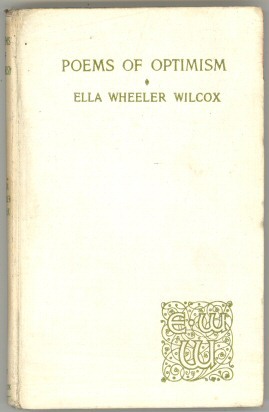
The Project Gutenberg eBook of Poems of Optimism
Title: Poems of Optimism
Author: Ella Wheeler Wilcox
Release date: February 1, 2005 [eBook #7421]
Most recently updated: July 20, 2014
Language: English
Credits: Transcribed from the 1919 Gay and Hancock edition by David Price
Transcribed from the 1919 Gay and Hancock edition by David Price, email ccx074@pglaf.org
POEMS OF OPTIMISM
BY
ELLA WHEELER WILCOX
GAY AND HANCOCK, LTD.
34 HENRIETTA STREET, COVENT GARDEN
LONDON
1919
All rights reserved
N.B.—The only volumes of my Poems issued with my approval in the British Empire are published by Messrs. Gay & Hancock.
ELLA WHEELER WILCOX
Published 1913
Reprinted 1915, 1918, 1919
CONTENTS
|
PAGE |
WAR |
|
Greater Britain |
|
Belgium |
|
Knitting |
|
Mobilisation |
|
Neutral |
|
A book for the King |
|
The men-made gods |
|
The Ghosts |
|
The poet’s theme |
|
Europe |
|
After |
|
The peace angel |
|
Peace should not come |
|
MISCELLANEOUS |
|
The Winds of Fate |
|
Beauty |
|
The invisible helpers |
|
To the women of Australia |
|
Replies |
|
A successful man |
|
Unsatisfied |
|
Separation |
|
To the teachers of the young |
|
Beauty making |
|
On Avon’s breast I saw a stately swan |
|
The little go-cart |
|
I am running forth to meet you |
|
Martyrs of peace |
|
Home |
|
The eternal now |
|
If I were a man, a young man |
|
We must send them out to play |
|
Protest |
|
Reward |
|
This is my task |
|
The statue |
|
Behold the earth |
|
What they saw |
|
His last letter |
|
A dialogue |
|
A wish |
|
Justice |
|
An old song |
|
Oh, poor, sick world |
|
Praise day |
|
Interlude |
|
The harp’s song |
|
The pendulum |
|
An old-fashioned type |
|
The sword |
|
Love and the seasons |
|
A naughty little comet |
|
The last dance |
|
A vagabond mind |
|
My flower room |
|
My faith |
|
Arrow and bow |
|
If we should meet him |
|
Faith |
|
The secret of prayer |
|
The answer |
|
A vision |
|
The second coming |
|
WAR
GREATER BRITAIN
Our hearts were not set on fighting,
We did not pant for the fray,
And whatever wrongs need righting,
We would not have met that way.
But the way that has opened before us
Leads on thro’ a blood-red field;
And we swear by the great God o’er us,
We will die, but we will not yield.
The battle is not of our making,
And war was never our plan;
Yet, all that is sweet forsaking,
We march to it, man by man.
It is either to smite, or be smitten,
There’s no other choice to-day;
And we live, as befits the Briton,
Or we die, as the Briton may.
We were not fashioned for cages,
Or to feed from a keeper’s hand;
Our strength which has grown thro’ ages
Is the strength of a slave-free land.
We cannot kneel down to a master,
To our God alone can we pray;
And we stand in this world disaster,
To fight, like a lion at bay.
BELGIUM
Ruined? destroyed? Ah, no; though blood
in rivers ran
Down all her ancient streets; though treasures manifold
Love-wrought, Time-mellowed, and beyond the price of gold
Are lost, yet Belgium’s star shines still in God’s
vast plan.
Rarely have Kings been great, since kingdoms
first began;
Rarely have great kings been great men, when all was told.
But, by the lighted torch in mailèd hands, behold,
Immortal Belgium’s immortal king, and Man.
KNITTING
At the concert and the play
Everywhere you see them sitting,
Knitting, knitting.
Women who the other day
Thought of nothing but their frocks
Or their jewels or their locks,
Women who have lived for pleasure,
Who have known no work but leisure,
Now are knitting, knitting, knitting
For the soldiers over there.
On the trains and on the ships
With a diligence befitting,
They are knitting.
Some with smiles upon their lips,
Some with manners debonair,
Some with earnest look and air.
But each heart in its own fashion,
Weaves in pity and compassion
In their knitting, knitting, knitting
For the soldiers over there.
Hurried women to and fro
From their homes to labour flitting,
Knitting, knitting,
Busy handed come and go.
Broken bits of time they spare,
Just to feel they do their share,
Just to keep life’s sense of beauty
In the doing of a duty,
They are knitting, knitting, knitting
For the soldiers over there.
MOBILISATION
Oh the Kings of earth have mobilised their
men.
See them moving, valour proving,
To the fields of glory going,
Banners flowing, bugles blowing,
Every one a mother’s son,
Brave with uniform and gun,
Keeping step with easy swing,
Yes, with easy step and light marching onward to the fight,
Just to please the warlike fancy of a King;
Who has mobilised his army for the strife.
Oh the King of Death has mobilised his men.
See the hearses huge and black
How they rumble down the track;
With their coffins filled with dead,
Filled with men who fought and bled;
Now from
fields of glory coming
To the sound of muffled drumming
They are lying still and white,
But the Kings have had their fight;
Death has mobilised his army for the grave.
NEUTRAL
That pale word ‘Neutral’ sits
becomingly
On lips of weaklings. But the men whose brains
Find fuel in their blood, the men whose minds
Hold sympathetic converse with their hearts,
Such men are never neutral. That word stands
Unsexed and impotent in Realms of Speech.
When mighty problems face a startled world
No virile man is neutral. Right or wrong
His thoughts go forth, assertive, unafraid
To stand by his convictions, and to do
Their part in shaping issues to an end.
Silence may guard the door of useless words,
At dictate of Discretion; but to stand
Without opinions in a world which needs
Constructive thinking, is a coward’s part.
A BOOK FOR THE KING
A book has been made for the King,
A book of beauty and art;
To the good king’s eyes
A smile shall rise
Hiding the ache in his heart—
Hiding the hurt and the grief
As he turns it, leaf by leaf.
A book has been made for the King,
A book of blood and of blight;
To the Great King’s eyes
A look shall rise
That will blast and wither and smite—
Yes, smite with a just God’s rage,
As He turns it, page by page.
THE MEN-MADE GODS
Said the Kaiser’s god to the god of the
Czar:
‘Hark, hark, how my people pray.
Their faith, methinks, is greater by far
Than all the faiths of the others are;
They know I will help them slay.’
Said the god of the Czar: ‘My people
call
In a medley of tongues; they know
I will lend my strength to them one and all.
Wherever they fight their foes shall fall
Like grass where the mowers go.’
Then the god of the Gauls spoke out of a
cloud
To the god of the King nearby:
‘Our people pray, tho’ they pray not loud;
They ask for courage to slaughter a crowd,
And to laugh, tho’ themselves may
die.’
And far out into the heart of Space
Where a lonely pathway crept,
Up over the stars, to a secret place,
Where no light shone but the light of His face,
Christ covered His eyes and wept.
THE GHOSTS
There was no wind, and yet the air
Seemed suddenly astir;
There were no forms, and yet all space
Seemed thronged with growing hosts.
They came from Where, and from Nowhere,
Like phantoms as they were;
They came from many a land and place—
The ghosts, the ghosts, the ghosts.
And some were white, and some were grey,
And some were red as blood—
Those ghosts of men who met their death
Upon the field of war.
Against the skies of fading day,
Like banks of cloud they stood;
And each wraith asked another wraith,
‘What were we fighting for?’
One said, ‘I was my mother’s all;
And she was old and blind.’
Another, ‘Back on earth, my wife
And week-old baby lie.’
Another, ‘At the bugle’s call,
I left my bride behind;
Love made so beautiful my life
I could not bear to die.’
In voices like the winds that moan
Among pine trees at night,
They whispered long, the newly dead,
While listening stars came out.
‘We wonder if the cause is known,
And if the war was right,
That killed us in our prime,’ they said,
‘And what it was about.’
They came in throngs that filled all
space—
Those whispering phantom hosts;
They came from many a land and place,
The ghosts, the ghosts, the ghosts.
THE POET’S THEME
Why should the poet of these pregnant times
Be asked to sing of war’s unholy crimes?
To laud and eulogise the trade which thrives
On horrid holocausts of human lives?
Man was a fighting beast when earth was
young,
And war the only theme when Homer sung.
’Twixt might and might the equal contest
lay:
Not so the battles of our modern day.
Too often now the conquering hero struts,
A Gulliver among the Lilliputs.
Success no longer rests on skill or fate,
But on the movements of a syndicate.
Of old, men fought and deemed it right and
just,
To-day the warrior fights because he must;
And in his secret soul feels shame because
He desecrates the higher manhood’s laws.
Oh, there are worthier themes for poet’s
pen
In this great hour than bloody deeds of men:
The rights of many—not the worth of
one—
The coming issues, not the battle done;
The awful opulence and awful need—
The rise of brotherhood—the fall of greed;
The soul of man replete with God’s own
force,
The call ‘to heights,’ and not the cry ‘to
horse.’
Are there not better themes in this great
age
For pen of poet, or for voice of sage,
Than those old tales of killing? Song is
dumb
Only that greater song in time may come.
When comes the bard, he whom the world waits
for,
He will not sing of War.
EUROPE
Little lads and grandsires,
Women old with care;
But all the men are dying men
Or dead men over there.
No one stops to dig graves;
Who has time to spare?
The dead men, the dead men
How the dead men stare.
Kings are out a-hunting—
Oh, the sport is rare;
With dying men and dead men
Falling everywhere.
Life for lads and grandsires;
Spoils for kings to share;
And dead men, dead men,
Dead men everywhere.
AFTER
Over the din of battle,
Over the cannons’ rattle,
Over the strident voices of men and their dying groans,
I hear the falling of thrones.
Out of the wild disorder
That spreads from border to border,
I see a new world rising from ashes of ancient towns;
And the Rulers wear no crowns.
Over the blood-charged water,
Over the fields of slaughter,
Down to the hidden vaults of Time, where lie the worn-out
things
I see the passing of Kings.
THE PEACE ANGEL
Angel of Peace, the hounds of war,
Unleashed, are all abroad,
And war’s foul trade again is made
Man’s leading aim in life.
Blood dyes the billow and the sod;
The very winds are rife
With tales of slaughter. Angel, pray,
What can we do or think or say
In times like these?
‘Child, think of
God!’
‘Before this little speck in space
Called Earth with light was shod,
Great chains and tiers of splendid spheres
Were fashioned by His hand.
Be thine the part to love and laud,
Nor seek to understand.
Go lift thine eyes from death-charged guns
To one who made a billion suns;
And trust and wait.
Child, dwell on God!’
PEACE SHOULD NOT COME
Peace should not come along this foul, earth
way.
Peace should not come, until we cleanse the path.
God waited for us; now in awful wrath
He pours the blood of men out day by day
To purify the highroad for her feet.
Why, what would Peace do, in a world where hearts
Are filled with thoughts like poison-pointed darts?
It were not meet, surely it were not meet
For Peace to come, and with her white robes hide
These industries of death—these guns and swords,—
These uniformed, hate-filled, destructive hordes,—
These hideous things, that are each nation’s pride.
So long as men believe in armèd might
Let arms be brandished. Let not Peace be sought
Until the race-heart empties out all thought
Of blows and blood, as arguments for Right.
The world
has never had enough of war,
Else war were not. Now let the monster stand,
Until he slays himself with his own hand;
Though no man knows what he is fighting for.
Then in the place where wicked cannons stood
Let Peace erect her shrine of Brotherhood.
MISCELLANEOUS
THE WINDS OF FATE
One ship drives east and another drives
west,
With the self-same winds that blow,
’Tis the set of the sails
And not the gales
That tell them the way to go.
Like the winds of the sea are the winds of fate,
As we voyage along through life,
’Tis the set of the soul
That decides its goal
And not the calm or the strife.
BEAUTY
The search for beauty is the search for
God
Who is All Beauty. He who seeks shall
find.
And all along the paths my feet have trod,
I have sought hungrily with heart and mind,
And open eyes for beauty,
everywhere.
Lo! I have found the world is very
fair.
The search for beauty is the search for God.
Beauty was first revealed to me by stars,
Before I saw it in my mother’s eyes,
Or, seeing, sensed it beauty, I was stirred
To awe and wonder by those orbs of light
All palpitant against empurpled skies.
They spoke a language to my childish heart
Of mystery and splendour, and of space,
Friendly with gracious, unseen presences.
Beauty was first revealed to me by stars.
Sunsets enlarged the meaning of the word.
There was a window looking to the west;
Beyond it, wide Wisconsin fields of grain,
And then a hill, whereon white flocks of clouds
Would gather in the afternoon to rest.
And when the sun went down behind that hill
What scenes of glory spread before my sight;
What beauty—beauty, absolute, supreme!
Sunsets enlarged the meaning of that word.
Clover in blossom, red and honey-sweet,
In summer billowed like a crimson sea
Across the meadow lands. One day, I stood
Breast-high amidst its waves, and heard the hum
Of myriad bees, that had gone mad like me
With fragrance and with beauty. Over us,
A loving sun smiled from a cloudless sky,
While a bold breeze kissed lightly as it passed,
Clover in blossom, red and honey-sweet.
Autumn spoke loudly of the beautiful.
And in the gallery of Nature hung
Colossal pictures hard against the sky,
Set forests gorgeous with a hundred hues;
And with each morning, some new wonder flung
Before the
startled world; some daring shade,
Some strange, new scheme of colour and of form.
Autumn spoke loudly of the beautiful.
Winter, though rude, is delicate in
art—
More delicate than Summer or than fall
(Even as rugged man is more refined
In vital things than woman). Winter’s touch
On Nature seemed most beautiful of all—
That evanescent beauty of the frost
On window panes; of clean, fresh, fallen snow;
Of white, white sunlight on the ice-draped trees.
Winter, though rude, is delicate in art.
Morning! The word itself is beautiful,
And the young hours have many gifts to give
That feed the soul with beauty. He who keeps
His days for labour and his nights for sleep
Wakes conscious of the joy it is to live,
And brings from that mysterious Land of Dreams
A sense of beauty that illumines earth.
Morning! The word itself is beautiful.
The search for beauty is the search for God.
THE INVISIBLE HELPERS
There are, there are
Invisible Great Helpers of the race.
Across unatlased continents of space,
From star to star.
In answer to some soul’s imperious need,
They speed, they speed.
When the earth-loving young are forced to
stand
Upon the border of the Unknown Land,
They come, they come—those angels who have trod
The altitudes of God,
And to the trembling heart
Their strength impart.
Have you not seen the delicate young maid,
Filled with the joy of life in her fair dawn,
Look in the face of death, all unafraid,
And smilingly pass on?
This is not human strength; not even faith
Has such large confidence in such an hour.
It is a power
Supplied by beings who have conquered death.
Floating from sphere to sphere
They hover near
The souls that need the courage they can give.
This is no vision of a dreamer’s mind.
Though we are blind
They live, they live,
Filling all space—
Invisible Great Helpers of the race.
TO THE WOMEN OF AUSTRALIA
A toast to the splendid daughters
Of the New World over the waters,
A world that is great as new;
Daughters of brave old races,
Daughters of heights and spaces,
Broad seas and broad earth places—
Hail to your land and you!
The sun and the winds have fed you;
The width of your world has led you
Out into the larger view;
Strong with a strength that is tender,
Bright with a primal splendour,
Homage and praise we render—
Hail to your land and you!
Sisters and daughters and mothers,
Standing abreast with your brothers,
Working for things that are true;
Thinking
and doing and daring,
Giving, receiving, and sharing,
Earning the crowns you are wearing—
Hail to your land and you!
REPLIES
You have lived long and learned the secret
of life, O Seer!
Tell me what are the best three things to seek—
The best three things for a man to seek on earth?
The best three things for a man to seek, O Son!
are these:
Reverence for that great Source from whence he came;
Work for the world wherein he finds himself;
And knowledge of the Realm toward which he goes.
What are the best three things to love on
earth, O Seer!
What are the best three things for a man to love?
The best three things for a man to love, O Son!
are these:
Labour which keeps his forces all in action;
A home
wherein no evil thing may enter;
And a loving woman with God in her heart.
What are the three great sins to shun,
O Seer!—
What are the three great sins for a man to shun?
The three great sins for a man to shun, O Son!
are these:
A thought which soils the heart from whence it goes;
An action that can harm a living thing;
And undeveloped energies of mind.
What are the worst three things to fear,
O Seer!—
What are the worst three things for a man to fear?
The worst three things for man to fear, O Son!
are these:
Doubt and suspicion in a young child’s eyes;
Accusing shame upon a woman’s face;
And in himself no consciousness of God.
EARTH BOUND
New paradise, and groom and bride;
The world was all their own;
Her heart swelled full of love and pride;
Yet were they quite alone?
‘Now how is it, oh how is it, and why is it’ (in
fear
All silent to herself she spake) ‘that something strange
seems here?’
Along the garden paths they walked—
The moon was at its height—
And lover-wise they strolled and talked,
But something was not right.
And ‘Who is that, now who is that, oh who is that,’
quoth she,
(All silent in her heart she spake) ‘that seems to follow
me?’
He drew her closer to his side;
She felt his lingering kiss;
And yet a shadow seemed to glide
Between her heart and his.
And
‘What is that, now what is that, oh what is that,’
she said,
(All silent to herself she spake) ‘that minds me of the
dead?’
They wandered back by beds of bloom;
They climbed a winding stair;
They crossed the threshold of their room,
But something waited there.
‘Now who is this, and what is this, and where is
this,’ she cried,
(All silent was the cry she made) ‘that comes to haunt and
hide?’
Wide-eyed she lay, the while he slept;
She could not name her fear.
But something from her bedside crept
Just as the dawn drew near,
(She did not know, she could not know—how could she
know?—who came
To haunt the home of one whose hand had dug her grave of
shame).
A SUCCESSFUL MAN
There was a man who killed a loving maid
In some mad mood of passion; and he paid
The price, upon a scaffold. Now his name
Stands only as a synonym for shame.
There was another man, who took to wife
A loving woman. She was full of life,
Of hope, and aspirations; and her pride
Clothed her like some rich mantle.
First,
the wide
Glad stream of life that through her veins had sway
He dammed by rocks, cast in it, day by day.
Her flag of hope, flung gaily to the world,
He placed half mast, and then hauled down, and furled.
The aspirations, breathing in each word,
By subtle ridicule, were made absurd:
The delicate fine mantle of her pride,
With rude unfeeling hands, was wrenched aside:
And by mean avarice, or vulgar show,
Her quivering woman’s heart was made to know
That she was but a chattel, bought to fill
Whatever niche might please the buyer’s will.
So she was murdered, while the slow years
went.
And her assassin, honoured, opulent,
Lived with no punishment, or social ban!
‘A good provider, a successful man.’
UNSATISFIED
The bird flies home to its young;
The flower folds its leaves about an opening bud;
And in my neighbour’s house there is the cry of a
child.
I close my window that I need not hear.
She is mine, and she is very beautiful:
And in her heart there is no evil thought.
There is even love in her heart—
Love of life, love of joy, love of this fair world,
And love of me (or love of my love for her);
Yet she will never consent to bear me a child.
And when I speak of it she weeps,
Always she weeps, saying:
‘Do I not bring joy enough into your life?
Are you not satisfied with me and my love,
As I am satisfied with you?
Never would I urge you to some great peril
To please my whim; yet ever so you urge me,
Urge me to
risk my happiness—yea, life itself—
So lightly do you hold me.’ And then she weeps,
Always she weeps, until I kiss away her tears
And soothe her with sweet lies, saying I am content.
Then she goes singing through the house like some bright bird
Preening her wings, making herself all beautiful,
Perching upon my knee, and pecking at my lips
With little kisses. So again love’s ship
Goes sailing forth upon a portless sea,
From nowhere unto nowhere; and it takes
Or brings no cargoes to enrich the world.
The
years
Are passing by us. We will yet be old
Who now are young. And all the man in me
Cries for the reproduction of myself
Through her I love. Why, love and youth like ours
Could populate with gods and goddesses
This great, green earth, and give the race new types
Were it made fruitful! Often I can see,
As in a vision, desolate old age
And loneliness descending on us two,
And nowhere in the world, nowhere beyond the earth,
Fruit of my loins and of her womb to feed
Our hungry
hearts. To me it seems
More sorrowful than sitting by small graves
And wetting sad-eyed pansies with our tears.
The bird flies home to its young;
The flower folds its leaves about an opening bud;
And in my neighbour’s house there is the cry of a
child.
I close my window that I need not hear.
SEPARATION
HE
One decade and a half since first we came
With hearts aflame
Into Love’s Paradise, as man and mate;
And now we separate.
Soon, all too soon,
Waned the white splendour of our honeymoon.
We saw it fading; but we did not know
How bleak the path would be when once its glow
Was wholly gone.
And yet we two were forced to follow on—
Leagues, leagues apart while ever side by side.
Darker and darker grew the
loveless weather,
Darker the way,
Until we could not stay
Longer together.
Now that all anger from our hearts has died,
And love
has flown far from its ruined nest,
To find sweet shelter in another breast,
Let us talk calmly of our past mistakes,
And of our faults; if only for the sakes
Of those with whom our futures will be cast.
You shall speak first.
SHE
A woman would speak last—
Tell me my first grave error as a wife.
HE
Inertia. My young veins
were rife
With manhood’s ardent blood; and love was fire
Within me. But you met my strong desire
With lips like frozen rose leaves—chaste, so
chaste
That all your splendid beauty seemed but waste
Of love’s materials. Then of that beauty
Which had so pleased my sight
You seemed to take no care; you felt no duty
To keep yourself an object of delight
For lover’s-eyes; and appetite
And indolence soon wrought
Their devastating changes. You were not
The woman I had sworn to love and cherish.
If love is starved, what can love do but perish?
Now will
you speak of my first fatal sin
And all that followed, even as I have done?
SHE
I must begin
With the young quarter of our
honeymoon.
You are but one
Of countless men who take the
priceless boon
Of woman’s love and kill it at the start,
Not wantonly but blindly.
Woman’s passion
Is such a subtle thing—woof of her heart,
Web of her spirit; and the body’s part
Is to play ever but the lesser rôle
To her white soul.
Seized in brute fashion,
It fades like down on wings of butterflies;
Then dies.
So my love died.
Next, on base Mammon’s cross you nailed my
pride,
Making me ask for what was mine by right:
Until, in my own sight,
I seemed a helpless slave
To whom the master gave
A grudging dole. Oh, yes, at times gifts showered
Upon your
chattel; but I was not dowered
By generous love. Hate never framed a curse
Or placed a cruel ban
That so crushed woman, as the law of man
That makes her pensioner upon his purse.
That necessary stuff called gold is such
A cold, rude thing it needs the nicest touch
Of thought and speech when it approaches love,
Or it will prove the certain death thereof.
HE
Your words cut deep; ’tis time we separate.
SHE
Well, each goes wiser to a newer mate.
TO THE TEACHERS OF THE YOUNG
How large thy task, O teacher of the young,
To take the ravelled threads by parents flung
With careless hands, and through consummate care
To weave a fabric, fine and firm and fair.
God’s uncompleted work is thine to do—
Be brave and true!
BEAUTY MAKING
Methinks there is no greater work in life
Than making beauty. Can the mind conceive
One little corner in celestial realms
Unbeautiful, or dull or commonplace?
Or picture ugly angels, illy clad?
Beauty and splendour, opulence and joy,
Are attributes of God and His domain,
And so are worth and virtue. But why preach
Of virtue only to the sons of men,
Ignoring beauty, till they think it sin?
Why, if each dweller on this little globe
Could know the sacred meaning of that word
And understand its deep significance,
Men’s thoughts would form in beauty, till their dreams
Of heaven would find expression in their lives,
However
humble; they themselves would grow
Godlike, befitting such a fair estate.
Let us be done with what is only good,
Demanding here and now the beautiful;
Lest, with the mind and eye on earth untrained,
We shall be ill at ease when heaven is gained.
ON AVON’S BREAST I SAW A STATELY SWAN
One day when England’s June was at its
best,
I saw a stately and imperious swan
Floating on Avon’s fair untroubled breast.
Sudden, it seemed as if all strife had gone
Out of the world; all discord, all unrest.
The sorrows and the sinnings of the race
Faded away like nightmares in the dawn.
All heaven was one blue background for the grace
Of Avon’s beautiful, slow-moving swan;
And earth held nothing mean or commonplace.
Life seemed no longer to be hurrying on
With unbecoming haste; but softly trod,
As one who reads in emerald leaf, or lawn,
Or crimson rose a message straight from God.
. . . . .
On Avon’s breast I saw a stately swan.
THE LITTLE GO-CART
It was long, long ago that a soul like a
flower
Unfolded, and blossomed, and passed in an hour.
It was long, long ago; and the memory seems
Like the pleasures and sorrows that come in our dreams.
The kind years have crowned me with many a
joy
Since the going away of my wee little boy;
Each one as it passed me has stooped with a kiss,
And left some delight—knowing one thing I miss.
But when in the park or the street, all
elate
A baby I see in his carriage of state,
As proud as a king, in his little go-cart—
I feel all the mother-love stir in my heart!
And I seem to be back in that long-vanished May;
And the baby, who came but to hurry away
In the little white hearse, is not dead, but alive,
And out in his little go-cart for a drive.
I whisper a prayer as he rides down the
street,
And my thoughts follow after him, tender and sweet;
For I know, by a law that is vast and divine,
(Though I know not his name) that the baby is mine!
I AM RUNNING FORTH TO MEET YOU
I am running forth to meet you, O my Master,
For they tell me you are surely on the way;
Yes, they tell me you are coming back again
(While I run, while I run).
And I wish my feet were winged to speed on faster,
And I wish I might behold you here to-day,
Lord of men.
I am running, yet I walk beside my
neighbour,
And I take the duties given me to do;
Yes, I take the daily duties as they fall
(While I run, while I run),
And my heart runs to my hand and helps the labour,
For I think this is the way that leads to you,
Lord of all.
I am running, yet I turn from toil and duty,
Oftentimes to just the art of being glad;
Yes, to just the joys that make the earth-world bright
(While I run, while I run).
For the soul that worships God must worship beauty,
And the heart that thinks of You can not be sad,
Lord of light.
I am running, yet I pause to greet my
brother,
And I lean to rid my garden of its weed;
Yes, I lean, although I lift my thoughts above
(While I run, while I run).
And I think of that command, ‘Love one another,’
As I hear discordant sounds of creed with creed,
Lord of Love.
I am running, and the road is lit with
splendour,
And it brightens and shines fairer with each span;
Yes, it brightens like the highway in a dream
(While I run, while I run).
And my heart to all the world grows very tender,
For I seem to see the Christ in every man,
Lord supreme.
MARTYRS OF PEACE
Fame writes ever its song and story,
For heroes of war, in letters of glory.
But where is the story and where is the song
For the heroes of peace and the martyrs of wrong?
They fight their battles in shop and mine;
They die at their posts and make no sign.
They herd like beasts in a slaughter pen;
They live like cattle and suffer like men.
Why, set by the horrors of such a life,
Like a merry-go-round seems the battle’s strife,
And the open sea, and the open boat,
And the deadly cannon with bellowing throat.
Oh, what are they all, with death thrown in,
To the life that has nothing to lose or win—
The life that has nothing to hope or gain
But ill-paid labour and beds of pain?
Fame, where is your story and where is your
song
For the martyrs of peace and the victims of wrong?
HOME
The greatest words are always solitaires,
Set singly in one syllable; like birth,
Life, love, hope, peace. I sing the worth
Of that dear word toward which the whole world fares—
I sing of home.
To make a home, we should take all of love
And much of labour, patience, and keen joy;
Then mix the elements of earth’s alloy
With finer things drawn from the realms above,
The spirit home.
There should be music, melody and song;
Beauty in every spot; an open door
And generous sharing of the pleasure store
With fellow-pilgrims as they pass along,
Seeking for home.
Make ample room for silent friends—the books,
That give so much and only ask for space.
Nor let Utility crowd out the vase
Which has no use save gracing by its looks
The precious home.
To narrow bounds let mirrors lend their aid
And multiply each gracious touch of art;
And let the casual stranger feel the part—
The great creative part—that love has played
Within the home.
Here bring your best in thought and word and
deed,
Your sweetest acts, your highest self-control;
Nor save them for some later hour and goal.
Here is the place, and now the time of need,
Here in your home.
THE ETERNAL NOW
Time with his back against the mighty wall,
Which hides from view all future joy and sorrow,
Hears, without answer, the impatient call
Of puny man, to tell him of to-morrow.
Moral, be wise, and to the silence bow,
These useless and unquiet ways forsaking;
Concern thyself with the Eternal Now—
To-day hold all things, ready for thy taking.
IF I WERE A MAN, A YOUNG MAN
If I were a man, a young man, and knew what I
know to-day,
I would look in the eyes of Life undaunted
By any Fate that might threaten me.
I would give to the world what the world most wanted—
Manhood that knows it can do and be;
Courage that dares, and faith that can see
Clear into the depths of the human soul,
And find God there, and the ultimate goal,
If I were a man, a young man, and knew what I know to-day.
If I were a man, a young man, and knew what I
know to-day,
I would think of myself as the masterful creature
Of all the Masterful plan;
The Formless Cause, with form and feature;
The Power that heeds not limit or
ban;
Man, wonderful man.
I would do good deeds, and forget them straightway;
I would weave my woes into ropes
and climb
Up to the heights of the helper’s gateway;
And Life should serve me, and
Time,
And I would sail out, and out, and
find
The treasures that lie in the deep
sea, Mind.
I would dream, and think, and
act;
I would work, and love, and pray,
Till each dream and vision grew
into a fact,
If I were a man, a young man, and knew what I know to-day.
If I were a man, a young man, and knew what I
know to-day,
I would guard my passions as Kings guard
treasures,
And keep them high and clean.
(For the will of a man, with his passions,
measures;
It is strong as they are keen.)
I would think of each woman as some one’s
mother;
I would think of each man as my own blood
brother,
And speed him along on his way.
And the glory of life in this wonderful hour
Should fill me and thrill me with Conscious
power,
If I were a man, a young man, and knew what I know to-day.
WE MUST SEND THEM OUT TO PLAY
Now much there is need of doing must not be
done in haste;
But slowly and with patience, as a jungle is changed
to a town.
But listen, my brothers, listen;
it is not always so:
When a murderer’s hand is lifted to kill, there is no time
to waste;
And the way to change his purpose is first to knock
him down
And teach him the law of kindness
after you give him the blow.
The acorn you plant in the morning will not
give shade at noon;
And the thornless cactus must be bred by year on
year of toil.
But listen, my brothers, listen;
it is not ever the way,
For the
roots of the poison ivy plant you cannot pull too soon;
If you would better your garden and make the most of
your soil,
Hurry and dig up the evil things
and cast them out to-day.
The ancient sin of the nations no law can ever
efface;
We must wait for the mothers of men to grow, and
give clean souls to their sons.
But listen, my brothers,
listen—when a child cries out in pain,
We must rise from the banquet board and go, though the host is
saying grace;
We must rise and find the Herod of Greed, who is
killing our little ones,
Nor ever go back to the banquet
until the monster is slain.
The strong man waits for justice, with lifted
soul and eyes,
As a sturdy oak will face the storm, and does not
break or bow.
But listen, my brothers, listen;
the child is a child for a day;
If a
merciless foot treads down each shoot, how can the forest
rise?
We are robbing the race when we rob a child; we must
rescue the children NOW;
We must rescue the little slaves
of Greed and send them out to play.
PROTEST
To sit in silence when we should protest
Makes cowards out of men. The human race
Has climbed on protest. Had no voice been raised
Against injustice, ignorance and lust
The Inquisition yet would serve the law
And guillotines decide our least disputes.
The few who dare must speak and speak again
To right the wrongs of many. Speech, thank God,
No vested power in this great day and land
Can gag or throttle; Press and voice may cry
Loud disapproval of existing ills,
May criticise oppression and condemn
The lawlessness of wealth-protecting laws
That let the children and child-bearers toil
To purchase ease for idle millionaires,
Therefore do I protest against the boast
Of independence in this mighty land.
Call no
chain strong which holds one rusted link,
Call no land free that holds one fettered slave
Until the manacled, slim wrists of babes
Are loosed to toss in childish sport and glee,
Until the Mother bears no burden save
The precious one beneath her heart; until
God’s soil is rescued from the clutch of greed
And given back to labour, let no man
Call this the Land of Freedom.
REWARD
Fate used me meanly; but I looked at her and
laughed,
That none might know how bitter was the cup I quaffed.
Along came Joy, and paused beside me where I sat,
Saying, ‘I came to see what you were laughing
at.’
THIS IS MY TASK
When the whole world resounds with rude
alarms
Of warring arms,
When God’s good earth, from border unto border
Shows man’s disorder,
Let me not waste my dower of mortal might
In grieving over wrongs I cannot right.
This is my task: amid discordant strife
To keep a clean sweet centre in my life;
And though the human orchestra may be
Playing all out of key—
To tune my soul to symphonies above,
And sound the note of love.
This is my task.
When by the minds of men most beauteous
Faith
Seems doomed to death,
And to her place is hoisted, by soul treason,
The dullard Reason,
Let me not
hurry forth with flag unfurled
To proselyte an unbelieving world.
This is my task: in depths of unstarred night
Or in diverting and distracting light
To keep (in crowds, or in my room alone)
Faith on her lofty throne;
And whatsoever happen or befall,
To see God’s hand in all.
This is my task.
When, in church pews, men worship God in
words,
But meet their kind with swords,
When Fair Religion, stripped of holy passion,
Walks masked as Fashion,
Let me not wax indignant at the sight;
Or waste my strength bewailing her sad plight.
This is my task: to search in my own mind
Until the qualities of God I find;
To seek them in the hearts of friend and foe—
Or high or low;
And in my hours of toil, or prayer, or play,
To live my creed each day.
This is my task.