
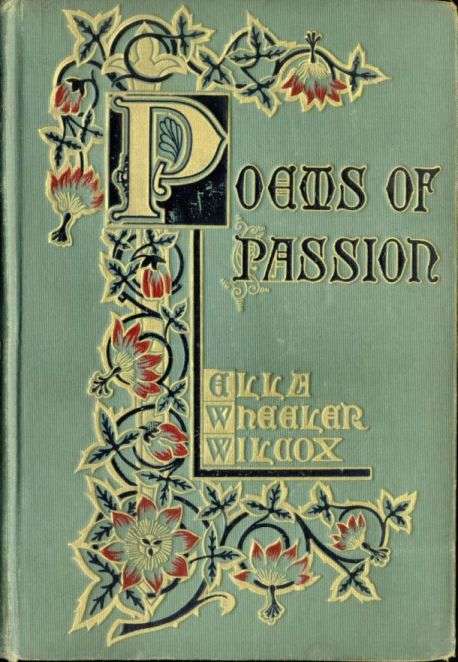
The Project Gutenberg eBook of Poems of Passion
Title: Poems of Passion
Author: Ella Wheeler Wilcox
Release date: September 30, 2005 [eBook #16776]
Most recently updated: March 13, 2025
Language: English
Credits: E-text prepared by Chuck Greif and Pat Saumell
POEMS OF PASSION
BY
ELLA WHEELER WILCOX
Illustrated
OTHER BOOKS
by
Ella Wheeler Wilcox
THREE WOMEN
POEMS OF POWER
MAURINE
POEMS OF PASSION
POEMS OF PLEASURE
KINGDOM OF LOVE AND OTHER POEMS
AN ERRING WOMAN'S LOVE
EVERY-DAY THOUGHTS
MEN WOMEN AND EMOTIONS
AN AMBITIOUS MAN
THE BEAUTIFUL LAND OF NOD
AROUND THE YEAR WITH ELLA
WHEELER WILCOX A Birthday Book
W.B. CONKEY COMPANY
Publishers—CHICAGO
1883
What know you of the soul from whence it sprung?
His secret thought unto the listening crowd?
You have its shape, its color and no more.
That lie beneath the surface of the seas.
Here, take them at your pleasure; but think not
Where lie our shipwrecks and our coral caves.
THE POET'S SONG
PREFACE
Among the twelve hundred poems which have emanated from my too prolific pen there are some forty or fifty which treat entirely of that emotion which has been denominated "the grand passion"—love. A few of those are of an extremely fiery character.
When I issued my collection known as "Maurine, and Other Poems," I purposely omitted all save two or three of these. I had been frequently accused of writing only sentimental verses; and I took pleasure and pride in presenting to the public a volume which contained more than one hundred poems upon other than sentimental topics. But no sooner was the book published than letters of regret came to me from friends and strangers, and from all quarters of the globe, asking why this or that love poem had been omitted. These regrets were repeated to me by so many people that I decided to collect and issue these poems in a small volume to be called "Poems of Passion." By the word "Passion" I meant the "grand passion" of love. To those who take exception to the title of the book I would suggest an early reference to Webster's definitions of the word.
Since this volume has caused so much agitation throughout the entire country, and even sent a tremor across the Atlantic into the Old World, I beg leave to make a few statements concerning some of the poems.
The excitement of mingled horror and amaze seems to center upon four poems, namely: "Delilah," "Ad Finem," "Conversion," and "Communism."
"Delilah" was written and first published in 1877. I had been reading history, and became stirred by the power of such women as Aspasia and Cleopatra over such grand men as Antony, Socrates, and Pericles. Under the influence of this feeling I dashed off "Delilah," which I meant to be an expression of the powerful fascination of such a woman upon the memory of a man, even as he neared the hour of death. If the poem is immoral, then the history which inspired it is immoral. I consider it my finest effort.
"Ad Finem" was written in 1878. I think there are few women of strong character and affections who cannot, from either experience or observation, understand the violent intensity of regret and despair which sometimes takes possession of the human heart after the loss by death, fate, or the force of circumstances, of some one very dear.
In "Ad Finem" I intended to give voice to this very common experience of almost every heart. Many noble women have since told me that the poem was true to life. It is not, as many people have wilfully or stupidly construed it, a bit of poetical advice to womankind to "barter the joys of Paradise" for "just one kiss." It is simply an illustration of a moment of turbulent anguish and vehement despair, such moments of unreasoning and overwhelming sorrow as the most moral people may experience during a lifetime.
In "Communism" I endeavored to use a new simile in illustrating that somewhat hackneyed theme of the supremacy of Love over Reason; and simply to carry out my idea I represented the violent uprising of the Communist emotions against King Reason.
"Conversion" was suggested to me by the remark of a gentleman friend. In speaking to me of the woman he loved, he said: "I have always been a skeptic regarding the existence of heaven, but I am so much happier in my love for this woman than I ever supposed it possible for me to be on earth that I begin to believe that the tales of heavenly raptures may be true."
I embodied his idea in the poem which has brought, with a few others, so much censure and criticism upon this volume, although it contains nearly seventy-five other selections quite irreproachable in character, however faulty they may be in construction.
It is impossible to pursue a successful literary career and follow the advice of all one's "best friends." I have received severe censure from my orthodox friends for writing liberal verses. My liberal friends condemn my devout and religious poems as "aiding superstition." My early temperance verses were pronounced "fanatical trash" by others.
With all due thanks and appreciation for the kind motives which interest so many dear friends in my career, I yet feel compelled to follow the light which my own intellect and judgment cast upon my way, rather than any one of the many conflicting rays which other minds would lend me.
ELLA WHEELER.
CONTENTS
POEMS OF PASSION
"REJOICE, AND MEN WILL SEEK YOU"
LOVE'S LANGUAGE.
In the faint flush upon the tell-tale cheek,
And in the pallor that succeeds it; by
The quivering lid of an averted eye—
The smile that proves the patent to a sigh—
Thus doth Love speak.
By the uneven heart-throbs, and the freak
Of bounding pulses that stand still and ache,
While new emotions, like strange barges, make
Along vein-channels their disturbing course;
Still as the dawn, and with the dawn's swift force—
Thus doth Love speak.
In the avoidance of that which we seek—
The sudden silence and reserve when near—
The eye that glistens with an unshed tear—
The joy that seems the counterpart of fear,
As the alarmed heart leaps in the breast,
And knows and names and greets its godlike guest—
Thus doth Love speak.
In the proud spirit suddenly grown meek—
The haughty heart grown humble; in the tender
And unnamed light that floods the world with splendor;
In the resemblance which the fond eyes trace
In all fair things to one beloved face;
In the shy touch of hands that thrill and tremble;
In looks and lips that can no more dissemble—
Thus doth Love speak.
In the wild words that uttered seem so weak
They shrink ashamed to silence; in the fire
Glance strikes with glance, swift flashing high and higher
Like lightnings that precede the mighty storm;
In the deep, soulful stillness; in the warm,
Impassioned tide that sweeps through throbbing veins
Between the shores of keen delight and pains;
In the embrace where madness melts in bliss,
And in the convulsive rapture of a kiss—
Thus doth Love speak.
LOVE'S LANGUAGE
IMPATIENCE.
The once fleet mornings linger by the way,
Their sunny smiles touched with malicious glee
At my unrest; they seem to pause, and play
Like truant children, while I sigh and say,
How can I wait?
Refused to pause or loiter with me long;
But now they idly fill their hands with flowers,
And make no haste, but slowly stroll among
The summer blooms, not heeding my one song,
How can I wait?
They reach forth to a future day, and bring
Sweet dreams of you to people all my mind;
And time speeds by on light and airy wing.
I feast upon your face, I no more sing,
How can I wait?
A pitying night has flung upon my soul.
You are not near me, and I know full well
My heart has need of patience and control;
Before we meet, hours, days, and weeks must roll.
How can I wait?
Until the sunlight of your eyes shall shine
Upon my world that seems so desolate?
Until your hand-clasp warms my blood like wine;
Until you come again, oh, love of mine,
How can I wait?
COMMUNISM.
When my heart is asleep and my brain has sway,
It is then that I vow we must part forever,
That I will forget you, and put you away
Out of my life, as a dream is banished
Out of the mind when the dreamer awakes;
That I know it will be, when the spell has vanished,
Better for both of our sakes.
I know it is wiser for us to part;
But Love is a spy who is plotting treason,
In league with that warm, red rebel, the Heart.
They whisper to me that the King is cruel,
That his reign is wicked, his law a sin;
And every word they utter is fuel
To the flame that smoulders within.
With the fever of youth and its mad desires,
When my brain in vain bids my heart be quiet,
When my breast seems the centre of lava-fires,
Oh, then is the time when most I miss you,
And I swear by the stars and my soul and say
That I will have you and hold you and kiss you,
Though the whole world stands in the way.
My fierce emotions roam out of their lair;
They hate King Reason for being royal;
They would fire his castle, and burn him there.
Oh, Love! they would clasp you and crush you and kill you,
In the insurrection of uncontrol.
Across the miles, does this wild war thrill you
That is raging in my soul?
"LOVE'S IMPATIENCE"
THE COMMON LOT.
To waste on one the riches of her soul,
Who takes the wealth she gives him, but cannot
Repay the interest, and much less the whole.
For some response to my fond gaze and touch,
It seems to me there is no sadder fate
Than to be doomed to loving overmuch.
So thoughtful of my comfort, and so true.
Yes, yes, dear heart; but I, not being blind,
Know that I am not loved as I love you.
Will fill my soul with music and with song;
And if you seem abstracted, or I miss
The heart-tone from your voice, my world goes wrong.
When at some thoughtless word the tears will start;
You cannot understand how aught you speak
Has power to stir the depths of my poor heart.
Or feign indifference where I now adore;
For if I seemed to love you less you would,
Manlike, I have no doubt, love me the more.
A constant heart; for fact doth daily prove
That constancy finds oft a cruel sting,
While fickle natures win the deeper love.
COMMON LOT
INDIVIDUALITY.
Just as a weaker woman loves her own,
Better than I love my beloved art,
Which, till you came, reigned royally, alone,
My king, my master. Since I saw your face
I have dethroned it, and you hold that place.
Your frown can make the whole world like a tomb;
Your smile shines brighter than the sun, by far.
Sometimes I think there is not space or room
In all the earth for such a love as mine,
And it soars up to breathe in realms divine.
Could break my heart, as women's hearts do break.
If my wan days had nothing to expect
From your love's splendor, all joy would forsake
The chambers of my soul. Yes, this is true.
And yet, and yet—one thing I keep from you.
Into my long pursued and worshipped art;
Though your great love fills me with such content
No other love finds room now, in my heart.
Yet that rare essence was my art's alone.
Thank God, you cannot grasp it; 'tis mine own.
With that vast love, as passionate as tender,
I feel an exultation as I know
I have not made you a complete surrender.
Here is my body; bruise it, if you will,
And break my heart; I have that something still.
Or bind the perfume of the rose, as well.
God put it in my soul when I was born;
It is not mine to give away, or sell,
Or offer up on any altar shrine.
It was my art's; and when not art's, 'tis mine,
Or anything which stands 'twixt me and you.
But that strange essence God bestowed, I say,
To permeate the work He gave to do:
And it cannot be drained, dissolved, or sent
Through any channel save the one He meant.
FRIENDSHIP AFTER LOVE.
Has burned itself to ashes, and expires
In the intensity of its own fires,
There come the mellow, mild, St. Martin days,
Crowned with the calm of peace, but sad with haze.
So after Love has led us, till he tires
Of his own throes and torments and desires,
Comes large-eyed friendship: with a restful gaze
He beckons us to follow, and across
Cool, verdant vales we wander free from care.
Is it a touch of frost lies in the air?
Why are we haunted with a sense of loss?
We do not wish the pain back, or the heat;
And yet, and yet, these days are incomplete.
LOVE TRIUMPANT
QUERIES.
That last strange time of a hundred times?
When we met to swear that we could forget—
I your caresses, and you my rhymes—
The rhyme of my lays that rang like a bell,
And the rhyme of my heart with yours, as well?
That was bitter with lees of the wasted wine,
When the tattered remains of a threadbare bliss,
And the worn-out shreds of a joy divine,
With a year's best dreams and hopes, were cast
Into the rag-bag of the Past?
With a chuckle of glee at a bargain made,
Did you discover, like me, one day,
That, hid in the folds of those garments frayed,
Were priceless jewels and diadems—
The soul's best treasures, the heart's best gems?
The place of those jewels so rare and chaste?
Do all that you borrow or beg or buy
Prove to be nothing but skilful paste?
Have you found pleasure, as I found art,
Not all-sufficient to fill your heart?
Of the old delight that we cast away,
And find no worth in the silken threads
Of newer fabrics we wear to-day?
Have you thought the bitter of that last kiss
Better than sweets of a later bliss?
Whatever your answer, I understand
That there is no pathway by which we can go
Back to the dead past's wonderland;
And the gems he purchased from me, from you,
There is no rebuying from Time, the Jew.
"THE OLD DELIGHT THAT WE CAST AWAY"
UPON THE SAND.
Is like a mansion built upon the sand.
Though brave its walls as any in the land,
And its tall turrets lift their heads in grace;
Though skilful and accomplished artists trace
Most beautiful designs on every hand,
And gleaming statues in dim niches stand,
And fountains play in some flow'r-hidden place:
Of adverse fate is blown, or sad rains fall,
Day in, day out, against its yielding wall,
Lo! the fair structure crumbles to the dust.
Love, to endure life's sorrow and earth's woe,
Needs friendship's solid mason-work below.
REUNITED.
Tie up the broken threads of that old dream,
And go on happy as before, and seem
Lovers again, though all the world may scoff.
Our parting and our meeting, and the tears
That rusted out the gold-work of the years,
The frosts that fell upon our gardens green.
Who made our loving hearts her idle toys,
And once more revel in the old sweet joys
Of happy love. Nay, it is not too late!
Forget the silver gleaming in my hair;
Look only in my eyes! Oh! darling, there
The old love shone no warmer then than now.
I find the lost sweet memory of my youth,
Bright with the holy radiance of thy truth,
And hallowed with the blue of summer skies.
Like reunited lovers, hand in hand,
Back, and yet onward, to the sunny land
Of our To Be, which was our Long Ago.
WHAT SHALL WE DO?
My path leads there, and yours another way.
What shall we do with this fond love, dear heart?
It grows a heavier burden day by day.
There is not room enough to hide it, dear;
Not even the mighty storehouse of the past
Could cover it from our own eyes, I fear.
Merged into one great sea, too shallow then
Would be its waters to sink this emotion
So deep it could not rise to life again.
It would not in a thousand years expire.
Nay! it would thrive, exult, expand, and grow,
For from its very birth it fed on fire.
Give it no food, of glance, or word, or sigh;
No memories, even, of any bygone day;
No crumbs of vain regrets—so let it die.
"THE BEAUTIFUL BLUE DANUBE."
He smiles in her lifted eyes;
Like waves of that mighty river,
The strains of the "Danube" rise.
They float on its rhythmic measure
Like leaves on a summer-stream;
And here, in this scene of pleasure,
I bury my sweet, dead dream.
Like a star, shines out her face,
And the form his strong arm presses
Is sylph like in its grace.
As a leaf on the bounding river
Is lost in the seething sea,
I know that forever and ever
My dream is lost to me.
That grand old wordless rhyme;
And still those two ate swaying
In perfect tune and time.
If the great bassoons that mutter,
If the clarinets that blow,
Were given a voice to utter
The secret things they know,
On the Danube's battle-plains
The unknown hosts outnumber
Who die 'neath the "Danube's" strains?
Those fall where cannons rattle,
'Mid the rain of shot and shell;
But these, in a fiercer battle,
Find death in the music's swell.
Is blended the dying groan;
But here, in the halls of fashion,
Hearts break, and make no moan.
And the music, swelling and sweeping,
Like the river, knows it all;
But none are counting or keeping
The lists of these who fall.