
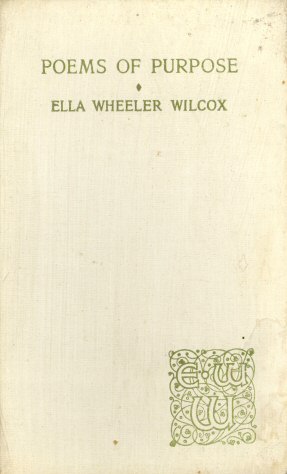
The Project Gutenberg eBook of Poems of Purpose
Title: Poems of Purpose
Author: Ella Wheeler Wilcox
Release date: October 1, 2004 [eBook #6618]
Most recently updated: August 14, 2014
Language: English
Credits: Transcribed from the 1919 Gay and Hancock edition by David Price
Transcribed from the 1919 Gay and Hancock edition by David Price, email ccx074@pglaf.org
POEMS OF PURPOSE
BY
ELLA WHEELER WILCOX
GAY AND HANCOCK, LTD.
54 HENRIETTA STREET, COVENT
GARDEN
LONDON
1919
All rights reserved
CONTENTS
|
PAGE |
A Good Sport |
|
A Son Speaks |
|
The Younger Born |
|
Happiness |
|
Seeking for Happiness |
|
The Island of Endless Play |
|
The River of Sleep |
|
The Things that Count |
|
Limitless |
|
What They Saw |
|
The Convention |
|
Protest |
|
A Bachelor to a Married Flirt |
|
The Superwoman |
|
Certitude |
|
Compassion |
|
Love |
|
Three Souls |
|
When Love is Lost |
|
Occupation |
|
The Valley of Fear |
|
What would it be? |
|
War Mothers |
|
A Holiday |
|
The Undertone |
|
Gypsying |
|
Song of the Road |
|
The Faith we Need |
|
The Price he Paid |
|
Divorced |
|
The Revealing Angels |
|
The Well-born |
|
Sisters of Mine |
|
Answer |
|
The Graduates |
|
The Silent Tragedy |
|
The Trinity |
|
The Unwed Mother to the Wife |
|
Father and Son |
|
Husks |
|
Meditations |
|
The Traveller |
|
What Have You Done? |
N.B.—The only volumes of my Poems issued with my approval in the British Empire are published by Messrs. Gay & Hancock.
ELLA WHEELER WILCOX.
A GOOD SPORT
I was a little lad,
and the older boys called to me from the pier:
They called to me: ‘Be a sport: be a sport! Leap in
and swim!’
I leaped in and swam, though I had never been taught a stroke.
Then I was made a hero, and they all shouted:
‘Well done! Well done,
Brave boy, you are a sport, a good sport!’
And I was very glad.
But now I wish I had learned to swim the right
way,
Or had never learned at all.
Now I regret that day,
For it led to my fall.
I was a youth, and I heard the older men
talking of the road to wealth;
They talked of bulls and bears, of buying on margins,
And they
said, ‘Be a sport, my boy, plunge in and win or lose it
all!
It is the only way to fortune.’
So I plunged in and won; and the older men patted me on the
back,
And they said, ‘You are a sport, my boy, a good
sport!’
And I was very glad.
But now I wish I had lost all I ventured on
that day—
Yes, wish I had lost it all.
For it was the wrong way,
And pushed me to my fall.
I was a young man, and the gay world called me
to come;
Gay women and gay men called to me, crying:
‘Be a sport; be a good sport!
Fill our glasses and let us fill yours.
We are young but once; let us dance and sing,
And drive the dull hours of night until they stand at bay
Against the shining bayonets of day.’
So I filled my glass, and I filled their glasses, over and over
again,
And I sang
and danced and drank, and drank and danced and sang,
And I heard them cry, ‘He is a sport, a good
sport!’
As they held their glasses out to be filled again.
And I was very glad.
Oh the madness of youth and song and dance and
wine,
Of woman’s eyes and lips, when the night dies in the arms
of dawn!
And now I wish I had not gone that way.
Now I wish I had not heard them say,
‘He is a sport, a good sport!’
For I am old who should be young.
The splendid vigour of my youth I flung
Under the feet of a mad, unthinking throng.
My strength went out with wine and dance and song;
Unto the winds of earth I tossed like chaff,
With idle jest and laugh,
The pride of splendid manhood, all its wealth
Of unused power and health—
Its dream of looking into some pure girl’s eyes
And finding there its earthly paradise—
Its hope of
virile children free from blight—
Its thoughts of climbing to some noble height
Of great achievement—all these gifts divine
I cast away for song and dance and wine.
Oh, I have been a sport, a good sport;
But I am very sad.
A SON SPEAKS
Mother, sit down,
for I have much to say
Anent this widespread ever-growing theme
Of woman and her virtues and her rights.
I left you for the large, loud world of men,
When I had lived one little score of years.
I judged all women by you, and my heart
Was filled with high esteem and reverence
For your angelic sex; and for the wives,
The sisters, daughters, mothers of my friends
I held but holy thoughts. To fallen stars
(Of whom you told me in our last sweet talk,
Warning me of the dangers in my path)
I gave wide pity as you bade me to,
Saying their sins harked back to my base sex.
Now listen, mother mine: Ten years have passed
Since that clean-minded and pure-bodied youth,
Thinking to write his name upon the stars,
Went from your presence. He returns to you
Fallen from his altitude of thought,
Hiding deep scars of sins upon his soul,
His fair illusions shattered and destroyed.
And would you know the story of his fall?
He sat beside a good man’s honoured
wife
At her own table. She was beautiful
As woods in early autumn. Full of soft
And subtle witcheries of voice and look—
His senior, both in knowledge and in years.
The boyish admiration of his glance
Was white as April sunlight when it falls
Upon a blooming tree, until she leaned
So close her rounded body sent quick thrills
Along his nerves. He thought it accident,
And moved a little; soon she leaned again.
The half-hid beauties of her heaving breast
Rising and falling under scented lace,
The teasing tendrils of her fragrant hair,
With intermittent touches on his cheek,
Changed the
boy’s interest to a man’s desire.
She saw that first young madness in his eyes
And smiled and fanned the flame. That was his fall;
And as some mangled fly may crawl away
And leave his wings behind him in the web,
So were his wings of faith in womanhood
Left in the meshes of her sensuous net.
The youth, forced into sudden manhood, went
Seeking the lost ideal of his dreams.
He met, in churches and in drawing-rooms,
Women who wore the mask of innocence
And basked in public favour, yet who seemed
To find their pleasure playing with men’s hearts,
As children play with loaded guns. He heard
(Until the tale fell dull upon his ears)
The unsolicited complaints of wives
And mothers all unsatisfied with life,
While crowned with every blessing earth can give
Longing for God knows what to bring content,
And openly or with appealing look
Asking for sympathy. (The first blind step
That leads from wifely honour down to shame,
Is ofttimes hid with flowers of sympathy.)
He saw proud women who would flush and pale
With sense of outraged modesty if one
Spoke of the ancient sin before them, bare
To all men’s sight, or flimsily conceal
By veils that bid adventurous eyes proceed,
Charms meant alone for lover and for child.
He saw chaste virgins tempt and tantalise,
Lure and deny, invite—and then refuse,
And drive men forth half crazed to wantons’ arms.
Mother, you taught me there were but two
kinds
Of women in the world—the good and bad.
But you have been too sheltered in the safe,
Old-fashioned sweetness of your quiet life,
To know how women of these modern days
Make licence of their new-found liberty.
Why, I have been more tempted and more shocked
By belles and beauties in the social whirl,
By trusted wives and mothers in their homes,
Than by the women of the underworld
Who sell their favours. Do you think me mad?
No, mother; I am sane, but very sad.
I miss my boyhood’s faith in
woman’s worth—
Torn from my heart, by ‘good folks’ of the earth.
THE YOUNGER BORN
The modern English-speaking young girl is the astonishment of the world and the despair of the older generation. Nothing like her has ever been seen or heard before. Alike in drawing-rooms and the amusement places of the people, she defies conventions in dress, speech, and conduct. She is bold, yet not immoral. She is immodest, yet she is chaste. She has no ideals, yet she is kind and generous. She is an anomaly and a paradox.
We are the
little daughters of Time and the World his wife,
We are not like the children, born in their younger
life,
We are marred with our mother’s follies and torn with
our father’s strife.
We are the little daughters of the modern
world,
And Time, her spouse.
She has brought many children to our father’s house
Before we came, when both our parents were content
With simple pleasures and with quiet homely ways.
Modest and mild
Were the fair daughters born to them in those fair days,
Modest and mild.
But Father Time grew restless and longed for
a swifter pace,
And our mother pushed out beside him at the cost of her tender
grace,
And life was no more living but just a headlong race.
And we are wild—
Yea, wild are we, the younger born of the World
Into life’s vortex hurled.
With the milk of our mother’s breast
We drank her own unrest,
And we learned our speech from Time
Who scoffs at the things sublime.
Time and the World have hurried so
They could not help their younger born to grow;
We only follow, follow where they go.
They left their high ideals behind them as they
ran;
There was but one goal, pleasure, for Woman or
for Man,
And they robbed the nights of slumber to lengthen the
days’ brief span.
We are the demi-virgins of the modern day;
All evil on the earth is known to us in thought,
But yet we do it not.
We bare our beauteous bodies to the gaze of men,
We lure them, tempt them, lead them on, and then
Lightly we turn away.
By strong compelling passion we are never stirred;
To us it is a word—
A word much used when tragic tales are told;
We are the younger born, yet we are very old
In understanding, and our knowledge makes us bold.
Boldly we look at life,
Loving its stress and strife,
And hating all conventions that may mean restraint,
Yet shunning sin’s black taint.
We know wine’s taste;
And the young-maiden bloom and sweetness of our
lips
Is often in eclipse
Under the brown weed’s stain.
Yet we are chaste;
We have no large capacity for joy or pain,
But an insatiable appetite for pleasure.
We have no use for leisure
And never learned the meaning of that word
‘repose.’
Life as it goes
Must spell excitement for us, be the cost what may.
Speeding along the way,
We ofttimes pause to do some generous little
deed,
And fill the cup of need;
For we are kind at heart,
Though with less heart than head,
Unmoral, not immoral, when the worst is said;
We are the product of the modern day.
We are the little daughters of Time and the World his
wife,
We are not like the children, born in their younger
life,
We are marred with our mother’s follies and torn with
our father’s strife.
HAPPINESS
There are
so many little things that make life beautiful.
I can recall a day in early youth when I was longing for
happiness.
Toward the western hills I gazed, watching for its approach.
The hills lay between me and the setting sun, and over them led a
highway.
When some traveller crossed the hill, always a fine grey dust
rose cloudless against the sky.
The traveller I could not distinguish, but the dust-cloud I could
see.
And the dust-cloud seemed formed of hopes and
possibilities—each speck an embryo event.
At sunset, when the skies were fair, the dust-cloud grew radiant
and shone with visions.
The
happiness for which I waited came not to me adown that western
slope,
But now I can recall the cloud of golden dust, the sunset, and
the highway leading over the hill,
The wonderful hope and expectancy of my heart, the visions of
youth in my eyes; and I know this was happiness.
There are so many little things that make
life beautiful.
I can recall another day when I rebelled at life’s
monotony.
Everywhere about me was the commonplace; and nothing seemed to
happen.
Each day was like its yesterday, and to-morrow gave no promise of
change.
My young heart rose rebellious in my breast; and I ran aimlessly
into the sunlight—the glowing sunlight of June.
I sent out a dumb cry to Fate, demanding larger joys and more
delight.
I ran blindly into a field of blooming clover.
It was breast-high, and billowed about me like rose-red waves of
a fragrant sea.
The bees were singing above it; and their little brown
bodies were loaded with honey-dew, extracted from the clover
blossoms.
The sun reeled in the heavens dizzy with its own splendour.
The day went into night, without bringing any new event to change
my life.
But now I recall the field of blooming clover, and the
honey-laden bees, the glorious June sunlight, and the passion of
youth in my heart; and I know that was happiness.
There are so many little things that make
life beautiful.
Yesterday a failure stared me in the face, where I had thought to
welcome proud success.
There was no radiant cloud of dust against the western sky, and
no clover field lying fragrant under mid-June suns,
Neither was youth with me any more.
But under the vines that clung against my
walls, a flock of birds sought shelter just at twilight;
And,
standing at my casement, I could hear the twitter of their voices
and the soft, sweet flutter of their wings.
Then over me there fell a sense of peace and calm, and love for
all created things, and trust illimitable.
And that I knew was happiness.
There are so many little things to make life beautiful.
SEEKING FOR HAPPINESS
Seeking for
happiness we must go slowly;
The road leads not down avenues of haste;
But often gently winds through by ways lowly,
Whose hidden pleasures are serene and chaste
Seeking for happiness we must take heed
Of simple joys that are not found in speed.
Eager for noon-time’s large effulgent
splendour,
Too oft we miss the beauty of the dawn,
Which tiptoes by us, evanescent, tender,
Its pure delights unrecognised till gone.
Seeking for happiness we needs must care
For all the little things that make life fair.
Dreaming of future pleasures and
achievements
We must not let to-day starve at our door;
Nor wait till after losses and bereavements
Before we count the riches in our store.
Seeking
for happiness we must prize this—
Not what will be, or was, but that which is.
In simple pathways hand in hand with duty
(With faith and love, too, ever at her side),
May happiness be met in all her beauty
The while we search for her both far and wide.
Seeking for happiness we find the way
Doing the things we ought to do each day.
THE ISLAND OF ENDLESS PLAY
Said Willie to Tom,
‘Let us hie away
To the wonderful Island of Endless Play.
It lies off the border of “No School
Land,”
And abounds with pleasure, I understand.
There boys go swimming whenever they please
In a lovely river right under the trees.
And marbles are free, so you need not buy;
And kites of all sizes are ready to fly.
We sail down the Isthmus of Idle
Delight—
We sail and we sail for a day and a night.
And then, if favoured by billows and breeze,
We land in the Harbour of Do-as-You-Please.
And there lies the Island of Endless Play,
With no one to say to us, Must, or Nay.
Books are not known in that land so fair,
Teachers are stoned if they set foot there.
Hurrah for the Island, so glad and free,
That is the country for you and me.’
So away went Willie and Tom together
On a pleasure boat, in the lazy weather,
And they sailed in the teeth of a friendly breeze
Right into the harbour of ‘Do-as-You-Please.’
Where boats and tackle and marbles and kites
Were waiting them there in this Land of Delights.
They dwelt on the Island of Endless Play
For five long years; then one sad day
A strange, dark ship sailed up to the strand,
And ‘Ho! for the voyage to Stupid Land,’
The captain cried, with a terrible noise,
As he seized the frightened and struggling boys
And threw them into the dark ship’s hold;
And off and away sailed the captain bold.
They vainly begged him to let them out,
He answered only with scoff and shout.
‘Boys that don’t study or work,’ said
he,
‘Must sail one day down the Ignorant Sea
To Stupid Land by the No-Book Strait,
With Captain Time on the Pitiless Fate.’
He let out the sails and away went the three
Over the waters of Ignorant Sea,
Out and away to Stupid Land;
And they live there yet, I understand.
And there’s where every one goes, they say,
Who seeks the Island of Endless Play.
THE RIVER OF SLEEP
There are curious
isles in the River of Sleep,
Curious isles without number.
We’ll visit them all as we leisurely creep
Down the winding stream whose current is deep,
In our beautiful barge of Slumber.
The very first isle in this wonderful stream
Quite close to the shore is lying,
And after a supper of cakes and cream
We come to the Night-Mare-Isle with a scream,
And hurry away from it crying.
And next is the Island-of-Lullaby,
And every one there rejoices.
The winds are only a perfumed sigh,
And the birds that sing in the treetops try
To imitate Mothers’ voices.
A little beyond is the Isle-of-Dreams;
Oh, that is the place to be straying.
Everything there is just as it seems;
Dolls are real and sunshine gleams,
And no one calls us from playing.
And then we come to the drollest isle,
And the funniest sounds come pouring
Down from its borderlands once in a while,
And we lean o’er our barge and listen and smile;
For that is the Isle-of-Snoring.
And the very last isle in the River of Sleep
Is the sunshiny Isle-of-Waking.
We see it first with our eyes a-peep,
And we give a yawn—then away we leap,
The barge of Slumber forsaking.
THE THINGS THAT COUNT
Now, dear, it
isn’t the bold things,
Great deeds of valour and might,
That count the most in the summing up of life at the end of the
day.
But it is the doing of old things,
Small acts that are just and right;
And doing them over and over again, no matter what others say;
In smiling at fate, when you want to cry, and in keeping at work
when you want to play—
Dear, those are the things that count.
And, dear, it isn’t the new ways
Where the wonder-seekers crowd
That lead us into the land of content, or help us to find our
own.
But it is keeping to true ways,
Though the music is not so loud,
And there
may be many a shadowed spot where we journey along alone;
In flinging a prayer at the face of fear, and in changing into a
song a groan—
Dear, these are the things that count.
My dear, it isn’t the loud part
Of creeds that are pleasing to God,
Not the chant of a prayer, or the hum of a hymn, or a jubilant
shout or song.
But it is the beautiful proud part
Of walking with feet faith-shod;
And in loving, loving, loving through all, no matter how things
go wrong;
In trusting ever, though dark the day, and in keeping your hope
when the way seems long—
Dear, these are the things that count.
LIMITLESS
When the motive is
right and the will is strong
There are no limits to human power;
For that great Force back of us moves along
And takes us with it, in trial’s hour.
And whatever the height you yearn to climb,
Though it never was trod by the foot of man,
And no matter how steep—I say you
can,
If you will be patient—and use your time.
WHAT THEY SAW
Sad man, Sad man, tell me,
pray,
What did you see to-day?
I saw the unloved and unhappy old, waiting for
slow delinquent death to come;
Pale little children toiling for the rich, in rooms where
sunlight is ashamed to go;
The awful almshouse, where the living dead rot slowly in their
hideous open graves.
And there were shameful things.
Soldiers and forts, and industries of death, and devil-ships, and
loud-winged devil-birds,
All bent on slaughter and destruction. These and yet more
shameful things mine eyes beheld:
Old men upon lascivious conquest bent, and young men living with
no thought of God,
And half-clothed women puffing at a weed, aping the vices of the
underworld,
Engrossed
in shallow pleasures and intent on being barren wives.
These things I saw.
(How God must loathe His earth!)
Glad man, Glad man, tell
me, pray.
What did you see to-day?
I saw an agèd couple, in whose eyes
Shone that deep light of mingled love and faith,
Which makes the earth one room of paradise,
And leaves no sting in death.
I saw vast regiments of children pour,
Rank after rank, out of the schoolroom door
By Progress mobilised. They seemed to say:
‘Let ignorance make way.
We are the heralds of a better day.’
I saw the college and the church that stood
For all things sane and good.
I saw God’s helpers in the shop and slum
Blazing a path for health and hope to come,
And True
Religion, from the grave of creeds,
Springing to meet man’s needs.
I saw great Science reverently stand
And listen for a sound from Border-land,
No longer arrogant with unbelief—
Holding itself aloof—
But drawing near, and searching high and low
For that complete and all-convincing proof
Which shall permit its voice to comfort grief,
Saying, ‘We know.’
I saw fair women in their radiance rise
And trample old traditions in the dust.
Looking in their clear eyes,
I seemed to hear these words as from the skies:
‘He who would father our sweet children
must
Be worthy of the trust.’
Against the rosy dawn, I saw unfurled
The banner of the race we usher in,
The supermen and women of the world,
Who make no code of sex to cover sin;
Before they till the soil of parenthood,
They look to it that seed and soil are good.
And I saw, too, that old, old sight, and best—
Pure mothers, with dear babies at the breast.
These things I saw.
(How God must love His earth!)
THE CONVENTION
From the Queen Bee
mother, the mother Beast, and the mother Fowl in the fen,
A call went up to the human world, to Woman, the mother of
men.
The call said, ‘Come: for we, the dumb, are given speech
for a day,
And the things we have thought for a thousand years we are going
at last to say.’
Much they marvelled, these women of earth, at
the strange and curious call,
And some of them laughed, and some of them sneered, but they
answered it one and all,
For they wanted to hear what never before was heard since the
world began—
The spoken word of Beast and Bird, and the message it held for
Man.
‘A plea for shelter,’ the woman said,
‘or food in the wintry weathers,
Or a foolish request that we be dressed without their furs or
feathers.
We will do what we can for the poor dumb things, but they must be
sensible.’ Then
The meeting was called and a she-bear stood and voiced the
thought of the fen.
‘Now this is the message we give to
you’ (it was thus the she-bear spake):
‘You the creatures of homes and shrines, and we of the wold
and brake,
We have no churches, we have no schools, and our minds you
question and doubt,
But we follow the laws which some Great Cause, alike for us all,
laid out.
‘We eat and we drink to live; we shun the
things that poison and kill,
And we settle the problems of sex and birth by the law of the
female will,
For never was one of us known by a male, or made to
mother its kind,
Unless there went from our minds consent (or from what
we call the mind).
‘But you, the highest of all she-things, you gorge
yourselves at your feasts,
And you smoke and drink in a way we think would lower the
standard of beasts;
For a ring, a roof and a rag, you are bought by your males, to
have and to hold,
And you mate and you breed without nature’s need, while
your hearts and your bodies are cold.
‘All unwanted your offspring come, or you
slay them before they are born;
And now the wild she-things of the earth have spoken and told
their scorn.
We have no mind and we have no souls, maybe as you
think—And still,
Never one of us ate or drank the things that poison and kill,
And never was one of us known by a male except by our wish and
will.’
PROTEST
To sit in silence
when we should protest
Makes cowards out of men. The human race
Has climbed on protest. Had no voice been raised
Against injustice, ignorance and lust
The Inquisition yet would serve the law
And guillotines decide our least disputes.
The few who dare must speak and speak again
To right the wrongs of many. Speech, thank God,
No vested power in this great day and land
Can gag or throttle; Press and voice may cry
Loud disapproval of existing ills,
May criticise oppression and condemn
The lawlessness of wealth-protecting laws
That let the children and child-bearers toil
To purchase ease for idle millionaires.
Therefore
do I protest against the boast
Of independence in this mighty land.
Call no chain strong which holds one rusted link,
Call no land free that holds one fettered slave.
Until the manacled, slim wrists of babes
Are loosed to toss in childish sport and glee;
Until the Mother bears no burden save
The precious one beneath her heart; until
God’s soil is rescued from the clutch of greed
And given back to labour, let no man
Call this the Land of Freedom.
A BACHELOR TO A MARRIED FLIRT
All that a man can
say of woman’s charms,
Mine eyes have spoken and my lips have told
To you a thousand times. Your perfect arms
(A replica from that lost Melos mould),
The fair firm crescents of your bosom (shown
With full intent to make their splendours known),
Your eyes (that mask with innocence their
smile),
The (artful) artlessness of all your ways,
Your kiss-provoking mouth, its lure, its guile—
All these have had my fond and frequent praise.
And something more than praise to you I gave—
Something which made you know me as your slave.
Yet slaves, at times, grow mutinous and
rebel.
Here in this morning hour, from you apart,
The mood is on me to be frank and tell
The thoughts long hidden deep down in my heart.
These
thoughts are bitter—thorny plants, that grew
Below the flowers of praise I plucked for you.
Those flowery praises led you to suppose
You were my benefactor. Well, in truth,
When lovely woman on dull man bestows
Sweet favours of her beauty and her youth,
He is her debtor. I am yours: and yet
You robbed me while you placed me thus in debt.
I owe you for keen moments when you stirred
My senses with your beauty, when your eyes
(Your wanton eyes) belied the prudent word
Your curled lips uttered. You are worldly
wise,
And while you like to set men’s hearts on flame,
You take no risks in that old passion-game.
The carnal, common self of dual me
Found pleasure in this danger play of yours.
(An egotist, man always thinks to be
The victor, if his patience but endures,
And holds in leash the hounds of fierce desire,
Until the silly woman’s heart takes fire.)
But now it is the Higher Self who speaks—
The Me of me—the inner Man—the
real—
Whoever dreams his dream and ever seeks
To bring to earth his beautiful ideal.
That lifelong dream with all its promised joy
Your soft bedevilments have helped destroy.
Woman, how can I hope for happy life
In days to come at my own nuptial hearth,
When you who bear the honoured name of wife
So lightly hold the dearest gifts of earth?
Descending from your pedestal, alas!
You shake the pedestals of all your class.
A vain, flirtatious wife is like a thief
Who breaks into the temple of men’s souls,
And steals the golden vessels of belief,
The swinging censers, and the incense bowls.
All women seem less loyal and less true,
Less worthy of men’s faith since I met you.
THE SUPERWOMAN
What will the
superwoman be, of whom we sing—
She who is coming over the dim border
Of Far To-morrow, after earth’s disorder
Is tidied up by Time? What will she bring
To make life better on tempestuous earth?
How will her worth
Be greater than her forbears? What new power
Within her being will burst into flower?
She will bring beauty, not the transient
dower
Of adolescence which departs with youth—
But beauty based on knowledge of the truth
Of its eternal message and the source
Of all its potent force.
Her outer being by the inner thought
Shall into lasting loveliness be wrought.
She will bring virtue; but it will not be
The pale, white blossom of cold chastity
Which hides a barren heart. She will be
human—
Not saint or angel, but the superwoman—
Mother and mate and friend of superman.
She will bring strength to aid the larger
Plan,
Wisdom and strength and sweetness all combined,
Drawn from the Cosmic Mind—
Wisdom to act, strength to attain,
And sweetness that finds growth in joy or pain.
She will bring that large virtue,
self-control,
And cherish it as her supremest treasure.
Not at the call of sense or for man’s
pleasure
Will she invite from space an embryo soul,
To live on earth again in mortal fashion,
Unless love stirs her with divinest passion.
To motherhood she will bring common
sense—
That most uncommon virtue. She will give
Love that is more than she-wolf violence
(Which slaughters others that its own may live).
Love that will help each little tendril mind
To grow and climb;
Love that will know the lordliest use of Time
In training human egos to be kind.
She will be formed to guide, but not to
lead—
Leaders are ever lonely—and her sphere
Will be that of the comrade and the mate,
Loved, loving, and with insight fine and clear,
Which casts its searchlight on the course of fate,
And to the leaders says, ‘Proceed’ or
‘Wait.’
And best of all, she will bring holy faith
To penetrate the shadowy world of death,
And show the road beyond it, bright and broad,
That leads straight up to God.
CERTITUDE
There was a time
when I was confident
That God’s stupendous mystery of birth
Was mine to know. The wonder of it lent
New ecstasy and glory to the earth.
I heard no voice that uttered it aloud,
Nor was it written for me on a scroll;
Yet, if alone or in the common crowd,
I felt myself a consecrated soul.
My child leaped in its dark and silent room
And cried, ‘I am,’ though all unheard by men.
So leaps my spirit in the body’s gloom
And cries, ‘I live! I shall be born again.’
Elate with certitude towards death I go,
Nor doubt, nor argue, since I know, I know!
COMPASSION
He was a failure,
and one day he died.
Across the border of the mapless land
He found himself among a sad-eyed band
Of disappointed souls; they, too, had tried
And missed their purpose. With one voice they cried
Unto the shining Angel in command:
‘Oh, lead us not before our Lord to stand,
For we are failures, failures! Let us hide.’
Yet on the Angel fared, until they stood
Before the Master. (Even His holy place
The hideous noises of the earth assailed.)
Christ reached His arms out to the trembling brood,
With God’s vast sorrow in His listening
face.
Come unto Me,’ He said; ‘I, too, have
failed.’
LOVE
Dreaming of love,
the ardent mind of youth
Conceives it one with passion’s brief
delights,
With keen desire and rapture. But, in truth,
These are but milestones to sublime heights
After the highways, swept by strong emotions,
Where wild winds blow and blazing sun rays beat,
After the billows of tempestuous oceans,
Fair mountain summits wait the lover’s
feet.
The path is narrow, but the view is wide,
And beauteous the outlook towards the west
Happy are they who walk there side by side,
Leaving below the valleys of unrest,
And on the radiant altitudes above
Know the serene intensity of love.
THREE SOULS
Three Souls there
were that reached the Heavenly Gate,
And gained permission of the Guard to wait.
Barred from the bliss of Paradise by sin,
They did not ask or hope to enter in.
‘We loved one woman (thus their story ran);
We lost her, for she chose another man.
So great our love, it brought us to this door;
We only ask to see her face once more.
Then will we go to realms where we belong,
And pay our penalty for doing wrong.’
‘And wert thou friends on
earth?’ (The Guard spake thus.)
‘Nay, we were foes; but Death made friends of us.
The dominating thought within each Soul
Brought us together, comrades, to this goal,
To see her
face, and in its radiance bask
For one great moment—that is all we ask.
And, having seen her, we must journey back
The path we came—a hard and dangerous track.’
‘Wait, then,’ the Angel said, ‘beside me
here,
But do not strive within God’s Gate to peer
Nor converse hold with Spirits clothed in light
Who pass this way; thou hast not earned the right.’
They waited year on year. Then, like a
flame,
News of the woman’s death from earth-land came.
The eager lovers scanned with hungry eyes
Each Soul that passed the Gates of Paradise.
The well-beloved face in vain they sought,
Until one day the Guardian Angel brought
A message to them. ‘She has gone,’ he said,
‘Down to the lower regions of the dead;
Her chosen mate went first; so great her love
She has resigned the joys that wait above
To dwell with him, until perchance some day,
Absolved from sin, he seeks the Better Way.’
Silent, the lovers turned. The pitying
Guard
Said: ‘Stay (the while his hand the door unbarred),
There
waits for thee no darker grief or woe;
Enter the Gates, and all God’s glories know.
But to be ready for so great a bliss,
Pause for a moment and take heed of this:
The dearest treasure by each mortal lost
Lies yonder, when the Threshold has been crossed,
And thou shalt find within that Sacred Place
The shining wonder of her worshipped face.
All that is past is but a troubled dream;
Go forward now and claim the Fact Supreme.’
Then clothed like Angels, fitting their
estate,
Three Souls went singing, singing through God’s Gate.
WHEN LOVE IS LOST
When love is lost,
the day sets towards the night,
Albeit the morning sun may still be bright,
And not one cloud-ship sails across the sky.
Yet from the places where it used to lie
Gone is the lustrous glory of the light.
No splendour rests in any mountain height,
No scene spreads fair and beauteous to the sight;
All, all seems dull and dreary to the eye
When love is lost.
Love lends to life its grandeur and its
might;
Love goes, and leaves behind it gloom and blight;
Like ghosts of time the pallid hours drag by,
And grief’s one happy thought is that we die.
Ah, what can recompense us for its flight
When love is lost?
OCCUPATION
There must in heaven
be many industries
And occupations, varied, infinite;
Or heaven could not be heaven.
What gracious tasks
The Mighty Maker of the universe
Can offer souls that have prepared on earth
By holding lovely thoughts and fair desires!
Art thou a poet to whom words come not?
A dumb composer of unuttered sounds,
Ignored by fame and to the world unknown?
Thine may be, then, the mission to create
Immortal lyrics and immortal strains,
For stars to chant together as they swing
About the holy centre where God dwells.
Hast thou the artist instinct with no skill
To give it form or colour? Unto thee
It may be
given to paint upon the skies
Astounding dawns and sunsets, framed by seas
And mountains; or to fashion and adorn
New faces for sweet pansies and new dyes
To tint their velvet garments. Oftentimes
Methinks behind a beauteous flower I see,
Or in the tender glory of a dawn,
The presence of some spirit who has gone
Into the place of mystery, whose call,
Imperious and compelling, sounds for all
Or soon or late. So many have passed on—
So many with ambitions, hopes, and aims
Unrealised, who could not be content
As idle angels even in paradise.
The unknown Michelangelos who lived
With thoughts on beauty bent while chained to toil
That gave them only bread and burial—
These must find waiting in the world of space
The shining timbers of their splendid dreams,
Ready for shaping temples, shrines, and towers,
Where radiant hosts may congregate to raise
Their glad hosannas to the God Supreme.
And will there not be gardens glorious,
And mansions all embosomed among blooms,
Where
heavenly children reach out loving arms
To lonely women who have been denied
On earth the longed-for boon of motherhood?
Surely God has provided work to do
For souls like these, and for the weary, rest.
THE VALLEY OF FEAR
In the journey of
life, as we travel along
To the mystical goal that is hidden from sight,
You may stumble at times into Roadways of Wrong,
Not seeing the sign-board that points to the right.
Through caverns of sorrow your feet may be led,
Where the noon of the day will like midnight appear.
But no matter whither you wander or tread,
Keep out of the Valley of Fear.
The Roadways of Wrong will wind out into
light
If you sit in the silence and ask for a Guide;
In the caverns of sorrow your soul gains its sight
Of beautiful vistas, ascending and wide.
In by-paths of worry and trouble and strife
Full many a bloom grows bedewed by a tear,
But wretched and arid and void of all life
Is the desolate Valley of Fear.
The Valley of Fear is a maddening maze
Of paths that wind on without exit or end,
From nowhere to nowhere lead all of its ways,
And shadows with shadows in more shadows blend.
Each guide-post is lettered, ‘This way to
Despair,’
And the River of Death in the darkness flows near,
But there is a beautiful Roadway of Prayer
This side of the Valley of Fear.
This beautiful Roadway is narrow and steep,
And it runs up the side of the Mountain of Faith.
You may not perceive it at first if you weep,
But it rises high over the River of Death.
Though the Roadway is narrow and dark at the base,
It widens ascending, and ever grows clear,
Till it shines at the top with the Light of God’s face,
Far, far from the Valley of Fear.
When close to that Valley your footsteps shall
fare,
Turn, turn to the Roadway of Prayer—
The beautiful Roadway of Prayer.
WHAT WOULD IT BE?
Now what were the
words of Jesus,
And what would He pause and say,
If we were to meet in home or street,
The Lord of the world to-day?
Oh, I think He would pause and say:
‘Go on with your chosen labour;
Speak only good of your neighbour;
Widen your farms, and lay down your arms,
Or dig up the soil with each sabre.’
Now what were the answer of Jesus
If we should ask for a creed,
To carry us straight to the wonderful gate
When soul from body is freed?
Oh, I think He would give us this creed:
‘Praise God whatever betide you;
Cast joy on the lives beside you;
Better the earth, by growing in worth,
With love as the law to guide you.’
Now what were the answer of Jesus
If we should ask Him to tell
Of the last great goal of the homing soul
Where each of us hopes to dwell?
Oh, I think it is this He would tell:
‘The soul is the builder—then wake it;
The mind is the kingdom—then take it;
And thought upon thought let Eden be wrought,
For heaven will be what you make it.’
AMERICA
I am the refuge of
all the oppressed,
I am the boast of the free,
I am the harbour where ships may rest
Safely ’twixt sea and sea.
I hold up a torch to a darkened world,
I lighten the path with its ray.
Let my hand keep steady
And let me be ready
For whatever comes my way—
Let me be ready.
Oh, better than fortresses, better than
guns,
Better than lance or spear,
Are the loyal hearts of my daughters and sons,
Faithful and without fear.
But my daughters and sons must understand
That Attila did not die.
And they must be ready,
Their
hands must be steady,
If the hosts of hell come nigh—
They must be ready.
If Jesus were back on the earth with men,
He would not preach to-day
Until He had made Him a scourge, and again
He would drive the defilers away.
He would throw down the tables of lust and greed
And scatter the changers’ gold.
He would be ready,
His hand would be steady,
As it was in that temple of old—
He would be ready.
I am the cradle of God’s new world,
From me shall the new race rise,
And my glorious banner must float unfurled,
Unsullied against the skies.
My sons and daughters must be my strength,
With courage to do and to dare,
With hearts that are ready,
With hands that are steady,
And their slogan must be, Prepare!—
They must be ready!
With a prayer on the lip they must shoulder arms,
For after all has been said,
We must muster guns,
If we master Huns—
And Attila is not dead—
We must be ready!