
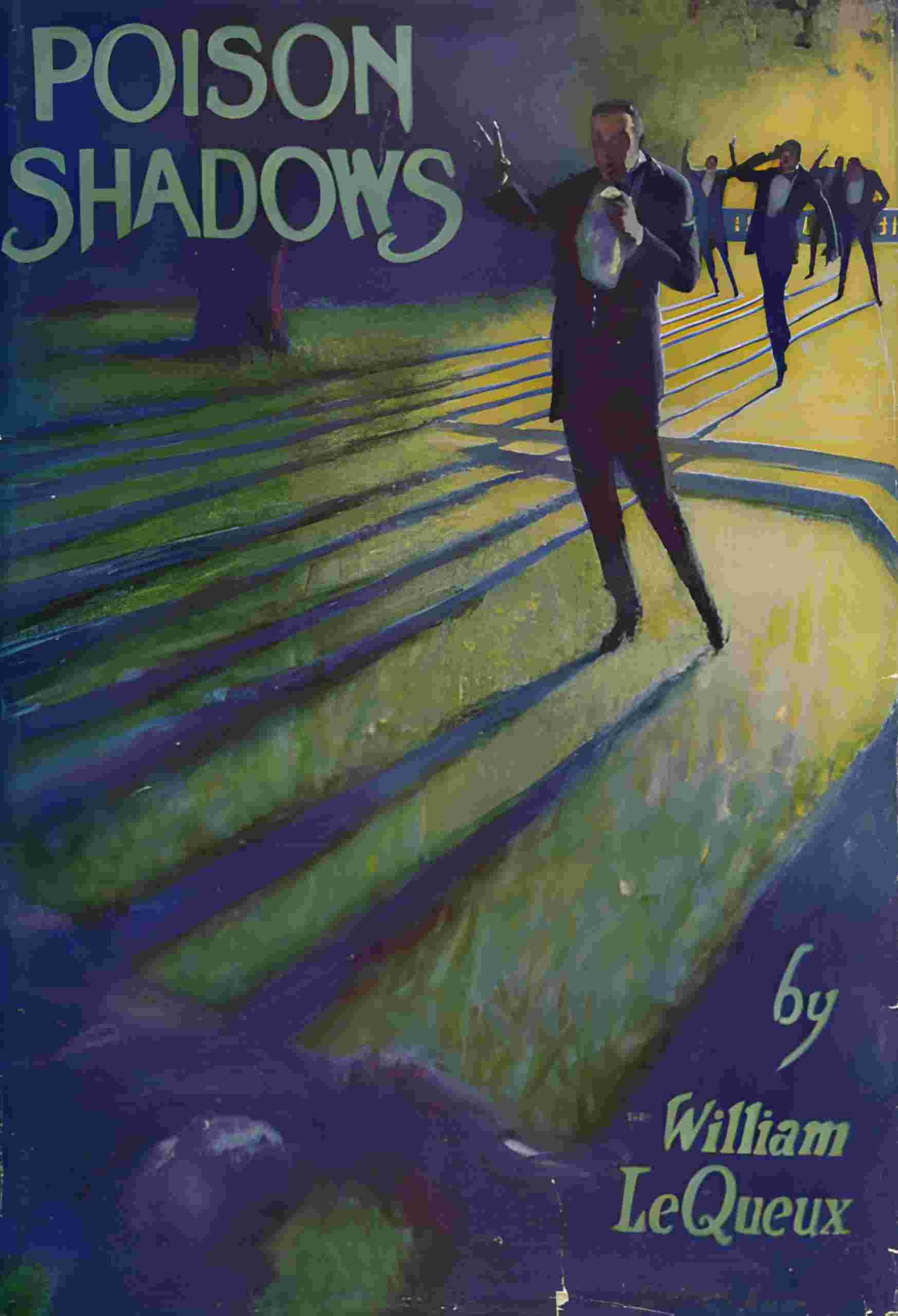
The Project Gutenberg eBook of Poison shadows
Title: Poison shadows
Author: William Le Queux
Release date: December 1, 2025 [eBook #77378]
Language: English
Original publication: New York: The Macaulay Company, 1927
Credits: an anonymous Project Gutenberg volunteer
POISON SHADOWS
BY
WILLIAM LE QUEUX
AUTHOR OF “THE TATTOO MYSTERY”
NEW YORK
THE MACAULAY COMPANY
[COPYRIGHT]
Published in England under the title
“THE CHAMELEON”
Copyright, 1927, by
WILLIAM Le QUEUX
CONTENTS
II. THE HOUSE AT HAMPTON COURT
III. WHAT POLICE CONSTABLE ASKEW SAW
XI. A VISITOR AT THE GUEST HOUSE
POISON SHADOWS
CHAPTER I.
A SOUL FOR SALE
“You must be firm, Gordon. It doesn’t matter in the least whether Sibell loves him or hates him. She must marry him, otherwise we shall both find ourselves in the cart. So there must be no argument. Don’t you agree?” asked the woman.
“Of course I agree, my dear Etta. But my ward is stubborn and absolutely refuses to see him again,” replied the bald-headed, deformed man who stood at Lady Wyndcliffe’s side at the window of her private sitting-room overlooking the golden sands and summer sea at the Grand Hotel on the Digue at Knocke, on the Belgian coast.
“It’s all rot! She must be made to see reason!” replied the slim, dark-haired, good-looking woman in a flimsy blue-striped frock, which mutely spoke of the Parisian couturière. “Young Otway is all very well, but he hasn’t a penny, while Gretton inherited over half a million from his father, who made a satisfactory deal in wool during the war and by it became Mayor of Bradford. Gussie’s a bit of an ass, but all the better for us. We both want money very badly. And I’ve so far worked the cards so that he is madly in love with her. Only we must at all hazards get rid of Otway. A penniless young doctor is no good for Sibell.”
“I agree with every word you say,” replied the queer old hunchback, Gordon Routh, in his high-pitched, squeaky voice. “You and I have had many deals which have been mutually satisfactory, and now is it not strange that we should be bartering away the girl’s future?”
“Oh, hang sentiment!” laughed the Countess. “We must have funds at any cost. Gussie Gretton is rich, and if Sibell marries him we must squeeze enough out of him to keep us in all we want of this world’s goods.”
“The Bank of England wouldn’t be sufficient for you, my dear Etta,” laughed the man. “You’d spend it all, and then try and get an overdraft. You’re the most extravagant woman I know.”
“What about your own losses at Monte—eighty thousand pounds in one year—eh?” remarked Lady Wyndcliffe. “I’ve been an infernal fool at the tables also, I admit. I lost forty thousand francs at the Casino last night, and have given an IOU to the accommodating old bean who runs the show.”
“Like myself, you broadcast the handy little slips, scatter them all over Europe, and they are accepted because of your high title, and the ingenuity of your press-agent,” remarked the bald-headed, bead-eyed little man whose humorous smile lit up his countenance always. Then he looked at her admiringly, and added: “I wonder, my dear Etta, what the world really thinks of you?”
“I don’t care a Belgian franc what the devil it thinks,” she laughed. “The public know that the Countess of Wyndcliffe moves in the best society and is seen everywhere—at Court, at Epsom, at Cowes, at Deauville, at St. Moritz, and at Monte Carlo. Her photographs look out upon the suburban buyers of the sixpenny illustrated weeklies, and she has always one, or perhaps two débutantes under her wing. She is what the good people of Hampstead, Watford, Richmond, or Felixstowe term ‘in Society.’ ”
“And thank heaven I’m out of it now,” the man laughed.
His companion drew a long sigh, and her well-arched brows contracted.
“I only wish I were. It’s a wearing life this, with lots of friends, lots of limelight, and no money. Wyndcliffe is getting quite impossible nowadays. Billesdon is let to a retired straw-hat maker from Luton, and I can hardly make enough, or save enough, to live.”
Etta Wyndcliffe—or, to give her her full title from Burke, Countess of Wyndcliffe of Billesdon Hall, Rutland; Cloyne Castle, Aberdeenshire; 112A West Halkin Street; and Villa Mon Aise, Cannes—was one of the many bright young Society women of to-day who lead a reckless, hectic life with the fees they earn by introducing daughters of rich commoners into the fringe of Society.
Watch your newspaper, and you will often see in the season that Lady So-and-So gave a dance at Claridge’s for the daughter of Mrs. Fitz-Allan Smith. It is Mrs. Fitz-Allan Smith who pays Lady So-and-So heavily for the privilege of shaking hands and dancing with her guests who go there to obtain a champagne supper gratis.
Etta Wyndcliffe was one of the great crowd of impecunious aristocrats, with a wide circle of friends, some of whom nowadays open shops, while others breed dogs, others keep beauty-parlors, and still others manage to pay their way by taking the womenfolk of parvenus under their wing, and sometimes presenting them at Court. Etta was young for her age, slim, refined, with handsome features, dark, penetrating eyes, and a fine complexion. Though thirty-three, she did not look more than twenty-five, while she danced and played tennis or golf as actively as any young girl. She was the second wife of old Wyndcliffe, who went through Carey Street about a year after he married her, and she had had to shift for herself ever since.
She lived in West Halkin Street, and managed somehow to scrape along upon funds provided by the parents of girls whom she chaperoned. The hectic, adventurous life she led in London during the season, and at the Continental resorts out of it, had caused her to become greedy and unscrupulous, for she drove hard bargains with mothers of marriageable daughters, whom she hawked around in the hope of finding them husbands. Her enemies—and she had many—said very hard things of her—how, having grown tired of one particular friend, a hard-up ne’er-do-well named Eustace Power, she had induced a wealthy American girl whom she was chaperoning to marry him, and they had actually split the commission.
As she stood at the hotel window that August morning, the Countess of Wyndcliffe looked little more than a girl, with a face so innocent and charming that it gave no index to her insatiable mania for gambling, or of the fast and vicious circle in which she moved.
“You really can’t be so horribly broke,” the man said. “You got three thousand when the Clements girl was married in June.”
“And I worked terribly hard for it, I assure you. I also had the vinegar man’s girl on my hands, as well as Sibell.”
“You got nothing for Sibell, and she’s cost you a lot in lunches, theatre-tickets, and dances, I know. It was very good of you, Etta, to take her.”
“And now, just when we’ve played our cards discreetly, the infernal little hussy—excuse me calling her that, even though I am her aunt—refuses to see Gussie Gretton again.”
“He hasn’t the best of reputations, she says.”
“What man has until after he’s sown his wild oats?” she asked.
“Well, according to all accounts, Gretton has sown a pretty heavy crop. He’s already narrowly escaped being cited in two divorce cases,” said Sibell’s guardian.
“That makes the women run after him all the more,” declared the irresponsible Countess. “Sibell ought to be proud that he, with all his wealth, wants to marry her. She’s a darned little idiot. I tell you, Gordon, I’m fed up to the teeth. Gretton is so infatuated that he has promised me five thousand on the day he marries her, and I’m ready to split it with you. Then you’ll split with me anything we get afterwards,” she said, discussing the sale of the girl’s soul as she would a business deal.
“I’ll try and do my best. But she’s over head and ears in love with that young Otway.”
“Love! Bah! There’s really no such thing as true love nowadays. Smart frocks, a pretty face, and proper environment, and girls think that men fall in love. The idea of real love disappeared with the hansom cab.”
“But, really, Etta, there is surely some affection left in the world!” piped the deformed old gambler.
“Among the common folk, I suppose. Not among us. Marriage nowadays merely means the uniting of money and poverty, or vice versa. The modern girl does not begin to know what life is until she’s divorced.”
“And to you, my dear Etta, a neat little secret commission comes in from both sides!”
The pretty Society adventuress grinned.
“Well, when one has to live on one’s wits—as I have, alas! because Wyndcliffe is such a fool—one must not be too particular with whom one mixes. Heaven knows! I have sometimes to lunch and dine with most fearful crooks and howling dagoes. Only a fortnight ago in Paris I found myself in debt forty thousand francs at ‘chemmy’ at the Bel Air. It was three o’clock in the morning, and I only had fifty francs in the world to pay my taxi to the hotel. Old Ducocq, the director, a decent sort of paternal crook, took my IOU, but next day he came to the hotel and demanded as the price of its return that I should entertain at dinner at the Ritz a pair of American financiers whom I knew to be clever crooks, and two innocent Englishmen, their ‘pigeons,’ whom they were inducing to put money into some rotten scheme. In return for the bit of paper I signed, I had to carry out their demand, and I read in the next day’s Paris Daily Mail that I had asked the pair of share-swindlers to dinner. No, my dear Gordon, I’m not sailing in smooth waters, just now, I can assure you.”
“My dear Etta, you’re like me! We are merely gipsies in the world. When our hats are on, our roofs are on. We live for to-day, and to-morrow may take care of itself. The tables are my curse, just as they are yours. You’ll admit that?”
“Certainly I do. I’ve nothing to hide from you, my dear old Gordon. Do you remember that night in the Cercle Privé in Monte, when I was broke to the world and you helped me out with three billets de mille. I took to you from that moment, and I even tried to save you from plunging as you did. But you wouldn’t hear me. I don’t blame you, my dear Gordon. Why should I? I listen to nobody myself. That’s why we are both so damnably hard up and are kindred spirits—eh?”
“Hard up! Why, at this moment I have only a couple of hundred francs to my name,” said the hunchback, who had run through a fortune. “I don’t see how I’m going to pay my hotel bill.”
“I’m in just the same box,” replied her smart little ladyship. “We must raise it from somewhere even if I have to get a little loan from Gussie.”
“A bit on account of commission, eh?” laughed the man.
“If you go to the tables you can always ask a friend for a loan, making a run of bad luck the legitimate excuse. It doesn’t then look as though you really are hard up—only temporarily embarrassed,” said the Countess, pulling a wry face. “But,” she added, “I’m chronically affected that way.”
Suddenly the door opened and a bright-faced, fair, shingled-haired girl in a flimsy summer frock burst gaily into the room, greeting her guardian, and then turning to her aunt, she said:
“You’re up early, auntie! Why, it must have been nearly three when we left Roberts’. I went for a walk by the sea after that. It was simply gorgeous.”
“With Gussie?”
“No. With Leonard Capel. We’re entering for the tango competition at the Memling to-morrow night.”
The Countess and the hunchback exchanged glances.
“I don’t think, Sibell, you should go for nocturnal rambles with a stranger,” said the Countess reprovingly.
“Why not, auntie? Several other girls went for walks with their dancing-partners,” remarked Sibell. “Besides, it isn’t any worse than dancing in a night-club with some dago you’ve never set eyes upon before and allowing him to pay for your supper,” she added meaningly.
Etta knew at what the girl hinted. They had both danced with a rich young Argentine, whose name they did not know, at the Florida Club in London one night a month before, and he had paid sixteen pounds for supper for the three.
But Lady Wyndcliffe led a hectic life paid for by those she took beneath her aristocratic wing, and, after all, in the course of her butterfly career she had done much more risky things than that.
Sibell Dare was extremely pretty, with a sweet, intelligent countenance, big, wondering eyes of childlike blue, a small mouth with full, red lips that required not the application of lip-stick, and a slim, supple figure the grace of which had been improved by constant dancing. After Cheltenham College, she had been two years in Paris, and now she was as smart and attractive a girl as could be found in all London. Her aunt, the Countess, had taken her from Routh’s home at Cookham and introduced her into Society, where she had many admirers, of whom Augustus Gretton was the most ardent.
She, however, cared for none of them, being devoted to Brinsley Otway, a struggling young doctor practising out at Golder’s Green. They had met at the house of a married school-friend up at Hampstead two years before, and had been lovers ever since.
“Leonard Capel wants me to go to Ostend to spend the day. I’m going,” said the girl, feeling somehow that she had interrupted a conversation between her deformed guardian and the Countess.
“My dear child! Why, you hardly know the man!” Etta chimed in quickly. “If you want to go to Ostend, why not accept Gussie’s invitation to motor you there? I heard him ask you yesterday.”
“Well, just because Gussie doesn’t interest me at all. He’s such a he-haw, superior person that I have no patience with him. I tell you frankly he bores me stiff, for he regards himself as very superior, and, after all, his father only started life as a cheap tailor. My father was, at least, a man of independent means.”
“I’m glad you are proud of your birth, child,” said the old man in his curious voice. “But nowadays you must remember that men are judged only by their pockets, not by their ancestry. Personally, I think Gussie a very excellent and worthy fellow.”
“When I have a husband—if that time ever comes—I shall want him all to myself, uncle, and not share him with half a dozen women, as Gussie’s wife must,” replied the high-spirited girl frankly.
“A man, when he marries, gives up all his feminine entanglements,” declared Etta. “Look at old Lord Ushaw, one of the worst roués in all Mayfair. He married little Ena Urquhart, to whom I introduced him, and now there’s no happier pair in all England.”
“An exception does not make the rule,” laughed the girl. “But I want you both to be reassured upon one point—that I shall never marry Gussie Gretton—even if there isn’t another man in the world.”
The Countess pursed her thin carmine lips at the girl’s open defiance, while her guardian turned away to conceal his annoyance.
“Well, I think you’re a little idiot!” declared Etta, who always spoke her mind to the girls she chaperoned. “You may never have the chance to marry such a charming and wealthy man. Brinsley Otway is not to be compared with him; besides, he has only the few guineas he earns by doctoring. It wouldn’t buy you your shoes.”
The girl paused for a few moments, and, noticing her guardian’s head turned away towards the sunlit sea, exclaimed:
“Well, auntie, we shall never agree upon the point, so why discuss it further? I’ll be back to dinner. We’re lunching at the Continental in Ostend, and going to the Casino afterwards. Bye-bye, uncle! Cheerio!”
And the girl went out, closing the door after her.
“That seems farewell to all our hopes, Etta, doesn’t it?” remarked the old hunchback despairingly.
“I don’t know,” replied the well-dressed woman in a hard, determined voice. “We must assume different tactics. I, for one, don’t intend to be beaten, and I’m sure Gussie doesn’t.”
CHAPTER II.
THE HOUSE AT HAMPTON COURT
Three months had gone by.
The hunchback Routh and his ward were back at home at The Myrtles, a pretty, rose-embowered cottage situated at the end of a garden that ran down to the picturesque Thames close to Cookham.
It was not yet eight o’clock in the morning, and Elsie, the stout maid-of-all-work, had placed the breakfast on the table of the cosy old-world sitting-room. Sibell, looking charming in her cotton gown, sat in the deep window-seat reading a letter she had just had from Brinsley Otway while she waited for her guardian to return from his morning walk.
Besides the letter from her lover the girl had received a second letter from a firm of solicitors, Harrington, Bailey, Marsham & Keys, of Bedford Row, London, informing her that by that post they had written to Mr. Gordon Routh and that he would inform her of the contents of their letter.
The letter in question she had placed beside old Mr. Routh’s plate.
A few minutes later the hunchback came in with a cheery greeting, and before he sat down to breakfast tore open the letter and read it.
“My dear Sibell!” he gasped. “Think of it! Your old Uncle Henry has died in Brisbane, and has left you the whole of his fortune and all his property!”
The girl stood staring at him, scarce believing the truth.
“Poor Uncle Henry dead!” she cried. “Why, I’ve heard it said that he had twenty thousand a year!”
“Quite. His property was a very valuable one. Besides, he inherited your Aunt Henrietta’s money also. But the lawyers say that according to his will, dated two years ago, all is left to you. By Jove, Sibell! you’re the luckiest girl in England!” added the old man.
“Well, if I am to have Uncle Henry’s money, I won’t forget you,” declared the pretty girl affectionately. “You’ve been a father to me ever since I was a tiny tot, and I know after you lost all your money how difficult it has been to make both ends meet. This place, for instance, is pleasant enough in summer—but it isn’t like Curzon Street.”
Gordon Routh read the letter again, and said enthusiastically:
“Well, after this good news let’s have breakfast and run up to town and see these lawyers. They ask you to call upon them as soon as convenient. They were your father’s lawyers, and I know old Harrington very well.”
They ate their meal hurriedly, and Sibell rushed upstairs, changed into a town kit, and at eleven o’clock they alighted from a taxi in Bedford Row, that broad street of dismal lawyers’ offices in the vicinity of Gray’s Inn.
Without ceremony they were ushered into the private room of Mr. Alexander Harrington, a white-haired old solicitor, head of the well-known firm, who greeted them, and, producing a file of papers, addressed Sibell, saying:
“No doubt my letter came as a surprise to you, Miss Dare. My late client, Mr. Henry Dare—who, as you know, has lived abroad for some thirty years or more—died on June 10th last at Brisbane, and I have his will here, by which you are sole legatee under a certain condition which I think you will not find very irksome. The estate is a very considerable one, consisting of railway securities, a quantity of valuable house property in the West End of London, the family estate at Coningsby, near Wotton-under-Edge, and the old Guest House at Hampton Court.”
“I’ve heard that the place has been closed for about thirty years,” remarked Sibell’s guardian.
“Yes,” replied Mr. Harrington. “According to the terms of the will, the contents can be sold, and Miss Dare has to refurnish the house and live in it.”
“Why?”
“Who knows?” asked old Mr. Harrington, arching his grey brows. “My late client was a somewhat eccentric man. Possibly you know the romance and tragedy connected with the Guest House?”
Sibell declared that she was in ignorance.
“Well, when I was a young man,” said the old solicitor, “Mr. Beeforth Dare, a client of my father, met with a fatal accident in the hunting field early in 1895, and his son Henry, aged twenty-one, succeeded him. The Guest House at Hampton Court, together with its original Elizabethan furniture, was left to him as one of the ancestral homes of the Dares, and just at that time your Uncle Henry fell in love and became engaged to marry Mary Forrester, one of the Forresters of Glencree. A week before the date fixed for her marriage she went down to Hampton Court to stay with her fiancé’s mother, when, while out walking in Bushey Park, she was suddenly taken mysteriously ill, was carried back, and died within an hour. An autopsy was held, and the poor girl’s death was declared to be due to heart disease.
“This so upset your Uncle Henry that he had the house at once closed, just as it stood, without moving anything. His mother went to live in London, while he went abroad to his brother John who, after a somewhat disgraceful career, had gone out to the Malay States as an assistant-manager of a rubber plantation. For three years my client lived in Singapore. Then he travelled from place to place for over twenty years, never returning to England, and he has unfortunately died in Australia. Two years ago he called me to Paris, where, at the Hôtel Continental, I executed his will.”
“Then, according to its terms, I am compelled to live at the Guest House?” asked the girl, naturally much interested.
“That is so. If you fail to do so, one third of my late client’s property goes to the London Hospital, one third to the Middlesex, and the remainder to your guardian, Mr. Gordon Routh,” said old Mr. Harrington. “When he was making his will I queried the clause, but he said he intended to see you and explain his reasons why he wished you to live at the Guest House. He has unfortunately died before he could do so.”
“But as he hated the place himself it is hardly fair to expect my ward to live there, is it?” exclaimed the hunchback in his shrill voice.
“I admit, it is not. But the house, when reopened, will be found to be a very quiet and pleasant residence. It must, of course, be very dirty and neglected at present. The door has never been opened for about thirty years. The furniture is antique, and no doubt in a very bad state. If it were mine I should sell it all by auction, and have the place redecorated and refurnished.”
“That’s what I must do,” Sibell said.
“Very well. Then I will give the matter over to the firm of estate agents who have had it in hand, and you can go and inspect the place and pick out anything you wish to keep. At the same time, I will take steps to prove the will immediately, as all the formalities have been observed in Australia.”
“The place was the scene of the great blow which befell my Uncle Henry. I hope its possession will not be harmful to me,” remarked the happy girl, with a nervous laugh.
“Why should it be?” asked the old solicitor. “The death of my late client’s fiancée was a natural event, and might, of course, have taken place anywhere.”
That same afternoon Sibell and her guardian took a taxi through Hammersmith and Richmond to Hampton Court, where they had no difficulty in finding the ancient red-brick mansion, an old Tudor place built at the same time as Hampton Court Palace itself, standing back behind rusted railings in its neglected grounds, with great spreading oaks and chestnuts. The roomy old house, with its mullioned windows and high chimneys, was half covered with ivy, which had so climbed that in one part it overspread the roof. The windows were mostly boarded up, the carriage-drive overgrown with bushes and weeds, and the broad stone steps leading to the portico were deep in moss and lichen.
From two windows on the ground floor the boards had rotted and fallen away, disclosing ragged holland blinds that were once yellow, but now black and stained; while the huge, rusty padlock and chain on the gate told their own tale.
They of course could not enter the place, but even on that bright autumn afternoon its exterior looked terribly neglected, depressing, and mysterious, though the view afforded of Bushey Park, its deer and its famous avenue of chestnuts, was most picturesque and charming.
In the immediate vicinity were several other old-world houses, all of them prosperous-looking and well kept, but the Guest House, the scene of that broken romance of long ago, presented a sorry appearance of neglect, a derelict in that quiet, peaceful backwater of modern life.
“When it is put into order, repainted and redecorated, it will be a very fine residence,” declared old Mr. Routh, looking through the gate into the weedy wilderness that was once a garden.
The girl standing at her guardian’s side reflected. The falling leaves of the great trees were stirred in the golden autumn sunset, and from somewhere came a sharp bugle call from the barracks in the vicinity. Her eyes were fixed upon the heavy oak door, grey and weather-beaten, that door which had not been opened for thirty years to admit light and air to the deserted place.
What did that house of mystery contain for her? It was her possession, hers by right, and in order to secure her splendid inheritance she must live within those time-mellowed, red-brick walls.
The fair-haired girl in jumper and skirt drew a long breath. Something—she knew not what it was—warned her of some sinister influence that was exercised there. She was no believer in psychic forces. Many of her silly companions had attended séances and believed in spiritualism, but she, a level-headed, intelligent girl, had never believed in what she termed the “bunkum” of it all. There were, she admitted, certain secrets of Nature hidden from mankind, but discovered in modern times—the mysteries of steam, of electricity, of the internal combustion engine, aeronautics, submarine navigation, wireless communication, and radio-television. But the supernatural she had always ruled out, even though the Countess of Wyndcliffe, to be up to date and in the swim, was essentially “psychic”—as the term is known in Society—and she had been compelled to follow her.
That night the old gambler and his protégée returned to Cookham, naturally elated at the day’s surprises. Sibell, instead of a needy girl dependent upon the old gambler’s slender means, was now a considerable heiress and her own mistress, hence she sat down and wrote to her lover, Otway, a brief résumé of the good news and of her day’s doings.
In the issue of the Richmond and Twickenham Times on the following Saturday there appeared a letter above the signature “Scrutator” headed “The Guest House, Hampton Court,” which created a good deal of local interest, and a cutting of which Mr. Harrington sent to Sibell. The letter read:
“It is understood that the Guest House at Hampton Court is at last to be reopened, after being closed by its former owner, Mr. Henry Dare, thirty years ago. The house was built in 1541 for the reception of visitors who could not be entertained in the Royal Palace, but tradition has it—and the facts have been recorded by the archæologists Emberley and Wright—that certain curious phenomena were observed there during the eighteenth century.
“According to the earliest record, preserved in the Record Office in London, it was purchased in 1595 by a French nobleman, the Marquis D’Aire of Aire, a town in Gascony, who was French Ambassador to Queen Elizabeth—whose descendants afterwards anglicised their name to Dare. From time to time at least two sudden and mysterious deaths took place within its walls, culminating in the tragic death of the fiancée of the late owner, a pretty girl of twenty-one named Mary Forrester, who one day in October 1895 was taken suddenly ill while on a visit when walking in Bushey Park, and died in a chair in the drawing-room in her lover’s arms.
“A very similar incident occurred in the house in question in 1784, on a day when George III drove down from London to Hampton Court to receive one of the Spanish Princes. On that day, after leaving the Palace, the Marquis Henri D’Aire, in whose possession the house was then, was taken suddenly ill on descending the stairs, and expired two hours later from causes which the doctors could not ascertain.
“To archæologists and others the reopening of this house of mystery, after having been closed for so many years, will be of considerable interest, as it is known to contain much valuable Tudor furniture and many objects of art brought from France by the ancestors of its late owner, to whom its possession brought the great tragedy of his life.”
On receipt of the cutting Sibell went up to London and showed it to Brinsley Otway, whom she found in his surgery in his small corner house at Golder’s Green. The dark-haired, clean-shaven, alert young man who had distinguished himself at Guy’s and been fully qualified about three years before, stood in his rather shabby consulting-room and read it over carefully.
“It is most interesting,” he said. “We must find the writer, who no doubt can give us some further information.”
That afternoon he gave over his work to a friend, and a visit to the editor of the newspaper at Richmond revealed the fact that the writer was a Mr. Geoffrey Sharp, long a resident at East Molesey, on the opposite bank of the Thames to Hampton Court, and a well-known local antiquary.
That same evening Sibell and her tall, athletic lover called upon the white-haired old gentleman, who, as soon as Sibell had introduced herself as the heiress of the late Mr. Henry Dare, at once became communicative.
“The Guest House is of great interest in many respects,” declared the old man, peering at her through his steel-rimmed spectacles as he sat in his book-lined den. “It is mentioned by several authorities as the scene of several—well—accidental and unaccountable deaths.”
And he showed them two large volumes by noted antiquaries in which mention was made of the place and the mysterious occurrences.
“But, my dear young lady,” he added, “of course there are many other houses around which evil tradition has arisen. Much of it has been due to ill-natured reports spread long ago by neighbors who, disliking the owners of the premises, invented all sorts of stories in order to depreciate the value of the property.”
“Have there been any other stories regarding the place?” inquired the girl eagerly.
“Er—well—nothing that has ever been substantiated except the sudden deaths which were probably mere coincidences,” replied old Mr. Sharp. “Therefore, if I were you, I would not allow the matter to worry you in the least. When the place is cleaned and redecorated it will no doubt prove a most delightful old-world residence, and I, for one, hope you will one day marry and enjoy it.”
The girl exchanged glances with her lover, blushed, and thanked the old man for his good wishes. Then, later on, they left.
On the following morning Mr. Herbert Gray, junior partner in the firm of Shalford, Stevens & Gray, the well-known estate agents and auctioneers of Kingston-on-Thames, arrived at the rusty iron gate of the Guest House, accompanied by three men, namely, two of his clerks and a local locksmith. The great old padlock was so rusty that it could not be opened, hence the steel chain had to be filed and broken, an operation which took nearly an hour.
Then the quartette of explorers mounted the moss-grown steps leading to the portico, but after thirty years of neglect the key would not turn in the lock. So with a crowbar the grey old oak door was forced, and from the dingy interior came a dank, mouldy whiff of stale air. Everywhere in the hall hung great blankets of dusty cobwebs which swayed in the wind admitted through the open door.
The place was in semi-darkness, therefore the workman, aided by the two young clerks, opened the shutters and windows of room after room, admitting light and air, and revealing the hopelessly neglected condition of the house, with its marvellous collection of Elizabethan furniture, the upholstery of which, like the tapestry and carpets, was ragged and decaying. Through the dirt-encrusted windows of ancient green glass set in lead, the weak autumn sunshine tried to struggle, falling instead upon the moth-eaten carpets.
In the big dining-room there still remained upon the long table with great carved legs a cloth that had once been white, and whereon stood blackened silver bowls that had once contained fruit, an empty champagne bottle, and three dusty glasses. Everything had been left just as it was on the day of the death of Henry Dare’s poor little Victorian fiancée, Mary Forrester.
“By Jove!” remarked the auctioneer to one of his clerks. “What a chance for collectors! A lot of this must go to Christie’s. Look at that tallboy yonder, that fifteenth-century credence, and that Carolean day-bed!”
Half-an-hour or so, with their coats off, they spent opening the ground-floor rooms and examining the dusty contents, getting their hands and faces covered in dust and dirt. Now and then they heard the sounds of scurrying rats behind the old oak panelling, while ever and anon great wreaths of cobwebs, swaying in the wind, were torn away and fell.
For them all, even used as they were to enter old houses, it was a strange experience. As a connoisseur of antique furniture, Mr. Herbert Gray realized the considerable value of certain “museum pieces,” as they are called in the trade. He saw that more than one piece of Tudor and Elizabethan furniture would be welcomed in the national collection at South Kensington, and his business mind anticipated a fat commission from the sale of “the valuable contents” of the ancient house.
From the spacious, stone-flagged entrance-hall ran a broad oaken staircase with low steps, worn thin by the tread of generations of the D’Aires. Up them the all-powerful Cardinal Wolsey himself, and afterwards Thomas Cromwell, the arch-enemy of the Papists and destroyer of monasteries, had often ascended to visit the Ambassador, the Marquis Louis D’Aire, in the long withdrawing-room on the first floor. And up those same stairs went the auctioneer and his assistants on their journey of investigation.
The junior partner of the firm led the way, examining with deliberation some fine family portraits by Kneller, Romney, and Sir Peter Lely as he went, and upon the wide landing came to an open door leading into a great dark apartment.
Very soon the five long windows of the huge room were unshuttered, revealing the spacious withdrawing-room, the walls of which were covered with ancient tapestry, which hung ragged, forlorn, and rotting, some magnificent old furniture, including an early satinwood spinet of genuine Louis XIV and some George I chairs, with carved cabriole legs, a lacquer screen inlaid with jade, soapstone, and agate, and a quantity of dusty but valuable old china. For the first time for thirty years the light of day fell into that apartment, and the sickly beams of the sun gave it an aspect of dismal bygone glory, of an age long past and forgotten.
“What a magnificent room!” remarked Mr. Gray, as he crossed it and, standing at one of the windows, gazed round in admiration upon some exquisite pieces of Elizabethan furniture, all original and unrestored, as they all were, also three Chinese vases with covers of the Yung Cheng period.
For a second he paused, and, placing his hand upon his chest, he glanced out of the dingy window into the neglected garden below, a tangle of bushes and weeds.
Then of a sudden, before anyone could approach him, he was seized by an inexplicable faintness, and, staggering across the room, sank into an old arm-chair upholstered in faded crimson velvet.
“I—I’m ill!” he managed to gasp to his three companions. “Oh! the pains—pains—around my heart! Oh! It’s agony!”
“Get a doctor—quick!” cried one of the clerks, while the other dashed out to the nearest telephone, leaving the locksmith and the chief clerk at his side.
The pair endeavored to rouse him, but his face had gone as white as paper, and, staring fixedly, he lay back inert and motionless in the chair. Once he drew a long breath, convulsions shook his frame, and then he remained white and still.
Within ten minutes an elderly doctor, who arrived in a car, was at his side, but after a brief examination he raised his head to the three anxious men, and said:
“A very serious heart attack! I hope it may not prove fatal. But, gentlemen, I cannot conceal from you the fact that he may not recover!”
CHAPTER III.
WHAT POLICE CONSTABLE ASKEW SAW
The doctor, whose name was Clements, dashed in his car across the bridge to his surgery in East Molesey, where he snatched up some drugs and restoratives, and ten minutes later had recrossed the river and was again beside his unconscious patient.
By dint of constant and unremitting attention, lasting for over two hours, the stricken man was brought back to consciousness, and presently was able to describe his symptoms.
“I believe this is an accursed house!” he said. “I felt a curious dizziness as soon as I entered this room. Though I said nothing, I felt a strange sensation in my arms, which spread slowly across my chest until a sudden spasm shot through my heart, causing me to hold my breath. Time after time I felt the pain repeatedly, until it became excruciating. I couldn’t get my breath, and suddenly I was plunged in darkness and knew nothing more.”
“Have you ever had similar attacks before?” asked Dr. Clements, standing beside the patient’s chair and holding his hand.
“Never. It is the first—and I hope it will be the last,” he replied, smiling faintly.
“Well, I must run you home in the car, and you must keep quiet for a few days. I will examine you to-morrow,” said the doctor. “I think you may be suffering from what we term false angina—nothing to be really alarmed about.”
“I have never experienced such curious pains in my arms and chest,” Mr. Gray declared. “I’m forty, and have had excellent health up to the present.”
“The heart is always a mysterious thing,” remarked Dr. Clements. “While every other organ of the body may be in perfect order, the heart may be seriously affected and give no warning until suddenly death intervenes. Therefore nobody should ever boast of his good health. It is always dangerous to do so.”
Hence, about two hours and a half after Mr. Herbert Gray’s sudden illness, he was conveyed by the doctor to his home at Surbiton, he giving strict injunctions to his clerks that no word was to be said in the office concerning his mysterious seizure.
The house having been opened forcibly, the locksmith that evening placed a new Yale latch upon the front door, while an ex-constable named Farmer, who frequently became caretaker on premises for which the firm of Shalford, Stevens & Gray acted as agents, was placed in charge.
The autumn twilight was falling as the stout, round-faced Farmer was standing alone on the moss-grown doorstep smoking his pipe, when suddenly a police constable on his beat made his appearance.
Knowing the house so well, he was naturally surprised to see the shutters open and the caretaker at the door. Instantly he recognised him as an ex-constable of his own Division, and, approaching, exclaimed:
“Hulloa, Dick! What’s up here?”
“I dunno! They seem to have opened this old place for some reason. It’s in a horrible state o’ dirt. I’ve been half choked with dust and cobwebs. Come in and have a liker.”
Thus invited by his friend Farmer, Police Constable Askew of the T Division Metropolitan Police, followed him into the hall, dark, dusty, and mysterious in the fading light.
“I don’t like this place,” Askew said, glancing around. “It’s haunted.”
“Haunted be blowed! You aren’t afraid of ghosts, are yer?”
“I don’t know,” replied the constable in an uncertain tone. “I don’t like this house—and never have ever since I’ve been in Hampton.”
“Only because it’s been shut up a long time,” replied Farmer. “I’ve lived in lots of old houses since I went on pension, and I’ve never seen anything more terrifying than a rat or two, or perhaps a bat. I’ve heard lots of noises that I couldn’t account for—but noises hurt nobody. I tell yer, Askew, you haven’t done twenty-eight years on the streets as I have, but you’ll never see anything uglier than your own self. And that’s the truth!”
“That’s all right,” replied the younger man in uniform. “But I’ve seen something in this here place that I don’t like at all. I haven’t told anybody, because they’d laugh at me, a constable. At the section house they’d say I was drunk, and the subdivisional inspector would have his eye on me. But I saw something here a week ago what wants a lot of explaining away.”
“Now that’s interesting!” said the caretaker. “Get a chair and let’s sit outside. I’d like to know what you saw.”
Both men took valuable old spindle-legged chairs from beneath the staircase and placed them in the portico, in the darkening night.
Distant lights twinkled across the wide, level swards of Bushey Park, while at the barracks a bugle sounded, and somewhere from afar up the winding Thames came the shrill whistle of a tug towing barges to the upper reaches.
Askew, an ex-sergeant of Fusiliers in the Great War, pulled out a “gasper” and lit it, though not supposed to smoke on duty, while Farmer filled his heavy briar, applied a match deliberately, and said:
“Now, tell me. What did you see here?”
“Something funny—can’t account for it any way.”
“Before that article appeared in the Richmond and Twickenham Times—or after?”
“A week before,” Askew replied. “I of course saw what they said in the paper about the happenings in this house thirty years ago.”
“And what did you actually see? Personally I don’t believe in anything supernatural.”
“Well, I don’t hardly know how to describe it,” said the constable, taking a long draw at his cigarette and holding his helmet on his knee. “It was last Monday week, at about a quarter-past two in the morning. The weather was rainy, and I was coming up the road to the Green when I saw something in the window just here on the left of the hall”—and he pointed to it. “It’s the window where the shutter had fallen half away. I saw an indistinct green light. For the moment I thought I was dreaming, for no light had ever been seen in the house before. I stood and watched. The light got greener, and then slowly it faded away. Once I thought that it was flames and that the place was on fire. That’s all, Dickie. Now how do you account for that, eh?”
“Did you examine the premises?” asked Farmer, recollecting the strict official orders in the case of anything mysterious seen at night.
“I did most certainly. The first thing I did was to see that the lock on the gate had not been tampered with. Then, ten minutes after the light had faded, I climbed the wall and made a thorough examination of the premises in order to be able to give evidence if any burglars had been at work. But I found absolutely nothing. I’ve been over the wall here dozens of times, especially when those fire-raisers of country houses were about. I had special orders to keep this place under observation when I was on night duty. All I’ve ever seen, however, was that funny dull green light. The dirty old holland blind was down, so I could not see anybody inside. That’s where the mystery of it all comes in. I’ve told my wife, and she tells me to say nothing to nobody.”
“Are you quite sure that nobody was in the house—no thief?” asked Farmer, puzzled, for Askew was so insistent.
“As certain as I sit here. I examined all the doors and windows, as we’ve been ordered to do, as you know. Nothing had been disturbed.” Then, after a pause, he added, “I don’t like the place, and I can quite imagine that people die mysteriously here. Why has it been opened after thirty years?”
“Perhaps it is to release the evil spirits, of which your green light is one,” Farmer laughed.
Police Constable Askew, a tall, athletic Cornishman, drew himself up in his chair, and asked:
“Do you think I’m a liar? Do you doubt what I tell you—that I saw the green light with my own eyes?”
“No, I don’t,” replied the caretaker. “But, while some people see things, it seems that others see nothing. They aren’t gifted with second sight as they calls it. How long did this light last?”
“Oh, only about a second or two. If it hadn’t been for that dirty old blind I could have seen right into the hall here. I tell you, Dickie, I’ve seen something that can’t be explained, and I fully agree with that article in the Richmond Times that this here house on the Green brings sudden death on to people. Mind you yourself don’t have heart disease,” he added warningly.
“Phew! No fear of that, old man,” Farmer laughed. “After all my years on the streets in the ‘T’ I’m not addicted to either fright or heart trouble in any way. I was married twenty-one years ago, when I joined at Bow Street. But,” he added, “don’t you think it was just a little bit of imagination on your part—that green light? Just think!”
“No. I’ve seen it three times now.”
“Tell me exactly what it’s like,” asked Farmer, most interested.
“Well, I can only describe it as a dull, pale-green glow—and then it quickly fades away. If it was at sunset I could quite imagine that it was a light reflected through a window upon some bright, polished surface, but there isn’t any sun at two o’clock in the morning. Further, the place being locked and barred as it has been all these years, there can have been nobody inside. If there had been, then Mr. Gray and his people would have noticed traces of anybody being unlawfully on the premises.”
“Quite true. They found the place just as it had been left thirty years ago. Perry, our chief clerk, told me. It seems that the heavy dust and close atmosphere upset Mr. Gray, so he went home early, a bit off color.”
“Yes. The air is pretty thick inside, I should fancy.”
“It is. To-morrow I’m going to clear up one of the rooms and bring my old camp-bed and some cooking things,” said Farmer. “There’s going to be an auction, and I feel sure the things’ll fetch good prices unless there’s a big ‘knock-out.’ ”
“Knock-outs aren’t fair. They ought to be stopped,” declared the tall man in uniform. “But I tell you, Farmer, I’d rather that you took care of these blooming premises than me. I’ll have to go on now, for I’ve got to meet my sergeant at the Palace Gates, and I have only just time,” he added, glancing at his wristlet watch.
“I’m not going to bed yet. Come back here and have a few whiffs when you’ve gone round.”
“Righto!” replied the tall constable, and, hitching up his belt, he descended the moss-grown, slippery steps, tramping heavily away in the direction of the gates of the old-world Palace of Wolsey, the point where he had to report to his sergeant.
The autumn night was still and warm. After Askew had gone, Farmer sat back lazily in his chair smoking his pipe and reflecting that for the first time in thirty years that heavy old front door had been opened. Now and then as he sat alone, whiffs of close, mouldy air came from within, air that filtered through those blankets of heavy dust-laden cobwebs which festooned the ceilings, the work of the busy spiders through three decades. Ever and anon strange noises, and creaks of highly seasoned wood, came from the dark interior. Weird they were in the dead silence, yet Farmer, used to “noises” in unoccupied houses, smoked on, quite unperturbed.
The old turret clock in Hampton Court Palace chimed the hour—two o’clock—and the paraffin lamp which the caretaker had set in the hall was growing dim because he had not replenished it before he began his vigil. Had there been sleeping accommodation Farmer would have gone to bed, but as there was none he sat quite unruffled in the old spindle-legged chair in the wide portico and dozed.
Presently he fell asleep. How long he was unconscious he did not know, but he was at last awakened by Askew crying:
“Are you asleep, Farmer? Did you see it?”
“See what?” asked the other, springing startled to his feet, with heavy eyes.
“Why! the light!”
“The light? What the deuce do you mean, sonny?”
“That funny light! It was showing in the window only a few seconds ago as I came across the Green!” cried the man excitedly.
“Now look here, Askew!” exclaimed Farmer. “You’ve gone dotty!”
“I swear that I saw it just for one second,” declared the constable. “You were asleep?”
“I suppose I must ha’ been,” admitted the stout caretaker. “But I don’t believe in ghosts and green lights at night.”
“Well, I don’t care what you or anybody says, that’s the fourth time I’ve seen that mysterious green glow. What the devil it is I don’t know—only I’ve seen it!”
“I wish I’d seen it also,” laughed Farmer, still unconvinced.
Constable Askew shone his lantern into the dark hall, but all remained undisturbed.
“Shall we have a look around?” he asked. “It won’t do us any harm.”
So the two men entered the dusty, neglected place, Askew shining his electric lantern into every dark corner, but finding nothing.
“It’s got on your nerves,” declared Farmer, when they were again standing together in the portico. “I’d ask for a change of beat, if I were you.”
“Then you really don’t believe what I’ve told you, eh?” asked the constable.
“I only believe what I see, my dear sonny,” was the caretaker’s quiet reply.
“You’ll see it one day, mark me! I haven’t told anybody, because I know I won’t be believed,” said the police officer excitedly.
“I sincerely hope I shall,” laughed Farmer, relighting his pipe and reseating himself in his chair. “But you take my advice, P.C. Askew, and get on another beat where you can’t give your imagination quite so much play.”
“I tell you it isn’t imagination,” declared the other vehemently. “Surely I can believe my own eyes!”
“You may be able to, but I’m older than you, and I find I sometimes can’t. In any case, my dear boy, I don’t believe in your green light till I myself sees it,” Farmer said frankly. “You’re surely old enough in the Force to know how many haunted houses there are about. Why, I’ve known dozens of ’em, but there’s never been any truth in any of the stories.”
“There is in this one. You saw what they said in the paper about it.”
“I did, of course. But they were only coincidences. Besides, they said nothing about this curious glow you’ve seen.”
“Because they know nothing about it,” he replied, taking a draw at the “gasper” he had lit.
“I’d write to the papers about it if I were you,” remarked Farmer sarcastically.
“And be put down as a blooming fool. Not quite!” was the constable’s reply.
“Then next time you see the green glow in the window just come straight in and have a good liker around to make sure your eyes haven’t deceived you,” urged the stout ex-policeman. “One thing, I’ll bet you, sonny, that in this place you’ll see nothing uglier than Police Officer Askew himself.” And he laughed.
“I don’t care what you think, but I’ve seen a mysterious light in this here locked-up house! And one day you’ll see it too. Mark me! Good morning, Farmer.”
And in the first grey dawn Askew turned and strode leisurely away from the Green, continuing his beat in the direction of Hampton Wick.
CHAPTER IV.
THE SIGN OF EVIL
At eleven o’clock on the following morning Brinsley Otway, having arranged with a fellow-doctor named Tarrant, living in the Finchley Road at Golder’s Green, to look after his practice for the day, met Sibell at Paddington, crossed to Waterloo by tube, and took train to Hampton Court, where they lunched at the old-world “Mitre” and afterwards went on to the Guest House.
“Ugh! What a place!” exclaimed the fair-haired, well-dressed girl as she entered the front door, which was open to admit sunshine and air. “How dreadfully mouldy it smells, and look at all the cobwebs!”
“Only what one must expect after being closed so long,” remarked the dark-faced young doctor beside her.
Farmer, the caretaker, and two of the auctioneer’s men in green baize aprons were in the dining-room, raising a terrible dust in their futile endeavor to clean up the place, so that they might catalogue its contents prior to the sale, and allow a few days’ private view.
As Sibell stood in the doorway of the great old room, she could scarcely see across it for clouds of dust. Through the open windows came the pale autumn sunlight, which showed up the general shabbiness and decay of the place, the damp-rotted carpet and hangings, the moth-eaten tapestry, and the heavy Tudor furniture.
“I could never live in this dreadful place, Brin,” she declared, using the pet name she had bestowed upon him. “Isn’t it horribly dull and depressing?”
“It is. But it is very interesting to be in an atmosphere of centuries ago,” her lover said. “The world has progressed, while this house has remained just the same. Successive owners have never altered it. It has been their creed. Apparently they held, for centuries, the same idea of keeping it just as its original owner had it. The place reminds me of the old house of Plantin, the Flemish patrician and printer in Antwerp, who started to print in 1576, and his business has been carried on uninterrupted till to-day. His house and furniture have never been altered. It is the same here in the Guest House, which should be preserved as a museum!”
“If I am compelled to live in it I want everything quite modern,” declared the girl. “I will have everything cleared out and sold.”
“Won’t you keep anything?” asked the young doctor. “I would certainly retain something of your ancestors—if I were you, dearest.”
“Perhaps I will when I’ve seen everything. But isn’t the place in a terrible state?”
It certainly was.
No word had reached either of them regarding the mysterious attack from which Mr. Gray had suffered on the previous day, or the fact that he was still confined to his bed with his doctor in attendance. Mr. Gray had ordered his staff to keep the mysterious affair a complete secret, being afraid to frighten the young lady into whose possession the Guest House had so suddenly passed. As a man of business he hesitated to be any party to the sensational tradition of sinister happenings in the place. His firm had had the house under its charge for half a century, and he naturally felt that he should not encourage any undue interest that might be derogatory to the value of the estate.
Only that morning he had again telephoned from his bedside ordering that not a word should leak out to Miss Dare.
From room to room Sibell and her lover wandered, examining the dusty, neglected home of the D’Aires, finding each room filled with furniture and objects of art which any museum would be proud to possess.
Upon the panelled walls of several rooms hung time-mellowed family portraits by great painters of the past, including one of a pretty little daughter of the ancient French house, Gabrielle D’Aire. Sibell admired it, and said she would retain it. Not till afterwards did she learn that it was one of Sir Joshua Reynolds’s hitherto unknown pictures, nor that the larger one which hung beside it was a Rembrandt. Indeed it was not until a fortnight after, when the art dealers were allowed to inspect the house, that the treasures were identified.
Through the dismal, dust-laden house the lovers wandered from room to room. Everywhere the autumn sunlight fell across the faded carpets through those old leaded windows of green glass, many panes of which were broken. Over everything lay the decay of thirty years—the brilliant, prosperous days of Victoria the Good, the height of Britain’s world-power.
Together they entered a small room at the rear, the windows of which overlooked the tangled garden, where the golden leaves of autumn were fluttering down from the high elms which overshadowed the house. The little room was lined from floor to ceiling with heavy books, the leather bindings of which smelt close and stuffy—the eighteenth-century room of a studious man, which had probably been neglected ever since the accession of George the Third. The writing-table was a little narrow one like a bedside table, and the chairs were all Carolean, cane-seated and cane-backed.
“This seems to be one of the cosiest rooms,” Sibell remarked. “It shall be your own little den, Brin. You can fit it up as a laboratory, so that you can study all your germs, or ‘bugs,’ as you call them.”
Her lover, who had his hand already clasped in hers, for they were alone, kissed her upon the lips, and replied:
“My darling, any room will do for my research work. It is best upstairs in the attics, so as to be out of the way.”
“But, my dear Brin, I insist that you have a nice room, dearest,” she said, looking up into his face with eyes full of the lovelight. “This room will be quite handy for everything.”
She gazed into his face with wondering eyes—those big eyes which always held him beneath her spell, so that he could never look upon another woman with any other feeling than as a doctor would towards his female patients.
“Only if we marry, Sibell.”
“Marry? Of course we shall!” she cried. “I am yours, if you will only accept me! Did we not decide that long ago?”
“You were poor then. Now you are rich, my darling. A penniless doctor like myself is but a poor husband for you.”
“My darling Brin. How very foolish you are! What are you talking about?”
“Only that I think Gretton would make a far better husband for you. Your guardian doesn’t care for me—neither does Lady Wyndcliffe. I feel it always. I am only a mere hard-working suburban doctor, with nothing except the fees I earn in the poor but respectable neighborhood of the Finchley Road, and without even a single public appointment. Each one I seek is always given to somebody else. And yet in bacteriology and toxicology I earned honors at my examinations.”
“Don’t worry, my dear old Brin. I am yours—and you know it. I want no other man and will have no other,” declared the girl sweetly, as she drew his head towards her.
He hugged her to his breast and kissed her fondly upon the lips, for they were alone in that dingy room, nobody being near. Her words gave him the greatest comfort and encouragement any man could receive, for he realized that he loved her with that great, all-absorbing affection which, alas! comes to few men, love, alas! being so often a mere passionate pretence in order to secure sympathy, companionship, or, more often, fortune. As it has ever been through all the ages, so it is to-day, every woman of every country is open to the flattery of a man who seeks her, not from any love of her, but for his own self-advancement in finance, in the higher social scale, or the puny one of suburban or provincial bridge-parties.
The onlooker who travels the world over, and whose heart is hidebound, sees so much that is amusing, on board liners, on expensive tours, and in hotels-de-luxe from end to end of Europe or America, that he begins to wonder if there really exists any real love commencing with the capital L.
This is the note of this present romance of the writer’s observation—the love between the poor but pretty, neat-ankled girl who suddenly inherited a fortune, and with it a house of evil repute as residence, and a hard-working suburban London doctor, whose modern knowledge was equal to many great specialists in Harley Street, and—though he did not know it—his name had already been placed upon the list of Home Office experts to be called upon to analyse and fix the culprit in the next case of any fresh mystery of crime submitted by Scotland Yard.
As an ordinary hard-working practitioner in Golder’s Green he had given evidence at the Old Bailey, six months before, in a most complicated case which concerned the introduction of germs of a fatal disease into the whiskey-and-soda nightcap of a man who had motored a friend and his wife home from the Palace Theatre. Otway had, with unerring knowledge, fixed the guilt upon both the accused, who were convicted for attempted murder, Scotland Yard having afterwards sent him their thanks.
Through that trial Otway had been marked out for advancement on the lines followed by Pepper, Willcox, and the select list of Home Office pathologists whose word is law to a jury in any criminal court.
Though the pair were unaware of it, the room in which they stood had been the study of the great lawyer Sir Geoffrey Dare, who was famous in the early days of King George III, and whose name has been handed down in legal history as the prosecutor in the famous case of the Durrants, husband and wife, whom he proved to have poisoned a family of six persons in order to secure their inheritance. In that room many conferences had been held with witnesses in the famous trial, which resulted in both prisoners being hanged at Tyburn. Sir Geoffrey, who was the most famous criminal lawyer of his time, was brother of John Dare, the traveller who first explored the Areg region of the Sahara.