
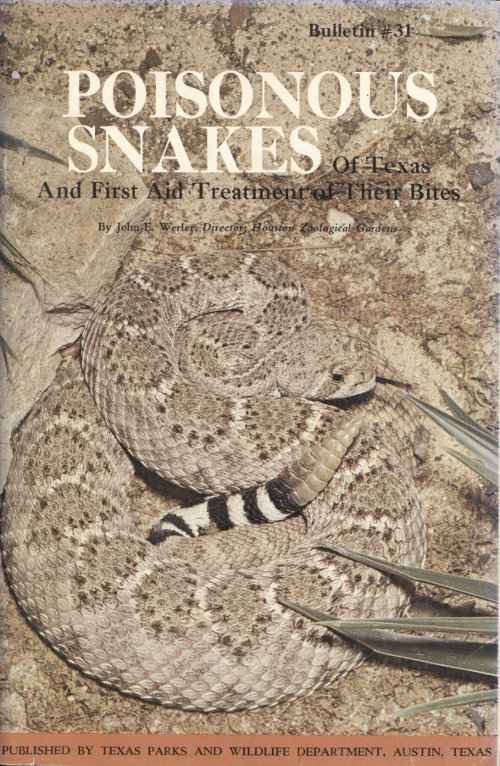
The Project Gutenberg eBook of Poisonous Snakes of Texas and First Aid Treatment of Their Bites
Title: Poisonous Snakes of Texas and First Aid Treatment of Their Bites
Author: John E. Werler
Release date: November 21, 2017 [eBook #56021]
Most recently updated: October 23, 2024
Language: English
Credits: Produced by Stephen Hutcheson and the Online Distributed
Proofreading Team at http://www.pgdp.net
TEXAS PARKS AND WILDLIFE DEPARTMENT
POISONOUS SNAKES OF TEXAS
AND FIRST AID TREATMENT
OF THEIR BITES
BULLETIN NO. 31
Originally published February 1950
Revised February 1952
Reprinted May 1960
Revised July 1963; May 1964
Reprinted Jan. 1967
Reprinted Jan. 1969
Reprinted August 1970
By
JOHN E. WERLER
Director, Houston Zoological Gardens
Published by Texas Parks and Wildlife Department
Austin, Texas
TABLE OF CONTENTS
- INTRODUCTION 4
- PRECAUTIONS AT HOME 5
- PROTECTION IN THE FIELD 7
- RECOGNIZING THE POISONOUS KINDS 8
- THE PIT VIPERS 12
- THE COPPERHEADS 13
- Southern 14
- Northern 16
- Broadbanded 18
- Trans-Pecos 20
- THE COTTONMOUTH 22
- Western Cottonmouth 22
- THE RATTLESNAKES 25
- Western Massasauga 26
- Western Pigmy 28
- Western Diamondback 30
- Timber 34
- Canebrake 36
- Banded Rock 38
- Mottled Rock 40
- Blacktailed 42
- Mojave 44
- Prairie 46
- THE ELAPID SNAKES 48
- Texas Coral 48
- VENOMS 52
- DIAGNOSING THE BITE 53
- SEVERITY OF THE BITE 54
- FIRST AID TREATMENT 55
- SUGGESTIONS TO PHYSICIANS 57
- BIBLIOGRAPHY 61
- FILMS 62
INTRODUCTION
This Bulletin has been prepared in response to many requests from hunters, ranchers, telephone construction personnel, Boy Scouts and others who spend much time outdoors, for a concise and illustrated guide to the poisonous snakes of Texas. The information presented is merely an outline of the poisonous snakes found within the state and is not intended to replace the several excellent snake books now on the market.
Sixteen species and subspecies of poisonous snakes, belonging to four general groups, are found in Texas. The most characteristic features of each are described. A photograph accompanies each description and a map indicating the snake’s known range by counties is included. With this information, the reader should have little difficulty recognizing the poisonous snakes found in his region and, should he be required to render first aid for snake bite, the text and photos covering this subject will help him to do the job successfully.
A number of persons have extended help during the current revision of this booklet. I am most indebted to Alvin Flury, information and education officer for the Texas Parks and Wildlife Department, who not only did much of the necessary legwork for the project, but who also provided the impetus that saw it to completion. Thanks are due also to the following persons for county records of poisonous snakes in Texas: Ralph W. Axtell, Richard J. Baldauf, Edward W. Bonn, Bryce C. Brown, James R. Dixon, Alvin Flury, John W. Forsyth, W. C. Glazener, W. Grainger Hunt, L. M. Klauber, Verlin Nethery, Floyd Potter, Kirk Preston, Stephen Preston, Gerald G. Raun, Michael Sabath, Joe T. Stevens, Ernest C. Tanzer, Donald W. Tinkle, Clay Touchstone and John Wooters. Live specimens for making photographs used here were provided by Russell J. Long, Rusty Martin, Ernest C. Tanzer, Clay Touchstone and Lawrence Curtis. Finally, I wish to thank Robert L. Carlisle, Joseph F. Gennaro, Richard MacAllister, Don W. Micks, J. Fred Mullins, A. C. Stimson and John H. Werler for other information and assistance.
JOHN E. WERLER
POISONOUS SNAKES OF TEXAS
AND FIRST AID TREATMENT
OF THEIR BITES
It is widely known among snake bite authorities that more persons die from snake bite in Texas than in any other state of the nation. This startling fact should encourage every Texan to obtain a thorough working knowledge of the correct first aid treatment for snake bite so he will be prepared to act promptly in the event of an emergency. In addition, and perhaps just as important, he should learn how to prevent a bite before it can happen. This means knowing where to expect poisonous snakes, how to avoid them, and how to identify on sight the venomous kinds found in the region where he lives.
PRECAUTIONS AT HOME
Statistics show that a large percentage of all bites takes place near the home and more than a few of these are inflicted upon small children playing in their yards. Therefore, let us consider first the possible presence of poisonous snakes around the home and some precautions that can be taken to keep them away.
Each year Texas zoos receive calls from distressed home owners within city limits who have discovered rattlesnakes or copperheads under their houses or beneath trash piles on their property. These people ask for assistance in the removal of the snakes or for advice which may prevent similar future invasions. The trespassing snake often can be disposed of quickly, but the removal of one snake does not always solve the problem. Something must be done to discourage other snakes from taking residence on the grounds.
The steps to be taken are simple; chief among them is the removal of all rubbish. Rock piles, trash piles, stacked lumber, tree stumps and other forms of debris near or under houses often harbor rats and mice which form the principal food of most snakes. In addition, this trash furnishes cover for the reptiles and offers them protection from enemies and bad weather. Therefore, if all rubbish is removed from the premises, the food and shelter which attract snakes are largely eliminated and the snakes are forced to seek a more suitable environment. Dense, low growing plants may also supply cover for snakes.
Finally, the removal of rubbish and dense vegetation enables the homeowner to easily see and destroy poisonous snakes that may be present. In settled areas, however, where poisonous snakes are particularly abundant and present a serious problem, it may be necessary to take further protective measures.
Dr. C. M. Bogert of the American Museum of Natural History has suggested the use of a quarter-inch mesh wire fence to keep snakes off residential property. This yard-high, snake-proof fence is placed around the house in much the same manner as an ordinary picket fence, except that the bottom must be set about six inches into the ground to prevent snakes forcing their way beneath it. In addition, all gates must be provided with close-fitting sills on the bottoms and sides to insure a completely tight enclosure.
Experiments with fences of this kind were made to determine their effectiveness and to seek possible improvements in their construction, with the result that one important change was made. Copperheads and small rattlesnakes could not get over the vertically-straight fence, but a six-foot rattlesnake used in the experiment was able to climb over it. When the same fence was tilted outward at a 30-degree angle, not even the largest snake was able to reach the top. Although such fences are expensive and difficult to keep in good repair, they may be desirable under some circumstances.
A less costly method of keeping snakes away from residential property has been proposed by the manufacturers of a new chemical that allegedly repels and kills snakes. The product, a granular material with a civet musk odor, is reported by its distributors to kill a snake less than two feet in length if it is exposed longer than 20 seconds. Preliminary tests made at the Houston Zoo indicate that, in spite of claims to the contrary, the material had little effect on the snakes used. Each of more than a dozen different specimens, including examples of all the local poisonous kinds, unhesitatingly crawled through a wide barrier of the repellent that was poured on the ground. In some instances, the snake’s tongue contacted the granules, but none of the test reptiles showed any ill effects from exposure to the chemical. While these crude tests are certainly not conclusive, it would seem advisable to use commercial repellents with some reservations until they can be proved effective. Meanwhile, we can still prevent most snake bites by observing a few simple safe practices.
PROTECTION IN THE FIELD
In the field, where poisonous snakes are more common, they present a greater hazard to human life; consequently, campers, crop farmers and others who spend a great deal of time outdoors should necessarily take more care in avoiding snake bites. Because almost all snake bites are inflicted on the arms or legs of the victim, these limbs require special protection. The use of a little caution, when placing hands or feet where snakes may be partially or completely hidden from view, is the best protection you can give them. This is particularly true when climbing hand-over-hand on rocky ledges, where your hands reach the level of the ledge before your eyes do. Rattlesnakes and copperheads are partial to such rocky hillsides and here, especially during the warm days of early spring, they prefer to coil and sun themselves.
Armadillo and pack rat burrows also make excellent shelters for rattlesnakes, and only a reckless person would find an excuse to reach into one of these holes. Yet one year, in South Texas alone, at least two snake bites occurred when the victims, each in search of small game, reached into armadillo holes and were bitten by rattlesnakes coiled there.
Another way to invite snake bite is to thoughtlessly turn over a log with bare hands or to step over one without first looking to see whether a snake is coiled on the other side. Many snakes, particularly the copperhead and coral snake, are fond of hiding beneath or within decaying logs, as any snake collector will testify, and such a log is at all times to be considered a potential snake den. If a log must be moved, use a long stick as a pry-bar. Stepping over a log will be less risky if boots or high-top shoes are worn, but even then it is safer to see first what is on the other side.
Several types of footwear offer good protection against the bites of most snakes. Especially effective are high-top leather shoes, riding boots, rubber boots or a combination of army “paratrooper shoes” and heavy leather puttees. Probably the best of these is a snakeproof boot made of extra heavy bullhide leather, sold by the Gokey Company, 94 East 4th Street, St. Paul, Minnesota. For protection of the legs above the knees, snakeproof pants that weigh little more than ordinary duck trousers are available. They consist of three thicknesses of duck material and one layer of fine wire mesh, flexible enough to allow easy knee movement. Snakeproof leggings of similar material can be purchased for safeguarding just the lower legs. Recently marketed aluminum leggings furnish good protection in many cases, but some brands tested were too thin and easily damaged; others were too uncomfortable.
If a poisonous snake is discovered close by, the best protection is to remain as still as possible until the snake has moved away. It should be remembered that a snake is quick to strike at a moving object, so to quickly step away at such a moment may be disastrous. If a rattlesnake is heard nearby but cannot be located, do not begin a wild dash for safety. Location of the snake may be misjudged and by taking a step you are likely to walk into, rather than away from, it. Again, remain still until the snake is sighted and, when it is certain the snake is at least five or six feet away and no others are nearby, slowly back away. If you must move away, do so as slowly as possible.
Because our native poisonous snakes are mostly nocturnal in their activities, remaining hidden during the day and emerging at night in search of food, a flashlight should be used by persons who find it necessary to travel through snake country after dark. During the cool days of spring and autumn, however, nocturnal habits are often reversed. During the day snakes search for warm spots in which to sun themselves; by nightfall they are again under cover.
None of our poisonous Texas snakes ordinarily can strike more than three-quarters of its body length, unless it has a firm backing or is striking downward from an incline. Certainly none has the ability to jump at an enemy, a feat often attributed to the rattlesnake. A snake on the defensive is coiled with the forward part of its body in a loose S position. When striking, this coil is straightened out and the head is thrust forward. It is not necessary for a snake to strike from a coil in order to bite. If picked up near the head, it may simply turn, open its mouth and bite the hand.
It is dangerous to believe, as many do, that a water moccasin cannot bite under water, and woe to the person who dares to seize a submerged cottonmouth.
RECOGNIZING THE POISONOUS KINDS
Suppose, in spite of attention to the precautions and protective measures just outlined, someone is bitten by an unidentified snake. Certainly the victim would not wish to delay treatment if the snake were poisonous, because every minute wasted would make recovery more difficult. On the other hand, he would not care to undergo either the pain associated with snake bite treatment or the anxiety following a bite if a harmless snake were the cause of the accident. Yet time and again people have been bitten by harmless snakes and have been needlessly given first aid and hospital treatment because the offending snake was incorrectly classified as poisonous. Still others have been bitten by harmless snakes and died from nothing more than fright.
When recognition of the snake is doubtful, it should, if possible, be killed and taken to a hospital or doctor’s office for correct identification. Always keep in mind, however, that a recently killed poisonous snake may still be potentially dangerous. Even after its head is cut from the body, a reptile is capable of marked reflex activity; merely touching the head may cause it to bite. To be on the safe side, use a stick to lift or carry a dead snake.
It is evident that the ability to distinguish between harmless and poisonous snakes goes hand in hand with a knowledge of proper first aid treatment. Ability to recognize a poisonous snake on sight can best be achieved by a study of live poisonous kinds and a comparison of them with harmless species. At many zoos, where both kinds are on display in glass-fronted cages, they may be examined safely. If a zoo is not conveniently near, an examination of photographs showing the different kinds is probably the next best way to become familiar with them.
It is generally considered by the layman that four kinds of poisonous snakes are found in the United States—the rattlesnake, cottonmouth, copperhead and coral snake. This grouping, although somewhat arbitrary and certainly not zoologically correct, is firmly established in the minds of most people and may very well be here to stay. Nevertheless, a more accurate and scientific approach is possible if we consider each species and subspecies as a different kind.
Illustrations in this booklet show the 16 kinds (species and subspecies) of poisonous snakes known in Texas. These photographs, together with descriptions in the text, should aid in identification. The accompanying distribution map for each form has been compiled from county records based on museum specimens, but in a few cases reliable “sight” records have been used as proof of a snake’s occurrence within a county.
Distribution of snakes within Texas is incompletely known because of a lack of reliable records; for this reason, the distribution maps are necessarily far from complete. It is hoped, however, that the lists will be brought up to date as new localities come to light. If the reader can make any additions to the present lists, he is asked to communicate with the author or to deliver specimens to the nearest large college, zoo or museum maintaining a zoological collection.
Only 16 of the approximately 106 different kinds of snakes found in the state are dangerously poisonous to man, and some are so rare that they are seldom seen. In addition, we have in Texas several species of smaller snakes known as opisthoglyphs, each possessing a mild venom and a set of small grooved fangs far back in the upper jaw. Because of their weak and limited supply of venom and small fangs, which are poorly adapted for injecting poison into large animals, these rear-fanged snakes are considered harmless to man. By far, the majority of species are small, being not more than 15 inches long and about three-sixteenths of an inch thick. In this group are the blackheaded snakes (genus Tantilla) found over most of the state. The slightly larger spotted night snakes (genus Hypsiglena) of west and central Texas have enlarged but ungrooved teeth in the upper jaw. Two Mexican rear-fanged snakes, found as far north as the Brownsville region, are somewhat larger. They are the blackstriped snake (Coniophanes imperialis imperialis) which grows to about 20 inches in length, and the Texas cat-eye snake (Leptodeira annulata septentrionalis), which reaches a length of about three feet. Still another species, the very rare Texas lyre snake (Trimorphodon vilkinsonii), is known from extreme western Texas. It is generally less than three feet long.
In spite of the small percentage of poisonous kinds of snakes in the state, it must be made clear that no one general rule can be used safely to identify all of them at a glance. It is a mistaken idea that all venomous snakes have broad, triangular heads. On the contrary, by using this rule, many of our harmless snakes look more dangerous than do some poisonous kinds. Furthermore, this generalization is made useless by several exceptions, a notable example being the coral snake which has a round head and does not look at all poisonous.
Even the characteristic rattle is not always present to make a rattlesnake’s identification certain. Sometimes the snake’s rattle is accidentally broken off, in which case this identifying appendage is gone. Then, too, a rattlesnake often is coiled in such a way that its rattles are concealed beneath a loop of its body. Again, the tell-tale rattle is not visible and it is necessary to recognize the snake by some other means.
Disregard all so-called “easy” rules by which poisonous snakes may be identified; instead, learn to know each one by its general overall appearance. For example, to identify the cottonmouth, look for a combination of its most characteristic features—relatively short, stout body and a broad, flat head. Also look for a body color of black, dark brown or olive and from 10 to 15 wide, usually indistinct, crossbands which are generally lighter in the center than on the edges. The upper jaw below the eye, as well as the lower jaw, will be light colored in contrast to the dark color above the eye. Together, these characteristics will make identification quite certain at a reasonable distance. Remember that the young of this snake are colored differently from the adults and you will not be able to identify the juvenile by using the color characteristics of the adult snake.
THE PIT VIPERS
Our poisonous Texas snakes belong to two families—the Viperidae (subfamily Crotalinae—pit vipers) and the Elapidae (cobra-like snakes). The pit vipers, which include rattlesnakes, copperheads and cottonmouths, possess an opening on either side of the head, between the eye and the nostril. With these heat-sensitive pits, the snake can locate warm-blooded prey in the dark and make a direct hit upon a rat or mouse which it cannot see.
Snakes belonging to this family are further characterized by the possession of elliptical eye pupils, somewhat triangular-shaped heads and long, movable fangs in the front of the upper jaw. Each fang is connected by a tube to the poison gland located just behind the eye. When the snake is at rest and its mouth is closed, the fangs lie folded back against the roof of the mouth. During the strike, the mouth is opened so that the upper and lower jaws form an angle of nearly 180 degrees. The fangs are then erected to point almost directly forward. With the fangs in this position, the strike results in a stabbing action rather than a true bite.
THE COPPERHEADS
Four kinds of copperheads are known in Texas. They are much smaller and more slender than the closely related cottonmouth and, because they have proportionately smaller fangs and less venom, are not very dangerous to man. The four copperheads resemble one another by having the same general pattern of chestnut or reddish-brown crossbands on a lighter body color. Differences are based mostly on the size and shape of crossbands and in the degree of marking present on the belly.
Copperheads are most common in rocky areas of hilly or mountainous country, as well as in wooded bottomlands. They are rarely seen in dry, cactus country. Although spending most of their time on the ground, copperheads occasionally climb bushes and low trees in search of food. Along the Colorado River near Wharton, they were observed high in trees; some were 40 feet above the ground. The snakes reached these unusual heights by crawling along wild grape vines that clung to the tree trunks and draped over lower limbs. One snake hunter in the area collected nearly 100 copperheads by pulling them off the branches.
Copperheads do most of their feeding at night. During the spring in some parts of the state, they are found in large numbers along streams and other moist areas, where they spend most of the day hidden beneath decaying logs and other debris which affords good cover. Copperheads also can be expected when air temperatures are high, and when the soil and vegetation are wet from recent rain. They often make their homes within the suburbs of large cities where, due to their nocturnal habits and protective coloration, they are apt to be overlooked.
Not quick to seek cover when approached, copperheads prefer to lie perfectly still until an intruder has passed. Once molested, they frequently vibrate their tails and, if among dry leaves, produce a buzzing sound not unlike that made by a rattlesnake. Copperheads are quick to strike at any annoying object, and often bite several times in rapid succession.
Copperheads seldom deliver a fatal bite because of their short fangs and small size. Their strike is often blocked by a mere trouser leg. Records of the Antivenin Institute of America show that during a 10-year period, not a single death resulted from 308 recorded copperhead bites regardless of the lack or kind of treatment given victims. In spite of these reassuring figures, it must be remembered that the copperhead is potentially a dangerous snake, especially when the bite involves a child. All bites from this species should receive the same urgent consideration given the bite of a diamondback rattlesnake.
The four forms of copperheads occurring in Texas are the only kinds found in the United States.
SOUTHERN COPPERHEAD
Agkistrodon contortrix contortrix
Description—Lighter in color than the other copperheads, this form has a body color of light brown or tan, often with a pinkish tinge. Hourglass-shaped crossbands of darker brown are very narrow along the middle of the back and are sometimes broken, forming two separate triangular markings, one on each side of the body. As on the northern copperhead, the bands are rounded at their bases. The belly is pale and indistinctly marked.
Size—Adults average between 20 and 30 inches long, while some especially large examples reach a length of more than 40 inches.
Young—The average number in a brood is five or six. As with all North American pit vipers, the young do not hatch from eggs but are born alive, enclosed in a thin membranous sack. They are paler than adults, with a more vivid pattern, and a bright sulphur yellow tail tip.
Distribution in Texas—The southern copperhead is known in about the eastern third of the state, where it has been found in the following counties: Austin, Bastrop, Bowie, Brazoria, Brazos, Burleson, Calhoun, Chambers, Cherokee, Colorado, Fort Bend, Gonzales, Grimes, Hardin, Harris, Harrison, Henderson, Hopkins, Houston, Jefferson, Leon, Liberty, Madison, Matagorda, Montgomery, Nacogdoches, Newton, Orange, Polk, Robertson, San Jacinto, Smith, Tarrant, Trinity, Victoria, and Walker.
NORTHERN COPPERHEAD
Agkistrodon contortrix mokasen
Description—This darker form has a pattern of reddish-brown or chestnut colored crossbands, which become narrower near the middle of the back and rounded at the bases. The darker color of these “dumbbell” shaped bands contrasts with the hazel-brown body color. The underside of the snake is dark and indistinctly mottled with gray or black. Its head is usually of a lighter tint than the body.
Size—Adults usually are about two and a half feet long but record size individuals of more than 40 inches have been caught.
Young—Newborn northern copperheads, from three to 14 in a brood, may be from eight to 10 inches long.
Distribution—Records of this snake are rather widely scattered over the northeastern part of the state. Specimens have been collected in the following counties: Bastrop, Bowie, Burleson, Cass, Collin, Colorado, Coryell, Dallas, Ellis, Fannin, Grayson, Guadalupe, Hopkins, Hunt, Kaufman, Lamar, Lee, McLennan, Milam, Morris, Robertson, Smith, Somervell, and Titus.
BROADBANDED COPPERHEAD
Agkistrodon contortrix laticinctus
Description—The very broad, straight edged crossbands of this snake easily distinguish it from other copperheads. The similar Trans-Pecos copperhead differs by the presence of a light colored inverted U at the base of each crossband. The dark brown bands of this form are slightly narrower at the middle of the back than on the sides; their nearly straight edges gives the bands a squarish appearance. The dark crossbands contrast strongly with the lighter body color, while the belly is of almost the same shade as the bands. The tail is tipped with yellowish green, more pronounced in the young.
Size—Snakes of this subspecies probably reach a length of three feet but most adults are about two feet long.
Young—Litters probably average five or six but little else is known about the breeding habits of this form.
Distribution—Widely scattered records include the following counties: Atascosa, Bandera, Bastrop, Bexar, Bosque, Burnet, Callahan, Comal, Cooke, Crockett, Denton, Dimmit, Eastland, Fayette, Frio, Gillespie, Gonzales, Grayson, Guadalupe, Hamilton, Hays, Kendall, Kerr, Mason, Medina, McLennan, Parker, Palo Pinto, Real, San Saba, Tarrant, Taylor, Throckmorton, Tom Green, Travis, Uvalde, Victoria, Wilson, Wise, and Young.
TRANS-PECOS COPPERHEAD
Agkistrodon contortrix pictigaster
Description—This species resembles the broadbanded copperhead by its straight edged, squarish crossbands but differs from all other copperheads by having uniformly dark or strongly mottled belly. It also differs from the broadbanded form by the presence of a light colored inverted U at the base of each crossband. The pattern consists of about 13 chestnut-brown crossbands with narrow, dark borders. The color between the bands is light hazel brown, flecked with darker brown.
Size—This is the smallest of the copperheads, probably not reaching a length of two and one-half feet.
Young—Nothing is known of the breeding habits of this rare snake.
Distribution—This form apparently is restricted to the mountains of West Texas, where it is known in Brewster, Jeff Davis, Presidio and Terrell Counties. Until 1949 it was found sparingly throughout its range and less than a dozen specimens had been found by experienced collectors. Recently, however, students from The University of Texas obtained about 100 of these snakes during a six weeks’ summer course in a small section of Terrell County. This indicates that the Trans-Pecos copperhead is common, but in restricted areas only. Such areas generally are in wooded canyons and live oak groves where there is some leaf litter.
THE COTTONMOUTH
Only one kind of cottonmouth is found in Texas. It is one of our heaviest and largest poisonous snakes and may reach a length of more than five feet. When viewed from above, the head appears triangular shaped and from the side the head looks flat on top.
The eye pupils, as with all members of the pit viper sub-family, are elliptical.
WESTERN COTTONMOUTH
Agkistrodon piscivorus leucostoma
Description—This is the most variable poisonous snake in the state, both in color and in the presence or absence of markings. Adults are much less brilliantly marked than are the young or newborn snakes. Adults have a background of dark brown and are marked by from 10 to 15 dark, wide crossbands somewhat lighter in the center than at the edges. The bands, which have irregular edges, become a little wider along the sides. However, not all cottonmouths look like this. While some individuals have clearly defined crossbands, others have none. There is also considerable variation in color. Some cottonmouths are brown; some are olive brown or olive green; and some are entirely black. The lower jaw, as well as the upper jaw below the eye, is light in contrast to the dark color on top of the head. Young cottonmouths are vividly marked on a background of reddish-brown, highlighted by darker brown bands edged with white. They look much like copperheads.
Size—In Texas, this heavy-bodied snake reaches a maximum length of about four and a half or five feet, but the average is more nearly three feet.
Young—About eight are born in each litter. They are from six to eight inches long at birth.
Distribution—The cottonmouth has been reported in the following counties: Anderson, Aransas, Atascosa, Austin, Bandera, Bexar, Bowie, Brazos, Brazoria, Burleson, Burnet, Cass, Calhoun, Chambers, Cherokee, Collin, Colorado, Comal, Dallas, Denton, Ellis, Falls, Fannin, Fisher, Fort Bend, Galveston, Goliad, Gonzales, Grayson, Guadalupe, Hardin, Harris, Harrison, Hays, Henderson, Houston, Jasper, Jefferson, Kaufman, Kerr, Kimble, Lamar, Leon, Liberty, Limestone, Marion, Mason, Matagorda, Maverick, McLennan, Medina, Montgomery, Morris, Nacogdoches, Newton, Nueces, Orange, Parker, Polk, Red River, Refugio, Robertson, San Jacinto, San Patricio, Shelby, Smith, Sterling, Tarrant, Tom Green, Travis, Uvalde, Val Verde, Victoria, Walker, Wharton, Wilson, and Wise.
The cottonmouth is one of our largest poisonous snakes. It is particularly abundant in the coastal marshes of southeastern Texas where it is found along streams, ponds and lakes. Although ordinarily rather sluggish, it immediately draws back its head and opens its mouth widely in a threatening manner when annoyed, exposing the white tissue lining the inside of the mouth. This characteristic pose is responsible for its popular name. Moreover, like the copperhead, which also lacks rattles, it has the habit of vibrating its tail when sufficiently annoyed. Thus, when it is among dry leaves, or if the tail strikes a hard object, the resulting sound may be similar to that made by a rattlesnake.
The name water moccasin, which is loosely applied to any and all water snakes as well as to the cottonmouth, has resulted in a popular but misplaced belief that all “water” snakes are poisonous. It should be pointed out here that the cottonmouth, Agkistrodon piscivorus leucostoma, is our only poisonous aquatic serpent. The several kinds of harmless water snakes, which in some instances resemble it, are devoid of poison. They can, at most, inflict a bite no more serious than the scratch of a cat and these wounds require only the first aid recommended for minor cuts.
Harmless water snakes most frequently mistaken for the cottonmouth include the large diamondbacked water snake of central and eastern Texas, the blotched water snake found over most of the state, and the yellowbellied and broadbanded water snakes of eastern Texas. Most of them are relatively heavy bodied, possess somewhat diamond shaped heads and, although not venomous, will bite viciously if stepped upon or handled.
THE RATTLESNAKES
More than one-half of all the poisonous kinds of snakes known in Texas are rattlesnakes, and records show that almost every county has at least one variety. Texas rattlesnakes range in size from the very small, 18-inch western pigmy rattlesnake, which rarely if ever causes death among humans, to the seven-foot western diamondback rattlesnake, known to be one of the most dangerous snakes in North America. All have comparatively stout bodies, facial pits characteristic of the family, and rattles.
The rattle, which sets this snake apart, is a series of loosely interlocking horny segments which, when vibrated, produce a sharp buzzing sound as the segments strike against one another. A rattlesnake’s age cannot be determined by the number of segments of its rattle because a new segment is added with each shedding of the skin. Because a snake may shed several times a year, the resulting number of segments added annually may be six or more. On the other hand, the segments are frequently broken off as the rattle becomes caught in underbrush, so that few rattlesnakes have a complete rattle.
WESTERN MASSASAUGA
Sistrurus catenatus tergeminus
Description—The general body color is brown or gray. About 39 dark brown, oval blotches extend along the middle of the back while two rows of smaller blotches are found along each side. These blotches are narrowly edged with a lighter color.
Size—Adults average two feet in length; larger specimens are sometimes as long as three feet.
Young—The young resemble the adults but are lighter in color. Average number in a litter is eight or nine and they measure eight or nine inches at birth.
Distribution—Records of this snake are widely scattered throughout the state, including the following counties: Andrews, Aransas, Armstrong, Bell, Bosque, Brazos, Calhoun, Cameron, Chambers, Clay, Colorado, Crosby, Dickens, El Paso, Gaines, Galveston, Hardeman, Haskell, Hemphill, Jim Hogg, Johnson, King, Matagorda, McLennan, Midland, Nolan, Nueces, Parker, Pecos, Roberts, Shackelford, Sutton, Tarrant, Throckmorton, Victoria, Wheeler, Wilbarger, Winkler, Yoakum, and Young.
This small rattlesnake is uncommon in Texas, although years ago it was plentiful in some parts of the state. J. K. Strecker in his Reptiles and Amphibians of Texas, 1915, states:
Mr. Luttrell of Claude, Armstrong County, informed me that he has often killed from 50 to 60 during one wheat season, but during the past four or five years he has not seen more than half a dozen a year.
Wet places, usually near swamps or marshes, are its favorite habitat. One of our most docile rattlesnakes, it is seldom inclined to use its rattle, even when almost stepped upon.
WESTERN PIGMY RATTLESNAKE
Sistrurus miliarius streckeri
Description—The body color of this snake is from gray to grayish-brown. Its back is marked with about 35 small, dark spots which are wider than long. Another row of smaller spots is located along each side toward the belly.
Size—Specimens average 18 inches long and large examples may reach a length of more than two feet.
Young—The normal brood contains from eight to 10 but some may have as many as 18. Average length of the newborn is five or six inches.
Distribution—All county records of this snake, except one from Mitchell County, are in the eastern part of the state. The Mitchell County record may be an error. Records include the following counties: Anderson, Angelina, Brazoria, Brazos, Chambers, Cooke, Dallas, Galveston, Hardin, Harris, Harrison, Henderson, Houston, Jasper, Jefferson, Lamar, Leon, Liberty, Matagorda, McLennan, Mitchell, Montgomery, Newton, Orange, Red River, Refugio, Robertson, San Jacinto, Smith, Somervell, Victoria, Walker, Wharton, and Wise.
The western pigmy rattlesnake prefers to live in dry areas; reports of professional collectors indicate that it is found in greatest number after heavy rains and at night. While more aggressive than its close relative, the massasauga, its small size makes it one of our least dangerous poisonous snakes. Its rattle is small, often difficult to see, and cannot be heard at distances greater than a few feet.
WESTERN DIAMONDBACK RATTLESNAKE
Crotalus atrox
Description—Although individuals of this species show a great deal of variation in color, from a chalky white to a dull red, they can be identified immediately by the alternate black and white rings of about equal width on the tail. There is a pattern of brown diamond shaped markings along the middle of the back, which stands out against the lighter body color. Each diamond has a narrow light border.
Size—Adults are generally from three and a half to four and a half feet long. Reliable reports indicate that this species grows to a length of over seven and a half feet, and six-foot specimens are not rare.
Young—Broods average 10 or 12 but occasionally contain 20 or more. The newborn diamondback is about a foot long and looks very much like the adult.