
He is a great banker and broker now, and directs the finances of a little world of his own, but as he looks out from his luxurious office on Broadway on the ever-busy throng on the streets, he grows reminiscent, and, suddenly scratching his nose, breaks out into a great laugh.
“You noticed me just now scratching my nose, didn’t you?” he said, and he laughed again, “and you can’t see anything to laugh about, but I remember the time when it would have cost me my life if I had attempted to do so. It is a strange story and well worth relating.”
The speaker was J. Frank Howell, the noted Broadway financier and his companion a member of the House of Morgan.
“It occurred in 1881, when I was out in Nevada, and working as a telegraph operator at Beowawa, a little station on the Central Pacific Railroad. I had acquired a complete knowledge of the Chinook language, had become a fair student of Indian poker, could eat jack rabbits like an Ogallala and considered myself quite a sport among the children of the sage brush state.
“A few weeks of this kind of existence fitted me for great and more promising fields of usefulness, and when the gold excitement broke out at Yankee Blade, 125 miles down the line, I bade goodbye to Johnson Sides, Nastyshack Jim and other of my playmates, and started on the stage for Yankee Blade in company with three other adventurous spirits.
“I will never be able to explain how it happened, but it must have been that the outlaw, Jim Slack, knew that I had drawn my month’s salary and that I was aboard the stage coach, for just as we were leaving Dogtown, we were halted by a lone highwayman, who lost no time in ordering us to throw up our hands, forming us into a line in the rear of the stage. There we were, the four passengers and ‘Stub,’ the driver, all with arms pointed skyward, while the merry Jim Slack rifled our pockets.
“The bandit cracked jokes with us, saying he was sorry he had to do it, but he needed the ‘mon,’ and he hoped that he wouldn’t overlook any small change we might still have left in our jeans.
“At this moment my nose began to itch, but I knew it was sure death to lower my hand to scratch it, and what was I to do, for I could hardly stand it? I addressed the robber: ‘I say, Mr. Highwayman, my nose itches me pretty badly, won’t you please allow me to lower my arm to scratch it?’” I asked in a most plaintive manner.
“‘Never mind, I will do that little job for you myself,’ was his reply, and taking the point of his Colt’s revolver he rubbed my nose very briskly till I told him I had enough, and thanked him for his courtesy, and the passengers and ‘Stub,’ the driver, laughed merrily.
“I never knew, till I had it done with the business end of a revolver in the hands of a stage robber, the exquisite delight of the privilege of scratching one’s own nose.”
Finis
Introduction.
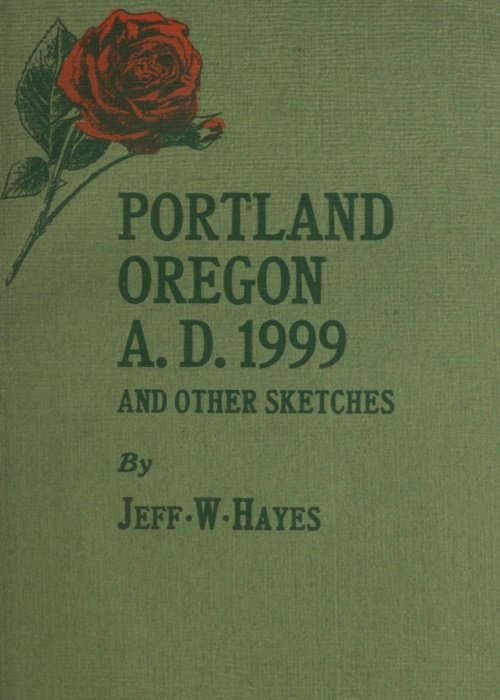
Welcome to Project Gutenberg’s edition of Portland, Oregon, A. D. 1999 and other sketches, a novel by Jeff W. Hayes. Hayes also released this book under the title of Paradise on Earth. Aside from the title, the cover and contents of both books are the same.
This Project Gutenberg version.
We based our production of Portland, Oregon, A. D. 1999 and other sketches on the edition of the novel with that title, published in 1913, by F. W. Baltes and Company. We used the scanned copy from the Bancroft Library of the University of California available at the Internet Archives as our source.
Detailed Notes.
Instead of correcting (and changing) a lot of the narrative, we tried to preserve as much of it as possible. The spelling of words such as encoure, mein, employe, brusquesness, pleasureable, inadvertantly, and aboriginies were retained.
We did change familiar or occurrence because these words were used other times in this book and spelled correctly those other times. All changes are listed in the Emendations and Issues section of these notes.
For the few words hyphenated and split between two lines for spacing in this book, we silently rejoin words based on other uses of the word in this novel. When this book had no template, outside sources were used. The author’s other books on the Internet Archive provided some assistance. Google’s Ngram viewer identified the most-common spelling of the word for the era. Some of the harder decisions are listed in the Hyphenated Words section.
Other issues that have come up in transcribing the book are listed in the Emendations and Issues section of these Detailed Notes.
Emendations and Issues.
- On Page vi, Add question mark to the story Where Did You Get That Oil? in the Contents to match the title of the story beginning on page 55.
- Missing or incorrect quotation marks at the beginning of Chapter 4, Chapter 8, and Chapter 9 were corrected.
- Change A.D. to A. D.--Page viii, and the plain title page.
- On Page 2, change informaiton to information.
- On Page 10, change crominals to criminals.
- On Page 11, change occurrance to occurrence.
- On Page 23, change familier to familiar.
- On Page 25, change effected to affected.
- On Page 27, Remove unnecessary single quote before that in the clause “‘that the first class buildings.
- On Page 29, change nations to nation’s.
- On Page 32, add period after More Denouements to make it like the rest of the chapter titles in Part One. Added period after the chapter titles in Part Two for practical reasons.
- On Page 33, Change Cmmissioner to Commissioner.
- On Page 45, add a period after him in good reports from him.
- On Page 49, Replace comma after Thee with a period in “Nearer My God to Thee.”
- On Page 53, remove right quote after never returned.
- On Page 56, change given to give.
- On Page 60, change report to reports.
- On Page 92, change filing to filling.
- On Page 96, change double quote to single quote after Kentucky Home.
- On Page 112, Add beginning left quote before I never knew.
Hyphenated Words.
- Page 9 high-toned.
- Page 23 outskirts.
- Page 31 tombstones. Author used this spelling in Tales of the Sierras.
- Page 35 forbade.
- Page 87 half-way. Author used this spelling in Autographs and Memoirs of the Telegraph.
- Page 101 horseman. Author used this spelling in Tales of the Sierras.
- Page 111 Nastyshack Jim, referring to the Modoc warrior Jim Shacknasty.