
WeRead Powered by ReaderPub
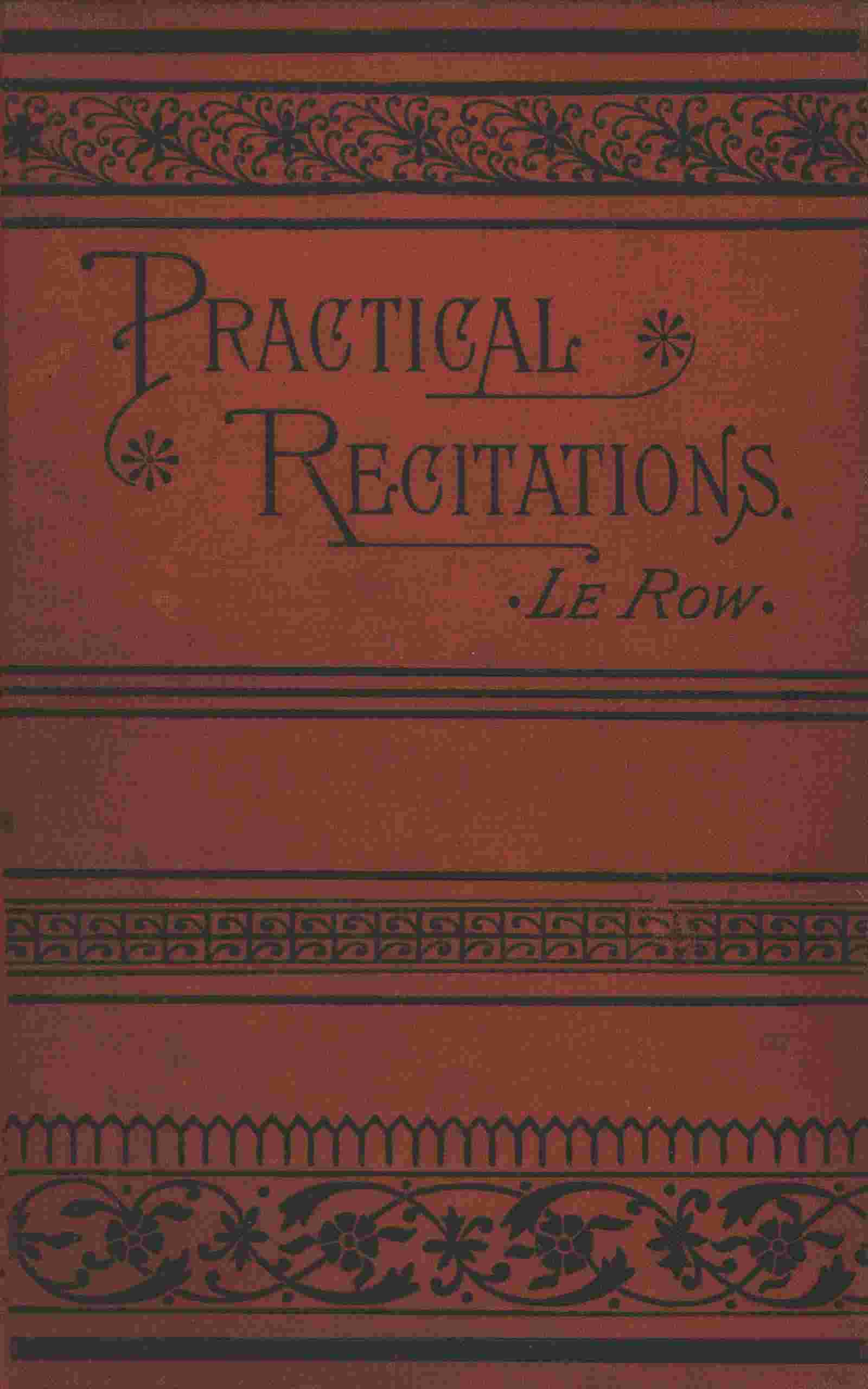
Practical recitations / cover

Practical recitations /

Chapter 121: Abraham Lincoln.
Open in WeRead

About This Book

A practical reader compiled by an elocution instructor combines concise pedagogical guidance with a wide-ranging anthology of short recitations and concert pieces suitable for upper grammar and high schools. The introductory section covers methods for teaching reading, physical and breathing exercises, articulation drills, emphasis, and handling punctuation and poetic rhythm. The anthology gathers brief, classroom-tested selections for classroom recitations, holidays, poets’ birthdays, and concert performance, emphasizing simplicity, moral tone, and opportunities for many pupils to participate. Annotated lists and varied styles aid teachers in selecting appropriate material for different occasions and abilities.

JAMES RUSSELL LOWELL.

Born Feb. 22, 1819.


James Russell Lowell.

[HARVARD COMMENCEMENT POEM.]

Oliver Wendell Holmes.

This is your month, the month of perfect days,
Birds in full song and blossoms all ablaze;
Nature herself your earliest welcome breathes,
Spreads every leaflet, every bower in wreaths;
Carpets her paths for your returning feet,
Puts forth her best your coming steps to greet;
And Heaven must surely find the earth in tune
When Home, sweet Home, exhales the breath of June.
These blessed days are waning all too fast,
And June’s bright visions mingling with the past;
Lilacs have bloomed and faded, and the rose
Has dropped its petals, but the clover blows
And fills its slender tubes with honeyed sweets;
The fields are pearled with milk-white margarites;
The dandelion, which you sang of old,
Has lost its pride of place, its crown of gold,
But still displays its feathery-mantled globe,
Which children’s breath or wandering winds unrobe.
These were your humble friends; your opened eyes
Nature had trained her common gifts to prize;
Not Cam or Isis taught you to despise
Charles, with his muddy margin, and the harsh,
Plebeian grasses of the reeking marsh.
New England’s home-bred scholar, well you knew
Her soil, her speech, her people, through and through,
And loved them ever with the love that holds
All sweet, fond memories in its fragrant folds.
Though far and wide your winged words had flown,
Your daily presence kept you all our own,
Till with a sorrowing sigh, a thrill of pride,
We heard your summons, and you left our side
For larger duties and for tasks untried.
Atlantic Monthly.

We have been under the necessity of telling some unpleasant truths about American literature from time to time; and it is with hearty pleasure that we are now able to own that the Britishers have been, for the present, utterly and apparently hopelessly beaten by a Yankee in one important department of poetry. The tyranny of a vulgar public opinion and the charlatanism which is the price of political power, are butts for the shafts of the satirist which European poets may well envy Mr. Lowell.—North British Review.


Though eminent and able in many ways, Lowell remains absolutely a poet in feeling. His native genius was fostered by the associations of a singularly beautiful home; nourished by the works of the dramatists, by the ideal pictures of poets and novelists, by the tender solemnity of the discourses of his father, and of Channing and others of his father’s friends. Though he was not a rhyming prodigy like Pope, lisping in numbers, his first effusions as he came to manhood were in poetic form.—Frances H. Underwood.


Lowell is a remarkable man and poet. That he is one of the first poets of this age, no man will deny. He is sincerely a reformer; his sympathies are entirely with the oppressed and down-trodden. Some of his poems are exceedingly beautiful, while others are full of grand thoughts which strike upon the ear and heart like the booming cannon-shot, which tells that an ardently desired conflict has commenced.—David W. Bartlett.


The most characteristic and most essential happens to be the most salient quality of Mr. Lowell’s style. It is a wit that is as omnipresent and as tireless as electricity itself. The effect is quite indescribable. We are sure that no other equal amount of literature could be produced that would yield to a competent assay a larger net result of pure wit. Generally the spirit of the wit is humane and gracious.—W. C. Wilkinson.


Mr. Lowell says somewhere that the art of writing consists largely in knowing what to leave in the ink-pot. How many volumes of Lowell’s prose works if not in the waste-basket are almost as effectually buried in papers and magazines? What his working life has given to the world will give the reader some notion of what the world has not got, and will serve to call attention to the condensed wealth contained in “Among my Books” and “My Study Windows.”—Rev. H. R. Haweis.


A Lowell Alphabet.

Another star ’neath Time’s horizon dropped
To gleam o’er unknown lands and seas;
Another heart that beat for freedom stopped,—
What mournful words are these!
To the Memory of Hood.
Bowing then his head, he listened
For an answer to his prayer;
No loud burst of thunder followed,
Not a murmur stirred the air.
A Parable.
Care, not of self, but of the common weal,
Had robbed their eyes of youth, and left instead
A look of patient power and iron will.
A Glance behind the Curtain.
Dear, common flower, that grow’st beside the way
Fringing the dusty road with harmless gold,
First pledge of blithesome May.
To the Dandelion.
Each man is some man’s servant; every soul
Is by some other’s presence quite discrowned;
Each owes the next through all the imperfect round.
The Pioneer.
For mankind are one in spirit,
And an instinct bears along,
Round the earth’s electric circle,
The swift flash of right or wrong.
The Present Crisis.
Glorious fountain!
Let my heart be
Fresh, changeful, constant,
Upward, like thee!
The Fountain.

He could believe the promise of to-morrow
And feel the wondrous meaning of to-day;
He had a deeper faith in holy sorrow
Than the world’s seeming loss could take away.
Ode.
It is God’s day. It is Columbus’s,
A lavish day! One day, with life and heart,
Is more than time enough to find a world.
Columbus.
Joy comes, grief goes, we know not how;
Everything is happy now,
Everything is upward striving.
The Vision of Sir Launfal.
Knew you what silence was before?
Here is no startle of dreaming bird
That sings in his sleep, or strives to sing.
Pictures from Appledore.
Life may be given in many ways,
And loyalty to Truth be sealed
As bravely in the closet as the field.
Commemoration Ode.
My soul went forth, and, mingling with the tree,
Danced in the leaves; or, floating in the cloud,
Saw its white double in the stream below.
Under the Willows.
Not always unimpeded can I pray,
Nor, pitying saint, thine intercession claim.
Sea-weed.
O realm of silence and of swart eclipse,
The shapes that haunt thy gloom
Make signs to us, and move thy withered lips
Across the gulf of doom.
To the Past.

Pan leaps and pipes all summer long,
The fairies dance each full-mooned night,
Would we but doff our lenses strong,
And trust our wiser eyes’ delight.
The Foot-path.
Quite spent and out of breath he reached the tree,
And, listening fearfully, he heard once more
The low voice murmur “Rhoecus,” close at hand.
Rhoecus.
Roots, wood, bark, and leaves singly perfect may be,
But, clapt hodge-podge together, they don’t make a tree.
A Fable for Critics.
Since first I heard our North wind blow,
Since first I saw Atlantic throw
On our fierce rocks his thunderous snow,
I loved thee, Freedom!
Ode to France.
Thine is music such as yields
Feelings of old brooks and fields,
And, around this pent-up room,
Sheds a woodland, free perfume.
To Perdita, Singing.
Untremulous in the river clear,
Towards the sky’s image, hangs the imaged bridge;
So still the air that I can hear
The slender clarion of the unseen midge.
Summer Storm.
Violet! sweet violet!
Thine eyes are full of tears;
Are they wet
Even yet
With the thought of other years?
Song.

Wrong ever builds on quicksands, but the Right
To the firm center lays its moveless base.
Prometheus.
Extemp’ry mammoth turkey-chick fer a Fejee Thanksgivin’.
The Biglow Papers.
Yet sets she not her soul so steadily
Above that she forgets her ties to earth.
Irene.
Zekle crep’ up quite unbeknown
An’ peeked in thru’ the winder,
An’ there sot Huldy all alone
’Ith no one nigh to hender.
The Courtin’.

The First Snow-fall.

The snow had begun in the gloaming,
And busily all the night
Had been heaping field and highway
With a silence deep and white.
Every pine and fir and hemlock
Wore ermine too dear for an earl,
And the poorest twig on the elm-tree
Was ridged inch deep with pearl.
From sheds new roof’d with Carrara
Came Chanticleer’s muffled crow;
The stiff sails were softened to swan’s down,
And still flutter’d down the snow.
I stood and watch’d by the window
The noiseless work of the sky,
And the sudden flurries of snow-birds
Like brown leaves whirling by.
I thought of a mound in sweet Auburn
Where a little head-stone stood;
How the flakes were folding it gently,
As did robins the babes in the wood.
Up spoke our own little Mabel,
Saying, “Father, who makes it snow?”
And I told of the good All-father
Who cares for us here below.
Again I look’d at the snow-fall,
And thought of the leaden sky
That arch’d o’er our first great sorrow,
When that mound was heap’d so high.
I remember’d the gradual patience
That fell from that cloud like snow,
Flake by flake, healing and hiding
The scar of our deep-plung’d woe.
And again to the child I whisper’d,
“The snow that husheth all,
Darling, the merciful Father
Alone can make it fall!”
Then, with eyes that saw not, I kiss’d her;
And she, kissing back, could not know
That my kiss was given to her sister,
Folded close under deepening snow.


Abraham Lincoln.

Nature, they say, doth dote,
And cannot make a man
Save on some worn-out plan,
Repeating us by rote.
For him her Old World molds aside she threw,
And, choosing sweet clay from the breast
Of the unexhausted West,
With stuff untainted shaped a hero new,
Wise, steadfast in the strength of God, and true.
How beautiful to see
Once more a shepherd of mankind indeed,
Who loved his charge, but never loved to lead;
One whose meek flock the people joyed to be,
Not lured by any cheat of birth,
But by his clear-grained human worth,
And brave old wisdom of sincerity!
They knew that outward grace is dust;
They could not choose but trust
In that sure-footed mind’s unfaltering skill,
And supple-tempered will,
That bent like perfect steel to spring again and thrust.
His was no lonely mountain-peak of mind—
Broad prairie, rather, genial, level-lined,
Fruitful and friendly for all human kind.
Here was a type of the true elder race,
And one of Plutarch’s men talked with us face to face.

Wendell Phillips.

He stood upon the world’s broad threshold; wide
The din of battle and of slaughter rolled;
He saw God stand upon the weaker side,
That sank in seeming loss before its foes;
Many there were who made great haste and sold
Unto the cunning enemy their swords.
He scorned their gifts of fame, and flower, and gold,
And underneath their soft and flowery words
Heard the cold serpent hiss; therefore he went
And humbly joined him to the weaker part.
Fanatic named, and fool, yet well content
So he could be the nearer to God’s heart,
And feel its solemn pulses sending blood
Through all the wide-spread veins of endless good.

Freedom.

Men!—whose boast it is that ye
Come of fathers brave and free,
If there breathe on earth a slave,
Are ye truly free and brave?
If ye do not feel the chain
When it works a brother’s pain,
Are ye not base slaves indeed—
Slaves unworthy to be freed?
Is true Freedom but to break
Fetters for our own dear sake,
And, with leathern hearts, forget
That we owe mankind a debt?
No!—true freedom is to share
All the chains our brothers wear,
And with heart and hand to be
Earnest to make others free!
They are slaves who fear to speak
For the fallen and the weak;
They are slaves who will not choose
Hatred, scoffing, and abuse,
Rather than in silence shrink
From the truth they needs must think.
They are slaves who dare not be
In the right with two or three.