
WeRead Powered by ReaderPub
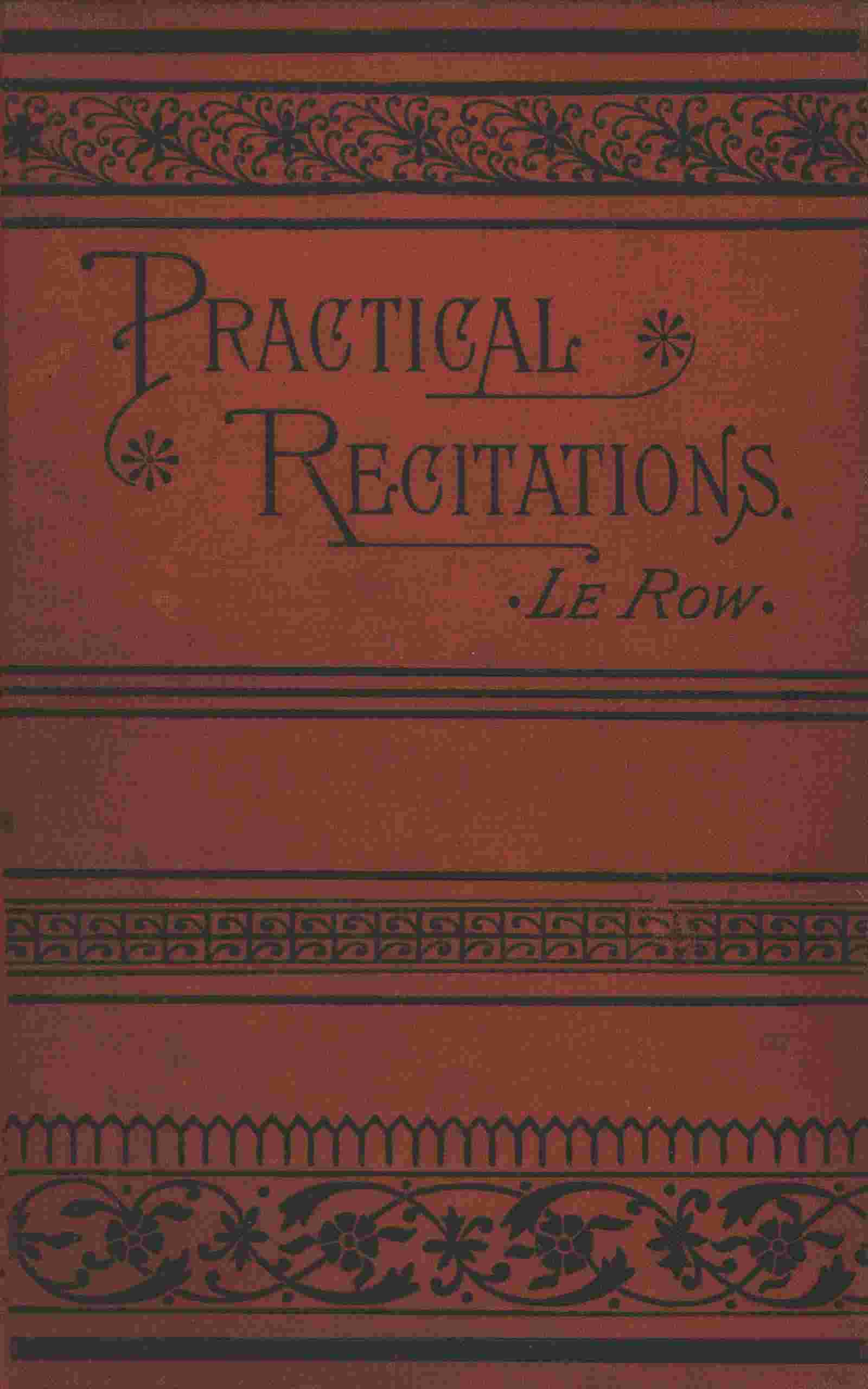
Practical recitations / cover

Practical recitations /

Chapter 97: The Violet.
Open in WeRead

About This Book

A practical reader compiled by an elocution instructor combines concise pedagogical guidance with a wide-ranging anthology of short recitations and concert pieces suitable for upper grammar and high schools. The introductory section covers methods for teaching reading, physical and breathing exercises, articulation drills, emphasis, and handling punctuation and poetic rhythm. The anthology gathers brief, classroom-tested selections for classroom recitations, holidays, poets’ birthdays, and concert performance, emphasizing simplicity, moral tone, and opportunities for many pupils to participate. Annotated lists and varied styles aid teachers in selecting appropriate material for different occasions and abilities.

WILLIAM CULLEN BRYANT.

Born Nov. 3, 1794. Died June 12, 1878.


William Cullen Bryant.

Fitz-Greene Halleck.

Bryant, whose songs are thoughts that bless
The heart,—its teachers and its joy,—
As mothers blend with their caress
Lessons of truth and gentleness
And virtue for the listening boy.
Spring’s lovelier flowers for many a day
Have blossomed on his wandering way;
Beings of beauty and decay,
They slumber in their autumn tomb;
But those that graced his own Green River
And wreathed the lattice of his home,
Charmed by his song from mortal doom,
Bloom on, and will bloom on forever.

Bryant had a wonderful memory. His familiarity with the English poets was such that when at sea, where he was always too ill to read much, he would beguile the time by reciting page after page from favorite poems. He assured me that however long the voyage, he had never exhausted his resources. He was scarcely less familiar with the languages and literatures of Germany, France and Spain, Greece and Rome. He spoke all living languages except the Greek with facility and correctness.—John Bigelow.


The name of Bryant cannot be mentioned by any friend to American letters without respect as well as admiration. The hold that he has on the profoundest feelings of his countrymen is to be referred to the genuineness, delicacy, depth, and purity of his sentiment. He is so genuine that he testifies to nothing in scenery or human life of which he has not had a direct personal consciousness. He follows the primitive bias of his nature rather than the caprices of fancy. His compositions always leave the impression of having been born, not manufactured or made.—Edwin P. Whipple.


It is the glory of this man that his character outshone even his great talent and his large fame. Distinguished equally for his native gifts and his consummate culture, his poetic inspiration and his exquisite art, he is honored and loved to-day even more for his stainless purity of life, his unswerving rectitude of will, his devotion to the higher interests of his race, his unfeigned patriotism, and his broad humanity.—Rev. Henry W. Bellows.


When Cooper died, the restless city paused to hear Bryant’s words of praise and friendship. When Irving followed Cooper, all hearts turned to Bryant. Now Bryant has followed Cooper and Irving, the last of that early triumvirate of American literature. The broad and simple outline of his character and career had become universally familiar like a mountain or the sea. A patriarch of our literature, the oldest of our poets, he felt the magic of human sympathy, the impulse of his country, the political genius of his race, and was a public political leader.—George William Curtis.


A Bryant Alphabet.

Alike, beneath thine eye,
The deeds of darkness and of light are done;
High towards the star-lit sky
Towns blaze, the smoke of battle blots the sun.
Hymn to the North Star.
Beneath the forest’s skirt I rest,
Whose branching pines rise dark and high,
And hear the breezes of the West
Among the thread-like foliage sigh.
The West Wind.
Calm rose afar the city spires, and thence
Came the deep murmur of its throng of men;
And as its grateful odors met thy sense,
They seemed the perfumes of thy native fen.
To a Mosquito.
Darker—still darker! the whirlwinds bear
The dust of the plains to the middle air;
And hark to the crashing, long and loud,
Of the chariot of God, in the thunder-cloud!
The Hurricane.

Enough of drought has parched the year, and scared
The land with dread of famine. Autumn, yet,
Shall make men glad with unexpected fruits.
The Conjunction of Jupiter and Venus.
Far back in the ages,
The plow with wreaths was crowned;
The hands of kings and sages
Entwined the chaplet round.
Ode for an Agricultural Celebration.
Glide on in your beauty, ye youthful spheres,
To weave the dance that measures the years;
Glide on, in the glory and gladness sent
To the furthest wall of the firmament.
Song of the Stars.
Hear, Father, hear thy faint afflicted flock
Cry to thee, from the desert and the rock;
While those who seek to slay thy children, hold
Blasphemous worship under roofs of gold.
Hymn of the Waldenses.
I know where the timid fawn abides
In the depths of the shaded dell,
Where the leaves are broad, and the thicket hides
From the eye of the hunter well.
An Indian Story.
Journeying, in long serenity, away
In such a bright, late quiet, would that I
Might wear out life like thee!
October.
Knit they the gentle ties which long
These Sister States were proud to wear,
And forged the kindly links so strong
For idle hands in sport to tear?
Not Yet.

Lament who will, in fruitless tears,
The speed with which our moments fly;
I sigh not over vanished years,
But watch the years that hasten by.
The Lapse of Time.
Might but a little part,
A wandering breath, of that high melody
Descend into my heart,
And change it till it be
Transformed and swallowed up, O love, in thee!
The Life of the Blessed.
Not from the sands or cloven rocks,
Thou rapid Arve! thy waters flow;
Nor earth, within her bosom, locks
Thy dark unfathomed wells below.
To the River Arve.
Oh, deem not they are blest alone
Whose lives a peaceful tenor keep;
The Power who pities man has shown
A blessing for the eyes that weep.
Blessed are they that Mourn.
Peace to the just man’s memory; let it grow
Greener with years, and blossom through the flight
Of ages.
The Ages.
——the great deep
Quivered and shook, as shakes the glimmering air
Above a furnace.
Sella.
Raise, then, the hymn to Death. Deliverer!
God hath anointed thee to free the oppressed
And crush the oppressor.
Hymn to Death.
Seek’st thou the plashy brink
Of weedy lake, or marge of river wide,
Or where the rocking billows rise and sink
On the chafed ocean side?
To a Waterfall.

Thou unrelenting Past!
Strong are the barriers round thy dark domain
And fetters, sure and fast,
Hold all that enter thy unbreathing reign.
The Past.
Upon the mountain’s distant head
With trackless snows forever white,
Where all is still, and cold, and dead,
Late shines the day’s departing light.
Upon the Mountain’s Distant Head.
Violets spring in the soft May shower;
There, in the summer breezes, wave
Crimson phlox and moccasin flower.
The Maiden’s Sorrow.
Welcome to grasp of friendly hands; to prayers
Offered where crowds in reverent worship come
Or softly breathed amid the tender cares
And loving inmates of thy quiet home.
The Life that Is.
Alexis calls me cruel;
The rifted crags that hold
The gathered ice of winter,
He says, are not more cold.
Song from the Spanish.
Yet these sweet sounds of the early season
And these fair sights of its sunny days,
Are only sweet when we fondly listen,
And only fair when we fondly gaze.
An Invitation to the Country.
Leave Zelinda altogether,
Whom thou leavest oft and long,
And in the life thou lovest
Forget whom thou dost wrong.
The Alcayde of Molina.


The Third of November.

On my cornice linger the ripe, black grapes ungathered;
Children fill the groves with the echoes of their glee,
Gathering tawny chestnuts, and shouting when beside them
Drop the heavy fruit of the tall black walnut tree.
Glorious are the woods in their latest gold and crimson,
Yet our full-leaved willows are in their freshest green,
Such a kindly autumn, so mercifully dealing
With the growths of summer, I never yet have seen.
Like this kindly season may life’s decline come o’er me;
Past is manhood’s summer, the frosty months are here;
Yet be genial airs, and a pleasant sunshine left me,
Leaf, and fruit, and blossom, to mark the closing year.

The Night Journey of a River.

O darkling River! Through the night I hear
Thy wavelets rippling on the pebbly beach;
I hear thy current stir the rustling sedge
That skirts thy bed; thou intermittest not
Thine everlasting journey, drawing on
A silvery train from many a woodland spring
And mountain brook. The dweller by thy side,
Who moored his little boat upon thy beach,
Though all the waters that upbore it then
Have slid away o’er night, shall find, at noon
Thy channels filled with waters freshly drawn
From distant cliffs and hollows, where the rill
Comes up amid the water-flags. All night
Thou givest moisture to the thirsty roots
Of the lithe willow and overhanging plane,
And cherishest the herbage of thy bank,
Spotted with little flowers, and sendeth up
Perpetually the vapors from thy face,
To steep the hills with dew, or darken heaven
With drifting clouds, that trail the shadowy shower.


The Hurricane.

Lord of the winds! I feel thee nigh,
I know thy breath in the burning sky!
And I wait, with a thrill in every vein,
For the coming of the hurricane!
And lo! on the wing of the heavy gales,
Through the boundless arch of heaven he sails.
Silent and slow, and terribly strong,
The mighty shadow is borne along,
Like the dark eternity to come;
While the world below, dismayed and dumb,
Through the calm of the thick, hot atmosphere
Looks up at its gloomy folds with fear.
* * * * *
He is come! he is come! Do ye not behold
His ample robes on the wind unrolled?
Giant of air! we bid thee hail!—
How his gray skirts toss in the whirling gale!
How his huge and writhing arms are bent
To clasp the zone of the firmament,
And fold, at length, in their dark embrace,
From mountain to mountain the visible space!
Darker—still darker! the whirlwinds bear
The dust of the plains to the middle air;
And hark to the crashing, long and loud,
Of the chariot of God in the thunder-cloud!
You may trace its path by the flashes that start
From the rapid wheels where’er they dart,
As the fire-bolts leap to the world below,
And flood the skies with a lurid glow.


Green River.

Yet pure its waters—its shallows are bright
With colored pebbles and sparkles of light,
And clear the depth where its eddies play,
And dimples deepen and whirl away,
And the plane-tree’s speckled arms o’ershoot
The swifter current that mines its root,
Through whose shifting waves as you walk the hill,
The quivering glimmer of sun and rill
With a sudden flash on the eye is thrown,
Like the ray that streams from the diamond stone!
Oh, loveliest there the spring days come,
With blossoms, and birds, and wild bees’ hum;
The flowers of summer are fairest there,
And freshest the breath of the summer air;
And sweetest the golden autumn day
In silence and sunshine glides away.

The Violet.

When birchen buds begin to swell,
And woods the bluebirds’ warble know,
The little violet’s modest bell
Peeps from the last year’s leaves below.
Oft in the sunless April day
Thy early smile has stayed my walk;
But midst the gorgeous blooms of May
I passed thee on thy humble stalk.
So they who climb to wealth forget
The friends in darker fortunes tried;
I copied them, but I regret
That I should ape the ways of pride.