
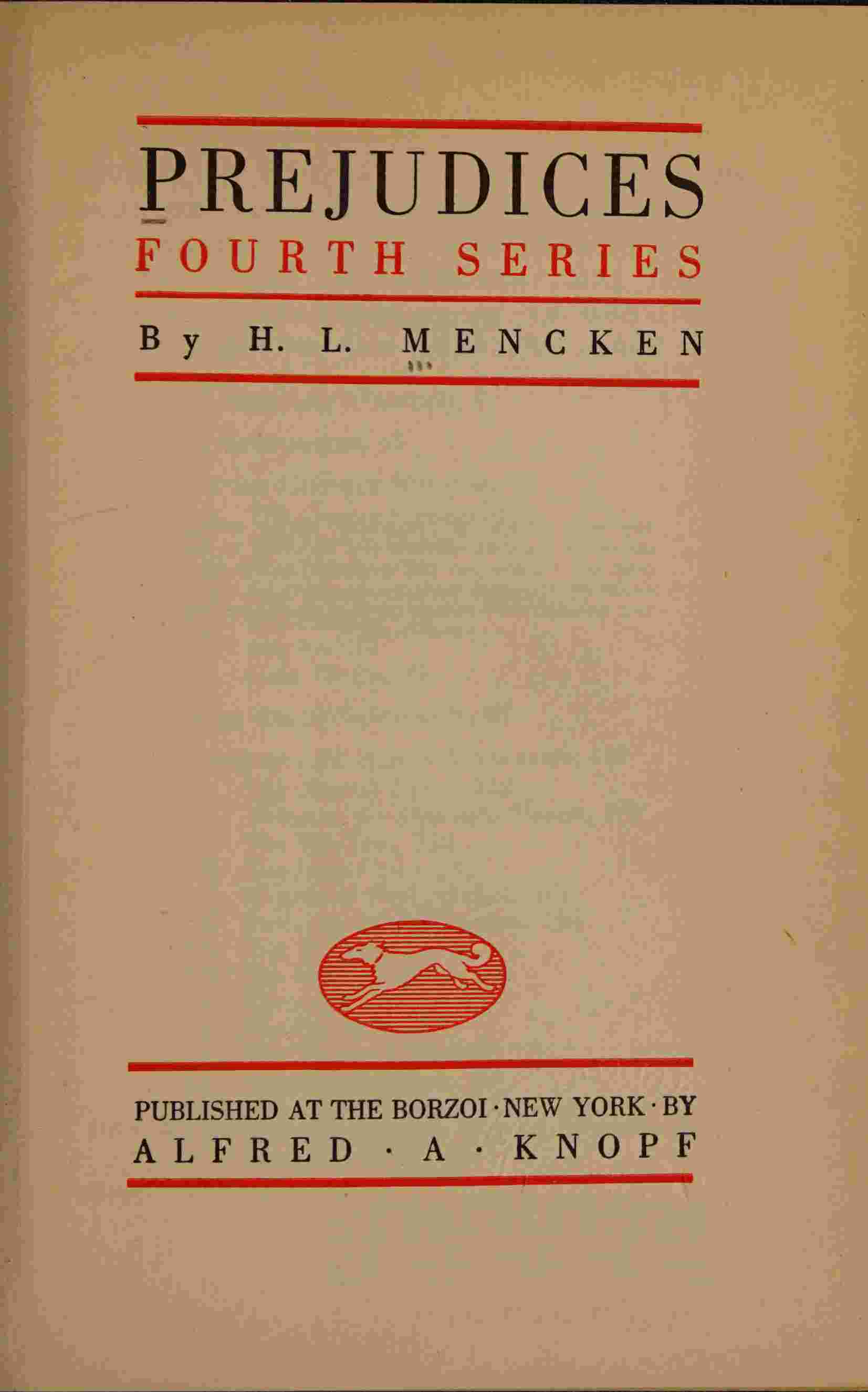
PREJUDICES: FOURTH SERIES
I. THE AMERICAN TRADITION
1
Ever since Dr. William Crary Brownell, de l’Académie Américaine, published his little volume, “Standards,” in 1917, a vast hullabaloo has been going on among the native, white, Protestant Gelehrten of the Republic, particularly in the great open spaces of the South and Middle West, in favor of what they call the American tradition in letters. Perhaps I libel Brownell, a worthy if somewhat gummy man, by hinting that he started this whooping; it may be that its actual generator was George Creel, the Rev. Dr. Newell Dwight Hillis, the Hon. James M. Beck, the Hon. A. Mitchell Palmer or some other such master-mind of that patriotic and intelligent era. Whatever its parentage, it was at least born in the holiest of wedlock, and to the applause of all right-thinking men; and if I now presume to pull its ear I surely hope that no one will suspect that I thereby question its legitimacy. It is, in fact, absolutely and irrefragably American from snout to os calcis, not only in outward seeming and demeanor, but also in inner essence, and anyone who flouts it also flouts everything that is most sacred in the spirit of Americanism. To that business I herewith address myself briefly.
What, then, is the spirit of Americanism? I precipitate it conveniently into the doctrine that the way to ascertain the truth about anything, whether in the realms of exact knowledge, in the purple zone of the fine arts or in the empyrean reaches of metaphysics, is to take a vote upon it, and that the way to propagate that truth, once it has been ascertained and proclaimed by lawful authority, is with a club. This doctrine, it seems to me, explains almost everything that is indubitably American, and particularly everything American that is most puzzling to men of older and less inspired cultures, from American politics to American learning, and from the lush and unprecedented American code of morals to the amazing and almost fabulous American code of honor. At one end it explains the archetypical buffooneries of the Ku Klux Klan, the American Legion, the Anti-Saloon League, the Department of Justice and all other such great engines of cultural propaganda, and at the other end it explains the amusing theory that the limits of the nation’s æsthetic adventures are to be fixed by a vague and self-appointed camorra of rustic Ph.D.’s, and that any artist, indigenous or imported, who dares to pass them is not only a sinner against the beautiful but also a traitor to the flag, and that he ought, shall and must be throttled by the secular arm. Patriotism thus gathers in æsthetics and gives it suck, as it has already given suck to ethics. There are artists who are worthy of the boon of freedom, and there are artists who are criminal and must be put down, as anarchists and polygamists are put down. The fancies of the poet in his velvet coat, the vast soarings and grapplings of the metaphysician in his damp cell, the writhings of the logician chained to his rock, become either right or wrong, and whatever is right in them is American and whatever is wrong is not American.
How far this last notion goes under the Constitution is best shown, not in the relatively pianissimo pronunciamentoes of such suave and cautious dons as Brownell, who are themselves often sadly polluted by foreign ideas, despite their heroic struggle to remember Valley Forge and San Juan Hill, but in the far more frank and passionate bulls of their followers in the seminaries of the cow States, where every male of Homo sapiens has copious vibrissæ on his chest and Nordic blue eyes in his head, and is a red-blooded, go-getting, up-and-coming he-man. I introduce at once a perfect speciman, Doughty of Texas—a savant but little known in the diabetic East, but for long a favorite expert in comparative morals in the university at Austin—not a professor, alas, for he lacks the Ph.D., but amicus curiæ to the other professors, as befits his trade of jurisconsult, and a frequent author of critical papers. Doughty has passion but he also has diligence: a combination not too common. Unlike the lean and slippered Beers, of Yale, who once boasted that he had read none of the books he was denouncing, Doughty is at pains to look into even the most subversive, as a dutiful Censor Librorum looks into even “Science and Health” and the works of Dr. Marie C. Stopes. Some time ago, determined to get at and expose the worst, he plowed magnificently through a whole library—through all the new poetry from Carl Sandburg to “The Spoon River Anthology,” and all the new novels from Dreiser to Waldo Frank, and all the vast mass of immoral criticism accompanying them, from that in the Dial and the Nation to that in the Little Review, S4N and the Chicago Literary Times. “For many months now,” he reported when he emerged at last, “there has passed before me the whole ghastly array.... I have read the ‘books’; the ‘fiction’ and the ‘verse’; the ‘drama,’ the ‘articles’ and the ‘essays’; the ‘sketches’ and the ‘criticisms,’ and whatever else is squeaked and gibbered by these unburied and not-to-be-handled dead.... It is this unnamable by-product of congenital deficiency, perverted dissipation and adulterated narcotics ... which I refer to as ‘modern [American] literature.’”
And what is the Texas Taine’s verdict upon this modern American literature? The verdict, in brief, of all other right-thinking, forward-looking he-men, North, East, South, West—the verdict of every American who truly loves the flag, and knows congenitally what is right and what is wrong. He not only finds that it is, in itself, nothing but “swept-up rottenness and garbage—the dilute sewage of the sordid mental slums of New York and Chicago”; he also finds that the ladies and gentlemen who compose it are no more than “a horde of chancre-laden rats,” that they constitute a “devil’s crew of perverted drug-addicts,” that they are engaged unanimously upon a “flabby and feeble assault ... upon that ancient decency that for unnumbered generations of the white Northern races of mankind, at least, has grown and strengthened as a seed cast upon kindly soil,” and, finally, that “no one of the ‘writers’ of this unhappy array was in the service of the United States in the Great War”—in brief, that the whole movement is no more than a foul conspiracy to tear down the flag, uproot the Republic and exterminate the Nordic Blond, and that, in consequence, it is the duty of every American who is a member “of a white Nordic race, save the Teutonic,” to come sliding down the pole, grab the tarpot, and go galloping to the alarm. So concluding and stating in rich Texan phrases, the Doughty proceeds to rend specifically a typical book by one of these immigrant foes to “the heritage of American and English men.”... The one he chooses is “Jurgen,” by James Branch Cabell, of Virginia!
2
This long-horned policeman of letters, I admit, is more exuberant than most. There are no soothing elms on the campus at Austin; instead there is only the cindered plaza de toros of the Ku Klux Klan. Patriotism, down there, runs wilder than elsewhere. Men have large hands and loud voices. The sight of the flag makes their blood leap and boil; when it is affronted they cannot control themselves. Nevertheless, the doctrine thus stated in harsh terms by the dreadful Doughty, is, in its essence, precisely the doctrine of his more urbane colleagues—of Brownell de l’Académie Américaine, of Brander Matthews de l’Académie Américaine, of Sherman de l’Académie Américaine, of Erskine de l’Institut National, of Boynton, of old Beers, of all the rest. It is a doctrine, as I have said, that is thoroughly American—as American, indeed, as Prohibition, correspondence schools, the Knights of Pythias or chewing-gum. But by the same token it is a doctrine that has no more fundamental sense or dignity than the politics of a Coolidge or the theology of a Billy Sunday. It is, to come to the bald fact at once, mere drivel—an endless series of false assumptions and non-sequiturs—bad logic piled recklessly upon unsound facts. It is the product of men who, drilled beyond their capacity for taking in ideas and harrowed from infancy by harsh and unyielding concepts of duty, have borrowed the patriotic philosophy of suburban pastors and country schoolmarms, and now seek to apply it to the consideration of phenomena that are essentially beyond their comprehension, as honor is beyond the comprehension of a politician. It is rural Fundamentalism in the black gown and disarming whiskers of Wissenschaft; its inevitable fruit is what Ernest Boyd has aptly called Ku Klux Kriticism.
The simple truth, of course, is that the standards and traditions these sublimated Prohibition enforcement officers argue for so eloquently have no actual existence in the first-line literature of the American people—that what they demand is not a lofty fidelity to a genuine ideal, but only an artificial and absurd subservience to notions that were regarded with contempt by every American of the civilized minority even when they prevailed. In other words, what they argue for is not a tradition that would take in Poe, Hawthorne, Emerson, Whitman and Mark Twain, but a tradition that would pass over all these men to embrace Cooper, Bryant, Donald G. Mitchell, N. P. Willis, J. G. Holland, Charles Dudley Warner, Mrs. Sigourney and the Sweet Singer of Michigan. Even Longfellow, I daresay, must be left out, for didn’t he drink of green and terrible waters in Paris as a youth and didn’t Poe accuse him of stealing from the Spanish and the German? Certainly even Longfellow, to go back to Doughty’s interdict, “simmered in the devil’s cauldron of central Europe” and was “spewed out of Italy and France.” Could Bryant himself qualify? Didn’t he trifle with strange tongues and admire enemy aliens? And what of Lowell? His Dante studies surely had a sinister smack; one can’t imagine a Texas Grand Goblin approving them. Bayard Taylor I refrain from mentioning at all. His translation of “Faust” came to a just judgment at last when it was hurled from the shelves of every American university patronized by the issue of 100 per cent. Americans. Its incineration on a hundred far-flung campuses, indeed, was the second great patriotic event of the annus mirabilis which saw the launching of Brownell’s “Standards” and the entrance of the Ku Klux Klan into literary criticism.
How little the patriot-pedagogues know of the veriest elements of American literary history was shown very amusingly some time ago when one of them, a specialist in the Emerson tradition, got himself into a lather denouncing some Greenwich Village Brandes for arguing that beauty was independent of morals and its own sufficient justification—only to be confronted by the disconcerting fact that Emerson himself had argued the same thing. Can it be that even pedagogues are unaware that Emerson came to fame by advocating a general deliverance from the stupid and flabby tradition his name is now evoked to support, that his whole system of ideas was an unqualified protest against hampering traditions of every sort, that if he were alive today he would not be with the professors but unalterably against them? And Emerson was surely not alone. Go through the list of genuinely first-rate men: Poe, Hawthorne, Whitman, Mark Twain. One and all they stood outside the so-called tradition of their time; one and all, they remained outside the tradition that pedants try so vainly to impose upon a literature in active being today. Poe’s poems and tales not only seemed strange to the respectable dolts of his time; they seemed downright horrible. His criticism, which tells us even more about him, was still worse: it impinged upon such dull fellows as Griswold exactly as “Jennie Gerhardt” impinged upon the appalled tutors in the alfalfa colleges. And what of Hawthorne? Hawthorne’s onslaught upon the Puritan ethic was the most formidable and effective ever delivered, save only Emerson’s. And Whitman? Whitman so staggered the professors that it is only within the last few years that they have begun to teach him at all; those who flourished in 1870 avoided all mention of him as carefully as their successors of today avoid mention of Dreiser or Cabell. And Mark Twain? I put a professor on the stand, to wit, my Christian friend, Phelps of Yale. Go to Phelps’ “Essays on Modern Novelists,” and you will find a long and humorous account of the efforts of unintelligent pedagogues to read Mark out of the national letters altogether—and go to Van Wyck Brooks’ “The Ordeal of Mark Twain” and you will discover what great damage that imbecility did to the man himself. Phelps printed his book in 1910. It was the first book by a doctor of beautiful letters to admit categorically that Mark was an artist at all! All the other professors, even in 1910, were still teaching that Washington Irving was a great humorist and Mark a mere clown, just as they are teaching now that the criticism of Howells and Lowell was superior to the criticism of Huneker, and that Henry van Dyke is a great artist and Cabell a bad one.
Historically, there is thus nothing but folly and ignorance in all the current prattle about a restoration of the ancient American tradition. The ancient American tradition, in so far as it was vital and productive and civilized, was obviously a tradition of individualism and revolt, not of herd-morality and conformity. If one argues otherwise, one must inevitably argue that the great men of the Golden Age were not Emerson, Hawthorne, Poe and Whitman, but Cooper, Irving, Longfellow and Whittier. This nonsense, no doubt, is actually argued in the prairie seminaries; it even has its prophets, perhaps, in backwaters of the East; certainly one finds little in controversion of it in the prevailing text-books. But it remains nonsense all the same. The fact that it has been accepted for years explains the three great disgraces of American letters: the long neglect of Whitman, Melville and Mark Twain. And the fact that it is now challenged actively—that practically all young Americans of any appreciable intelligence now rebel against it—that the most significant sign of the times, in many ways, is the open revolt of the new generation against the teaching of their elders—this fact explains the new vigor that has got into American literature, and its consequent running amok. That running amok, to be sure, is leading to excesses—but so did the running amok of Whitman lead to excesses; so did the timorous running amok of Mark Twain. In order to get the rest of “Leaves of Grass” we must somehow manage to survive “A Woman Waits for Me”; in order to get “Huckleberry Finn” we must swallow the buffooneries of “The Innocents Abroad.” In brief, we must be willing to pay a price for freedom, for no price that is ever asked for it is half the cost of doing without it.
3
It so happens that many of the men and women who have sought to exercise this freedom in our time have been of stocks other than the so-called Anglo-Saxon, either wholly or in part—that they have represented the newer stocks which threaten, not only in the fine arts but in practically all departments of human activity, including even business, to oust the Anglo-Saxon from his old hegemony. The fact, in a day of increasing racial consciousness, has greatly colored the whole controversy and made it extraordinarily bitter. The doctrine gradually set up between 1914 and 1917, and given the full force of law in the latter year, that a citizen of German blood, or suspected of German blood, stood on a plane inferior to that occupied by a citizen of British blood, and had a less valid claim to the equal protection of the Constitution and the laws—this doctrine was extended, in the post-war years of terror, to all Americans not specifically Anglo-Saxon. How seriously it has been taken in the more remote parts of the Republic is well displayed by the strophes that I have quoted from good Doughty—a gentleman who seems quite as content to take his anthropology from Madison Grant and Gertrude Atherton as he is to take his manners from the cattle-herders of his native steppes. Even more ludicrous attempts to set up Ku Klux criteria in letters might be dredged from the writings of more urbane, and, in theory, more intelligent and civilized critics—for example, Brander Matthews. The rancorous animosity that has pursued such men as Dreiser is certainly not wholly æsthetic, or even moral; it is, to a very large extent, racial. The man is obviously not an Anglo-Saxon; ergo, there is something sinister about him, and he must be put down. The more solid becomes his position as a man of letters, the more offensive he becomes to the colonial mind. His crime, indeed, is that he has made headway—that a new American tradition, differing radically from the old one that pedagogues preach, tends to grow up around him—that in European eyes, and even in English eyes, he becomes more typical of America than any of the literary Knights of Pythias who are pitted against him. It thus becomes a matter of self-preservation to dispose of him, and when it turns out to be difficult to do so by logical means then there is a quick and easy recourse to evangelistic means.
The effects of this holy war, alas, have differed greatly from those intended. Far from alarming and stampeding the non-Anglo-Saxons upon whom it has been waged, it has actually forced them, despite their differences, into a certain common action, and so made them far more formidable than they were when it began. And far from establishing any superiority in the Anglo-Saxon, it has only spread the suspicion that, for all his pretensions, he must be a very inferior fellow at bottom, else he would not be so eager to call in the mob to help him in a purely literary feud. As one who has stood on the battlements for years, and smelt the powder of every salvo, I can only report that I have come to believe in this inferiority thoroughly, and that it seems to me to be most obvious in those who most vociferously uphold the so-called American tradition. They are, in the main, extremely stupid men, and their onslaughts are seldom supported by any formidable weight of metal. What they ask the rest of us to do, in brief, is simply to come down voluntarily and irrationally to their own cultural level—the level of a class that easily dominated the country when it was a series of frontier settlements, but that has gradually lost leadership as civilization has crept in. The rest of us naturally refuse, and they thereupon try to make acquiescence a patriotic matter, and to alarm the refractory with all sorts of fantastic penalties. But it must be obvious that they fail far more often than they succeed—and their failure is a melancholy proof of their intrinsic inferiority. The current of thought in the United States, at least among the relatively civilized minority, is not actually toward the abject colonialism that they advocate; it is against that colonialism. We are further from sweetness and light today than we ever were before, and we are further from cultural slavery to the harassed and care-worn Motherland. With overwhelming numbers on their side, and every form of external authority, and all the prevailing shibboleths, the spokesmen of Anglo-Saxon domination come to grief every time they tackle the minority, or even any minority within the minority, and at no time do they come to grief more dramatically than when they prepare for battle, in the traditional Anglo-Saxon manner, by first trying to tie their opponents’ hands.
When I speak of Anglo-Saxons, of course, I speak inexactly and in the common phrase. Even within the bounds of that phrase the American of the prevailing stock is Anglo-Saxon only partially, for there is probably just as much Celtic blood in his veins as Germanic, and his norm is to be found, not South of the Tyne and west of the Severn, but on the bleak Scotch hills. Among the first English colonists there were unquestionably many men of purely Teutonic stock from the East and South of England, and their influence is yet visible in many characteristic American folkways, in certain traditional American ideas—some of them now surviving only in national hypocrisies—, and, above all, in the fundamental peculiarities of the American dialect of English. But their Teutonic blood was early diluted by Celtic strains from Scotland, from the North of Ireland and from the West of England, and today those Americans who are regarded as being most thoroughly Anglo-Saxons—for example, the mountaineers of the Appalachian slopes from Vermont to Georgia—are obviously far more Celtic than Teutonic, not only physically but also mentally. They are leaner and taller than the true English, and far more given to moral obsessions and religious fanaticism. A Methodist revival is not an English phenomenon; it is Scotch. So, fundamentally, is Prohibition. So is the American tendency, marked by every foreign student of our history, to turn all political combats into moral crusades. The English themselves, of course, have been greatly polluted by Scotch, Irish and Welsh blood during the past three centuries, and for years past their government has been largely in the hands of Celts, but though this fact, by making them more like Americans, has tended to conceal the difference that I am discussing, it has certainly not sufficed to obliterate it altogether. Such a man as Lloyd George, in all his ways of thinking, is almost precisely like an American—but the English notion of humor remains different from the American notion, and so does the English view of personal liberty, and on the same level of primary ideas there are many other obvious differences.
But though I am thus convinced that the American Anglo-Saxon wears a false label, and grossly libels both of the great races from which he claims descent, I can imagine no good coming of trying to change it. Let him call himself whatever he pleases. Whatever he calls himself, it must be plain that the term he uses designates a genuinely distinct and differentiated race—that he is separated definitely, in character and habits of thought, from the men of all other recognizable strains—that he represents, among the peoples of the earth, almost a special species, and that he runs true to type. There is, indeed, very little tendency to variation in him—that is, in the mass. The traits that he developed when the first mixture of races took place in colonial days are the traits that he still shows; despite the vast changes in his material environment, he is almost precisely the same, in the way he thinks and acts, as his forefathers were. Some of the other great races of men, during the past two centuries, have changed very noticeably—for example, think of the complete dying out of adventurousness in the Spaniards and its sudden appearance in the Germans—but the American Anglo-Saxon has stuck to his hereditary guns. Moreover, he tends to show much less variation than other races between man and man. It is an axiom that, when five Russians or Germans meet, there are four parties in conflict, but it is equally an axiom that, among a hundred Americans, at least ninety-five will be found to hold exactly the same views upon all subjects that they can grasp at all, and may be trusted to react exactly alike to all ordinary stimuli. No other race, save it be the Chinese, is so thoroughly solid, or so firmly unresponsive to ideas from without.
4
The good qualities of this so-called Anglo-Saxon are many, and I am certainly not disposed to question them, but I here pass them over without apology, for he devotes practically the whole of his literature and fully a half of his oral discourse to celebrating them himself, and so there is no danger that they will ever be disregarded. No other known man, indeed, is so violently the blowhard, save it be his English kinsman; even the Frenchman, by comparison, is relatively modest and reticent. In this fact lies the first cause of the ridiculous figure he commonly cuts in the eyes of other people: he brags and blusters so incessantly that, if he actually had the combined virtues of Socrates, the Cid and the Twelve Apostles, he would still go beyond the facts, and so appear a mere Bombastes Furioso. This habit, I believe, is fundamentally English, but it has been exaggerated in the Americano by his larger admixture of Celtic blood. In late years in America it has taken on an almost pathological character, and is to be explained, perhaps, only in terms of the Freudian necromancy. Braggadocio, in the 100 per cent. American—“we won the war,” “it is our duty to lead the world,” “the land of the free and the home of the brave,” the “Americanization” movement, and so on—is probably no more than a protective mechanism erected to conceal an inescapable sense of inferiority.
That this inferiority is real must be obvious to any impartial observer. Whenever the Anglo-Saxon, whether of the English or of the American variety, comes into sharp conflict with men of other stocks, he tends to be worsted, or, at best, to be forced back upon extraneous and irrelevant aids to assist him in the struggle. Here in the United States his defeat is so palpable that it has filled him with vast alarms, and reduced him to seeking succor in grotesque and extravagant devices. In the fine arts, in the sciences and even in the more complex sorts of business the children of the later immigrants are running away from the descendants of the early settlers. To call the roll of Americans eminent in almost any field of human endeavor beyond that of mere dull money-grubbing is to call a list of strange and often outlandish names; even the panel of Congress presents a startling example. Of the Americans who have come into notice during the past fifty years as poets, as novelists, as critics, as painters, as sculptors and in the minor arts, less than half bear Anglo-Saxon names, and in this minority there are few of pure Anglo-Saxon blood. So in the sciences. So in the higher reaches of engineering and technology. So in philosophy and its branches. So even in industry and agriculture. In those areas where the competition between the new and the old blood-streams is most sharp and clear-cut, say in New York, in seaboard New England and in the farming States of the upper Middle West, the defeat of the Anglo-Saxon is overwhelming and unmistakable. Once his predominance everywhere was actual and undisputed; today, even where he remains heavily superior numerically, it is largely sentimental and illusory.
The descendants of the later immigrants tend generally to move upward; the descendants of the first settlers, I believe, tend plainly to move downward, mentally, spiritually and even physically. Civilization is at its lowest mark in the United States precisely in those areas where the Anglo-Saxon still presumes to rule. He runs the whole South—and in the whole South there are not as many first-rate men as in many a single city of the mongrel North. Wherever he is still firmly in the saddle, there Ku Kluxery flourishes, and Fundamentalism, and lynching, and Prohibition, and all the other stupid and anti-social crazes of inferior men. It is not in the big cities, with their mixed population, that the death-rate is highest, and politics most corrupt, and religion nearest to voodooism, and every decent human aspiration suspect; it is in the areas that the recent immigrations have not penetrated, where “the purest Anglo-Saxon blood in the world” still flows. I could pile up evidences, but they are not necessary. The fact is too plain to be challenged. One testimony will be sufficient: it comes from two inquirers who made an exhaustive survey of a region in Southeastern Ohio, where “the people are more purely Americans than in the rest of the State”:
Here gross superstition exercises strong control over the thought and action of a large proportion of the people. Syphilitic and other venereal diseases are common and increasing over whole counties, while in some communities nearly every family is afflicted with inherited or infectious disease. Many cases of incest are known; inbreeding is rife. Imbeciles, feeble-minded, and delinquents are numerous, politics is corrupt, and selling of votes is common, petty crimes abound, the schools have been badly managed and poorly attended. Cases of rape, assault, and robbery are of almost weekly occurrence within five minutes walk of the corporation limits of one of the county seats, while in another county political control is held by a self-confessed criminal. Alcoholic intemperance is excessive. Gross immorality and its evil results are by no means confined to the hill districts, but are extreme also in the towns.
As I say, the American of the old stock is not unaware of this steady, and, of late, somewhat rapid degeneration—this gradual loss of his old mastery in the land his ancestors wrung from the Indian and the wild cat. He senses it, indeed, very painfully, and, as if in despair of arresting it in fact, makes desperate efforts to dispose of it by denial and concealment. These efforts often take grotesque and extravagant forms. Laws are passed to hobble and cage the citizen of newer stocks in a hundred fantastic ways. It is made difficult and socially dangerous for him to teach his children the speech of his fathers, or to maintain the cultural attitudes that he has inherited from them. Every divergence from the norm of the low-cast Anglo-Saxon is treated as an attentat against the commonwealth, and punished with eager ferocity. On the level of the country Ku Kluxers the thing goes to the length of downright assault; a man in Arkansas or Mississippi who ventured to speak a foreign language, or to concern himself publicly with such of the fine arts as country Methodists cannot comprehend, or to let it be known that he was a member of the Roman Catholic Church would run some risk of being tarred and feathered by his neighbors, or of having his house burned down over his head. Worse, there is scarcely less pressure in the higher reaches of the so-called intellect. The demand for a restoration of what is called the American tradition in letters is nothing more or less, at bottom, than a demand for a supine and nonsensical conformity—a demand that every American, regardless of his racial character and his natural way of thinking, force all his thoughts into the low-caste Anglo-Saxon mold. It is bound to fail of effect, of course, and in that very fact lies the best of imaginable proofs of the mental poverty of those who voice it. It is not brought forward in an effort at persuasion; it is issued as an order, raucously and absurdly—and every time it is flouted the Anglo-Saxon slips another inch down the hill. He cannot prevail in fair competition, and, for all his bellicose flourishes, he cannot prevail by force and intimidation. There remains for him the rôle of martyr, and in this he already begins to display himself affectingly. The music of Americans, we are told gravely, is barred out of our concert halls and opera houses because their managers and conductors are all accursed foreigners. American painters and sculptors have to struggle against a dense tide of immigrants. American criticism has become so anti-American that poets and novelists of the old stock are on a sort of blacklist, and cannot get justice. Only in the colleges does the Anglo-Saxon intellectual hold his own, and even there he is now menaced by swarms of Jews, and must devise means of putting them down or perish with his brothers of the fine arts.
5
It so happens that I am myself an Anglo-Saxon—one of far purer blood, indeed, than any of the half-bleached Celts who pass under the name in the United States and England. I am Angle and I am Saxon, and I am very little else, and that little is all safely white, Nordic, Protestant and blond. Thus I feel free, without risk of venturing into bad taste, to regard frankly the soi-disant Anglo-Saxon of this incomparable Republic and his rather less dubious cousin of the Motherland. How do the two appear to me, after a quarter of a century spent largely in accumulating their disfavor? What are the characters that I discern most clearly in the so-called Anglo-Saxon type of man? I may answer at once that two stick out above all others. One is his curious and apparently incurable incompetence—his congenital inability to do any difficult thing easily and well, whether it be isolating a bacillus or writing a sonata. The other is his astounding susceptibility to fears and alarms—in short, his hereditary cowardice.
To accuse so enterprising and successful a race of cowardice, of course, is to risk immediate derision; nevertheless, I believe that a fair-minded examination of its history will bear me out. Nine-tenths of the great feats of derring-do that its sucklings are taught to venerate in school—that is, its feats as a race, not the isolated exploits of its extraordinary individuals, most of them at least partly of other stocks—have been wholly lacking in even the most elementary gallantry. Consider, for example, the events attending the extension of the two great empires, English and American. Did either movement evoke any genuine courage and resolution? The answer is plainly no. Both empires were built up primarily by swindling and butchering unarmed savages, and after that by robbing weak and friendless nations: Mexico, Spain, the Boer republics. Neither produced a hero above the average run of those in the movies; neither exposed the folks at home to the slightest danger of reprisal. The battles of Omdurman and Manila Bay were typical of these great swarmings of the Anglo-Saxon—the first a bald massacre, and the second a combat at odds of at least fifty to one. They produced highly typical Anglo-Saxon heroes—Kitchener, an Irishman, and Dewey, largely French. Almost always, indeed, mercenaries have done the Anglo-Saxon’s fighting for him—a high testimony to his common sense, but scarcely flattering, I fear, to the truculence he boasts of. The British empire was won mainly by Irishmen, Scotchmen and native allies, and the American empire, at least in large part, by Frenchmen and Spaniards. Moreover, neither great enterprise cost any appreciable amount of blood; neither presented grave and dreadful risks; neither exposed the conqueror to the slightest danger of being made the conquered. The British won most of their vast dominions without having to stand up in a single battle against a civilized and formidable foe, and the Americanos won their continent at the expense of a few dozen puerile skirmishes with savages. All the Indian wars in American history, from the days of John Smith to those of Custer, did not bring down as many men as the single battle of Tannenberg. The total cost of conquering the whole area from Plymouth Rock to the Golden Gate and from Lake George to the Everglades, including even the cost of driving out the French, Dutch, English and Spaniards, was less than the cost of defending Verdun.
So far as I can make out there is no record in history of any Anglo-Saxon nation entering upon any great war without allies, nor upon any war at all when there was the slightest danger of getting beaten, or even of suffering serious damage. The French have done it, the Dutch have done it, the Germans have done it, the Japs have done it, and even such inferior nations as the Danes, the Spaniards, the Boers and the Greeks have done it, but never the English or Americans. Can you imagine the English taking such a chance as the Germans took in 1914, or as the Turks took in 1922, or as the French prepare to take today? Can you imagine the United States resolutely facing a war in which the odds against it were as huge as they were against Spain in 1898? It seems to me that the facts of history are wholly against any such fancy. The Anglo-Saxon always tries to take a gang with him when he goes to war, and even when he has it behind him he is very uneasy, and prone to fall into panic at the first threat of genuine danger. Here I put an unimpeachably Anglo-Saxon witness on the stand, to wit, Dr. Charles W. Eliot, of Harvard. I find him saying, in an article quoted with approbation by the Congressional Record, that during the Revolutionary War the colonists now hymned so eloquently in the school-books “fell into a condition of despondency from which nothing but the steadfastness of Washington and the Continental army and the aid from France saved them,” and that “when the War of 1812 brought grave losses a considerable portion of the population experienced a moral collapse, from which they were rescued only by the exertions of a few thoroughly patriotic statesmen and the exploits of three or four American frigates on the seas”—to say nothing of an enterprising Corsican gentleman, Bonaparte by name. In both these wars the Americans had enormous and obvious advantages, in terrain, in allies and in men; nevertheless, they fought, in the main, very badly, and from the first shot to the last a majority of them stood in favor of making peace on almost any terms. The Mexican and Spanish Wars I pass over as perhaps too obscenely ungallant to be discussed at all; of the former, General U. S. Grant, who fought in it, said that it was “the most unjust war ever waged by a stronger against a weaker nation.” Who remembers that, during the Spanish War, the whole Atlantic Coast trembled in fear of the Spaniards’ feeble fleet—that all New England had hysterics every time a strange coal-barge was sighted on the sky-line, that the safe-deposit boxes of Boston were emptied and their contents transferred to Worcester, and that the Navy had to organize a patrol to save the coast towns from depopulation? Perhaps those Reds, atheists and pro-Germans remember it who also remember that during the World War the entire country went wild with fear of an enemy who, without the aid of divine intervention, obviously could not strike it a blow at all—and that the great moral victory was gained at last with the assistance of twenty-one allies and at odds of eight to one.
But the American Civil War remains? Does it, indeed? The almost unanimous opinion of the North, in 1861, was that it would be over after a few small battles; the first soldiers were actually enlisted for but three months. When, later on, it turned unexpectedly into a severe struggle, recruits had to be driven to the front by force, and the only Northerners remaining in favor of going on were Abraham Lincoln, a few ambitious generals and the profiteers. I turn to Dr. Eliot again. “In the closing year of the war,” he says, “large portions of the Democratic party in the North and of the Republican party advocated surrender to the Confederacy, so down-hearted were they.” Down-hearted at odds of two to one! The South was plainly more gallant, but even the gallantry of the South was largely illusory. The Confederate leaders, when the war began, adopted at once the traditional Anglo-Saxon device of seeking allies. They tried and expected to get the aid of England, and they actually came very near succeeding. When hopes in that direction began to fade (i. e., when England concluded that tackling the North would be dangerous), the common people of the Confederacy, the progenitors of the chivalric Ku Kluxers of today, threw up the sponge, and so the catastrophe, when it came at last, was mainly internal. The South failed to bring the quaking North to a standstill because, to borrow a phrase that Dr. Eliot uses in another connection, it “experienced a moral collapse of unprecedented depth and duration.” The folks at home failed to support the troops in the field, and the troops in the field began to desert. Even so early as Shiloh, indeed, many Confederate regiments were already refusing to fight.
This reluctance for desperate chances and hard odds, so obvious in the military record of the English-speaking nations, is also conspicuous in times of peace. What a man of another and superior stock almost always notices, living among so-called Anglo-Saxons, is (a) their incapacity for prevailing in fair rivalry, either in trade, in the fine arts or in what is called learning—in brief, their general incompetence, and (b) their invariable effort to make up for this incapacity by putting some inequitable burden upon their rivals, usually by force. The Frenchman, I believe, is the worst of chauvinists, but once he admits a foreigner to his country he at least treats that foreigner fairly, and does not try to penalise him absurdly for his mere foreignness. The Anglo-Saxon American is always trying to do it; his history is a history of recurrent outbreaks of blind rage against peoples who have begun to worst him; hence Know Nothingism, Ku Kluxery, American Legionism, and all the rest of it. Such movements would be inconceivable in an efficient and genuinely self-confident people, wholly assured of their superiority, as a Frenchman is of his or a German of his, and they would be equally inconceivable in a truly gallant and courageous people, disdaining unfair advantages and overwhelming odds. Theoretically launched against some imaginary inferiority in the non-Anglo-Saxon man, either as patriot, as democrat or as Christian, they are actually launched at his general superiority, his greater fitness to survive in the national environment. The effort is always to penalize him for winning in fair fight, to handicap him in such a manner that he will sink to the general level of the Anglo-Saxon population, and, if possible, even below it. Such devices, of course, never have the countenance of the Anglo-Saxon minority that is authentically superior, and hence self-confident and tolerant. Of that minority I do not speak here. It is serene in peace as it is brave in war. But in the United States, at least, it is pathetically small, and it tends steadily to grow smaller and feebler. The communal laws and the communal mores are made by the folk, and they offer all the proof that is necessary, not only of its general inferiority, but also of its alarmed awareness of that inferiority. The normal American of the “pure-blooded” majority goes to rest every night with an uneasy feeling that there is a burglar under the bed, and he gets up every morning with a sickening fear that his underwear has been stolen.
6
It is difficult, I submit, to admire such a people unreservedly, despite the good qualities that I have passed over. They lack the ease and tolerance, the fine adventurousness and love of hazard which go with a sense of firm security—in other words, with a sense of genuine superiority. The Anglo-Saxon of the great herd is, in many important respects, the least civilized of men and the least capable of true civilization. His political ideas are crude and shallow. He is almost wholly devoid of æsthetic feeling; he does not even make folk-lore or walk in the woods. The most elementary facts about the visible universe alarm him, and incite him to put them down. Educate him, make a professor of him, teach him how to express his soul, and he still remains palpably third-rate. He fears ideas almost more cravenly than he fears men. His blood, I believe, is running thin; perhaps it was not much to boast of at the start; in order that he may exercise any functions above those of a trader, a pedagogue or a mob orator, it needs the stimulus of other and less exhausted strains. Poe, Whitman, Mark Twain—these were typical products of such crosses. The fact that they increase is the best hope of the intellect in America. They shake the old race out of its spiritual lethargy, and introduce it to disquiet and experiment. They make for a free play of ideas. In opposing the process, whether in politics, in letters or in the ages-long struggle toward the truth, the prophets of Anglo-Saxon purity and tradition only make themselves ridiculous. Under the absurd Kultur that they advocate Aggasiz would have been deported and Whitman would have been hanged, and the most eminent literati flourishing in the Republic today would be Edgar Guest and Dr. Frank Crane.
The success of these so-called Anglo-Saxons in the world, I am convinced, has been due, not so much to their merits but to their defects—and especially to their high capacity for being alarmed and their aversion to what may be called romance—in other words, to their harshly practical minds, their disdain of intellectual enterprise, their dull common sense. They have saved their hides and their money while better sportsmen were taking chances. But the bitter must go with the sweet. Such qualities belong to Lumbricus terrestris rather than to Homo sapiens. They may be valuable, but they are not pretty. Today, at the height of his triumph in the world, the Anglo-Saxon somehow looks shabby—England trembling before one-legged and bankrupt France, the United States engaged in a grotesque pogrom against the wop, the coon, the kike, the papist, the Jap, the what-not—worse, engaged in an even more grotesque effort to put down ideas as well as men—to repeal learning by statute, regiment the arts by lynch-law, and give the puerile ethical and theological notions of lonely farmers and corner grocers the force and dignity of constitutional axioms. As I stand on the side-lines, observing the show, I find it very hard to admire. But, save when ethyl alcohol in dilute aqueous solution has dulled my native pity, I find it even harder to laugh.