
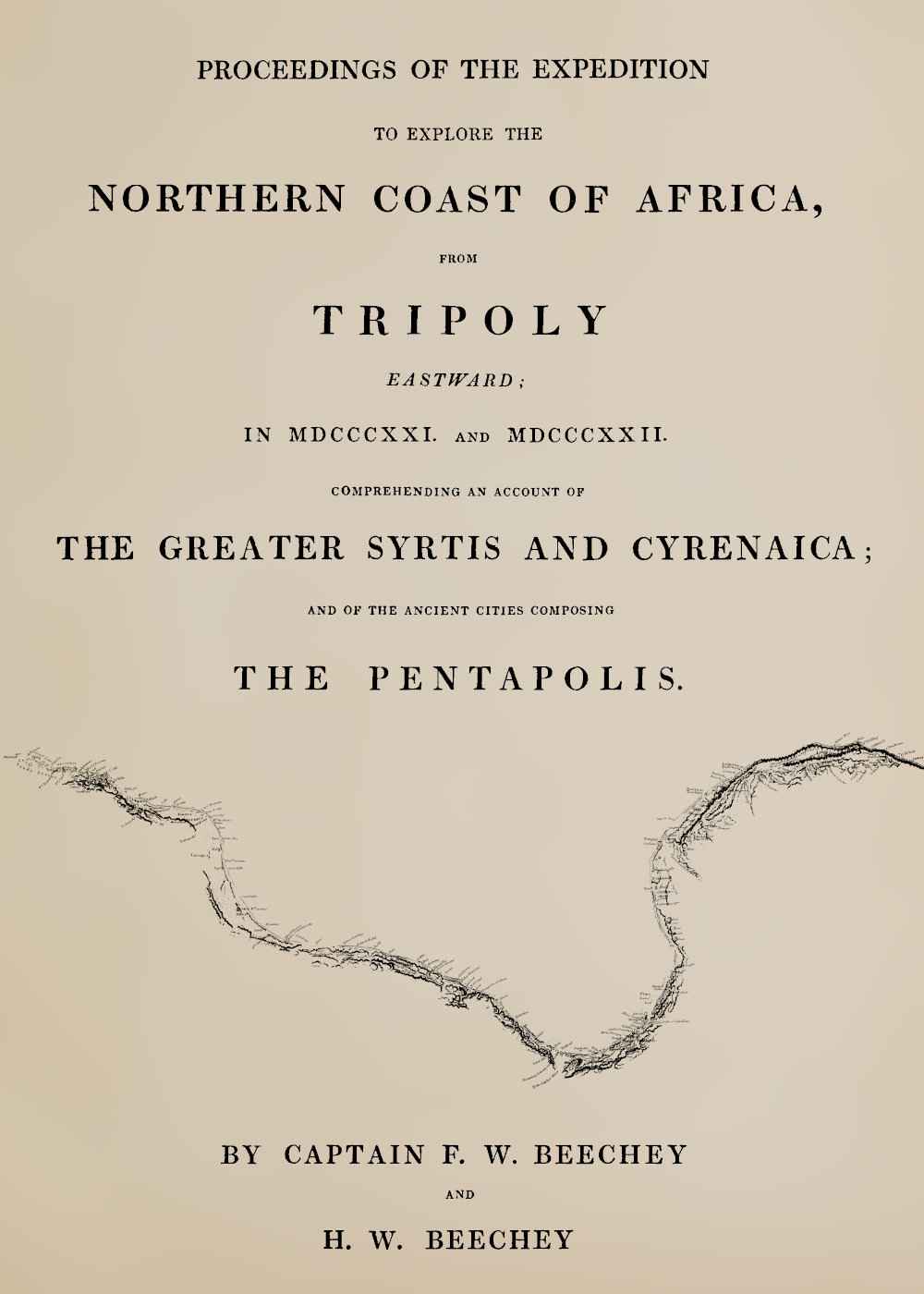
The Project Gutenberg eBook of Proceedings of the expedition to explore the northern coast of Africa, from Tripoly eastward
Title: Proceedings of the expedition to explore the northern coast of Africa, from Tripoly eastward
in MDCCCXXI. and MDCCCXXII., comprehending an account of the Greater Syrtis and Cyrenaica; and of the ancient cities composing the pentapolis
Author: Frederick William Beechey
H. W. Beechey
Release date: August 2, 2023 [eBook #71318]
Language: English
Original publication: United Kingdom: John Murray, 1828
Credits: Galo Flordelis (This file was produced from images generously made available by The Internet Archive)
PROCEEDINGS OF THE EXPEDITION
TO EXPLORE THE
NORTHERN COAST OF
AFRICA,
FROM
TRIPOLY
EASTWARD;
IN MDCCCXXI. AND MDCCCXXII.
COMPREHENDING AN ACCOUNT OF
THE GREATER SYRTIS AND
CYRENAICA;
AND OF THE ANCIENT CITIES COMPOSING
THE
PENTAPOLIS.
BY CAPTAIN F. W. BEECHEY,
R.N., F.R.S.,
AND
H. W. BEECHEY, Esq., F.S.A.
LONDON:
JOHN MURRAY, ALBEMARLE-STREET.
MDCCCXXVIII.
LONDON:
Printed by WILLIAM CLOWES,
Stamford-Street.
DEDICATION.
TO
THE RIGHT
HONOURABLE
THE EARL
BATHURST,
AND
THE RIGHT
HONOURABLE
THE LORD
VISCOUNT MELVILLE,
&c. &c. &c.
My Lords,
We beg leave to submit to your inspection our account of the Proceedings of the Expedition to which we had the honour of being appointed by your Lordships; and to express our best thanks for the flattering encouragement which it receives from the sanction of your Lordships’ names.
A book of travels in countries so interesting as those to which our researches have been directed, would once have been considered, however indifferently it might be written, as a tribute of more than ordinary value to its patrons. But so much has been effected, during your Lordships’ administration, for the advancement of science and general knowledge, that a traveller of our own times appears before the public, unassisted by the presence of that little cloud of mystery through which he would formerly have been seen to so much advantage; and his work must no longer depend for its attractions upon wonders which have ceased to be marvelled at; or hair-breadth escapes, which have now become familiar, and no longer excite an awe, almost amounting to reverence, for those who return to tell of them. Our book will, however, possess the advantage of novelty; for the country through which we have passed is, even in the present day, little known to the general reader; and its remains have never been described with sufficient accuracy to make them properly intelligible. We confess that our narrative will chiefly be found acceptable to those who are interested in the description of antiquities, and have pleasure in tracing the connexion between the past and the present in countries described by ancient poets and historians. We must even allow that those parts of our journal which have been considered by some as the most entertaining, are those which we should spare with as little regret as the public would probably experience in parting with them. Such as our work is, however, we submit it, respectfully, to the attention, as well as to the indulgence of your Lordships; and shall be happy if the little tribute which we offer to private worth and public desert, may be found in some measure deserving of the honour which patronage so distinguished has conferred upon it.
If our researches have enabled us to contribute any matter of interest to that large and valuable fund of public knowledge, which has accumulated so considerably during your Lordships’ official career, it will be read with some feeling of internal satisfaction by those who afforded us the means of acquiring it; and we ourselves shall look back with pleasure upon labours which have not been unattended by advantage. If it might have chanced (as we have reason to believe) that, at a moment when economy had been less imperative than it was at the period of our Expedition, we could have extended our researches farther; we feel convinced, at the same time, that your Lordships would also, at a period more auspicious than that which we allude to, have enabled us to prosecute them with greater effect.
With these impressions, we have the honour to remain,
My Lords,
Your Lordships’ grateful and obedient Servants,
HENRY W. BEECHEY,
FREDERIC W. BEECHEY.
Harley-Street, June, 1827.
CONTENTS.
| Introduction | xix |
| CHAPTER I. | |
| Arrival of the Expedition at Tripoly; pleasing appearance of the Town from the Sea — Friendly Reception of the Party by the Consul — Interview with the Bashaw, who promises his protection and assistance — Appointment of the Escort — Visits to some of the Mahometan Residents in Tripoly — Sidi Mahommed d’Ghies — Preparations for the Journey — Adoption of the Costume of the Country — This precaution recommended on the experience of the Party — Visit from the Arab Escort — Description of their principal, Shekh Mahommed el Dúbbah — Sketch of the Shekh’s former Life — Friendly attentions of the European Residents of Tripoly — Arrival of Dr. Oudney and Lieutenant Clapperton | Page 1 |
| CHAPTER II. | |
| General Description of Tripoly; its Castle and Port — The Buildings of Tripoly commended by Leo Africanus — Present Condition of the City — Its existing ancient remains — Burial-ground of the Ancient City — Sepulchral urns of glass discovered there by Mr. Consul Warrington — Remarks of Leo Africanus on the soil and level of Tripoly in the fifteenth and sixteenth Centuries — Accumulation of soil since that period — Advance of the Sea, mentioned by Leo Africanus, still observable on the Coast of Northern Africa — These appearances adduced in confirmation of Major Rennell’s remarks on the Lake Tritonis and the Lesser Syrtis — Historical Sketch of Tripoly — Its actual state and improved condition under the present Bashaw — Abolition of Piracy, and partial discontinuance of the Slave Trade | 12 |
| CHAPTER III. | |
| Departure of the Expedition from Tripoly — Passage through Tagiura — Fertile appearance of the latter — Its Mosque, and actual remains — Tagiura considered as the site of Abrotonum — Existence of a Salt-water Lake at Tagiura, consistent with Strabo’s account of Abrotonum — Present tranquil condition of the Country in this Neighbourhood contrasted with its dangerous state in the time of Consul Tully — Sand-heaps to the eastward of Tagiura — Remarks on their formation, and on the accumulation of Sand in other places — Dangers of the Sand-storm considered — Passage over the Sandy Tract to the eastward of Tagiura — Arrive at Wady Ramleh — Stormy weather at that place — Take leave of our European friends who had accompanied us from Tripoly — Continuance of the gale — Arrive at Wady’m’Seyd — Attempt to pass, without success, across the Sand-hills to the Coast — Arrive at Guadigmata — Position of Graphara, as laid down by Scylax, considered — Ancient remains discovered by Captain Smyth in the neighbourhood of Wady’m’Seyd and Abdellata — Remarks on these, considered as the remains of Graphara — Scuffle with the Arabs at Sidy Abdellati — Remains at that place indicative of an ancient military station — Cross the range of Selem — Extensive view from its summit over the fertile plains of Lebida and Jumarr — Rains still continue — Distress of the Camels — Meet with the English Consul on his return from an Excursion to Lebida — Report of a troop of marauding Arabs lying in wait for our Party | 33 |
| CHAPTER IV. | |
| Arrival at Lebida — Remarks on its position and resources as compared with those of Tripoly — Short account of the City and its remains — Allusion to the African Tribe Levatæ (or Levata) by Procopius — The same Tribe mentioned by Leo Africanus — Suggestions of Major Rennell on the resemblance between the terms Levata and Libya — Former position of this Tribe near the Coast confirmed by Procopius — Remarks on the term Lybia — Visit from the Shekh of Lebida — Violent Storm at that place retards the advance of the party — Intrusion upon the premises of a celebrated Marábūt — Dangerous consequences of this intrusion predicted by our escort — Departure from Lebida — Remains of the Aqueduct, and of the Causeway mentioned by Strabo — Arrive at the River Cinyphus, now Wad’ el Kháhan — Remarks on the River and the Morass in its immediate Neighbourhood — Observations on the faulty position of the Cinyphus in the Maps of Cellarius — This position probably suggested by some remarks of Pliny, Ptolemy, and Mela — Extreme fertility of the region of the Cinyphus — Remarks on this district, and that of Byzacium — Suggestions of Signor Della Cella with respect to them — Present appearance of the region of the Cinyphus consistent with the description of Herodotus — Neglected condition of the district under the Arabs — Account of Lebida and its remains by Captain Smyth | 50 |
| CHAPTER V. | |
| Arrival at Zelīten — Description of the Village and District of that name — Harbour of Zelīten — Remains in its Neighbourhood probably those of the Cisternæ Oppidum of Ptolemy — Tomb of the Marábūt Sidy Abd el Salám — Respect shewn to it by our party in passing before it — General appearance of these Structures — Arab credulity and superstition — Leave Zelīten — Remains between it and Selīn — Arrive at Selīn, the Orir, apparently, of Signor Della Cella — Proceed to Zoúia — Ports called by the Arabs Mersa Gusser and Mersa Zoraig — Arrive at Mesurata, the Western Boundary of the Greater Syrtis — Description of the Town and District of Mesurata — Account of them by Leo Africanus — Visit from the Shekh of Mesurata — Splendid Costume and Equipage of the Shekh compared with that of our Bedouin Guide, Shekh Mahommed el Dúbbah — Allusion to the report mentioned at the end of the Third Chapter — Great demand for Medicine at Mesurata — Considerate conduct of Mr. Campbell — Speedy success of his treatment in many difficult cases — Miraculous cure of a young Arab woman by an itinerant Sherif and Marábut — Detention of the party at Mesurata — Observations on Cape Mesurata, considered as the Cephalus Promontorium of Strabo — Remarks of Signor Della Cella on this subject — Alterations proposed by that gentleman in the punctuation of a passage in Strabo descriptive of the Promontory — Actual appearance of the Promontory sufficiently consistent with the account of Strabo — Well-founded Remarks of Signor Della Cella on the extension of the Gharian Chain, &c. — Extensive View from the Sand-hills at the back of Mesurata — Singular contrast presented by the view over the dreary wastes of the Syrtis compared with that over the plain of Mesurata — Hot wind, and swarm of Locusts accompanying it — Alarm of the Arabs of Mesurata — Precautions adopted by them on the occasion — Destructive consequences (mentioned by Shaw) resulting from the visit of a flight of Locusts which he witnessed — Remarks of Pliny on the same subject — Arrival of the Camels, and departure from Mesurata | 81 |
| CHAPTER VI. | |
| Entrance of the Syrtis — Extensive Lake, or Marsh, described by Strabo — Remarks of Strabo compared with the actual appearance and extent of the Marsh — Remains considered as those of the ancient Naval Station, described by Strabo, at the Mouth of the Lake — Appearance of another Station more to the northward — Gulf of Zuca — Remarks of Signor Della Cella connected with it — Resemblance of the names Zuchis and Zuca — Non-existence of the Gulf of Zuca in the Greater Syrtis — Error of D’Anville and modern Geographers on this point — Remarks of Signor Della Cella on the terms Marsh and Lake, as applied to the body of water mentioned by Strabo — Dimensions of the existing Marsh — Alleged danger of crossing it — Insulated spots in several parts of the Marsh, corresponding with the accounts of Strabo — Arrival at Sooleb — Appearance of Pasturage in this Neighbourhood — Liberality of Shekh Mahommed — Cause of it ascertained — Sooleb occupies the place assigned in modern Charts to the Gulf of Zuca — Continuance of the Marsh — Remains near Mahada called Kusser el Jébbah — Story connected with them related by the Dúbbah — Unwillingness of our Arab Guides to cross the Marsh — Cause of this ascertained — Narrow escape of two of our party — Nature of the Soil in this Neighbourhood — French Inscription left by the Boats of the Chevrette — Another left by the Barge of the Adventure — Arrive at Mahàd Hassàn, probably the Turriss Hassàn of Edrisi — Remains at Mahàd Hassàn — Arrive at Giraff, where the Marsh terminates altogether — Refractory conduct of our Camel-drivers — Improvement in the appearance of the country — Arrival at Zaffrān — Grateful verdure of its Pasturage — Remains at Zaffrān considered as those of Aspis — Their nature and appearance described — Port called Mersa Zaffrān considered as that of Aspis — Difficulties attending this position — Remains on the Beach — Supposed Date of the Buildings at Zaffrān — Remarks connected with them — Castles mentioned by Leo Africanus — Construction of the Forts at Zaffrān | 113 |
| CHAPTER VII. | |
| Remarks on the City of Sort, or Sert, of Edrisi and other Arab Geographers — Description of it by Leo Africanus — Position of Sert, on the authority of Abulfeda — Zaffrān considered as Asna — Remarks of Major Rennell on these Places — Remains at Medīnét Sultàn considered as those of Sort — Columns and other Remains described by Signor Della Cella, in the Neighbourhood of Zaffrān — Train of Argument adopted by the Doctor on this occasion — Remarks of the same Writer on the Tower of Euphrantas, and the Town of Charax, as laid down by Strabo — Nature of the Inscriptions on the Columns alluded to by Signor Della Cella — Formidable Appearance of the Coast at Zaffrān — General Appearance of the Country in its Neighbourhood — Species of Crocus abounding there — Obliging Treatment of our Party by the Arabs of Zaffrān — Arrival at Medīnét Sultàn — Description of its Remains — Further Remarks on the Tower of Euphrantas — Arrival at Nehīm — Aukward Situation of Shekh Mahommed el Dúbbah — Visit of the Dúbbah to our Tent — Object of it discovered — Departure of Shekh Mahommed, well pleased with the result of his Visit | 150 |
| CHAPTER VIII. | |
| Leave Nehīm — Arrive at Boosaida — Shekh Hamed Shakshak — Return of Shekh Mahommed — Revival of the Report above mentioned — Motive for renewing it — Discharge our Mesurata Camel-drivers — Treaty with the Dúbbah for others — Interested conduct of Shekh Mahommed — Commencement of another Salt-Lake at Sharfa — Easy mode of shifting Quarters practised by the Arabs — Their manner of travelling — Termination of the Lake — Arrive at Shegga — Remains of Forts observed there — Other Remains in its neighbourhood — Abundant Pasturage at Shegga — Fortress of Bengerwàd — Peculiarities of its Position — Bengerwàd considered as the Castle of Euphrantas — Objections to this supposition — Reasons in favour of it — Leave Wady Shegga — Cross a Tract of Red Sand — Spacious Bay at Ras Howeijah — Good Anchorage probably found there — Remains of an ancient Town near Ras Howeijah considered as those of Charax — Trade of Charax alluded to, as mentioned by Strabo — Further reasons for placing the Tower of Euphrantas at Bengerwàd — Allusion to the barter of Silphium at Charax — Emendations of Strabo’s Text proposed by Signor Della Cella — Arrive at Hudīa — Alleged Origin of this Name as applied to the place in question — Hudīa lately infested by a formidable Band of Robbers — Precautions of our Arab Escort to prevent any Attack — Rigorous Measures of Mahommed Bey apparently very necessary — Remarkable Hill of Gypsum at Hudīa — Celebration of Christmas-day by our Party at Hudīa — Fortress at Mahirīga — Arrival of a party of Pilgrims from the Westward — Disturbance at Linoof — Apparent causes of it — Ill behaviour of the Dúbbah — His sudden change of Conduct, and artful Manœuvres — Remarks on Arab Character — Satisfactory Termination of the Disturbance — Arrival at Mukhtár, the Boundary of the Districts of Syrt and Barka | 178 |
| CHAPTER IX. | |
| Barren and desolate appearance of the Country in the Neighbourhood of Muktáhr — Sulphur Mines at Kebrīt — Extensive Marsh near Muktáhr — Arrive at Sachrīn, the southernmost Point of the Gulf — Singularly desolate and comfortless Appearance of it — Examination of the Coast from the Heights of Jerīa — Extreme Difference of its Outline from that laid down in modern Charts — Suggested Causes of this Error — Accumulation of Sand on the Beach in this Neighbourhood — Alarm of Signor Della Cella in passing it — Causes of this Accumulation considered — Character of the Country at the Bottom of the Gulf — Observations of Signor Della Cella respecting it — Allusion of the Doctor to the Expedition of the Psylli — Remarks on the Latitude of this part of the Gulf — Monuments of the Philæni — Record of their Patriotism by Sallust — Various Positions of the Philænian Altars by the Ancients — Boreum Promontorium and Oppidum of Cellarius — Suggested Causes of their Position by this Author in the Bottom of the Gulf — Observations on the Nature of the Soil of the Greater Syrtis — Allusion to the March of Cato across it — Island called Bushaifa at the Bottom of the Gulf — Gradual Improvement in the Appearance of the Country — Arrival at Braiga — Remains observed there — Harbour of Braiga — Heaps of Sulphur lying on the Beach there for Embarkation — Salt Lake and Marsh at Braiga below the Level of the Sea — Well-constructed Forts at Braiga — Braiga considered as the Site of Automala — Contest between the Avarice and Conscience of the Dúbbah — Its termination in favour of the latter — Arrival at Tabilba — Excavations and Remains there — Tabilba considered as the Maritimæ Stationes of Ptolemy — Arrive at Ain Agàn — Chain of Salt Lakes and Marshes said to extend two Days to the South-eastward — Island of Gàra, probably the Gaia of Ptolemy — Wells of sweet Water, two Miles to the North-east of Shiebah — Abduction of a Lamb from an Arab Shepherd by our Party — Consequences of this Measure — Departure of the Dúbbah in search of his Camels — Arrival at Carcora — Two Boat Coves observed there — Springs of Fresh Water within a few feet of a Salt Water Lake — Arrive at Ghimēnes — Forts and Remains there — Excavated Tombs in the Neighbourhood — Change of Weather experienced — Wasted Condition of our Horses from Fatigue and want of Water — Hardy Constitution of the Barbary Horses — Treatment of them by the Arabs — Improved Appearance of the Country in approaching Bengazi — Singular Fences of Stone generally adopted in this part of the Country — Causes of their Erection — Position of Bengazi — Fertile Appearance of the Country about it — Arrival at Bengazi — Friendly Reception of our Party by Signor Rossoni, the British Resident there — Establish ourselves in the Town for the rainy Season | 209 |
| CHAPTER X. | |
| OBSERVATIONS ON THE GULF AND SHORES OF THE GREATER SYRTIS. | |
| The Dimensions of the Gulf, according to Ancient Writers, considered, and compared with those resulting from the Observations of the Expedition — Difference in the Statements of the several Writers quoted — Reasons why a Difference may be expected in their Accounts — Observations of Major Rennell on the Measurements of the Ancients — Ptolemy’s Outline of the Gulf more correct than any hitherto given — Number of Square Miles of Error in modern Charts of the Greater Syrtis — The Ideas of Ancient Writers (Herodotus excepted) with respect to the Nature and Resources of the Syrtis (the Territory, not the Gulf of the Greater Syrtis is here meant) more erroneous than the Dimensions which have been assigned to the Gulf itself — The General Character of the Syrtis not that of a Sandy Plain — Incorrectness of the Arab Accounts of what is termed by them the Desert of Barka — Account of Herodotus considered — Apparent Accuracy of his Statements — Inferences drawn from them — Ancient Accounts of the Gulf of the Greater Syrtis, dimensions excepted, very correct — Accumulation of Soil on the Shores of the Gulf accounted for — Apparent Elevation of the General Level of the Syrtis — Advance of the Sea on the Northern Coast of Africa — Appearance of the Coast at Alexandria and Carthage consistent with that of the Shores of the Greater Syrtis and Cyrenaica — Observations of Major Rennell and Dr. Shaw on the Elevation of the Coast of Tunis, and the Advance of the Sea in that quarter — Observations of Lucan on the Level of the Greater Syrtis — Dangers of the Navigation of the Gulf of Syrtis considered — Inset into the Gulf still existing to a great extent — Flux and Reflux of the Sea mentioned by Strabo and Mela considered — Remarks on the Derivation of the term Syrtis | 254 |
| CHAPTER XI. | |
| The Rainy Season sets in at Bengazi towards the middle of January, and continues with little interruption till the beginning of March — Miserable Condition of the Town during that period — Construction of the Houses — Improvidence of the Arabs — Dirty state of the Streets — Swarms of insects which infest them — Position of Bengazi — Description of its Harbour — Castle of the Bey — Visit to Bey Halīl — Friendly Reception of our Party by his Excellency — Occupations and arrangements during the Rainy Season — The Shekh el Belad Mahommed — Jews of Bengazi — Trade of the Town — Produce of the Environs — Wretched state of the Bullock Vessels — Mahometan Inhabitants of Bengazi — Alarm of the Lower Classes during our residence there — Confusion resulting from it — Mob collected at our door on this occasion — Narrow Escape of Mr. Giacomo Rossoni — Friendly Conduct of our Mahometan Acquaintance — Parley with the Arabs — Dispersion of the Mob — Prejudices of the Arabs respecting the Treatment of Diseases — Fatal Effects of this species of Folly at Bengazi — Prevalent Diseases in Bengazi and its vicinity — Singular cause of Alarm among a Party of Arab Shekhs — Arab notions of decorum and propriety contrasted with those of European Nations — Bengazi supposed to occupy the Site of Berenice and Hesperis — Existing Remains there — Little regard manifested by Turks and Arabs for the relics of Antiquity — Probable Limits of Berenice — Quarries, and singular Chasms in its Neighbourhood — Gardens of Hesperides — Position of the Gardens according to Scylax, Pliny, and Ptolemy — Conjectures of Gosselin and others respecting them — Circumstances which appear to favour our position of the Gardens — Lakes and Subterranean Caverns in the Neighbourhood of Bengazi, (or Berenice) — Concealed Body of Water observed in one of the latter — Examination of the Caverns — Remarks of the Bey respecting it — The Subterranean Stream in question considered as the River Lathon, or Lethe — Testimonies of the Ancients on this point — Supposed Communication of the Subterranean Stream with the Lake adjoining the Harbour of Bengazi — Signification of the term Lathon alluded to — Further Remarks in confirmation of our suggested Position of the River, and of its probable Communication with the Lake above mentioned — Remarks of Strabo and Cellarius on the subject — Temple of Venus, and Lake Tritonis of Strabo — Remarks on the name Berenice — Total ignorance of the Arabs of Bengazi with respect to the former celebrity of their City — Pleasing little Fable of Kazwini, on the changes which take place in the Nature and Appearance of Places, and the little knowledge which remains, after a lapse of time, of their former Condition, even on the spots where they existed | 281 |
| CHAPTER XII. | |
| Remarks on the Soil of Bengazi and the Country in its Neighbourhood — Distinction of Sex in the Palm-tree, &c., noticed by the Ancients and by Mahometan Writers — Persian Anecdote of a Love-sick Date-tree — Remarks of Shaw on the Propagation and Treatment of the Palm — Arab Mode of cultivating the Sandy Tracts in the Neighbourhood of Bengazi — Journey to Carcora — Completion of the Coast-line from that Place to Bengazi — Return to Bengazi, and Departure for Teuchira and Ptolemeta — Description of the Country between Bengazi and these Places — Remains observable in this Track — Correspondence of the Tower called Gusser el Towēl with that of Cafez, mentioned by Edrisi — Probable Site of Adriane — Arrival at Birsis — Remains in its neighbourhood, at Mably (or Mabny), considered as those of Neapolis — Hospitality of the Arabs of Birsis — Remains of Teuchira — Position of the City — Quarries without the Walls covered with Greek Inscriptions — Teuchira a Town of Barca — Walls of the City repaired by Justinian — No Port observable at Teuchira — Mistake of Bruce in confounding Teuchira with Ptolemeta — Good Supply of fresh Water at Teuchira — The excavated Tombs of the ancient City used as Dwelling-houses by the Arabs of the Neighbourhood — Indisposition of our Chaous (or Janissary) — Route from Teuchira to Ptolemeta — Remains at Ptolemeta — Port and Cothon of the ancient City — Other Remains observable there — Ptolemaic Inscriptions — Picturesque Ravines in the Neighbourhood of Ptolemeta — Position of the City — Remains of Bridges observed there — Advantages of its Site — Extreme Drought at Ptolemeta, recorded by Procopius — Reparation of the Aqueducts and Cisterns by the Emperor Justinian — Existing Remains of an extensive Cistern at Ptolemeta, probably among those alluded to by Procopius — State of the Town, its Solitude and Desolation — Luxuriant Vegetation which encumbered its Streets when the Place was first visited by our Party — Change of Scene on returning to it in Summer-time | 339 |
| CHAPTER XIII. | |
| OBSERVATIONS ON THE CITIES OF TEUCHIRA AND PTOLEMETA. | |
| Actual Condition of the City of Teuchira — Perfect State and great Strength of its Walls — Suggested Period of their Erection — Mode in which they are constructed — Gates of the City — Narrow Passage communicating with them — Probable Advance of the Sea at Teuchira — Line described by the Walls — Estimated Circuit of them according to Signor Della Cella — Greek Inscriptions cut in various parts of them — Suggestions of Signor Della Cella respecting them — Actual Nature of the Inscriptions — Excavated Tombs in the Quarries of Teuchira — Egyptian Names of Months generally adopted by the Inhabitants of the City — General Nature of the Plans of the Tombs — Some of the Bodies appear to have been burnt, and others to have been buried entire — No Difference appears to have obtained at Teuchira between the Modes of Burial adopted by its Greek and Roman Inhabitants — Encumbered State of what are probably the earliest Tombs — Solitary instance of a Painted Tomb at Teuchira — Remains of Christian Churches, and other Buildings within the Walls — Disposition of the Streets — Remains without the Walls — No Statues, or Remains of them, discovered by our Party at Teuchira — Remarks on the Wall of Ptolemeta — Remains of a Naustothmos, or Naval Station, observed there — Other Remains of Building on the Beach near the Station — Further traces of the City-Wall — Dimensions of Ptolemeta — Remains of Theatres found there — Description of the larger one — Ruins described by Bruce as part of an Ionic Temple — Other Remains in the Neighbourhood of these — Remarks on the Style of some of the Buildings of Ptolemeta, as contrasted with those of Egypt and Nubia — Probable Date of its existing Remains | 367 |
| CHAPTER XIV. | |
| JOURNEY FROM PTOLEMETA TO MERGE. | |
| Departure from Ptolemeta — Romantic and Picturesque Appearance of the Road — Luxuriant Vegetation which adorned it — Arrive at the Summit of the first Range — Bedouin Tents on the Plain above — Pleasing Manners of their Inhabitants — Character of the Scenery on the Summit of the Lower Range — Beauty of the Route continues — Arrive at the Plain of Merge — Character and Position of the Plain — Our Camel-Drivers refuse to proceed — Artful Conduct of Abou-Bukra — Appeal to Bey Halil — Projected Mission to Derna — Abou-Bukra comes to Terms, and brings his Camels for the Journey — Pools of Fresh Water collected in the Plain of Merge — Use made of them by the Arabs — Prevalence of a Virulent Cutaneous Disease among the Arab Tribes of Merge and its Neighbourhood — Remains of a Town at one extremity of the Plain — Remarks on the District and City of Barca — Testimonies of Strabo, Pliny, Ptolemy, and Scylax, respecting the Port of Barca — Remarks on the Position of the City of that Name — Arab Accounts of Barca — Edrisi, Abulfeda, &c. — Unsatisfactory Nature of the Accounts in Question — Mode of reconciling the Arab Accounts of Barca with those of Scylax — Suggested Position of the Ancient City — Peculiarity of Soil attributed to Barca — Observations on its Produce and Resources — State of Barca under the Arabs — Decay of the Ancient City after the building of Ptolemais on the Site of its Port — The Barcæans remarkable for their Skill in the Management of Horses and Chariots — Their Country formerly celebrated for its excellent Breed of Horses — Degeneracy of the present Breed — Account of Barca by Herodotus — Other Accounts of its Origin — Siege and Plunder of the City by the Persians under Amasis — Subsequent state of the City till the building of Ptolemais | 386 |
| CHAPTER XV. | |
| JOURNEY FROM MERGE TO CYRENE. | |
| Departure from Merge — Deep Marks of Chariot-wheels on the Stony Road indicative of an ancient Track — Valley of Bogràta — Ancient Wells observed there — Valley of Hareebe — Beauty and Luxuriance of the Country continue — Roses of the Cyrenaica mentioned by Athenæus as celebrated for the excellence of their Perfume — Oil (or Ointment) of Roses made at Cyrene in the time of Berenice (probably the Daughter of Magas) — Difficulty and Danger of some Parts of the Road — Apprehensions of our Arab Conductors — They appear to have been groundless — Arrive at Margàd — Bad State of the Road continues — Quarrel between Abou-Bukra and one of our Servants — Consequences of the Quarrel — Departure of Abou-Bukra — Continue our Route alone and succeed in finding the right Track — Return of Abou-Bukra and his people — Satisfactory Termination of the Disturbance — Oppressive Sirocco Wind — Nature of the Country on approaching Cyrene — First Appearance of a Plant resembling the Daucus, or Wild Carrot — Resemblance of this Plant to the Silphium, as expressed on ancient Coins — Points in which it differs from it — Remarks on the Silphium as mentioned by ancient Writers — Testimony of Herodotus, Arrian, Theophrastus, Pliny, Athenæus — Bill of Fare of the Kings of Persia, stated by Polyænus to have been discovered in the royal Palace by Alexander the Great — Silphium mentioned in this among other articles of Food — Description of the Plant by Theophrastus and Pliny — Celebrity and Scarcity of the Silphium and of the Extract from it — Extraordinary Cause of the first Appearance of the Silphium in the Cyrenaica, as mentioned by Pliny on the authority of Greek Writers — Effects produced by the Plant on the Sheep and Cattle who were allowed to eat it — Similar Effects produced by the Plant observed by the Expedition on Camels — Extraordinary Medicinal Qualities imputed to the Silphium by Pliny — The use of it recommended by the Roman Naturalist as a sovereign remedy for almost everything but the Tooth-ache — Fatal Consequences recorded by Pliny, of applying it in the Case last mentioned — Silphium offered by the People of Cyrene to their first King Battus, as the most valuable Production of their Country — State in which the Plant observed by the Expedition most resembles the Silphium on the Coins of Cyrene — Partition of the Road from Merge to Cyrene — Extensive Traces of Building observed along the ancient, or lower Road — Approach to Cyrene indicated by innumerable Sarcophagi and Tombs — Position of these along the sides of the Roads, as observable at Pompeii and other ancient Towns — Frequent Traces of Chariot-wheels still observable along the Roads, deeply indented in the rocky Soil of the Place — The earlier Tombs distinguished by their simplicity and good taste — The later by a more ornamented and less perfect style — Busts and Statues scattered everywhere about among the Tombs — Difference of Style and Character observable in these — Remains of an Aqueduct — Fountain of Cyrene | 405 |
| CHAPTER XVI. | |
| Description of the Fountain — Excavations which enclose it — Sculptured Tablet discovered at the entrance of one of the Chambers — Early Character of its Style — Beautiful Bas-Relief in white Marble discovered near the Fountain — Indications of Porticoes in front of the excavated Chambers — Greek Inscription cut over one of them — Remains in front of the Fountain — Aqueduct above it — Peripteral Temple, probably of Diana — Female Statue discovered there — Position of Cyrene — Delightful View from the Town — Excavated Galleries and Tombs — Nature and Style of the Tombs — Variety displayed in the disposition of their Interiors — Remains of Painting discovered in them — Suite of what appear to be Allegorical Compositions, painted on the Metopes of one of the Doric Tombs — Practice, at Cyrene, of painting the several Members of Architecture — Remarks connected with this Practice | 424 |
| CHAPTER XVII. | |
| Arrival of Captain Smyth at Derna — Our Party set out from Cyrene to meet him — Remains of Ancient Forts, and Sarcophagi observed on the Journey — Marks of Chariot-wheels in the Stony Track indicative of an ancient Road — Barren Appearance of the Mountains which rise at the back of Derna — Perilous Descent from their Summit to the Plain below — Exhausted condition of our Horses in accomplishing it — Arrive at Derna, where we found the Adventure, and wait upon Captain Smyth — Description of the town of Derna — Ravages occasioned by the Plague there — Prompt Measures of Mahommed Bey in subduing it — Some Account of Mahommed Bey — Civility and attention received by our Party from Signor Regignani the British Agent at Derna — Take leave of Mr. Tindall, who sails on board the Adventure — Departure from Derna on our road to Apollonia — Gradual increase of Vegetation observed on the Route — Thickly-wooded Ravines and dangerous Passes on this Road — Beautiful Stream at Elthroon — Arrive at El Hilal — Capacious Harbour at that place — Ancient Remains observed there — Arab Encampment at El Hilal — Dishonest Conduct of our Chaous — Arrive at Apollonia — No Water to be found there — Begin to dig a Well in order to procure some, our stock being wholly exhausted — Bad Success of this attempt — Continue our Journey to Cyrene — Miss the Path over the Mountain, and lose our way among the Thickets and Underwood — Inconvenience of this mistake to all Parties — Find the right track, and at length reach the Fountain of Apollo — Rencontre of our Servants with some female Inhabitants of the Mountain — Singular position of the Caves which they lived in — Gain intelligence at Cyrene of a Spring in the neighbourhood of Apollonia — Set out again for that place — Description of the Road — Architectural Remains, and beautiful appearance of the Country through which it passes — Meet with an Hyæna in the dusk of the evening — The forest much infested by these animals and Jackalls — Peculiarities of both — Arrive at Apollonia, and find the Springs described to us — Other Caves in the Mountain — Unwillingness of their Inhabitants to admit us — Description of the City of Apollonia | 467 |
| CHAPTER XVIII. | |
| Observations on the Position of Ras Sem — Remarks of Bruce connected with this place — Difficulty of reconciling the several positions assigned to it — Extravagant Stories related of its Petrifactions, supposed to be those of Human Beings — Fallacy of these Statements as recorded by Shaw — Report of Petrified Remains at Ghirza made to Captain Smyth by Mukni (Bey, or Sultan, of Fezzan) during the progress of his Excavations at Lebda — Journey of Captain Smyth in search of the objects described to him — Description of the actual Remains at Ghirza — Monumental Obelisk discovered there, and Tombs, combining a mixture of the Egyptian and Grecian styles of Architecture — Indifferent Taste and Execution of these Remains — Veneration in which they are held by Mahometans of all classes, who suppose them to be Petrified Human Beings of their own persuasion — Geographic Position of Ghirza determined by Captain Smyth — Further Observations on the Remains at Apollonia — Return of our party to Cyrene — Account of that City continued | 501 |
| CHAPTER XIX. | |
| Historical Sketch of Cyrene — Its Foundation by a Lacedæmonian Colony — Dynasty of the Battiades, or Family of Battus — Cession of the Country to Ptolemy Lagus — And afterwards to the Romans by Apion, the last of the Ptolemies who possessed it — Cyrene becomes a Roman Province, and is united in one Government with Crete — Illustrious Persons who were natives of Cyrene — Tenets of the Sect of Philosophers termed Cyrenaic — Decay of the City and its final Desertion in Christian times after the Transfer of the Bishopric to Ptolemeta — Return of the Expedition to Bengazi, and its subsequent Departure for Malta | 558 |
APPENDIX.
| OBSERVATIONS ON THE PORTS AND HARBOURS FROM TRIPOLY TO DERNA, IN THEIR ACTUAL CONDITION. | Page iii |
| REMARKS ON THE NAVAL AFFAIRS OF THE ANCIENTS, AND THE RATES OF SAILING OF THEIR VESSELS AT DIFFERENT PERIODS. | xvii |
| REMARKS ON THE NAVAL AFFAIRS OF THE ANCIENTS, AND THE RATES OF SAILING OF THEIR VESSELS AT DIFFERENT PERIODS. | xxxii |
| OBSERVATIONS ON ROAD MEASUREMENTS DEDUCED FROM THE ORDINARY WALKING PACE OF HORSES AND CAMELS. | xlii |
| TABLE OF DISTANCES MEASURED BY CAMEL AND HORSE PACE. | xliv |
| POSITION OF PLACES BY OBSERVATION. | xlv |
| OBSERVATIONS FOR VARIATION. | xlviii |
LIST OF PLATES.
| Chapter | ||
| 1. | Solitary Palm-Tree at Arar, remarkable as being the only Tree in the Greater Syrtis | VI. |
| 2. | Formidable Appearance of the Coast at Zaffran | ib. |
| 3. | Remains of an Ancient Bridge at Ptolemeta | XII. |
| 4. | Remains of an Ancient Mausoleum at Ptolemeta | ib. |
| 5. | Remains of an Ionic Building at Ptolemeta (Vignette) | ib. |
| 6. | Remains of an early Christian Church at Ptolemeta | ib. |
| 7. | Singular Position of Two Inhabited Caves in the Neighbourhood of Apollonia | XVII. |
| 8. | Position of the Amphitheatre, the Fountain of Apollo, and some other Remains at Cyrene | XVI. |
| 9. | Elevation of the Internal Façade of an Excavated Tomb at Cyrene | ib. |
| 10. | Suite of Allegorical Figures painted on the Metopes of One of the Excavated Tombs at Cyrene | ib. |
| 11. | Partial View of the Tombs on the Heights of Cyrene | ib. |
| 12. | Architectural Front of One of the Doric excavated Tombs at Cyrene | XVIII. |
| 13. | Entrance to the Fountain of Apollo at Cyrene (Vignette) | XVI. |
| LIST OF CHARTS AND PLANS. | ||
| General Chart of the Route | I. | |
| Chart, showing the Difference between the Coast Line of former Charts, and that obtained by the Expedition | X. | |
| Plan of the Port and Neighbourhood of Bengazi | XI. | |
| Plan of the City of Teuchira | XII. | |
| Plan of the City of Ptolemeta | ib. | |
| Plan of the City and Environs of Cyrene | XV. | |
| Plan of the City, on a larger Scale | ib. | |
| Plan of the Town of Derna and of the Port of Zaffran | XVII. | |
| Plan of the Port and City of Apollonia | ib. | |
INTRODUCTION.
In offering to the Public an account of the mission, the proceedings of which will form the subject of the present Narrative, it may be proper to state briefly the circumstances which gave rise to it, and the objects to which its inquiries were chiefly directed.
When Captain Smyth visited the Northern Coast of Africa, in the year 1817, he had many opportunities (during the course of his Survey) of obtaining information connected with the state of the country and the points most deserving of notice which it presented. The exertions of this active and intelligent officer procured at Lebida the matter for the only plan which we have of that city and its antiquities, while his journey to Ghirza made us acquainted with the actual nature of those remains, so important in Arab estimation, the account of which is given at the latter part of our narrative[1].
Captain Smyth had proposed to extend his journey eastward; for the friendly disposition of the Bashaw of Tripoly had been diligently cultivated by himself and Colonel Warrington, His Majesty’s Consul-general at the Regency, and the whole tract of country between Tripoly and Derna was open to the researches of the English. Circumstances, however, prevented him from doing so, and on returning to England he submitted the information which he had been able to collect to the Admiralty, and suggested that a party might be advantageously employed in exploring the Greater Syrtis and Cyrenaica, as well as the country to the eastward of Derna as far as Alexandria and the Oasis of Ammon.
Many spots of more than ordinary interest were comprehended within the limits of the Syrtis and Cyrenaica: some of these had been the favourite themes of mythology, haunts in which the poets of Greece and Rome had loved to linger; and others had been celebrated in the more sober language of historians whose fame is less perishable than the objects which they describe. But whatever might once have been the state of a country placed before us so conspicuously in pages which are dear to us, there had not in our own times been any opportunity of ascertaining its actual condition. The name of Cyrene was familiar to classic ears, but no one had visited its remains; the “secret springs” of Lethe and the Gardens of the Hesperides had almost been confounded with the fables of antiquity; and the deep and burning sands, overspread with venomous serpents, which were supposed to form the barrier between Leptis Magna and Berenice, had rarely been trodden since the army of Cato had nearly found a grave beneath their weight[2].
The outline of this extensive Gulf (the Greater Syrtis), the coast of which was as formidable to the vessels of the ancients as its sands were supposed to have been to their armies, had never been accurately laid down in modern charts, and the contradictory statements of its form and peculiarities appeared to call for minute investigation. There were many geographical points to be determined in the space between Tripoly and Bengazi, and remains of several ancient towns (besides Cyrene) were known to exist in the Pentapolis, of which no plans had hitherto been made. Under all these circumstances it appeared to Captain Smyth that, as he was himself about to sail in the Adventure to finish his survey of the northern coast of Africa, it might so be arranged that a party on shore should proceed simultaneously along the tract of country mentioned, communicating from time to time with his vessel as occasions might offer in the course of their route. The views of His Majesty’s Government were at this period favorable to the cause of research; and the labours of many skilful and enterprising men had been, since the peace, advantageously directed to various points of interest, from the sultry plains of Fezzan to the borders of the Frozen Ocean. It was therefore not long after the plan in question had been submitted to the Admiralty and the Colonial Department, that it was acceded to by Earl Bathurst and Lord Melville; and the means of carrying it into effect were referred to the consideration of one of the heads of the Admiralty, whose well-directed ability had often been manifested in the promotion and arrangement of similar undertakings, and whose exertions in the cause of science and discovery are well known and highly appreciated[3].
Accordingly, when the necessary dispositions had been made, Lieutenant Beechey was appointed on the part of the Admiralty to undertake the coast line from Tripoly to Derna,—if practicable, as far as Alexandria; and Mr. Tyndall, a young gentleman on board the Adventure, was directed to assist him in the survey. Earl Bathurst appointed Mr. Beechey to examine and report on the antiquities of the country, and Mr. Campbell of the Navy was soon after nominated to accompany the expedition as surgeon. The party was embarked on board His Majesty’s Ship Adventure, and sailed from England early in July with Captain Smyth, proceeding directly to Malta: there they were joined by Lieutenant Coffin of the Navy, who had come out in the Adventure, and who handsomely volunteered his services on shore, which were accepted without hesitation. A short time was sufficient to complete the few remaining preparations, and the expedition left Malta for Tripoly.
We have already said that it had been in contemplation to extend our journey farther to the eastward, and to examine the country between that place and Alexandria, in which it seemed probable that interesting remains might be found. We had in that event proposed to return by Siwah, and along the track of Horneman to Augila; from which place we should have re-entered the Greater Syrtis, and explored some of the more inland parts of it in the course of our journey back to Tripoly. Circumstances, however, which it will not here be necessary to explain, prevented our going farther eastward than Derna, and limited the period of our stay in the Pentapolis to a much shorter period than we had originally calculated upon. Our work has in consequence assumed the form of a Journal, and has become more contracted on points of unquestionable interest, and more diffuse in matters which would otherwise have been omitted, than it would have been in the character which we wished it to have taken. We do not, however, mean to apologize for having done less than we might have done under the circumstances in which we were placed; or to underrate the value of the matter which we have been able to lay before the Public: the materials which we had to work upon are in themselves sufficiently interesting to call for the attention of those who read for information, and the labour which has been employed in collecting them (during the whole course of a long and fatiguing journey) has not been thrown away upon trifles.
We have given to the world (we may say with the greatest accuracy) an extensive tract of coast which has been hitherto unsurveyed, and of which our best charts afforded a very imperfect outline, as will appear by a reference to the maps at the head of the work.
We have obtained the plans of towns and places, (rendered interesting by antiquity, and by the rank which they hold in the pages of history,) of which we have hitherto had no details; and have described, or made drawings of every object of note which has presented itself on the field of our operations. In fact, whatever may be the merit of our work in other respects, or the value attached to our exertions, we are satisfied ourselves with the matter acquired and with the labour and diligence which has been employed in collecting it; and it is because our materials are worthy of more attention than we had time and opportunities to bestow upon them, that we regret we are not able to offer them to the Public in a more complete form than we have been able to give them. Had it been in our power to employ excavation, on a more extensive scale than we did, and to bestow as much time upon every object worth attention as its importance appeared to demand, our work could have been a more perfect one; that is to say, it would have treated of art, and its details more exclusively (we mean the details of sculpture, architecture, and painting,) than it does in the shape which it at present assumes. We might also have given additional interest to our narrative by introducing more plates than we have been able to insert; but our number has been (we believe necessarily) limited, and we may add that the selection of those which appear might have been better if we had known, before the drawings went to the engraver, that we should have been obliged to leave out so many of them.
Something should be said to account for the delay which has taken place in publication since the work was first announced. We may state that, so far as we are ourselves concerned, more than three parts of the MS. was finished at least two years ago; and that the remainder was only kept back because it could not be completed till the first portion was printed.