
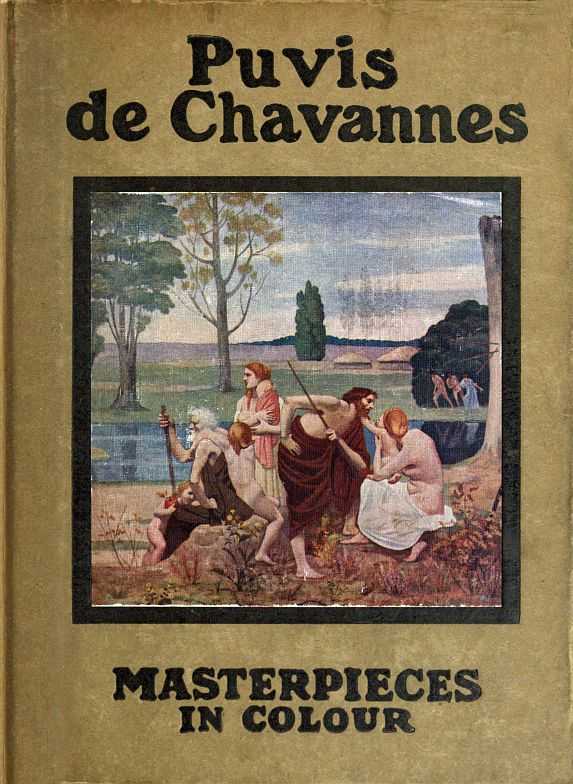
(In the Museum, Amiens)
This painting, admirable in execution, is quite interesting to study, because it serves to show in what a purely personal manner, wholly detached from mythological traditions, Puvis de Chavannes interpreted Antiquity.
Following the example of Marseilles and Amiens, the city of Poitiers, which in 1872 had just completed the building of a City Hall, commissioned Puvis de Chavannes to decorate the main staircase.
The two subjects chosen by the artist, with the approbation of the municipality, were as follows:
First panel:—"Radegonde, having retired to the Convent of the Holy Cross, offers an asylum to the poets and protects Literature against the barbarism of those days."
Second panel:—"The year 732: Charles Martel saves Christendom by his victory over the Saracens near Poitiers."
The legend of Radegonde is well known: "The virtuous spouse of Clotaire, fleeing from the brutality of that crowned free-booter and hiding in a convent in order to escape his pursuit." But this convent is by no means a cloister; the practice of arts and letters is pursued alternately with the singing of psalms.
The door stands open to poets. One of them, Fortunatus, passing through Poitiers, stops there and is received with cordial hospitality, and conceiving for the saintly queen a delicate and chaste love, he remains for twenty years in this abode in which he purposed to spend only a few days.
Puvis de Chavannes has magnificently rendered the poetic beauty of this historic episode by representing one of the fêtes given by Radegonde in the Convent of the Holy Cross.
In the second panel, we see Charles Martel returning to Poitiers, victorious over the Saracens and receiving the benediction of the bishops. Here the artist's brush attains a vigour of expression such as in all his life he found but few occasions to employ. The countenances of the bishops, notably, stand out with a relief and an energy that are remarkable.
M. Marius Vachon relates that he once asked the artist, who was a personal friend, to what documents he had recourse in order to give such forbidding features to the prelates in his painting:
"I got the suggestion for them," he replied, laughing, "from an old set of chess men, consisting of the coarse and grouchy faces of knights and jesters."
THE LAST YEARS
In the days following the Franco-Prussian War and the Commune, the Government conceived the project of decorating the Panthéon, which had just been once more secularized, in order to convert it into a temple wherein all the shining lights of the nation could be brought together and honoured.
M. de Chennevières, who at that time was director of the Beaux Arts gave the first place, in that illustrious line, to the noble and serene Genevieve, patron saint of Paris, incarnate ideal of patriotism.
Accordingly it was a series of religious paintings that M. de Chennevières required of Puvis de Chavannes, when he entrusted him with a large share of the decoration.
This type of painting, although new to Puvis de Chavannes, failed to intimidate him. He had too much patriotic fire, more than enough Christian faith, and above all too thorough a mastery of his profession not to approach this task with full confidence. It is enough to visit the Panthéon just once in order to be convinced of this. A more magnificent realization of Saint Genevieve could not be conceived of, even in dreams. But are these paintings to be classed with religious art? One would hesitate to assert it, if the pictures habitually consecrated to religious themes are to be taken as a standard. But they are something better than that, because the virgin protectress of Paris is in these pictures profoundly human; she is brought very close to us, and we see her despoiled of the aureole that would have removed her too far from our vision and our hearts.
The whole world knows, at least through reproductions, the series of paintings consecrated to the life of this saint. First of all, we have Saint Genevieve as a child, singled out from a crowd by Saint Germain, because she is marked with the divine seal. "I chose the hour," wrote Puvis de Chavannes, "at which history claimed possession of this heroic woman. These two are not an old man and a child, they are two great souls face to face. The glance which they ardently exchange is, in its moral significance, the culminating point of the composition."
Next in order comes the Piety of Saint Genevieve. The pious child is at her prayers before a cross formed by two interlacing branches. This is the prologue of a life filled with miracles, divine recompense accorded only to supernatural virtue. The artist has admirably reproduced the mystic fervour of that child whose future was foreordained to be so beautiful.
Subsequently, in 1896, the Government entrusted Puvis de Chavannes with the execution of two new panels, likewise dedicated to the life of Saint Genevieve. The two themes chosen were the following:
"Ardent in her faith and in her charity, Genevieve, whom the greatest perils could not swerve from her duty, brings sustenance to Paris, besieged and threatened with famine."
"Genevieve, sustained by her pious solicitude, keeps watch over sleeping Paris."
These noble paintings were the last productions of the great artist. A sort of premonition told him that the end was near, in spite of his robust health. "How I shall devote myself to the Panthéon," he wrote, "when I am finished with the Hôtel de Ville! I intend it to be a sort of last will and testament."
In these last paintings, Saint Genevieve is no longer a child. Having attained womanhood, her saintliness is such that, from all sides, people come to take shelter behind her veil, like children around their mother, as soon as danger is announced.
For the purpose of portraying this hieratic and inspired figure, Puvis de Chavannes found the ideal model close at hand, in the noble woman who had associated her entire life with his. Genevieve bringing sustenance to Paris is the artist's wife who, already mortally ill, inflicted upon herself the most cruel suffering, in order to pose in her husband's studio. The disease which was killing her was known only to herself, and she had the heroism to conceal it up to the supreme hour when, conquered at last, she was stricken down. In painting the pensive and dolorous attitude of Genevieve watching over sleeping Paris, the poor artist never once suspected that he was tracing for the last time the portrait of her who had been the consolation and the joy of his whole existence.
The unfortunate woman lacked the strength to play her rôle to the end; she was forced to take to her bed. The artist, no less heroic than she, feeling that his own life was slipping away with hers, yet wishing to complete this last work,—his testament—transported his easel beside the dying woman's bed, and there finished the sketches for his picture.
In the intervals of time between the paintings executed for the Panthéon, Puvis de Chavannes produced certain other large compositions in no wise inferior either in importance or in merit, notably, in 1883, a large painting for the Palace of Arts, at Lyons.
The municipal government of that city, wishing to have the main staircase of the palace decorated, entrusted the execution to the great artist who was at the same time a compatriot. He felt a very special joy in accepting this commission, for he had always retained a vivid memory of the city of his birth.
He endowed it with three pictures of a very high order, one of which, The Sacred Wood, dear to the Arts and the Muses, is considered by many to be the artist's masterpiece.
Puvis de Chavannes breaks away from the mythological theme so often treated that it has become hackneyed. It is not on Helicon that he groups his Muses, but on the shore of a lake, in a setting of verdure softly illuminated by the rays of the moon. At the foot of a portico, Calliope is seen declaiming verses before her sisters. Some of the Muses appear attentive; others converse together; one of them is reclining lazily upon the grass. Euterpe and Thalia, heralded from the sky by song and the accompanying lyre, approach to join the group.
(In the Amphitheatre of the Sorbonne)
In this immense composition, in which the groups are balanced with admirable harmony, there is an exalted and pervading beauty. It makes itself felt in the prevailing mood of the subject as a whole, in the expressions of the several characters, in the naturalness of their attitudes and in the luminous clarity of the landscape.
Antiquity, as treated by Puvis de Chavannes, loses nothing of its nobility, but quite the contrary. It even gains in real beauty, because his Muses profit by being despoiled of those conventional attitudes, in which an immutable tradition has trammelled them. The artist has retained only such of their attitudes as cannot detract in any way from the naturalness of their movements or their lines.
In the same Palace of Arts, Puvis de Chavannes painted two additional allegorical panels representing The Rhone and The Saône, both of which are admirably effective.
To about the same period belongs his well known painting, The Poor Fisherman, at present in the Musée du Luxembourg.
In this work, which he painted as a relaxation from his more extensive efforts, Puvis de Chavannes has tried to portray, as Millet so often did, all the sordid and lamentable misery of the slaves of toil, who bend their poor aching backs beneath the burden of physical distress and mental degradation. This work is a fine and eloquent lesson in humanity.
In 1889, the Hôtel de Ville, in Paris, proceeding with the still unfinished decoration of its numerous halls and chambers, entrusted Puvis de Chavannes with the task of decorating the main staircase and the first salon in the suite of reception rooms.
On one wall of this salon, he painted Winter, on the other Summer. These two compositions are of imposing dimensions and admirable in execution.
Winter shows us a snow-clad stretch of forest landscape. Woodsmen are hauling the trunks of trees which others of their number have just felled. Nothing could be more impressive than his rendering of the desolation of winter; and the truth, the exactitude of the physical effort these men are putting forth, with every muscle straining tensely on the rope.
Summer shows us a delightful and smiling landscape flooded with light; bathing women plunge their nude forms beneath the water, while a mother, seated on the grass, nurses her new born child. In this picture Puvis de Chavannes, who was a landscape painter of the first order, has surpassed himself; the work is a miracle of open air and grateful shade.
Unfortunately, the room in which these two magnificent pictures are placed suffers from a deplorable want of light, and its scanty dimensions make it impossible to stand back at a sufficient distance to see them to advantage. The Hôtel de Ville should for its own credit assign them a place more in keeping with their worth.
For the museum at Rouen, Puvis de Chavannes painted an allegory entitled Inter Artes et Naturam, charming in fantasy and poetic feeling. According to his habit, he has grouped together in synthetic form the various things which constitute the wealth or serve to mark the characteristics of the province of Normandy.
Labourers heaping up architectural fragments preserved from all the various epochs proclaim the variety and antiquity of its monuments; its special art is represented by a young girl painting a tulip on a porcelain plate and by a lad carrying a tray of pottery; its principal agricultural richness is revealed by the action of a woman, bending down a branch of an apple-tree, in order that her child may reach the fruit. And at the bottom of the picture flows the Seine, rolling its flood past a long sequence of manufactories, and bearing in its course heavily laden boats.
This picture is one of Puvis de Chavannes' most ingenious conceptions; furthermore, it possesses great charm of detail.
In 1891, the trustees of the Boston Museum approached Puvis de Chavannes with a request to decorate the main staircase of that edifice.
The negotiations were troublesome. In spite of his delight at having a new work to produce, in spite of the legitimate pride he felt in this homage paid to French art, Puvis de Chavannes hesitated to accept the commission. For the first time he faced the necessity of painting a canvas without having studied beforehand the physiognomy, the environment, the illumination of the space he was to decorate, and his artist's conscience suffered. Besides, certain misunderstandings had arisen between American trustees and the painter; several times relations were on the point of being broken off; and no definite agreement was reached until after the lapse of four years.
Puvis de Chavannes began this work in 1895; he did not finish it until 1898. The surface to be covered was to be divided into nine large panels, three facing the entrance, three to the right, three to the left. The choice of subjects was left to him.
For the central panel Puvis de Chavannes chose a theme already treated twice by him: The inspiring Muses acclaim Genius, Messenger of Light.
Against a background of sea and of blue sky, a Genius with the radiant features of a child advances, holding a torch in each hand. At sight of the Genius the muses run forward and range themselves on each side.
The ninth muse, still floating through the air, hastens to rejoin her companions.
This whole charming group of women is deliciously painted and one is at a loss which to admire the more; the originality of the artistic conception, or the peculiarly rare delicacy of the painter's skill.
The eight subordinate panels represent Bucolic Poetry, Dramatic Poetry, Epic Poetry, History, Astronomy, Physics, Chemistry and Philosophy. All these paintings produce a decorative effect of the highest order, and many critics consider, not without reason, that this group of frescoes in the Boston Library constitutes the masterpiece of Puvis de Chavannes.
However that may be, the authorities of the great American city are very proud of this absolutely unique decorative ensemble, and whenever any distinguished stranger passes through Boston he is conducted to admire it. Is not this a beautiful homage to French art, of which Puvis de Chavannes was one of the most glorious exponents?
THE LANDSCAPE PAINTER
There is, in the work of Puvis de Chavannes, so much harmony and balance; the place occupied by each figure is so perfectly planned to accord the unity of the whole, that one does not perceive at first, because of the wise ordering of the assembled parts, how many-sided the artist's genius was. And so it happens that the landscape painter in him does not appear excepting under analysis. Yet few artists have advanced the science of landscape so far; indeed, in all his compositions it holds a position, if not of first importance, at least one equal to that of his figures. In his eyes it was not a matter of convention, a decoration, an accessory, but an indispensable part of the picture, so indispensable indeed that, without the landscape the picture would not exist. In short, it is in his landscape that Puvis de Chavannes has always placed the local colour of his compositions, and not in his figures. The latter are generally clad in antique fashion, in order to remain representative of humanity in general, but the setting is local: his Ave, Picardia Nutrix, for instance, shows us the land of Picardy with its level plains and its melancholy horizons: similarly, the two frescoes in the Palace of Longchamps reproduce faithfully the sun-flooded coast of Marseilles and the animation of its quays;—and yet the hurrying crowds upon them belong to no definite race nor to any determinable epoch.
It is always so in the paintings of Puvis de Chavannes: the landscape and the living figures harmonize, fit in, complete each other, and the consummate art of the landscape painter yields in no way to that of the painter of figures.
(In the Museum, Amiens)
This work dates from the same period as Repose and Peace. It marks the début of Puvis de Chavannes in his career as an artist. In spite of some reminiscences of his training, his individuality already asserts itself, and the originality of composition is unmistakable.
Puvis de Chavannes has been criticized on the ground that in such of his pictures as evoke antiquity, he sacrificed accepted tradition and acquired knowledge. From this to a direct charge of ignorance was an easy step; and it was quickly taken. That the artist attached a mediocre importance to accuracy in decoration or antique costume, there can be no question. Truth, in his eyes, consisted less in the detailed reconstruction of garments than in the faithful representation of that eternally living model, the human soul, over which whole centuries have passed, without availing to modify it. All else is merely accessory and secondary, if not actually negligible. At the same time, no one was ever more truly impregnated with the spirit of antiquity, as he had imbibed it from his readings, from his travels and from his own meditations. Contrary to what has been thought, he was not proud; nor held himself aloof from all other schools of painting except his own. Nothing could be further from the truth. Puvis was acquainted with all the schools; and no one admired more sincerely than he the great masters of each and every country. He had traversed Italy, Germany, and the Netherlands, examining, studying, admiring. And here is precisely wherein his great glory consists; that having studied all methods, analyzed all processes, he still remained true to himself,—in other words, that he was a painter of inimitable originality.
Puvis de Chavannes kept abreast of all the ideas that stand for personality and progress. Far from being a recluse, solely concerned with his own painting, he followed the contemporary literary movement, and none of the happenings that took place around him escaped his knowledge.
Nevertheless, his chief preoccupation was his art and his desire to express, with his brush, the greatest possible degree of human nature. This he achieved in his magnificent series of immortal works; but it was only at the cost of a vast amount of conscientious labour. Few masters have had so keen an intuition of beauty, or a higher and more spontaneous inspiration; and no one, perhaps, has been so distrustful of himself, of his inspiration, of his intuition. He did not surrender himself to them until he had submitted them to the test of searching argument and uncompromising common sense. It is due to this careful weighing in the balance, to this wise mingling of youthful enthusiasm and mature severity that the work of Puvis de Chavannes owes that harmonious beauty that insures it an eternal glory.
And so, when in 1898 he passed away, not a dissenting voice was raised amid the concert of eulogies and of regrets which marked his end. For a long time previous, Puvis de Chavannes had ceased to have detractors; admiration had stifled envy. And, from the moment that he crossed beyond the threshold of life, Puvis de Chavannes entered fully into immortality.
CATALOGUE OF THE WORKS OF PUVIS DE CHAVANNES
Musée du Luxembourg; The Poor Fisherman.
Panthéon; Saint Genevieve marked with the divine seal.—The Piety of Saint Genevieve.—Saint Genevieve providing for besieged Paris.—Saint Genevieve watching over sleeping Paris.—Two decorative Friezes, including Faith, Hope, and Charity, and a series of Saints.
Hôtel de Ville; Summer, Winter.—Victor Hugo offering his lyre to the city of Paris.
Amphitheatre of the Sorbonne; Letters, Sciences and Arts.
Museum at Amiens; Peace.—War.—Labour.—Repose.—A Standard-Bearer.—A Harvester.—A Woman weeping over the ruins of her house.—A Woman Spinning.—Ave, Picardia Nutrix.—Ludus pro Patria.
Church at Campagnat; Ecce Homo.
Palace of Longchamps (Marseilles): Marseilles, a Greek Colony.—Marseilles, Gateway of the Orient.
Museum at Marseilles: The Return from the Hunt.
Hôtel de Ville, Poitiers: Saint Radegonde gives asylum to the Poets.—Charles Martel re-enters Poitiers after his conquest of the Saracens.
Palace of Fine Arts, Lyons: The Sacred Wood dear to the Arts and the Muses.
Museum at Rouen: Inter Artes et Naturam.
Public Library, Boston: The inspiring Muses acclaim Genius, Messenger of Light.
Museum at Chartres: Summer.
Private Collections: Herodiade.—Autumn.—Sleep.
Transcriber's Notes
Simple typographical errors were corrected.
Punctuation and spelling were made consistent when a predominant preference was found in this book; otherwise they were not changed.