
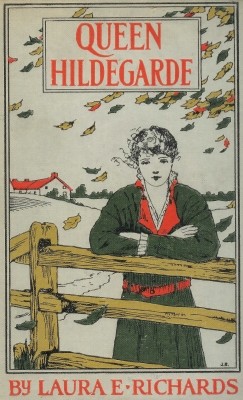
CHAPTER IV.
THE NEW HILDA.
The morning came laughing into Hilda's room, and woke her with such a flash of sunshine and trill of bird-song that she sprang up smiling, whether she would or no. Indeed, she felt happier than she could have believed to be possible. The anger, the despair, even the self-humiliation and anguish of repentance, were gone with the night. Morning was here,—a new day and a new life. "Here is the new Hildegarde!" she cried as she plunged her face into the clear, sparkling water. "Do you see me, blue dragons? Shake paws, you foolish creatures, and don't stand ramping and glaring at each other in that way! Here is a new girl come to see you. The old one was a minx,—do you hear, dragons?" The dragons heard, but were too polite to say anything; and as for not ramping, why they had ramped and glared for fifty years, and had no idea of making a change at their time of life.
The gilt cherubs round the little mirror were more amiable, and smiled cheerfully at Hilda as she brushed and braided her hair, and put on the pretty blue gingham frock. "We have no clothes ourselves," they seemed to say, "but we appreciate good ones when we see them!" Indeed, the frock fitted to perfection. "And after all," said the new Hilda as she twirled round in front of the glass, "what is the use of an overskirt?" after which astounding utterance, this young person proceeded to do something still more singular. After a moment's hesitation she drew out one of the white aprons which she had scornfully laid in the very lowest drawer only twelve hours before, tied it round her slender waist, and then, with an entirely satisfied little nod at the mirror, she tripped lightly downstairs and into the kitchen. Dame Hartley was washing dishes at the farther end of the room, in her neat little cedar dish-tub, with her neat little mop; and she nearly dropped the blue and white platter from her hands when she heard Hilda's cheerful "Good morning, Nurse Lucy!" and, turning, saw the girl smiling like a vision of morning.
"My dear," she cried, "sure I thought you were fast asleep still. I was going up to wake you as soon as I had done my dishes. And did you sleep well your first night at Hartley's Glen?"
"Oh, yes! I slept very sound indeed," said Hilda, lightly. And then, coming close up to Dame Hartley, she said in an altered tone, and with heightened color: "Nurse Lucy, I did not behave well last night, and I want to tell you that I am sorry. I am not like mamma, but I want to grow a little like her, if I can, and you must help me, please!"
Her voice faltered, and good Nurse Lucy, laying down her mop, took the slender figure in her motherly arms, from which it did not now shrink away.
"My lamb!" she said; "Miss Mildred's own dear child! You look liker your blessed mother this minute than I ever thought you would. Help you? That I will, with all my heart!—though I doubt if you need much help, coming to yourself so soon as this. Well, well!"
"Coming to herself!" It was the same phrase the good dame had used the night before, and it struck Hilda's mind with renewed force. Yes, she had come to herself,—her new self, which was to be so different from the old. How strange it all was! What should she do now, to prove the new Hilda and try her strength? Something must be done at once; the time for folded hands and listless revery was gone by.
"Shall I—may I help you to get breakfast?" she asked aloud, rather timidly.
"Breakfast? Bless you, honey, we had breakfast two hours ago. We farmers are early birds, you know. But you can lay a plate and napkin for yourself, if you like, while I drop a couple of fresh eggs and toast a bit of bacon for you. Do you like bacon, then?"
Rather disappointed at the failure of her first attempt to be useful, Hilda laid the snowy napkin on the shining table, and chose a pretty blue and white plate from the well-stocked shelves of the dresser.
"And now open that cupboard, my lamb," said her hostess, "and you'll find the loaf, and a piece of honeycomb, and some raspberries. I'll bring a pat of butter and some milk from the dairy, where it's all cool for you."
"Raspberries!" cried Hilda. "Oh, how delightful! Why, the dew is still on them, Nurse Lucy! And how pretty they look, with the cool green leaves round them!"
"Ay!" said the good woman, "Jacob brought them in not ten minutes ago. He thought you would like them fresh from the bushes."
Hilda's cheek rivalled the raspberries in bloom as she bent over them to inhale their fragrance. The farmer had picked these himself for her,—had probably left his work to do so; and she had called him an odious old savage, and an unkempt monster, and—oh dear! decidedly, the old Hilda was a very disagreeable girl. But here were the eggs, each blushing behind its veil of white, and here was the milk, and a little firm nugget in a green leaf, which was too beautiful to be butter, and yet too good to be anything else. And the new Hilda might eat her breakfast with a thankful heart, and did so. The white rose nodded to her from the west window much more cordially than it had done the night before. It even brought out a little new bud to take a peep at the girl who now smiled, instead of scowling across the room. The vines rustled and shook, and two bright black eyes peeped between the leaves. "Tweet!" said the robin, ruffling his scarlet waistcoat a little. "When you have quite finished your worms, you may come out, and I will show you the garden. There are cherries!" and away he flew, while Hilda laughed and clapped her hands, for she had understood every word.
"May I go out into the garden?" she asked, when she had finished her breakfast and taken her first lesson in dish-washing, in spite of Dame Hartley's protest. "And isn't there something I can do there, please? I want to work; I don't want to be idle any longer."
"Well, honey," replied the dame, "there are currants to pick, if you like such work as that. I am going to make jelly to-morrow; and if you like to begin the picking, I will come and help you when my bread is out of the oven."
Gladly Hilda flew up to her room for the broad-leaved hat with the daisy-wreath; and then, taking the wide, shallow basket which Dame Hartley handed her, she fairly danced out of the door, over the bit of green, and into the garden.
Ah! the sweet, heartsome country garden that this was,—the very thought of it is a rest and a pleasure. Straight down the middle ran a little gravel path, with a border of fragrant clove-pinks on either side, planted so close together that one saw only the masses of pale pink blossoms resting on their bed of slender silvery leaves. And over the border! Oh the wealth of flowers, the blaze of crimson and purple and gold, the bells that swung, the spires that sprang heavenward, the clusters that nodded and whispered together in the morning breeze! Here were ranks upon ranks of silver lilies, drawn up in military fashion, and marshalled by clumps of splendid tiger-lilies,—the drum-majors of the flower-garden. Here were roses of every sort, blushing and paling, glowing in gold and mantling in crimson. And the carnations showed their delicate fringes, and the geraniums blazed, and the heliotrope languished, and the "Puritan pansies" lifted their sweet faces and looked gravely about, as if reproving the other flowers for their frivolity; while shy Mignonette, thinking herself well hidden behind her green leaves, still made her presence known by the exquisite perfume which all her gay sisters would have been glad to borrow.
Over all went the sunbeams, rollicking and playing; and through all went Hildegarde, her heart filled with a new delight, feeling as if she had never lived before. She talked to the flowers. She bent and kissed the damask rose, which was too beautiful to pluck. She put her cheek against a lily's satin-silver petals, and started when an angry bee flew out and buzzed against her nose. But where were the currant-bushes? Ah! there they were,—a row of stout green bushes, forming a hedge at the bottom of the garden.
Hilda fell busily to work, filling her basket with the fine, ruddy clusters. "How beautiful they are!" she thought, holding up a bunch so that the sunlight shone through it. "And these pale, pinky golden ones, which show all the delicate veins inside. Really, I must eat this fat bunch; they are like fairy grapes! The butler fay comes and picks a cluster every evening, and carries it on a lily-leaf platter to the queen as she sits supping on honey-cakes and dew under the damask rose-bush."
While fingers and fancy were thus busily employed, Hilda was startled by the sound of a voice which seemed to come from beyond the currant-bushes, very near her. She stood quite still and listened.
"A-g, ag," said the voice; "g-l-o-m, glom,—agglom; e-r er,—agglomer; a-t-e, ate,—agglomerate." There was a pause, and then it began again: "A-g, ag; g-l-o-m, glom," etc.
Hilda's curiosity was now thoroughly aroused; and laying down her basket, she cautiously parted the leaves and peeped through. She hardly knew what she expected to see. What she did see was a boy about ten years old, in a flannel shirt and a pair of ragged breeches, busily weeding a row of carrots; for this was the vegetable garden, which lay behind the currant-bushes. On one side of the boy was a huge heap of weeds; on the other lay a tattered book, at which he glanced from time to time, though without leaving his work. "A-n, an," he was now saying; "t-i, ti,—anti; c-i-p, cip,—anticip; a-t-e, ate,—anticipate. 'To expect.' Well! that is a good un. Why can't they say expect, 'stead o' breakin' their jawsen with a word like that? Anticip-ate! Well, I swan! I hope he enjoyed eatin' it. Sh'd think 't'd ha giv' him the dyspepsy, anyhow."
At this Hilda could contain herself no longer, but burst into a merry peal of laughter; and as the boy started up with staring eyes and open mouth, she pushed the bushes aside and came towards him. "I am sorry I laughed," she said, not unkindly. "You said that so funnily, I couldn't help it. You did not pronounce the word quite right, either. It is anticipate, not anticip-ate."
The boy looked half bewildered and half grateful. "Anticipate!" he repeated, slowly. "Thanky, miss! it's a onreasonable sort o' word, 'pears ter me." And he bent over his carrots again.
But Hilda did not return to her currant-picking. She was interested in this freckled, tow-headed boy, wrestling with four-syllabled words while he worked.
"Why do you study your lesson out here?" she asked, sitting down on a convenient stump, and refreshing herself with another bunch of white currants. "Couldn't you learn it better indoors?"
"Dunno!" replied the boy. "Ain't got no time ter stay indoors."
"You might learn it in the evening!" suggested Hilda.
"I can't keep awake evenin's," said the boy, simply. "Hev to be up at four o'clock to let the cows out, an' I git sleepy, come night. An' I like it here too," he added. "I can l'arn 'em easier, weedin'; take ten weeds to a word."
"Ten weeds to a word?" repeated Hilda. "I don't understand you."
"Why," said the boy, looking up at her with wide-open blue eyes, "I take a good stiff word (I like 'em stiff, like that an—anticipate feller), and I says it over and over while I pull up ten weeds,—big weeds, o' course, pusley and sich. I don't count chickweed. By the time the weeds is up, I know the word, I've larned fifteen this spell!" and he glanced proudly at his tattered spelling-book as he tugged away at a mammoth root of pusley, which stretched its ugly, sprawling length of fleshy arms on every side.
Hilda watched him for some moments, many new thoughts revolving in her head. How many country boys were there who taught themselves in this way? How many, among the clever girls at Mademoiselle Haut-ton's school, had this sort of ambition to learn, of pride in learning? Had she, the best scholar in her class, had it? She had always known her lessons, because they were easy for her to learn, because she had a quick eye and ear, and a good memory. She could not help learning, Mademoiselle said. But this,—this was something different!
"What is your name?" she asked, with a new interest.
"Bubble Chirk," replied the freckled boy, with one eye on his book, and the other measuring a tall spire of pigweed, towards which he stretched his hand.
"What!" cried Hilda, in amazement.
"Bubble Chirk!" said the boy. "Kin' o' curus name, ain't it? The hull of it's Zerubbabel Chirk; but most folks ain't got time to say all that. It trips you up, too, sort o'. Bubble's what they call me; 'nless it's Bub."
The contrast between the boy's earnest and rather pathetic face, and his absurdly volatile name, was almost too much for Hilda's gravity. But she checked the laugh which rose to her lips, and asked: "Don't you go to school at all, Bubble? It is a pity that you shouldn't, when you are so fond of study."
"Gin'lly go for a spell in the winter," replied Bubble. "They ain't no school in summer, y' know. Boys hes to work, round here. Mam ain't got nobody but me 'n Pink, sence father died."
"Who is Pink?" asked Hilda, gently.
"My sister," replied Bubble. "Thet ain't her real name, nuther. Mam hed her christened Pinkrosia, along o' her bein' so fond o' roses, Mam was; but we don't call her nothin' only Pink."
"Pink Chirk!" repeated Hilda to herself. "What a name! What can a girl be like who is called Pink Chirk?"
But now Bubble seemed to think that it was his turn to ask questions. "I reckon you're the gal that's come to stay at Mr. Hartley's?" he said in an interrogative tone.
Hilda's brow darkened for a moment at the word "gal," which came with innocent frankness from the lips of the ragged urchin before her. But the next moment she remembered that it was only the old Hilda who cared about such trifles; so she answered pleasantly enough:
"Yes, I am staying at Mr. Hartley's. I only came yesterday, but I am to stay some time."
"And what mought your name be?" inquired Master Chirk.
"Hildegardis Graham." It was gently said, in a very different voice from that which had answered Farmer Hartley in the same words the night before; but it made a startling impression on Bubble Chirk.
"Hildy—" he began; and then, giving it up, he said simply: "Well, I swan! Do ye kerry all that round with ye all the time?"
Hilda laughed outright at this.
"Oh, no!" she said; "I am called Hilda generally."
"But you kin spell the hull of it?" asked the boy anxiously.
"Yes, certainly!" Bubble's eager look subsided into one of mingled awe and admiration.
"Reckon ye must know a heap," he said, rather wistfully. "Wish't I did!"
Hilda looked at him for a moment without speaking. Her old self was whispering to her. "Take care what you do!" it said. "This is a coarse, common, dirty boy. He smells of the stable; his hair is full of hay; his hands are beyond description. What have you in common with such a creature? He has not even the sense to know that he is your inferior." "I don't care!" said the new Hilda. "I know what mamma would do if she were here, and I shall do it,—or try to do it, at least. Hold your tongue, you supercilious minx!"
"Bubble," she said aloud, "would you like me to teach you a little, while I am here? I think perhaps I could help you with your lessons."
The boy looked up with a sudden flash in his blue eyes, while his face grew crimson with pleasure.
"Would I like it?" he cried eagerly. But the next moment the glow faded, and he looked awkwardly down at his ragged book and still more ragged clothes. "Guess I ain't no time to l'arn that way," he muttered in confusion.
"Nonsense!" said Hilda, decidedly. "There must be some hour in the day when you can be spared. I shall speak to Farmer Hartley about it. Don't look at your clothes, you foolish boy," she continued, with a touch of Queen Hildegardis' quality, yet with a kindly intonation which was new to that potentate. "I am not going to teach your clothes. You are not your clothes!" cried Her Majesty, wondering at herself, and a little flushed with her recent victory over the "minx." The boy's face brightened again.
"That's so!" he said, joyously; "that's what Pink says. But I didn't s'pose you'd think so," he added, glancing bashfully at the delicate, high-bred face, with its flashing eyes and imperial air.
"I do think so!" said Hilda. "So that is settled, and we will have our first lesson to-morrow. What would you—"
"Hilda! Hilda! where are you, dear?" called Dame Hartley's voice from the other side of the currant-bush-hedge. And catching up her basket, and bidding a hasty good-by to her new acquaintance and future scholar, Hildegarde darted back through the bushes.
Zerubbabel Chirk looked after her a few moments, with kindling eyes and open mouth of wonder and admiration.
"Wall!" he said finally, after a pause of silent meditation, "I swan! I reelly do! I swan to man!" and fell to weeding again as if his life depended on it.
CHAPTER V.
THE BLUE PLATTER.
Among the leavés green!"
Thus sang Hildegarde as she sat in the west window, busily stringing her currants. She had been thinking a great deal about Bubble Chirk, making plans for his education, and wondering what his sister Pink was like. He reminded her, she could not tell why, of the "lytel boy" who kept fair Alyce's swine, in her favorite ballad of "Adam Bell, Clym o' the Clough, and William of Cloudeslee;" and the words of the ballad rose half unconsciously to her lips as she bent over the great yellow bowl, heaped with scarlet and pale-gold clusters.
Among the leavés green,
Whenas men hunt east and west
With bows and arrowés keen,
"For to raise the deer out of their denne,—
Such sights have oft been seen;
As by three yemen of the north countree:
By them it is, I mean.
"The one of them hight Adam Bell,
The other Clym o' the Clough;
The third was Willyam of Cloudeslee,—
An archer good enough.
"They were outlawed for venison,
These yemen every one.
They swore them brethren on a day
To English wood for to gone.
"Now lythe and listen, gentylmen,
That of myrthes loveth to hear!"
At this moment the door opened, and Farmer Hartley entered, taking off his battered straw hat as he did so, and wiping his forehead with a red bandanna handkerchief. Hilda looked up with a pleasant smile, meaning to thank him for the raspberries which he had gathered for her breakfast; but to her utter astonishment the moment his eyes fell upon her he gave a violent start and turned very pale; then, muttering something under his breath, he turned hastily and left the room.
"Oh! what is the matter?" cried Hilda, jumping up from her chair. "What have I done, Nurse Lucy? I have made the farmer angry, somehow. Is this his chair? I thought—"
"No, no, honey dear!" said Nurse Lucy soothingly. "Sit ye down; sit ye down! You have done nothing. I'm right glad of it," she added, with a tone of sadness in her pleasant voice. "Seeing as 'tis all in God's wisdom, Jacob must come to see it so; and 'tis no help, but a deal of hindrance, when folks set aside chairs and the like, and see only them that's gone sitting in them." Then, seeing Hilda's look of bewilderment, she added, laying her hand gently on the girl's soft hair: "You see, dear, we had a daughter of our own this time last year. Our only one she was, and just about your age,—the light of our eyes, our Faith. She was a good girl, strong and loving and heartsome, and almost as pretty as yourself, Hilda dear; but the Father had need of her, so she was taken from us for a while. It was cruel hard for Jacob; cruel, cruel hard. He can't seem to see, even now, that it was right, or it wouldn't have been so. And so I can tell just what he felt, coming in just now, sudden like, and seeing you sitting in Faith's chair. Like as not he forgot it all for a minute, and thought it was herself. She had a blue dress that he always liked, and she'd sit here and sing, and the sun coming in on her through her own window there, as she always called it: like a pretty picture she was, our Faith."
"Oh!" cried Hilda, taking the brown, motherly hand in both of hers, "I am so very, very sorry, dear Nurse Lucy! I did not know! I will never sit here again. I thought—"
But she was ashamed to say what she had thought,—that this chair and table had been set for her to tempt her to sit down "in a kitchen!" She could hear herself say it as she had said it last night, with a world of scornful emphasis. How long it seemed since last night; how much older she had grown! And yet—and yet somehow she felt a great deal younger.
All this passed through her mind in a moment; but Nurse Lucy was petting her, and saying: "Nay, dearie; nay, child! This is just where I want you to sit. 'Twill be a real help to Farmer, once he is used to it. Hark! I hear him coming now. Sit still! To please me, my dear, sit still where ye are."
Hilda obeyed, though her heart beat painfully; and she bent in real distress over the currants as Farmer Hartley once more entered the room. She hardly knew what she feared or expected; but her relief was great when he bade her a quiet but cheerful "Good-day!" and crossing the room, sat down in his great leather arm-chair.
"Dinner'll be ready in five minutes, Jacob!" said the good dame, cheerily; "I've only to lay the table and dish the mutton."
"Oh! let me help," cried Hilda, springing up and setting her bowl of currants on the window-sill.
So between the two the snowy cloth was laid, and the blue plates and the shining knives and forks laid out. Then they all sat down, and the little maid-servant came too, and took her place at the end of the table; and presently in came a great loutish-looking fellow, about one or two and twenty, with a great shock of sandy hair and little ferret-eyes set too near together, whom Dame Hartley introduced as her nephew. He sat down too, and ate more than all the rest of them put together. At sight of this man, who gobbled his food noisily, and uttered loud snorts between the mouthfuls, the old Hilda awoke in full force. She could not endure this; mamma never could have intended it! The Hartleys were different, of course. She was willing to acknowledge that she had been in the wrong about them; but this lout, this oaf, this villainous-looking churl,—to expect a lady to sit at the same table with him: it was too much! She would ask if she might not dine in her own room after this, as apparently it was only at dinner that this "creature" made his appearance.
Farmer Hartley had been very silent since he came in, but now he seemed to feel that he must make an effort to be sociable, so he said kindly, though gravely,—
"I see ye're lookin' at that old dish, Huldy. 'Tis a curus old piece, 'n' that's a fact. Kin ye read the motter on it?"
Hilda had not been looking at the dish, though her eyes had been unconsciously fixed upon it, and she now bent forward to examine it. It was an oblong platter, of old blue and white crockery. In the middle (which was now visible, as the "creature" had just transferred the last potato to his own plate, stabbing it with his knife for that purpose) was a quaint representation of a mournful-looking couple, clad in singularly ill-fitting aprons of fig-leaves. The man was digging with a spade, while the woman sat at a spinning-wheel placed dangerously near the edge of the deep ditch which her husband had already dug. Round the edge ran an inscription, which, after some study, Hilda made out to be the old distich:
"When Adam delved, and Eve span,
Where was then the gentleman?"
Hilda burst out laughing in spite of her self.
"Oh, it is wonderful!" she cried. "Who ever heard of Eve with a spinning-wheel? Where did this come from, Farmer Hartley? I am sure it must have a history."
"Wa-al," said the farmer, smiling, "I d'no ez 't' hes so to speak a hist'ry, an' yit there's allays somethin' amoosin' to me about that platter. My father was a sea-farin' man most o' his life, an' only came to the farm late in life, 'count of his older brother dyin', as owned it. Well, he'd picked up a sight o' queer things in his voyages, father had; he kep' some of 'em stowed away in boxes, and brought 'em out from time to time, ez he happened to think of 'em. Wa-al, we young uns growed up (four of us there was, all boys, and likely boys too, if I do say it), and my brother Simon, who was nex' to me, he went to college. He was a clever chap, Simon was, an' nothin' would do for him but he must be a gentleman.
"'Jacob kin stick to the farm an' the mill; if he likes,' says he, 'an' Tom kin go to sea, an' William kin be a minister,—'t's all he's good fer, I reckon; but I'm goin' ter be a gentleman!' says Simon. He said it in father's hearin' one day, an' father lay back in his cheer an' laughed; he was allays laughin', father was. An' then he went off upstairs, an' we heard him rummagin' about among his boxes up in the loft-chamber. We dassn't none of us tech them boxes, we boys, though we warn't afeard of nothin' else in the world, only father. Presently he comes down again, still a-laughin', an' kerryin' that platter in his hand. He sets it down afore Simon, an' says he, 'Wealthy,' says he (that was my mother), 'Wealthy,' says he, 'let Simon have his victuals off o' this platter every day, d'ye hear? The' ain't none other that's good enough for him!' an' then he laughed again, till he fairly shook, an' Simon looked black as thunder, an' took his hat an' went out. An' so after Simon went to college, every time he come home for vacation and set down to table with his nose kind o' turned up, like he was too good to set with his own kith and kin, father 'ud go an git the old blue platter and set it afore him, an' say, 'Here's your dish, Simon; been diggin' any lately, my son?' and then lay back in his cheer and laugh."
"And did Simon become—a—a gentleman?" asked Hilda, taking her own little lesson very meekly, in her desire to know more.
Farmer Hartley's brow clouded instantly, and the smile vanished from his lips. "Poor Simon!" he said, sadly. "He might ha' been anythin' he liked, if he'd lived and—been fortunate."
"Simon Hartley is dead, Hilda dear," interposed Dame Hartley, gently; "he died some years ago. Will you have some of your own currants, my dear?—Hilda has been helping me a great deal, Father," she added, addressing her husband. "I don't know how I should have got all my currants picked without her help."
"Has she so?" exclaimed the farmer, fixing his keen gray eyes on the girl. "Waal! waal! to think o' that! Why, we sh'll hev her milkin' that cow soon, after all; hey, Huldy?"
Hildegarde looked up bravely, with a little smile. "I will try," she said, cheerfully, "if you will risk the milk, Farmer Hartley."
The old farmer returned her smile with one so bright and kind and genial that somehow the ice bent, then cracked, and then broke. The old Hilda shrank into so small a space that there was really very little left of her, and the new Hilda rose from table feeling that she had gained a new friend.
So it came to pass that about an hour later our heroine was walking beside the farmer on the way to the barnyard, talking merrily, and swinging the basket which she was going to fill with eggs. "But how shall I find them," she asked, "if the hens hide them away so carefully?"
"Oh, you'll hear 'em scrattlin' round!" replied the farmer. "They're gret fools, hens are,—greter than folks, as a rule; an' that is sayin' a good deal."
They crossed the great sunny barn-yard, and paused at the barn-door, while Hilda looked in with delight. A broad floor, big enough for a ballroom, with towering walls of fragrant hay on either side reaching up to the rafters; great doors open at the farther end, showing a snatch of blue, radiant sky, and a lovely wood-road winding away into deep thickets of birch and linden; dusty, golden, cobwebby sunbeams slanting down through the little windows, and touching the tossed hay-piles into gold; and in the middle, hanging by iron chains from the great central beam, a swing, almost big enough for a giant,—such was the barn at Hartley Farm; as pleasant a place, Hilda thought, as she had ever seen.
"Waal, Huldy, I'll leave ye heer," said the farmer; "ye kin find yer way home, I reckon."
"Oh, yes, indeed!" said Hilda. "But stop one moment, please, Farmer Hartley. I want to know—will you please—may I teach Bubble Chirk a little?" The farmer gave a low whistle of surprise; but Hilda went on eagerly: "I found him studying, this morning, while he was weeding the garden,—oh! studying so hard, and yet not neglecting his work for a minute. He seems a very bright boy, and it is a pity he should not have a good education. Could you spare him, do you think, for an hour every day?" She stopped, while the farmer looked at her with a merry twinkle in his eye.
"You teach Bubble Chirk!" he said. "Why, what would your fine friends say to that, Miss Huldy? Bubble ain't nothin' but a common farm-boy, if he is bright; an' I ain't denyin' that he is."
"I don't know what they would say," said Hildegarde, blushing hotly, "and I don't care, either! I know what mamma would do in my place; and so do you, Farmer Hartley!" she added, with a little touch of indignation.
"Waal, I reckon I do!" said Farmer Hartley. "And I know who looks like her mother, this minute, though I never thought she would. Yes!" he said, more seriously, "you shall teach Bubble Chirk, my gal; and it's my belief 'twill bring you a blessin' as well as him. Ye are yer mother's darter, after all. Shall I give ye a swing now, before I go; or are ye too big to swing!"
"I—don't—know!" said Hildegarde, eying the swing wistfully. "Am I too big, I wonder?"
"Yer ma warn't, when she was here three weeks ago!" said the farmer. "She just sot heer and took a good solid swing, for the sake of old times, she said."
"Then I will take one for the sake of new times!" cried Hilda, running to the swing and seating herself on its broad, roomy seat. "For the sake of this new time, which I know is going to be a happy one, give me three good pushes, please, Farmer Hartley, and then I can take care of myself."
One! two! three! up goes Queen Hildegarde, up and up, among the dusty, cobwebby sunbeams, which settle like a crown upon her fair head. Down with a rush, through the sweet, hay-scented air; then up again, startling the swallows from under the eaves, and making the staid and conservative old hens frantic with anxiety. Up and down, in broad, free sweeps, growing slower now, as the farmer left her and went to his work. How perfect it was! Did the world hold anything else so delightful as swinging in a barn? She began to sing, for pure joy, a little song that her mother had made for her when she was a little child, and used to swing in the garden at home. And Farmer Hartley, with his hand on the brown heifer's back, paused with a smile and a sigh as he heard the girl's sweet fresh voice ring out gladly from the old barn. This was the song she sang:—
(Swinging high, swinging low),
I would give to you a ring
(Swinging, oh!)
With a diamond set so bright
That the shining of its light
Should make morning of the night
(Swinging high, swinging low)—
Should make morning of the night
(Swinging, oh!).
On each ringlet as it fell
(Swinging high, swinging low)
I would tie a golden bell
(Swinging, oh!);
And the golden bells would chime
In a little merry rhyme,
In the merry morning time
(Swinging high, swinging low)—
In the happy morning time
(Swinging, oh!).
You should wear a satin gown
(Swinging high, swinging low),
All with ribbons falling down
(Swinging, oh!).
And your little twinkling feet,
O my Pretty and my Sweet!
Should be shod with silver neat
(Swinging high, swinging low)—
Shod with silver slippers neat
(Swinging, oh!).
But I'm not a fairy, Pet
(Swinging high, swinging low),
Am not even a king, as yet
(Swinging, oh!).
So all that I can do
Is to kiss your little shoe,
And to make a queen of you
(Swinging high, swinging low),
Make a fairy queen of you
(Swinging, oh!).
CHAPTER VI.
HARTLEY'S GLEN.
How many girls, among all the girls who may read this little book, have seen with their own eyes Hartley's Glen? Not one, perhaps, save Brynhild and the Rosicrucian, for whom the book is written. But the others must try to see it with my eyes, for it is a fair place and a sweet as any on earth. Behind the house, and just under the brow of the little hill that shelters it, a narrow path dips down to the right, and goes along for a bit, with a dimpled clover-meadow on the one hand, and a stone wall, all warm with golden and red-brown lichens, on the other. Follow this, and you come to a little gateway, beyond which is a thick plantation of larches, with one grim old red cedar keeping watch over them. If he regards you favorably, you may pass on, down the narrow path that winds among the larches, whose feathery finger-tips brush your cheek and try to hold you back, as if they willed not that you should go farther, to see the wonders which they can never behold.
But you leave them behind, and come out into the sunshine, in a little green glade which might be the ballroom of the fairy queen. On your right, gleaming through clumps of alder and black birch, is a pond,—the home of cardinal flowers and gleaming jewel-weed; a little farther on, a thicket of birch and maple, from which comes a musical sound of falling water. Follow this sound, keeping to the path, which winds away to the left. Stop! now you may step aside for a moment, and part the heavy hanging branches, and look, where the water falls over a high black wall, into a sombre pool, shut in by fantastic rocks, and shaded from all sunshine by a dense fringe of trees. This is the milldam, and the pond above is no natural one, but the enforced repose and outspreading of a merry brown brook, which now shows its true nature, and escaping from the gloomy pool, runs scolding and foaming down through a wilderness of rocks and trees. You cannot follow it there,—though I have often done so in my barefoot days,—so come back to the path again. There are pines overhead now, and the ground is slippery with the fallen needles, and the air is sweet—ah! how sweet!—with their warm fragrance. See! here is the old mill itself, now disused and falling to decay. Here the path becomes a little precipice, and you must scramble as best you can down two or three rough steps, and round the corner of the ruined mill. This is a millstone, this great round thing like a granite cheese, half buried in the ground; and here is another, which makes a comfortable seat, if you are tired.
But there is a fairer resting-place beyond. Round this one more corner, now, and down,—carefully, carefully!—down this long stairway, formed of rough slabs of stone laid one below the other. Shut your eyes now for a moment, and let me lead you forward by the hand. And now—now open the eyes wide, wide, and look about you. In front, and under the windows of the old mill, the water comes foaming and rushing down over a rocky fall some sixty feet high, and leaps merrily into a second pool. No sombre, black gulf this, like the one above, but a lovely open circle, half in broad sunshine, half dappled with the fairy shadows of the boughs and ferns that bend lovingly over it. So the little brook is no longer angry, but mingles lovingly with the deep water of the pool, and then runs laughing and singing along the glen on its way down to the sea. On one side of this glen the bank rises abruptly some eighty feet, its sides clothed with sturdy birches which cling as best they may to the rocky steep. On the other stretches the little valley, a narrow strip of land, but with turf as fine as the Queen's lawn, and trees that would proudly grace Her Majesty's park,—tall Norway firs, raising their stately forms and pointing their long dark fingers sternly at the intruders on their solitude; graceful birches; and here and there a whispering larch or a nodding pine. The other wall of the valley, or glen, is less precipitous, and its sides are densely wooded, and fringed with barberry bushes and climbing eglantine.
And between these two banks, and over this green velvet carpet, and among these dark fir-trees,—ah! how the sun shines. Nowhere else in the whole land does he shine so sweetly, for he knows that his time there is short, and that the high banks will shut him out from that green, pleasant place long before he must say good-night to the more common-place fields and hill-sides. So here his beams rest right lovingly, making royal show of gold on the smooth grass, and of diamonds on the running water, and of opals and topazes and beryls where the wave comes curling over the little fall.
And now, amid all this pomp and play of sun and of summer, what is this dash of blue that makes a strange, though not a discordant, note in our harmony of gold and green? And what is that round, whitish object which is bobbing up and down with such singular energy? Why, the blue is Hildegarde's dress, if you must know; and the whitish object is the head of Zerubbabel Chirk, scholar and devotee; and the energy with which said head is bobbing is the energy of determination and of study. Hilda and Bubble have made themselves extremely comfortable under the great ash-tree which stands in the centre of the glen. The teacher has curled herself up against the roots of the tree, and has a piece of work in her hands; but her eyes are wandering dreamily over the lovely scene before her, and she looks as if she were really too comfortable to move even a finger. The scholar lies at her feet, face downwards, his chin propped on his hands, his head bobbing up and down. The silence is only broken by the noise of the waterfall and the persistent chirping of some very cheerful little bird.
Presently the boy raised his head and cried joyfully, "I've fetched him, Miss Hildy! I know it, now, jest like pie!" Whereupon he stood up, and assuming a military attitude, submitted to a severe geographical catechising, and came off with flying colors.
"That was a very good recitation," said Hilda, approvingly, as she laid the book down. "You shall have another ballad to-day as a reward. But, Bubble," she added, rather seriously, "I do wish you would not use so much slang. It is so senseless! Now what did you mean by saying 'just like pie,' in speaking of your lesson just now?"
"Oh! come now, Miss Hildy!" said Bubble, bashfully, "the' ain't no use in your tellin' me you don't know what pie is."
"Of course I know what pie is, you silly boy!" said Hilda, laughing. "But what has pie to do with your geography lesson?"
"That's so!" murmured the boy, apologetically. "That's a fact, ain't it! I won't say 'like pie' no more; I'll say 'like blazes,' instead."
"You needn't say 'like' anything!" cried Hilda, laughing again; "just say, I know my lesson 'well,' or 'thoroughly.' There are plenty of real words, Bubble, that have as much meaning as the slang ones, and often a great deal more."
"That's so," said Bubble, with an air of deep conviction. "I'll try not to talk no more slang, Miss Hildy. I will, I swan!"
"But, Bubble, you must not say 'I swan' either; that is abominable slang."
Bubble looked very blank. "Why, what shall I say?" he asked, simply. "Pink won't let me say 'I swow,' 'cause it's vulgar; an' if I say 'by' anything, Ma says it's swearin',—an' I can't swear, nohow!"
"Of course not," said Hilda. "But why must you say anything, Bubble,—anything of that sort, I mean?"
"Oh!" said the boy, "I d' 'no 's I kin say ezackly why, Miss Hildy; but—but—wal, I swan! I mean, I—I don't mean I swan—but—there now! You see how 'tis, Miss Hildy. Things don't seem to hev no taste to 'em, without you say somethin'."
"Let me think," said Hilda. "Perhaps I can think of something that will sound better."
"I might say, 'Gee Whittekers!'" suggested Bubble, brightening up a little. "I know some fellers as says that."
"I don't think that would do," replied Hilda, decidedly. "What does it mean?"
"Don't mean nothing as I knows on," said the boy; "but it sounds kind o' hahnsome, don't it?"
Hilda shook her head with a smile. She did not think "Gee Whittekers" a "hahnsome" expression.
"Bubble," she said after a few moments' reflection, during which her scholar watched her anxiously, "I have an idea. If you must say 'something,' beside what you actually have to say, let it be something that will remind you of your lessons; then it may help you to remember them. Instead of Gee—what is it?—Gee Whittekers, say Geography, or Spelling, or Arithmetic; and instead of 'I swan,' say 'I study!' What do you think of this plan?"
"Fustrate!" exclaimed Bubble, nodding his head enthusiastically. "I like fustrate! Ge-ography! Why, that sounds just like pie! I—I don't mean that, Miss Hildy. I didn't mean to say it, nohow! It kind o' slipped out, ye know." Bubble paused, and hung his head in much confusion.
"Never mind!" said Hilda, kindly. "Of course you cannot make the change all at once, Bubble. But little by little, if you really think about it, you will bring it about. Next week," she added, "I think we must begin upon grammar. You are doing very well indeed in spelling and geography, and pretty well in arithmetic; but your grammar, Bubble, is simply frightful."
"Be it?" said Bubble, resignedly. "I want to know!"
"And now," said the young instructress, rising, and shaking out her crumpled frock, "that is enough for to-day, Bubble. We must be going home soon; but first, I want to take a peep at the lower part of the old mill, that you told me about yesterday. You have been in there, you say? And how did you get in?"
"I'll show ye!" cried Bubble, springing up with alacrity, and leading the way towards the mill. "I'll show ye the very place, Miss Hildy. 'Tain't easy to get in, and 'tain't no place for a lady, nohow; but I kin git in, jist like—like 'rithmetic!"
"Bravo, Bubble!" said Hilda, laughing merrily. "That is very well for a beginning. How long is it since the mill was used?" she asked, looking up at the frowning walls of rough, dark stone, covered with moss and lichens.
"Farmer Hartley's gran'f'ther was the last miller," replied Bubble Chirk. "My father used to say he could just remember him, standin' at the mill-door, all white with flour, an' rubbin' his hands and laughin', jes' the way Farmer does. He was a good miller, father said, an' made the mill pay well. But his eldest son, that kem after him, warn't no great shakes, an' he let the mill go to wrack and ruin, an' jes' stayed on the farm. An' then he died, an' Cap'n Hartley came (that's the farmer's father, ye know), an' he was kind o' crazy, and didn't care about the mill either, an' so there it stayed.
"This way, Miss Hildy!" added the boy, breaking off suddenly, and plunging into the tangled thicket of shrubs and brambles that hid the base of the mill. "Thar! ye see that hole? That's whar I get in. Wait till I clear away the briers a bit! Thar! now ye kin look in."
The "hole" was a square opening, a couple of feet from the ground, and large enough for a person of moderate size to creep through. Hildegarde stooped down and looked in. At first she saw nothing but utter blackness; but presently her eyes became accustomed to the place, and the feeble light which struggled in past her through the opening, revealed strange objects which rose here and there from the vast pit of darkness,—fragments of rusty iron, bent and twisted into unearthly shapes; broken beams, their jagged ends sticking out like stiffly pointing fingers; cranks, and bits of hanging chain; and on the side next the water, a huge wheel, rising apparently out of the bowels of the earth, since the lower part of it was invisible. A cold, damp air seemed to rise from the earth. Hilda shivered and drew back, looking rather pale. "What a dreadful place!" she cried. "It looks like a dungeon of the Inquisition. I think you were very brave to go in there, Bubble. I am sure I should not dare to go; it looks so spectral and frightful."
"Hy Peters stumped me to go," said Bubble, simply, "so o' course I went. Most of the boys dassent. And it ain't bad, after the fust time. They do say it's haunted; but I ain't never seed nothin'."
"Haunted!" cried Hilda, drawing back still farther from the black opening. "By—by what, Bubble?"
"Cap'n's ghost!" replied the boy. "He used to go rooklin' round in there when he was alive, folks say, and some thinks his sperit haunts there now."
"Oh, nonsense!" said Hildegarde, with a laugh which did not sound quite natural. "Of course you don't believe any such foolishness as that, Bubble. But what did the old—old gentleman—want there when he was alive? I can't imagine any one going in there for pleasure."
"Dunno, I'm sure!" replied Bubble. "Father, he come down here one day, after blackberries, when he was a boy. He hearn a noise in there, an' went an' peeked in, an' there was the ol' Cap'n pokin' about with his big stick in the dirt. He looked up an' saw father, an' came at him with his stick up, roarin' like a mad bull, father said. An' he cut an' run, father did, an' he hearn the ol' Cap'n laughin' after him as if he'd have a fit. Crazy as a loon, I reckon the Cap'n was, though none of his folks thought so, Ma says."
He let the wild briers fly back about the gloomy opening, and they stepped back on the smooth greensward again. Ah, how bright and warm the sunshine was, after that horrible black pit! Hilda shivered again at the thought of it, and then laughed at her own cowardice. She turned and gazed at the waterfall, creaming and curling over the rocks, and making such a merry, musical jest of its tumble into the pool. "Oh, lovely, lovely!" she cried, kissing her hand to it. "Bubble, do you know that Hartley's Glen is without exception the most beautiful place in the world?"
"No, miss! Be it really?" asked Zerubbabel, seriously. "I allays thought 'twas kind of a sightly gully, but I didn't know't was all that."
"Well, it is," said Hilda. "It is all that, and more; and I love it! But now, Bubble," she added, "we must make haste, for the farmer will be wanting you, and I have a dozen things to do before tea."
"Yes, miss," said Bubble, but without his usual alacrity.
Hilda saw a look of disappointment in his honest blue eyes, and asked what was the matter. "I ain't had my ballid!" said Zerubbabel, sadly.
"Why, you poor lad, so you haven't!" said Hildegarde. "But you shall have it; I will tell it to you as we walk back to the farm. Which one will you have,—or shall I tell you a new one?"
The blue eyes sparkled with the delight of anticipation. "Oh, please!" he cried; "the one about the bold Buckle-oh!"
Hilda laughed merrily. "The bauld Buccleugh?" she repeated. "Oh! you mean 'Kinmont Willie.' Yes, indeed, you shall have that. It is one of my favorite ballads, and I am glad you like it."
"Oh, I tell yer!" cried Bubble. "When he whangs the table, and says do they think his helmet's an old woman's bunnit, an' all the rest of it,—I tell ye that's some, Miss Hildy!"
"You have the spirit of the verse, Bubble," said Hilda, laughing softly; "but the words are not quite right." And she repeated the splendid, ringing words of Buccleugh's indignant outcry: