
Now, although because of his bonds he could not see what passed, Khian heard tumult behind him. He heard Anath the Vizier and other councillors praying Pharaoh to forego his purpose because their case and the case of the whole city was desperate, beleaguered as they were by the countless hosts of Babylon, and it seemed mad to die that Pharaoh might satisfy his hate upon the Prince his son. Moreover, crowds from the city who had also heard the proclamation were rushing into the open space behind the gate, sweeping aside the soldiers by whom it was guarded, and shouting such words as:
“Pharaoh! Spare the Prince Khian! Must we all die because you would torment and murder him who was born of you?”
Then above the tumult Anath spoke again, saying in a high cold voice, like one who threatens rather than prays:
“Pharaoh, this is a very evil business. The Prince is beloved in Tanis and it is not well for kings to kill those whom the people love when the enemy is at their gates.”
Now Apepi answered, hissing like one mad with rage:
“Be silent, Anath and the rest of you, or as I serve this traitor, so shall you be served. Slaves, to your task!”
Behind Khian arose guttural murmurings. It seemed to him that the black tormentors shrank from their office. Again the furious Pharaoh commanded, but still they hung back. Then came the sound of a blow and groans and Khian knew that he had cut one of them down and guessed that the others would no longer dare to resist his will. On the farther side of the moat he saw Ru the giant marching to and fro like a caged lion and shaking his great axe. Beyond him now were ranged a company of archers, their arrows set upon the strings, waiting the word to loose, while behind the archers he perceived Tau, and leaning on him Nefra clad in her glittering mail. Then he lifted up his voice and cried:
“Ru! Hear me—Khian. Bid the archers shoot, for thus would I die, rather than in torment.”
He could say no more for Apepi, stepping forward, struck him heavily upon the face and bade the torturers gag him, a sight at which the army of Babylon groaned, as did the inhabitants of Tanis who now packed the Place of the Gateway in thousands. Ru roared out a curse that sounded like the bellow of a wounded bull, then turning, repeated Khian’s words to the archers who lifted their bows and looked to Tau for the order to shoot. But Tau gave no order, only motioned to them to hold their hands, while Nefra sank to her knees as though she swooned.
Khian became aware of black hands tearing at his garments, then there was a smell of fire and an agony darted through him. The slow sacrifice was begun! He shut his eyes, making his soul ready to depart.
There was a sound behind him, a very strange sound of wrestling and blows. He opened his eyes and looked. Past him, staggering backwards, went the form of Pharaoh, and in his breast was fixed a knife. At the edge of the gateway platform he stopped, clinging to the seat in which Khian was bound.
“Dog!” he gasped, “Dog of a Vizier! I have spared you too long; it should have been done last night. But I waited——”
“Aye,” answered the voice of Anath, “you over-shot yourself, Pharaoh, and gave the dog time to bite. Away with you to Set, son-murderer.”
A withered form, that of Anath, leapt forward, its black eyes gleaming in the yellow wrinkled face, a thin arm smote with the tormentor’s heated iron at the hands that gripped the seat, crushing and burning them. Apepi loosed his hold and with a cry fell backwards into the moat beneath.
Ru saw him fall and leaped into the water, swimming with great strokes. As the Pharaoh rose he seized him with his mighty hands and dragged him to the bank where he broke him like a stick, then cast him to the shore.
“Pharaoh Apepi is dead!” piped the thin voice of Anath, “but Pharaoh Khian lives! Life! Blood! Strength! Pharaoh! Pharaoh! Pharaoh!”
So he cried as he hacked at Khian’s bonds and dragged away the gag, and all the multitude beneath took up the ancient greeting, shouting:
“Life! Blood! Strength! Pharaoh! Pharaoh! Pharaoh!”
It was evening. Khian lay upon a couch in the royal pavilion of the Babylonians, whither by his own command he had been brought, since as yet Nefra could not enter the city. The Lady Kemmah and a leech bathed his bruised face and bandaged his swollen knee, while Nefra, who stood near, shivered at the sight of a long red burn upon his flesh made by the touch of hot iron.
Then suddenly a question burst from her:
“Tell me, Khian, why did you fly away from me in the battle, when you might have escaped and spared us all this agony?”
“Did not some two thousand sound men and with them very many wounded rejoin this army upon that day, Lady,” asked Khian, “being the survivors of the force which was sent to rescue me and the garrison of the mountain stronghold?”
“They did, and were questioned, but knew nothing except that you drove out your chariot and surrendered yourself to the Shepherds, after which the attack upon them ceased.”
“Then do you not understand that sometimes it is right that one man should offer himself up for many?”
“Yes,” answered Nefra, colouring, “I understand now—that you are even nobler than I thought. Yet, when you could have escaped, why did you fly away, as I saw you do?”
“Ask the Prophet Tau,” replied Khian wearily.
“Why did Khian fly away, my Uncle? Tell me if you know, since he will not.”
“Does not the oath sworn of those who enter into the fellowship of the Dawn demand that they shall never break a promise, Niece? Perchance our brother here had vowed to deliver himself up in Egypt, and did so, even when he might have stayed at your side. So at least I have believed from the first.”
“Is that so, Khian?”
“It is so, Nefra. With this oath I bought the lives of those men. Would you have had me break it even to win my own—and you?”
“I cannot say, but oh! Khian, you are noble, who did this knowing that if you died, all my life I should have been ignorant why you died, seeming to desert me.”
“Not so, Nefra, since Tau knew and would have told you at his own time.”
“How did you know that which was hid from me, my Uncle?”
“My office has its secrets, Niece. Enough that I knew, as I knew also that it would never be necessary for me to set out the truth to you.”
“So you let me suffer all these things when there was no need, my Uncle!” exclaimed Nefra angrily.
“Perhaps, Niece, and to your own good. Why should you alone escape from suffering which is the medicine of the soul, you, who if you be the Queen of Egypt, are, as I would pray you to remember, first and foremost a sister of the Dawn and the servant of its laws? Be humble, Sister. Sacrifice your self-will. Learn to obey if you would command, and seek, not self-will or glory but the light. For so, when these little storms have rolled away, you shall find the eternal calm.”
“Faith! Have faith!” muttered Temu who stood behind.
“Aye,” went on Tau, “have faith and humility, for by faith we climb and in humility we serve—not ourselves but others, which is the only true service. I say these things to you now even in the hour of your joy, for soon we must part, I to my hermitage and you to your throne, and then who can reprove Pharaoh on the throne?”
“You could and will, I am sure, my Uncle,” Nefra answered, tossing her head.
Then suddenly her mood changed and, turning, she threw her arms about him and kissed him on the brow, saying:
“Oh! my most beloved Uncle, what is there that I do not owe to you? When I was a babe you saved me and my mother from the hands of those traitorous Theban nobles, with whom soon I hope to talk if they be still alive.”
“I think that the Lady Kemmah and Ru here had something to do with that, Niece.”
“Yes, yet they did but fulfil their offices, whereas you travelled up Nile to rescue us.”
“Fulfilling my orders, Niece.”
“Then you brought us to the pyramids and there you watched over my childhood, teaching me all the little that I know. Afterwards it was you who led me to Babylon and in secret worked upon the heart of the Great King, so that, as though at my prayers, he abandoned his plan of wedding me to Mir-bel and gave me this great army that has brought us victory and peace.”
“God, for His own purposes, changed the heart of my father, Ditanah, on that matter, not I, Niece.”
“Afterwards,” she continued, taking no heed of his words, “you comforted me in a hundred ways; also it was you who held me back from accompanying the five thousand to the mountain stronghold which, had I done so, would have brought me to death or shame. Oh! and I know not what besides. And how have I paid you back? Often enough with pride and angry words and rebellion against your commands; aye, and disbelief when you told me that if I found patience all would work for my good and that of Khian, whom I believed dead, even when you bade me hope on. Yet,” she added in another voice, “if I behaved thus, it was your fault, not mine, for who was it that spoiled me in my youth, giving me my way when I should have been taught obedience?”
“The holy Roy, I think; also the Lady Kemmah,” answered Tau with his quiet smile.
At this moment guards challenged without. Then the curtain of the pavilion was drawn and, heralded by Ru, there entered the old Vizier Anath and with him others of the councillors and captains of the Shepherds.
Anath and his company prostrated themselves thrice, to Nefra, to Khian, and to the Prince Abeshu, the General of the armies of Babylon.
“Queen and Princess,” he said, “on behalf of all the Shepherds we come to surrender to you the city of Tanis and to pray your clemency for those who have fought against you and for every one who breathes within its walls. Is it granted?”
“Be my mouth and answer,” said Nefra to Tau. “Your mind is my mind and by your words I will be bound, as I think will his Highness, the Prince Khian, who is still too sick for ceremonies.”
“It is granted,” said Tau. “To those who will be loyal to Nefra, Queen of Egypt, and to Khian, Prince of the North, whom she purposes to take as husband, all is forgiven. To-morrow we enter Tanis and proclaim the great peace.”
“We hear and thank you, Queen and Princess,” said Anath. “Now I have a word to say to the Prince Khian, I who come before him with the blood of Pharaoh on my hands, for which deed I crave pardon. Let the Prince hearken. When the Prince was cast into prison, it was I who saved him with the help of yonder Brother of the Dawn and a certain jailer. Being suspected of this deed by Pharaoh I was disgraced and myself imprisoned. Therefore I could not rescue him when he was shut up in the pyramid or prevent his pursuit to the mountain outpost of the Babylonians where he took refuge. Afterwards I regained power because Pharaoh knew that I alone might perchance save him from the fangs of the Lion of Babylon. When the great host poured down upon Egypt I counselled Pharaoh to surrender and, if the Prince still lived, proclaim a marriage between his son, Khian and the royal Nefra. For answer he struck me like a dog—see, here are the marks”—and he touched his head. “Afterwards Pharaoh fled, his attack having failed, and the Prince Khian, through his own nobleness, fell into his power. I pleaded for his life in vain, both in the palace and on the gateway, but Pharaoh was mad with jealousy and hate and would have put the Prince to death by torment before the very eyes of the royal Nefra and of the host of Babylon. Then, before it was too late, I smote, and saved the Prince and the people of the Shepherds. Have I pardon for this deed?”
Now Tau went to where Khian lay upon his couch and talked with him apart. Presently he returned and said:
“Anath, what you did must be done. To-morrow make sacrifice in the temple of your gods and receive the forgiveness of your gods for the shedding of royal blood to save other royal blood and the lives of tens of thousands who are innocent. Then appear before us in the palace of Tanis that there may be given back to you the wand and chain of office of Vizier of the Upper and the Lower Lands. The word is spoken. Record it, Scribe Temu. Anath, withdraw!”
Thirty days had passed. Tau had handed over the command of the host of Babylon to the general next in rank to him at a great ceremony, and putting off his mail and royal emblems, had donned the white robe of the Prophet of the Dawn and returned to the Temple of the Pyramid, leaving Temu behind him because such was the will of Nefra and Khian. Save for a force of ten thousand picked men who remained to guard the grand-daughter of the Great King until all was accomplished, that army had marched for Babylon. There were ceremonies at which all who served his father, now known as “Apepi the Accursed,” swore fealty to Khian his son, but at these Nefra was not present, nor as yet had there been any coronation, for indeed none knew whether Khian of the North or Nefra of the South ruled over Egypt. Some grumbled that this should be so, but others glanced at the encampment of the ten thousand Babylonian guards and bade them be silent.
Khian recovered but slowly. With skilful tending his leg healed indeed, though now he knew that all his life he must be lame, but the sufferings which he had undergone had left him shaken in both mind and body. First there was the palace dungeon, then the long confinement in the bowels of the pyramid, then the flight from the pursuers to the Babylonian outpost; also the wound that would not heal, while for moons he must lie upon his back among strangers whose tongue as yet he did not speak, companioned only by Temu with his prayers and maxims, and ignorant of the fate of Nefra.
Afterwards followed the wild joy of the knowledge that she lived and was near, the rescue by the five thousand, the desperate battle in the desert, the surrender and the sacrifice, the sight of Nefra in the second battle, and her abandonment for honour’s sake, knowing that she would not understand; the coming to Egypt and to Tanis, the meeting with his father Apepi; the pain of the hot iron and the agony of suspense upon the pylon top while Nefra watched below. All these events, young and strong though he was, had broken his body and eaten into his spirit, so that he must rest and keep himself apart by day, while at night, when at last sleep found him, he was visited by evil dreams and tremors, so that at length it was said throughout the city that soon the Pharaoh to be would join his forefathers in their burial place.
Anath came to him with reports of affairs, to which he listened patiently, saying little. Temu read to him from ancient rolls, or offered up the prayers of the Order of the Dawn at his side, and talked of faith. Ru visited him also and spoke of battle or of the wonders of Babylon, and how Nefra there had learned the arts of war, a tale at which he laughed a little. Lastly, from time to time, accompanied by Kemmah who stood far off gazing through the window-place, came Nefra herself and spoke softly of love and marriage when he should be well again.
Still he did not grow well, so having talked with Tau by messenger, Nefra took another counsel. Telling Khian that Tanis in the low land was too hot for him, she set him in a ship and travelled with him slowly up the Nile, till at last the pyramids appeared. At the first sight of these pyramids Khian’s manner changed: he became alert and eager as he used to be, even gay, talking to her of all that had befallen him among them. Rejoicing at this change, that evening she caused him to be borne ashore to a camp that had been set in the midst of the palm grove where first she had found him sleeping and whence, after Ru had taken his goods, disguised as a messenger, she had conducted him to the secret home of the Brotherhood.
Here that night Khian slept better than he had done since, many months before, wearing Nefra’s betrothal ring upon his finger, he had left this spot to return to Tanis and make report of his mission to Apepi.
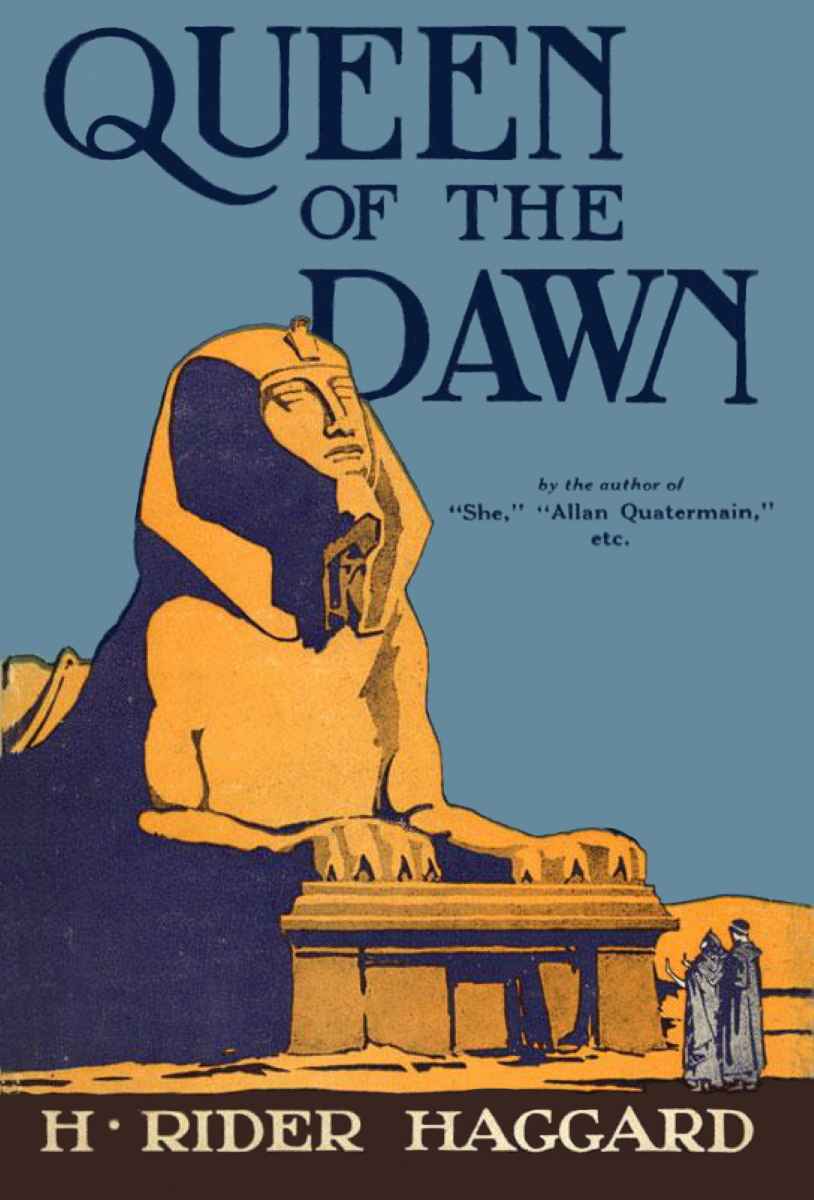
On the following morning, while it was still quite dark, Ru entered his tent and assisted him to rise. Then he set him in a litter in which Khian, asking no questions, was borne across the sands till they came to a great shape outlined against the starry sky, which he knew to be that of the Sphinx. Here he descended from the litter, which departed, leaving him alone.
At length the dawn began to break and in its tender light he saw that he was not alone, for by his side, wrapped in a gray cloak, stood a hooded figure that might have been that of a lad or a slender woman.
By the gods! he knew this figure: it was that of the “Young Person” who—oh! years and years ago—had guided him from the palm grove to the Sphinx and there had tied a bandage about his eyes. The height was the same, the very cloak and hood seemed to be the same.
“So, Young Person,” he said, “you still ply your business of guiding travellers across the sands.”
“That is so, Scribe Rasa,” answered the figure in a gruff voice.
“And do you still steal their packages—or hide them? My litter I think has gone.”
“I still take that which I desire, Scribe Rasa, who must live and be happy if I can.”
“And do you still blindfold messengers?”
“Yes, Scribe Rasa, when it is necessary to hide secrets from them. Indeed, be pleased to suffer that I do so to you for the second time, and bide here a while alone.”
“I obey,” he answered, laughing, “for although you may not know it, Young Person, since first we met I have suffered many things and learned one great lesson from them, also from the lips of a certain Temu, namely, to have faith. Therefore bind on and I will submit as gently as though I were sure that when sight is given back to my eyes they would behold a vision of heaven come to earth. See, I kneel, or rather stoop, for kneel I cannot.”
The gray-cloaked figure bent over him, the silken kerchief once more was bound upon his brow—oh! how well he remembered its soft substance and its odour! Then, leaning on his guide’s shoulder, he limped a little distance till the feigned voice bade him be seated upon a bank of sand and wait.
Presently voices, men’s voices, prayed him to rise. He did so with their help, and those men supported him down passages in which their footsteps echoed, to some chamber where they clothed him in new garments and set a headdress on his brow, what headdress or what garments he did not know, and when he asked they would not answer.
Again he was helped forth, as he thought into a large place where whisperings ran as though from a gathered multitude. Someone bade him to be seated and he sank on to a cushioned chair and waited.
Far away a voice cried:
“Ra is risen!” and from all round him rose a sound of singing.
He knew the sound. It was that of the ancient chant with which on days of festival the Brotherhood of the Dawn greeted the rising of the sun. It died away; there was deep silence; he heard a rustling as of robes. Then suddenly and in unison from a hundred throats there rose a great cry of:
“The Queen of the Dawn! Hail! Queen of the Dawn! Hail, Light-Bringer! Hail Life-Giver! Hail, Consecrated Sister! Hail, Heaven-appointed Uniter of the riven Lands!”
Khian could bear no more. He snatched at the bandage about his eyes. Perhaps it had been loosened, at least it fell. Lo! there before him stood Nefra glittering in the rays of the risen sun, wearing the robes of Egypt’s queen and crowned with Egypt’s crown, a living loveliness; a glory to behold.
For a moment she stood thus while the shoutings echoed from the vaulted roof of the great temple hall. She lifted her sceptre and there was silence. Then she turned and came to him who, he found, was seated on a throne. To Kemmah and to Ru she gave the sceptre and her regal symbols. From her head she lifted the double crown and set it on his brow. She kneeled and did him homage; yes, with her lips she touched his hand.
“Egypt’s Queen greets Egypt’s King!” she said.
Khian stared at her, astonished. Then, though of a sudden pain and weakness struck him once more, he struggled from the throne, purposing to offer it to her. But she shook her head and would none of it. Supporting him with her strong young arm, she led him to where stood Tau the Prophet in front of the gathered Councillors of the Dawn. Tau joined their hands. In the presence of the Brotherhood, living and dead, and in the name of that Spirit whom they worshipped, he blessed them, giving them to each other, uniting them to all eternity, on earth and beyond the earth.
So it was finished.
Nefra and Khian stood together gazing by the light of the moon at the mighty mass of the Pyramid of Ur.
“Our holiday is done, Wife,” he said, “and to-morrow, ceasing to be but a Brother and a Sister of the Dawn, we must become the rulers of Egypt united at last from the Cataracts to the sea. Strange has been our lot since first side by side we looked upon yonder pyramid. Yet, Beloved, I think that the Strength which preserved us through so many perils and now, from sickness and the gates of death has brought me with joy to those of health, will be with us in the years to come.”
“So Roy the holy prophesied, and in him, if in any man, lived the spirit of Truth, Husband. At least, thanking the gods for what they have given us, let us go straight forward in humility, remembering that though we be King and Queen of Egypt, first and foremost we remain Brother and Sister of the Dawn, sworn to its holy faith and to the service of mankind.”
At that moment this royal pair heard a sound behind them and, turning, beheld the lean and withered Sheik of the Pyramids.
“Would your Majesties wish to ascend?” he said, bowing and pointing to the mass of Ur. “The moon is very clear and there is no wind; also I desire to show Pharaoh the spot whence those accursed cliff-climbers rolled to their doom on the day of his escape.”
“Nay, Captain,” answered Khian, “of Ur I have had enough who am lamed for life. Henceforth be you its king.”
“And its spirit also,” added Nefra, “for no more may I stand upon the crests of pyramids who am doomed to a dizzier pinnacle of power. Farewell, you gallant man. Our thanks be yours with all you seek and we can give.”
Then Khian and Nefra turned and, hand clasped in hand, wandered back to where Ru and Kemmah waited with the escort to accompany them to the vessel that made ready to sail with the night wind.
“Now,” said Kemmah the white-haired to Ru the mighty Ethiop, “now I understand the meaning of the vision that I saw when yonder Queen was born, and why the goddesses of Egypt gave to her the name of Uniter of Lands.”
“Yes,” answered Ru, “and I understand why the gods of Ethiopia gave me a good axe and the strength to use it well on a certain Theban stairway.”
THE END
TRANSCRIBER’S NOTES.
Alterations to the text:
Note: minor spelling and hyphenization inconsistencies (e.g. foresworn/forsworn, surefooted/sure-footed, tomb-dwellers/tomb dwellers, etc.) have been preserved.
A few punctuation corrections: quotation mark pairing, missing periods, etc.
[Chapter III]
Change “a bite of food will looes your tongue” to loose.
[Chapter VII]
“certain bribed Thebian nobles” to Theban.
[Chapter X]
“Ru stared ... then answered stupidly;” change semicolon to colon.
[Chapter X]
“you will find youself growing” to yourself.
[Chapter XVII]
“unless take they us with them” to they take.
[Chapter XXII]
“the blow fell upon his thick headress” to headdress.
[End of Text]