
“But there are,” persisted Adlena. “How could I get the one in your drawer when the key is around your own neck?”
“I’m not sure I don’t know,” admitted the princess, beginning to be puzzled. “But come with me into my rooms. If my fairy cloak is indeed in the drawer, then I will believe you.”
So they went to the drawer, and of course found the magic cloak, as the cunning Zixi had planned. Fluff pulled it out and held the two up together to compare them; and they seemed to be exactly alike.
“I think yours is a little the longer,” said Adlena, and threw it over the shoulders of the princess. “No, I think mine is the longer,” she continued; and removing the magic cloak, put her own upon Fluff. They seemed to be about the same length, but Adlena kept putting first one and then the other upon the princess, until they were completely mixed, and the child could not have told one from the other.
“Which is mine?” she finally asked, in a startled voice.
“This, of course,” answered Adlena, folding up the imitation cloak which the imps had made, and putting it away in the drawer.
Fluff never suspected the trick, so Zixi carried away the magic cloak she had thus cleverly stolen; and she was so delighted with the success of her stratagem that she could have screamed aloud for pure joy.
As soon as she was alone and unobserved, the witch-queen slipped out of the palace, and, carrying the magic cloak in a bundle under her arm, ran down the streets of Nole and out through the gate in the wall and away toward the mountain where the lilac-grove lay.
“At last!” she kept saying to herself. “At last I shall see my own beautiful reflection in a mirror, instead of that horrid old hag!”
When she was safe in the grove she succeeded, by means of her witchcraft, in transforming the girl Adlena back into the beautiful woman known throughout the kingdom of Ix as Queen Zixi. And then she lost no time in throwing the magic cloak over her shoulders.
“I wish,” she cried in a loud voice, “that my reflection in every mirror will hereafter show the same face and form as that in which I appear to exist in the sight of all mortals!”
Then she threw off the cloak and ran to the crystal spring, saying: “Now, indeed, I shall at last see the lovely Queen Zixi!”
But as she bent over the spring, she gave a sudden shriek of disappointed rage; for glaring up at her from the glassy surface of the water was the same fearful hag she had always seen as the reflection of her likeness!
The magic cloak would grant no wish to a person who had stolen it.
Zixi, more wretched than she had ever been before in her life, threw herself down upon her face in the lilac-grove and wept for more than an hour, which is an exceedingly long time for tears to run from one’s eyes. And when she finally arose, two tiny brooks flowed from the spot and wound through the lilac-trees—one to the right and one to the left.
Then, leaving the magic cloak—to possess which she had struggled so hard and sinfully—lying unheeded upon the ground, the disappointed witch-queen walked slowly away, and finally reached the bank of the great river.
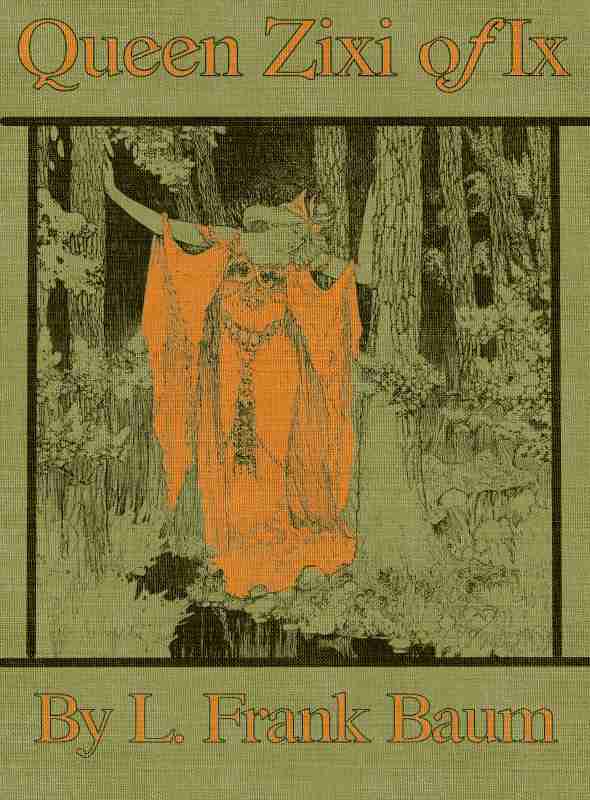
“SHE THREW OFF THE CLOAK AND RAN TO THE CRYSTAL SPRING.”
Here she found a rugged old alligator who lay upon the bank, weeping with such bitterness that the sight reminded Zixi of her own recent outburst of sorrow.
“Why do you weep, friend?” she asked, for her experience as a witch had long since taught her the language of the beasts and birds and reptiles.
“Because I cannot climb a tree,” answered the alligator.
“But why do you wish to climb a tree?” she questioned, surprised.
“Because I can’t,” returned the alligator, squeezing two more tears from his eyes.
“But that is very foolish!” exclaimed the witch-queen, scornfully.
“Oh, I don’t know,” said the alligator. “It doesn’t strike me that it’s much more foolish than the fancies some other people have.”
“Perhaps not,” replied Zixi, more gently, and walked away in deep thought.
While she followed the river-bank, to find a ferry across, the dusk fell, and presently a gray owl came out of a hollow in a tall tree and sat upon a limb, wailing dismally.
Zixi stopped and looked at the bird.
“Why do you wail so loudly?” she asked.
“‘BECAUSE I CANNOT CLIMB A TREE,’ ANSWERED THE ALLIGATOR.”
“Because I cannot swim in the river like a fish,” answered the owl, and it screeched so sadly that it made the queen shiver.
“Why do you wish to swim?” she inquired.
“Because I can’t,” said the owl, and buried its head under its wing with a groan.
“But that is absurd!” cried Zixi, with impatience.
The owl had an ear out, and heard her. So it withdrew its head long enough to retort:
“I don’t think it’s any more absurd than the longings of some other folks.”
“Perhaps you are right,” said the queen, and hung her head as she walked on.
By and by she found a ferryman with a boat, and he agreed to row her across the river. In one end of the boat crouched a little girl, the ferryman’s daughter, and she sobbed continually, so that the sound of the child’s grief finally attracted Zixi’s attention.
“Why do you sob?” questioned the queen.
“Because I want to be a man,” replied the child, trying to stifle her sobs.
“Why do you want to be a man?” asked Zixi, curiously.
“Because I’m a little girl,” was the reply.
This made Zixi angry.
“You’re a little fool!” she exclaimed loudly.
“There are other fools in the world,” said the child, and renewed her sobs.
“‘WHY DO YOU SOB?’ QUESTIONED THE QUEEN.”
Zixi did not reply, but she thought to herself:
“We are all alike—the alligator, the owl, the girl, and the powerful Queen of Ix. We long for what we cannot have, yet desire it not so much because it would benefit us, as because it is beyond our reach. If I call the others fools, I must also call myself a fool for wishing to see the reflection of a beautiful girl in my mirror when I know it is impossible. So hereafter I shall strive to be contented with my lot.”
This was a wise resolution, and the witch-queen abided by it for many years. She was not very bad, this Zixi; for it must be admitted that few have the courage to acknowledge their faults and strive to correct them, as she did.
Chapter XVI.
THE PLAIN ABOVE THE CLOUDS.
I have already mentioned how high the mountains were between Noland and the land of Ix; but at the north of the city of Nole were mountains much higher—so high, indeed, that they seemed to pierce the clouds, and it was said the moon often stopped on the highest peak to rest. It was not one single slope up from the lowlands; but first there was a high mountain, with a level plain at the top; and then another high mountain, rising from the level and capped with a second plain; and then another mountain, and so on; which made them somewhat resemble a pair of stairs. So that the people of Nole, who looked upon the North Mountains with much pride, used to point them out as “The Giant’s Stairway,” forgetting that no giant was ever big enough to use such an immense flight of stairs.
Many people had climbed the first mountain, and upon the plain at its top flocks of sheep were fed; and two or three people boasted they had climbed the second steep; but beyond that the mountains were all unknown to the dwellers in the valley of Noland. As a matter of fact, no one lived upon them; they were inhabited only by a few small animals and an occasional vulture or eagle which nested in some rugged crag.
But at the top of all was an enormous plain that lay far above the clouds, and here the Roly-Rogues dwelt in great numbers.
I must describe these Roly-Rogues to you, for they were unlike any other people in all the world. Their bodies were as round as a ball—if you can imagine a ball fully four feet in thickness at the middle. And their muscles were as tough and elastic as india-rubber. They had heads and arms resembling our own, and very short legs; and all these they could withdraw into their ball-like bodies whenever they wished, very much as a turtle withdraws its legs and head into its shell.
The Roly-Rogues lived all by themselves in their country among the clouds, and there were thousands and thousands of them. They were quarrelsome by nature, but could seldom hurt one another; because, if they fought, they would withdraw their arms and legs and heads into their bodies, and roll themselves at one another with much fierceness. But when they collided they would bounce apart again, and little harm was done.
In spite of their savage dispositions the Roly-Rogues had as yet done no harm to any one but themselves, as they lived so high above the world that other people knew nothing of their existence. Nor did they themselves know, because of the clouds that floated between, of the valleys which lay below them.
But, as ill luck would have it, a few days after King Bud’s army had defeated the army of Ix, one of the Roly-Rogues, while fighting with another, rolled too near the edge of the plain whereon they dwelt, and bounded down the mountain-side that faced Noland. Wind had scattered the clouds, so his fellows immediately rolled themselves to the edge and watched the luckless Roly-Rogue fly down the mountain, bounce across the plain, and thence speed down the next mountain. By and by he became a dot to their eyes, and then a mere speck; but as the clouds had just rolled away for a few moments the Roly-Rogues could see, by straining their eyes, the city of Nole lying in the valley far below.
It seemed, from that distance, merely a toy city, but they knew it must be a big place to show so far away; and since they had no cities of their own, they became curious to visit the one they had just discovered.
The ruler of the Roly-Rogues, who was more quarrelsome than any of the rest, had a talk with his chief men about visiting the unknown city.
“We can roll down the mountain just as our brother did,” he argued.
“But how in the world could we ever get back again?” said one of the chiefs, sticking his head up to look with astonishment at the ruler.
“We don’t want to get back,” said the other, excitedly. “Some one has built many houses and palaces at the foot of the mountains, and we can live in those, if they are big enough and if there are enough of them.”
“ALL THE HUNDREDS AND THOUSANDS OF ROLY-ROGUES THAT WERE IN EXISTENCE ASSEMBLED UPON THE EDGE OF THEIR PLAIN, AND, AT THE WORD OF THEIR RULER, HURLED THEMSELVES DOWN THE MOUNTAIN WITH TERRIBLE CRIES AND WENT BOUNDING AWAY TOWARD THE PEACEFUL CITY OF NOLE.”
“Perhaps the people won’t let us,” suggested another chief, who was not in favor of the expedition.
“We will fight them and destroy them,” retorted the ruler, scowling at the chief as if he would make him ashamed of his cowardice.
“Then we must all go together,” said a third chief; “for, if only a few go, we may find ourselves many times outnumbered and at last be overcome.”
“Every Roly-Rogue in the country shall go!” declared the ruler, who brooked no opposition when once he had made up his mind to a thing.
On the plain grew a grove of big thorn-trees, bearing thorns as long and sharp as swords; so the ruler commanded each of his people to cut two of the thorns, one for each hand, with which to attack whatever foes they might meet when they reached the unknown valley.
Then, on a certain day, all the hundreds and thousands of Roly-Rogues that were in existence assembled upon the edge of their plain, and, at the word of their ruler, hurled themselves down the mountain with terrible cries and went bounding away toward the peaceful city of Nole.
Chapter XVII.
THE DESCENT OF THE ROLY-ROGUES.
King Bud and Princess Fluff were leading very happy and peaceful lives in their beautiful palace. All wars and dangers seemed at an end, and there was nothing to disturb their content.
All the gold that was needed the royal purse-bearer was able to supply from his overflowing purse. The gigantic General Tollydob became famous throughout the world, and no nation dared attack the army of Noland. The talking dog of old Tallydab made every one wonder, and people came many miles to see Ruffles and hear him speak. It was said that all this good fortune had been brought to Noland by the pretty Princess Fluff, who was a favorite of the fairies; and the people loved her on this account as well as for her bright and sunny disposition.
“THE GREAT BALL STRUCK THE FIELD NEAR THEM.”
King Bud caused his subjects some little anxiety, to be sure; for they never could tell what he was liable to do next, except that he was sure to do something unexpected. But much is forgiven a king; and if Bud made some pompous old nobleman stand on his head, to amuse a mob of people, he would give him a good dinner afterward and fill his purse with gold to make up for the indignity. Fluff often reproved her brother for such pranks, but Bud’s soul was flooded with mischief, and it was hard for him to resist letting a little of the surplus escape now and then.
After all, the people were fairly content and prosperous, and no one was at all prepared for the disasters soon to overtake them.
One day, while King Bud was playing at ball with some of his courtiers on a field outside the city gates, the first warning of trouble reached him. Bud had batted a ball high into the air, and while looking upward for it to descend he saw another ball bound from the plain at the top of the North Mountains, fly into the air, and then sink gradually toward him. As it approached, it grew bigger and bigger, until it assumed mammoth proportions; and then, while the courtiers screamed in terror, the great ball struck the field near them, bounced high into the air, and came down directly upon the sharp point of one of the palace towers, where it stuck fast with a yell that sounded almost human.
For some moments Bud and his companions were motionless through surprise and fear; then they rushed into the city and stood among the crowd of people which had congregated at the foot of the tower to stare at the big ball impaled upon its point. Once in a while, two arms, two short legs, and a head would dart out from the ball and wiggle frantically, and then the yell would be repeated and the head and limbs withdrawn swiftly into the ball.
It was all so curious that the people were justified in staring at it in amazement; for certainly no one had ever seen or heard of a Roly-Rogue before, or even known such a creature existed.
Finally, as no one else could reach the steeple-top, Aunt Rivette flew into the air and circled slowly around the ball. When next its head was thrust out, she called:
“Are you a mud-turtle or a man?”
“I’ll show you which, if I get hold of you,” answered the Roly-Rogue, fiercely.
“Where did you come from?” asked Aunt Rivette, taking care the wiggling arms did not grab her.
“‘WHERE DID YOU COME FROM?’ ASKED AUNT RIVETTE.”
“That is none of your business,” said the RolyRogue. “But I didn’t intend to come, that you may depend upon.”
“Are you hurt?” she inquired, seeing that the struggles of the creature made him spin around upon the steeple-point like a windmill.
“No, I’m not hurt at all,” declared the Roly-Rogue; “but I’d like to know how to get down.”
“What would you do if we helped you to get free?” asked Aunt Rivette.
“I’d fight every one of those idiots who are laughing at me down there!” said the creature, its eyes flashing wickedly.
“Then you’d best stay where you are,” returned old Rivette, who flew back to earth again to tell Bud what the Roly-Rogue had said.
“I believe that is the best place for him,” said Bud; “so we’ll let him stay where he is. He’s not very ornamental, I must say, but he’s very safe up there on top of the steeple.”
“We might have him gilded,” proposed the old woman, “and then he’d look better.”
“I’ll think it over,” said the king, and he went away to finish his ball game.
The people talked and wondered about the queer creature on the steeple, but no one could say where it came from or what it was; they were naturally much puzzled.
The next day was bright with sunshine; so, early in the forenoon, Bud and Fluff had the royal cook fill their baskets with good things to eat, and set out to picnic on the bank of the river that separated Noland from the kingdom of Ix. They rode ponies, to reach the river sooner than by walking; and their only companions were Tallydab, the lord high steward, and his talking dog, Ruffles.
It was after this picnic party had passed over the mountain, and were securely hidden from any one in the city of Nole, that the ruler of the Roly-Rogues and his thousands of followers hurled themselves down from their land above the clouds and began bounding toward the plain below.
The people first heard a roar that sounded like distant thunder; and when they looked toward the North Mountains they saw the air black with tiny bouncing balls that seemed to drop from the drifting clouds which always had obscured the highest peak.
But, although appearing small when first seen, these balls grew rapidly larger as they came nearer; and then, with sharp reports like pistol-shots, they began dropping upon the plain by dozens and hundreds and then thousands.
As soon as they touched the ground they bounded upward again, like rubber balls the children throw upon the floor; but each bound was less violent than the one preceding it, until finally within the streets of the city and upon all the fields surrounding it lay the thousands of Roly-Rogues that had fallen from the mountain-peak.
At first they lay still, as if stunned by their swift journey and collision with the hard earth; but after a few seconds they recovered, thrust out their heads and limbs, and scrambled upon their flat feet.
Then the savage Roly-Rogues uttered hoarse shouts of joy, for they were safely arrived at the city they had seen from afar, and the audacious adventure was a success.
CHAPTER XVIII.
THE CONQUEST OF NOLAND.
It would be impossible to describe the amazement of the people of Nole when the Roly-Rogues came upon them.
Not only was the descent wholly unexpected, but the appearance of the invaders was queer enough to strike terror to the stoutest heart.
Their round bodies were supported by short, strong legs having broad, flattened feet to keep them steady. Their arms were short, and the fingers of their hands, while not long, were very powerful.
But the heads were the most startling portions of these strange creatures. They were flat and thick on the top, with leathery rolls around their necks; so that, when the head was drawn in, its upper part rounded out the surface of the ball. In this peculiar head the Roly-Rogue had two big eyes as shiny as porcelain, a small stubby nose, and a huge mouth. Their strange leather-like clothing fitted their bodies closely and was of different colors—green, yellow, red, and brown.
Taken altogether, the Roly-Rogues were not pretty to look at; and although their big eyes gave them a startled or astonished expression, nothing seemed ever to startle or astonish them in the least.
When they arrived in the valley of Nole, after their wonderful journey down the mountains, they scrambled to their feet, extended their long arms with the thorns clasped tight in their talon-like fingers, and rushed in a furious crowd and with loud cries upon the terror-stricken people.
The soldiers of Tollydob’s brave army had not even time to seize their weapons; for such a foe, coming upon them through the air, had never been dreamed of.
And the men of Nole, who might have resisted the enemy, were too much frightened to do more than tremble violently and gasp with open mouths. As for the women and children, they fled screaming into the houses and bolted or locked the doors, which was doubtless the wisest thing they could have done.
“AS FOR THE WOMEN AND CHILDREN, THEY FLED SCREAMING INTO THE HOUSES.”
General Tollydob was asleep when the calamity of this invasion occurred; but hearing the shouts, he ran out of his mansion and met several of the Roly-Rogues face to face. Without hesitation the brave general rushed upon them; but two of the creatures promptly rolled themselves against him from opposite directions, so that the ten-foot giant was crushed between them until there was not a particle of breath left in his body. No sooner did these release him than two other Roly-Rogues rolled toward him; but Tollydob was not to be caught twice, so he gave a mighty jump and jumped right over their heads, with the result that the balls crashed against each other.
This made the two Roly-Rogues so angry that they began to fight each other savagely, and the general started to run away. But other foes rolled after him, knocked him down, and stuck their thorns into him until he yelled for mercy and promised to become their slave.
Tullydub, the chief counselor, watched all this from his window, and it frightened him so greatly that he crawled under his bed and hid, hoping the creatures would not find him. But their big round eyes were sharp at discovering things; so the Roly-Rogues had not been in Tullydub’s room two minutes before he was dragged from beneath his bed, and prodded with thorns until he promised obedience to the conquerors.
The lord high purse-bearer, at the first alarm, dug a hole in the garden of the royal palace and buried his purse so no one could find it but himself. But he might have saved himself this trouble, for the Roly-Rogues knew nothing of money or its uses, being accustomed to seizing whatever they desired without a thought of rendering payment for it.
Having buried his purse, old Tillydib gave himself up to the invaders as their prisoner; and this saved him the indignity of being conquered.
“OTHER FOES ROLLED AFTER HIM AND KNOCKED HIM DOWN.”
The lord high executioner may really be credited with making the only serious fight of the day; for when the Roly-Rogues came upon him, Tellydeb seized his ax, and, before the enemy could come near, he reached out his long arm and cleverly sliced the heads off several of their round bodies.
The others paused for a moment, being unused to such warfare and not understanding how an arm could reach so far.
But, seeing their heads were in danger, about a hundred of the creatures formed themselves into balls and rolled upon the executioner in a straight line, hoping to crush him.
They could not see what happened after they began to roll, their heads being withdrawn; but Tellydeb watched them speed toward him, and, stepping aside, he aimed a strong blow with his ax at the body of the first Roly-Rogue that passed him. Instead of cutting the rubber-like body, the ax bounced back and flew from Tellydeb’s hand into the air, falling farther away than the long arm of the executioner could reach. Therefore he was left helpless, and was wise enough to surrender without further resistance.
Finding no one else to resist them, the Roly-Rogues contented themselves with bounding against the terrorized people, great and humble alike, and knocking them over, laughing boisterously at the figures sprawling in the mud of the streets.
And then they would prick the bodies of the men with their sharp thorns, making them spring to their feet again with shrieks of fear, only to be bowled over again the next minute.
But the monsters soon grew weary of this amusement, for they were anxious to explore the city they had so successfully invaded. They flocked into the palace and public buildings, and gazed eagerly at the many beautiful and, to them, novel things that were found. The mirrors delighted them, and they fought one another for the privilege of standing before the glasses to admire the reflection of their horrid bodies.
They could not sit in the chairs, for the round bodies would not fit them; neither could the Roly-Rogues understand the use of beds. For when they rested or slept the creatures merely withdrew their limbs and heads, rolled over upon their backs, and slept soundly—no matter where they might be.
The shops were all entered and robbed of their wares, the Roly-Rogues wantonly destroying all that they could not use. They were like ostriches in eating anything that looked attractive to them; one of the monsters swallowed several pretty glass beads, and some of the more inquisitive of them invaded the grocery-shops and satisfied their curiosity by tasting of nearly everything in sight. It was funny to see their wry faces when they sampled the salt and vinegar.
“STEPPING ASIDE, TELLYDEB AIMED A STRONG BLOW WITH HIS AX AT THE BODY OF THE FIRST ROLY-ROUGE.”
Presently the entire city was under the dominion of the Roly-Rogues, who forced the unhappy people to wait upon them and amuse them; and if any hesitated to obey their commands, the monsters would bump against them, pull their hair, and make them suffer most miserably.
Aunt Rivette was in her room at the top of the palace when the Roly-Rogues invaded the city of Nole. At first she was as much frightened as the others; but she soon remembered she could escape the creatures by flying; so she quietly watched them from the windows. By and by, as they explored the palace, they came to Aunt Rivette’s room and broke in the door; but the old woman calmly stepped out of her window upon a little iron balcony, spread her great wings, and flew away before the Roly-Rogues could catch her.
Then she soared calmly through the air, and having remembered that Bud and Fluff had gone to the river on a picnic, she flew swiftly in that direction and before long came to where the children and old Tallydab were eating their luncheon, while the dog Ruffles, who was in good spirits, sang a comic song to amuse them.
They were much surprised to see Aunt Rivette flying toward them; but when she alighted and told Bud that his kingdom had been conquered by the Roly-Rogues and all his people enslaved, the little party was so astonished that they stared at one another in speechless amazement.
“Oh, Bud, what shall we do?” finally asked Fluff, in distress.
“Don’t know,” said Bud, struggling to swallow a large piece of sandwich that in his excitement had stuck fast in his throat.
“One thing is certain,” remarked Aunt Rivette, helping herself to a slice of cake, “our happy lives are now ruined forever. We should be foolish to remain here; and the sooner we escape to some other country where the Roly-Rogues cannot find us, the safer we shall be.”
“But why run away?” asked Bud. “Can’t something else be done? Here, Tallydab, you’re one of my counselors. What do you say about this affair?”
Now the lord high steward was a deliberate old fellow, and before he replied he dusted the crumbs from his lap, filled and lighted his long pipe, and smoked several whiffs in a thoughtful manner.
“It strikes me,” said he at last, “that by means of the Princess Fluff’s magic cloak we can either destroy or scatter these rascally invaders and restore the kingdom to peace and prosperity.”
“‘BUT WHERE’S THE CLOAK?’ ASKED THE DOG.”
“Sure enough!” replied Bud. “Why didn’t we think of that before?”
“You will have to make the wish, Bud,” said Fluff, “for all the rest of us have wished, and you have not made yours yet.”
“All right,” answered the king. “If I must, I must. But I’m sorry I have to do it now, for I was saving my wish for something else.”
“But where’s the cloak?” asked the dog, rudely breaking into the conversation. “You can’t wish without the cloak.”
“The cloak is locked up in a drawer in my room at the palace,” said Fluff.
“And our enemies have possession of the palace,” continued Tallydab, gloomily. “Was there ever such ill luck!”
“Never mind,” said Aunt Rivette, “I’ll fly back and get it—that is, if the Roly-Rogues haven’t already broken open the drawer and discovered the cloak.”
“Please go at once, then!” exclaimed Fluff. “Here is the key,” and she unfastened it from the chain at her neck and handed it to her aunt. “But be careful, whatever you do, that those horrible creatures do not catch you.”
“I’m not afraid,” said Aunt Rivette, confidently. And taking the key, the old lady at once flew away in the direction of the city of Nole, promising to return very soon.
Chapter XIX.
THE BRAVERY OF AUNT RIVETTE.
The Roly-Rogues were so busy rioting that they did not look into the air and discover Aunt Rivette flying over the city. So she alighted, all unobserved, upon a balcony of the palace, just outside the chamber of the Princess Fluff, and succeeded in entering the room.
The creatures had ransacked this apartment, as they had every other part of the royal palace, and Fluff’s pretty dresses and ornaments were strewn about in dreadful confusion. But the drawer in which rested the magic cloak was still locked, and in a few moments the old woman had the precious garment in her hands.
It was, as we know, the imitation cloak Queen Zixi had made and exchanged for the real one; but so closely did it resemble the fairy cloak that Aunt Rivette had no idea she was carrying a useless garment back to her little niece and nephew. On the contrary, she thought to herself: “Now we can quickly dispose of these monstrous rogues and drive them back to their own country.”
Hearing some one moving about in the next room, she ran to the window and soon was flying away with the cloak to the place where she had left Bud and Fluff.
“Good!” cried the lord high steward, when he saw the cloak. “Now we have nothing more to fear. Put on your cloak, your Majesty, and make the wish.”
Bud threw the cloak over his shoulders.
“What shall I wish?” he asked.
“Let me see,” answered Tallydab. “What we want is to get rid of these invaders. Wish them all in the kingdom of Ix.”
“Oh, no!” cried Fluff; “it would be wicked to injure Queen Zixi and her people. Let us wish the Roly-Rogues back where they came from.”
“That would be folly!” said the dog Ruffles, with an accent of scorn. “For they could easily return again to our city of Nole, having once learned the way there.”
“That is true,” agreed Aunt Rivette. “The safest thing to do is to wish them all dead.”
“But it would be an awful job to bury so many great balls,” objected Bud. “It would keep all our people busy for a month, at least.”
“Why not wish them dead and buried?” asked Ruffles. “Then they would be out of the way for good and all.”
“A capital idea!” responded Tallydab.
“But I haven’t seen these curious creatures yet,” said Bud; “and if I now wish them all dead and buried, I shall never get a glimpse of one of them. So let’s walk boldly into the city, and when they appear to interfere with us I’ll make the wish and the Roly-Rogues will instantly disappear.”
So the entire party returned to the city of Nole; Bud and Fluff riding their ponies, Aunt Rivette fluttering along beside them, and the lord high steward walking behind with his dog.
The Roly-Rogues were so much surprised to see this little party boldly entering the streets of the city, and showing no particle of fear of them, that they at first made no offer to molest them.
Even when Bud roared with laughter at their queer appearance, and called them “mud-turtles” and “foot-balls,” they did not resent the insults; for they had never heard of either a turtle or a foot-ball before.
“HE MADE OLD TULLYDUB, THE LORD COUNSELOR, ROCK HIM GENTLY AS HE LAY UPON HIS BACK.”
When the party had reached the palace and the children had dismounted, Bud laughed yet louder; for the gigantic General Tollydob came to the kitchen door, wearing an apron while he polished a big dish-pan, the Roly-Rogues having made him a scullion.
“JIKKI WAS SCRATCHING THE BACK OF ANOTHER ROLY-ROGUE.”
The ruler of the Roly-Rogues was suffering from a toothache, so he had rolled himself into a ball and made old Tullydub, the lord high counselor, rock him gently as he lay upon his back, just as one would rock a baby’s cradle.
“THE LORD HIGH PURSE-BEARER WAS WAVING A FAN.”
Jikki was scratching the back of another Roly-Rogue with a sharp garden-rake, while Jikki’s six servants stood in a solemn row at his back. They would do anything for Jikki, but they would not lift a finger to serve any one else; so the old valet had to do the scratching unaided.
These six young men had proved a great puzzle to the Roly-Rogues, for they found it impossible to touch them or injure them in any way; so, after several vain attempts to conquer them, they decided to leave Jikki’s servants alone.
The lord high purse-bearer was waving a fan to keep the flies off two of the slumbering monsters; and the lord high executioner was feeding another Roly-Rogue with soup from a great ladle, the creature finding much amusement in being fed in this manner.
King Bud, feeling sure of making all his enemies disappear with a wish, found rare sport in watching his periwigged counselors thus serving their captors; so he laughed and made fun of them until the Roly-Rogue ruler stuck his head out and commanded the boy to run away.
“Why, you ugly rascal, I’m the King of Noland,” replied Bud; “so you’d better show me proper respect.”
With that he picked up a good-sized pebble and threw it at the ruler. It struck him just over his aching tooth, and with a roar of anger the Roly-Rogue bounded toward Bud and his party.
The assault was so sudden that they had much ado to scramble out of the way; and as soon as Bud could escape the rush of the huge ball, he turned squarely around and shouted:
“I wish every one of the Roly-Rogues dead and buried!”
“THE LORD HIGH EXECUTIONER WAS FEEDING ANOTHER ROLY-ROGUE WITH SOUP FROM A GREAT LADLE.”
Hearing this and seeing that the king wore the magic cloak, all the high counselors at once raised a joyful shout, and Fluff and Bud gazed upon the Roly-Rogues expectantly, thinking that of course they would disappear.
But Zixi’s cloak had no magic powers whatever; and now dozens of the Roly-Rogues, aroused to anger, bounded toward Bud’s little party.
“THE LORD HIGH STEWARD AND HIS DOG WENT DOWN BEFORE THE RUSH.”
I am sure the result would have been terrible had not Aunt Rivette suddenly come to the children’s rescue. She threw one lean arm around Bud and the other around Fluff, and then, quickly fluttering her wings, she flew with them to the roof of the palace, which they reached in safety.
The lord high steward and his dog went down before the rush, and the next moment old Tallydab was crying loudly for mercy, while Ruffles limped away to a safe spot beneath a bench under an apple-tree, howling at every step and shouting angry epithets at the Roly-Rogues.
“I wonder what’s the matter with the cloak,” gasped Bud. “The old thing’s a fraud; it didn’t work.”
“Something went wrong, that’s certain,” replied Fluff. “You’re sure you hadn’t wished before, aren’t you?”
“Yes, I’m sure,” said Bud.
“Perhaps,” said Aunt Rivette, “the fairies have no power over these horrible creatures.”
“That must be it, of course,” said the princess. “But what shall we do now? Our country is entirely conquered by these monsters; so it isn’t a safe place for us to stay in.”
“I believe I can carry you anywhere you’d like to go,” said Aunt Rivette. “You’re not so very heavy.”
“‘I’LL SOON CARRY YOU OVER THE MOUNTAIN AND THE RIVER INTO THE KINGDOM OF IX.’”
“Suppose we go to Queen Zixi, and ask her to protect us?” the princess suggested.
“That’s all right, if she doesn’t bear us a grudge. You know we knocked out her whole army,” remarked Bud.
“Quavo the minstrel says she is very beautiful, and kind to her people,” said the girl.
“Well, there’s no one else we can trust,” Bud answered gloomily; “so we may as well try Zixi. But if you drop either of us on the way, Aunt Rivette, I’ll have to call in the lord high executioner.”
“Never fear,” replied the old woman. “If I drop you, you’ll never know what has happened. So each one of you put an arm around my neck, and cling tight, and I’ll soon carry you over the mountain and the river into the kingdom of Ix.”