
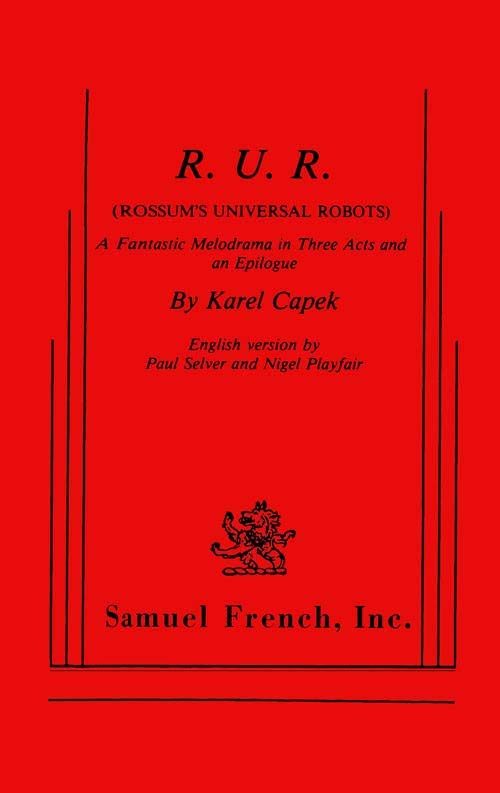
The play is laid on an island somewhere on our planet, and on this island is the central office of the factory of Rossum’s Universal Robots. “Robot” is a Czech word meaning “worker.” When the play opens, a few decades beyond the present day, the factory had turned out already, following a secret formula, hundreds of thousands, and even millions, of manufactured workmen, living automats, without souls, desires or feelings. They are high-powered laborers, good for nothing but work. There are two grades, the unskilled and the skilled, and especially trained workmen are furnished on request.
When Helena Glory, president of the Humanitarian League, comes to ascertain what can be done to improve the condition of those overspecialized creatures, Harry Domin, the general manager of the factory, captures her heart and hand in the speediest courting on record in our theatre. The last two acts take place ten years later. Due to the desire of Helena to have the Robots more like human beings, Dr. Gall, the head of the physiological and experimental departments, has secretly changed the formula, and while he has partially humanized only a few hundreds, there are enough to make ringleaders, and a world revolt of robots is under way. This revolution is easily accomplished, as robots have long since been used when needed as soldiers and the robots far outnumber human beings.
The rest of the play is magnificent melodrama, superbly portrayed, with the handful of human beings at bay while the unseen myriads of their own robots close in on them. The final scene is like Dunsany on a mammoth scale.
Then comes the epilogue, in which Alquist, the company’s builder, is not only the only human being on the island, but also the only one left on earth. The robots have destroyed the rest of mankind. They spared his life because he was a worker. And he is spending his days unceasingly endeavoring to discover and reconstruct the lost formula. The robots are doomed. They saved the wrong man. They should have spared the company’s physicist. The robots know that their bodies will wear out in time and there will be no new multitudes of robots to replace them. But Alquist discovers two humanized robots, a young man and young woman, who have a bit of Adam and Eve in them, and the audience perceives that mankind is about to start afresh. Nature has won out, after all.