
WeRead Powered by ReaderPub
Race and nationality cover

Race and nationality

Chapter 1: RACE AND NATIONALITY
Open in WeRead

Explore more books like this:

About This Book

An anthropologist challenges claims that deep-seated racial instincts explain national conflict, rejecting ideas of an inherently superior blond or Aryan race and arguing there is no scientific basis for racial hierarchies. The essay distinguishes linguistic, cultural, and political identities from physical types, shows how bodily types are widely distributed across regions irrespective of national boundaries, attributes social differences to historical and environmental factors rather than heredity, and cautions against fears of admixture and simplistic conflation of race with nationality.

The Project Gutenberg eBook of Race and nationality

This ebook is for the use of anyone anywhere in the United States and most other parts of the world at no cost and with almost no restrictions whatsoever. You may copy it, give it away or re-use it under the terms of the Project Gutenberg License included with this ebook or online at www.gutenberg.org. If you are not located in the United States, you will have to check the laws of the country where you are located before using this eBook.

Title: Race and nationality

Author: Franz Boas

Release date: September 19, 2025 [eBook #76900]

Language: English

Original publication: New York, NY: American Association for International Conciliation, 1915

Credits: Aaron Adrignola, Daniel Lowe, and the Online Distributed Proofreading Team at https://www.pgdp.net (This file was produced from images generously made available by The Internet Archive)

*** START OF THE PROJECT GUTENBERG EBOOK RACE AND NATIONALITY ***

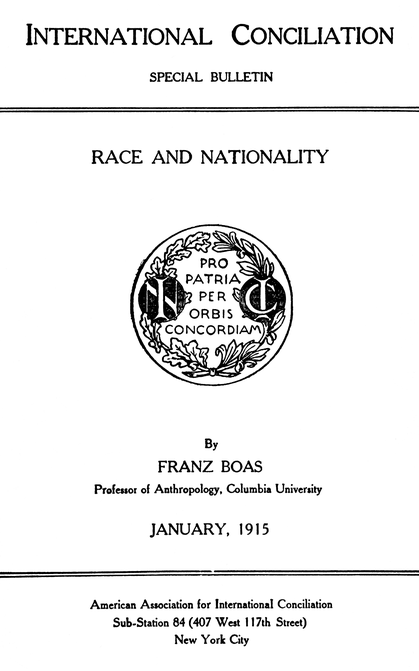
International Conciliation

SPECIAL BULLETIN

RACE AND NATIONALITY

By
FRANZ BOAS
Professor of Anthropology, Columbia University

JANUARY, 1915

American Association for International Conciliation
Sub-Station 84 (407 West 117th Street)
New York City

The editor of Everybody’s Magazine, in which this article appeared in briefer form in November, 1914, has kindly granted permission for its republication in this series.