
CHAPTER XIII.
THE MEANING OF THE COFFIN.
Frank Armond and Walter Lyman felt a chill pass over their frames as they gazed down upon the coffin and the four burly, rough-looking men standing around it.
The Irishman acted quite easy and indifferent about the matter, as he did on all occasions.
The coffin was small; about the size that a ten-year-old child would require.
For a moment the robbers gazed at it, then one of them asked:
“Do ye s’pose the body’s all right into it?”
“Don’t know,” was the response. “It mout hev got shook around; however, it won’t take long ter look,” and in a few moments the lid was removed.
The lantern was lowered as the four men bent over the coffin, and our friends in the tree parted the foliage carefully, and peered down, eager to get a glimpse of the dead.
And true enough they did. The pale waxen face of a beautiful child, wrapped in a sheet was revealed to their startled gaze.
“It’s all right,” growled one of the robbers.
“Ya-as, put on the lid, and let’s git it sunk quick as possible.”
While the robber with the knife was screwing on the lid of the coffin, one of the others went to the canoe and brought a shovel, with which he at once began digging a grave.
In a few moments a grave had been dug some three feet deep, and the coffin placed therein, and then covered up—the sods and turfs of grass being replaced so as to conceal every trace of the ground having been disturbed.
“That’s it!” exclaimed one of the robbers, when their task was finished; “the duty o’ the livin’ to the dead is done.”
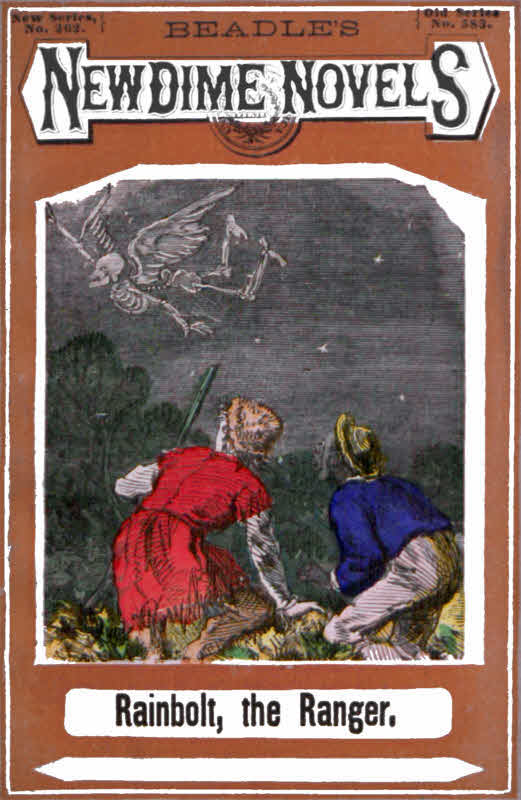
At that instant a wild scream was heard overhead, and looking up the robbers, as well as our friends in the tree, beheld that horrible, mysterious creature—the Aërial Demon—float over the island and disappear down the stream.
It acted like a charm on the rebellious robbers, for they rushed to their canoe, and in a moment were flying upon the stream, fearing to speak above a whisper.
As soon as they were out of sight our friends descended from the tree.
“Ay, now, and it’s a lovely set of critters they ware,” said the Irishman; “and it’s mees thet’ll dig up the coffin as soon as daylight comes and look into the mather a leetle so I will.”
“I’m sure we have seen all that’s to be seen,” said Walter, “and so let the dead rest.”
“There, now, and it’s yees thet know little av the bloody robber deviltry. There’s a thrick in it, now mind.”
As the night was quite warm, Walter and Frank laid down upon the ground and soon fell asleep, leaving Flick on guard.
When they awoke in the morning the sun was up, and the first thing they saw was Flick O’Flynn just lifting the coffin out the grave.
“Humph! I suppose you are satisfied now you’ve dug up the body,” said Walter, rising to his feet.
“Nary bit av it, Mishter Walter, I haven’t see’d inside yet,” said the Irishman, as he began to unscrew the lid.
Walter and Frank came and stood by and watched him perform the operation with no little curiosity. The last screw removed, the lid was lifted and—
There was the pale waxen face of the dead upturned to the clear morning sun, with the flaxen-white hair clustered about the face.
“I suppose you are satisfied now,” said Frank.
Flick burst into a loud laugh and replied:
“Ay, and it’s blind yees are. Can’t yees see the thrick?”
“Trick? no; what do you mean, O’Flynn?” asked Frank.
“That, now!” replied the Irishman, and he clutched his fingers in the silken hair of the corpse and held up to the astonished gaze of the young men the trunkless head of a WAX-FIGURE!
He now laid down the waxen head and proceeded to unroll what appeared the body wrapped in a white sheet. Fold after fold was unrolled, until finally, a small leather bag, filled with some hard metal rolled out. Flick seized the bag, and taking up his knife cut it open, and then turning it up he poured into the coffin a great heap of gold coin.
“Thet’s the body,” said Flick, a grin of triumph overspreading his broad, florid face.
“Yes, yes, yes,” replied Frank, “and a clever trick it is. But why do they take so much trouble in burying their gold?”
“Thinking, thet if any greenhorn like yeeselfs should rhun ag’inst the coffin and open it, see the dead face, or wax figure in’t, they would misthrust nothing—put it back and go their way, jist as yees would have done in this case.”
Flick now filled the leather bag with pebbles, wrapped it in the old ragged clothes taken from the mute half-breed, and stuffed it back into the coffin with the wax-figure. He then consigned the coffin to the earth again—covered it over and smoothed down the sods.
The three pocketed their gold, the generous Irishman having insisted on dividing it equally, which proved no little incumbrance as well as fortune, and taking up their arms crossed over to the main-land.
By this time long fasting was beginning to tell upon their strength, and it was at once decided to procure something to appease their gnawing hunger.
A few minutes’ hunting resulted in Flick shooting a fawn, a portion of which was at once roasted. After the meal had been dispatched, another slice of meat was cooked and stowed away in the young sportsmen’s game-bags for future use.
Feeling much refreshed they now continued their journey through the hills, and ere long discovered an Indian trail.
The party at once set off to follow it, and pursued rapidly until it entered a deep, black defile, where the growth of heavy pines almost excluded the rays of the sun.
“Faith, and it’s not the farst thime thet mees hev been through here,” said Flick; “and every time I could imagine thet mees felt the icy fingers av Old Nick upon me.”
Scarcely had the last word left his lips, than a huge, dusky hand was thrust down from among the foliage of the low, drooping boughs under which he was passing—clutched him with its cold, bony fingers by the nape of the neck, and drew him from the ground, up among the dark boughs with the quickness of a flash.