
CHAPTER XVIII.
IN THE ROBBERS’ RANCH.
Solomon Strange felt a cold chill creep over him as he seated himself in the robber captain’s private apartment, which was furnished with all the elegance that heart could wish and gold procure. An oil lamp was burning on a chintz-covered stand, lighting up the room.
“You’ve a cozy lair here, Dungarvon,” said Strange, gazing around, with apparent admiration.
“Yes, one into which I defy the lightning’s bolt to enter,” returned the captain, as he crossed the room, and took from an alcove in the wall a bottle of brandy and a couple of silver goblets, which he placed upon the table. “But come, Black Bear, wheel your chair up to the table and let’s drink to our success.”
Strange could not deny the robber chief’s request, for he was then an honored guest in his house, so he moved his chair to the table and filled the goblets with the brandy. Then with one hand he parted the hairy mask from his lips, and with the other he lifted the goblet, and with a “Here’s to you, captain,” dashed off the fiery liquid at a draught.
After several glasses had been drank, Dungarvon seized a rope communicating with some other room and jerked it violently. Strange heard the faint tinkle of a bell, and a moment after the wall on the side opposite from that through which they had entered, rolled apart, and a slim, pale youth of some twenty years entered.
“Roderick,” said the captain, addressing the youth, “bring me and the great chief, Black Bear, some supper at once.”
The youth turned and left the room, the walls closing after him.
“That’s our cook,” said the chief-robber.
Presently Roderick returned with a well-prepared lunch, which the robber-captain and his guest ate with a keen appetite.
After the meal had been dispatched, Dungarvon said:
“Now we are ready for business, Brandon; but excuse me for a moment,” and he passed out through the opening through which Roderick had come and went.
“Well, that beats me,” muttered Strange, when he found himself alone; “the idea of these rocky walls parting at the touch of their inmates. Wonder if they will part at my touch?” and rising, he advanced to the wall through which they had entered the room, and touched the little projecting rock that he had seen Duval touch when they entered, expecting to see the walls roll back. But he was disappointed; they remained immovable as the rock of ages, and after several fruitless efforts to possess himself of the secret, he took his seat.
A few minutes later Dungarvon entered the room, followed by a score of his men, rough, burly-looking fellows, whose waists were girded with knives and pistols.
Dungarvon introduced his men to the supposed Black Bear, then said:
“Well, Brandon, we’re ready.”
“And so am I,” returned Strange.
“Then advance through that opening into the adjoining chamber nine paces and stop,” said the chief.
Strange advanced into the chamber, which was black as Hades, and which, from the hollow, sepulchral echo of his footfalls, he knew was large and capacious. Had it been the real Blufe Brandon, his cowardly heart would have shrunk with terror, knowing what was coming.
Through the dark nine paces, Solomon Strange groped his way, then stopped. At that instant the room was suddenly lit up by a glowing light from behind. And, horrors!
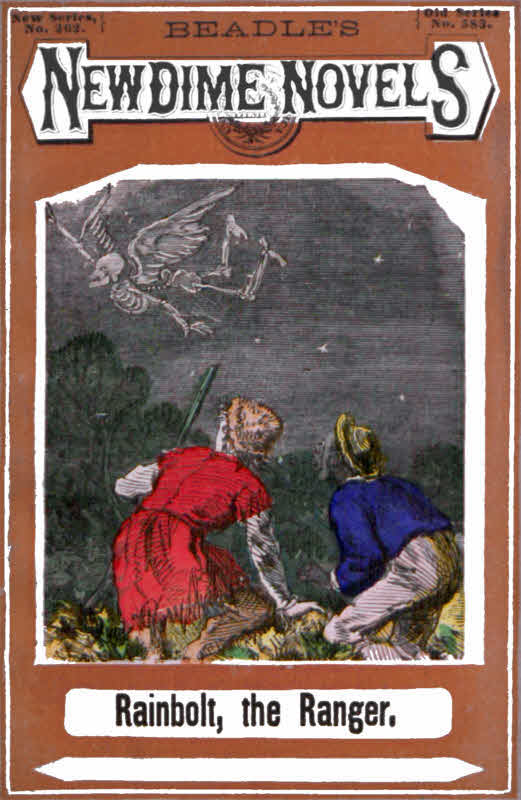
He stood on one side of a long table, while facing him on the other side, sat, bolt upright, in arm-chairs, with black cloaks thrown over their shoulders, a dozen human skeletons glaring at him in a ghastly, horrifying manner. Each one clutched in its bony hand, which protruded from under the cloak, a small glittering dagger. On the table in front of each one sat a small glass goblet filled with some red liquid resembling blood. Not a living soul was to be seen in the room.
Although the mysterious Solomon Strange had expected to see the same, as Dungarvon had told him, he felt an inward shudder of horror and disgust, and had he not been playing a desperate and secret game, he would have turned away and cursed the robbers for their fiendishness in thus tampering with the remains of the dead. But such an act would have exposed him, and he resolved to go on with the play he had successfully begun.
The instant the light had flashed upon the ghastly figures before him, the one in the center arose to a standing posture, as though possessed of life. The grinning mouth was opened, and then these words seemed to fall from its lips, hollow and sepulchral:
“Bluford Brandon, are you aware of what you have done? do you know that you have entered the brotherhood of Mountain Men? If you do, beware!” and the figure raised its bony hand in which it clutched the glittering dagger as if to strike, then it fell at its side again. Then each of the other ghastly figures raised their glittering daggers, and as they dropped again, they seemed to repeat, in one voice:
“Beware!”
The standing figure then went on:
“Look at these glasses, Bluford Brandon; they contain the blood of those who once were Mountain Men—the blood of those who stand before you, those who were once as you now are; but we were traitors; we essayed to betray our brothers into the hands of the Government detectives; but, ah! the vengeance of the brotherhood fell upon us, and sapped our life-blood out, and left us what you see us—a ghastly warning to others! And now again I say, beware!”
“Beware!” chattered the other figures.
At this instant the room was wrapped in blinding darkness. Then Strange distinguished the light footfalls of hurrying feet. He heard the robbers removing the ghastly figures, and the ventriloquist that had put the words of life in their mouths, scrambling from under the table, where he had been concealed with others of the robbers, who, with wire connections, had raised the arms of the skeletons.
Presently all became silent, then the light flashed through the chamber again, and in the chairs where the skeleton had sat, Solomon Strange saw a number of robbers seated, while, where the figure stood, Duval Dungarvon was standing.
Instead of daggers, the robbers held in their hands the goblets of (not blood) red, sparkling wine, which as they lifted to their lips, Dungarvon said:
“Here’s to Black Bear, the great Cheyenne chief, our new and distinguished member of the brotherhood of Mountain Men,” and as he concluded, they placed the goblets to their lips and drank.
And thus ended the ceremony, which, to the reader, may be horrifying and even disgusting, nevertheless it is a positive fact that such a custom did exist among the mountain robbers.
“Now, come, Black Bear,” said Dungarvon, taking that supposed worthy by the skin-clad arm, “and I will show you through our ranch, and the secrets connected with it.”
The two crossed the wide chamber, which Dungarvon had designated the “Cloister of the Ghouls,” and entered a smaller apartment that was brilliantly lighted. In this room was a carpenter’s work-bench and tools of all kinds.
“This,” said Dungarvon, “is the mechanical department. We often find it necessary to our success to use a carpenter to make coffins and other things. But let us go on.”
They passed into another apartment.
“This is our engraving-room and mint, for making counterfeit ‘greenbacks’ and ‘gold coin.’ Now I will show you how we make our doors open and close,” he said, leading Solomon Strange, who was drinking in every word with the deepest interest, back to his own apartment.
“You see this small projection; by pushing on it when the door is open, it will close; and by pulling upon it, it will open the door, thus,” and the robber-chief illustrated the matter, by causing the wall to roll apart and then shut again. “Now, the whole thing is worked by hidden springs, how exactly, no one ever knew, but the inventor, who was three years in constructing the doors in this cavern. First, however, immense grooves were chiseled in the floor and ceiling, and in them, these great rocks move on invisible rollers. All the machinery that works it is concealed in an artificial cavity back in the permanent walls. Now see, Brandon, if you can open and shut the door.”
The supposed Brandon seized hold of the projection, and pulled toward him. A thrill of joy passed through his frame, as the heavy walls rolled apart. Then he pressed upon the projection, and they closed again.
“Now I have one more apartment to show you, Blufe, and that’s what we call ‘the Dead Fall,’ where old Barker and the two Omaha ‘larks,’ are consigned.”
Procuring a lantern, the robber-captain and his friend passed out into the main entrance. This they followed some distance until they came to where a wall, crossing the passage at right angles, disputed their further entrance.
“This,” said Dungarvon, tapping the wall before them, “is the door to the ‘Dead Fall.’ See here. By pressing a spring in this niche, the door is unlocked, and by pressing another in this niche, the door rolls back into a cavity in the wall and the passage is continued. No one not acquainted with the cavern would ever know but what the passage terminates here. Shall we enter the Dead Fall?”
“Certainly,” returned Strange: “by all means. I should like to see the man that was thrown into a fifty-foot shaft and climbed out alive.”
The robber-captain opened the door and they advanced into the great chamber, wherein Willis and Ralph had been entrapped, and where they were now imprisoned with Barker.
Closing the door after them, they advanced to where the prisoners lay upon a couch of old skins. They all arose to a sitting posture when they heard the two men entering.
Willis and Ralph looked sad and dejected, but Barker: God of mercy! he resembled a skeleton more than a human. He was wasted away to a mere shadow, while long beard and hair of snowy whiteness hung down upon his breast and shoulders. His hands were like the claws of an eagle, and great, pitiful eyes stared at the robber-chief with a wild expression.
“Well, my larks, how are you getting along?” asked Dungarvon, with a demoniac leer.
“Oh, God! we are dying by inches,” returned Barker.
The robber-captain laughed mockingly, while Solomon Strange turned away with tears of pity in his eyes.
In a moment more the robber-chief and his companion left the Dead Fall. When they had got back into the captain’s room, a fresh bottle of brandy was brought out and placed upon the table.
Drawing the cork, the robber-chief passed the bottle over to Strange, saying:
“Here, Brandon, take the golden nectar right from Black Betty’s lips—no use foolin’ with goblets.”
Strange took up the bottle, and while the captain’s eyes were turned, he managed to pour half the contents on the floor under pretense of drinking, then passed the bottle back to Dungarvon.
The captain took it, and holding it up between his eyes and the light, exclaimed with a drunken leer:
“By Jove, Brandon, you have got a lip for glory, and now I’ll show you that I can swamp the other half,” and so saying, he turned the bottle to his lips and emptied it.
Strange chuckled to himself, as the captain staggered to a chair, saying:
“S’pose you’re going to stay all night with me, Brandon, are you (hic) not? My men are all in bed long (hic) ago.”
“Well, I reckon, as we’re having a good time, I will stay.”
“That’s it, Blufe, you’re (hic) a jolly dog of a boy. Just look in the alcove (hic) and get another Black Betty.” But before the bottle could be brought, the robber rolled upon the floor like a dead man.
“Thank God! my time has come,” muttered Strange to himself. And taking up the robber’s lantern he lit it. In one corner of the room stood a number of rifles with powder-horns and shot-pouches hung upon them. Strange selected three of the finest-looking, one of which proved to be Willis Armond’s repeating rifle, and taking them in his arms he opened the outlet in the wall and passed out into the main entrance. He then leaned the rifles against the wall, and turning moved toward the Dead Fall.
In a moment he had reached the door, and pressing the two springs it rolled back into the wall. He entered the room and stood before the prisoners.
“Barker, Armond, Rodman, come,” he said, speaking hastily, “come, if you wish to escape!”
“And, in the name of God, who are you that speaks thus,” gasped Willis, starting up at sound of the man’s voice; “are you a beast, or are you a human in disguise?”
“I’m a friend. Let that suffice. Come, I say, come.”
Strange led the way and the three prisoners arose and followed him, though the young men were compelled to assist Barker.
In a moment they came to where Strange had left the guns.
“Here are rifles and ammunition,” he said, handing each of them a weapon, “and here is my hunting-knife. Now wait here a moment.”
He opened the walls and passed into Dungarvon’s room, and returned in a moment with a bottle of brandy.
“Here, boys, take this. It will strengthen you,” he said. “At the door or mouth of the cavern is a sentinel. Should he demand a password, say to him, ‘Golden.’ Should he recognize you in the dark, knock him down and fly. One word more. Barker, do you know where the Devil’s Tarn is?”
“Yes,” returned Barker.
“Meet me there to-morrow evening. Don’t fail. Go.”
The prisoners moved along the dark passage, wondering who their strange deliverer could be. At the mouth of the cavern they found the wary sentinel sound asleep, and passing him, they plunged out into the free air of heaven.
Strange waited until they had had time to make their escape, then he turned and moved back to the door of the Dead Fall. He saw that it was fastened, then he placed his finger into the niche and tore out the spring that unlocked it. His work for the night was accomplished. The door to the Dead Fall could never be opened until it was battered down with sledges, and, consequently, the robbers would never know but that the prisoners were still in there.
Softly Solomon Strange stole back into the robber-captain’s room, and having put out the lantern, he stretched himself upon the carpeted floor and soon fell asleep.
When he awoke it was daylight, though no ray of sunshine ever shone in the cavern. Lamps furnished the only light there. Dungarvon had slept off the effect of his night’s carouse, and when his guest awoke he found him seated by the table reading a paper that one of his spies had brought in from Cheyenne City during the night.
Breakfast was brought in to the captain and his guest, the other robbers dining in the Cloister of the Ghouls.
After their morning repast was over, the false Black Bear took his departure for the Indian encampment, having expressed a hope that when he came back to the ranch he would have Silvia Sanford to hand over to the robber-captain.
Briskly through the forest and over the stony hills went the mysterious Solomon Strange.
Keeping to the right of the Indian encampment he struck the little glade wherein, but two nights ago, he had slain the renegade chief, Blufe Brandon, and entered a small cavern near at hand.
Ten minutes passed by, then he appeared again. But he was not in the disguise of the Black Bear. He wore his own ragged garments and carried his heavy, knotted club. For a moment he stood and gazed around him, then he strode away toward the west, his long yellow hair and whiskers streaming in the wind.
He had not gone far when his ears caught the sound of clattering hoofs. He looked down the path before him and saw Rodger Rainbolt, the ranger, coming toward him.
Stopping, he placed one foot in advance of the other, seized his club in both hands, and swinging it aloft, cried out:
“Stop! stop! stop, my lord, or I’ll beat you, beat you down!”