
CHAPTER II.
THE AERIAL DEMON OF THE MOUNTAIN.
Night had fallen, but through the darkness gleamed the cheerful light of a camp-fire that burned in a little wooded valley, near where it debouched from the Black Hills into the great plain, or Buffalo Range. Within its radius of light, two men were visible—one lying upon the ground asleep, the other seated before the fire, evidently keeping guard. The former was a short, heavy-set man, of some five and thirty years, with a broad, florid face, that told of humor and good-nature. A rifle was lying near, a hunting-knife was in his belt, and, though sound asleep, his hand grasped a short, stout club or shillalah which alone would have proclaimed his Hibernian extraction.
The Irishman’s companion was a type of a different nationality. He was a tall, powerful negro, with skin black as the ebon darkness around him. He possessed limbs and muscles of Herculean development, and a face firm, courageous and intellectual in its outlines. He held a double rifle, which flashed like a bar of silver in the firelight. Both were dressed in garbs of buck-skin, half-savage and half-civilized in fashion.
The negro sat with his rifle resting in the hollow of his arm, gazing into the glowing fire with a kind of vacant look.
As the minutes stole by, his eyes grew heavy with watching, and, presently, his head rolled languidly upon his shoulders in a gentle doze. Soon, however, he was aroused by a sound—the sound of approaching footsteps. He sprung to his feet, and, shading his eyes with his hand, peered into the gloom. At this moment five human figures emerged from the forest and halted within the radius of light. It was Colonel Wayland Sanford and his four young companions.
Colonel Sanford fixed his eyes upon those of the negro, and for a moment the two stood glaring at each other with a look of recognition, surprise, fear and revenge depicted upon their features. A profound silence ensued. The hand of the darky wandered mechanically to his knife, while the cold, gray eyes of Sanford flashed like burning coals, and his breast heaved and throbbed as though an internal volcano was surging within it.
The colonel was the first to break the silence.
“Ebony Jim! Villain and rascal!” he exclaimed, fiercely. “Is it you?—you who deserve shooting without ceremony?”
The colonel’s words seemed to transform the negro. His defiant, courageous look gave way to one of fear.
“Oh, good Lor’!” he exclaimed, fairly trembling, “it’s ole Massa Sanfor’, de poor young missus’ father, and now dis poor nigger’s time am come!”
“Ah! you fear the halter of justice, do you, you black wretch!” exclaimed the colonel, indignantly. “For four years I have hunted you—to shoot you!”
“Oh, good Heaben, massa, I hab done nuffin’!”
“Then what brought you here, and why do you fear me?”
“’Cause, massa, I s’pose you and dem gemman dar come to ’rest dis nigger—”
“For what?”
“Why, you ’members I war hid in de woods when poor Massa Walraven war taken to de Debbil’s Tarn and—”
“Hush! hush! for God’s sake, Ebony, speak not of that affair!” cried the colonel, growing suddenly changed in his tone toward the darky. He spoke so loud that the Irishman was awakened from his slumber.
“Och, and be the Howly Vargin, and who’s this that comes a disthurbing of me paceful shlumber at the dead hour av night? Wirra, but I’ll sphring afoot and bate their heads wid me ole shillalah, so I will, as me name is Flick O’Flynn,” exclaimed the Hibernian, rising to a sitting posture and rubbing his eyes confusedly.
“I am sorry we have disturbed you,” said Frank Armond, apologetically, “but I hope you will pardon us for the unceremonious intrusion.”
“Ay, and thet I will,” replied O’Flynn, gaining his equilibrium of mind, “for it’s mees thet’s glad to say the likes av yees in this h’athing conthry, so it is, so it is.”
In the mean time, Colonel Sanford had stepped to Ebony’s side, and spoke in a lower and kinder voice:
“Forgive me, Ebony, for my rashness; but tell me truthfully, where is Florence Walraven?”
“Why should dis nigger know better dan enny body else, massa?”
“Because I know you assisted her to flee from home four years since, and now where is she?”
“Good Lor’ only knows. S’pecks she’s in heaben wid de angels,” replied the negro, apparently much surprised.
“Come, Ebony!” exclaimed Sanford, growing nervous and excited again. “Trifle not with me. You have lied to me already; you know where Florence is; you assisted her to flee. Speak, tell me the truth or your life shall pay—”
“Good Lor’, you misjudge dis nigger, Massa Sanfor’. Nebber sence poor Massa Walraven went into the army have I see’d de young missus, and when Massa Walraven was convictioned ob bein’ a traitor and taken to de Debbil’s Tarn—I means when he war punished so orfully—dis nigger run away into de mountain fear he be sarved so too, ’case he see’d something, and nebber hab I see’d de young missus, nor nobody, till dis blessed minit.”
“Are you speaking the truth, Ebony?” asked the colonel, seriously, calmly.
“As I’s a born nigger dat’s de truf, Massa Sanfor’.”
“Then forgive me, old boy, for my hasty accusal,” said the colonel, extending his hand to the darky. “Florence has been missing for four years, and we always suspicioned you of stealing her away.”
“Dis nigger cherishes nuffin ill in his heart to’rds ole Massa Sanfor’,” said Ebony, grasping the colonel’s hand, “but oh! how his heart aches when he t’inks ob dat awful—awful ’fair at the Debbil’s Tarn.”
“Hush, Ebony, about the Devil’s Tarn,” said Sanford in a whisper. “It racks my soul with torture. Promise me you’ll not mention it again.”
“I promise,” said the negro.
“Then let us be seated and talk of other things.”
They all gathered around the fire and Colonel Sanford informed the two hunters of their mission there.
“Be garry, and it’s Flick O’Flynn of Carricksfergus that can bate in more rhed niggars’ skulls than any man on the job, and yees kin count mees in on the parsuit av the ghal, also. Wirra! but mees am in me glory when swinging me old shillalah among the dirthy blackg’ards, so it is, so it—Har—rk!”
Though the Hibernian was talking quite boisterously, his practiced ear caught a far-off and peculiar sound, coming from the Black Hills.
“Ay, and didn’t ye hear thet, now?” he asked.
“No; what was it?” queried Sanford.
“It was a sound rhesembling the thuang av a horn—there she am again!”
This time all heard it, and, true enough, it was the far-off blast of a horn. Flick O’Flynn and Ebony exchanged inquiring and ominous glances.
“A hunter, I suppose,” said young Rodman.
“Not a bit av it! It’s the gathering call av robbers, in yonder hills,” said O’Flynn, pointing away westward over the Black Hills.
“But what means that?” asked Willis Armond, pointing up toward the dark sky.
All eyes gazed upon the object in question with wonder and surprise. It was a bright, glowing speck not unlike a blazing star; but it was moving, drifting slowly through the heavens—now east—now west—now sinking—now rising—now circling around and around—again standing still against the black canopy of heaven.
“That is surely not a star,” said Walter Lyman.
“No; but it’s a mystery to me,” said Colonel Sanford.
Again the twang of the horn was heard, and, as its echoes rolled back through the hills, the mysterious blazing star was seen to glide away through the heavens and disappear in a moment behind the mountain range.
“That is a mystery that is not the agency of man,” said the colonel.
“Oh, Lor’! I tell ye, Massa Sanfor’, our time am come! Dat war de horn ob de ark-angel wakin’ up de dead.”
“You’re a fool, Ebony; you’ve lost all the courage you ever did possess.”
“I knows I’s a fool, massa, but I’s been a wicked nigger, and de world am comin’ to a eend, and oh, Lor’ ob Heabens! dar comes de Ole Nick—de Ole Nick!—de Ole Nick! after dis chile—oh—oh—oh!”
Ebony stretched out his hands as if to keep off some horrible object. His eyes were lifted upward and glared like those of a madman. His lips stood slightly apart, revealing his firm-set teeth, and his features were convulsed with horror.
“Ebony! Ebony! are you going mad?” exclaimed Sanford, excitedly.
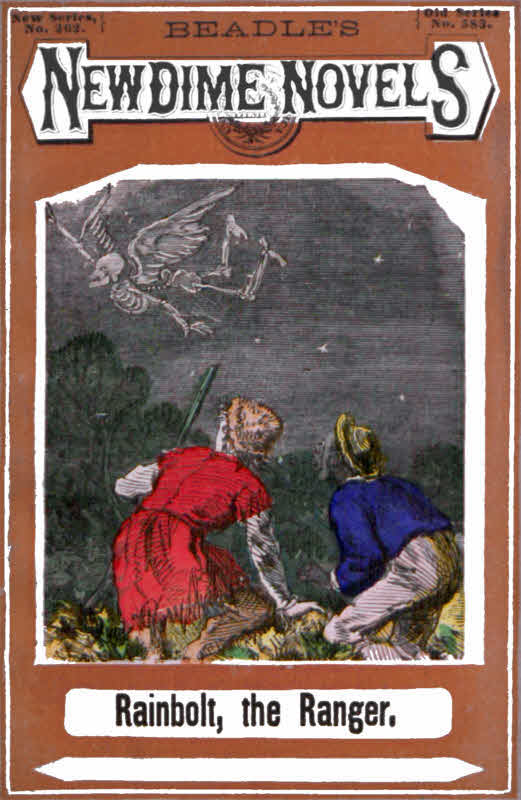
The negro moved not a muscle nor his uplifted eyes, but, at that instant, a fierce and terrible scream burst over the heads of the little group. All started and lifted their eyes upward, and as they did so, every face became blanched with terror. They saw what Ebony saw, and startled as he did. They saw not a human nor a beast, but an awful, terrible figure—a figure resembling a human skeleton floating through the air, high over the tree-tops, its ghastly proportions revealed by the smoke and flame emitted from the sunken eyes, the distended nostrils and the wide, grinning mouth. Great white arms beat and buffeted the air like the wings of a struggling vampire, while scream after scream pealed wild and unearthly from the horrid creature’s lips. It was fully a hundred feet above the tree-tops and moved swiftly—so swift, that in a moment it had floated over the camp and disappeared behind the dark hills.
The party stood transfixed with horror. Colonel Sanford was the first to break the silence.
“In the name of God, what was it?” he gasped.
“I tell you it’s de Ole Nick after dis poor, black nigger,” persisted Ebony.
Flick O’Flynn acted quite indifferent. He showed but little surprise at sight of the horrid creature, yet he exclaimed:
“Holy Mother! it makes the hair sthand on mees head, and polar icebergs rholl down me back, but then it’s not the first time that Flick O’Flynn of Carricksfergus, has see’d thet chreature.”
“What is it? beast, human, fiend or—”
“Ay, there now, and it’s the horrid chreature known as the Aerial Demon of the Mountain.”