
CHAPTER III.
A MOMENT OF PERIL.
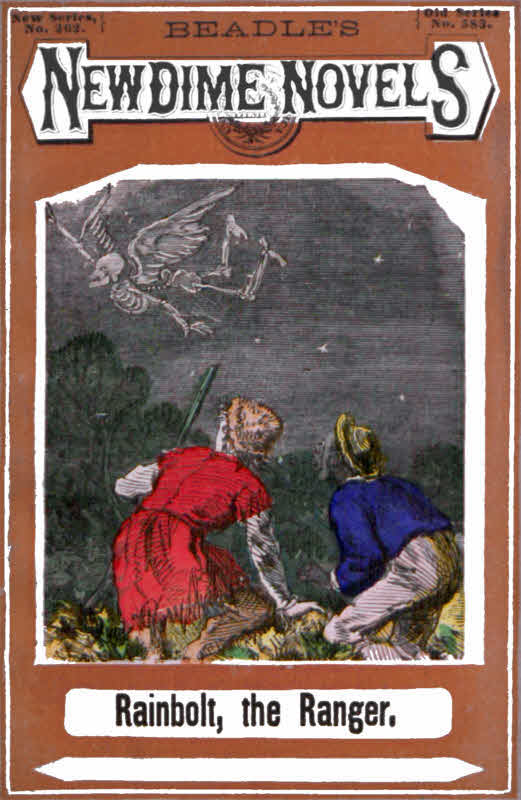
For some time the wildest excitement prevailed in the hunters’ camp over what O’Flynn had said was the Aerial Demon, the scourge of the Black Hills.
Flick could throw no light on the subject, further than that he had seen it once before, and heard of its being seen by others, and striking terror to the hearts of the Indians.
For fully an hour this aerial apparition was the subject of conversation, and many and curious were the suppositions entertained by the party as to its nature.
By this time the clouds had rolled away, and the blue dome of heaven was glimmering with myriads of stars. The murky shadows were lifted from the great plain that stretched away in tranquil beauty like an ocean, broken now and then by a silvery lake or stream, or a little woodland isle that nestled down on its bosom like a mere black speck. And as the moments stole by, a score of dusky forms suddenly emerged from the shadow of one of those prairie islands, and moved silently over the plain.
It was a band of hostile Cheyenne Indians, heading toward the Black Hills.
As the night was far advanced, and Colonel Sanford and his young friends were greatly fatigued with their long tramp through the mountain, they concluded to remain with the hunters until morning, inasmuch as they had promised to accompany them on the morrow in pursuing the red-skins. The fire was replenished with fuel. The flames leaped up and relieved the gloom for many feet around; but backed in by the great woods on one side, and the rise of a hill on the other, the light was, as it were, pent up in the immediate vicinity.
And so it was hidden from the gaze of those on the near plain but not to those on the hills, nor to those far out on the plain.
Flick O’Flynn was to stand guard the rest of the night—he refusing all offers of relief. He lit his pipe and seated himself before the fire, with his shillalah lying across his knees. The rest of the party stretched themselves in various attitudes about the fire to rest.
Just then a night-bird fluttered overhead with a startled scream. Every man sprung quickly to his feet. Was it the Aerial Demon again? They glanced around them. No. It was not the demon, but a sight equally as horrifying met their gaze. Out from the deep gloom, into the glare of the roaring camp-fire—with the silence of phantoms, their painted visages aglow with diabolical triumph, their hands clutching a knife or tomahawk, came a score of Cheyenne Indians, surrounding our friends on every side like sheep in a slaughter-pen. For a moment they paused just within the circle of light; then they uttered a yell, so fierce that the blood stood like ice in the veins of the whites.
“Och! and be the Howly Mother, it’s a sorry time we’ll have,” exclaimed Flick O’Flynn, whirling his shillalah about his head; “but here goes,” and he dashed among the savages with a yell.
“And here comes dis chile,” exclaimed Ebony, clubbing his rifle and following.
“We have got to fight for our lives,” said Colonel Sanford, who, possessing no weapon, stooped and picked up a heavy club, one end of which was afire, and swinging it aloft he dashed in among the savages, Frank and Willis Armond, Walter Lyman and Ralph Rodman following suit with clubbed rifles.
The conflict instantly became fearful.
The Cheyennes were three to one, and our friends fought with the desperation of despair—of madmen. Several savages went down, but the death of each one made the survivors all the more desperate; and presently Walter Lyman fell unconscious from a blow on the head, and Willis Armond received a severe wound on the arm. Defeat and death stared our friends in the face—they were being gradually overpowered—the savages were closing in upon them—another moment—but hark! what sound was that? Was it the voice of doom?