
CHAPTER IV.
THE MASTER OF THE EAGLE.
It was the wild scream of a bird that fell upon the ears of the combatants, but at the next instant a horseman dashed wildly in among the savages, a drawn saber in hand. And so swift did the stranger swing the polished weapon right and left upon the tufted skulls of the red-skins that it seemed a broad sheet of flame. Nor did this strange man come alone to the rescue. A large, tame gray eagle accompanied him, and the fierce bird seemed inspired with the same warlike spirit of its master. Down into the savages’ faces, striking with talon, beak and wing, swooped the great bird with a scream, tearing and lacerating the flesh and eyes at every stroke.
The scale of battle was turned as if by magic. The savages, defeated and terrified, fled into the shelter of the forest, pursued by Ebony and the stranger’s fierce bird, leaving half their number behind, dead.
All eyes were now turned upon their strange deliverer.
He was a young man, not more than thirty. In stature he was about five feet six inches. His figure was firmly knit but flexible; and every movement supple, easy and graceful. His hair was of a dark brown, as was also his beard that in a great measure concealed his face and hung to the pommel of his saddle. A few premature wrinkles were faintly traced about his eyes.
A tunic of blue velveteen ornamented with yellow fringe and confined at the waist by a leather belt, buck-skin trowsers, buck-skin leggings and moccasins, and a gray felt hat constituted his garb.
A saber, a brace of revolvers in his belt, and a rifle that was swung at his back by means of a strap passing over his shoulder, were the weapons he carried.
The animal he rode was a black, mettlesome mustang with arched neck and flashing eyes, clear limbs and muscular proportions.
A large, and what appeared cumbersome, pair of well-filled saddle-bags were thrown over the cantle of the saddle, while on one side hung a double field-glass, and on the other side a coiled silver horn.
Replacing his saber in its scabbard, he turned and gazed upon those he had rescued. From one to the other his eyes wandered until they met those of Wayland Sanford, when a strange, wild light flashed in them. A momentary silence ensued. The horseman was the first to speak:
“A warm time you were having, my friends,” he said, in a clear voice.
“Indeed we were,” replied the old colonel, with a nervous tremor in his voice induced by exertion and excitement; “and whom have we the honor of thanking for our rescue?”
“My name is Rodger Rainbolt,” replied the horseman, in his clear, ringing voice, in which there was much of wild bluntness; “and now your name if you please?”
“Wayland Sanford.”
The ranger was silent for a moment, then he asked:
“What brings Wayland Sanford here in these wilds, dressed in the fine clothes of a citizen?”
The colonel informed him of the abduction of his daughter, and that they were in pursuit of the Indians.
“Uh-humph!” ejaculated the ranger, when he had heard the colonel’s story.
At this moment Ebony returned from pursuit of the flying savages, and, as the ranger’s eyes fell upon him, he turned his animal so that the fire would not shine in his face.
In the mean time, Flick O’Flynn and Frank Armond were busily engaged in restoring young Lyman to his senses, of which a blow on the head had bereft him; while the young surgeon, Ralph Rodman, turned his attention to Willis’ bleeding arm.
“Do you know what tribe the Indians belong to that captured your girl?” asked Rainbolt, after a moment’s silence.
“They were Cheyennes,” replied the colonel.
“Black Bear’s cut-throats, I suppose,” returned the handsome ranger.
“Golly mighty!” suddenly exclaimed Ebony, peering up into the ranger’s face as he spoke; “dat sounds jist like Massa Walraven’s voice, as I’s a born nigger, but den it’s not his face, for Massa Walraven died long ago—died at de Debbil’s Tarn,” and he turned away.
The ranger flashed a quick glance upon Sanford, who was moving uneasily; then in a tone of indifference said:
“I am afraid you will not succeed in rescuing your daughter if Black Bear has reached or does reach his haunts.”
“God forbid that he should!” exclaimed Sanford.
“But,” continued the horseman, “since I am not particularly engaged at present, I can and will devote my time to assisting you in rescuing your girl. I wish, however, to act strictly alone, for the assistance I have will enable me to do so with success—but, I had entirely forgot my companion,” and taking the silver horn from his saddle, he placed it to his lips and blew a shrill blast.
Immediately after this act the winnowing of great wings was heard, and a moment later the eagle that attacked the savages so fiercely settled down from the gloom overhead and perched itself upon the shoulder of the ranger. Blood was on its talons and beak.
“A noble pet you have, Mr. Rainbolt,” said the colonel, admiringly.
“Yes, sir; one that will be worth more to me in rescuing your daughter than a dozen men. His instinct is wonderful and his strength prodigious. One stroke of his wing, Mr. Sanford, would break your arm as though it were a straw. I have known him to carry in his talons a weight of a hundred pounds. Ah, a noble bird is Echo, my eagle. He hates a red-skin with all the bitterness of his master.”
“You must have had great patience in training him, Mr. Rainbolt.”
“I do not claim all that honor. He was partly trained when he came into my possession. He was given me by an old Californian named Barker.”
“Barker!” burst involuntarily from Sanford’s lips; “Gustave Barker?”
“Yes; Gustave Barker,” replied the ranger, eying the colonel sharply. “Do you know him?”
“Oh—no, I have heard of him,” replied Sanford, recovering from his sudden excitement.
There was a few moments’ silence, broken only by the impatient pawing of the ranger’s steed.
Doctor Rodman had succeeded in restoring Lyman to his senses, and had carefully dressed Willis’ arm, which, after all, had only sustained a flesh-wound.
“I say, Lyman,” said the young physician, after his friend had recovered his senses, “that blow you got on the head is what is termed in legal phrase, ‘’Salt and battery,’ ain’t it?”
“Yes,” replied the young lawyer, rubbing his sore head; “but, in this affair there is more ‘battery’ than ‘’sault’; however, I shall bring action at once for damages.”
“And try the case before—what is it?—oh, yes; the Aerial Demon,” said Willis, laughing.
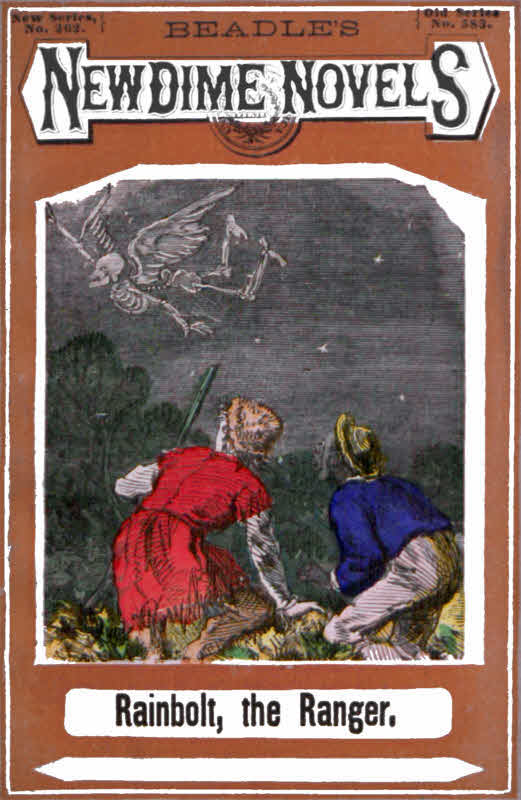
“The Aerial Demon!” exclaimed Rainbolt, “have you seen that horrid, mysterious creature?”
“Yes; it passed over our camp an hour or so ago. Can you throw any light on the real nature of the mystery?”
“Nothing more than that it is the most frightful object I ever saw,” returned the ranger.
“Ay, now, and it’s yees that spakes the thruth loudly, for it’s mees that’s see’d the chreature twice, and both times it stharted polar icebergs down my back, so it did,” said Flick.
“Well,” said Rainbolt, “since I can be of no further service to you, gentlemen, I may as well take my departure. Should I succeed in rescuing your daughter, Mr. Sanford, I will communicate the fact to you at once,” and as he concluded, he took from his pocket a time-worn memoranda, and tearing out one of the stained leaves handed it to Colonel Sanford, saying: “Read that, Colonel Wayland Sanford, and good-night to you all,” and as he spoke the pet eagle arose into the air—the spirited mustang pricked up its ears, champed its bit impatiently, and the next moment Rodger Rainbolt, the ranger, was gone.
“He’s a curious fellow—a living mystery,” said Ralph Rodman; “but what ails you, colonel?—what ails you?”
“Oh! nothing, nothing but excitement, as usual,” replied the colonel, evasively; “but, let me see what the ranger wants me to read.”
He turned and stirred up the waning camp-fire, and seating himself upon the ground glanced at the paper. A groan escaped his lips as he did so, and the paper dropped from his hand, and falling into the fire was consumed in an instant, while the colonel’s hands dropped to his knees and his eyes became fixed upon the fire.
“What did he write, uncle?” asked Frank.
There was no response to his question.
Frank repeated it. Still no reply.
“The ranger has thrown the colonel’s mind into a quandary,” said young Lyman.
“Like the red naygur did yours,” said Flick O’Flynn.
“How is it, colonel?” asked Rodman.
The colonel was still silent. Frank Armond advanced and laid his hand upon his uncle’s shoulder, but he started back with a thrill of horror. The limbs of the colonel were rigid as death; his eyes were still fixed upon the fire with a cold, glassy, vacant stare. His lips stood slightly apart and his features were ghastly as the dead’s.
“Uncle! uncle!” exclaimed Frank, shaking him violently, “what ails you? Come, rouse up—great God, what can it mean, Rodman?”
The young doctor was bending over the colonel, his fingers resting upon the old man’s pulse.
“Come, speak, Ralph, what does it mean?” repeated Frank.
“Heavens!” exclaimed the young doctor, starting up, “what could the ranger have written? It has killed the colonel, as God’s in Heaven, boys; he is dead—stone dead!”