
The Project Gutenberg eBook of Rambles and Recollections of an Indian Official
Title: Rambles and Recollections of an Indian Official
Author: Sir W. H. Sleeman
Release date: March 27, 2005 [eBook #15483]
Most recently updated: November 29, 2022
Language: English
Credits: Produced by Philip H Hitchcock
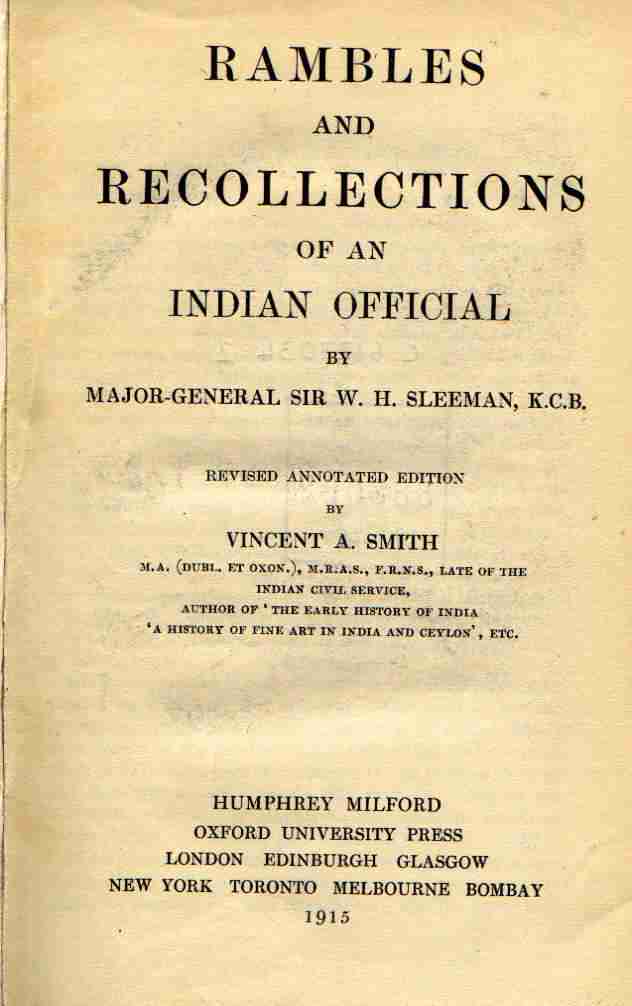
RAMBLES AND RECOLLECTIONS
OF AN
INDIAN OFFICIAL
GENERAL SIR W. H SLEEMAN. K.C.B.
RAMBLES
AND
RECOLLECTIONS
OF AN
INDIAN OFFICIAL
BY
MAJOR-GENERAL SIR W. H. SLEEMAN, K.C.B.
REVISED ANNOTATED EDITION
BY
VINCENT A. SMITH
M.A. (DUBL. ET OXON.), M.R.A.S., F.R.N.S., LATE OF
THE
INDIAN CIVIL SERVICE,
AUTHOR OF 'THE EARLY HISTORY OF INDIA'
'A HISTORY OF FINE ART IN INDIA AND CEYLON'.
ETC.
HUMPHREY MILFORD
OXFORD UNIVERSITY PRESS
LONDON EDINBURGH GLASGOW
NEW YORK TORONTO MELBOURNE BOMBAY
1915
Transcriber's Note
In producing this e-text the numerous notes have been moved to the end of their respective chapters and renumbered. The printed 'Additions and Corrections' have been included in the relevant text.
The map showing the author's route has been confined to the area immediately adjacent to the route, to preserve legibility while maintaining a reasonable file size.
In the printed edition the spelling of certain words is not always consistent. This is especially true of the use of diacritical marks on certain words, even within a single page. This e-text attempts to reproduce the spellings exactly as used in the printed edition.
AUTHOR'S DEDICATION
MY DEAR SISTER,
Were any one to ask your countrymen in India what has been their greatest source of pleasure while there, perhaps nine in ten would say, the letters which they receive from their sisters at home. These, of all things, perhaps, tend most to link our affections with home by filling the landscapes, so dear to our recollections, with ever varying groups of the family circles, among whom our infancy and our boyhood have been passed; and among whom we still hope to spend the winter of our days.
They have a very happy facility in making us familiar with the new additions made from time to time to the dramatis personae of these scenes after we quit them, in the character of husbands, wives, children, or friends; and, while thus contributing so much to our happiness, they no doubt tend to make us better citizens of the world, and servants of government, than we should otherwise be, for, in our 'struggles through life in India', we have all, more or less, an eye to the approbation of those circles which our kind sisters represent—who may, therefore, be considered in the exalted light of a valuable species of unpaid magistracy to the Government of India.
No brother has ever had a kinder or better correspondent than I have had in you, my dear sister; and it was the consciousness of having left many of your valued letters unanswered, in the press of official duties, that made me first think of devoting a part of my leisure to you in these Rambles and Recollections, while on my way from the banks of the Nerbudda river to the Himālaya mountains, in search of health, in the end of 1835 and beginning of 1836. To what I wrote during that journey I have now added a few notes, observations, and conversations with natives, on the subjects which my narrative seemed to embrace; and the whole will, I hope, interest and amuse you and the other members of our family; and appear, perchance, not altogether uninteresting or uninstructive to those who are strangers to us both.
Of one thing I must beg you to be assured, that I have nowhere indulged in fiction, either in the narrative, the recollections, or the conversations. What I relate on the testimony of others I believe to be true; and what I relate upon my own you may rely upon as being so. Had I chosen to write a work of fiction, I might possibly have made it a good deal more interesting; but I question whether it would have been so much valued by you, or so useful to others; and these are the objects I have had in view. The work may, perhaps, tend to make the people of India better understood by those of my own countrymen whose destinies are cast among them, and inspire more kindly feelings towards them. Those parts which, to the general reader, will seem dry and tedious, may be considered, by the Indian statesman, as the most useful and important.
The opportunities of observation, which varied employment has given me, have been such as fall to the lot of few; but, although I have endeavoured to make the most of them, the time of public servants is not their own; and that of few men has been more exclusively devoted to the service of their masters than mine. It may be, however, that the world, or that part of it which ventures to read these pages, will think that it had been better had I not been left even the little leisure that has been devoted to them.
Your ever affectionate brother,
W. H. SLEEMAN.
CONTENTS
CHAPTER 1
Annual Fairs held on the Banks of Sacred Streams in India
CHAPTER 2
Hindoo System of Religion
CHAPTER 3
Legend of the Nerbudda River
CHAPTER 4
A Suttee on the Nerbudda
CHAPTER 5
Marriages of Trees—The Tank and the
Plantain—Meteors—Rainbows
CHAPTER 6
Hindoo Marriages
CHAPTER 7
The Purveyance System
CHAPTER 8
Religious Sects—Self-government of the
Castes—Chimneysweepers—Washerwomen [1]—Elephant
Drivers
CHAPTER 9
The Great Iconoclast—Troops routed by Hornets—The
Rānī of
Garhā—Hornets' Nests in India
CHAPTER 10
The Peasantry and the Land Settlement
CHAPTER 11
Witchcraft
CHAPTER 12
The Silver Tree, or 'Kalpa Briksha'—The 'Singhāra', or
Trapa bispinosa, and the Guinea-Worm
CHAPTER 13
Thugs and Poisoners
CHAPTER 14
Basaltic Cappings of the Sandstone Hills of Central
India—Suspension Bridge—Prospects of the Nerbudda
Valley—Deification of a Mortal
CHAPTER 15
Legend of the Sāgar Lake—Paralysis from eating the Grain
of the Lathyrus sativus
CHAPTER 16
Suttee Tombs—Insalubrity of deserted Fortresses
CHAPTER 17
Basaltic Cappings—Interview with a Native Chief—A
Singular Character
CHAPTER 18
Birds' Nests—Sports of Boyhood
CHAPTER 19
Feeding Pilgrims—Marriage of a Stone with a Shrub
CHAPTER 20
The Men-Tigers
CHAPTER 21
Burning of Deorī by a Freebooter—A Suttee
CHAPTER 22
Interview with the Rājā who marries the Stone to the
Shrub—Order of the Moon and the Fish
CHAPTER 23
The Rājā of Orchhā—Murder of his many
Ministers
CHAPTER 24
Corn Dealers—Scarcities—Famines in India
CHAPTER 25
Epidemic Diseases—Scape-goat
CHAPTER 26
Artificial Lakes in Bundēlkhand-Hindoo, Greek, and Roman
Faith
CHAPTER 27
Blights
CHAPTER 28
Pestle-and-Mortar Sugar-Mills—Washing away of the Soil
CHAPTER 29
Interview with the Chiefs of Jhānsī—Disputed
Succession
CHAPTER 30
Haunted Villages
CHAPTER 31
Interview with the Rājā of Datiyā—Fiscal
Errors of Statesmen—Thieves and Robbers by Profession
CHAPTER 32
Sporting at Datiyā—Fidelity of Followers to their Chiefs
in India—Law of Primogeniture wanting among Muhammadans
CHAPTER 33
'Bhūmiāwat'
CHAPTER 34
The Suicide-Relations between Parents and Children in India
CHAPTER 35
Gwālior Plain once the Bed of a Lake—Tameness of
Peacocks
CHAPTER 36
Gwālior and its Government
CHAPTER 37 [2]
Contest for Empire between the Sons of Shah Jahān
CHAPTER 38 [2]
Aurangzēb and Murād Defeat their Father's Army near
Ujain
CHAPTER 39 [2]
Dārā Marches in Person against his Brothers, and is
Defeated
CHAPTER 40 [2]
Dārā Retreats towards Lahore—Is robbed by the
Jāts—Their Character
CHAPTER 41 [2]
Shāh Jahān Imprisoned by his Two Sons, Aurangzēb and
Murād
CHAPTER 42 [2]
Aurangzēb Throws off the Mask, Imprisons his Brother
Murād, and Assumes the Government of the Empire
CHAPTER 43 [2] Aurangzēb Meets Shujā in Bengal, and Defeats him, after Pursuing Dārā to the Hyphasis
CHAPTER 44 [2]
Aurangzēb Imprisons his Eldest Son—Shujā and all
his Family are Destroyed
CHAPTER 45 [2]
Second Defeat and Death of Dārā, and Imprisonment of his
Two Sons
CHAPTER 46 [2]
Death and Character of Amīr Jumla
CHAPTER 47
Reflections on the Preceding History
CHAPTER 48
The Great Diamond of Kohinūr
CHAPTER 49
Pindhārī System—Character of the Marāthā
Administration—Cause of their Dislike to the Paramount
Power
CHAPTER 50
Dhōlpur, Capital of the Jāt Chiefs of
Gohad—Consequence of Obstacles to the Prosecution of
Robbers
CHAPTER 51
Influence of Electricity on Vegetation—Agra and its
Buildings
CHAPTER 52
Nūr Jahān, the Aunt of the Empress Nūr Mahal,[3]
over whose Remains the Tāj is built
CHAPTER 53
Father Gregory's Notion of the Impediments to Conversion in
India—Inability of Europeans to speak Eastern Languages
CHAPTER 54
Fathpur-Sīkrī—The Emperor Akbar's
Pilgrimage—Birth of Jahāngīr
CHAPTER 55
Bharatpur—Dīg—Want of Employment for the Military
and the Educated Classes under the Company's Rule
CHAPTER 56
Govardhan, the Scene of Kriahna's Dalliance with the Milkmaids
CHAPTER 57
Veracity
CHAPTER 58
Declining Fertility of the Soil—Popular Notion of the
Cause
CHAPTER 59
Concentration of Capital and its Effects
CHAPTER 60
Transit Duties in India—Mode of Collecting them
CHAPTER 61
Peasantry of India attached to no existing Government—Want of
Trees in Upper India—Cause and Consequence—Wells and
Groves
CHAPTER 62
Public Spirit of the Hindoos—Tree Cultivation and Suggestions
for extending it
CHAPTER 63
Cities and Towns, formed by Public Establishments, disappear as
Sovereigns and Governors change their Abodes
CHAPTER 64
Murder of Mr. Fraser, and Execution of the Nawāb Shams-ud-
dīn
CHAPTER 65
Marriage of a Jāt Chief
CHAPTER 66
Collegiate Endowment of Muhammadan Tombs and Mosques
CHAPTER 67
The Old City of Delhi
CHAPTER 68
New Delhi, or Shāhjahānābād
CHAPTER 69
Indian Police—Its Defects—and their Cause and
Remedy
CHAPTER 70
Rent-free Tenures—Right of Government to Resume such
Grants
CHAPTER 71
The Station of Meerut—'Atālīs' who Dance and Sing
gratuitously for the Benefit of the Poor
CHAPTER 72
Subdivisions of Lands—Want of Gradations of
Rank—Taxes
CHAPTER 73
Meerut-Anglo-Indian Society
CHAPTER 74
Pilgrims of India
CHAPTER 75
The Bēgam Sumroo
CHAPTER 76
ON THE SPIRIT OF MILITARY DISCIPLINE IN THE NATIVE ARMY OF
INDIA
Abolition of Corporal Punishment—Increase of Pay with Length
of Service—Promotion by Seniority
CHAPTER 77
Invalid Establishment
Appendix:
Thuggee and the part taken in its Suppression by General Sir W. H.
Sleeman, K.C.B., by Captain J. L. Sleeman
Supplementary Note by the Editor
Additions and Corrections
Notes:
1. A blunder for 'Sweepers' and 'Washermen'
2. Chapters 37 to 46, inclusive, are not reprinted in this edition.
3. A mistake. See post, Chapter 52, note 1.
EDITOR'S PREFACE (1893)[1]
The Rambles and Recollections of an Indian Official, always a costly book, has been scarce and difficult to procure for many years past. Among the crowd of books descriptive of Indian scenery, manners, and customs, the sterling merits of Sir William Sleeman's work have secured it pre-eminence, and kept it in constant demand, notwithstanding the lapse of nearly fifty years since its publication. The high reputation of this work does not rest upon its strictly literary qualities. The author was a busy man, immersed all his life in the practical affairs of administration, and too full of his subject to be careful of strict correctness of style or minute accuracy of expression. Yet, so great is the intrinsic value of his observations, and so attractive are the sincerity and sympathy with which he discusses a vast range of topics, that the reader refuses to be offended by slight formal defects in expression or arrangement, and willingly yields to the charm of the author's genial and unstudied conversation.
It would be difficult to name any other book so full of instruction for the young Anglo-Indian administrator. When this work was published in 1844 the author had had thirty-five years' varied experience of Indian life, and had accumulated and assimilated an immense store of knowledge concerning the history, manners, and modes of thought of the complex population of India. He thoroughly understood the peculiarities of the various native races, and the characteristics which distinguish them from the nations of Europe; while his sympathetic insight into Indian life had not orientalized him, nor had it ever for one moment caused him to forget his position and heritage as an Englishman. This attitude of sane and discriminating sympathy is the right attitude for the Englishman in India.
To enumerate the topics on which wise and profitable observations will be found in this book would be superfluous. The wine is good, and needs no bush. So much may be said that the book is one to interest that nondescript person, the general reader in Europe or America, as well as the Anglo-Indian official. Besides good advice and sound teaching on matters of policy and administration, it contains many charming, though inartificial, descriptions of scenery and customs, many ingenious speculations, and some capital stories. The ethnologist, the antiquary, the geologist, the soldier, and the missionary will all find in it something to suit their several tastes.
In this edition the numerous misprints of the original edition have been all, and, for the most part, silently corrected. The extremely erratic punctuation has been freely modified, and the spelling of Indian words and names has been systematized. Two paragraphs, misplaced in the original edition at the end of Chapter 48 of Volume I, have been removed, and inserted in their proper place at the end of Chapter 47; and the supplementary notes printed at the end of the second volume of the original edition have been brought up to the positions which they were intended to occupy. Chapters 37 to 46 of the first volume, describing the contest for empire between the sons of Shāh Jahān, are in substance only a free version of Bernier's work entitled, The Late Revolution of the Empire of the Great Mogol. These chapters have not been reprinted because the history of that revolution can now be read much more satisfactorily in Mr. Constable's edition of Bernier's Travels. Except as above stated, the text of the present edition of the Rambles and Recollections is a faithful reprint of the Author's text.
In the spelling of names and other words of Oriental languages the Editor has 'endeavoured to strike a mean between popular usage and academic precision, preferring to incur the charge of looseness to that of pedantry'. Diacritical marks intended to distinguish between the various sibilants, dentals, nasals, and so forth, of the Arabic and Sanskrit alphabets, have been purposely omitted. Long vowels are marked by the sign ¯. Except in a few familiar words, such as Nerbudda and Hindoo, which are spelled in the traditional manner, vowels are to be pronounced as in Italian, or as in the following English examples, namely: ā, as in 'call'; e, or ē, as the medial vowel in 'cake'; i, as in 'kill'; ī, as the medial vowels in 'keel'; u, as in 'full'; ū, as the medial vowels in 'fool'; o, or ō, as in 'bone'; ai, or āi, as 'eye' or 'aye', respectively; and au, as the medial sound in 'fowl'. Short a, with stress, is pronounced like the u in 'but'; and if without stress, as an indistinct vowel, like the A in 'America'.
The Editor's notes, being designed merely to explain and illustrate the text, so as to render the book fully intelligible and helpful to readers of the present day, have been compressed into the narrowest possible limits. Even India changes, and observations and criticisms which were perfectly true when recorded can no longer be safely applied without explanation to the India of to-day. The Author's few notes are distinguished by his initials.
A copious analytical index has been compiled. The bibliography is as complete as careful inquiry could make it, but it is possible that some anonymous papers by the Author, published in periodicals, may have escaped notice.
The memoir of Sir William Sleeman is based on the slight sketch prefixed to the Journey through the Kingdom of Oude, supplemented by much additional matter derived from his published works and correspondence, as well as from his unpublished letters and other papers generously communicated by his only son, Captain Henry Sleeman. Ample materials exist for a full account of Sir William Sleeman's noble and interesting life, which well deserves to be recorded in detail; but the necessary limitations of these volumes preclude the Editor from making free use of the biographical matter at his command.
The reproduction of the twenty-four coloured plates of varying merit which enrich the original edition has not been considered desirable. The map shows clearly the route taken by the Author in the journey the description of which is the leading theme of the book.
EDITOR'S PREFACE (1915)
My edition published by Archibald Constable and Company in 1893 being out of print but still in demand, Mr. Humphrey Milford, the present owner of the copyright, has requested me to revise the book and bring it up to date.
This new edition is issued uniform with Mr. Beauchamp's third edition of Hindu Manners, Customs, and Ceremonies by the Abbé J. A. Dubois (Oxford: at the Clarendon Press, 1906), a work bearing a strong resemblance in substance to the Rambles and Recollections, and, also like Sleeman's book in that it 'is as valuable to-day as ever it was—even more valuable in some respects'.
The labour of revision has proved to be far more onerous than was expected. In the course of twenty-one years the numerous changes which have occurred in India, not only in administrative arrangements, but of various other kinds, necessitate the emendation of notes which, although accurate when written, no longer agree with existing facts. The appearance of many new books and improved editions involves changes in a multitude of references. Such alterations are most considerable in the annotations dealing with the buildings at Agra, Sikandara, Fathpur-Sīkrī, and Delhi, and the connected political history, concerning which much new information is now available. Certain small misstatements of fact in my old notes have been put right. Some of those errors which escaped the notice of critics have been detected by me, and some have been rectified by the aid of criticisms received from Sir George Grierson, C.I.E., Mr. William Crooke, sometime President of the Folklore Society, and other kind correspondents, to all of whom I am grateful. Naturally, the opportunity has been taken to revise the wording throughout and to eliminate misprints and typographical defects. The Index has been recast so as to suit the changed paging and to include the new matter.
Captain James Lewis Sleeman of the Royal Sussex Regiment has been good enough to permit the reproduction of his grandfather's portrait, and has communicated papers which have enabled me to make corrections in and additions to the Memoir, largely enhancing the interest and value of that section of the book.
Notes:
1. Certain small changes have been made.
MEMOIR
OF
MAJ.-GEN. SIR WILLIAM HENRY SLEEMAN, K.C.B.
The Sleemans, an ancient Cornish family, for several generations owned the estate of Pool Park in the parish of Saint Judy, in the county of Cornwall. Captain Philip Sleeman, who married Mary Spry, a member of a distinguished family in the same county, was stationed at Stratton, in Cornwall, on August 8, 1788, when his son William Henry was born.
In 1809, at the age of twenty-one, William Henry Sleeman was nominated, through the good offices of Lord De Dunstanville, to an Infantry Cadetship in the Bengal army. On the 24th of March, in the same year, he sailed from Gravesend in the ship Devonshire, and, having touched at Madeira and the Cape, reached India towards the close of the year. He arrived at the cantonment of Dinapore, near Patna, on the 20th December, and on Christmas Day began his military career as a cadet. He at once applied himself with exemplary diligence to the study of the Arabic and Persian languages, and of the religions and customs of India. Passing in due course through the ordinary early stages of military life, he was promoted to the rank of ensign on the 23rd September, 1810, and to that of lieutenant on the 16th December, 1814.
Lieutenant Sleeman served in the war with Nepal, which began in 1814 and terminated in 1816. During the campaign he narrowly escaped death from a violent epidemic fever, which nearly destroyed his regiment. 'Three hundred of my own regiment,' he observes, 'consisting of about seven hundred, were obliged to be sent to their homes on sick leave. The greater number of those who remained continued to suffer, and a great many died. Of about ten European officers present with my regiment, seven had the fever and five died of it, almost all in a state of delirium. I was myself one of the two who survived, and I was for many days delirious.[1]
The services of Lieutenant Sleeman during the war attracted attention, and accordingly, in 1816, he was selected to report on certain claims to prize-money. The report submitted by him in February, 1817, was accepted as 'able, impartial, and satisfactory'. After the termination of the war he served with his regiment at Allahabad, and in the neighbouring district of Partābgarh, where he laid the foundation of the intimate knowledge of Oudh affairs displayed in his later writings.
In 1820 he was selected for civil employ, and was appointed Junior Assistant to the Agent of the Governor-General, administering the Sāgar and Nerbudda territories. Those territories, which had been annexed from the Marāthās two years previously, are now included in the jurisdiction of the Chief Commissioner of the Central Provinces. In such a recently-conquered country, where the sale of all widows by auction for the benefit of the Treasury, and other strange customs still prevailed, the abilities of an able and zealous young officer had ample scope. Sleeman, after a brief apprenticeship, received, in 1822, the independent civil charge of the District of Narsinghpur, in the Nerbudda valley, and there, for more than two years, 'by far the most laborious of his life', his whole attention was engrossed in preventing and remedying the disorders of his District.
Sleeman, during the time that he was in charge of the Narsinghpur District, had no suspicion that it was a favourite resort of Thugs. A few years later, in or about 1830, he was astounded to learn that a gang of Thugs resided in the village of Kandēlī, not four hundred yards from his court-house, and that the extensive groves of Mandēsar on the Sāgar road, only one stage distant from his head-quarters, concealed one of the greatest bhīls, or places of murder, in all India. The arrest of Feringheea, one of the most influential Thug leaders, having given the key to the secret, his disclosures were followed up by Sleeman with consummate skill and untiring assiduity. In the years 1831 and 1832 the reports submitted by him and other officers at last opened the eyes of the superior authorities and forced them to recognize the fact that the murderous organization extended over every part of India. Adequate measures were then taken for the systematic suppression of the evil. 'Thuggee Sleeman' made it the main business of his life to hunt down the criminals and to extirpate their secret society. He recorded his experiences in the series of valuable publications described in the Bibliography. In this brief memoir it is impossible to narrate in detail the thrilling story of the suppression of Thuggee, and I must be content to pass on and give in bare outline the main facts of Sleeman's honourable career.[2]
While at Narsinghpur, Sleeman received on the 24th April, 1824, brevet rank as Captain. In 1825, he was transferred, and on the 23rd September of the following year, was gazetted Captain. In 1826, failure of health compelled him to take leave on medical certificate. In March, 1828, Captain Sleeman assumed civil and executive charge of the Jabalpur (Jubbulpore) District, from which he was transferred to Sāgar in January, 1831. While stationed at Jabalpur, he married, on the 21st June, 1829, Amélie Josephine, the daughter of Count Blondin de Fontenne, a French nobleman, who, at the sacrifice of a considerable property, had managed to escape from the Revolution. A lady informs the editor that she remembers Sleeman's fine house at Jabalpur. It stood in a large walled park, stocked with spotted deer. Both house and park were destroyed when the railway was carried through the site.
Mr. C. Eraser, on return from leave in January, 1832, resumed charge of the revenue and civil duties of the Sāgar district, leaving the magisterial duties to Captain Sleeman, who continued to discharge them till January, 1835. By the Resolution of Government dated 10th January, 1835, Captain Sleeman was directed to fix his head-quarters at Jabalpur, and was appointed General Superintendent of the operations for the Suppression of Thuggee, being relieved from every other charge. In 1835 his health again broke down, and he was obliged to take leave on medical certificate. Accompanied by his wife and little son, he went into camp in November, 1835, and marched through the Jabalpur, Damoh, and Sāgar districts of the Agency, and then through the Native States of Orchhā, Datiyā, and Gwālior, arriving at Agra on the 1st January, 1836. After a brief halt at Agra, he proceeded through the Bharatpur State to Delhi and Meerut, and thence on leave to Simla. During his march from Jabalpur to Meerut he amused himself by keeping the journal which forms the basis of the Rambles and Recollections of an Indian Official. The manuscript of this work (except the two supplementary chapters) was completed in 1839, though not given to the world till 1844. On the 1st of February, 1837, in the twenty- eighth year of his service, Sleeman was gazetted Major. During the same year he made a tour in the interior of the Himalayas, which he described at length in an unpublished journal. Later in the year he went down to Calcutta to see his boy started on the voyage home.
In February, 1839, he assumed charge of the office of Commissioner for the Suppression of Thuggee and Dacoity. Up to that date the office of Commissioner for the Suppression of Dacoity had been separate from that of General Superintendent of the measures for the Suppression of Thuggee, and had been filled by another officer, Mr. Hugh Eraser, of the Civil Service. During the next two years Sleeman passed much of his time in the North-Western Provinces, now the Agra Province in the United Provinces of Agra and Oudh, making Murādābād his head-quarters, and thoroughly investigating the secret criminal organizations of Upper India.
In 1841 he was offered the coveted and lucrative post of Resident at Lucknow, vacant by the resignation of Colonel Low; but that officer, immediately after his resignation, lost all his savings through the failure of his bankers, and Sleeman, moved by a generous impulse, wrote to Colonel Low, begging him to retain the appointment.
Sleeman was then deputed on special duty to Bundēlkhand to investigate the grave disorders in that province. While at Jhānsī in December, 1842, he narrowly escaped assassination by a dismissed Afghan sepoy, who poured the contents of a blunderbuss into a native officer in attendance.[3]
During the troubles with Sindhia which culminated in the battle of Mahārājpur, fought on the 29th December, 1843, Sleeman, who had become a Lieut.-Colonel, was Resident at Gwālior, and was actually in Sindhia's camp when the battle unexpectedly began. In 1848 the Residency at Lucknow again fell vacant, and Lord Dalhousie, by a letter dated 16th September, offered Sleeman the appointment in the following terms:
The high reputation you have earned, your
experience of civil administration, your knowledge of the people,
and the qualifications you possess as a public man, have led me to
submit your name to the Council of India as an officer to whom I
could commit this important charge with entire confidence that its
duties would be well performed. I do myself, therefore, the honour
of proposing to you to accept the office of Resident at Lucknow,
with especial reference to the great changes which, in all
probability, will take place. Retaining your superintendency of
Thuggee affairs, it will be manifestly necessary that you should be
relieved from the duty of the trials of Thugs usually condemned at
Lucknow.
In the hope that you will not withhold from the Government
your services in the capacity I have named, and in the further hope
of finding an opportunity of personally making your
acquaintance,
I have the honour to be,
Dear Colonel Sleeman,
Very faithfully yours,
DALHOUSIE.[4]
The remainder of Sleeman's official life, from January, 1849, was spent in Oudh, and was chiefly devoted to ceaseless and hopeless endeavours to reform the King's administration and relieve the sufferings of his grievously oppressed subjects. On the 1st of December, 1849, the Resident began his memorable three months' tour through Oudh, so vividly described in the special work devoted to the purpose. The awful revelations of the Journey through the Kingdom of Oude largely influenced the Court of Directors and the Imperial Government in forming their decision to annex the kingdom, although that decision was directly opposed to the advice of Sleeman, who consistently advocated reform of the administration, while deprecating annexation. His views are stated with absolute precision in a letter written in 1854 or 1855, and published in The Times in November, 1857:
We have no right to annex or confiscate Oude; but we have a right, under the treaty of 1837, to take the management of it, but not to appropriate its revenues to ourselves. We can do this with honour to our Government and benefit to the people. To confiscate would be dishonest and dishonourable. To annex would be to give the people a government almost as bad as their own, if we put our screw upon them (Journey, ed. 1858, vol. i, Intro., p. xxi).
The earnest efforts of the Resident to suppress crime and improve the administration of Oudh aroused the bitter resentment of a corrupt court and exposed his life to constant danger. Three deliberate attempts to assassinate him at Lucknow are recorded.
The first, in December, 1851, is described in detail in a letter of Sleeman's dated the 16th of that month, and less fully by General Hervey, in Some Records of Crime, vol. ii, p. 479. The Resident's life was saved by a gallant orderly named Tīkarām, who was badly wounded. Inquiry proved that the crime was instigated by the King's moonshee.
The second attempt, on October 9, 1853, is fully narrated in an official letter to the Government of India (Bibliography, No. 15). Its failure may be reasonably ascribed to a special interposition of Providence. The Resident during all the years he had lived at Lucknow had been in the habit of sleeping in an upper chamber approached by a separate private staircase guarded by two sentries. On the night mentioned the sentries were drugged and two men stole up the stairs. They slashed at the bed with their swords, but found it empty, because on that one occasion General Sleeman had slept in another room.
The third attempt was not carried as far, and the exact date is not ascertainable, but the incident is well remembered by the family and occurred between 1853 and 1856. One day the Resident was crossing his study when, for some reason or another, he looked behind a curtain screening a recess. He then saw a man standing there with a large knife in his hand. General Sleeman, who was unarmed, challenged the man as being a Thug. He at once admitted that he was such, and under the spell of a master-spirit allowed himself to be disarmed without resistance. He had been employed at the Residency for some time, unsuspected.
Such personal risks produced no effect on the stout heart of Sleeman, who continued, unshaken and undismayed, his unselfish labours.
In 1854 the long strain of forty-five years' service broke down Sleeman's strong constitution. He tried to regain health by a visit to the hills, but this expedient proved ineffectual, and he was ordered home. On the 10th of February, 1856, while on his way home on board the Monarch, he died off Ceylon, at the age of sixty-seven, and was buried at sea, just six days after he had been granted the dignity of K.C.B.
Lord Dalhousie's desire to meet his trusted officer was never gratified. The following correspondence between the Governor-General and Sleeman, now published for the first time, is equally creditable to both parties:
BARRACKPORE PARK,
January 9th, 1856.