
The Project Gutenberg eBook of Rambles by Land and Water; or, Notes of Travel in Cuba and Mexico
Title: Rambles by Land and Water; or, Notes of Travel in Cuba and Mexico
Author: Benjamin Moore Norman
Release date: July 28, 2011 [eBook #36878]
Most recently updated: January 7, 2021
Language: English
Credits: Produced by Julia Miller, Josephine Paolucci and the Online
Distributed Proofreading Team at https://www.pgdp.net. (This
file was produced from images generously made available
by The Internet Archive/American Libraries.)
RAMBLES BY LAND & WATER.
RAMBLES
BY
LAND AND WATER,
OR
NOTES OF TRAVEL
IN
CUBA AND MEXICO;
INCLUDING A CANOE VOYAGE UP THE RIVER PANUCO, AND RESEARCHES AMONG THE RUINS OF TAMAULIPAS, &c.
"He turns his craft to small advantage, Who knows not what to light it brings."
By B. M. NORMAN,
AUTHOR OF RAMBLES IN YUCATAN, ETC
NEW-YORK:
PUBLISHED BY PAINE & BURGESS.
NEW ORLEANS:
B. M. NORMAN.
1845.
Entered according to Act of Congress, in the year 1845, by
PAINE & BURGESS,
in the Clerk's office of the District Court of the United States, for
the Southern District of New York.
Stereotyped by Vincent L. Dill,
128 Fulton st. Sun Building, N. Y.
C. A. Alvord, Printer; Cor. of John and Dutch sts.
PREFACE.
The present work claims no higher rank than that of a humble offering to the Ethnological studies of our country. Some portions of the field which it surveys, have been traversed often by others, and the objects of interest which they present, have been observed and treated of, it may be, with as much fidelity to truth, and in a more attractive form. Of that the reading public will judge for itself. But there are other matters in this work, which are now, for the first time, brought to light. And it is the interest, deep and growing, which hangs about every thing relating to those mysterious relics of a mysterious race, which alone emboldens the author to venture once more upon the troubled sea of literary enterprise. Had circumstances permitted, he would have extended his researches among the sepulchres of the past, with the hope of securing a more ample, and a more worthy contribution to the museum of American Antiquities. He has done what he could, under the circumstances in which he was placed. From what he has been enabled to accomplish, alone and unaided, he hopes that others, more capable, and better furnished with "the sinews" of travel, will be induced to make a thorough exploration of these regions of ruined cities and empires, and bring to light their almost boundless treasures of curious and interesting lore. The field is immense. It is, as yet, scarcely entered upon. No one of its boundaries is accurately ascertained. The researches made, and the materials gathered, are yet insufficient to enable us to solve satisfactorily the great problem of the origin of the races, that once filled this vast region with the arts and luxuries of civilization, and reared those mighty and magnificent structures, and fashioned those wonderful specimens of sculptured art, which now remain, in ruins, to perpetuate the memory of their greatness, though not of their names.
The exploration and illustration of these marvels of antiquity, belong appropriately to American literature. They should be accomplished by American enterprise. If not soon attempted, the honor, the pleasure, and the profit, will assuredly fall into other hands. Enough has already been done, to awaken a general interest and curiosity among the wonder-seeking and world-exploring adventurers of Europe; and, if we do not speedily follow up our small beginnings, with an efficient and thorough survey, the Belzonis, and the Champollions of the Old World, will have anticipated our purpose, and borne away forever the palm and the prize.
But who shall undertake the arduous achievement? Who shall be responsible for its faithful execution? If the difficulties are too great for individual enterprise, could it not be accomplished by a concert of action between the numerous respectable Historical and Antiquarian Societies of our country? What more interesting field for their united labors? Which of them will take the hint, and set the ball in motion?
It is only required, that when it is done, it should be well done—not a mere experiment in book-making, a catch-penny picture book, without plan, or argument, or conclusion, leaving all the questions it proposed to discuss and solve, more deeply involved in the mist than before—but a substantial standard work, complete, thorough and conclusive, such as all our libraries would be proud to possess, and posterity would be satisfied to rely upon. There are men among us of the right kind, with the taste, the courage, the zeal, and the skill both literary and artistic, to do the work as it should be done. But they have not the means to go on their own account. They must be sent duly commissioned and provided, prepared and resolved to abide in the field, till they have traversed it in all its length and breadth and investigated and decyphered so far as it can now be done, every trace that remains of its ancient occupants and rulers—and the country, and the world, will reap the advantage of their labors.
The author does not presume to flatter himself, that he has done any thing, in his present or any other humble offering, towards the accomplishment of such a work as the above suggestion proposes. He is fully conscious of his incompetence to such an undertaking. His main desire, and his highest aim, has been to present the matter in such a light, as to awaken the attention, and stimulate the interest of those who have the means, the influence, and the capacity to do it ample justice. And yet, he would not be true to himself, if he did not declare, that, in the effort to secure this end, he has used his utmost endeavor to afford, to the reader of his notes, a just equivalent for that favorable regard, which is found in that wholesome impulse which ought invariably and naturally to precede the perusal of any book.
New Orleans, October, 1845.
CONTENTS
CHAPTER I.
PAGE
Voyage from new orleans to havana.—description of the capital of cuba, 21
Introductory remarks, 21
Departure from New Orleans, 23
Compagnons de Voyage, 24
Grumblers and grumbling, 24
Arrival at Havana, 25
Passports.—Harbor of Havana, 26
Fortifications.—Moro Castle, 27
The city, its houses, &c., 28
An American Sailor, 29
Society in Havana, 30
Barriers to social intercourse, 31
Individual hospitality, 32
Love of show, 33
Neatness of the Habañeros, 34
CHAPTER II.
Public buildings of havana.—the tomb of columbus, 35
The Tacon Theatre, 35
The Fish Market, 36
The Cathedral 36
Its architecture—paintings—shrines, 37
Decline of Romanism, 38
The Tomb of Columbus, 39
The Inscription, 40
Reflections, 40
Burial, and removal of his remains, 41
Ceremonies of his last burial, 41
Reception of remains at Havana, 42
The funeral procession, 43
The Pantheon, 43
Mr. Irving's reflections, 44
Plaza de Armas, 44
A misplaced monument, 45
Statue of Ferdinand VII., 45
Regla—business done there, 46
Going to decay, 47
Material for novelists, 48
CHAPTER III.
The suburbs of havana, and the interior of the island, 49
Gardens.—Paseo de Tacon, 49
Guiness, an inviting resort for invalids, 50
Scenery on the route.—Farms—hedges—orange groves, 51
Luxuriance of the soil, 52
Sugar and Coffee plantations, 52
Forests and birds, 53
Arrival at Guiness.—The town, 53
Valley of Guiness, 54
Buena Esperanza, 54
Limonar—Madruga—Cardenas—Villa Clara, 55
Hints to invalids, 55
Dr. Barton, 56
Splendors of a tropical sky, 57
The Southern Cross, 58
CHAPTER IV.
General view of the island of cuba, its cities, towns, resources, government, &c. 59
Political importance of Cuba, 59
Coveted by the nations, 60
Climate and forests, 61
Productions and Population, 62
Extent—principal cities, 63
Matanzas.—Cardenas, 64
Principe.—Santiago 65
Bayamo—Trinidad.—Espiritu Santo, 66
Government of Cuba, 66
Don Leopold O'Donnell.—Count Villa Nueva, 67
General Tacon, his services, 67
State of Cuba when appointed governor, 68
Change affected by his administration, 69
His retirement, 70
Commerce of Cuba with the United States, 70
Our causes of complaint, 71
The true interests of Cuba, 71
State of education, 72
Low condition of the people, 73
Discovery of Cuba, 73
Early History.—Velasquez.—Narvaez, 74
Story of the Cacique Hatuey, 75
The island depopulated, 76
Rapidly colonized by Spaniards, 77
Seven cities founded in four years, 77
Havana removed.—The Gibraltar of America, 77
Possibility of a successful attack, 78
CHAPTER V.
Departure from havana.—the gulf of mexico.—arrival at vera cruz, 79
The British mail steamer Dee, 79
Running down the coast, 80
Beautiful scenery—associations, 81
Discoveries of Columbus.—The island groups, 82
The shores of the continent, 83
The Columbian sea, 84
The common lot of genius, 85
Sufferings of the great.—Cervantes,—Hylander, &c., 86
Associations, historical and romantic, 87
Shores of the Columbian sea, 88
Wonderful changes wrought by time, 89
Peculiar characteristics of this sea, 90
Arrival at Vera Cruz.—Peak of Orizaba 90
Castle of St. Juan de Ulloa, 91
The harbor and the city 92
Best view from the water—houses—churches, 93
Suburbs—population, 94
Health—early history, 95
The old and new towns of Vera Cruz, 96
CHAPTER VI.
Santa anna de tamaulipas and its vicinity, 97
The old and new towns of Tampico, 97
The French Hotel, 98
Early history of Tampico.—Grijalva, 98
Situation of the new town—health, 99
Commerce of the place—smuggling, 100
Foreign letters—mails, 101
Buildings—wages—rents—tone of morals, 102
Gambling almost universal, 103
The army.—The Cargadores, 104
The Market Place—monument to Santa Anna, 105
A national dilemma, 106
"The Bluff"—Pueblo Viejo, 107
Visit to Pueblo Viejo, 108
Its desolate appearance.—"La Fuente," 109
Return at sunset.—Beautiful scenery, 110
The Rancheros of Mexico, 110
The Arrieros, 111
A home comparison, 111
CHAPTER VII.
Canoe voyage up the river panuco.—rambles among the ruins of ancient cities, 113
An independent mode of travelling, 113
The river Panuco—its luxuriant banks, 114
A Yankee Brick Yard, 115
Indians—their position in society, 116
An Indian man and woman, 117
Topila Creek.—"The Lady's Room," 118
Fellow lodgers, 119
An aged Indian, 120
Ancient ruins—site of an aboriginal town, 121
Rancho de las Piedras 122
The Topila hills—mounds, 122
An ancient well, 123
A wild fig tree—mounds, 124
An incident—civil bandoleros, 125
CHAPTER VIII.
Further explorations or the ruins in the vicinity of the rancho de las piedras, 127
Situation of the ruins, 127
Discoveries—a female head 128
Description—transportation to New York, 129
Colossal head, 130
The American Sphinx, 132
Conjectures, 134
Curiously ornamented head, 136
A mythological suggestion, 137
Deserted by my Indian allies, 138
A thrilling adventure, 139
The escape, 140
A road side view, 140
CHAPTER IX.
Visit to the ancient town of panuco.—ruins, curious relics found there, 141
Route along the banks of the river, 141
Scenery—rare and curious trees, 142
Panuco and its inhabitants, 143
Language—antiquarian researches—Mr. Gallatin, 144
Extensive ruins in the vicinity of Panuco, 145
Sepulchral effigy, 145
Custom of the ancient Americans.—A conjecture, 147
An inference, and a conclusion, 148
Ruins on every side—Cerro Chacuaco, &c. 149
A pair of vases, 150
CHAPTER X.
Discovery of talismanic penates.—return by night to tampico, 151
Two curious ugly looking images, 151
Speculations, 152
Humbugs, 153
The blending of idolatries, 154
Far-fetched theories, 155
Similarity in forms of worship evidence of a common origin, 156
Ugliness deified—Ugnee—Gan—Miroku, 157
The problem settled, 158
The Chinese—Tartars—Japanese, 159
Return to the "Lady's Room," 160
Travelling by night—arrival at Tampico, 161
Rumor of war—attitude of the French, 161
Mexicans check-mated, 162
Backing out, 163
Dii Penates, 164
CHAPTER XI.
Excursion on the tamissee river.—chapoté, its appearance in the lakes and the gulf of mexico, 165
Once more in a canoe, 165
The Tamissee—its fertile banks, 166
Wages of labor—a promising speculation, 167
The Banyan.—The Royal Palm, 168
Extensive ruins.—Mounds on Carmelote creek, 169
A Yankee house.—The native Mexicans, 170
The chapoté in the lakes of Mexico, 171
The chapoté in the gulf of Mexico, 172
New Theory of the Gulf Stream, 172
Comparative temperature of the Gulf Stream and the Ocean, 174
Objections to this new Theory, 175
Another Theory, not a new one, 177
Tampico in mourning, 178
CHAPTER XII.
General view of mexico, past and present.—sketch of the career of santa anna. 179
Ancient Mexico—its extent—its capital, 180
Its imperial government—its sovereigns, 181
Its ancient glory.—The last of a series of monarchies, 182
Extent and antiquity of its ruins, 183
Present condition of Mexico, 184
Population—government—transfer of power, 185
The Revolution—Iturbide, 186
Internal commotions—Factions, 187
Santa Anna, his origin and success 188
Victoria.—Santa Anna in retirement, 189
Pedraza,—Santa Anna in arms again, 189
Guerrero—Barradas defeated by Santa Anna, 190
Bustamente President.—Pedraza again, 190
Santa Anna President.—Taken prisoner at San Jacinto, 191
Returns to Mexico, and goes into retirement, 191
In favor again.—Dictator—President, 192
Paredes—Herrera—Santa Anna banished, 193
Literature in Mexico—Veytia—Clavigero, 194
Antonio Gama,—The inflated character of the Press, 195
Preparing to depart—annoyances, 196
Detained by illness,—Kindness of the American Consul, 197
Departure—at home, 198
CHAPTER XIII.
The two american riddles, 199
Baron Humboldt's caution, 199
Enigmas of the Old World but recently solved, 200
The two extremes of theorists, 201
A medium course, 202
Previous opinions of the author confirmed, 203
Absence of tradition respecting American buildings, 203
Nature and importance of tradition, 204
The Aztecs an imaginative people, 205
Supposed effect of the conquest upon them, 206
The Aztecs not the only builders,—The Toltecs 207
Extensive remains of Toltec architecture,—A dilemma, 208
Character and condition of these ruins, 208
Evidently erected in different ages, 209
Origin of the builders—sceptical philosophies, 210
The solitary tradition, 211
Imaginary difficulties—tropical animals, 212
A new Giant's Causeway, 212
The Aborigines were not one, but many races, 213
No head of the American type found among their sculptural remains, 213
Art an imitation of nature—copies only from life, 214
Inference from the absence of the Indian type, 214
American ruins of Asiatic origin, 215
Migratory habits of the early races of men, 215
Overflowings of the populous north, 215
Conclusion, 216
LIST OF EMBELLISHMENTS.
PAGE.
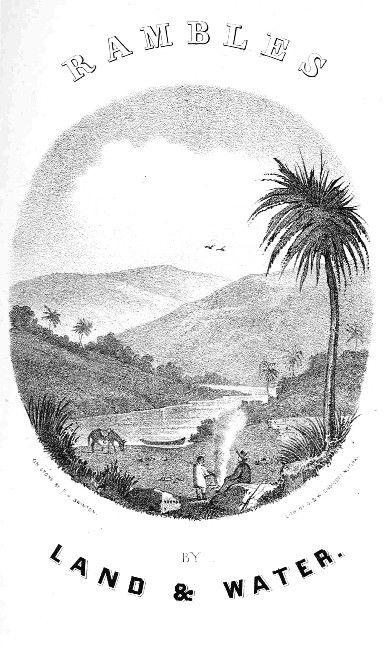
Vignette title page.
Moro castle, havana. 27
Peak of orizaba. 90
Castle of san juan de ulloa, vera cruz. 91
Indian man and woman. 117
Female head. 128
Colossal head. 130
The american sphinx. 132
Curiously ornamented head. 136
A situation. 139
A road side. 140
Sepulchral effigy. 145
A pair of vases. 150
Travelling by night. 161
Talismanic penates. 164
Fragments of idols. 178