
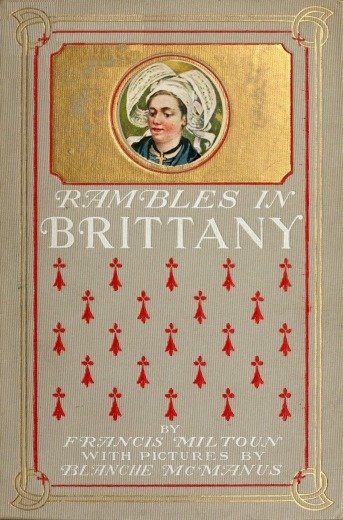
The Project Gutenberg eBook of Rambles in Brittany
Title: Rambles in Brittany
Author: M. F. Mansfield
Illustrator: Blanche McManus
Release date: June 3, 2013 [eBook #42866]
Most recently updated: October 23, 2024
Language: English
Credits: Produced by Chuck Greif and the Online Distributed
Proofreading Team at http://www.pgdp.net (This file was
produced from images generously made available by The
Internet Archive)
Every attempt has been made to replicate the original book as printed. Some typographical errors have been corrected. No attempt has been made to correct or normalize the printed accentuation or spelling of French names or words. The images have been moved from the middle of a paragraph to the closest paragraph break. (etext transcriber’s note) |
RAMBLES IN BRITTANY
WORKS OF
FRANCIS MILTOUN
The following, each 1 vol., library 12mo, cloth, gilt top, profusely illustrated. Net, $2.00; postpaid, $2.16
Rambles in Normandy
Rambles in Brittany
The Cathedrals and Churches of the Rhine
The following, each 1 vol., library 12mo, cloth, gilt top, profusely illustrated. Postpaid, $2.50
The Cathedrals of Northern France
The Cathedrals of Southern France
L. C. PAGE & COMPANY
New England Building, Boston, Mass.
Rambles
in
B R I T T A N Y
By Francis Miltoun
With Many Illustrations
By Blanche McManus
Boston
L. C. PAGE & COMPANY
1906
Copyright, 1905
By L. C. Page & Company
(INCORPORATED)
——
All rights reserved
Published October, 1905
COLONIAL PRESS
Electrotyped and Printed by C. H. Simonds & Co.
Boston, U. S. A.
APOLOGIA
NO promise given to the hostess of one’s inn is alleged as an excuse for writing this book, but it is true that rosy, busy Madame X of the Soleil d’Or, in the fishing village in which the work received its final collation and revision, watched its growth for many a week, daily declaring her hope of some day receiving a volume containing “your impressions.” And, indeed, her hope shall not be vain, for one of the first copies shall be most speedily despatched to her. Moreover, the author and artist hope that it may be acceptable to her critical mind, for she is not likely to be lenient, though she knows full well that to the many authors and artists who make a refuge of her modest inn for months she owes her livelihood.
The book is a record of many journeys and many rambles by road and rail around the coast, and in no sense is it put forth either as a special or as a complete survey of things and matters Breton.
Many lights and shadows have been thrown upon the screen from various points, but the effort has been made to blend them all into a pleasing whole, which shall supplement the guide-books of convention.
It were not possible to do more than has been attempted within the limits of a volume such as this, and therefore many details of routes, and historical data of a relative sort, and a certain amount of topographical information have been scattered through the volume or placed in the appendix, in the belief that such information is greatly needed in a work attempting to purvey “travel talk” even in small measure.
Some of this knowledge is so little subject to change that it may well stand for all time, and, in these days of well-nigh universal travel, may be not thought out of place in a volume intended both for the armchair traveller and also for him who journeys by road and rail. That only a very limited quantity of such information can be included is a misfortune, inasmuch as such a handbook is often used when no other aid is accessible to the traveller.
Finally, the illustrative material, the large number of drawings of sights and scenes, of great architectural monuments, and of the dress of the people, is offered less as a complete pictorial survey than as a panorama of impressions received on and off the beaten track,—and more satisfying and truthful than the mere snap-shots of hurried travel.
In addition, many maps, plans, and diagrams should give many of the itineraries a lucidity often lacking in the usual railway maps.
CONTENTS
| CHAPTER | PAGE | |
| Apologia | v | |
| PART I. | ||
| I. | Introductory | 3 |
| II. | The Province and the People | 11 |
| III. | The Topography of the Province | 33 |
| IV. | Travel Routes in Brittany | 45 |
| V. | The Breton Tongue and Legend | 59 |
| VI. | Manners and Customs | 70 |
| VII. | The Fisheries | 88 |
| PART II. | ||
| I. | The Loire in Brittany | 99 |
| II. | Nantes To Vannes | 116 |
| III. | The Morbihan—Vannes and the “Golfe” | 140 |
| IV. | Auray and the Megalithic Monuments of Morbihan | 159 |
| V. | Morbihan—Lorient and Its Neighbourhood | 179 |
| VI. | Finistère—South | 187 |
| VII. | Finistère—North | 221 |
| VIII. | The Côtes du Nord | 249 |
| IX. | The Emerald Coast | 271 |
| X. | On the Road in Brittany—Mayenne, Fougères, Laval, and Vitré | 309 |
| XI. | Rennes and Beyond | 329 |
| XII. | Religious Festivals and Pardons | 341 |
| Appendices | 359 | |
| Index: A, B, C, D, E, F, G, H, J, K, L, M, N, O, P, Q, R, S, T, V. | 373 | |
LIST OF ILLUSTRATIONS
| PAGE | |
| Constable’s Tower, Vannes (See page 147) | Frontispiece |
| The Loire at Nantes | facing 4 |
| Device of Anne of Brittany | 17 |
| Anne of Brittany | 18 |
| Breton Post-card | 21 |
| St. Brieuc | facing 30 |
| Croisic | facing 42 |
| Map of Brittany | facing 44 |
| The Main Roads of Brittany | 48 |
| Travel Routes in Brittany | 55 |
| St. Pol de Léon | facing 60 |
| The Breton Tongue | 62 |
| Gilles de Laval | 66 |
| Young Bretons | 78 |
| From the Artist’s Sketch Book | 80 |
| La Coiffe Polka | 81 |
| Ironing Coifs | 83 |
| Breton Types | 85 |
| Douarnenez | facing 88 |
| Pornic | 113 |
| Donjon of Clisson | facing 114 |
| St. Nazaire | 123 |
| Ancient Fortifications of Guérande (Diagram) | 126 |
| Châteaubriant | facing 128 |
| Children of Redon | 133 |
| Tour d’Elven | facing 138 |
| Market-woman, Vannes | 142 |
| The Country near Vannes | 143 |
| Ancient City Walls, Vannes (Diagram) | 147 |
| Château of Suscino | facing 148 |
| General Plan of Château of Suscino (Diagram) | 149 |
| Ploërmel | facing 152 |
| Shrine of St. Etienne, Josselin | 154 |
| Château de Josselin | facing 156 |
| Interior of Market-house, Auray | facing 160 |
| Shrine of St. Roch, Auray | 162 |
| The Lines of Carnac | 168 |
| The Lines of Carnac | facing 168 |
| Map of Carnac and the Surrounding Country | 170 |
| Quiberon | facing 172 |
| Hennebont | facing 182 |
| Quimperlé | facing 188 |
| Market-house, Faouët | facing 192 |
| Market-day | 193 |
| Rosporden | 196 |
| Stone Crucifix, Concarneau | facing 198 |
| Concarneau | 199 |
| Pont Aven | facing 202 |
| Environs of Pont Aven (Map) | 204 |
| From the Museum at Quimper | 207 |
| Cape de la Chèvre | facing 214 |
| Woman of Chateaulin | 217 |
| Camaret | facing 220 |
| Landerneau | facing 224 |
| Calvary, Plougastel | facing 228 |
| Lighthouse of Créac’h, Ouessant | facing 236 |
| Roscoff | 239 |
| Ma Douez | 244 |
| Carved Wood Staircase, Morlaix | facing 246 |
| Procession of Sailors, St. Jean du Doigt | 247 |
| Old House, Tréguier | 253 |
| House of Ernest Renan, Tréguier | 254 |
| Shrine of St. Yves, Tréguier | 256 |
| A Binou Player | 261 |
| Binic | 267 |
| Ramparts of St. Malo | facing 272 |
| House of Duguay-Trouin, St. Malo | 281 |
| Tower of Solidor, St. Servan | facing 284 |
| Plans of the Tower of Solidor | 285 |
| The Valley of the Rance (Map) | 292 |
| Duguesclin | 293 |
| Rez-de-Chaussée of Donjon, Dinan (Diagram) | 295 |
| Coif of Miniac | 307 |
| Mayenne | facing 310 |
| Plan of the Ancient Walls and Towers Of Fougères | 314 |
| Beucheresse Gate, Laval | 319 |
| Plan of Vitré in 1811, Showing City Walls | 321 |
| Château de Vitré | facing 322 |
| Tower of St. Martin, Vitré | 323 |
| Château de Rochers | 325 |
| Arms of Madame de Sévigné | 327 |
| Monastery of St. Mélaine, Rennes | 331 |
| Huelgoat | facing 340 |
| Pardon of St. Jean du Doigt | facing 352 |
| The Provinces of France (Map) | 359 |
| The Ancient Provinces of France (Map) | 361 |
| Comparative Metric Scale (Diagram) | 364 |
| Sketch Map of Circular Tour in Brittany | 366 |
| Architectural Names of the Various Parts Of A Feudal Château (Diagram) | 367 |
| Tide and Weather Signals in the Ports of Brittany (Diagram) | 368 |
PART I.
RAMBLES IN BRITTANY
CHAPTER I.
INTRODUCTORY
THE regard which every one has for the old French provinces is by no means inexplicable. Out of them grew the present solidarity of republican France, but in spite of it the old limits of demarcation are not yet expunged. One and all retain to-day their individual characteristics, manners, and customs, and also a certain subconscious atmosphere.
Many are the casual travellers who know Normandy and Brittany, at least know them by name and perhaps something more, but how many of those who annually skim across France, in summer to Switzerland and in winter to the Riviera or to Italy, there to live in seven-franc-a-day pensions, and drink a particularly vile brand of tea, know where Brittany leaves off and Normandy begins, or have more than the vaguest of vague notions as to whether the charming little provincial capital of Nantes, on the Loire, is in Brittany or in Poitou. A recollection of their school-day knowledge of history will help them on the latter point, but geography will come in and puzzle them still more.
There are many French writers, and painters for that matter, who have made these provinces famous. Napoleon, perhaps, set the fashion, when he wrote, in 1786, that eulogy beginning: “It is now six or seven years since I left my native country.” More familiar is the “Native Land” of Lamartine. Camille Flammarion wrote “My Cradle,” meaning Champagne; Dumas wrote of Villers-Cotterets, and Chateaubriand and Renan of Brittany; but head and shoulders above them all stand out Frederic Mistral and his fellows of the Félibres at Avignon and Arles.
All this offers a well-nigh irresistible fascination for those who love literary and historic shrines,—and who does not in these days of universal travel, personally conducted or otherwise? Not every one can follow in the footsteps of Sterne with equal facility and grace, or bask in the radiance of a Stevenson or a Gautier. Still, it is given to most of us who know the lay of the land to discover for ourselves the position of these celebrated shrines, whether the pilgrimage be historical, literary, or artistic.
This is what gives a charm to travel, and even where no new thing is actually discovered, no new pathways broken, there is, after all, a certain zest in such an exploration rivalling that to be obtained from an expedition to the uttermost confines of the Dark Continent, to Tibet, or to Tierra del Fuego.
Primarily, the ancient provinces of France have a story of historical and romantic purport not equalled in the chronicles of any other nation. The distinctive types are but vaguely limned, but the Norman and the Breton stand out most distinctly, and such figures as the Norman and Breton dukes of real history live even more vividly in one’s mind than D’Artagnan and his fellows in the great portrait-gallery of Dumas.
One need not be of the antiquary species in order to revel in the great monuments of history abounding in Brittany even as in Normandy. There are many and beautiful shrines elsewhere,—and doubtless some are more popularly famous than any in Brittany,—but none have played greater or more important rôles in the history and development of the France of to-day than those of the two northwestern provinces.
As has been said, each of the great provinces into which France was divided previous to the Revolution possessed characteristics, unmistakable even to-day. As to the topography of any single one, the question is so vast in its detail that more than mention of principal features can hardly be made in a book such as this. It is then perhaps enough that some slight information concerning Brittany and its principal places should be recorded here, and that the chief configurations of its territory should be outlined.
In addition to the principal old-time governments, there were the ancient fiefs and local divisions, and these in many cases had names often encountered in history and literature. Sometimes these were relics of the still earlier day, of Gaul before the Roman conquest, their ancient names having come down through the ages with but little change.
If one would understand the economic or agricultural aspect of France of to-day, he must know these principal provinces by name at least.
When one is at Chartres, he must be aware that he is on the edge of the great plateau of Beauce,—the granary of France,—and that as he crosses into Brittany—perhaps through Perche, whence come the great-footed Percherons—he enters the country of the ancient Veneti. Farther west lies rock-bound Cornouaille, which in every characteristic resembles Cornwall in Britain; Léon on the north, and finally Penthièvre.
The traveller remakes his history where he finds it. If he have a good memory, this is not a difficult process, but, in any case, the French guide-books, that is to say, those written in French, not the English or Anglo-German variety, are sufficiently explicit as to dates and events to set him on the right track.
The armchair traveller usually desires something more. He likes his plain stories garnished with a not too elaborate series of embellishment, both as to text and illustration, giving him some tangible reminder of things as they are in this enlightened twentieth century, when tram-cars have taken the place of the diligence, and the electric light has supplanted the tallow dip, and one may well say with Sterne: “Since France is so near to England, why not go to France?”
Here, in spots all but unknown even in Normandy and Brittany, the traveller finds for himself monuments of a civilization gone before and of a local history not yet completely erased, and as interesting as those of any land made famous by antiquaries whose only claim to fame rests upon their questionable ability in propounding new theories, of which the chief merit is plausibility,—a process of history-making sadly overdone of late in some parts.
Both in Brittany and in Normandy there are innumerable glorious architectural monuments of a past from which history may be builded anew. Character counts for a great deal with cities as with individuals. One can love Rouen as the capital of the ancient Normandy, or Nantes as the capital of Lower Brittany, but he will no more have the same sort of affection for Lyons or for Nice than he will have it for Manchester or for Chicago.
In the days of old, when each little town had its dignitaries, who may have been counts or who may have been bishops, there was perhaps more individuality than in the present age of monotonous prefects and mayors. Nantes had its dukes, and Rouen had its prelates, and both of them, even to-day, overshadow the civic dignitaries of their time; hence it is the memory of the parts played by them which induces an association of ideas prompting a desire to know personally the ground trodden by them.
Normandy and Brittany are supposed to be the happy hunting-grounds of cheap tourists and trippers, but, as a matter of fact, the former do not go beyond Dieppe, or the latter beyond the Channel Islands,—with possibly a day excursion to St. Malo,—so no discomfort need really arise from the fear of their presence. Furthermore, the tourists from across Channel that one does meet in Normandy or Brittany to-day are not so outrageous in their dress and manners as the type pictured by Punch.
It is a generally recognized fact that no special hardship is involved in modern travel; caravansaries have for the most part given way to inns which, if not exactly palatial, at least furnish creature comforts of a quality quite as good or a great deal better than those to which most travellers are accustomed at home. One may, and most likely will, miss his or her particular brand of tea or tobacco, but will find substitutes quite as excellent, and as far as the language question is concerned, why, that lies at one’s own door, unless one wants to go out as a disciple of Esperanto, the modern successor of Volapuk, dead years ago of sheer weight of consonants.
This book, then, is meant to ensure better knowledge on the part of the casual traveller of that delectable land which may be somewhat vaguely described as old France, of which Brittany and Normandy are as representative in their survivals as any other part.
CHAPTER II.
THE PROVINCE AND THE PEOPLE
BRITTANY, the ancient province which underwent such a strife of warfare and bloodshed in the struggle against invaders, and finally against France, has become one of the most loyal of all the old-time divisions making up the present republic. Her struggle against a curtailment of her ancient rights and the attempts to conserve her liberties were futile, and when the Duchess Anne took Louis XII. for her second husband, Brittany became a part of the royal domain never to be separated therefrom.
It was Duguesclin who saved it for France, Duchess Anne who enriched it, Chateaubriand, Lamennais, Laennec, and Renan who made it illustrious in letters, and Duguay-Trouin, Jacques Cartier, Surcouf, Du Couëdic, and many besides who added to all this the spirit of adventure and romance with which the chronicles of Brittany have ever abounded.
Commonly it has been called a land of granite, an expression which has been consecrated by the usage of many years, but it is also a land most picturesque, melancholy, and dreamy, with immense horizons of sea and sky, and a climate strictly temperate throughout all the year.