
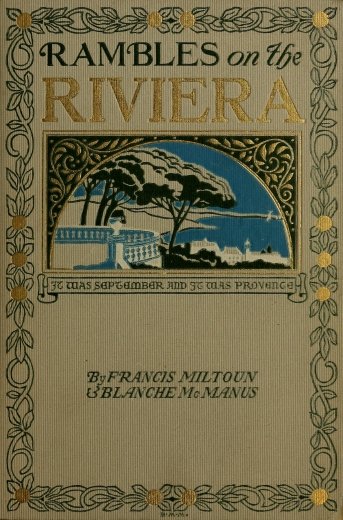
The Project Gutenberg eBook of Rambles on the Riviera
Title: Rambles on the Riviera
Author: M. F. Mansfield
Illustrator: Blanche McManus
Release date: June 13, 2013 [eBook #42941]
Most recently updated: October 23, 2024
Language: English
Credits: Produced by Chuck Greif and the Online Distributed
Proofreading Team at http://www.pgdp.net (This file was
produced from images generously made available by The
Internet Archive)
|
Every attempt has been made to replicate the original book as printed. Some typographical errors have been corrected. A list follows the etext. No attempt has been made to correct or normalize the French orthography of the printed book. The images have been moved from the middle of paragraphs to the closest paragraph break for ease of reading. (etext transcriber’s note) |
RAMBLES ON THE RIVIERA
WORKS OF
FRANCIS MILTOUN
The following, each 1 vol., library 12mo, cloth, gilt top, profusely illustrated. $2.50
Rambles on the Riviera
Rambles in Normandy
Rambles in Brittany
The Cathedrals and Churches of the Rhine
The Cathedrals of Northern France
The Cathedrals of Southern France
The Cathedrals of Italy (In preparation)
The following, 1 vol., square octavo, cloth, gilt top, profusely illustrated. $3.00
Castles and Chateaux of Old Touraine and the Loire Country
L. C. P A G E & C O M P A N Y
New England Building, Boston, Mass.
R a m b l e s
o n
t h e
R I V I E R A
Being some account of journeys made en automobile
and things seen in the fair land of Provence
B Y
F R A N C I S
M I L T O U N
Author of “Rambles in Normandy,” “Rambles in Brittany,”
“Castles and Chateaux of Old Touraine,” etc.
With Many Illustrations
Reproduced from paintings made on the spot
B Y
B L A N C H E
M C M A N U S
BOSTON
L. C. P A G E & C O M P A N Y
1906
Copyright, 1906
By L. C. PAGE & COMPANY
(INCORPORATED)
——
All rights reserved
First Impression, July, 1906
COLONIAL PRESS
Electrotyped and Printed by C. H. Simonds & Co.
Boston, U. S. A.
APOLOGIA
THIS book makes no pretence at being a work of historical or archæological importance; nor yet is it a conventional book of travel or a glorified guide-book. It is merely a record of things seen and heard, with some personal observations on the picturesque, romantic, and topographical aspects of one of the most varied and beautiful touring-grounds in all the world, and is the result of many pleasant wanderings of the author and artist, chiefly by highway and byway, in and out of the beaten track, in preference to travel by rail.
The French Riviera proper is that region bordering upon the Mediterranean west of the Italian frontier and east of Toulon. Nowadays, however, many a traveller adds to the delights of a Mediterranean winter by breaking his journey at one or all of those cities of celebrated art, Nîmes, Arles, and Avignon; or, if he does not, he most assuredly should do so, and know something of the glories of the past civilization of the region which has a far more æsthetic reason for being than the florid Casino of Monte Carlo or the latest palatial hotel along the coast.
For this reason, and because the main gateway from the north leads directly past their doors, that wonderful group of Provençal cities and towns, beginning with Arles and ending with Aix-en-Provence, have been included in this book, although they are in no sense “resorts,” and are not even popular “tourist points,” except with the French themselves.
Particularly are the byways of Old Provence unknown to the average English and American traveller; the wonderful Pays d’Arles, with St. Rémy and Les Baux; the Crau; that fascinating region around the Étang de Berre; the coast between Marseilles and Toulon (and even Marseilles itself); the Estaque; Les Maures; and the Estérel; and yet none of them are far from the beaten track of Riviera travel.
Of the region of forests and mountains that forms the background of the Riviera resorts themselves almost the same thing can be said. The railway and the automobile have made it all very accessible, but ninety per cent., doubtless, of the travellers who annually hie themselves in increasing numbers to Cannes, Nice, Monte Carlo, and Menton know nothing of that wonderful mountain country lying but a few miles back from the sea.
The town-tired traveller, for pleasure or edification, could not do better than devote a part of the time that he usually gives to the resorts of convention to the exploring of any one of a half-dozen of these delightful petits pays: Avignon and Vaucluse, with memories of Petrarch and his Laura; the pebbly Crau, south of Arles; and the fringe of delightful little towns surrounding the Étang de Berre.
Any or all of these will furnish the genuine traveller with emotions and sensations far more pleasurable than those to be had at the most blasé resort that ever opened a golf-links or set up a roulette-wheel, which, to many, are the chief attractions (and memories) of that strip of Mediterranean coast-line known as the Riviera.
The scheme of this book had long been thought out, and much material collected at odd visits, but at last it could be delayed no longer, and the whole was threaded together by hundreds of miles of travel, en automobile, through the highways and byways of the region.
The pictures were made “on the spot,” and, as living, tangible records of things seen, have, perhaps, a quality of appealing interest that is not possessed by the average illustration.
The result is here presented for the value it may have for the traveller or the stay-at-home, it being always understood that no great thing was attempted and little or nothing presented that another might not see or learn for himself.
The reason for being, then, of this book is that it does give a little different view-point of the attractions of Maritime Provence and the Mediterranean Riviera from that to be hitherto gleaned in any single volume on the subject, and as such it is to be hoped that it serves its purpose sufficiently well to merit consideration.
F. M.
Châteauneuf-les-Martigues, January, 1906.
| PAGE | ||
| Apologia | v | |
| PART I. | ||
| CHAPTER | ||
| I. | A Plea for Provence | 3 |
| II. | The Pays d’Arles | 24 |
| III. | St. Rémy de Provence | 42 |
| IV. | The Crau and the Camargue | 56 |
| V. | Martigues: the Provençal Venice | 70 |
| VI. | The Étang de Berre | 87 |
| VII. | A Seascape: From the Rhône To Marseilles | 107 |
| VIII. | Marseilles—Cosmopolis | 122 |
| IX. | A Ramble with Dumas and Monte Cristo | 144 |
| X. | Aix-en-Provence and About There | 156 |
| PART II. | ||
| I. | Marseilles to Toulon | 177 |
| II. | Over Cap Sicié | 202 |
| III. | The Real Riviera | 226 |
| IV. | Hyères and Its Neighbourhood | 239 |
| V. | St. Tropez and Its “Golfe” | 254 |
| VI. | Fréjus and the Corniche d’Or | 271 |
| VII. | La Napoule and Cannes | 292 |
| VIII. | Antibes and the Golfe Jouan | 305 |
| IX. | Grasse and Its Environs | 319 |
| X. | Nice and Cimiez | 330 |
| XI. | Villefranche and the Fortifications | 348 |
| XII. | Eze and la Turbie | 359 |
| XIII. | Old Monaco and New Monte Carlo | 370 |
| XIV. | Menton and the Frontier | 398 |
| Appendices | 409 | |
| Index: A, B, C, D, E, F, G, H, I, J, L, M, N, O, P, R, S, T, V | 431 | |
| PAGE | |
| On the Riviera | Frontispiece |
| “It was September, and it was Provence” | facing 8 |
| A Young Arlesienne | facing 36 |
| Abbey of Montmajour and Vineyard | 39 |
| Baker’s Tally-sticks | 48 |
| St. Rémy | facing 48 |
| A Panetière | 52 |
| The Bulls of the Camargue | 59 |
| Les Saintes Maries | facing 60 |
| Église de la Madeleine, Martigues | facing 70 |
| House of M. Ziem, Martigues | facing 74 |
| Martigues | 77 |
| Loup | 86 |
| Istres | facing 92 |
| The Kilometre West of Salon | 102 |
| Bouches-du-rhône to Marseilles (Map) | 108 |
| Fos-sur-Mer | 111 |
| Chateauneuf | facing 112 |
| Roadside Chapel, St. Pierre | 114 |
| Flower Market, Cours St. Louis | 129 |
| A Cabanon | facing 134 |
| Marseilles in 1640 (Map) | 141 |
| Notre Dame de la Garde and the Harbour Of Marseilles | facing 148 |
| Environs of Marseilles (Map) | 150 |
| Château d’If | facing 150 |
| Les Pennes | facing 160 |
| Roquevaire | 166 |
| Convent Garden, St. Zacharie | facing 170 |
| Marseilles To Toulon (Map) | 176 |
| Cassis | facing 180 |
| La Ciotat and the Bec de l’Aigle | 185 |
| St. Nazaire-du-Var | facing 198 |
| Fishing-boats at Tamaris | facing 208 |
| In Toulon’s Old Port | facing 212 |
| Toulon To Fréjus (Map) | 220 |
| In Les Maures | facing 222 |
| Comparative Theometric Scale | 230 |
| The Terrace, Monte Carlo | facing 234 |
| The Peninsula of Giens | facing 242 |
| Ruined Chapel near St. Tropez | facing 258 |
| Fréjus to Nice (Map) | 277 |
| St. Raphaël | facing 278 |
| Maison Close, St. Raphaël | 280 |
| On the Corniche d’Or | facing 284 |
| Offshore from Agay | facing 286 |
| On the Golfe de la Napoule | facing 292 |
| Cannes and Its Environs (Map) | 301 |
| Jouan-les-Pins | 306 |
| Antibes and Its Environs (Map) | 313 |
| St. Honorat | 317 |
| Flower Market, Grasse | facing 322 |
| Gourdon | 328 |
| Nice to Vintimille (Map) | 331 |
| A Niçois | 334 |
| Nice | facing 338 |
| Olive Pickers in the Var | facing 344 |
| Environs of Nice (Map) | 345 |
| Cap Ferrat | facing 348 |
| Villa of Leopold, King of Belgium | 356 |
| Eze | 360 |
| Augustan Trophy, La Turbie | 364 |
| A Roquebrune Doorway | facing 368 |
| Monte Carlo and Monaco (Map) | 371 |
| The Game | 383 |
| Overlooking Monaco and Monte Carlo | facing 390 |
| The Ravine of Saint Dévote, Monte Carlo, | facing 396 |
| Pont Saint Louis | 406 |
| The Provinces of France (Map) | 409 |
| The Ancient Provinces of France (Map) | 411 |
| Ensemble Carte de Touring Club de France (Map) | 420 |
| The “Taride” Maps | 421 |
| Three Riviera Itineraries (Maps) | 423 |
| Comparative Metric Scale (Diagram) | 427 |
| The Log of an Automobile | 429 |
PART I.
OLD PROVENCE
RAMBLES ON
THE RIVIERA
CHAPTER I.
A PLEA FOR PROVENCE
“À Valence, le Midi commence!” is a saying of the French, though this Rhône-side city, the Julia-Valentia of Roman times, is in full view of the snow-clad Alps. It is true, however, that as one descends the valley of the torrential Rhône, from Lyons southward, he comes suddenly upon a brilliancy of sunshine and warmth of atmosphere, to say nothing of many differences in manners and customs, which are reminiscent only of the southland itself. Indeed this is even more true of Orange, but a couple of scores of miles below, whose awning-hung streets, and open-air workshops are as brilliant and Italian in motive as Tuscany itself. Here at Orange one has before him the most wonderful old Roman arch outside of Italy, and an amphitheatre so great and stupendous in every way, and so perfectly preserved, that he may well wonder if he has not crossed some indefinite frontier and plunged into the midst of some strange land he knew not of.
The history of Provence covers so great a period of time that no one as yet has attempted to put it all into one volume, hence the lover of wide reading, with Provence for a subject, will be able to give his hobby full play.
The old Roman Provincia, and later the mediæval Provence, were prominent in affairs of both Church and State, and many of the momentous incidents which resulted in the founding and aggrandizing of the French nation had their inception and earliest growth here. There may be some doubts as to the exact location of the Fossés Mariennes of the Romans, but there is not the slightest doubt that it was from Avignon that there went out broadcast, through France and the Christian world of the fourteenth century, an influence which first put France at the head of the civilizing influences of Christendom.
The Avignon popes planned a vast cosmopolitan monarchy, of which France should be the head, and Avignon the new Rome.
The Roman emperors exercised their influence throughout all this region long before, and they left enduring monuments wherever they had a foothold. At Orange, St. Rémy, Avignon, Arles, and Nîmes there were monumental arches, theatres, and arenas, quite the equal of those of Rome itself, not in splendour alone, but in respect as well to the important functions which they performed.
The later middle ages somewhat dimmed the ancient glories of the Romanesque school of monumental architecture—though it was by no means pure, as the wonderfully preserved and dainty Greek structures at Nîmes and Vienne plainly show—and the roofs of theatres and arenas fell in and walls crumbled through the stress of time and weather.
In spite of all the decay that has set in, and which still goes on, a short journey across Provence wonderfully recalls other days. The traveller who visits Orange, and goes down the valley of the Rhône, by Avignon, St. Rémy, Arles, Nîmes, Aix, and Marseilles, will be an ill-informed person indeed if he cannot construct history for himself anew when once he is in the midst of this multiplicity of ancient shrines.
Day by day things are changing, and even old Provence is fast coming under the influences of electric railroads and twentieth-century ideas of progress which bid fair to change even the face of nature: Marseilles is to have a direct communication with the Rhône and the markets of the north by means of a canal cut through the mountains of the Estaque, and a great port is to be made of the Étang de Berre (perhaps), and trees are to be planted on the bare hills which encircle the Crau, with the idea of reclaiming the pebbly, sandy plain.
No doubt the deforestation of the hillsides has had something to do, in ages past, with the bareness of the lower river-bottom of the Rhône which now separates Arles from the sea. Almost its whole course below Arles is through a treeless, barren plain; but, certainly, there is no reflection of its unproductiveness in the lives of the inhabitants. There is no evidence in Arles or Nîmes, even to-day—when we know their splendour has considerably faded—of a poverty or dulness due to the bareness of the neighbouring country.
Irrigation will accomplish much in making a wilderness blossom like the rose, and when the time and necessity for it really comes there is no doubt but that the paternal French government will take matters into its own hands and turn the Crau and the Camargue into something more than a grazing-ground for live-stock. Even now one need not feel that there is any “appalling cloud of decadence” hanging over old Provence as some travellers have claimed.
The very best proof one could wish, that Provence is not a poor impoverished land, is that the best of everything is grown right in her own boundaries,—the olive, the vine, the apricot, the peach, and vegetables of the finest quality. The mutton and beef of the Crau, the Camargue, and the hillsides of the coast ranges are most excellent, and the fish supply of the Mediterranean is varied and abundant; loup, turbot, thon, mackerel, sardines, and even sole,—which is supposed to be the exclusive specialty of England and Normandy,—with langouste and coquillages at all times. No cook will quarrel with the supply of his market, if he lives anywhere south of Lyons; and Provence, of all the ancient gouvernements of France, is the land above all others where all are good cooks,—a statement which is not original with the author of this book, but which has come down since the days of the old régime, when Provence was recognized as “la patrie des grands maîtres de cuisine.”
“It was September, and it was Provence,” are the opening words of Daudet’s “Port Tarascon.” What more significant words could be uttered to awaken the memories of that fair land in the minds of any who had previously threaded its highways and byways? From the days of Petrarch writers of many schools have sung its praises, and the literature of the subject is vast and varied, from that of the old geographers to the last lays of Mistral, the present deity of Provençal letters.
The Loire divides France on a line running from the southeast to the middle of the west coast, parting the territory into two great divisions, which in the middle ages had a separate form of legislation, of speech, and of literature. The language south of the Loire was known as the langue d’oc (an expression which gave its name to a province), so called from the fact, say some etymologists and philologists, that the expression of affirmation in the romance language of the south was “oc” or “hoc.” Dialects were common enough throughout this region, as elsewhere in France; but there was a certain grammatical resemblance between them all which distinguished them from the speech of the Bretons and Normans in the north. This southern language was principally distinguished from northern French by the existence of many Latin roots, which in the north had been eliminated. Foreign influences, curiously enough, had not crept in in the south, and, like the Spanish and the Italian speech, that of Languedoc (and Provence) was of a dulcet mildness which in its survival to-day, in the chief Provençal districts, is to be remarked by all.
Northward of the Loire the langue d’œil was spoken, and this language in its ultimate survival, with the interpolation of much that was Germanic, came to be the French that is known to-day.
The Provençal tongue, even the more or less corrupt patois of to-day which Mistral and the other Félibres are trying to purify, is not so bad after all, nor so bizarre as one might think. It does not resemble French much more than it does Italian, but it is astonishingly reminiscent of many tongues, as the following quatrain familiar to us all will show: