
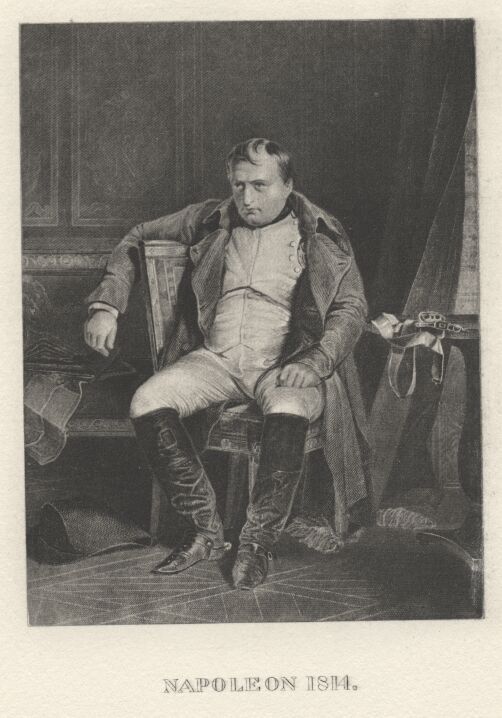
CHAPTER IV.
As I have announced previously, I shall endeavor to record in this chapter some recollections of events personal to the Emperor which occurred during the journey between the frontiers of France and Prussia. How sad a contrast results, alas! as we attempt to compare our journey to Moscow with that of our return. One must have seen Napoleon at Dresden, surrounded by a court of princes and of kings, to form an idea of the highest point which human greatness can reach. There more than ever elsewhere the Emperor was affable to all; fortune smiled upon him, and none of those who enjoyed with us the spectacle of his glory could even conceive the thought that fortune could soon prove unfaithful to him and in so striking a manner. I remember, among other particulars of our stay at Dresden, a speech I heard the Emperor make to Marshal Berthier, whom he had summoned at a very early hour. When the marshal arrived, Napoleon had not yet risen, but I received orders to bring him in at once; so that while dressing the Emperor, I heard between him and his major-general a conversation of which I wish I could remember the whole, but at least I am sure of repeating correctly one thought which struck me. The Emperor said in nearly these words:—
"I wish no harm to Alexander; it is not on Russia that I am making war, no more than on Spain; I have only one enemy,—England, and it is her I am striving to reach in Russia; I will pursue her everywhere." During this speech the marshal bit his nails, as was his constant habit. On that day a magnificent review was held, at which all the princes of the Confederation were present, surrounding their chief as great vassals of his crown.
When the various army-corps marshaled from the other side of the Elbe had advanced to the confines of Poland, we left Dresden, meeting everywhere the same enthusiasm on the advent of the Emperor. We were as a result sumptuously entertained in every place at which we halted, so anxious were the inhabitants to testify their regard for his Majesty, even in the person of those who had the honor of serving him.
At this time there was a general rumor in the army, and among the persons of the Emperor's household, that his intention was to re-establish the kingdom of Poland. Ignorant as I was, and from my position should naturally be, of all political matters, I heard no less than others the expression of an opinion which was universal, and which was discussed openly by all. Sometimes the Emperor condescended to ask me what I heard, and always smiled at my report, since I could not tell the truth and say anything that would have been disagreeable to him; for he was then, and I do not speak too strongly, universally adored by the Polish population.
On the 23d of June we were on the banks of the Niemen, that river already become so famous by the interview between the two Emperors, under circumstances very different from those in which they now found themselves.
The passage of the army began in the evening, and lasted for forty-eight hours, during which time the Emperor was almost constantly on horseback, so well he knew that his presence expedited matters. Then we continued our journey to Wilna, the capital of the Grand Duchy of Lithuania, and on the 27th arrived in front of this town, occupied by the Russians; and it may truly be said that there, and there alone, military operations began, for up to this time the Emperor had traveled as he would have done in the departments of the interior of France. The Russians, being attacked, were beaten and fell back, so that two days after we entered Wilna, a town of considerable size, which seemed to me to contain about thirty thousand inhabitants. I was struck with the incredible number of convents and churches which are there. At Wilna the Emperor was much gratified by the demand of five or six hundred students that they should be formed into a regiment. It is needless to say that such solicitations were always eagerly granted by his Majesty.
We rested for some time at Wilna; the Emperor thence followed the movement of his armies, and occupied himself also with organizing the Grand Duchy of Lithuania, of which this town, as is well known, is the capital. As the Emperor was often on horseback, I had sufficient leisure to acquaint myself thoroughly with the town and its environs. The Lithuanians were in a state of enthusiasm impossible to describe; and although I have seen during my life many fetes, I shall never forget the joyous excitement of the whole population when the grand national fete of the regeneration of Poland was celebrated, which owing either to a singular coincidence, or the calculation of the Emperor, was appointed for the 14th of July. The Poles were still uncertain as to the ultimate fate which the Emperor reserved for their country; but a future bright with hope shone before their eyes, until these visions were rudely dispelled by the Emperor's reply to the deputation from the Polish confederation established at Warsaw. This numerous deputation, with a count palatine at its head, demanded the integral re-establishment of the ancient kingdom of Poland. This was the Emperor's reply:—
"Messieurs, deputies of the Confederation of Poland, I have heard with interest what you have just said. Were I a Pole, I should think and act as you have done, and I should have voted like you in the assembly at Warsaw; for love of country is the first virtue of civilized man.
"In my position I have many opposing interests to reconcile, and many duties to fulfill. If I had reigned at the time of the first, second, or third division of Poland, I would have armed all my people to sustain you. As soon as victory permitted me to restore your ancient laws to your capital and to a part of your provinces, I have done so readily, without, however, prolonging a war which would have shed the blood of my subjects.
"I love your nation. For sixteen years I have seen your soldiers by my side on the fields of Italy as on those of Spain.
"I applaud all that you have done; I authorize the efforts you wish to make; and all that depends on me to carry out your resolutions shall be done.
"If your efforts are unanimous, you may indulge the hope of forcing your enemies to recognize your rights. But in these countries, so distant and so extensive, any hope of success can be founded only on the unanimous efforts of the population which occupies them.
"I have maintained the same position since my first appearance in Poland. I should add here that I have guaranteed to the Emperor of Austria the integrity of his States, and I could authorize no movement tending to disturb him in the peaceful possession of what remains to him of the Polish provinces. Let Lithuania, Samogitia, Witepsk, Polotsk, Mohilow, Wolhynia, Ukraine, and Podolia be animated by the same spirit I have seen in great Poland, and Providence will crown with success the holiness of your cause; it will recompense this devotion to your native country which has made you such an object of interest, and has obtained for you the right to my esteem and protection, on which you may rely under all circumstances."
I have thought it best to give here the entire reply of the Emperor to the deputies of the Polish confederation, as I was a witness of the effect it produced at Wilna. A few Poles with whom I was associated spoke to me of it with sorrow; but their consternation was not loudly expressed, and the air did not the less resound with cries of "Vive l'Empereur!" each time the Emperor showed himself in public, which is to say almost every day.
During our stay at Wilna some hopes were entertained that a new peace was about to be concluded, as an envoy had arrived from the Emperor Alexander. But these hopes were of short duration; and I have since ascertained that the Russian officer, M. Balochoff, fearing, like almost all of his nation, a reconciliation between the two emperors, delivered his message in such a manner as to rouse the pride of his Majesty, who sent him back after a cool reception. Everything smiled on the Emperor. He was then at the head of the most numerous as well as most formidable army he had ever commanded. On M. Balachoff's departure everything was set in order for the execution of his Majesty's plans.
When on the point of penetrating into the Russian territory, his Majesty no longer maintained his customary serenity; at least, I had occasion to remark that he was unusually silent at the hours I had the honor to approach him; and, nevertheless, as soon as his plans were made, and he had brought his troops from the other side of the Vilia, the river on which Wilna is situated, the Emperor took possession of the Russian territory with the enthusiastic ardor one would expect in a young man. One of the escort which accompanied him related to me that the Emperor spurred his horse to the front, and made him run at his utmost speed nearly a league through the woods alone, and notwithstanding the numerous Cossacks scattered through these woods which lie along the right bank of the Vilia.
I have more than once seen the Emperor much annoyed because there was no enemy to fight. For instance, the Russians had abandoned Wilna, which we had entered without resistance; and again, on leaving this town scouts announced the absence of hostile troops, with the exception of those Cossacks of whom I have spoken. I remember one day we thought we heard the distant noise of cannon, and the Emperor almost shuddered with joy; but we were soon undeceived, the noise was the sound of thunder, and suddenly the most frightful storm I have ever seen burst over the army. The land for a space of more than four leagues was so covered with water that the road could not be seen; and this storm, as fatal as a battle could have been, cost us a large number of men, several thousand horses, and a part of the immense equipments of the expedition.
It was known in the army that the Russians had done an immense amount of work at Drissa, where they had constructed an enormous intrenched camp; and the number of troops collected there, the considerable sums expended in the works, all gave reason to believe that the Russian army would await the French at this point; and this belief was all the more reasonable since the Emperor Alexander, in his numerous proclamations disseminated through the army, and several of which fell into our hands, boasted of conquering the French at Drissa, where (said these proclamations) we should find our grave. It was otherwise ordained by destiny; for the Russians, constantly falling back towards the heart of Russia, abandoned this famous camp of Drissa on the approach of the Emperor: I heard it said by many general officers that a great battle would have been at that time a salutary event for the French army, in which discontent was beginning to increase, first, for want of enemies to fight, and second; because privations of every kind became each day more unendurable. Whole divisions lived, so to speak, by pillage. The soldiers devastated the dwellings and cottages found at rare intervals in the country; and, in spite of the severe orders of the Emperor against marauding and pillaging, these orders could not be executed, for the officers themselves lived for the most part on the booty which the soldiers obtained and shared with them.
The Emperor affected before his soldiers a serenity which he was far from feeling; and from a few detached words which I heard him pronounce in this grave situation, I am authorized to believe that the Emperor desired a battle so ardently, only in the hope that the Emperor Alexander would make him new overtures leading to peace. I think that he would then have accepted it after the first victory; but he would never have consented to retrace his steps after such immense preparations without having waged one of those great battles which furnish sufficient glory for a campaign; at least, that is what I heard him say repeatedly. The Emperor also often spoke of the enemies he had to combat with an affected disdain which he did not really feel; his object being to cheer the officers and soldiers, many of whom made no concealment of their discouragement.
Before leaving Wilna, the Emperor established there a kind of central government, at the head of which he had placed the Duke of Bassano, with the object of having an intermediate point between France and the line of operations he intended to carry on in the interior of Russia. Disappointed, as I have said, by the abandonment of the camp of Drissa by the Russian army, he marched rapidly towards Witepsk, where the greater part of the French forces were then collected: but here the ire of the Emperor was again aroused by a new retreat of the Russians; for the encounters of Ostrovno and Mohilev, although important, could not be considered as the kind of battle the Emperor so ardently desired. On entering Witepsk, the Emperor learned that the Emperor Alexander, who a few days before had his headquarters there, and also the Grand Duke Constantine, had quitted the army, and returned to St. Petersburg.
At this period, that is to say, on our arrival at Witepsk, the report was spread abroad that the Emperor would content himself with taking position there, and organizing means of subsistence for his army, and that he would postpone till the next year the execution of his vast designs on Russia. I could not undertake to say what his inmost thoughts were on this subject; but what I can certify is that, being in a room adjoining his, I one day heard him say to the King of Naples, that the first campaign of Russia was ended, and that he would be the following year at Moscow, the next at St. Petersburg, and that the Russian war was a three years' campaign. Had it pleased Providence that his Majesty had executed this plan, which he outlined to the King of Naples so earnestly, so many of the brave would not have laid down their lives a few months after in the frightful retreat, the horrors of which I shall hereafter describe.
During our stay at Witepsk, the heat was so excessive that the Emperor was much exhausted, and complained of it incessantly; and I have never seen him under any circumstances so oppressed by the weight of his clothing. In his room he rarely wore his coat, and frequently threw himself on his bed to rest. This is a fact which many persons can attest as well as I; for he often received his general officers thus, though it had been his custom never to appear before them without the uniform which he habitually wore. Nevertheless, the influence which the heat had on his physical condition had not affected his great soul; and his genius ever on the alert embraced every branch of the administration. But it was easily seen by those whose positions enabled them best to know his character that the source of his greatest suffering at Witepsk was the uncertainty whether he should remain in Poland, or should advance without delay into the heart of Russia. While he was hesitating between these two decisions he was nearly always sad and taciturn.
In this state of vacillation between repose and motion, the Emperor's preference was not doubtful; and at the end of a council where I heard it said that his Majesty met with much opposition, I learned that we were to move forward and advance on Moscow, from which it was said that we were only twenty days' march distant. Among those who opposed most vehemently this immediate march on Moscow, I heard the names cited of the Duke of Vicenza and the Count of Lobau; but what I can assert of my own knowledge, and which I learned in a manner to leave no room for doubt, is that the grand marshal of the palace tried on numerous occasions to dissuade the Emperor from this project. But all these endeavors were of no avail against his will.
We then directed our course towards the second capital of Russia, and arrived after a few days march at Smolensk, a large and beautiful city. The Russians, whom he thought he had caught at last, had just evacuated it, after destroying much booty, and burning the greater part of the stores.
We entered by the light of the flames, but it was nothing in comparison to what awaited us at Moscow. I remarked at Smolensk two buildings which seemed to me of the greatest beauty,—the cathedral and the episcopal palace, which last seemed to form a village in itself, so extensive are the buildings, and being also separated from the city.
I will not make a list of the places with barbarous names through which we passed after leaving Smolensk. All that I shall add as to our itinerary during the first half of this gigantic campaign is that on the 5th of September we arrived on the banks of the Moskwa, where the Emperor saw with intense satisfaction that at last the Russians were determined to grant him the great battle which he so ardently desired, and which he had pursued for more than two hundred leagues as prey that he would not allow to escape him.
CHAPTER V.
THE day after the battle of the Moskwa, I was with the Emperor in his tent which was on the field of battle, and the most perfect calm reigned around us. It was a fine spectacle which this army presented, calmly re-forming its columns in which the Russian cannon had made such wide gaps, and proceeding to the repose of the bivouac with the security which conquerors ever feel. The Emperor seemed overcome with fatigue. From time to time he clasped his hands over his crossed knees, and I heard him each time repeat, with a kind of convulsive movement, "Moscow! Moscow!" He sent me several times to see what was going on outside, then rose himself, and coming up behind me looked out over my shoulder. The noise made by the sentinel in presenting arms each time warned me of his approach. After about a quarter of an hour of these silent marches to and fro, the sentinel advanced and cried, "To arms!" and like a lightning flash the battalion square was formed around the Emperor's tent. He rushed out, and then re-entered to take his hat and sword. It proved to be a false alarm, as a regiment of Saxons returning from a raid had been mistaken for the enemy.
There was much laughter over this mistake, especially when the raiders came in sight, some bearing quarters of meat spitted on the ends of their bayonets, others with half-picked fowls or hams which made the mouth water. I was standing outside the tent, and shall never forget the first movement of the sentinel as he gave the cry of alarm. He lowered the stock of his gun to see if the priming was in place, shook the barrel by striking it with his fist, then replaced the gun on his arm, saying, "Well, let them come; we are ready for them." I told the occurrence to the Emperor, who in his turn related it to Prince Berthier; and in consequence the Emperor made this brave soldier drink a glass of his best Chambertin wine.
It was the Duke of Dantzic who first entered Moscow, and the Emperor came only after him. This entry was made in the night, and never was there a more depressing scene. There was something truly frightful in this silent march of an army halted at intervals by messages from inside the city, which seemed to be of a most ominous character. No Muscovite figures could be distinguished except those of a few beggars covered with rags, who watched with stupid astonishment the army file past; and as some few of these appeared to be begging alms, our soldiers threw them bread and a few pieces of money. I cannot prevent a sad reflection on these unfortunate creatures, whose condition alone remains unchanged through great political upheavals, and who are totally without affection and without national sympathies.
As we advanced on the streets of the faubourgs, we looked through the windows on each side, and were astonished to perceive no human being; and if a solitary light appeared in the windows of a few houses, it was soon extinguished, and these signs of life so suddenly effaced made a terrible impression. The Emperor halted at the faubourg of Dorogomilow, and spent the night there, not in an inn, as has been stated, but in a house so filthy and wretched that next morning we found in the Emperor's bed, and on his clothes, vermin which are by no means uncommon in Russia. We were tormented by them also to our great disgust, and the Emperor did not sleep during the whole night he passed there. According to custom, I slept in his chamber; and notwithstanding the precaution I had taken to burn vinegar and aloes wood, the odor was so disagreeable that every moment the Emperor called me.
"Are you asleep, Constant?"—"No, Sire."—"My son, burn more vinegar, I cannot endure this frightful odor; it is a torment; I cannot sleep." I did my best; but a moment after, when the fumes of the vinegar were evaporated, he again recommended me to burn sugar or aloes wood.
It was two o'clock in the morning when he was informed that a fire had broken out in the city. The news was received through Frenchmen residing in this country, and an officer of the Russian police confirmed the report, and entered into details too precise for the Emperor to doubt the fact. Nevertheless, he still persisted in not believing it. "That is not possible. Do you believe that, Constant? Go, and find out if it is true." And thereupon he threw himself again on his bed, trying to rest a little; then he recalled me to make the same inquiries.
The Emperor passed the night in extreme agitation, and when daylight came he knew all. He had Marshal Mortier called, and reprimanded both him and the young guard. Mortier in reply showed him, houses covered with iron the roofs of which were uninjured, but the Emperor pointed out to him the black smoke which was issuing from them, pressed his hands together, and stamped his heels on the rough planks of his sleeping-room.
At six o'clock in the morning we were at the palace of the Kremlin, where Napoleon occupied the apartment of the Czars, which opened on a vast esplanade reached by a broad stone staircase. On this same esplanade could be seen the church in which were the tombs of the ancient sovereigns, also the senatorial palace, the barracks, the arsenal, and a splendid clock tower, the cross on which towers above the whole city. This is the gilded cross of Ivan. The Emperor threw a satisfied glance over the beautiful scene spread out before him; for no sign of fire was yet seen in all the buildings which surrounded the Kremlin. This palace is a mixture of Gothic and modern architecture, and this mingling of the two styles gives it a most singular appearance.
Within these walls lived and died the old dynasties of the Romanoff and Ruric; and this is the same palace which has been so often stained with blood by the intrigues of a ferocious court, at a period when all quarrels were settled with the poniard. His Majesty could not obtain there even a few hours of quiet sleep.
In fact, the Emperor, somewhat reassured by the reports of Marshal Mortier, was dictating to the Emperor Alexander words of peace, and a Russian flag of truce was about to bear this letter, when the Emperor, who was promenading the length and breadth of his apartment, perceived from his windows a brilliant light some distance from the palace. It was the fire, which had burst out again fiercer than ever; and as the wind from the north was now driving the flames in the direction of the Kremlin, the alarm was given by two officers who occupied the wing of the building nearest the fire. Wooden houses of many various colors were devoured in a few moments, and had already fallen in; magazines of oil, brandy, and other combustible materials, threw out flames of a lurid hue, which were communicated with the rapidity of lightning to other adjoining buildings. A shower of sparks and coals fell on the roofs of the Kremlin; and one shudders to think that one of these sparks alone falling on a caisson might have produced a general explosion, and blown up the Kremlin; for by an inconceivable negligence a whole park of artillery had been placed under the Emperor's windows.
Soon most incredible reports reached the Emperor; some said that Russians had been seen stirring the fire themselves, and throwing inflammable material into the parts of houses still unburned, while those of the Russians who did not mingle with the incendiaries, stood with folded arms, contemplating the disaster with an imperturbability which cannot be described. Except for the absence of cries of joy and clapping of hands they might have been taken for men who witness a brilliant display of fireworks. It was soon very evident to the Emperor that it was a concerted plot laid by the enemy.
He descended from his apartment by the great northern staircase made famous by the massacre of the Strelitz. The fire had already made such enormous progress that on this side the outside doors were half burned through, and the horses refused to pass, reared, and it was with much difficulty they could be made to clear the gates. The Emperor had his gray overcoat burned in several places, and even his hair; and a moment later we were walking over burning firebrands.
We were not yet out of danger, and were obliged to steer clear of the burning rubbish which encumbered our path. Several outlets were tried, but unsuccessfully, as the hot breezes from the fire struck against our faces, and drove us back in terrible confusion. At last a postern opening on the Moskwa was discovered, and it was through this the Emperor with his officers and guard succeeded in escaping from the Kremlin, but only to re-enter narrow streets, where the fire, inclosed as in a furnace, was increased in intensity, and uniting above our heads the flames thus formed a burning dome, which overshadowed us, and hid from us the heavens. It was time to leave this dangerous place from which one means of egress alone was open to us,—a narrow, winding street encumbered with debris of every kind, composed of flaming beams fallen from the roofs, and burning posts. There was a moment of hesitation among us, in which some proposed to the Emperor to cover him from head to foot with their cloaks, and transport him thus in their arms through this dangerous passage. This proposition the Emperor rejected, and settled the question by throwing himself on foot into the midst of the blazing debris, where two or three vigorous jumps put him in a place of safety.
Then ensued a touching scene between the Emperor and the Prince of Eckmuhl, who, wounded at the Moskwa, had himself borne back in order to attempt to save the Emperor, or to die with him. From a distance the marshal perceived him calmly emerging from so great a peril; and this good and tender friend by an immense effort hastened to throw himself into the Emperor's arms, and his Majesty pressed him to his heart as if to thank him for rousing such gentle emotions at a moment when danger usually renders men selfish and egotistical.
At length the air itself, filled with all these flaming masses, became so heated that it could no longer be breathed. The atmosphere itself was burning, the glass of the windows cracked,' and apartments became untenable. The Emperor stood for a moment immovable, his face crimson, and great drops of perspiration rolling from his brow, while the King of Naples, Prince Eugene, and the Prince de Neuchatel begged him to quit the palace, whose entreaties he answered only by impatient gestures. At this instant cries came from the wing of the palace situated farthest to the north, announcing that the walls had fallen, and that the fire was spreading with frightful rapidity; and seeing at last that his position was no longer tenable, the Emperor admitted that it was time to leave, and repaired to the imperial chateau of Petrovskoi.
On his arrival at Petrovskoi the Emperor ordered M. de Narbonne to inspect a palace which I think had belonged to Catherine. This was a beautiful building, and the apartments handsomely furnished. M. de Narbonne returned with this information; but almost immediately flames burst from every side, and it was soon consumed.
Such was the fury of these wretches who were hired to burn everything, that the boats which covered the Moskwa laden with grain; oats, and other provisions, were burned, and sunk beneath the waves with a horrible crackling sound. Soldiers of the Russian police had been seen stirring up the fire with tarred lances, and in the ovens of some houses shells had been placed which wounded many of our soldiers in exploding.
In the streets filthy women and hideous, drunken men ran to the burning houses and seized flaming brands, which they carried in every direction, and which our soldiers were obliged repeatedly to knock out of their hands with the hilts of their swords before they would relinquish them. The Emperor ordered that these incendiaries when taken in the act should be hung to posts in the public squares; and the populace prostrated themselves around these gallows, kissing the feet of those executed, praying, and signing themselves with the sign of the cross. Such fanaticism is almost unparalleled.
One incident of which I was a witness proves that those hired to carry out this vast plot acted, evidently, according to instructions given by higher authorities. A man covered with a sheepskin, old and tattered, with a miserable capon his head, boldly mounted the steps of the Kremlin. Under this filthy disguise an elegant costume was concealed; and when a stricter surveillance was instituted, this bold beggar himself was suspected, arrested, and carried before the police, where he was questioned by the officer of the post. As he made some resistance, thinking this proceeding somewhat arbitrary, the sentinel put his hand on his breast to force him to enter; and this somewhat abrupt movement pushing aside the sheepskin which covered him, decorations were seen, and when his disguise was removed he was recognized as a Russian officer. He had on his person matches which he had been distributing to the men of the people, and when questioned admitted that he was specially charged to keep alive the fire of the Kremlin. Many questions were asked, each eliciting new confessions, all of which were made in the most indifferent manner, and he was put in prison, and was, I think, punished as an incendiary; but of this I am not certain. When any of these wretches were brought before the Emperor, he shrugged his shoulders, and with gestures of scorn and anger ordered that they should be removed from his sight, and the grenadiers sometimes executed justice on them with their bayonets; but such exasperation can be well understood in soldiers thus driven by these base and odious measures from a resting-place earned by the sword.
In Petrovskoi, a pretty residence belonging to one of Alexander's chamberlains, a man was found concealed in one of the apartments his Majesty was to occupy; but not being armed he was released, as it was concluded that fright alone had driven him into this dwelling. The Emperor arrived during the night at his new residence, and waited there in intense anxiety till the fire should be extinguished at the Kremlin, intending to return thither, for the pleasure house of a chamberlain was no suitable place for his Majesty. Thanks to the active and courageous actions of a battalion of the guard, the Kremlin was preserved from the flames, and the Emperor thereupon gave the signal for departure.
In order to re-enter Moscow it was necessary to cross the camp, or rather the several camps, of the army; and we wended our way over cold and miry ground, through fields where all was devastation and ruin. This camp presented a most singular aspect; and I experienced feelings of bitter melancholy as I saw our soldiers compelled to bivouac at the gates of a large and beautiful city of which they were the conquerors, but the fire still more than they. The Emperor, on appointing Marshal Mortier governor of Moscow, had said to him, "Above all, no pillage; you will answer for it with your head." The order was strictly enforced up to the moment the fire began; but when it was evident that the fire would devour everything, and that it was useless to abandon to the flames what would be of much value to the soldiers, liberty was given them to draw largely from this great storehouse of the north.
It was at once sad and amusing to see around poor plank sheds, the only tents our soldiers had, the most magnificent furniture, silk canopies, priceless Siberian furs, and cashmere shawls thrown pell-mell with silver dishes; and then to see the food served on these princely dishes,—miserable black gruel, and pieces of horseflesh still bleeding. Good ammunition-bread was worth at this time treble all these riches, and there came a time when they had not even horseflesh.
On re-entering Moscow the wind bore to us the insufferable odor of burning houses, warm ashes filled our mouths and eyes, and frequently we drew back just in time before great pillars which had been burned in two by the fire, and fell noiselessly on this calcined soil. Moscow was not so deserted as we had thought. As the first impression conquest produces is one of fright, all the inhabitants who remained had concealed themselves in cellars, or in the immense vaults which extend under the Kremlin; and driven out by the fire like wolves from their lairs, when we re-entered the city nearly twenty thousand inhabitants were wandering through the midst of the debris, a dull stupor depicted on faces blackened with smoke, and pale with hunger; for they could not comprehend how having gone to sleep under human roofs, they had risen next morning on a plain. They were in the last extremity of want; a few vegetables only remained in the gardens, and these were devoured raw, while many of these unfortunate creatures threw themselves at different times into the Moskwa, endeavoring to recover some of the grain cast therein by Rostopchin's orders;
[Count Feodor Rostopchin, born 1765; died 1826. He denied that Moscow was burnt by his authority. He claimed that it was burnt partly by the French, and partly by Russians without orders.]
and a large number perished in the water in these fruitless efforts. Such was the scene of distress through which the Emperor was obliged to pass in order to reach the Kremlin.
The apartments which he occupied were spacious and well lighted, but almost devoid of furniture; but his iron bedstead was set up there, as in all the chateaux he occupied in his campaigns. His windows opened on the Moskwa, and from there the fire could still be plainly seen in various quarters of the city, reappearing on one side as soon as extinguished on the other. His Majesty said to me one evening with deep feeling, "These wretches will not leave one stone upon another." I do not believe there was ever in any country as many buzzards as at Moscow. The Emperor was annoyed by their presence, and exclaimed, "Mon Dieu! will they follow us everywhere?"
There were a few concerts during our stay at the Emperor's residence in Moscow; but Napoleon seemed much dejected when he appeared at them, for the music of the saloons made no impression on his harassed mind, and the only kind that ever seemed to stir his soul was that of the camp before and after a battle.
The day after the Emperor's arrival, Messieurs Ed—— and V—— repaired to the Kremlin in order to interview his Majesty, and after waiting some time without seeing him, were expressing their mutual regret at having failed in this expectation, when they suddenly heard a shutter open above their heads, and, raising their eyes, recognized the Emperor, who said, "Messieurs, who are you?"—"Sire, we are Frenchmen!" He requested them to mount the stairs to the room he occupied, and there continued his questions. "What is the nature of the occupation which has detained you in Moscow?"—"We are tutors in the families of two Russian noblemen, whom the arrival of the French troops have driven from their homes. We have submitted to the entreaties made by them not to abandon their property, and we are at present alone in their palaces." The Emperor inquired of them if there were still other Frenchmen at Moscow, and asked that they should be brought to him; and then proposed that they should charge themselves with maintaining order, appointing as chief, M. M——, whom he decorated with a tri-colored scarf. He recommended them to prevent the pillage of the French soldiers in the churches, and to have the malefactors shot, and enjoined them to use great rigor towards the galley-slaves, whom Rostopchin had pardoned on condition that they would set fire to the city.
A part of these Frenchmen followed our army in its retreat, seeing that a longer stay at Moscow would be most disagreeable to them; and those who did not follow their example were condemned to work on the streets.
The Emperor Alexander, when informed of the measures of Rostopchin, harshly rebuked the governor, and ordered him at once to restore to liberty these unfortunate Frenchmen.
CHAPTER VI.
We re-entered the Kremlin the morning of the 18th of September. The palace and the hospital for foundlings were almost the only buildings remaining uninjured. On the route our carriages were surrounded by a crowd of miserable Muscovites begging alms. They followed us as far as the palace, walking through hot ashes, or over the heated stones, which crumbled beneath their feet. The poorest were barefoot; and it was a heart-rending sight to see these creatures, as their feet touched the burning debris, give vent to their sufferings by screams and gestures of despair. As the only unencumbered part of the street was occupied by our carriages, this swarm threw themselves pell-mell against the wheels or under the feet of our horses. Our progress was consequently very slow, and we had so much the longer under our eyes this picture of the greatest of all miseries, that of a people burned out of their homes, and without food or the means to procure it. The Emperor had food and money given them.
When we were again established at the Kremlin, and had resumed our regular routine of living, a few days passed in perfect tranquillity. The Emperor appeared less sad, and in consequence those surrounding him became somewhat more cheerful. It seemed as if we had returned from the campaign, and taken up again the customary occupations of city life; but if the Emperor sometimes indulged in this illusion, it was soon dispelled by the sight Moscow presented as seen from the windows of his apartments, and each time Napoleon's eyes turned in that direction it was evident that he was oppressed by the saddest presentiments, although he no longer manifested the same vehement impatience as on his first stay at the palace, when he saw the flames surrounding him and driving him from his apartments. But he exhibited the depressing calm of a careworn man who cannot foresee how things will result. The days were long at the Kremlin while the Emperor awaited Alexander's reply, which never came. At this time I noticed that the Emperor kept constantly on his table Voltaire's history of Charles XII.
The Emperor was a prey to his genius for administration, even in the midst of the ruins of this great city; and in order to divert his mind from the anxiety caused by outside affairs, occupied himself with municipal organization, and had already arranged that Moscow should be stocked with provisions for the winter.
A theater was erected near the Kremlin, but the Emperor never attended. The troupe was composed of a few unfortunate French actors, who had remained in Moscow in a state of utter destitution; but his Majesty encouraged this enterprise in the hope that theatrical representations would offer some diversion to both officers and soldiers. It was said that the first actors of Paris had been ordered to Moscow, but of that I know nothing positively. There was at Moscow a celebrated Italian singer whom the Emperor heard several times, but only in his apartments, and he did not form part of the regular troupe.
Until the 18th of October the time was spent in discussions, more or less heated, between the Emperor and his generals, as to the best course to be pursued. Every one well knew that retreat had now become inevitable, and the Emperor was well aware of this fact himself; but it was plainly evident that it cost his pride a terrible struggle to speak the decisive word. The last days preceding the 18th were the saddest I have ever known. In his ordinary intercourse with his friends and counselors his Majesty manifested much coldness of manner; he became taciturn, and entire hours passed without any one present having the courage to begin a conversation. The Emperor, who was generally so hurried at his meals, prolonged them most surprisingly. Sometimes during the day he threw himself on a sofa, a romance in his hand which he simply pretended to read, and seemed absorbed in deep reverie. Verses were sent to him from Paris which he read aloud, expressing his opinion in a brief and trenchant style; he spent three days writing regulations for the French comedy at Paris. It is difficult to understand this attention to such frivolous details when the future was so ominous. It was generally believed, and probably not without reason, that the Emperor acted thus from motives of deep policy, and that these regulations for the French comedy at this time, when no bulletin had yet arrived to give information of the disastrous position of the French army, were written with the object of making an impression on the inhabitants of Paris, who would not fail to say, "All cannot be going so badly, since the Emperor has time to occupy himself with the theater."
The news received on the 18th put an end to all uncertainty. The Emperor was reviewing, in the first court of the Kremlin palace, the divisions of Ney, distributing the cross to the bravest among them, and addressing encouraging words to all, when an aide-de-camp, young Beranger, brought the news that a sharp engagement had taken place at Winkowo between Murat and Kutusoff, and that the vanguard of Murat had been overwhelmed and our position taken. Russia's intention to resume hostilities was now plainly evident, and in the first excitement of the news the Emperor's astonishment was at its height. There was, on the contrary, among the soldiers of Marshal Ney an electric movement of enthusiasm and anger which was very gratifying to his Majesty. Charmed to see how the shame of a defeat, even when sustained without dishonor, excited the pride and aroused a desire to retrieve it in these impassioned souls, the Emperor pressed the hand of the colonel nearest to him, continued the review, and ordered that evening a concentration of all the corps; and before night the whole army was in motion towards Woronowo.
A few days before quitting Moscow, the Emperor had the churches of the Kremlin stripped of their finest ornaments. The ravages of the fire had relaxed the protection that the Emperor had extended to the property of the Russians.
The most magnificent trophy in this collection was the immense cross of the great Ivan. It was necessary to demolish a part of the tower on which it stood in order to take it down, and it required stupendous efforts to break this vast mass of iron. It was the Emperor's intention to place it upon the dome of the Invalides, but it was sunk in the waters of Lake Semlewo.
The evening before the Emperor was to hold a review, the soldiers were busily employed polishing their arms and putting everything in order, to conceal as far as possible the destitute condition to which they were reduced. The most imprudent had exchanged their winter clothing for provisions, many had worn out their shoes on the march, and yet each one made it a point of honor to make a good appearance on review; and when the glancing rays of the sun shone on the barrels of the well-polished guns, the Emperor felt again in witnessing this scene some slight return of the emotions with which his soul was filled on the glorious day of his departure for the campaign.
The Emperor left twelve hundred wounded at Moscow, four hundred of whom were removed by the last corps which quitted the city. Marshal Mortier was the last to go. At Feminskoe, ten leagues from Moscow, we heard the noise of a frightful explosion; it was the Kremlin which had been blown up by the Emperor's orders. A fuse was placed in the vaults of the palace, and everything arranged so that the explosion should not take place within a certain time. Some Cossacks came to pillage the abandoned apartments, in ignorance that a fire was smoldering under their feet, and were thrown to a prodigious height in the air. Thirty thousand guns were abandoned in the fortress. In an instant part of the Kremlin was a mass of ruins. A part was preserved, and a circumstance which contributed no little to enhance the credit of their great St. Nicholas with the Russians was that an image in stone of this saint remained uninjured by the explosion, in a spot where almost everything else was destroyed. This fact was stated to me by a reliable person, who heard Count Rostopchin himself relate it during his stay in Paris.
On the 28th of October the Emperor retraced his way to Smolensk, and passed near the battle-field of Borodino. About thirty thousand corpses had been left on this vast plain; and on our approach flocks of buzzards, whom an abundant harvest had attracted, flew away with horrible croakings. These corpses of so many brave men presented a sickening spectacle, half consumed, and exhaling an odor which even the excessive cold could not neutralize. The Emperor hastened past, and slept in the chateau of Oupinskoe which was almost in ruins; and the next day he visited a few wounded who had been left in an abbey. These poor fellows seemed to recover their strength at the sight of the Emperor, and forgot their sufferings, which must have been very severe, as wounds are always much more painful when cold weather first begins. All these pale countenances drawn with suffering became more serene. These poor soldiers also rejoiced to see their comrades, and questioned them with anxious curiosity concerning the events which had followed the battle of Borodino. When they learned that we had bivouacked at Moscow, they were filled with joy; and it was very evident that their greatest regret was that they could not have been with the others to see the fine furniture of the rich Muscovites used as fuel at the bivouac fires. Napoleon directed that each carriage of the suite should convey one of these unfortunates; and this was done, everybody complying with the order with a readiness which gratified the Emperor exceedingly; and the poor wounded fellows said in accents of most ardent gratitude, that they were much more comfortable on these soft cushions than in the ambulances, which we could well believe. A lieutenant of the cuirassiers who had just undergone an amputation was placed in the landau of the Emperor, while he traveled on horseback.
This answers every accusation of cruelty so gratuitously made against the memory of a great man who has passed away. I have read somewhere with intense disgust that the Emperor sometimes ordered his carriage to pass over the wounded, whose cries of agony made not the slightest impression on him; all of which is false and very revolting. None of those who served the Emperor could have been ignorant of his solicitude for the unfortunate victims of war, and the care he had taken of them. Foreigners, enemies, or Frenchmen,—all were recommended to the surgeon's care with equal strictness.
From time to time frightful explosions made us turn our heads, and glance behind us. They were caissons which were being exploded that we might no longer be encumbered with them, as the march became each day more painful. It produced a sad impression to see that we were reduced to such a point of distress as to be compelled to throw our powder to the winds to keep from leaving it to the enemy. But a still sadder reflection came into our minds at each detonation,—the grand army must be rapidly hastening to dissolution when the material remaining exceeded our needs, and the number of men still left was so much short of that required to use it. On the 30th, the Emperor's headquarters were in a poor hovel which had neither doors nor windows. We had much difficulty in enclosing even a corner sufficient for him to sleep. The cold was increasing, and the nights were icy; the small fortified palisades of which a species of post relays had been made, placed from point to point, marked the divisions of the route, and served also each evening as Imperial headquarters. The Emperor's bed was hastily set up there, and a cabinet arranged as well as possible where he could work with his secretaries, or write his orders to the different chiefs whom he had left on the road and in the towns.
Our retreat was often annoyed by parties of Cossacks. These barbarians rushed upon us, lance in hand, and uttering rather howls of ferocious beasts than human cries, their little, long-tailed horses dashing against the flanks of the different divisions. But these attacks, though often repeated, had not, at least at the beginning of the retreat, serious consequences for the army. When they heard this horrible cry the infantry was not intimidated, but closed ranks and presented bayonets, and the cavalry made it their duty to pursue these barbarians, who fled more quickly than they came.
On the 6th of November, before leaving the army, the Emperor received news of the conspiracy of Malet and everything connected with it. He was at first astonished, then much dissatisfied, and ended by making himself very merry over the discomfiture of the chief of police, General Savary; and said many times that had he been at Paris no one would have budged, and that he could never leave at all without every one losing their heads at the least disturbance; and from this time he often spoke of how much he was needed in Paris.
Speaking of General Savary recalls to my memory an affair in which he was somewhat nonplussed. After quitting the command of the gendarmerie, to succeed Fouche in the office of minister of police, he had a little discussion with one of the Emperor's aides-de-camp. As he went so far as to threaten, the latter replied, "You seem to think you have handcuffs always in your pockets."
On the 8th of November the snow was falling, the sky covered with clouds, the cold intense, while a violent wind prevailed, and the roads were covered with sleet. The horses could make no progress, for their shoes were so badly worn that they could not prevent slipping on the frozen ground.
The poor animals were emaciated, and it was necessary that the soldiers should put their shoulders to the wheels in order to lighten their burdens.
There is something in the panting breath which issues from the nostrils of a tired horse, in the tension of their muscles, and the prodigious efforts of their loins, which gives us, in a high degree, the idea of strength; but the mute resignation of these animals, when we know them to be overladen, inspires us with pity, and makes us regret the abuse of so much endurance.
The Emperor on foot in the midst of his household, and staff in hand, walked with difficulty over these slippery roads, meanwhile encouraging the others with kind words, each of whom felt himself full of good-will; and had any one then uttered a complaint he would have been badly esteemed by his comrades. We arrived in sight of Smolensk. The Emperor was the least fatigued of all; and though he was pale, his countenance was calm, and nothing in his appearance indicated his mental sufferings; and indeed they must needs have been intense to be evident to the public. The roads were strewn with men and horses slain by fatigue or famine; and men as they passed turned their eyes aside. As for the horses they were a prize for our famished soldiers.
We at last reached Smolensk on the 9th, and the Emperor lodged in a beautiful house on the Place Neuve. Although this important city had suffered since we had passed through before, it still had some resources, and we found there provisions of all kinds for the Emperor's household and the officers; but the Emperor valued but little this privileged abundance, so to speak, when he learned that the army needed food for man and beast. When he learned of this his rage amounted to frenzy, and I have never seen him so completely beside himself. He had the commissary in charge of the provisions summoned, and reproached him in such unmeasured terms that the latter turned pale, and could find no words to justify himself, whereupon the Emperor became still more violent, and uttered terrible threats. I heard cries from the next room; and I have been told since that the quartermaster threw himself at the feet of his Majesty, beseeching pardon, and the Emperor, when his rage had spent itself, pardoned him. Never did he sympathize more truly with the sufferings of his army; never did he suffer more bitterly from his powerlessness to struggle against such overwhelming misfortunes.
On the 14th we resumed the route which we had traversed a few months before under far different auspices. The thermometer registered twenty degrees, and we were still very far from France. After a slow and painful march we arrived at Krasnoi. The Emperor was obliged to go in person, with his guard, to meet the enemy, and release the Prince of Eckmuhl. He passed through the fire of the enemy, surrounded by his old guard, who pressed around their chief in platoons in which the shell made large gaps, furnishing one of the grandest examples in all history of the devotion and love of thousands of men to one. When the fire was hottest, the band played the air, 'Where can one be better than in the bosom of his family?' Napoleon interrupted them, exclaiming, "Play rather, 'Let us watch over the safety of the Empire.'" It is difficult to imagine anything grander.
The Emperor returned from this combat much fatigued. He had passed several nights without sleeping, listening to the reports made to him on the condition of the army, expediting orders necessary to procure food for the soldiers, and putting in motion the different corps which were to sustain the retreat. Never did his stupendous activity find more constant employment; never did he show a higher courage than in the midst of all these calamities of which he seemed to feel the weighty responsibility.
Between Orcha and the Borysthenes those conveyances for which there were no longer horses were burned, and the confusion and discouragement became so great that in the rear of the army most of the stragglers threw down their arms as a heavy and useless burden. The officers of the armed police had orders to return by force those who abandoned their corps, and often they were obliged to prick them with their swords to make them advance. The intensity of their sufferings had hardened the heart of the soldier, which is naturally kind and sympathizing, to such an extent that the most unfortunate intentionally caused commotions in order that they might seize from some better equipped companion sometimes a cloak, sometimes food. "There are the Cossacks!" was their usual cry of alarm; and when these guilty tricks became known, and our soldiers recovered from their surprise, there were reprisals, and the confusion reached its height.
The corps of Marshal Davoust was one of those which suffered most in the whole army. Of the seventy thousand men with which it left France, there only remained four or five thousand, and they were dying of famine. The marshal himself was terribly emaciated. He had neither clothing nor food. Hunger and fatigue had hollowed his cheeks, and his whole appearance inspired pity. This brave marshal, who had twenty times escaped Russian bullets, now saw himself dying of hunger; and when one of his soldiers gave him a loaf, he seized it and devoured it. He was also the one who was least silent; and while thawing his mustache, on which the rain had frozen, he railed indignantly against the evil destiny which had thrown them into thirty degrees of cold. Moderation in words was difficult while enduring such sufferings.
For some time the Emperor had been in a state of great anxiety as to the fate of Marshal Ney, who had been cut off, and obliged to clear for himself a passage through the midst of the Russians, who followed us on every side.
As time passed the alarm increased. The Emperor demanded incessantly if Ney had yet been seen, accusing himself of having exposed this brave general too much, asking for him as for a good friend whom one has lost. The whole army shared and manifested the same anxiety, as if this brave soldier were the only one in danger. A few regarding him as certainly lost, and seeing the enemy threaten the bridges of the Borysthenes, proposed to cut them; but the army was unanimous in their opposition to this measure.
On the 20th, the Emperor, whom this idea filled with the deepest dejection, arrived at Basanoni, and was dining in company with the Prince of Neuchatel and the Duke of Dantzic, when General Gourgaud rushed in with the announcement that Marshal Ney and his troops were only a few leagues distant. The Emperor exclaimed with inconceivable joy, "Can it be true?" M. Gourgaud gave him particulars, which were soon known throughout the camp. This news brought joy to the hearts of all, each of whom accosted the other eagerly, as if each had found a long-lost brother; they spoke of the heroic courage which had been displayed; the talent shown in saving his corps in spite of snows, floods, and the attacks of the enemy. It is due Marshal Ney, to state here, that according to the opinion I have heard expressed by our most illustrious warriors, his safe retreat is a feat of arms to which history furnishes no parallel. The heart of our soldiers palpitated with enthusiasm, and on that day they felt the emotions of the day of victory! Ney and his division gained immortality by this marvelous display of valor and energy. So much the better for the few survivors of this handful of braves, who can read of the great deeds they have done, in these annals inspired by them. His Majesty said several times, "I would give all the silver in the vaults of the Tuileries to have my brave Ney at my side."
To Prince Eugene was given the honor of going to meet Marshal Ney, with a corps of four thousand soldiers. Marshal Mortier had disputed this honor with him, but among these illustrious men there were never any but noble rivalries. The danger was immense; the cannon of Prince Eugene was used as a signal, understood by the marshal, to which he replied by platoon fires. The two corps met, and even before they were united, Marshal Ney and Prince Eugene were in each other's arms; and it is said that the latter wept for joy. Such scenes make this horrible picture seem somewhat less gloomy. As far as the Beresina, our march was only a succession of small skirmishes and terrible sufferings.
The Emperor passed one night at Caniwki, in a wooden cabin containing only two rooms. The one at the back was selected by him, and in the other the whole service slept pell-mell. I was more comfortable, as I slept in his Majesty's room; but several times during the night I was obliged to pass into this room, and was then compelled to step over the sleepers worn out by fatigue. Although I took care not to hurt them, they were so close together that it was impossible not to place my feet on their legs or arms.
In the retreat from Moscow, the Emperor walked on foot, wrapped in his pelisse, his head covered with a Russian cap tied under the chin. I marched often near the brave Marshal Lefebvre, who seemed very fond of me, and said to me in his German-French, in speaking of the Emperor, "He is surrounded by a set of who do not tell the truth; he does not distinguish sufficiently his good from his bad servants. How will he get out of this, the poor Emperor, whom I love so devotedly? I am always in fear of his life; if there were needed to save him only my blood, I would shed it drop by drop; but that would change nothing, and perhaps he may have need of me."