
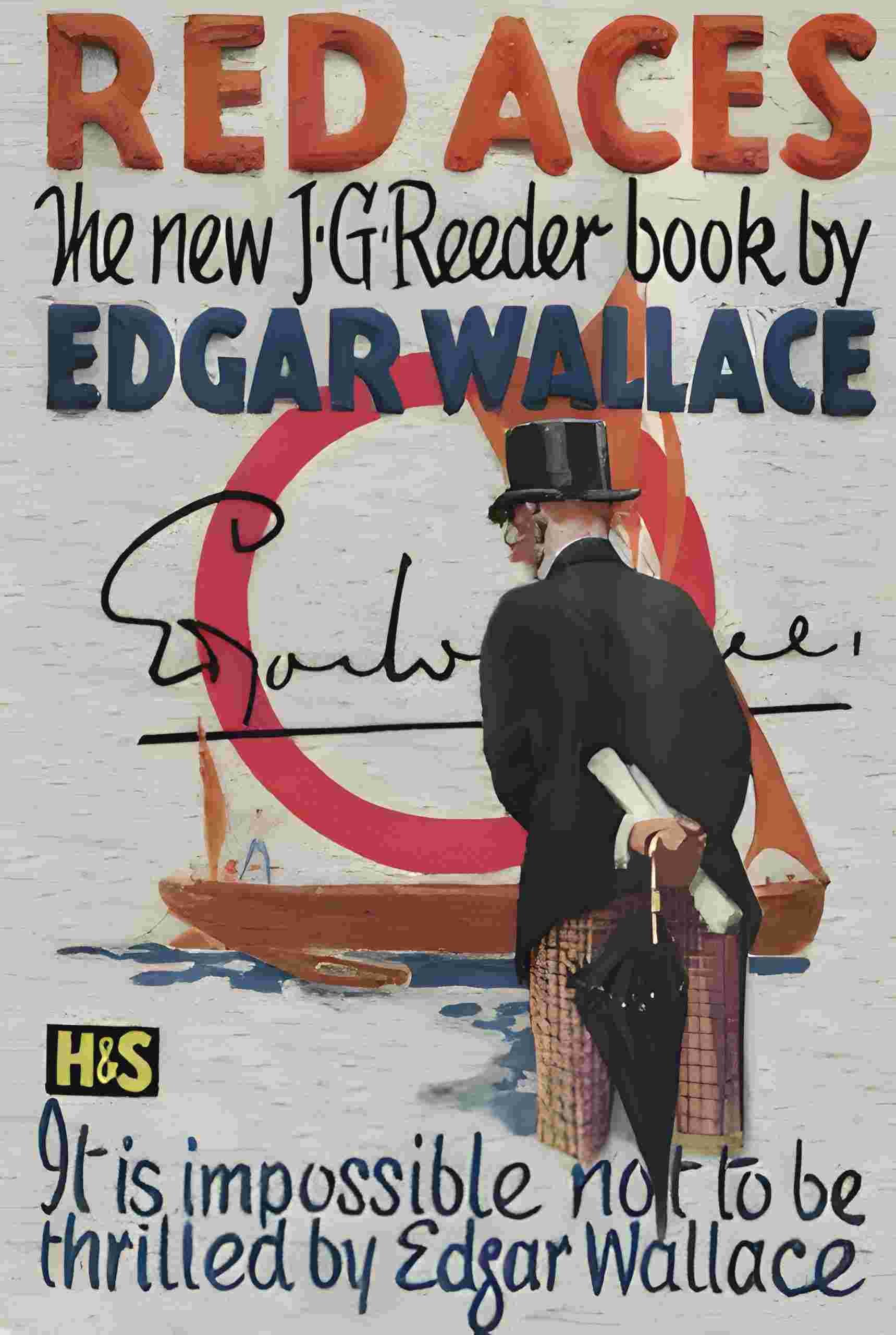
Mr. Reeder had produced a bundle of Treasury notes which he counted with great care. It was not a big bundle. Mr. Machfield, watching, guessed he was in the ten-pound line of business, and certainly there was no more than that on the table.
One by one those little notes of Reeder’s disappeared, until there was nothing left, and then a surprising thing happened. Mr. Reeder put his hand in his pocket, groped painfully and produced something which he covered with his hand. The croupier had raised his cards ready to deal—the game was trente-et-quarante—when the interruption came.
“Excuse me.” J.G. Reeder’s voice was gentle but everybody at the table heard it. “You can’t play with that pack: there are two cards missing.”
The croupier raised his head. The green shade strapped to his glossy head threw a shadow which hid the top half of his face.
He stared blandly at the interrupter—the dispassionate and detached stare which only a professional croupier can give.
“Pardon?” he said, puzzled. “I do not understand m’sieur. The pack is complete. It is never questioned——”
“There are two cards without which I understand you cannot play your game,” said Mr. Reeder, and suddenly lifted his hand.
On the table before him were two playing cards, the ace of diamonds and the ace of hearts. The croupier looked down at them, and then, with an oath, pushed back his chair and dropped his hand to his hip.
“Don’t move—I beg of you!”
There was an automatic pistol in Mr. Reeder’s hand, and its muzzle was directed towards the croupier’s white waistcoat.
“Ladies and gentlemen, there is nothing to be alarmed about. Stand back from the table against the wall, and do not come between me and Monsieur Lamontaine!”
He himself stepped backward.
“Over there!” he signalled to Machfield.
“Look here, Reeder——”
“Over there!” snarled J.G. Reeder. “Stand up by your friend. Ladies and gentlemen”—he addressed the company again without taking his eyes from the croupier—“there will be a few moments of acute unpleasantness. Your names and addresses will be taken, but I will use my best endeavours to avoid police court proceedings, because we are after something much more important than naughty people who play cards for money.”
And then the guests saw strange men standing in the doorway. They came from all directions—from Mr. Machfield’s study, from the hall below, from the roof above. They handcuffed Lamontaine and took away the two guns he carried, one in each hip pocket—Machfield was unarmed.
“What will the charge be?”
“Mr. Gaylor will tell you that at the police station. But I think the question is unnecessary. Honestly, don’t you, Mr. Machfield?”
Machfield said nothing.
CHAPTER XI
Mr. Reeder kept what he called a case-book, in which he inscribed a passionless account of all the cases in which he was engaged. Some of these cases had no value except to the technician, and would not interest anyone except perhaps the psycho-pathologist. Under the heading “Two Aces” appeared this account, written in his own handwriting.
In the year 1919 (wrote Mr. Reeder) there arrived at the Hotel Majestic in Nice a man who described himself in the hotel register as Rufus Machfield. He had a number of other names, but it is only necessary that Machfield should be used to identify this particular character. The man had a reputation as a cardsharp, and, in the pursuit of his nefarious calling, had “worked” the ships plying between England and New York. He had also been convicted on two occasions as a professional gambler in Germany.
He was of Danish origin, but at the time was a naturalized Englishman, with a permanent address in Colvin Gardens, Bayswater. At the Majestic Hotel he had met with Charles or Walter Lynn, an adventurer who had also “operated” the ships on the North Atlantic. On one of these trips Lynn had become acquainted with Mr. George McKay, a prosperous woollen merchant of Bradford. There is no evidence that they ever played cards together, and Mr. McKay does not recall that they did. But the friendship was of value to Lynn because Mr. McKay was in the habit of coming to Nice every year, and was in residence at the time Lynn and Machfield met. McKay was known as a resolute and successful gambler, and before now had figured in sensational play.
The two men, Lynn and Machfield, conferred together and decided upon a scheme to rob McKay at the tables. Gambling in Nice is not confined to the recognized establishments. There was at the time a number of Cercles Privés where play was even higher than at the public rooms, and the most reputable of these was “Le Signe” which, if it was not recognized, was winked at by the French authorities.
In order to swindle McKay, a patron of this club, it was necessary to secure the co-operation and help of an official. Lynn’s choice fell upon a young croupier named Lamontaine, and he in turn was to suborn two other croupiers, both of whom it was intended should receive a very generous share of the money.
Lamontaine proved to be a singularly pliable tool. He had married a young wife and had got into debt, and was fearful that this should come to the ears of the club authorities. An interview was arranged in Lyons; the scheme was put before the croupier by Lynn, and he agreed to come in, taking a half share for himself and his two fellow croupiers, the other half being equally divided between Lynn and Machfield. Lynn apparently demurred at the division, but Machfield was satisfied with his quarter share; the more so as he knew Mr. McKay had been winning very heavily, and providing he had the right kind of betting, there would be a big killing.
The game to be played was baccarat, for McKay could never resist the temptation of taking a bank, especially a big bank. It was very necessary that arrangements should be hurried on before the merchant left the South of France, and a fortnight after the preliminaries, Lamontaine reported that everything was in trim, that he had secured the co-operation of his comrades, and it was decided that the coup should be brought off on the Friday night.
It was arranged that Lynn should be the player, that after play was finished the conspirators should meet again at Lyons, when the loot was to be divided.
The cards were to be stacked so that the bank won every third coup. It was arranged that the signal for the conspirators to begin their betting was to be the dealing of two aces, the ace of diamonds and the ace of hearts. Somebody would draw a six to these, and the banker would have a “natural”—which means, I understand, that he would win.
Thereafter the betting was to be done by Lynn, and the first was a banco call—which meant, as the cards lay, that the bank would be swept into their pockets. They knew Mr. McKay would bid for the bank, but they would bid higher, and Lynn then took the bank with a capital of a million francs. Fourteen times the bank won, and had now reached enormous proportions, so much so that every other table in the room was deserted, and the table where this high play was going on was surrounded by curious watchers.
There were fourteen winning coups for the bank, and the amount gathered up at the finish by Lynn was something in the neighbourhood of £400,000. Lamontaine states that it was more, but Machfield is satisfied that it was in that region. The money was taken to the hotel, and the following night Lynn left for Lyons. He was to be joined the next day by Machfield, and on the Sunday they were to meet the croupier in Paris and pay him his share.
The night that Lynn left, however, one of the officials of the rooms made a statement to his chef. He had lost his nerve and he betrayed his comrades. Lamontaine, with the other croupier, was arrested on a charge of conspiracy, and Machfield only got away from the South of France by the skin of his teeth. He journeyed on to Lyons and arrived there in the early hours of the following afternoon. He hoped that no news of the arrests would have got into the papers and scared his partner, and certainly he did not wire warning Lynn. When he got to the hotel he asked for his friend, but was told that he had not arrived, nor had he made reservation of the rooms which had been agreed upon.
From that moment he disappeared from human ken, and neither Machfield nor any of his friends were able to trace him. It was no accident: it was a deliberate double-cross. Machfield played the game as far as he was able, and when Lamontaine was released from prison and came to Paris, a broken man, for his young wife had died while he was in gaol, he helped the croupier as well as he could, and together they came to England to establish gaming-houses, but primarily to find Lynn and force him to disgorge.
There was another person on the track of Lynn. McKay, who had been robbed, as he knew after the French court proceedings, employed me to trace him, but for certain reasons I was unable to justify his confidence.
I do not know in what year or month Lamontaine and Machfield located their man. It is certain that “Mr. Wentford,” as he called himself, lived in increasing fear of their vengeance. When they did locate him he proved to be an impossible man to reach. I have no doubt that the house was carefully reconnoitred, his habits studied, and that attempts were made to get at him. But those attempts failed. It is highly probable, though no proof of this exists, that he was well informed as to his enemy’s movements, for so far as can be gathered from the statement of his niece and checked by the admissions of Machfield, Lynn never left his house except on the days when Machfield and Lamontaine were in Paris—they frequently went to that city over the week-end.
It was Lamontaine who formed the diabolical plan which was eventually to lead to Wentford’s death. He knew that the only man admitted to the house was the mounted policeman who patrolled that part of the country, so he studied police methods, even got information as to the times on which the beat was patrolled, and on the night of the murder, soon after it was dark, he travelled down to Beaconsfield by car through the storm, accompanied by Machfield.
Lamontaine at some time or other had been on the French stage (he spoke perfect English) and I have no doubt was in a position to make himself up sufficiently well to deceive Wentford into opening the door. At seven o’clock Constable Verity left the station and proceeded on his patrol. At seven-thirty he was ruthlessly murdered by a man who stepped out of his concealment and shot him point-blank through the heart.
The body was taken into a field and laid out, the two murderers hoping that the snow would cover it. Lamontaine was already wearing the uniform of a police constable, and, mounting the horse, he rode on to Wentford’s house. The old man saw him through the window, and, suspecting nothing, got down and opened the door.
He may not have realized that anything was wrong until he was back in his parlour, for it was there that he was struck down. The two men intended leaving him in the cottage, but a complication arose whilst they were searching the place, or endeavouring to open the safe behind the bookcase. The telephone rang, and they heard Margot Lynn say that she was coming on but was delayed. One of them answered in a disguised voice.
The thing to do now was to remove the body. Lifting it out, they laid it over the horse’s saddle, and, guiding the nervous animal down to the road, led it towards Beaconsfield. Here a second complication arose: the lights of Mr. Enward’s car were seen coming toward them. The body was dropped by the side of the road, and the constable took his place on the horse’s back. The animal was smothered with the blood of the murdered man, and the clerk of Mr. Enward, the lawyer, taking the bridle quite innocently, must have rubbed his sleeve along the shoulder, for it was afterwards discovered that his coat was stained. That gave me my first clue, and I was able, owing to my peculiar mind, to reconstruct the crime as it had been committed.
The two men joined one another again in the vicinity of the cottage. They were not able to make any further attempt that night. One of them, however, heard that the girl knew where the money was cached. I am afraid I was responsible for this, and it was intended that she should be taken away, with the key of the safe deposit.…
Machfield had already become acquainted with the straitened circumstances of young McKay, the son of his victim, and probably to hit at his father, who he must have known was still hunting for him, used an opportunity which was offered by chance, to ruin him, as he believed.
Two hundred pounds, representing a portion of the money obtained from the bank by a fraudulent manager (3 years Penal Servitude; Central Criminal Court) through the instrumentality of his woman friend (5 years P.S., C.C.C.) was sent anonymously to the younger McKay by Machfield, and was traced to the young man.
After this came a note, also in Mr. Reeder’s hand:
“Rufus John Machfield and Antonio Lamontaine (sentence: death, C.C.C.) executed at Wandsworth Prison, April 17th. Executioner Ellis.”
Mr. Reeder was a stickler for facts.
KENNEDY THE CON. MAN
CHAPTER I
The man who stood with such an air of ease in the dock of the North-West London Police Court bore himself with a certain insolent dignity. There was a smile which was half contemptuous, half-amused, on his bearded face.
If, from time to time, his long white fingers thrust through the mass of goldy-brown hair that was brushed back from his high and narrow forehead, the gesture revealed neither nervousness nor embarrassment. Rather was this a trick of habit.
Though he wore no collar or tie, and his clothes and patent-leather shoes were daubed with last night’s mud, the clothes were new and well cut; the diamond ring which he wore, and which now sparkled offensively in the early morning light, hinted most certainly at an affluence which might be temporary or permanent.
He had in his possession when arrested (to quote the exact itemization of the constable who had given evidence on the matter) the sum of eighty-seven pounds ten shillings in Treasury notes, fifteen shillings in silver coinage, a gold and platinum cigarette case, a small but expensive bottle of perfume (unopened) and a few keys.
His name was Vladimir Litnoff; he was a Russian subject and his profession was that of an actor. He had appeared in Russian plays, and spoke English with the faintest trace of an accent.
Apparently, when he was in wine, as he had been on the previous evening, he spoke little but Russian, so that the two policemen who supported the charge of being drunk, and guilty of insulting and disorderly behaviour, could adduce no other than the language of offensive gesture to support their accusation.
The magistrate took off his glasses and leaned back in his chair wearily.
“Whilst you are living in this country you must behave yourself,” he said conventionally. “This is the second time you have been charged with disorderly conduct, and you will pay twenty shillings, and seven and six costs.”
Mr. Litnoff smiled, and bowed gracefully and stepped lightly from the dock.
Chief Inspector Gaylor, who was waiting in the corridor to give evidence on a much more serious charge, saw him pass and returned his smile good-humouredly. The policeman who had “picked up” the Russian followed from the court.
“Who is that fellow?” asked Gaylor.
“A Russian, sir. He was properly soused… drunk, in the Brompton Road. He was quiet enough but wouldn’t go away. Him and his brooches!”
“His whatses?” asked the inspector.
“That’s what he said when I took him—about the only English thing he did say: ‘You shall have my beautiful brooch—worth ten thousand!’ I don’t know what he was talking about. Another thing he said was that he’d got property in Monro—he shouted this out to the crowd as me and P.C. Leigh was taking him away.”
“Monro—that’s in Scotland somewhere.”
Just then Gaylor was called into court.
Later in the evening, as he glanced through his evening newspaper, he read an account of the police court proceedings. It was headed:
DRUNKEN MAN’S BRIBE OFFER TO POLICE.
TEN THOUSAND POUND BROOCH THAT
WAS DECLINED.“… P.C. Smith stated that the prisoner had offered him a ten thousand pound brooch to let him go.
“The Magistrate: Did he have this brooch in his possession?
“Witness: No, your Worship. In his imagination. (Laughter.)”
“Now Reeder would see something very peculiar about that,” said Mr. Gaylor to his young wife, and she smiled.
She liked Mr. J.G. Reeder, and, quite mistakenly, was sorry for him. He seemed so pathetically inefficient and helpless compared with the strong, capable men of Scotland Yard. Many people were sorry for Mr. Reeder—but there were quite a number who weren’t.
Jake Alsby, for example, was sorry for nobody but himself. He used to sit in his cell during the long winter evenings on Dartmoor and think of Mr. Reeder in any but a sympathetic mood. It was a nice, large, comfortable cell with a vaulted roof. It had a bed, with gaily coloured blankets, and was warm on the coldest day. He had the portrait of his wife and family on a shelf. The family ranged from a hideous little boy of ten to an open-mouthed baby of six months. Jake had never seen the baby in the flesh. He did not mind whether he saw his lady wife or family again, but the picture served as a stimulant to his flagging animosities. It reminded Jake that the barefaced perjury of Mr. J.G. Reeder had torn him from his family and cast him into a cold dungeon. A poetical fancy, but none the less pleasing to a man who had never met the truth face to face without bedecking the reality with ribbons of fiction.
It was true that Jake forged Bank of England notes, had been caught with the goods and his factory traced; it was true that he had been previously convicted for the same offence, but it was not true (as Mr. Reeder had sworn) that he had been seen near Marble Arch on the Monday before his arrest. It was Tuesday. Therefore Mr. Reeder had committed perjury.
To Jake came a letter from one who had been recently discharged from the hospitality of H.M. Prison at Princeton. It contained a few items of news, one of which was:
“… saw your old pal reeder yesterday he was in that machfield case him that done in the old boy at born end reeder dont look a day older he asked me how you was and i said fine and he said what a pity he only got seven he oughter got ten and i said…”
What his literary friend said did not interest the enraged man. There and then he began to think up new torments for the man who had perjured an innocent man (it was Tuesday, not Monday) into what has been picturesquely described as a “living hell.”
Three months after the arrival of this letter Jake Alsby was released, a portion of his sentence having been remitted for good conduct: that is to say, he had never once been detected in a breach of prison regulations. The day he was released, Jake went to London, to find his family in the workhouse, his wife having fled to Canada with a better man. Almost any man was better than Jake.
“This is Reeder’s little joke!” he said.
He fortified himself with hot spirits and went forth to find his man.
He did not follow a direct path to Mr. Reeder’s office, because he had calls to make, certain acquaintances to renew. In one of these, a most reputable hostelry, he came upon a bearded man who spoke alternately in English and in a queerly elusive language. He wore no collar or tie—when Vladimir reached his fourth whisky he invariably discarded these—and he spoke loudly of a diamond clasp of fabulous value. Jake lingered, fascinated. He drank with the man, whose language might be Russian but whose money was undoubtedly English, as was his language occasionally.
“You ask me, my frien’, what profession am I? An actor, yes! But it pays nothing. This, that, the other impresario rob—all rob. But my best work? I am ill! That is good work! Delirium—what-you-call-it? Swoons? Yes, swoons—voice ’usky, eh?”
“I know a graft like that,” said Jake, nodding wisely. “You chews soap.”
“Ah—nasty—no… ti dourak!”
Jake did not know that he was being called a fool, would not have been very upset if he had known. He was sure of one thing, that he was hooked up with a generous spender of money—a prince of fellows, seen in the golden haze of alcoholism. He had not yet reached the stage where he wanted to kick anybody. He was in that condition when he felt an inward urge to tell his most precious secrets.
“Ever ’eard feller call’ Reeder?” he asked profoundly. “Reg’lar old ’ound—goin’ get him!”
“Ach!” said his new-found friend.
“Gonna get ’im!” said Jake gravely.
The bearded man tilted up his glass until no dreg remained in the bottom. He seized Jake’s arm in a fierce friendliness and led him from the bar. The cold night air made Jake sag at the knees.
“Le’s go ’n bump ’um,” he said thickly.
“My frien’—why kill, eh?” They were walking unsteadily along arm in arm. Once Jake was pushed into the gutter by an unanticipated lurch. “Live—drink! See my beautiful brooch… my farm… vineyards… mountains… I’ll tell you, my frien’—somebody must know…”
This street through which they were passing was very dark and made up of little stores. Jake was conscious that he had passed a milk shop when he became aware that a man was standing squarely in their path.
“Hullo! … You want me… gotta brooch?”
It was Vladimir who spoke; he also was very drunk. The stranger did not speak.
The crash of the explosion made Jake Alsby reel. He had never heard a pistol fired at close quarters. He saw the Russian swaying on his feet, his head bent as though he were listening… he was fumbling at his waistcoat with both hands.
“Here… what’s the game?” Jake was sober now.
The man came nearer, brushed past him, thrusting his shoulder forward as he passed. Jake staggered under the impact. When he looked round, the shooter had melted into the thick darkness—there was the narrow opening of a mews hereabouts.
“Hurt, mate?”
The Russian had gone down to his knees, still gripping at his waistcoat. Then he pitched forward and hit the pavement horribly.
Jake felt himself go white… he looked round, and, turning, fled. He wanted to be out of this—murder! That’s what it was, murder.
He raced round the corner of the street and into the arms of a policeman. Whistles were blowing. Even as he fought to escape, he knew the impossibility of such a hope: policemen were running from everywhere.
“All right—I done nothin’… there’s a guy shot round the corner… some feller did it.”
Two officers took him to the station, and as a precautionary measure he was searched.
In the right hand pocket of his overcoat was found an automatic pistol that had been recently fired.
CHAPTER II
Mr. J.G. Reeder rang his bell and sighed. He sighed because it was the fourth time he had rung the bell without anything happening.
There were moments when he saw himself walking into the next room and addressing Miss Gillette in firm but fatherly tones. He would point out to her the impossible situation which was created when a secretary ignored the summons of her employer; he would insist that she did not bring into the office, or, if she brought, should not in business hours read the tender or exciting fiction which she favoured; he would say, in the same firm and fatherly way, that perhaps it would be better for everybody concerned if she found a new occupation, or a similar occupation in the service of somebody who had less exacting views on the question of duty. But always, when he rose from his chair after ringing four times, determined to settle the matter there and then, he sat down again and rang a fifth time.
“Dear, dear!” said Mr. Reeder. “This is very trying.”
At that moment Miss Gillette came into the room. She was pretty and slight and small. She had a tip-tilted nose and a faultless complexion, and her dully golden hair was a little untidy.
“I’m sorry,” she said. “Did you ring?”
Between her fingers she held a long, jade-green cigarette holder. Mr. Reeder had once asked her not to come into his office smoking: she invariably carried her cigarette in her hand nowadays, and he accepted the compromise.
“I think I did,” he said gently.
“I thought you did.”
Mr. Reeder winced as she put her cigarette holder on the mantelpiece, and, pulling a chair forward, sat down at his desk. She carried a book under her arm, and this she opened and laid on the table.
“Shoot,” she said, and Mr. Reeder winced again.
The trouble about Miss Gillette was her competence. If she had made mistakes and put letters in the wrong envelopes or forgot appointments, Mr. Reeder would have gone away to some foreign land, such as Eastbourne or Brighton, and would have written to her a sad letter of farewell, enclosing a month’s salary in lieu of notice. But she was devastatingly competent: she had built up a structure of indispensability; she had, in the shortest space of time, developed herself into a habit and a fixture.
“You mean that I am to proceed?” he asked gravely.
Another woman would have wilted under the reproof; there was something very wiltless about Miss Gillette. She just closed her eyes wearily.
“Let’s go,” she said, and it was Mr. Reeder who was reproved.
“This is a report on the Wimburg Case,” he said, and began his hesitant dictation.
As he grew into his subject, he spoke with greater and greater rapidity. Never once did Miss Gillette interrupt with a question, to gain time for her lagging pencil. There was a ceaseless snap as the pages of her notebook turned.
“That is all,” he said breathlessly. “I trust that I did not go too fast for you?”
“I hardly noticed that you were moving,” she said, wetted her fingers and flicked back the pages. “You used the word ‘unsubstantial’ three times: once you meant ‘inadequate’ and once ‘unreal’. I would suggest that we alter those.”
Mr. Reeder moved uncomfortably in his chair.
“Are you sure?” he asked feebly.
She was always sure, because she was always right.
It was not true to say that Mr. Reeder had ever engaged a secretary. It was Miss Gillette who engaged him. By one of those odd coincidences which are unacceptable to the lovers of fiction but which occur in everyday life, she arrived at Mr. Reeder’s office on the day and at the hour he was expecting a temporary typist from an agency. For some reason the agency lady did not arrive, or, if she did, was interviewed by Miss Gillette, who, fulfilling the practice of the young queen bee, destroyed her rival—in the nicest possible sense. And when Mr. Reeder, having concluded the work for which he had engaged her, would have dismissed her with a ten-shilling note, shyly tendered and brazenly accepted, he learned that she was a fixture. He lay awake for an hour on the following Friday night, debating with himself whether he should deduct the ten shillings from her salary.
“Are there any appointments?” he asked.
There was none. Mr. Reeder knew there was none before he asked. It was at this point that his daily embarrassment was invariably overcome.
“Nothing in the papers, I suppose?”
“Nothing except the Pimlico murder case. The funny thing is that the man who was killed——”
“Nothing funny about—um—that, my dear young lady,” murmured Mr. Reeder. “Funny? Dear, dear!”
“When I said ‘funny,’ I didn’t mean ‘amusing’ but ‘odd’,” she said. “And if you are getting back for ‘unsubstantial,’ you will be pleased to know that you have got. He was Vladimir Litnoff—you remember, the man who was drunk and said that he had a brooch.”
Mr. Reeder nodded calmly. Apparently Litnoff’s death was not startling news.
“It is my—um—mind, my dear young friend. I see evil things where other people see innocent things. And yet, in the question of human relationships, I take the kindliest and most charitable views. H’m! The young man who was with you at the Regal Cinema, for example——”
“Was the young man I’m going to marry when we earn enough to support one another,” she said promptly. “But how the devil did you see us?”
“S’sh!” said Mr. Reeder, shocked. “Strong—um—language is—um—most…”
She was looking at him frowningly.
“Sit down,” she said, and Mr. Reeder, who knew little of the rights of secretaries, but was quite sure that ordering their employers to sit down in their own offices was outside the table of privileges, sat down.
“I like you, John or Jonas or whatever the ‘J’ stands for,” she said, with outrageous coolness. “I didn’t realize that you were a detective when I came to you. I’ve worked for successions of tired business men, who bucked up sufficiently towards evening to ask me out to supper, but never a detective. And you’re different from all the men I’ve ever met. You’ve never tried to hold my hand——”
“I should hope not!” said Mr. Reeder, going very red. “I’m old enough to be your father!”
“There isn’t such an age,” she said. And then, very seriously: “Would you speak to Tommy Anton if I brought him here?”
“Tommy—you mean your—um——”
“My ‘um’—that describes him,” she nodded. “He’s a wonderful fellow—terribly awkward and shy, and he’ll probably make a bad impression, as you do, but he’s a really nice man.”
Now Mr. Reeder had been many things, but he had never acted in loco parentis, and the prospect was a trifle terrifying.
“You wish me to ask him—er—what his intentions are?”
She smiled at this, and she had a dazzling and beautiful smile.
“My dear, I know what his intentions are, all right. You don’t meet a man day after day for over a year without finding out something about his private ideas. No—it is something else.”
Mr. Reeder waited.
“If you were an ordinary employer,” she went on, “you’d take me by the scruff of my neck and fire me.” Mr. Reeder disclaimed such a ferocious quality with a feeble shake of his head. “But you’re not.”
She got up and walked to the window and looked out. What was she going to say? A most ghastly thought occurred to Mr. Reeder, one that made a cold shiver down his spine. But it was not that, for she turned suddenly.
“Tommy has been robbed of twenty-three thousand pounds,” she said.
He stared at her owlishly.
“Robbed?” She nodded. “When?”
“More than a year ago—before I met him. That is not why he is selling motor-cars on commission. He tries to sell them, but he isn’t very successful. His partner robbed him. They had a motor-car business. Tommy and this man Seafield were at Oxford together, and when they came down they started a motor-car agency. Tommy went to Germany to negotiate for an agency. When he came back Seafield had gone. He did not even leave a note—he just drew the money from the bank and went away.”
She saw a new light in Mr. Reeder’s eyes and could not but marvel that what to him was so small a matter should be of such immediate interest.
“And no message with his wife? … Unmarried, eh? H’m! He lived…”
“At an hotel—he was a bachelor. No, he didn’t tell anybody there—just said he was going away for a day or two.”
“Left his clothes behind and did not even pay his bill,” murmured Mr. Reeder.
Miss Gillette was surprised.
“You know all about it, then?”
“My queer mind,” he said simply.
There was a tap at the outer door.
“You had better see who that is,” said Mr. Reeder.
She went to the door and opened it. Standing on the mat outside was a clergyman, wearing a long black overcoat which reached to his heels. He looked at her dubiously.
“Is this Mr. Reeder’s office—the detective?” he asked.
She nodded, regarding the unexpected visitor with interest. He was a man of fifty, with greying hair. A mild, rather pallid man, who seemed to be ill at ease, for the fingers that gripped his umbrella, which he held about its middle as though he were all ready to signal a cab, clasped and unclasped in his agitation.
He looked at Mr. Reeder helplessly. Mr. Reeder, for his part, twiddled his thumbs and gazed at the visitor solemnly. It almost seemed that he was smitten dumb by the uniform of his visitor’s rectitude.
“Won’t you sit down, please?” There was something of the churchwarden in Mr. Reeder’s benevolent gesture.
“The matter I wish to speak about—well, I hardly know how to begin,” said the clergyman.
Here Mr. Reeder could not help him. It was on his tongue to offer the conventional suggestion that the best way to begin any story was to tell the unvarnished truth. Somehow this hardly seemed a delicate thing to say to a man of the cloth, so he said nothing.
“It concerns a man named Ralph—the merest acquaintance of mine… hardly that. I had corresponded with him on certain matters pertaining to the higher criticism. But I can hardly remember what points he raised or how I dealt with them. I never keep correspondence, not because I am unbusinesslike, but because letters have a trick of accumulating, and a filing system is a tyranny to which I will never submit.”
Mr. Reeder’s heart could have warmed to this frank man. He loathed old letters and filing was an abominable occupation.
“This morning I had a call from Mr. Ralph’s daughter. She lives with her father at Bishop’s Stortford in Essex. Apparently she came upon my name written on an envelope which she found in a wastepaper basket in her father’s office—he had a small office in Lower Regent Street, where he attended to whatever business he had.”
“What was his business?” asked Mr. Reeder.
“Actually he had none. He was a retired provision merchant who had made a fortune in the City. He may have had, and probably has, one or two minor interests to occupy his spare time. He came up to town last Thursday—curiously enough, I had a telephone call from him at my hotel when I was out. Since that day he has not been seen.”
“Dear me!” said Mr. Reeder. “What a coincidence!”
Dr. Ingham looked a painful enquiry.
“That you should have thought of me,” said Mr. Reeder. “It is very odd that people who lose people always come to me. And the young lady—she told you all this?”
Dr. Ingham nodded.
“Yes. She is naturally worried. It appears that she had a friend, a young man, who did exactly the same thing. Just walked out of his hotel and disappeared. There may be explanations, but it is very difficult to tell a young lady——”
“Very,” Mr. Reeder coughed discreetly, and said “very” again. “She suggested that you should come to me?”
The clergyman nodded. He appeared to be embarrassed by the nature of his mission.
“To be exact, she wished to come herself—I thought it was a friendly thing to interview you on her behalf. I am not a poor man, Mr. Reeder; I am, in fact, rather a rich man, and I feel that I should render whatever assistance is possible to this poor young lady. My dear wife would, I am sure, heartily endorse my action—I have been married twenty-three years, and I have never found myself in disagreement with the partner of my joys and sorrows. You, as a married man——”
“Single,” said Mr. Reeder, not without a certain amount of satisfaction. “Alas! Yes, I am—um—single.”
He looked at his new client glumly.
“The young lady is staying——”
“In town, yes,” nodded the other. “At Haymarket Central Hotel. You will take this case?”
Mr. Reeder pulled at his nose and fingered his close-clipped sidewhiskers. He settled his glasses on his nose and took them off again.
“Which case?” he asked.
Dr. Ingham was pained.
“The case I have outlined.” He groped beneath his clerical coat and produced a card. “I have written Mr. Lance Ralph’s office address on the back of my card——”
J.G. took the card and read its written inscription; turned it over and read the printed inscription. This gentleman was a doctor of divinity, and lived at Grayne Hall, near St. Margaret’s Bay, in the County of Kent.
“There isn’t a case,” said Mr. Reeder with the tenderness of one who is breaking bad news. “People are entitled to—um—disappear. Quite a number of people, my dear Dr. Ingham, refuse to exercise that right, I am sorry to say. They disappear to Brighton, to Paris, but re-appear at later intervals. It is a common phenomenon.”
The cleric looked at him anxiously, and passed his umbrella from one hand to the other.
“Perhaps I haven’t told you everything that should have been told,” he said. “Miss Ralph had a fiancé—a young man in a prosperous business, as she tells me, who also vanished, leaving his partner——”
“You are referring to Mr. Seafield?” But to his surprise, and perhaps to his annoyance, the clergyman showed no sign of amazement.
“Joan has a great friend in your office. Am I right in surmising it is the young lady who opened the door to me? This is how your name came up. We were discussing whether she should go to the police, when she mentioned your name. I thought you were the least unpleasant alternative, if you don’t mind that description.”
Mr. Reeder bowed graciously. He did not mind.
There followed an uncomfortable lacuna of silence, which neither of the men seemed inclined to fill. Mr. Reeder ushered the visitor to the door and went back to his desk, and for five minutes scribbled aimlessly on his blotting pad. He had a weakness for making grotesque drawings, and he was putting an extra long nose upon the elongated head of one of his fanciful sketches when Miss Gillette came in unannounced.
“Well, what do you think of that,” she asked.
Mr. Reeder stared at her.
“What do I think of what, Miss Gillette?” he demanded.
“Poor Joan, and she is such a darling. We have kept our friendship all through the Seafield business——”
“But how did you know about it?”
Mr. Reeder was very seldom bewildered, but he was frankly bewildered now.
“I was listening at the door,” said Miss Gillette shamelessly. “Well, not exactly listening, but I left my door open and he talks very loudly; parsons get that way, don’t they?”
J.G. Reeder’s face wore an expression that was only comparable to that of a wounded fawn.
“It is very—um—wrong to listen,” he began, but she dismissed all questions of propriety with an airy wave of her hand.
“It doesn’t matter whether it’s right or wrong. Where is Joan staying?”
This was a moment when Mr. J.G. Reeder should have risen with dignity, opened the door, pressed a fortnight’s wages into her hand, and dismissed her to the outer darkness, but he allowed the opportunity to pass.
“Can I bring Tommy to see you?”
She leant upon the table, resting her palms on the edge. Her enthusiasm was almost infectious.
“Tommy doesn’t look clever, but he really is, and he’s always had a theory about Seafield’s bolting. Tommy says that Frank Seafield would never have bought a letter of credit——”
“Did he have a letter of credit? I thought you told me that he drew the money out of the bank?”
Miss Gillette nodded.
“It was a letter of credit,” she said emphatically, “for £6,300. That’s how we knew he had gone abroad. The letter was cashed in Berlin and Vienna.”
For a long time Mr. J.G. Reeder looked out of the window.
“I should like to talk with Tommy,” he said gravely, and when he looked round Miss Gillette had gone.
For a quarter of an hour he sat with his hands folded on his lap, his pale eyes fixed vacantly on the chimney-pot of a house on the opposite side of the street, and then he heard a knock on the outer door. Rising slowly, he went out and opened it. The last person he expected to see was Inspector Gaylor.
“The Litnoff murder—are you interested?”
Mr. Reeder was interested in all murders, but not especially in the Litnoff case.
“Do you know that Jake Alsby was on his way to see you?”
Jake Alsby—Mr. Reeder frowned; he knew the name, and, going over the file of his mind, could place him.
“So far as my own opinion goes, Jake is a dead man,” said Gaylor. “He had been drinking with the Russian, who had quite a lot of money in his possession. A few minutes after they left the bar Litnoff was shot, and Jake, bolting for his life, was found in possession of a loaded pistol. Men have been hanged on less evidence than that.”
“I—um—doubt it. Not the fact that men have been—er—hanged on insufficient evidence, but that our poor friend was the guilty person. Jake is a ‘regular,’ and regulars do not carry guns—not in this country.”
Gaylor smiled significantly.
“He was searching for you,” he said. “He admits as much, and that makes his present attitude a little queer. For now he wants you to get him out of his trouble!”
“Dear me!” said Mr. Reeder, faintly amused.
“He thinks if he could see you for a few minutes and tell you what happened, you would walk out of Brixton Prison and lay your hand upon the man who committed the murder. There’s a compliment for you!”
“Seriously?” J.G. Reeder was frowning again.
Gaylor nodded.
“It’s rum, isn’t it? The fellow was undoubtedly on his way to give you hell and yet the first thing he does when he gets into trouble is to squeak to you for help! Anyway, the Public Prosecutor says he would like you to see him. Brixton has been notified. They know you there, and if you feel like listening to a few more or less fantastic lies, you ought to have an interesting evening.”
He had in his pocket-book two press cuttings which fairly covered the Litnoff shooting. Mr. Reeder accepted them with every evidence of gratitude, although he had very complete particulars of the case in the drawer of his writing table.
Gaylor had one quality which Mr. Reeder admired—he was no “lingerer.” There were many interesting people in the world who did not know where their interest ended: men who outstayed the excuse for their presence and dawdled from subject to subject. Gaylor was blessed with a sense of drama and could make his abrupt exit upon an effective line. He made such an exit now.
“You needn’t ask him to tell you about the diamond clasp,” he said. “He’ll tell you that! But don’t forget that the last time Litnoff was charged that bizarre note came into the evidence.”
Inspector Gaylor was a well read man and used words like “bizarre” without self-conscious effort.
When he had gone, Mr. Reeder fixed his glasses and read the cuttings which the detective had left. He found nothing that he did not already know. Jake Alsby was, as he had said, a ‘regular’, an habitual criminal with a working knowledge of the common law in so far as it affected himself. No old lag carries firearms, especially an old lag who is a convict on licence, and is liable to be arrested at sight. Judges are most unsympathetic in their attitude toward armed criminals, and Jake and his fellows knew too well the penalties of illicit armament to take the dreadful risk of being found in possession of an automatic pistol.
J.G. had a criminal mind. He knew exactly what he would have done had he been Jake Alsby and had shot his companion. He would have thrown away the pistol before he bolted. That Jake had not done so was proof to him that he was unaware that the pistol was in his pocket.
He was musing on this matter when he heard the door of the outer office open and the sound of low voices. A moment later Miss Gillette came in, a little out of breath. She closed the door behind her.
“I’ve brought them both,” she said rapidly. “I ’phoned to Joan—she was just going out.… Can I ask them to come in?”
He felt that it was almost an act of humility that she should ask his permission, and bowed his assent.
Tommy Anton was a tall young man; the sort that perhaps two women in the course of the years would regard as good-looking, but the rest would scarcely notice. Joan Ralph, on the other hand, was distinctly pretty and unusual. She was dark and clear-skinned, and had one of those supple figures that gave Mr. Reeder the impression that its owner did not wear sufficient clothes for warmth or safety.
“This is Tommy, and this is Joan.” Miss Gillette introduced them unnecessarily, for Mr. Reeder could hardly have mistaken one for the other.
The moment he saw them, he knew they would have nothing new to tell him if they were left to tell their own stories. He listened with great patience to the repetition of all he knew.
Tommy Anton gave a graphic description of his own amazement, consternation and emotions when he had discovered that his partner had vanished. He paid a loyal tribute to the character and qualities of the missing man——
“Did Mr. Seafield ever talk to you about a diamond brooch?” interrupted Mr. Reeder.
Tommy stared at him.
“No—we were in the car trade. He seldom discussed his private affairs. Of course, I knew about Joan——”
“Did your father ever speak of a diamond brooch or clasp?” Mr. Reeder addressed the girl, and she shook her head.
“Never… he never spoke about jewellery except—that was years ago when I first met Frank—Daddy put some money into the Pizarro expedition and so did Frank; they were awfully enthusiastic about it.”
Mr. Reeder looked up at the ceiling and went rapidly over the folders of his memory. When she was on the point of explaining, he stopped her with a gesture.
“Pizarro expedition… 1923… to recover the buried treasure of the Incas. It was organized by Antonio Pizarro, who claimed to be a descendant of the conqueror of Peru… his real name was Bendini—a New York Italian with three convictions for high-class swindles… the company was registered in London, and all the people who put money into the scheme lost it—isn’t that right?”
He beamed at her triumphantly and she smiled.
“I don’t know so much about it as you. Daddy put five hundred pounds into it and Frank put a hundred—he was at Oxford then. I know they lost their money. Frank didn’t mind very much, but Daddy was annoyed, because he was sure there were great treasure houses in Peru that had yet to be discovered.”
“And was there a talk of diamond brooches?” asked Mr. Reeder.
She hesitated.
“Jewels—I don’t remember that there was anything said about brooches.”
J.G. wrote down three words, one of which, she saw, was “Pizarro.” The second seemed to bear some resemblance to “Murphy.” She thought the association of the two names was a little incongruous. He questioned her shortly about her own situation. She had a small private income and there was no immediate urgency so far as money was concerned.
And then she asked if she could see him alone. Mr. Reeder had a happy feeling that Miss Gillette entirely disapproved of the request. She could do no less than withdraw, taking her Tommy with her. He found himself being sorry for that dumb and ordinary young man—so ordinary indeed that Mr. Reeder for the first time became conscious of his mental superiority to his secretary.
He had even the courage to open the door and look out. The murmur of voices from Miss Gillette’s room assured him that they were safe from the eavesdropping propensities of that curious young lady.
“Mr. Reeder,” he realized from her tone that Joan Ralph was finding some difficulty in fitting her thoughts into words, “I suppose it has occurred to you that my father may have gone off with—somebody. I am not stupid about these things and I know that men of his age do have—well, affairs. But I am perfectly sure that Daddy had none. Dr. Ingham hinted tactfully that this might be the situation; the doctor was awfully sweet about it, but I know that theory is wrong. Daddy had no friends. I used to open all his letters and there was never one that he objected to my seeing.”
“The letters that came to the office too?” he asked.
She smiled at the question.
“Naturally I did not see those—those were very few, and Daddy had nothing furtive in his composition. I did know that he was corresponding with Dr. Ingham; my father was what is known as a High Churchman and wrote letters to the Church papers. That is practically the only friend he had outside our little circle at Bishop’s Stortford.”
Mr. Reeder looked at her thoughtfully.
“Did you think Frank Seafield had—um—a lady friend?” he asked.
She was emphatic on this point. He would have been surprised if she had not been.
He guided her to Miss Gillette’s room and presently he heard the three go out. That Miss Gillette should have left the office without asking permission was not remarkable.
With great care he composed three telegrams, and, calling at the post office, handed them in. One was certainly addressed to Murphy.
A tramcar deposited him within walking distance of Brixton Prison, where men under remand are segregated.
Mr. Reeder was not unknown at Brixton, though his visits were rare, and within a few minutes of his arrival he was taken to a bare waiting room where he was joined by Jake Alsby.
The man was shaken. The rather defiant impertinent criminal Mr. Reeder had known had disappeared, and in his place was a man terror-stricken by the fate which had overcome him.
“You know me, Mr. Reeder.” His manner was a little wild, and the hand that emphasized almost every sentence was trembling. “I never had a gun in my life, and I would no more think of shooting a man than I would of cutting my own throat. I bashed a fellow or two——”
“And there are one or two that you intended bashing,” said Mr. Reeder, pleasantly.
“It was drink, Mr. Reeder,” pleaded Jake. “I suppose Gaylor told you that I was coming to see you. That dirty dog would say anything to put me wrong. Besides, Mr. Reeder, I didn’t know this Russian—why should I want to shoot him?”
Mr. Reeder shook his head.
“People sometimes shoot the merest acquaintances,” he said brightly. “Now tell me all about it, Alsby, with fewer lies than usual. Maybe I can help you. I don’t say that I can, but it may be possible.”
Alsby told his story as coherently as he could. Occasionally Mr. Reeder had to bring him back from rambling side issues, but, on the whole, the tale he had to tell was convincing. He forgot, however, one important detail.
“When that man was charged with being drunk some days ago,” said Mr. Reeder, “he talked to the police in his—um—intoxication, of a diamond clasp——”
“That’s right, sir,” interrupted the man eagerly. “He mentioned it to me, too. I’d forgotten all about that. He told me I could see it. I thought it was just being soused that made him speak that way, and, to tell you the truth, I’d forgotten all about it.” And then a new note of anxiety came into his tone: “Has that been lost? I swear I never saw it.”
J.G. Reeder looked at him long and fixedly. A gentle glow of satisfaction came to him. He had spoken of the clasp to Joan Ralph for no other reason than his recollection of the police court proceedings against Litnoff. That reference to the diamond brooch had intrigued him at the time he had read of it. Litnoff had no history as a receiver—that fact had been brought out in court.
“Try to remember, Alsby, what other things he said.”
Alsby knitted his forehead in an agony of recollection.
“I can’t remember anything, Mr. Reeder. I wasn’t with him long after we left the boozer—the public house. He was going home; he lived in Bloomsbury—Lammington Buildings. That was a funny thing: I had known of Lammington Buildings through a pal of mine, who got five years for slush printing. He had a friend who lived there.”
Mr. Reeder was interested mainly because the only address which the police knew in connection with Litnoff was his lodging in Pimlico.
“How did all this come out, that he was living in Lammington Buildings?” he asked.
“He wanted to take a taxi. I told him I was living in Holborn. He said ‘You can drop me at Lammington Buildings.’ After that he sort of corrected himself, but I knew he had let his address slip out. You are going to do something for me, ain’t you, Mr. Reeder? You have always been fair to me.”
“That is not my recollection of your expressed opinion,” said Mr. Reeder acidly.
Going back to town he pondered on the possibility that Litnoff also might have had a “friend” in this block of flats.
It was raining heavily when his ’bus dropped him at the corner of Southampton Row; but it had been raining more or less all day, and since he wore his shabby yellow mackintosh which, coming almost to his heels, gave him, despite his bent shoulders, a giant-like appearance, he did not think it necessary to unfurl the umbrella which he carried on his arm, summer and winter, although it was never known to be opened.
He found Lammington Buildings without much trouble. It was situate in a side turning off Gower Street.
Mr. Reeder opened his enquiries with the hall porter. The name of Litnoff was unknown; but the hall porter was a reader of newspapers and had seen a portrait of the murdered man. Almost before Mr. Reeder could put a question, the porter blurted out his suspicion.
“I bet that’s Schmidt. If it isn’t, it’s his twin brother. In fact, I was just writing a letter to the Daily Megaphone. I always thought that Schmidt was a queer customer. He only slept here once or twice a month. I was talking to Mrs. Adderly this afternoon about him. As a matter of fact, she’s in his flat now, though she’s one of those kind of women who wouldn’t talk. You can’t get a word out of her. I says to her ‘Suppose the police come here and want to know?’ ‘Let ’em come,’ she says. What can you do with a woman like that?”
Mr. Reeder could supply no reply to this pertinent question, and then, surprisingly, the hall porter said:
“I knew you, Mr. Reeder, the moment I put my eyes on you. You were in the Orderley Street affair. I was the porter at the hotel, if you will remember, who saw the man getting out of the window.…”
He went, with surprising accuracy, into the particulars of a case in which the detective had figured many years before.
Mr. Reeder was a good listener. He discovered at the very early stages of his career that the art of listening was the art of detection, and he allowed the porter to continue his reminiscences before he asked:
“Is Mrs. Adderly in the flat now?”
The porter pointed dramatically to a door that led to the front of the vestibule.
“Do you want to see her?”
“I should like,” said Mr. Reeder.
The porter rang and knocked. After a considerable time the door was opened a little way, and the space was filled by a suspicious looking and bare-armed lady, who wore a soiled apron and had a face which was equally in need of hot water and soap.
“This is Mr. Reeder,” said the porter, with such satisfaction that it was evident he had no deep affection for the untidy charwoman. “The well-known detective,” he added.
Mrs. Adderly wilted at the word.
“Everything can be explained,” she said, a little incoherently, and as Mr. Reeder followed her into the hall, she slammed the door in the face of the outraged porter, who at least expected to participate in the portion of the confidences which hitherto she had withheld from him.
“Will you come in, sir.”
She led the way into a barely furnished little room which obviously had served as a sitting-room. There was a table, a sideboard, a small square carpet on the floor, and a couple of chairs. On one wall was a map printed, as Mr. Reeder discovered, in Switzerland. It showed a section of the Canton of Vaud, and there was an irregular patch outlined in red ink from the contours; it evidently stood at some considerable height upon the lake. Its significance Mr. Reeder did not grasp till much later.
“I don’t know what to say or what to do next,” said Mrs. Adderly. She spoke very rapidly, without full stops, commas, or any other form of punctuation. “The money was honestly come by and is in the post office bank except the rent which I paid and I have a receipt with the stamp on it and I have done what Mr. Schmidt told me to do as I can prove by his letter. I am a widow with five mouths to fill.…”
She went on to explain that they were the property of her five legitimate offspring, that she “did” for respectable families, and that she had never been in trouble, or accepted out-door relief from the parish even in her most difficult times.
“What money is this?” interrupted Mr. Reeder when he thought she had gone far enough.
The money that had come to her on Wednesday. She had found it on the table in the dining room with a letter. Beneath her skirt she had a pocket. Mr. Reeder looked discreetly away while she explored this receptacle, and presently brought out an envelope from which she took a single sheet of notepaper.
“Please pay the rent with the enclosed. I am going away to France, and shall not be back for three months. You may take double wages while I am gone, and I do not wish you to discuss my business.”
The letter was written in a neat clerkly hand.
“You found this on the table, you say?”
“On Wednesday morning; I put the money into the Post Office saving bank,” she went on even more rapidly. “I paid the rent and I have got a printed receipt with a stamp on it——”
“Nobody doubts that,” said Mr. Reeder soothingly.
“If you are in the police——”
“I am not,” said Mr. Reeder. “I really am not a policeman at all, I am—um—an investigator.”
She knew very little about her employer. Three days a week she used to come to tidy the flat. For this purpose she was entrusted with a key. She had very strict orders that, if the door did not yield when she turned the key and was obviously bolted on the inside, she was to go away. This had happened three times in the course of the past year. Mr. Schmidt, though a very healthy-looking gentleman, was an invalid. Sometimes he had very bad spells, and she had come to find the atmosphere of his bedroom sickly with the smell of drugs. He never spoke about his business, and when he spoke at all, it was with a very strong foreign accent. She had an idea he was an actor, because she had once seen a box containing wigs and moustaches and theatrical make-up, and she had seen a photograph of him in some theatrical role.
Although it was a ground floor flat, it only consisted of three rooms and a kitchenette. One was entirely bare, except that in a cupboard he found three uncased pillows. Mrs. Adderly explained that occasionally Mr. Schmidt had a weakness for pillows, though the only time he ever slept there one sufficed him.
The bedroom contained an iron bedstead with a mattress, comparatively new, a small dressing chest, a mirror, a little table and two chairs. The bed was not made, but the blankets were neatly folded at the foot of the bare mattress and covered with a sheet. On the wall was a lithographed portrait of a man in a foreign uniform. Mr. Reeder guessed it was Russian. Over the bed was hung a shelf which contained four or five Russian books, and here he made a discovery, for on the fly-leaf of one was a long inscription in French:
“Presented to me by the Grand Duke Alexander on the occasion of my performance in ‘Revisor’.”
Beneath this was a single letter “L.”
The main interest for Mr. Reeder lay in the fact that the handwriting was not the same as that in the letter.
In the small cupboard he found two medicine bottles half filled. He sniffed one and discovered the unmistakable scent of spirits of chloroform. He was hardly as much impressed by the contents as by the labels, which were those of a Bloomsbury chemist. He left Mrs. Adderly and went in search of the disgruntled hall porter.
“Mr. Schmidt” had had visitors, but apparently they came after 11 o’clock at night at which hour the porter went off duty; the lift, being an automatic one, was operated by the tenants themselves. He would not have known of this, but for the fact that one of the other tenants in the building had seen people going into or coming from the flat in the middle of the night. They were invariably men.
A chemist’s shop on the corner of the block was Mr. Reeder’s next objective. The chemist was a suspicious man, not inclined to answer readily to the detective’s questions. Mr. Reeder, however, carried authority in the shape of a small warrant card, for he had definite association with the Public Prosecutor’s Department.
Both the chemist and his assistant had seen Mr. Schmidt. He had called to have medicines made up and to purchase surgical supplies.
“Surgical supplies?” Mr. Reeder was almost excited. “Dear me, how excellently that fits my theory! Pardon me, my dear sir… I—um—was rather carried away. Now, could you describe Mr. Schmidt?”
They could describe him quite graphically, and Mr. Schmidt was undoubtedly the dead Litnoff.
Mr. Reeder went home to his house in the Brockley Road, feeling rather satisfied with his discoveries. He had no illusion about his “luck.” In a few days the police would discover Litnoff’s home in Lammington Mansions (they found it the next day through the medium of a laundry mark as a matter of fact) and at best he was only those few days ahead of the “regulars.” There were no letters for him, and he had his tea and toast reading the evening newspapers the while, and at nine o’clock was in the act of writing up his diary when he heard the tinkle of the street door bell.
The housekeeper left the two visitors in the hall, and announced them to Mr. Reeder with bated breath.
“Two young ladies,” she said primly. “I told them you never saw visitors, but one of them said she was going to see you if she had to wait all night.”
If Mr. Reeder had harmonized with the tone of sharp disapproval, he would have ordered them immediately to be thrown into the street.
“Show them up, please,” he said.
One, at least, was Miss Gillette. He guessed the other, and guessed correctly, for Joan Ralph came into the room behind his trying secretary.
“I would have telephoned you, but I didn’t think it was safe,” said Miss Gillette almost before she was in the room. “You remember you asked Joan about a diamond clasp, or brooch, or something?”
Mr. Reeder offered her a chair.
“Have you seen it?”
A foolish question, he felt, when he saw Miss Gillette’s visible scorn.
“Of course we haven’t seen it. Joan and I went to dine to-night at the Corner House. Then a red haired young man came up and asked Joan if she ever wore plus-fours.”
Mr. Reeder leant back in his chair.
“If she wore plus-fours?” he repeated a little scandalized.
Miss Gillette nodded energetically.
“He was terribly nervous,” said Miss Gillette. “I have never known a red-haired man to be nervous before; they are usually rather, well, you know, the other way about, but he started talking a lot of stuff about his father being a jeweller and being ill, and then he mentioned a diamond brooch. He said he had under-valued it. I thought he was drunk. Joan didn’t.”
“What was his name?”
Joan Ralph shook her head.
“It was extraordinary, because I was once photographed in plus-fours. Daddy took the picture on a day when we had a lot of old Roedean girls down at Bishop’s Stortford and we played a sort of pastoral, and I borrowed my cousin’s plus-fours because I was supposed to represent a man. Daddy was rather amused and took a picture, and said it was the best photograph that he ever had of me.”
Mr. Reeder ran his fingers through his scanty hair.
“What did he say about the brooch?”
Miss Gillette was not sure that he said anything that was intelligent. It was not until after she had threatened to call for the manager, and the red-haired young man had retired abashed—“It was only then,” said Miss Gillette, “that we felt that we oughtn’t to have been so stupid and we should have asked him his name and address.”
Mr. Reeder nodded his agreement.
“He was a jeweller, his father was ill, he had under-valued a brooch, and he had seen a portrait of my young friend in plus-fours. That’s very remarkable. It is a great pity; you will very likely never see him again——”
“But we have,” interrupted Miss Gillette. “He was on the tram and he followed us right down here, in fact—he is outside the house at this minute.”
Mr. Reeder stared at her.
“Did you speak to him?”
“Of course we did not speak to him,” said Miss Gillette scornfully. “How could you speak to a red-haired young man in the street! He didn’t speak to us either, and he just sat in the corner of the tramcar and kept looking at us from behind his newspaper.”
Mr. Reeder walked to the window, pulled aside the curtain gently, and peered out. Standing under a lamp post, and barely visible, was a figure of a man, and even as Mr. Reeder looked, as though aware of the scrutiny, he turned rapidly in the direction of Lewisham High Road.