
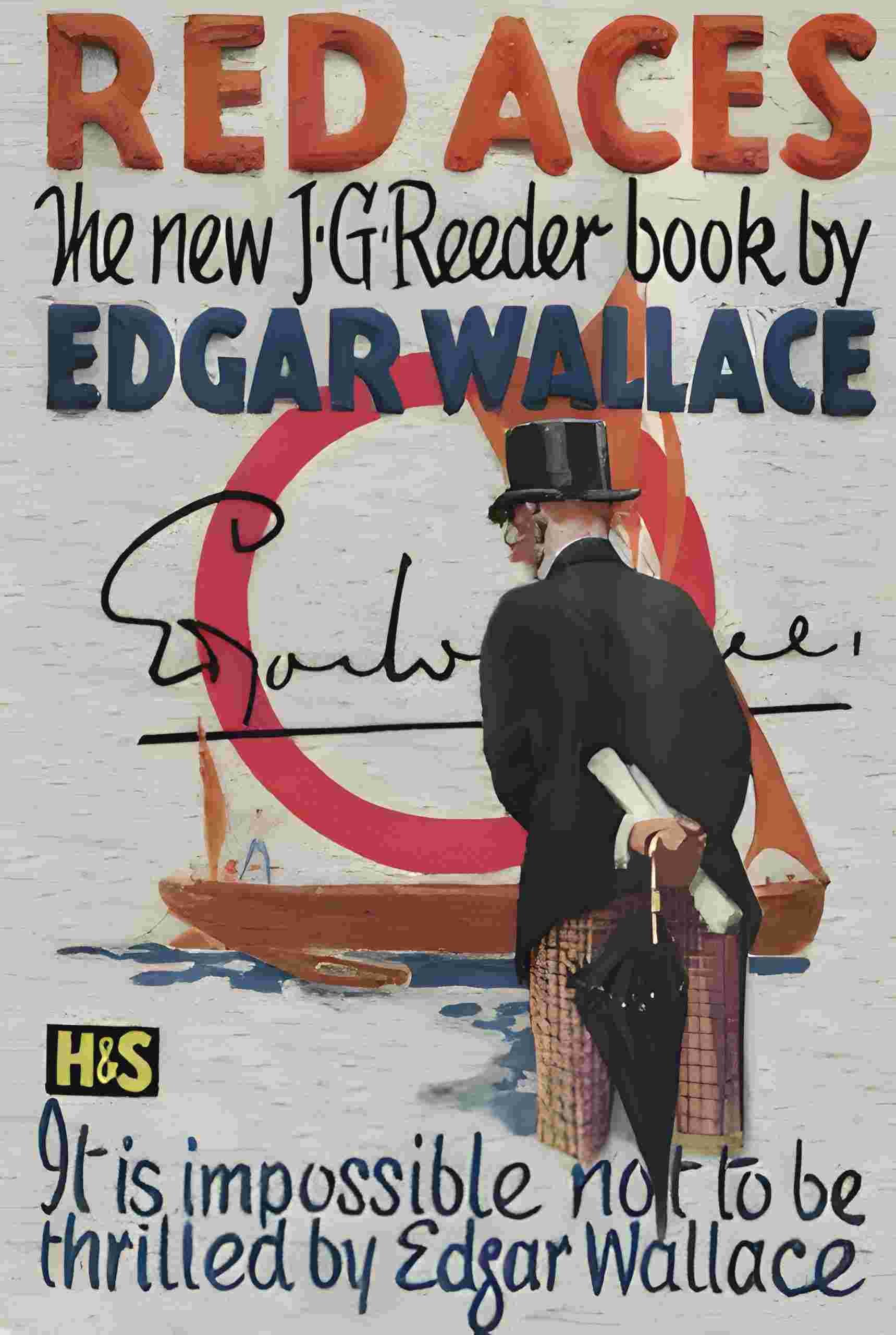
The Project Gutenberg eBook of Red aces
Title: Red aces
Being three cases of Mr. Reeder
Author: Edgar Wallace
Release date: July 21, 2025 [eBook #76541]
Language: English
Original publication: London: Hodder and Stoughton Limited, 1929
Credits: an anonymous Project Gutenberg volunteer
RED ACES
BEING THREE CASES OF MR. REEDER
by
EDGAR WALLACE
H&S
HODDER AND STOUGHTON
LIMITED LONDON
[DEDICATION]
TO MY FRIEND AND SECRETARY
R.G. CURTIS
CONTENTS
RED ACES
CHAPTER I
When a young man is very much in love with a most attractive girl he is apt to endow her with qualities and virtues which no human being has ever possessed. Yet at rare and painful intervals there enter into his soul certain wild suspicions, and in these moments he is inclined to regard the possibility that she may be guilty of the basest treachery and double dealing.
Everybody knew that Kenneth McKay was desperately in love. They knew it at the bank where he spent his days in counting other people’s money, and a considerable amount of his lunch hour writing impassioned and ill-spelt letters to Margot Lynn. His taciturn father, brooding over his vanished fortune in his gaunt riverside house at Marlow, may have employed the few moments he gave to the consideration of other people’s troubles in consideration of his son’s new interest. Probably he did not, for George McKay was entirely self-centred and had little thought but for the folly which had dissipated the money he had accumulated with such care, and the development of fantastical schemes for its recovery.
All day long, summer and winter, he sat in his study, a pack of cards before him, working out averages and what he called “inherent probabilities,” or at a small roulette wheel, where, alternately, he spun and recorded the winning numbers.
Kenneth went over to Beaconsfield every morning on his noisy motor-bicycle and came back every night, sometimes very late, because Margot lived in London. She had a small flat where she could not receive him, but they dined together at the cheaper restaurants and sometimes saw a play. Kenneth was a member of an inexpensive London club which sheltered at least one sympathetic soul. Except Mr. Rufus Machfield, the confident in question, he had no friends.
“And let me advise you not to make any here,” said Rufus.
He was a military-looking man of forty-five, and most people found him rather a bore, for the views which he expressed so vehemently, on all subjects from politics to religion, which are the opposite ends of the ethical pole, he had acquired that morning from the leading article of his favourite daily. Yet he was a genial person and a likeable man.
He had a luxurious flat in Park Lane, a French valet, a couple of hacks which he rode in the park, and no useful occupation.
“The Leffingham Club is cheap,” he said, “the food’s not bad, and it is near Piccadilly. Against that you have the fact that almost anybody who hasn’t been to prison can become a member——”
“The fact that I’m a member——” began Ken.
“You’re a gentleman and a public school man,” interrupted Mr. Machfield a little sonorously. “You’re not rich, I admit——”
“Even I admit that,” said Ken, rubbing his untidy hair.
Kenneth was tall, athletic, as good-looking as a young man need be, or can be without losing his head about his face. He had called at the Leffingham that evening especially to see Rufus and confide his worries. And his worries were enormous. He looked haggard and ill; Mr. Machfield thought it possible that he had not been sleeping very well. In this surmise he was right.
“It’s about Margot…” began the young man.
Mr. Machfield smiled.
He had met Margot, had entertained the young people to dinner at his flat, and twice had invited them to a theatre party.
“We’ve had a row, Rufus. It began a week ago. For a long time her reticence has been bothering me. Why the devil couldn’t she tell me what she did for a living? I wouldn’t say this to a living soul but you—it is horribly disloyal to her, and yet it isn’t. I know that she has no money of her own, and yet she lives at the rate of a thousand a year. She says that she is secretary to a business man, but the office where she works is in her own name. And she isn’t there more than a few days a week and then only for a few hours.”
Mr. Machfield considered the matter.
“She won’t tell you any more than that?”
Kenneth looked round the smoke-room. Except for a servant counting the cigars in a small mahogany cabinet, they were alone. He lowered his voice.
“She’ll never tell me any more… I’ve seen the man,” he said. “Margot meets him surreptitiously!”
Mr. Machfield looked at him dubiously.
“Oh… what sort of a man?”
Kenneth hesitated.
“Well, to tell you the truth, he’s elderly. It was queer how I came to see them at all. I was taking a ride round the country on Sunday morning. Margot told me that she couldn’t come to us—I asked her to lunch with us at Marlow—because she was going out of London. I went through Burnham and stopped to explore a little wood. As a matter of fact, I saw two animals fighting—I think they were stoats—and I went after them——”
“Stoats can be dangerous,” began Mr. Machfield. “I remember once——”
“Anyway I went after them with my camera. I’m rather keen on wild life photographs. And then I saw two people, a man and a girl, walking slowly away from me. The man had his arm round the girl’s shoulder. It rather made a picture—they stood in a patch of sunlight and with the trees as a background—well, it was rather an idyllic sort of picture. I put up my camera. Just as I pressed the button the man looked over his shoulder, and then the girl turned. It was Margot!”
He dabbed his brow with a handkerchief. Rufus was slightly amused to see anybody so agitated over so trifling a matter.
Kenneth swallowed his drink; his hand trembled.
“He was elderly—fifty… not bad looking. God! I could have killed them both! Margot was coolness itself, though she changed colour. But she didn’t attempt to introduce me or offer any kind of explanation.”
“Her father——” began Rufus.
“She has no father—no relations except her mother, who is an invalid and lives in Florence—at least I thought so,” snapped Kenneth.
“What did she do?”
The young man heaved a deep sigh.
“Nothing—just said: ‘How queer meeting you!’ talked about the beautiful day, and when I asked her what it all meant and what this man was to her—he had walked on and left us alone—she flatly refused to say anything. Just turned on her heel and went after him.”
“Extraordinary!” said Mr. Machfield. “You have seen her since?”
Kenneth nodded grimly.
“That same night she came to Marlow to see me. She begged me to trust her—she was really wonderful. It was terribly surprising to see her there at all. When I came down into the dining-room and found her there, I was knocked out—the servant didn’t say who she was and I kept her waiting.”
“Well?” asked his companion, when he paused.
“Well,” said Kenneth awkwardly, “one has to trust people one loves. She said that he was a relation—she never told me that she had one until then.”
“Except her mother who lives in Florence—that costs money, especially an invalid mother,” mused Rufus, fingering his long, clean-shaven upper lip. “What is the trouble now? You’ve quarrelled?”
Kenneth took a letter out of his pocket and passed it across to his friend, and Mr. Machfield opened and read it.
“Dear Kenneth: I’m not seeing you any more. I’m broken-hearted to tell you this. Please don’t try to see me—please! M.”
“When did this come?”
“Last night. Naturally, I went to her flat. She was out. I went to her office—she was out. I was late for the bank and got a terrible roasting from the manager. To make matters worse, there’s a fellow dunning me for two hundred pounds—everything comes at once. I borrowed the money for dad. What with one thing and another I’m desperate.”
Mr. Machfield rose from his chair.
“Come home and have a meal,” he said. “As for the money——”
“No, no, no!” Kenneth McKay was panic-stricken. “I don’t want to borrow from you—I won’t! Gad! I’d like to find that old swine and throttle him! He’s at the back of it! He has told her not to have anything more to do with me.”
“You don’t know his name?”
“No. He may live in the neighbourhood, but I haven’t seen him. I’m going to do a little detective work.” He added abruptly: “Do you know a man named Reeder—J.G. Reeder?”
Mr. Machfield shook his head.
“He’s a detective,” explained Kenneth. “He has a big bank practice. He was down at our place to-day—queer-looking devil. If he could be a detective anybody could be!”
Mr. Machfield said he recalled the name.
“He was in that railway robbery, wasn’t he? J.G. Reeder—yes. Pretty smart fellow—young?”
“He’s as old as—well, he’s pretty old. And rather old-fashioned.”
“Why do you mention him?” Mr. Machfield was interested.
“I don’t know. Talking about detective work brought him into my mind, I suppose.”
Rufus snapped his finger to the waiter and paid his bill.
“You’ll have to take pot luck—but Lamontaine is a wonderful cook. He didn’t know that he was until I made him try.”
So they went together to the little flat in Park Lane, and Lamontaine, the pallid, middle-aged valet who spoke English with no trace of a foreign accent, prepared a meal that justified the praise of his master. In the middle of the dinner the subject of Mr. Reeder arose again.
“What brought him to Beaconsfield—is there anything wrong at your bank?”
Rufus saw the young man’s face go red.
“Well—there has been money missing; not very large sums. I have my own opinion, but it isn’t fair to—well, you know.”
He was rather incoherent, and Mr. Machfield did not pursue the enquiry.
“I hate the bank anyway—I mean the work. But I had to do something, and when I left Uppingham the governor put me there—in the bank, I mean. Poor dear, he lost his money at Monte Carlo or somewhere—enormous sums. You wouldn’t dream that he was a gambler. I’m not grousing, but it is a little trying sometimes.”
Mr. Machfield accompanied him to the door that night and shivered.
“Cold—shouldn’t be surprised if we had snow,” he said.
In point of fact the snow did not come until a week later. It started as rain and became snow in the night, and in the morning people who lived in the country looked out upon a white world: trees that bore a new beauty and hedges that showed their heads above sloping drifts.
CHAPTER II
There was a car coming from the direction of Beaconsfield. The horseman, sitting motionless in the centre of the snowy road, watched the lights grow brighter and brighter. Presently, in the glare of the headlamps, the driver of the car saw a mounted policeman in the centre of the road, saw the lift of his gloved hand, and stopped the machine. It was not difficult to stop, for the wheels were racing on the surface of the road, which had frozen into the worst qualities of glass. And snow was falling on top of this.
“Anything wrong——”
The driver began to shout the question, and then he saw the huddled figure on the ground. It lay limply like a fallen sack; seemed at first glimpse to have nothing of human shape or substance.
The driver jumped out and went ploughing through the frozen snow.
“I just spotted him when I saw you,” said the policeman. “Do you mind turning your car just a little to the right—I want the lamps full on him.”
He swung himself to the ground and went, heavy-footed, to where the man lay.
The second inmate of the car got to the wheel and turned the machine with some difficulty so that the light blazed on the dreadful thing. The policeman’s horse strayed to the side of the car and thrust in his nodding head—he alone was unconcerned.
Taking his bridle with a shaking hand, the second man stepped out of the car and joined the other two.
“It is old Wentford,” said the policeman.
“Wentford… good God!”
The first of the two motorists fell on his knees by the side of the body and peered down into the grinning face.
Old Benny Wentford!
“Good God!” he said again.
He was a middle-aged lawyer, unused to such a horror. Nothing more terrible had disturbed the smooth flow of his life than an occasional quarrel with the secretary of his golf club. Now here was death, violent and hideous—a dead man on a snowy road… a man who had telephoned to him two hours before, begging him to leave a party and come to him, though the snow had begun to fall all over again.
“You know Mr. Wentford—he has told me about you.”
“Yes, I know him. I’ve often called at his house—in fact, I called there to-night but it was shut up. He made arrangements with the Chief Constable that I should call… h’m!”
The policeman stood over the body, his hands on his hips.
“You stay here—I’ll go and ’phone the station,” he said.
He hoisted himself into the saddle.
“Er… don’t you think we’d better go?” Mr. Enward, the lawyer, asked nervously. He had no desire to be left alone in the night with a battered corpse and a clerk whose trembling was almost audible.
“You couldn’t turn your car,” said the policeman—which was true, for the lane was very narrow.
They heard the jingle and thud of his horse’s canter and presently they heard it no more.
“Is he dead, Mr. Enward?” The young man’s voice was hollow.
“Yes… I think so… the policeman said so.”
“Oughtn’t we to make sure? He may only be… injured?”
Mr. Enward had seen the face now in the shadow of an uplifted shoulder. He did not wish to see it again.
“Better leave him alone till a doctor comes… it is no use interfering in these things. Wentford… good God!”
“He’s always been a little bit eccentric, hasn’t he?” The clerk was young, and, curiosity being the tonic of youth, he had recovered some of his courage. “Living alone in that tiny cottage with all his money. I was bicycling past it on Sunday—a concrete box: that is what my young lady called it. With all his money——”
“He is dead, Henry,” said Mr. Enward severely, “and a dead person has no property. I don’t think it quite—um—seemly to talk of him in—um—his presence.”
He felt the occasion called for an emotional display of some kind. He had never grown emotional over clients; least of all could this tetchy old man inspire such. A few words of prayer perhaps would not be out of place. But Mr. Enward was a churchwarden of a highly respectable church and for forty years had had his praying done for him. If he had been a dissenter… but he was not. He wished he had a prayer-book.
“He’s a long time gone.”
The policeman could not have been more than two hundred yards away, but it seemed a very long time since he had left.
“Has he any heirs?” asked the clerk professionally.
Mr. Enward did not answer. Instead, he suggested that the lights of the car should be dimmed. They revealed this Thing too plainly. Henry went back and dimmed the lights. It became terribly dark when the lights were lowered, and eyesight played curious tricks: it seemed that the bundle moved. Mr. Enward had a feeling that the grinning face was lifting to leer slyly at him over the humped shoulder.
“Put on the lights again, Henry,” the lawyer’s voice quavered. “I can’t see what I am doing.”
He was doing nothing; on the other hand, he had a creepy feeling that the Thing was behaving oddly. Yet it lay very still, just as it had lain all the time.
“He must have been murdered. I wonder where they went to?” asked Henry hollowly, and a cold shiver vibrated down Mr. Enward’s spine.
Murdered! Of course he was murdered. There was blood on the snow, and the murderers were.…
He glanced backward nervously and almost screamed. A man stood in the shadowy space behind the car: the light of the lamps reflected by the snow just revealed him.
“Who… who are you, please?” croaked the lawyer.
He added “please” because there was no sense in being rough with a man who might be a murderer.
The figure moved into the light. He was slightly bent and even more middle-aged than Mr. Enward. He wore a flat-topped felt hat, a long ulster and large, shapeless gloves. About his neck was an enormous yellow scarf, and Mr. Enward noticed, in a numb, mechanical way, that his shoes were large and square-toed and that he carried a tightly furled umbrella on his arm though the snow was falling heavily.
“I’m afraid my car has broken down a mile up the road.”
His voice was gentle and apologetic; obviously he had not seen the bundle. In his agitation Mr. Enward had stepped into the light of the lamps and his black shadow sprawled across the deeper shadow.
“Am I wrong in thinking that you are in the same predicament?” asked the newcomer. “I was unprepared for the—er—condition of the road. It is lamentable that one should have overlooked this possibility.”
“Did you pass the policeman?” asked Mr. Enward.
Whoever this stranger was, whatever might be his character and disposition, it was right and fair that he should know there was a policeman in the vicinity.
“Policeman?” The square-hatted man was surprised. “No, I passed no policeman. At my rate of progress it was very difficult to pass anything——”
“Going towards you… on horseback… a mounted policeman,” said Mr. Enward rapidly. “He said that he would be back soon. My name is Enward—solicitor—Enward, Caterham and Enward.”
He felt it was a moment for confidence.
“Delighted!” murmured the other. “We’ve met before. My name—er—is Reeder—R, double E, D, E, R.”
Mr. Enward took a step forward.
“Not the detective? I thought I’d seen you… look!”
He stepped out of the light and the heap on the ground emerged from shadow. The lawyer made a dramatic gesture. Mr. Reeder came forward slowly.
He stooped over the dead man, took an electric torch from his pocket and shone it steadily on the face. For a long time he looked and studied. His melancholy face showed no evidence that he was sickened or pained.
“H’m!” he said, and got up, dusting the snow from his knee. He fumbled in the recesses of his overcoat, produced a pair of eyeglasses, set them crudely on his nose and surveyed the lawyer over their top.
“Very—um—extraordinary. I was on my way to see him.”
Enward stared.
“You were on your way? So was I! Did you know him?”
Mr. Reeder considered this question.
“I—er—didn’t—er—know him. No, I had never met him.”
The lawyer felt that his own presence needed some explanation.
“This is my clerk, Mr. Henry Green.”
Mr. Reeder bowed slightly.
“What happened was this.…”
He gave a very detailed and graphic description, which began with the recounting of what he had said when the telephone call came through to him at Beaconsfield, and how he was dressed, and what his wife had said when she went to find his boots (her first husband had died through an ill-judged excursion into the night air on as foolish a journey), and how much trouble he had had in starting the car, and how long he had had to wait for Henry.
Mr. Reeder gave the impression that he was not listening. Once he walked out of the blinding light and peered back the way the policeman had gone; once he went over to the body and looked at it again; but most of the time he was wandering down the lane, searching the ground with his hand-lamp, with Mr. Enward following at his heels lest any of the narrative be lost.
“Is he dead… I suppose so?” suggested the lawyer.
“I—er—have never seen anybody—er—deader,” said Mr. Reeder gently. “I should say, with all reverence and respect, that he was—er—extraordinarily dead.”
He looked at his watch.
“At nine-fifteen you met the policeman? He had just discovered the body? It is now nine thirty-five. How did you know that it was nine-fifteen?”
“I heard the church clock at Woburn Green strike the quarter.”
Mr. Enward conveyed the impression that the clock struck exclusively for him. Henry halved the glory: he also had heard the clock.
“At Woburn Green—you heard the clock? H’m… nine-fifteen!”
The snow was falling thickly now. It fell on the heap, and lay in the little folds and creases of his clothes.
“He must have lived somewhere about here?”
Mr. Reeder asked the question with great deference.
“My directions were that his house lay off the main road… you would hardly call this a main road… fifty yards beyond a notice-board advertising land for sale—desirable building land.”
Mr. Enward pointed to the darkness.
“Just there—the notice-board. Curiously enough, I am the—er—solicitor for the vendor.”
His natural inclination was to emphasize the desirability of the land, but he thought it was hardly the moment. He returned to the question of Mr. Wentford’s house.
“I’ve only been inside the place once—two years ago, wasn’t it, Henry?”
“A year and nine months,” said Henry exactly.
His feet were cold, his spine chilled. He felt sick.
“You cannot see it from the lane,” Mr. Enward continued. “Rather a small, one-storey cottage. He had it specially built for him apparently. It is not exactly… a palace.”
“Dear me!” said Mr. Reeder, as though this were the most striking news he had heard that evening. “In a house he built himself! I suppose he has, or had, a telephone?”
“He telephoned to me,” said Mr. Enward; “therefore he must have a telephone.”
Mr. Reeder frowned as though he were trying to pick holes in the logic of this statement.
“I will go along and see if it is possible to get through to the police,” he suggested.
“The police have already been notified,” said the lawyer hastily. “I think we all ought to stay here together till somebody arrives.”
The man in the square hat, now absurdly covered with snow, shook his head. He pointed.
“Woburn Green is there. Why not go and arouse the—um—local constabulary?”
That idea had not occurred to the lawyer. His instinct urged him to return the way he had come and regain touch with realities in his own prosaic parlour.
“But do you think…” he blinked down at the body. “I mean, it’s hardly an act of humanity to leave him——”
“He feels nothing. He is probably in heaven,” said Mr. Reeder, and added: “Probably. Anyway, the police will know exactly where they can find him.”
There was a sudden screech from Henry. He was holding out his hand in the light of the lamp.
“Look—blood!” he screamed.
There was blood on his hand certainly.
“Blood—I didn’t touch him! You know that, Mr. Enward—I ain’t been anear him!”
Alas for our excellent system of secondary education! Henry was reverting to the illiterate stock whence he sprang.
“Not near him I ain’t been—blood!”
“Don’t squeak, please.” Mr. Reeder was firm. “What have you touched?”
“Nothing—I only touched myself.”
“Then you have touched nothing,” said Mr. Reeder with unusual acidity. “Let me look.”
The rays of his lamp travelled over the shivering clerk.
“It is on your sleeve—h’m!”
Mr. Enward stared. There was a red, moist patch of something on Henry’s sleeve.
“You had better go on to the police station,” said Mr. Reeder. “I will come and see you in the morning.”
CHAPTER III
Mr. Enward climbed into the driver’s seat gratefully, keeping some distance between himself and his shivering clerk. The car was on a declivity and would start without trouble. He turned the wheels straight and took off the brake. The machine skidded and slithered forward, and presently Mr. Reeder, following in its wake, heard the sound of the running engine.
His lamp showed him the notice-board in the field, and fifty yards beyond he came to a path so narrow that two men could not walk abreast. It ran off from the road at right angles, and up this he turned, progressing with great difficulty, for he had heavy nails in his shoes. At last he saw a small garden gate on his right, set between two unkempt hedges. The gate was open, and this methodical man stopped to examine it by the light of his lamp.
He expected to find blood and found it: just a smear. No bloodstains on the ground, but then the snow would have obliterated those. It had not obliterated the print of footmarks going up the winding path. They were rather small, and he thought they were recently made. He kept his light upon them until they led him into view of the squat house with its narrow windows and doorways. As he turned he saw a light gleam between curtains. He had a feeling that somebody was looking out at him. In another moment the light had vanished. But there was somebody in the house.
The footsteps led up to the door. Here he paused and knocked. There was no answer, and he knocked again more loudly. The chill wind sent the snowflakes swirling about him. Mr. Reeder, who had a secret sense of humour, smiled. In the remote days of his youth his favourite Christmas card was one which showed a sparkling Father Christmas knocking at the door of a wayside cottage. He pictured himself as a felt-hatted Father Christmas, and the whimsical fancy slightly pleased him.
He knocked a third time and listened, then, when no answer came, he stepped back and walked to the room where he had seen the light and tried to peer between the curtains. He thought he heard a sound—a thud—but it was not in the house. It may have been the wind. He looked round and listened, but the thud was not repeated, and he returned to his ineffectual starings.
There was no sign of a fire. He came back to knock for the fourth time, then tried the other side of the building, and here he made a discovery. A narrow casement window, deeply recessed and made of iron, was swaying to and fro in the wind, and beneath the window was a double set of footmarks, one coming and one going. They went away in the direction of the lane.
He came back to the door, and stood debating with himself what steps he should take. He had seen in the darkness two small white squares at the top of the door, and had thought they were little panes of toughened glass such as one sees in the tops of such doors. But, probably in a gust of wind, one of them became detached and fell at his feet. He stooped and picked it up: it was a playing card—the ace of diamonds. He put his lamp on the second: it was the ace of hearts. They had both apparently been fastened side by side to the door with pins—black pins. Perhaps the owner of the house had put them there. Possibly they had some significance, fulfilled the function of mascots.
No answer came to his knocking, and Mr. Reeder heaved a deep sigh. He hated climbing; he hated more squeezing through narrow windows into unknown places; more especially as there was probably somebody inside who would treat him rudely. Or they may have gone. The footprints, he found, were fresh; they were scarcely obliterated, though the snow was falling heavily. Perhaps the house was empty, and its inmate, whose light he had seen, had got away whilst he was knocking at the door. He would not have heard him jump from the window, the snow was too soft. Unless that thud he had heard——
Mr. Reeder gripped the sill and drew himself up, breathing heavily, though he was a man of considerable strength.
There were only two ways to go into the house: one was feet first, the other head first. He made a reconnaissance with his lamp and saw that beneath the window was a small table, standing in a tiny room which had evidently been used as a cloak cupboard, for there were a number of coats hanging on hooks. It was safe to go in head first, so he wriggled down on to the table, feeling extraordinarily undignified.
He was on his feet in a moment, gripped the handle of the door gingerly and opened it. He was in a small hall, from which one door opened. He tried this: it was fast, and yet not fast. It was as though somebody was leaning against it on the other side. A quick jerk of his shoulder, and it flew open. Somebody tried to dash past him, but Mr. Reeder was expecting that and worse. He gripped the fugitive…
“I’m extremely sorry,” he said in his gentle voice. “It is a lady, isn’t it?”
He heard her heavy breathing, a sob…
“Is there a light?”
He groped inside the lintel of the door, found a switch and turned it. Nothing happened for a moment, and then the lights came on suddenly. There was apparently a small light-making machine at the back of the house which operated when any switch was turned.
“Come in here, will you, please?”
He pressed her very gently into the room. Pretty, extraordinarily pretty. He did not remember ever having met a young lady who was quite as pretty as this particular young lady, though she was very white and her hair was in disorder, and on her feet were snow-boots the impression of which he had already seen in the snow.
“Will you sit down, please?”
He closed the door behind him.
“There’s nothing to be afraid of. My name is Reeder.”
She had been terrified for that moment; now she looked up at him intensely.
“You’re the detective?” she shivered. “I’m so frightened. I’m so frightened!”
Then she drooped over the table at which she sat, her face buried in her folded arms.
Mr. Reeder looked round the room. It was pleasantly furnished—not luxuriously so but pleasantly. Evidently a sitting-room. Except that the mantelboard had fallen or had been dragged on the floor, there was no sign of disorder. The hearth was littered with broken china pots and vases; the board itself was still held in position at one end by some attachment to the mantelpiece. That and the blue hearthrug before the fire, which was curiously stained. And there were other little splodges of darkness on the surface of the carpet, and a flower-pot was knocked down near the door.
He saw a waste-paper basket and turned over its contents. Covers of little books apparently—there were five of them, but no contents. By the side of the fireplace was a dwarf bookcase. The books were dummies. He pulled one end of the case and it swung out, being hinged at the other end.
“H’m!” said Mr. Reeder, and pushed the shelves back into their original position.
There was a cap on the floor by the table and he picked this up. It was wet. This he examined, thrust into his pocket, and turned his attention to the girl.
“How long have you been here, Miss——I think you had better tell me your name.”
She was looking up at him; he saw her wet her dry lips.
“Half an hour. I don’t know… it may be longer.”
“Miss——?” he asked again.
“Lynn—Margot Lynn.”
He pursed his lips thoughtfully.
“Margot Lynn. And you’ve been here half-an-hour. Who else has been here?”
“Nobody,” she said, springing to her feet. “What has happened? Did he—did they fight?”
He put his hand on her shoulder gently, and pressed her down into the chair.
“Did who fight whom?” asked Mr. Reeder. His English was always very good on these occasions.
“Nobody has been here,” she said inconsequently.
Mr. Reeder passed the question.
“You came from——?”
“I came from Bourne End station. I walked here. I often come that way. I am Mr. Wentford’s secretary.”
“You walked here at nine o’clock because you’re Mr. Wentford’s secretary? That was a very odd thing to do.”
She was searching his face fearfully.
“Has anything happened? Are you a police detective? Has anything happened to Mr. Wentford? Tell me, tell me!”
“He was expecting me: you knew that?”
She nodded. Her breath was coming quickly. He thought she found breathing a painful process.
“He told me—yes. I didn’t know what it was about. He wanted his lawyer here too. I think he was in some kind of trouble.”
“When did you see him last?”
She hesitated.
“I spoke to him on the telephone—once, from London. I haven’t seen him for two days.”
“And the person who was here?” asked Mr. Reeder after a pause.
“There was nobody here! I swear there was nobody here!” She was frantic in her desire to convince him. “I’ve been here half-an-hour—waiting for him. I let myself in—I have a key. There it is.”
She fumbled with trembling hands in her bag and produced a ring with two keys, one larger than the other.
“He wasn’t here when I came in. I—I think he must have gone to town. He is very—peculiar.”
Mr. J.G. Reeder put his hand in his pocket, took out two playing cards and laid them on the table.
“Why did he have those pinned to his door?”
She looked at him round-eyed.
“Pinned to his door?”
“The outer door,” said Mr. Reeder, “or, as he would call it, the street door.”
She shook her head.
“I’ve never seen them before. He is not the kind of man to put up things like that. He is very retiring and hates drawing attention to himself.”
“He was very retiring,” repeated Mr. Reeder, “and hated drawing attention to himself.”
CHAPTER IV
Something in his tone emphasized the tense he used. She shrank back.
“Was?” Her voice was a whisper. “He’s not dead… oh, my God! he’s not dead?”
Mr. Reeder smoothed his chin.
“Yes, I’m afraid—um—he is dead.”
She clutched the edge of the table for support. Mr. Reeder had never seen such horror, such despair in a human face before.
“Was it… an accident—or—or——”
“You’re trying to say ‘murder’,” said Reeder gently. “Yes, I’m very much afraid it was murder.”
He caught her in his arms as she fell, and, laying her on the sofa, went in search of water. The taps were frozen, but he found some water in a kettle, and, filling a glass with this, he returned to sprinkle it on her face, having a vague idea that something of the sort was necessary; but he found her sitting up, her face in her hands.
“Lie down, my dear, and keep quiet,” said Mr. Reeder, and she obeyed meekly.
He looked round the room. The thing that struck him anew was the revolver which hung on the wall near the right-hand side of the fireplace just above the bookcase. It was placed to the hand of anybody who sat with his back to the window. Behind the armchair was a screen, and, tapping it, Mr. Reeder discovered that it was of sheet iron.
He went outside to look at the door, turning on the hall light. It was a very thick door, and the inside was made of quarter-inch steel plate, screwed firmly to the wood. Leading from the kitchen was the bedroom, evidently Wentford’s. The only light here was admitted from an oblong window near the ceiling. There were no other windows, and about the narrow window was a stout steel cage. On the wall by the bed hung a second pistol. He found a third weapon in the kitchen, and, behind a coat hanging in the hall, a fourth.
The cottage was a square box of concrete. The roof, as he afterwards learned, was tiled over sheet iron, and, except for the window through which he had squeezed, there was none by which ingress could be had.
He was puzzled why this man, who evidently feared attack, had left any window so large as that through which he had come. He afterwards found the broken wire which must have set an alarm bell ringing when the window was opened.
There was blood on the mat in the hall, blood in the tiny lobby. He came back to where the girl was lying and sniffed. There was no smell of cordite, and having seen the body, he was not surprised.
“Now, my dear.”
She sat up again.
“I am not a police officer; I am a—er—a gentleman called in by your friend, Mr. Wentford—your late friend,” he corrected himself, “to do something—I know not what! He called me by ’phone; I gave him my—um—terms, but he offered me no reason why he was sending for me. You, as his secretary, may perhaps——”
She shook her head.
“I don’t know. He had never mentioned you before he spoke to me on the telephone.”
“I am not a policeman,” said Mr. Reeder again, and his voice was very gentle; “therefore, my dear, you need have few qualms about telling me the truth, because these gentlemen, when they come, these very active and intelligent men, will probably discover all that I have seen, even if I did not tell them. Who was the man who went out of this house when I knocked at the door?”
Her face was deathly pale, but she did not flinch. He wondered if she was as pretty when she was not so pale. Mr. Reeder wondered all sorts of queer little things like that; his mind could never stagnate.
“There was nobody—in this house—since I have been here——”
Mr. Reeder did not press her. He sighed, closed his eyes, shook his head, shrugged his shoulders.
“It’s a great pity,” he said. “Can you tell me anything about Mr. Wentford?”
“No,” she said in a low voice. “He was my uncle. I think you ought to know that. He didn’t want anybody to know, but that must come out. He has been very good to us—he sent my mother abroad; she is an invalid. I conducted his business.” All this very jerkily.
“Have you been here often?”
She shook her head.
“Not often,” she said. “We usually met somewhere by appointment, generally in a lonely place where one wouldn’t be likely to meet anybody who knew us. He was very shy of strangers, and he didn’t like anybody coming here.”
“Did he ever entertain friends here?”
“No.” She was very emphatic. “I’m sure he didn’t. The only person he ever saw was the police patrol, the mounted man who rides this beat. Uncle used to make him coffee every night. I think it was for the company—he told me he felt lonely at nights. The policeman kept an eye on him. There are two—Constable Steele and Constable Verity. My uncle always sent them a turkey at Christmas. Whoever was on duty used to ride up here. I was here late one night, and the constable escorted me to Bourne End.”
The telephone was in the bedroom. Mr. Reeder remembered he had promised to ’phone. He got through to a police station and asked a few questions. When he got back, he found the girl by the window, looking between the curtains.
Somebody was coming up the path. They could hear voices, and, looking through the curtain, he saw a string of lanterns and went out to meet a local sergeant and two men. Behind them was Mr. Enward. Reeder wondered what had become of Henry. Possibly he had been lost in the snow. The thought interested him.
“This is Mr. Reeder.” Enward’s voice was shrill. “Did you telephone?”
“Yes, I telephoned. We have a young lady here—Mr. Wentford’s niece.”
Enward repeated the words, surprised.
“His niece here? Really? I knew he had a niece. In fact——”
He coughed. It was an indelicate moment to speak of legacies.
“She’ll be able to throw a light on this business,” said the sergeant, more practical and less delicate.
“She could throw no light on any business,” said Mr. Reeder, very firmly for him. “She was not here when the crime was committed—in fact, she arrived some time after. She has a key which admitted her. Miss Lynn acts as her uncle’s secretary, all of which facts, I think, gentlemen, you should know.”
The sergeant was not quite sure about the propriety of noticing Mr. Reeder. To him he was almost a civilian, a man without authority, and his presence was therefore irregular. Nevertheless, some distant echo of J.G. Reeder’s fame had penetrated into Buckinghamshire. The police officer seemed to remember that Mr. Reeder either occupied or was about to occupy a semi-official position remotely or nearly associated with police affairs. If he had been a little clearer on the subject he would also have been more definite in his attitude. Since he was not so sure, it was expedient, until Mr. Reeder’s position became established, to ignore his presence—a peculiarly difficult course to follow when an officially absent person is standing at your elbow, murmuring flat contradictions of your vital theories.
“Perhaps you will tell me why you are here, sir?” said the sergeant with a certain truculence.
Mr. Reeder felt in his pocket, took out a large leather case and laid it carefully on the table, first dusting the table with the side of his hand. This he unfolded, and took out, with exasperating deliberation, a thick pad of telegrams. He fixed his glasses and examined the telegrams one by one, reading each through. At last he shook one clear and handed it to the officer. It ran:
“Wish to consult with you to-night on very important matter. Call me Woburn Green 971. Very urgent. Wentford.”
“You’re a private detective, Mr. Reeder?”
“More intimate than private,” murmured that gentleman. “In these days of publicity one has little more than the privacy of a goldfish in his crystal habitation.”
The sergeant saw something in the wastepaper basket and pulled it out. It was a small loose-leafed book. There was another, indeed many. He piled five on the table; but they were merely the covers and nothing more.
“Diaries,” said Mr. Reeder gently. “You will observe that each one is dingier than the other.”
“But how do you know they’re diaries?” demanded the police officer testily.
“Because the word ‘diary’ is printed on the inside covers,” said Mr. Reeder, more gently than ever.
This proved to be the case, though the printing had been overlooked. Mr. Reeder had not overlooked it; he had not even overlooked the two scraps of burnt paper on the hearth, all that remained of those diaries.
“There is a safe let into the wall behind that bookcase.” He pointed. “It may or may not be full of clues. I should imagine it is not. But I shouldn’t touch it if I were you, sergeant,” he said hastily, “not without gloves. Those detestable fellows from Scotland Yard will be here eventually, and they’ll be ever so rude if they photograph a finger-print and find it is yours.”
Gaylor of the Yard came at half past two. He had been brought out of his bed through a blinding snowstorm and along a road that was thoroughly vile.
The young lady had gone home. Mr. Reeder was sitting meditatively before the fire which he had made up, smoking the cheapest kind of cigarette.
“Is the body here?”
Mr. Reeder shook his head.
“Have they found that mounted policeman, Verity?”
Again Mr. Reeder signalled a negative.
“They found his horse. He was discovered on the Beaconsfield Road. It had bloodstains on the saddle.”
“Bloodstains?” said the startled officer.
“Stains of blood,” explained Mr. Reeder.
He was staring into the fire, the cigarette drooping limply from his mouth, on his face an air of unsettled melancholy; he did not even turn his head to address Inspector Gaylor.
“The young lady has gone home, as I said. The local constabulary gave you particulars of the lady, of course. She acted as secretary to the late Mr. Wentford, and he appears to have been very fond of her, since he has left his fortune as to two-thirds to the young lady and one-third to his sister. There is no money in the house as far as can be ascertained, but he banks with the Great Central Bank, Beaconsfield branch.” Reeder fumbled in his pocket. “Here are the two aces.”
“The two what?” asked the puzzled inspector.
“The two aces.” Mr. Reeder passed the playing cards over his shoulder, his eyes still upon the fire. “The ace of diamonds, and I believe the ace of hearts—I am not very well acquainted with either.”
“Where did you get these?”
The other explained, and he heard Gaylor’s exasperated chuckle.
“What’s this, a magazine story murder?” he asked contemptuously.
“I seldom read magazine stories,” said Mr. Reeder between yawns, “but these cards were put up after the murder.”
The detective examined the aces interestedly.
“Why are you so sure of that—why shouldn’t they have been put up before?”
J.G. groaned at his scepticism, and, reaching out, took a pack of cards from a little table.
“You will find the two aces missing from this pack. You would have also found that two cards had been stuck together. Blood does that. No finger-prints. I should imagine the cards were sorted over after the untimely demise of Mr. Wentford, and the two significant aces extracted and exhibited.”
The inspector made a very careful search of the bedroom and came back to find Mr. Reeder nodding himself to sleep.
“What did they do to the girl—these local blokes?” asked Gaylor coarsely.
Reeder’s right shoulder came up in a lazy shrug.
“They escorted her to the station and took a statement from her. The inspector was kind enough to furnish me with a copy—you will find it on this table. They also examined her hands and her clothes, but it was quite unnecessary. There is corroborative evidence that she arrived at Bourne End station at twelve minutes past eight as she says she did—the murder was committed at forty minutes past seven, a few minutes before or after.”
“How the dickens do you know that?” asked the astonished officer. “Is there any proof?”
Mr. Reeder shook his head.
“A romantic surmise.” He sighed heavily. “You have to realize, my dear Gaylor, that I have a criminal mind. I see the worst in people and the worst in every human action. It is very tragic. There are moments when”—he sighed again. “Forty minutes past seven,” he said simply. “That is my romantic surmise. The doctor will probably confirm my view. The body lay here,” he pointed to the hearthrug, “until—well, quite a considerable time.”
Gaylor was skimming two closely written sheets of foolscap. Suddenly he stopped.
“You’re wrong,” he said. “Listen to this statement made at the station by Miss Lynn. ‘I rang up my uncle from the station, telling him I might be late because of the snowy road. He answered “Come as soon as you can.” He spoke in a very low tone; I thought he sounded agitated!’ That knocks your theory about the time a little bit skew-wiff, eh?”
Mr. Reeder looked round and blinked open his eyes.
“Yes, doesn’t it? It must have been terribly embarrassing.”
“What was embarrassing?” asked the puzzled police officer.
“Everything,” mumbled Mr. Reeder, his chin falling on his breast.
CHAPTER V
(“The trouble about Reeder,” said Gaylor to the superintendent in the course of a long telephone conversation, “is that you feel he does know something which he shouldn’t know. I’ve never seen him in a case where he hasn’t given me the impression that he was the guilty party—he knew so much about the crime?”
“Humour him,” said the superintendent. “He’ll be in the Public Prosecutor’s Department one of these days. He never was in a case that he didn’t make himself an accessory by pinching half the clues.”)
At five o’clock the detective shook the sleeper awake.
“You’d better go home, old man,” he said. “We’ll leave an officer in charge here.”
Mr. Reeder rose with a groan, splashed some soda-water from a syphon into a glass and drank it.
“I must stay, I’m afraid, unless you have any very great objection.”
“What’s the idea of waiting?” asked Gaylor in surprise.
Mr. Reeder looked from side to side as though he were seeking an answer.
“I have a theory—an absurd one, of course—but I believe the murderers will come back. And honestly I don’t think your policeman would be of much use, unless you were inclined to give the poor fellow the lethal weapon necessary to defend himself.”
Gaylor sat down squarely before him, his large gloved hands on his knees.
“Tell papa,” he said.
Mr. Reeder looked at him pathetically.
“There is nothing to tell, my dear Mr. Gaylor; merely suspicion, bred, as I said, in my peculiarly morbid mind, having perhaps no foundation in fact. Those two cards, for example—that was a stupid piece of bravado. But it has happened before. You remember the Teignmouth case, and the Lavender Hill case, with the man with the slashed chest? I think they must get these ideas out of books,” he said, bending over to stir the embers of the fire. “The craze for that kind of literature must necessarily produce its reaction.”
Gaylor took the cards from his pockets and examined them.
“A bit of tomfoolery,” was his verdict.
Mr. Reeder sighed and shook his head at the fire.
“Murderers as a rule have no sense of humour. They are excitable people, frightened people, but they are never comic people.”
He walked to the door and pulled it open. Snow had ceased to fall. He came back.
“Where is the policeman you propose leaving on duty?” he asked.
“I’ll find one,” said Gaylor. “There are half-a-dozen within call. A whistle will bring one along.”
Mr. Reeder looked at him thoughtfully.
“I don’t think I should. Let us wait until daylight—or perhaps you wish to go? I don’t think anybody would harm you. I rather fancy they would be glad to see the back of you.”
“Harm me?” said Gaylor indignantly, but Reeder took no notice of the interruption.
“My own idea is that I should brew a dish of tea, and possibly fry a few eggs. I am a little hungry.”
Gaylor walked to the door and frowned out into the darkness. He had worked with Reeder before, and was too wise a man to reject the advice summarily. Besides, if Reeder was entering or had entered the Public Prosecutor’s Department, he would occupy a rank equivalent to superintendent.
“I’m all for eggs,” said Gaylor, and bolted the outer door.
The older man disappeared into the kitchen and came back with a kettle, which he placed upon the fire, went out again and returned with a frying-pan.
“Do you ever take your hat off?” asked Gaylor curiously.
Mr. Reeder did not turn his head, but shook the pan gently to ensure an even distribution of the boiling fat.
“Very rarely,” he said. “On Christmas Days sometimes.”
And then Gaylor asked a fatuous question; at least, it sounded fatuous to him, and yet subconsciously he felt that the other might supply an immediate and dramatic answer.
“Who killed Wentford?”
“Two men, possibly three,” said Mr. Reeder instantly; “but I rather think two. Neither was a professional burglar. One at any rate thought more of the killing than of any profit he might have got out of it. Neither found anything worth taking, and even if they had opened the safe they would have discovered nothing of value. The young lady, Miss Margot Lynn, could, I think, have saved them a lot of trouble in their search for treasure—I may be mistaken here, but I rarely fall into error. Miss Margot is——”
He stopped, looked round quickly.
“What is it?” asked Gaylor, but Reeder put his finger to his lips.
He rose, moving across the room to the door which led to the tiny lobby through which he had made his entrance. He stood with one hand on the knob, and Gaylor saw that in the other was a Browning pistol. Slowly he turned the handle. The door was locked from the inside.
In two strides Reeder was at the front door, turned the key and pulled it open. Then, to the inspector’s amazement, he saw his companion take one step and fall sprawling on his face in the snow. He ran to his assistance. Something caught him by the ankle and flung him forward.
Reeder was on his feet and assisted the other to rise.
“A little wire fastened between the door posts,” he explained.
A bright beam shot out from his electric torch as he turned the corner of the house. There was nobody in sight, but the window, which he had fastened, was open, and there were new footprints in the snow leading away into the darkness.
“Well, I’m damned!” said Gaylor.
J.G. Reeder said nothing. He was smiling when he came back into the room, having stopped to break the wire with a kick.
“Do you think somebody was in the lobby?”
“I know somebody was in the lobby,” he said. “Dear me! How foolish of us not to have had a policeman posted outside the door! You notice that a pane of glass has been cut? Our friend must have been listening there.”
“Was there only one?”
“Only one,” said Mr. Reeder gravely. “But was he the one who came that way before—I don’t think so.”
He took the frying-pan from the hearth where he had put it and resumed his frying of eggs, served them on two plates and brewed the tea. It was just as though death had not lurked in that lobby a few minutes before.
“No, they won’t come back; there is no longer a reason for our staying. There were two, but only one came into the house. The roads are very heavy, and they may have a long way to travel, and they would not risk being anywhere near at daybreak. At six o’clock the agricultural labourer of whom the poet Gray wrote so charmingly will be on his way to work, and they won’t risk meeting him either.”
They had a solemn breakfast, Gaylor plying the other with questions, which in the main he did not answer.
“You think that Miss Lynn is in this—in the murder, I mean?”
Reeder shook his head.
“No, no,” he said. “I’m afraid it isn’t as easy as that.”
Daylight had come greyly when, having installed a cold policeman in the house, they plodded down the lane. Reeder’s car had been retrieved in the night, and a more powerful machine, fitted with chain-wheels, was waiting to take them to Beaconsfield. They did not reach that place for two hours, for on their way they came upon a little knot of policemen and farm labourers looking sombrely at the body of Constable Verity. He lay under some bushes a few yards from the road, and he was dead.
“Shot,” said a police officer. “The divisional surgeon has just seen him.”
Stiff and cold, with his booted legs stretched wide, his overcoat turned up and his snow-covered cap drawn over his eyes, was the officer who had ridden out from the station courtyard so unsuspectingly the night before. His horse had already been found; the bloodstains that had puzzled and alarmed the police were now accounted for.
Gaylor and Reeder drove on into Beaconsfield. Gaylor was a depressed and silent man; Mr. Reeder was silent but not depressed.
As they came out into the main road he turned to his companion, and asked:
“I wonder why they didn’t bring their own aces?”
CHAPTER VI
The most accurate account of the double tragedy appeared in a late edition of the Evening Post-Courier.
“At some hour between eight and ten James Verity, a member of the Mounted Branch of the Buckinghamshire Constabulary, and Walter Wentford, an eccentric, and, it is believed, a rich recluse, were done to death in or in the vicinity of a lonely cottage in the neighbourhood of Beaconsfield. At a quarter past nine Constable Verity was patrolling the road and came upon a body which was afterwards identified as that of the late Mr. Wentford, who lived in a small cottage some hundred yards from the spot where the body was found. Mr. Wentford had been brutally bludgeoned, and was dead when the discovery was made. Simultaneously with the discovery there appeared upon the scene Mr. Walter Enward, a well known Beaconsfield solicitor, and his clerk, who, at Mr. Wentford’s request, were on their way to visit him. It is believed Mr. Wentford intended making a will, though no documents were found in the house to support this supposition.
“Leaving Mr. Enward to watch the body, Constable Verity rode toward Beaconsfield to summon assistance. He was never seen alive after that moment.
“The dead man’s niece, who also acted as his secretary, Miss Margot Lynn, had been summoned from London, and she, arriving at the cottage a few minutes after the body had been taken away by the unknown murderers, discovered the place in disorder, though she did not at that time suspect a tragedy.
“The mystery was still further complicated in the earlier hours of the dawn, when a cow-boy, on his way to work, discovered the dead body of Constable Verity on the Beaconsfield side of the lane where Mr. Wentford’s body was found. He had been shot through the heart at close range. No sound of the shot had been heard, but it may be explained that there are very few houses in the neighbourhood, and snow was falling heavily. A carter in the employment of a neighbouring farmer thought he had heard a shot fired much earlier in the evening, but this may be accounted for by the fact that snow was falling so thickly on the railway line, which is situated a mile away, that fog signals were being used.
“Chief Detective-Inspector Gaylor has been called in by the Buckinghamshire police, and he is being assisted by Mr. J.G. Reeder, of the Public Prosecutor’s Department.
“The time-table, so far as can be ascertained, is as follows:—
“7.0. Constable Verity left police station on patrol.
“9.14. Constable Verity discovers the dead body of Mr. Wentford.
“9.15. Mr. Enward and his clerk drive up by motor-car, and are stopped by the constable, who rides into Beaconsfield for assistance.
“6.45 am. The body of Constable Verity is found shot dead 120 yards north of where the body of Mr. Wentford was found.”
Mr. Kingfether, the sub-manager of the Beaconsfield branch of the Great Central Bank, read this account and was rightly agitated. He got to the bank very early that morning, for he had a letter to write, and his managerial office gave him the privacy he required. He was a serious man, with serious-looking spectacles on a pale, plump face. He had a little black moustache and his cheeks and chin were invariably blue, for he had what barbers call a “strong beard.”
The newspapers arrived as he was writing. They were pushed under the closed outer door of the bank, and, being at the moment stuck for the alternative to an often reiterated term of endearment, he rose and brought the newspapers into the office, put a new coal on the fire and sat down to glance through them. There were two papers, one financial and one human.
He read the latter first, and there was the murder in detail, though it had only occurred the night before. The discovery of the constable’s body was not described, because it had not been discovered when the paper went to press.
He read and re-read, his mind in a whirl, and then he took the telephone and called Mr. Enward. That gentleman was also in his office that snowy morning, though the hour was eight.
“Good morning, Kingfether… Yes, yes, it’s true.… I was practically a witness—they’ve found the poor policeman… dead… yes, murdered… yes, shot.… I was the last person to speak to him. Dreadful, dreadful, dreadful! That such horrors can be—I say that such horrors can be.… I said that such… What’s the matter with your phone? He banks with you? Really? Really? I’ll come over and talk with you…”
Mr. Kingfether hung up the telephone and wiped his face with his handkerchief. It was a face that became moist on the least provocation. Presently he folded the newspaper and looked at his unfinished letter. He was on the eighth page and the last words he had written were:
“… can hardly live the day through without seeing your darling face, my own…”
It was obvious that he was not writing to his general manager, or to a client who had overdrawn his account.
He added “beloved” mechanically, though he had used the word a dozen times before. Then he unfolded the paper and read of the murder again.
A knock at the side door: he went out to admit Enward. The lawyer was more important than usual. Participation in public affairs has this effect. And a news agency had telephoned to ask whether they could send a photographer, and Mr. Enward, shivering at the telephone in his pyjamas, had said “Yes” and had been photographed at his breakfast table at 7.30 a.m., poising a cup of tea and looking excessively grave. He would presently appear in one hundred and fifty newspapers above the caption “Lawyer Who Discovered His Own Client Murdered.”