
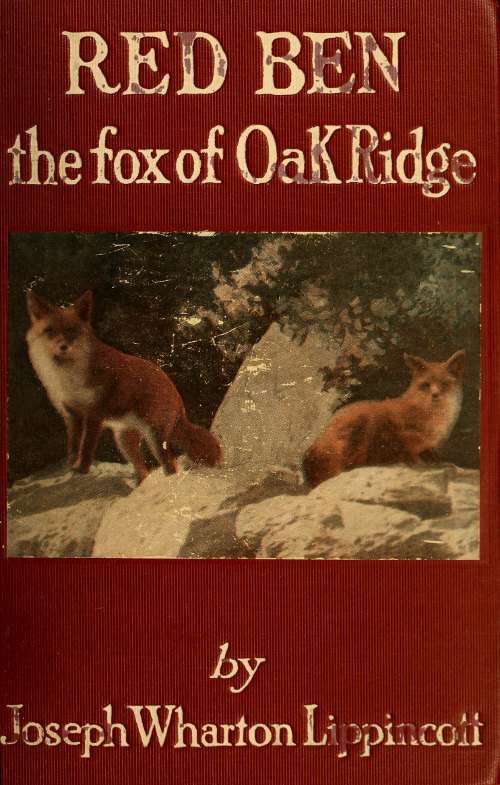
The Project Gutenberg eBook of Red Ben, the Fox of Oak Ridge
Title: Red Ben, the Fox of Oak Ridge
Author: Joseph Wharton Lippincott
Release date: August 14, 2018 [eBook #57688]
Language: English
Credits: Produced by Stephen Hutcheson and the Online Distributed
Proofreading Team at http://www.pgdp.net (This file was
produced from images generously made available by The
Internet Archive)
Courtesy Black Fox Magazine “Blackie instantly stopped”
RED BEN
the fox of Oak Ridge
by
Joseph Wharton Lippincott
Author of BUN—a wild rabbit
Illustrations by the author
THE PENN PUBLISHING
COMPANY PHILADELPHIA
1919
COPYRIGHT
1919 BY
THE PENN
PUBLISHING
COMPANY
RED BEN—THE FOX OF OAK RIDGE
To
a true lover of nature
—my father
INTRODUCTION
There is reason for the fox being termed the shrewdest of wild creatures. Unlike the deer and other vegetarians whose dinners often grow under their noses, he rarely gets a meal without outwitting other animals. He lacks the climbing ability of the opossum, the sharp claws of the lynx, the protective odor of the skunk, the diving powers of the otter—he is indeed just a little wild dog, a wonderfully bright, hardworking little animal whose cunning alone can lead him from his enemies and keep away the pangs of hunger.
He has been so persistently hunted by man that he is almost untameable; but as far as he dares to be, he is friendly under ordinary circumstances and fond of wandering around man’s dwellings. Chicken stealing is charged against him; but after all he holds the same position in the animal world that the wise old crow does among the birds—his good deeds and his crimes nearly balance. In “Bun, a Wild Rabbit,” the fox appeared as one of many woods creatures encountered by that doughty cottontail; but, to do him justice, a separate volume was required.
Foxes are much more plentiful than generally supposed. It is almost safe to say that wherever there are woods there are foxes, yet so wonderfully clever are they that few are seen. Whoever can distinguish their tracks from those of other animals is usually not disposed to tell of the discovery of fox “sign.” The friend of the fox fears the fox’s enemy; the trapper fears a competitor; and so the wily creature weaves his trail endlessly about the country side, unwatched except by the very few “who know.”
Imagination must play a part in making the story of a wild animal complete, especially that of such an intensely shy and crafty creature as a fox; but nothing is included here which does not fall within the actual powers of the swift and wily red fox of today. Indeed there are numbers of them very much like Red Ben. Parts of his story are written in the snows of many woodlands besides Oak Ridge, and adventures such as his are still happening in the quiet of moonlit nights.
As fast as man thinks out new methods of destruction, the fox finds fresh tricks through which to escape. And may he ever escape! For when the edges of our old fields no longer bear the imprint of his tireless feet, when the woodlands that delighted his wild little heart have been usurped by the tame dog and the tame cat, then indeed will have departed half their charm, half the thrill of winter walks.
J. W. G.
Bethayres, Pa.
Contents
- CHAPTER PAGE
- I. The Coming of the Red Fox 13
- II. The Den 20
- III. Learning to Hunt 35
- IV. Other Woodsfolk 45
- V. Gray Fox 56
- VI. A Long Chase 67
- VII. Red Ben Is Alone 75
- VIII. The Woods Awake 83
- IX. Studying the Enemy 93
- X. Jim Crow’s Signal 101
- XI. How Others Hunt 110
- XII. Ben’s Hundred Dollar Fox 121
- XIII. Red Ben Travels 130
- XIV. Blackie 138
- XV. Freedom Is Sweet 153
- XVI. The Road to the Sea 162
- XVII. The Other Fox 172
- XVIII. Home Again 183
Illustrations
- “Blackie instantly stopped”Frontispiece
- PAGE
- Fox track18
- “A gray squirrel was watching her”21
- “He became indignant”39
- Coon tracks40
- “Flying Squirrel, one of the very nicest of the woodsfolk”52
- “Gray Fox was waiting to trap him”61
- Red Ben63
- Red Ben’s Mother72
- The Mole85
- Deer Mouse86
- Shrew86
- “’Possum fell over backwards”90
- “They sat on their tails and held hands”113
- “Muskrat was busy pulling up grass”115
- “A turkey buzzard had been circling over him”133
- “They tore at each other through the wire”140
- “She stood on the threshold of the pen”154
- “Two coons who were having a loud altercation”163
- ’Possum tracks166
- “Holding to a limb with all four feet”185
RED BEN,
The Fox of Oak Ridge
CHAPTER I
THE COMING OF THE RED FOX
In the state of New Jersey there are still thousands of acres of low-lying woodlands, called pine barrens, where man has done little except chop down a few trees. Slowly but surely, however, the farmers are each year pushing their clearings deeper into this section, gradually overcoming the last barriers which Nature sets up to protect her own.
Ben Slown was one of these farmers. When the forest had been cut, he built a square house and a square barn. He planted straight-rowed orchards, he fenced in square, flat fields. He succeeded so well in stamping out all the natural loveliness that other practical farmers came there to start practical farms like his.
Soon there was a village; but Ben Slown’s square fields and the edge of the wild, interesting Pine Barrens were never separated, because no plow could conquer Oak Ridge and Cranberry Swamp.
The Ridge was a long mound covered with laurel, pines and white oaks. Cranberry Swamp, on the other hand, was low, wet ground which bore a nearly impenetrable mass of greenery, largely made up of tall cedars, holly bushes and cat briars. Through the swamp flowed a little creek in whose deep eddies green waterweeds swung with the current, giving glimpses now and then of turtles and slender, watchful pike.
When Ben Slown first planned to come to the Pine Barrens, his friends gloomily shook their heads.
“The foxes and other varmints will drive you out,” they warned. “You won’t be able to raise a chicken. The coons and crows will eat your corn. The woodchucks will destroy your vegetables. There are critters enough in the Barrens to keep you from being lonely, but they won’t be the kind of neighbors you want.”
“You just watch me,” boasted the farmer, “I’ll fix the varmints.”
He was no sooner settled in his new place than he began to put traps and poison around the cleared ground. All the little creatures that still lived there, and the others which came out of the woods at night to marvel at the strange new things to be seen—mice, snakes, birds, rabbits, mink, muskrats, woodchucks, coons, possums, skunks, foxes, deer and a lot of others—all suffered the same ill-treatment. But most of all he feared and hated the foxes, for they were clever enough to give him a little trouble. One after another was destroyed, however, and the farmer was having everything his own way when all at once there was a newcomer on the Ridge.
This was a red fox, a beautiful creature several inches taller than any of the gray foxes that lived in the Barrens. She found the farmer’s poisoned baits, but instead of taking them she took a chicken, and that right before his face.
This was the first fowl a fox had taken from Ben Slown, and therefore he complained all the more loudly; so loudly indeed that the neighbors began to think the destruction of the red fox the only thing that interested him. Instead of asking about his health, whoever met him would say, “Well, Ben, have you caught that pesky fox yet?” or perhaps, “Say, Ben, that old red fox of yours is bothering me now. Why don’t you keep her at home?”
Ben would mutter something, then pass on, his brows puckered from worrying over how to get rid of her. He might have worried far more had he known that in a burrow near the south end of Oak Ridge the red fox had four fine little fox pups.
Weeks went by, and still the fox and her tracks were seen occasionally, and still the farmer worried over that chicken he had lost. Then, one fine day, when the mice seemed scarce and the pups were very hungry, the fox dashed among the hens and took away another, this time a big white one.
Fox Track.
The farm yard was in an uproar. Chickens cackled and rushed about, cows mooed, sheepdogs barked, and Ben Slown, snatching his rifle from the rack, shot twice at the fox before she reached the woods, two fields away.
He was too much excited to aim well; the bullets went wild and the fox went on. The farmer, however, would not believe he had made a clean miss. Out to the fields he ran to see if a tuft of fur could be found on the ground.
He was walking around and around, growing more and more angry because where the fox had been he found only the white feathers of his pet hen, when out from the woods burst a neighboring farmer.
“Ben,” this man called, “Ben, get your shovel, quick! I’ve just found the red fox’s den!”
CHAPTER II
THE DEN
When the fox was making her wild rush to the woods, with the white hen held high in her strong jaws, she was thinking more about the four hungry pups in the home burrow than about the fuss she had left behind in the farmyard. In the friendly shelter of the woods, however, she began to feel very uneasy about it all. Everything had certainly gone wrong.
She laid down the limp body of the hen and looked back. Through the laurel and the straight trunks of the pines she could see the flat stretch of the fields she had just left. Ben Slown’s hurrying figure was there, but too far back to worry her now. There were no dogs loose, nothing else moving except three crows that were circling to find out what had happened to arouse the farmer.
“A gray squirrel was watching her”
Ahead of her lay Oak Ridge and the Swamp. What breeze there was came from that direction, laden with the smell of sweet fern. Still she felt uneasy. Her quick ear caught the scratching of claws on bark—a red headed woodpecker was examining a dead oak; that was all right. So also was the barking of a gray squirrel which was watching her from the limb of a pine. But why were the blue jays calling so loudly on the Ridge? Perhaps some enemy was near the pups.
Quickly picking up the hen she galloped towards the Ridge in that wonderfully silent way known only to the wild things.
She did not know that, though her own graceful body fitted into the woods like an illusive shadow, the white hen stood out like a beacon light. She did not know that on the Ridge it caught the eye of a friend of Ben Slown and held it while she circled the den and then called out the puppies to the feast. Her mother love had indeed overcome natural caution.
The den was nothing more than the enlarged burrow of an old woodchuck, who, years before, had been driven from the fields below. To the four puppies, however, it was all that a home ought to be. Wonderful to these was its narrow passage with the half turn at the end and the snug bed so far from the dangers of the world outside; wonderful too its collection of feathers and pieces of fur which told of happy feasts; but best of all was the sandy, sun bathed entrance in which they had basked and played on never to be forgotten May mornings in their early puppyhood.
Their father had never come to Oak Ridge to help the mother in feeding and protecting them. To her tireless energy they owed everything. Therefore to her they looked for everything, and she had never disappointed them. Nor would she ever disappoint them as long as they needed her and there was breath in her faithful body, for such is mother love in the fox world!
Here Ben Slown’s pet white hen found her last resting place. Into the mouth of the den, among the waiting pups, she was dropped, feathers and all, and down their little throats she passed, piece-by-piece, amid growling and crunching and pulling and fighting, for in no other way did they know how to show their thorough enjoyment.
A glorious feast it was! And when they were through, the mother, who had all this time been on guard, picked up for her share the bones that were left. She was still nosing about among the feathers when a man’s cough, from somewhere below in the woods, gave sudden warning of danger. Down she crouched, motionless in a moment; and without need of further signal, into the den tumbled the frightened pups.
The mother waited, with ears pointed to catch the slightest new sound. In the burrow behind her appeared a small head with ears cocked in the same way. Both heard the crack of a breaking twig.
Now the old fox slipped into the bushes and cautiously circled until she caught the scent of Farmer Slown and his friend, and heard their clothes scraping through the bushes. Amid the laurel she caught a glimpse of them sneaking along as noiselessly as they knew how to, the farmer in the lead, holding his long gun. They certainly looked as if they meant mischief.
Between them and the den the anxious fox ran to lead them away. A dog would have followed her in a rush, but the men were so busy in “pussy-footing” that they did not see her pass.
“Now,” whispered Ben’s friend, “look for the den right above that bunch of bushes ahead. Careful!”
Ben looked. First he saw a lot of white feathers which made him growl to himself; then he made out the mouth of the burrow, and last of all the sharp nose and bright eyes of the inquisitive pup. Ben looked at the pup and the pup looked back at him; neither had ever seen the other before, but fate had already decreed that they should meet often in the days to come. And so they watched each other now, until a fluffy feather, a beautiful white one, was picked up by an eddy of wind and whirled around and around the little fox’s head.
That reminded Ben of his troubles. He threw his rifle to his shoulder, only to find that at his first movement the pup had vanished in the burrow.
“Shucks! You little varmint!” he muttered. “We’ll get you all right. Up with the shovel, John, and let’s see dirt fly. Remember though, when we get the pups, that sharp faced one must be mine. He thinks he’s smart.”
Friend John took off his coat and dug with a will, while Ben sat on the wheat sack they had brought along to put the pups in. Both became greatly excited at actually having the young red foxes in their power. After the friend had dug a long while he looked inquiringly at Ben.
“When are you going to do a little digging yourself, Ben?” he asked suspiciously. Ben saw that the end was nearly reached, so took up the shovel with a laugh. The bag he stuffed well into the burrow to stop it up and to keep any fox from dashing out.
Meanwhile the four pups were cowering against the wall of earth at the very end of their home. Three were in one corner and the inquisitive one in another, all listening to the shovel coming nearer and nearer. Every time it jarred on a stone, the shivers ran up and down their spines; but they could do nothing, the burrow had no outlet besides the one the men were in.
Ben had a very healthy fear of being bitten; therefore the sight of the first little fox unnerved him completely. He knew that all of them were lightning quick, like bombshells on four legs. But Ben was cunning. He quickly thought out an elaborate plan of capture.
First of all he threw several shovels of earth over them, and pushed it in solidly so that they were buried tight. After that they could not move until Ben’s big hand picked them out by the scruff of the neck, one at a time.
The first poor, scared little fellow glared and kicked, but was somehow stuffed into the empty wheat sack. Two more followed him in the same way. Then the exultant farmer felt all around in the earth for more, and found none. He dug a little and felt around again. His hand slipped along the flank of the last pup, the inquisitive one that had crawled into a far corner of the den.
Suspicious at once, Ben poked a little farther. Had the little fox growled or moved an inch, or even trembled, he would have been discovered. But the loose, cold earth was mixed with his fur and his body was as rigid as the side of the burrow. Ben’s fingers at last moved on and the danger was past.
“Have you really got them all?” the other man asked.
“Every one!” growled Ben, getting up and giving the bag a shake. “Fill up the hole a bit, John, so no old cow can break her leg in it.”
Some minutes later the men reached the fields with their precious bag. Here Ben passed it over for his friend to carry awhile, and the latter took his first peep inside.
“Why, there are only three here!” he exclaimed. “I saw at least four when the old vixen carried that hen of yours to the den. You’ve certainly left one. Good thing we buried him. Back we’ll have to go.”
Meanwhile, however, there was frantic work going on at the den. The mother, who during the digging had been anxiously running to and fro in cover of the bushes, crept cautiously to the ruined home as soon as the men had left. She found a great ugly hole, with fresh dirt on all sides, but no sign of the happy pups who used to welcome her.
Around and around the lonely creature wandered, hunting with all her mother’s love. At last she jumped into the partly filled hole and sniffed and dug a little and then sniffed some more and listened. Something there suggested to her to dig deeper. So she set to work in earnest, tearing up the loose dirt with her forepaws and pulling it back in a heap behind her.
Every little while she jumped out to look around, then whisked back to her work, until at last she heard the buried pup sniffing and burrowing in his prison. Now she dug as she had never dug before, spurred by noisy activity of the little fox, who knew perfectly well that his mother was trying to reach him.
Rip, rip, rip, went her claws through the last strip of earth, and out popped the head of the pup, only to be seized and pulled almost off his body in his mother’s haste to get him out. She had heard the men coming.
The heavy pup was almost more than the old fox could carry; but somehow she dragged him out of the hole and leaped for the bushes, pulling him along by the loose skin at the back of his neck. The sudden shouts from the surprised men only served to spur her on, not, as they hoped, to make her drop her burden.
She knew the farmer had a gun. Bang! She was not hurt! The bullet only tore up the ground behind her. Bang! Another shot whizzed past. And then her jaws slipped on the pup’s neck and she dropped him.
The little fox rolled over, caught his balance and began to run entirely on his own hook. His legs were a bit wabbly, he did not know just where to go, but how he did work to get away! Into the bushes he went and on to more bushes; and then, right before him, he found his mother loping along, a safe, loving guide. His little heart beat easier then, but on he went, ever following that beautiful furry tail with the pure white tip. On and on and on, the two ran into the heart of Cranberry Swamp and to safety.
CHAPTER III
LEARNING TO HUNT
The pup went to sleep beside his mother in a bed of leaves under a fallen tree. With her there, he did not feel cold nor miss the other pups so much. He wondered where they were and would not have been surprised had they joined him at any moment; but his mother knew they were gone forever. Her joy at having this one little fellow left to her was almost pitiful. All through the long night she cuddled and tenderly licked him.
Just as the sky began to brighten for the day, she slipped out to get a drink and something to eat. A little distance from the fallen tree was a path. Here she made her first stop, to examine the ground and find out what creatures had passed that way during the night. Moving slowly, with her keen nose to the earth, she suddenly became aware of something following her. Around she whirled with teeth bared for defense, only to find herself looking into the mild, half ashamed eyes of the pup who, too lonely to stay in the bed, had noiselessly crept after her.
He hung his head now and looked wistfully at his mother until she licked his nose to show she forgave him and would let him come with her. In this way he started on his first big hunt.
A rabbit had travelled the path shortly before them, so the mother moved with caution. Whenever she sniffed at the fresh tracks, the pup, who followed close at her heels, sniffed too and understood perfectly well that a rabbit was near. When she at last sighted Bunny and crouched, the pup copied her movement exactly, and when she leaped he sprang too, all atremble with excitement. The old rabbit jumped quickly enough to get away, but the pup saw him and enjoyed all the thrills of his first chase.
Farther on they met a black and white skunk ambling home to his den. The pup, seeing him far ahead, crouched in readiness for attack. Here was a beautiful creature, no larger than the rabbit, actually coming towards him as though it wanted to be caught for breakfast. It never occurred to him that the skunk was a privileged character in the woods, whom foxes as well as smaller and larger animals had learned to let pass with plenty of room between. The mother, however, knew all about skunks and saw that trouble was coming. She rushed at the pup, nipped his ear and fairly shouldered him out of the way of the other animal.
The skunk saw at once that all the disturbance was only over a young fox who had not sense enough to know that every path belonged to him. Therefore, he passed grandly, without even slackening his pace or changing his direction one inch.
“He became indignant”
The pup, sniffing along the trail behind him, caught a disagreeable, musky smell which told, far better than his eyes could, that this animal was to be left alone. He followed him very carefully at what seemed a safe distance, until he became indignant and whirled half around with feathery tail straight in the air. That was warning enough to satisfy even the pup’s inquisitive mind, so he turned back with a bound and found his mother sitting in the path amusedly watching him. She saw that the little fox had already learned caution—the most important lesson of the woods.
A few yards farther they circled a marshy place where spring frogs were singing merrily; “peep, peep—peep,” they sang, over and over again. There seemed to be one piping from the bank, almost under the pup’s nose, but he could not find it, nor could he find any of the others, for they were in the water with only their small noses and eyes stuck out behind the blades of grass and twigs.
Coon Tracks
The old fox examined the mud for tracks, satisfied herself that those she found were made by a coon and not by man or dog, then turned to look for the pup. He was in the act of springing on something he had found in the grass. Up went his front paws, and then down he came right on top of a mouse which had been feeding on winter dried cranberries clinging to vines near the water. The pup had smelled it and found its hiding place all by himself. Now he tussled with the furry little creature until it had squeaked its last squeak.
The mother let him eat it all, then led away to Goose Creek. Here the incautious pup surprised a great blue heron in the act of catching a minnow. With a mighty flapping of big wings the scared bird started over the water, his long legs tucked up under his tail, his neck doubled back, so that it seemed only half its real length. When he got well away, his angry challenge—“u-r-g-h-h-, u-r-g-h, urgh, urgh”—could be heard all over Cranberry Swamp, warning his mate and all the other birds and animals, too, that there was danger lurking near.
A red squirrel ran out on a limb nearby to see what had disturbed the old fisherman. Two crows circled cautiously in that direction, a pair of wood ducks sprang from a pool below and winged their way up the creek towards a safer feeding ground; the frogs stopped peeping, and the lone kingfisher, sitting on a stub in the stream, enjoying the first rays of the morning sun, darted away with a rattling scream.
It was a wonderful lesson to the pup. It taught him that he must be careful not to disturb any creature that can spread alarm and excite the whole wood. It awoke in him the true fox nature which prompts the wisest of them to travel with all the noiseless stealth of a crafty Indian. He found out then what he saw more and more clearly the longer he lived, that there is a bond joining together the woods folk into one great family, for mutual protection.
He was the one feared, the outcast, this time; but at another time it might be a man with a gun, or a big hound, whom he would flee from, when warned, with the same dread as Blue Heron.
Now, he slunk back of some bushes and waited there while the noise and excitement died down.
Red Squirrel, however, kept his bright eyes on him, and fussed and scolded, without a stop. To him the branches were just like so many paths, over which he could run like the wind from one tree to another, until he reached the little hole in the hollow cedar he lived in, or dashed to another safe little hole under the roots of a magnolia, not far away. Therefore, when he was off the ground, why should he fear a fox, especially a young one like this? “Bur-r-r-r-r-r-r,” he fairly shouted as he danced and fumed first on one limb, then on one nearer, until so close overhead that the fox could see the four sharp teeth with which he gnawed nuts so easily.
There was something, however, which Red Squirrel had not thought about. With a young fox, or with any young animal, there is usually a mother. The annoying little nut eater had one glimpse of a red streak flinging itself at him from behind, then in a fright he lost his footing on the low limb, fell into the bushes, and had to run with all his might to get up the next tree without being punished. Very quiet after that, he let the foxes trot off unmolested.
CHAPTER IV
OTHER WOODSFOLK
The mother led the way towards the nest under the fallen tree, but was stopped in the old path by the sound of a man’s footsteps. Quickly she slipped into the bushes. The pup was not sure what to do. However, when he saw Farmer Ben’s friend, John, stalking down the path, he scrambled out of the way in a hurry.
“Well, if there isn’t Ben’s little sharp-nosed fox!” muttered the man in surprise. “Ben’s fox! Ha, ha. I should like to see Ben catch him now!” He saw how wonderfully the wild little animal melted away among the shadows, then he stalked off with many a shake of the head as he thought of his chickens at home.
Everyone he met after that had to be told the good joke about the den and Ben’s sharp-nosed fox, so the story spread, and “Ben’s fox” became for a time the special joy of all the village gossips, who liked Ben none too well. Those whom he had angered with sly bargains in the past, said that he himself was like a cunning fox—a black one; so it was a fox against a fox. “Black Ben against Red Ben,” someone of doubtful wit expressed it. This amused a number of the boys, and at once gave the little red fox a nickname. Through all his later career he was known as Red Ben.
When people good naturedly teased Ben Slown, who never could enjoy a joke on himself, he grew more and more surly. He soon saw that, until he caught the foxes, he would always be plagued, especially when someone lost a chicken. So he began to scheme and set more traps. He had always hated foxes, but never more bitterly than now.
With little suspicion of this, the mother was teaching Red Ben the tricks that every wise fox must know. Night after night they hunted mice together, or lay in wait for fat muskrats in the swamp, or chased big Bun or the other cottontail rabbits.
Often they played in the moonlight and wrestled and rolled by the hour in a sandy hillock near the Ridge. Both thoroughly enjoyed this. The usual game was a mock fight. The mother would rush at the pup and roll him head over heels, then hold him to the ground while he tried with all his might to break away. Sometimes she would pretend to bite a foot or a leg, or to tear an ear, he meanwhile striving to protect himself.
At first she was very careful not to hurt him, but as he grew stronger he also gained a wonderful quickness which often surprised the mother, whose own motions, although almost like lightning, were soon no match for his. Then the games became wildly exciting. The pup could escape the old fox’s rushes, and himself nip and worry and trip and get away, and then roll over and over with her, in a lightning battle to get the throat-hold which ended every game.
All this was splendid training for Red Ben. He could practice all kinds of fighting tricks and learn how to deal with an animal larger and stronger than himself. Had his little brothers lived to be his playmates, he might never have had this experience, which meant so much to him later on.
His cleverness and growing strength made him a wonderful companion for the old fox. She would go nowhere without him, and began to rely more and more on his help in their hunts.
It happened that wild strawberries were especially good that year, and so were eaten occasionally by the foxes, who picked up those the village children did not find. After them the cherries ripened, and the big mulberry tree at the corner of Ben Slown’s fence began to drop delicious fruit. Fat robins, starlings and black birds picked their share, but at night, especially after a rain heavy enough to knock down a good supply, the Oak Ridge animals fairly swarmed around the mulberry tree.
The shy red foxes usually reached it after the last sign of the sun had left the sky, so it was not strange that on one evening they found there ahead of them one of the deer from Cranberry Swamp with her two spotted fawns. The watchful doe scented them, gave one quick snort and led the fawns away in great bounds, for fear they were in danger. All three leaped over the field fence as if it had been a bush in the path.
The rush of the deer to cover frightened two rabbits just as the foxes came cautiously out of the wood. Away dashed Red Ben to head them off, but too late. When he returned, a huge coon hurried to the tree and began to swallow mulberries as fast as he could pick them up. The mother fox, however, took no notice of old Ring Tail, and he was too busy to worry over the foxes just then.
Up in the tree, Red Ben heard an occasional squeak, and soon spied a little brown squirrel which was quite the prettiest creature he had ever seen. While he watched, it suddenly sprang into the air with feet outstretched and sailed to a fence post near the wood; there it alighted almost as softly as a leaf, looking so much like a clinging piece of bark that the pup could hardly believe it was anything alive. This was Flying Squirrel, one of the very nicest of the woodsfolk.
While he was busy with the juicy mulberries the pup did not keep a very good watch behind him, and so was surprised suddenly to find White Stripe, the skunk, nosing around close by. He, too, liked the mulberries, it seemed. The fox kept one eye on him, but found he attended strictly to his own business.
A moment later a furry gray creature, nearly his own size, came stealthily along the fence. The pup was worried and ready to run at the slightest sign from his mother, but she kept right on nosing about, and old Possum joined the feeding. He, however, crawled up the big tree, where he wandered from limb to limb, picking off the ripest fruit and often by mistake knocking down some to the creatures below.
“Flying Squirrel, one of the very nicest of the woodsfolk”
It was a weird assemblage that the moon looked down upon that night. Two small coons came from the swamp with their mother for a hurried look around; White Stripe’s mate, a wonderful white skunk, also appeared, and a brown screech owl sat on a nearby pine limb to watch and whinny softly, so that his mate, who was looking for mice farther along the fence, might always know where to find him.
By this time Red Ben knew most of the wood creatures, and they knew him. Ringtail, Possum, White Stripe and Screech Owl were hunters; like himself they preferred meat to grass, fruit, roots and nuts. Although each had a scent entirely his own, each also had the “hunter” smell, quite different from the meadow mice, who lived on seeds and grass, or from Red Squirrel, who ate nuts, mushrooms and buds. Quite different too from the deer and from Bun, the big rabbit who lived near one of the farm gardens and enjoyed parsnips, string beans and other vegetables, whenever the clover was scarce.
The woodsfolk could be divided into two big families—the first one made up of those who hunt and the other of those who are hunted. The hunters get used to seeing each other and to running across each other’s trails at night. As long as there is food enough for all, they rarely quarrel; but jealousy and suspicion keep them from being real friends. Red Ben did not think of playing with the young coons; nor would young skunks have interested him at all as playmates.
The four-footed hunters all had teeth very much like those of a dog or a cat, while the little animals that they hunted had gnawing teeth, like those of the mouse. Even the woodchuck and the muskrat had gnawing teeth; they liked to eat grass and tender roots. Screech Owl and other hunters among the birds, from big Bald Eagle all the way down to little Sparrow Hawk, had hooked beaks and long sharp claws or talons, with which to catch their prey.