
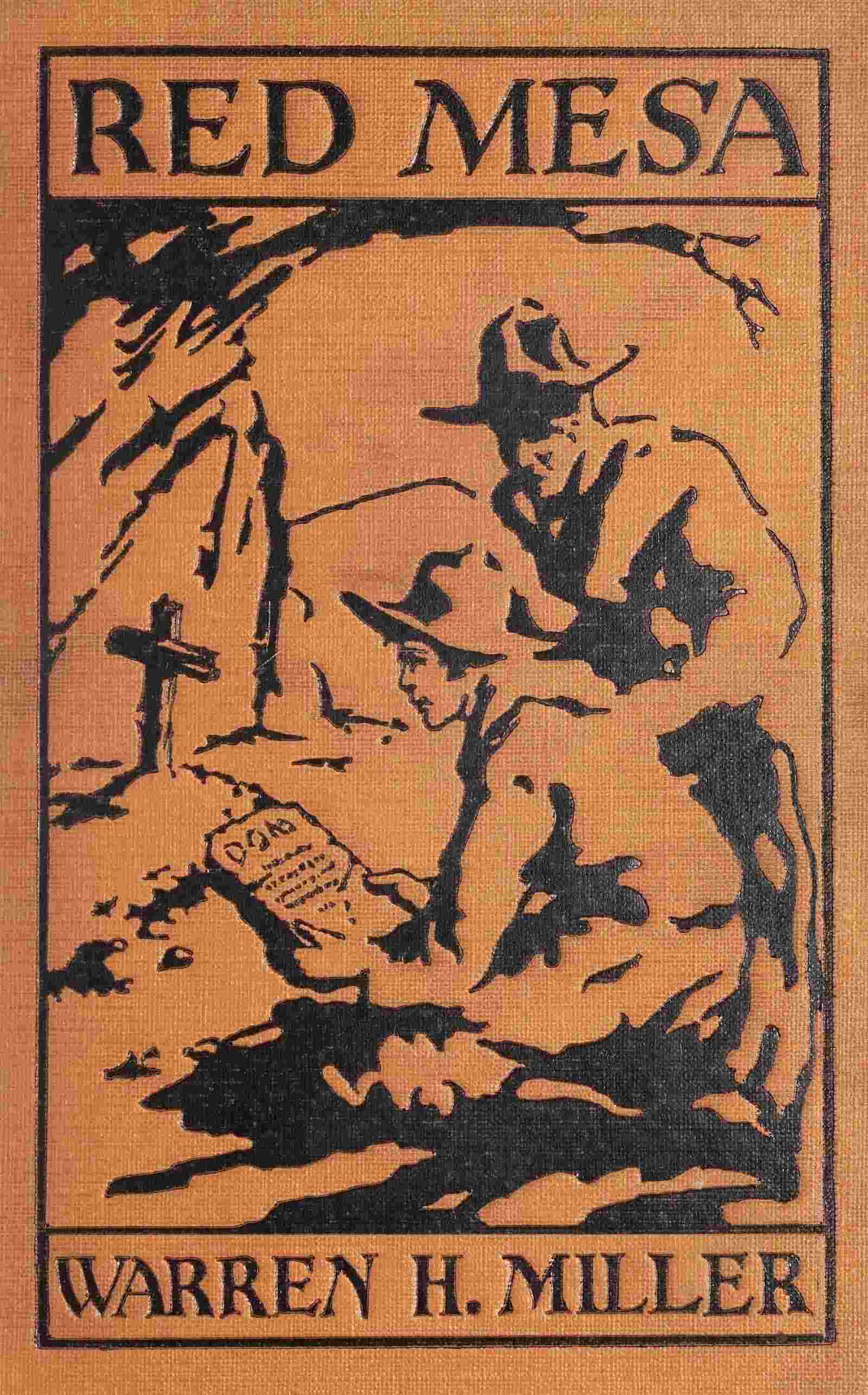
RED MESA
CHAPTER I
CAÑON HONANKI
ABOVE a timbered valley in the southwest rises a towering wall of gorgeous cliffs such as only Arizona can produce. Their rock pinnacles are banded with color—red strata, ochre, blue, green, and white—all in wavy horizontal lines like layer cake. These long walls were scoured clean and smooth long ago by prehistoric water action. They were broken with deep fissures—fissures that now cleave the cliff from top to bottom—“chimneys” that mean seven hundred feet of sheer ascent to him who would dare scale these heights.
Two riders sat gazing up, searching this cliff face, while an Airedale dog of huge and leonine aspect prowled about in the creek bottom near them, investigating this and that with snuffing nose.
“That cliff dwelling is up here somewhere, according to Doctor Fewkes’ map, John,” said the smaller and rangier of the pair, his puckered-up black eyes never leaving off their scrutiny of the cliff face. “Think we’ll find her?”
The older man, a great, bony and leathery cowman, who might have hailed from anywhere in the west from Montana to Arizona, took off his sombrero and mopped a sweaty brow with the loose end of his bandanna.
“Search me!” he grinned. “I’m a cowman, not no prophet—as the greenhorn axman said when the lumber boss as’t him which way his tree was goin’ to fall.” He looked lugubriously up at the cliff, shaking his head solemnly. “It’d take a horned toad with suckers on his feet to bust her, Siddy son.”
The youth tugged determinedly at the fine fuzz of black mustache that adorned his upper lip. “Honanki Ruins or bust—that’s our motto, John!” he retorted, his black eyes twinkling merrily at the reluctant cowman. “Here’s Fewkes’ map, with the ruins marked ‘Inaccessible’ on it, and, by jerry, we’re here, if the map’s right. They’re somewhere above us, and it’s up to us to bust ’em.”
“Yaas,” said Big John, shifting his weight to the nigh stirrup to give the white horse under him a change of load. “Somethin’ hed orter be done about it, thet’s shore! You mosey up—an’ I’ll hold yore hoss!”
All of which preliminaries usually meant that Big John really meant to take the lead in climbing himself once the ruins were found. Sid knew that all this feigned reluctance about climbing cliffs was mere camouflage on Big John’s part. He urged his pinto across the cañon so as to get a better view of the cliff face. He wanted to size up that cañon wall first, for he knew that the only way to keep Big John off that cliff was to tie him down, which “ain’t done.” The two had been boon comrades for a long time; first up in Montana on the hunt for the Ring-Necked Grizzly, later in the Cañon de Chelly region where the Black Panther of the Navaho had met his end. That expedition had been Sid’s start in practical ethnology. Now they were down in the White River reservation of the Apache, seeking out ruins that had been noted by Dr. Fewkes of the Smithsonian but had been left unexplored for lack of time and facilities.
“There it is!” rang out the youth’s voice excitedly from across Cañon Honanki (Bear Cañon). “Come over here, John!”
The huge cowman trotted his white mustang over to where Sid had halted his pinto under a big western pine. Far up, at least three hundred feet above the floor of the valley, they saw holes like swallow’s nests pierced in the cliff at irregular intervals. They seemed small and round and black as ink, and near them were carved on the rock odd circular spirals, lightning zigzags, primitive horses, apparently all legs, and geometrical armed-and-legged designs intended to represent men. Ragged holes further along on the cliff face showed that galleries and passageways ran in behind the living rock up there. These natural caves, common enough in Arizona, had been scoured out by water action in geologic times.
But it was a fearful place for human beings to attempt to climb to! Tall perpendicular folds in the cliff face cast their black shadows on the surrounding stone, the cracks beginning and ending nowhere. There were impracticable clefts, ledges that shaded off to flat precipice faces, dents and scoriations not over two feet deep, yet they seemed to be all the footholds for climbing that the place afforded.
“Gorry!—a cavate dwelling!” whooped Sid, overjoyed. “The kind that is built in the solid rock instead of being made of stone slabs, John,” he explained with the ethnologist’s enthusiasm.
Big John grinned. “Gawsh!” he exploded. “I s’pose that humans once tried to live in such places—but eagles would know better! Nawthin’ll do but we gotto bust her, eh?”
“Yep,” said Sid confidently. “A shaman or a pueblo priest lived up there once. Sort of hermit, you know. Holy man. If that old scout lived there we ought to be able to climb up once.—What think?”
“He didn’t come pilgriming down to shoot up the gulch muy plentiful, I’m bettin’!” averred Big John sardonically. “I’ll tell ye, Sid; thar’s only one way to bust her, and that’s to make a string of long ladders, same as he done. You don’t get me off this hoss on no fly-creepin’ climb without a-doin’ jest that—savvy?”
“Oh, thunder!” exclaimed Sid impatiently. “It’d take two days of perishing work. Le’s try to get up this cleft here.” He pointed to the beginnings of a practical ascent.
“No!” barked Big John, and his tone was final. “The Colonel, yore pappy, he’d stake me out an’ build a fire on me tummy ef I let ye do any sech thing. Thet halter’s still waitin’ for you, Sid, I’ll admit, to save having it proved on me, but I ain’t aimin’ to cheat your friends out of their necktie party none. We camps right here an’ does the job proper, sabe, lil’ hombre?”
Sid acquiesced, after a little further study of the cliff. There was a tall vertical cleft that led up to the swallow’s nest holes by a series of breaks and rises. It was easy to reconstruct the old shaman’s route by imagining the proper ladders set up so as to negotiate a number of these vertical rises. They could be made of slender lodgepole pine, with the branches left on for steps in place of the heavier logs with notched steps which the aborigines had used. And not over half a dozen of them would be needed altogether. It was worth doing, to “bust” an “Inaccessible.”
Making camp in that rainless country was a simple matter. Sid simply selected a pleasant site on a knoll down the cañon overlooking the brook under a canopy of huge pines, while Big John unsaddled both horses and took them to the nearest grass plot, staking them out and leaving Blaze, his Airedale, on guard. The dog had been a present from Colonel Colvin after the Black Panther trip. He had the noted sagacity of his breed, and with a year’s hunting experience with Ruler, the giant coonhound of that expedition, had become a most devoted and dependable “pardner” on all their hunts. After merely piling the sleeping and cooking gear and hanging up their food bags above the rodent zone, Sid was ready to go ladder cutting.
The White Mountain region is pine forest, sparsely timbered, the trees not crowded or packed so densely as in eastern forest growth. As a result, the mountains, which resemble much the rounded and rolling Alleghanies of the east, seem stippled with individual trees instead of banked in mossy green as with closely growing timber. In the river valleys, however, there are thickets as dense as in any well watered clime, so Sid lost no time in getting into such a pine grove armed with his light belt ax. That light, little long-handled ax of his was far more efficient than any sort of hatchet. It would drop a four-inch pole thirty feet high almost as quickly as a full ax.
Before the first tree crashed down Big John had joined him.
“This here Pinus Contorta (sounds like Julius Seizher only it ain’t) is the boy that will bust her quick, Siddy boy,” he laughed, rolling up his sleeves and baring a forearm like a lean ham. “You give a leetle feller like me elbowroom!” He took a full ax in one fist and smote a tree with it like chopping with a hatchet. About two judgmatical cuts sufficed to send it crashing down, whereat the giant cowman started after another. Sid saw that he would have his hands full just trimming the felled ones so he went for their boughs with his small ax.
“You cut off them tops whar’ there’s somethin’ substantial to it, Sid,” rang out Big John’s voice from the timber as he sent another pine tumbling about the youth’s ears. “Remember that I weigh a pound or two more’n a straw hat, son!”
“Help me put up this first one, now, John, she’s ready,” announced Sid, struggling to lift the trunk clear of the underbrush. Big John came over and heaved the whole tree unceremoniously up on his shoulder. With Sid guiding the lean end they made for the cliff. Pushing and panting they up-ended it and stood it ladderwise in a vertical fissure which gave on a ledge above. Sid swarmed up the short branch stubs, climbed out on the ledge, and waved his arms down to Big John below.
“Looks like one of us’d have to shinny up and haul the next one with a lariat,” he called down.
“Son, I got an idee—ef she don’t get away while I’m picketin’ her down,” said Big John. “You git up thar and hang my lariat honda over that point of rock, sabe, an’ then we’ll run yore lariat through the honda and snake up the next pole by one of the hosses.”
He got both lariats up from camp while Sid waited. Presently he returned, to cast it up with the sure whirling pitch of the born rope artist. Sid snatched it in and hauled his own up by the end of the other. Then he coiled both, attached them to his belt and started up the next cleft. The very pockets in the rock where feet of the ancient log ladders used to rest were easy to pick out as he climbed. What men had done a man could do! By the time he had everything fixed and the honda, or brass eye of the lariat, hung with the other rove through it, Big John was below with a horse and a fresh pole. It came snaking up as the cowman led the horse away, hauling on the lower end by the lariat tied to a cinch strap above the pony’s back.
Sid set the pole and climbed higher to the next ledge so that they could repeat the maneuver with a third pole. This was the limit for that horse-hoisting stunt, however, for he was now up over eighty feet and there was not rope enough in camp to double through the next honda. Big John yelled up as he tied on the fourth pole and then he led the horse back to graze again.
In a few minutes Sid saw him climbing up below him. He had no fear of height himself. That all belongs to the tenderfoot aloft for the first time. It attacks man in a sickening sort of stage fright at first, whether on cliff, high building, or the upper rigging of a ship. After a time familiarity wears it off and in its place there comes a cheerfulness over the immense outlook, the height and the distant scenery of it all; a joyous sense of freedom that must be part of the bird’s outlook on life. He waited for Big John on the ledge, looking about him interestedly. It was narrow but not dangerous up here. An old woman might have wanted a rail fence or something, he thought, but things were done on such a huge scale on this cliff that this very ledge that looked from below like a mere trace proved up here to be nearly three feet wide. Plenty!—Thousands! as the facetious Big John would have said.
Presently that cheerful son of Montana arrived, breathing heavily but entirely at ease. “Waal, son, it ain’t goin’ to freeze up an’ snow on our scheme jest yit! Tail on to this yere lariat and we’ll yank up another pole.”
They hauled away on the long rope which the cowman had tied to the butt of the fourth pole while down there. It weighed perhaps fifty pounds—nothing at all to mountain men! After a period of grunting effort the butt end came up over the ledge and the pole was gathered in and laid lengthwise. They then started on to prospect for the next fissure.
“Gosh durn it, how come, son? Hyar be stone steps leadin’ up back hyar, or you can steal my hoss!” came back Big John’s voice in the lead as they rounded the face of the huge pinnacle of rock. Sid hurried to catch up. That simplified matters a whole lot!
“Look yonder, John!” he cried excitedly, as they climbed up the row of stone pockets, “one more pole finishes us! See that hole in the wall across the crevasse?”
“Sho’ I do! But Sid, you ought to show some respect for the naked truth, son—which-same means we’re busted! Yore hole’s across a no-bottomed chasm, hombre, an’ we ain’t flies nor yit eagles, nohow!”
Sid climbed more notched steps that led up over a smooth billow of rock and then eyed the hole opposite, measuring the distance carefully. Here, evidently, began those scoured-out caves and tunnels in the living rock which led up to the cavate dwelling. There had been a log bridge across here once, but it had long since rotted through and perished.
“Let’s drop our fourth pole across and then, we’ve got her, John—that’s the answer!” declared Sid.
Big John shook his head solemnly. “Ef she breaks an’ lets this gent down, they ain’t goin’ to be no come-back, that’s sartain! No sir, nawthin’ stirring!”
“Oh, shucks—where’s that pole, John? Le’s get her up here and let her fall over anyhow!” exclaimed Sid hopefully. “Maybe we can hit the hole opposite with its other end.”
“I’ll try that much,” agreed Big John. “I ain’t purty but I’m shore strong—as the bohunk said when they as’t him to tote a saw log.” And without more ado he retraced his steps and picked up the pole. With it on his shoulder he came teetering along the ledge.
“Thar, Sid—miss an’ out! We got jest one shot,” he grunted, standing the pole up and aiming its fall carefully.
“Wait!” shouted Sid. “Tie the lariat to the middle of it! You’ll feel better if you’ve got that to keep her from breaking,” he suggested.
“Center shot, son; plumb center! Shore you got almost human intelligence!” grinned Big John, lowering the pole again. Sid seemed to have an even better idea than that, now. He coiled the lariat and cast it up, to fall around a rock pinnacle above them. Then he tied its other end near the center of the pole and they let it fall slowly, paying out rope while Big John guided it by main strength until its other end rested square in the jagged black pit of the cave across the chasm from where they were standing.
“Ain’t afraid of nawthin’, now, with that good old rawhide lariat holdin’ her up,” declared Big John, beginning to climb across. Sid followed him, once the heavy bulk of the cowman had left the pole on the other side. Below him dropped away an endless shadowy chasm, with the tiny pines and firs of the valley visible hot in the sunlight far below. On both sides towered above him the huge smooth walls of the chimney made by the pinnacle and its neighbors. Sid cast a mere glance at the prospect below, and then climbed over swiftly and joined Big John in the black depths of the tunnel.
It was some time before their eyes became accustomed to the dim light. Up and up inside the living rock the narrow fissure climbed. Old steps, cut in the rock or built of flat stone slabs, guided them. Here and there light was let in by those irregular ragged holes in the cliff wall which they had seen from below.
“No one but a shaman would live here,” declared Sid, speaking ethnologically; “a basket of corn, some dried meat and a string of peppers would last him a whole season. But there’s water up here somewhere.”
“Hed orter be!” said Big John laconically. “This place’s as dry as the professor’s book, whar the dust flewed out of the pages when you opened it. Besides, that Indian’d grow a beard a mile long while he’s jest gittin’ down out’n hyar fer a drink!”
There was water up there. After a long climb, when their aching knees positively refused to lift for another step, they came to a little basin hollowed out of the rock by human hands. A thin trace of water came weeping down from somewhere in the interior here, to lose itself and evaporate on the outside cliff face. A spruce growing out of the crevice, which they could see through the next window, showed that all that water was being preëmpted by just that one tree. A spruce seed had found it somehow. Nature leaves nothing unutilized.
A blaze of light now lit up the chasm ahead. The gallery in the rock became more open and led upward to a wide door cut out of the rock. Here the shaman of long ago had looked out on the frailties and follies of the world below him, serene, indifferent, meditating on the destinies of his people. Those times surely needed one wise man to sit apart and do the thinking for them all, for in this pueblo country the hostile and warlike Apaches had been fearsome invaders even before the time of the Spaniards. How long before that they and the Navaho had come down from the far north no man knows. But they found the peaceful and sedentary pueblo Indians an easy prey, and gradually they drove them all out of these cliff dwellings in the mountains to build themselves defensive villages on the high mesas of the Painted Desert to the north.
Sid and Big John stopped at that natural doorway to look out below. Cañon Honanki lay a green-spired paradise below them. Bare, barren cliffs, streaked with color, rose opposite. A short way down the valley the horses could be picked out grazing placidly. The watchful Blaze lay near them and he rose and barked at sight of his master, his faint volleys echoing up the cliffs.
“Now for Mr. Inaccessible—the cavate dwelling!” exclaimed Sid triumphantly. He led on upward until he came to a low door built in a stone wall laid up without mortar. Entering it, they saw that a round window cut through the cliff stone lit up the small cave room. Baskets, finely woven, of a texture and quality seldom seen nowadays, greeted Sid’s delighted eyes. There were shallow marriage and ceremonial baskets; bottle-shaped ones waterproofed with piñon gum, the kind now called tus and used in medicine dances; large granary baskets still filled with dry kernels of blue, black, red, and white corn. A few black pottery jars, decorated with white lightning zigzags, stood in the corners. Strings of corn ears, red peppers, and dried onions, all musty and shriveled, hung from poles let into the roof of the cave.
“The old bird was a rain-maker, all right,” said Big John, pointing irreverently at the zigzags on the jars and baskets. “Claimed he invented the lightning, all-same as Benjamin Franklin.”
But Sid did not answer. Instead his eyes were riveted in sheer astonishment on the smooth rock wall of the cave, and he grabbed Big John’s sleeve and pointed, speechless with wonder.
“Gorry!—Look there, John!” he finally found breath to exclaim. “Here is the last place a fellow would expect to see the writing of a white man, I’ll say!”
“Well, I’ll be durned!” growled Big John, peering at the letters with Sid.
Written on the wall, in red earth letters and still as bright as the day they were made, was—a name! a Spanish name!
Fra Pedro Del Vacas, 1680.
“Can you beat it!” cried Sid, breathlessly. “Gorry, what a find!—Le’s see, John,” he went on excitedly, “1680 was the year of the big massacre, wasn’t it?”
“Search me!” said Big John whimsically. “All I know about them greasers is that you shore don’t have to oil yore bullets none to slip ’em through their feathers.”
“Sure it was 1680!” continued Sid, ignoring Big John’s observation upon our Mexican neighbors. “That year all the tribes rose against their Spanish friars. Most of them were murdered or martyred—especially those that the Apaches got hold of. This Fra came up here to the old shaman for refuge. Why did he write that inscription then? Because he was dying, of course! Escaped from the Apaches somehow, wounded perhaps, and was carried up here by the pueblo people. The Spanish missionaries did not carve their initials on every rock. He left his name for the next missionary to find, if ever one should visit this pueblo again. It means something, John. We’ll look for pueblo graves, next, and maybe get some more light on it.”
Sid’s idea of searching for graves might seem astounding to any one but an ethnologist. But the richest prehistoric relics are always obtained from exhumed graves, usually located near some shaman’s cave. The body was always mummied, and with it were buried most of the pueblo Indian’s possessions. Here the early cotton blankets, yucca sandals, baskets, pottery, and weapons are found in a tolerable state of preservation, and they all show that the prehistoric pueblo dwellers lived very much as their descendants do to-day.
Big John was used to Sid’s intense enthusiasms in ethnological matters and was accustomed to following him around—to see that he “didn’t break his fool neck an’ so cheat that rope that’s waitin’ fer him” as he always put it. He bent his tall frame in pursuit as Sid dodged out of the house and darted for a deep and dusty grotto that lay behind it. A huge horizontal fissure, not over four feet high, had been worn out here by the waters, undermining the cliffs above for a considerable distance. A stratum of mud, long since dried to dust, covered the floor of the fissure. Closely dotted over it were slabs of stone, under each of which one would find a small stone kiva or dry well. The mummy would be discovered sitting upright in it, swathed about with cotton blanketing made long before the first wool from the first sheep that gave it was stolen from the Spaniards by the Navaho. Generally also the mummy was covered with ceremonial basketry. But Sid passed them all by, for the present. What he was searching for now was a white man’s grave. And, far back under the rock he found it, a long mound with a rude cross set in the dust at its head. A single flat stone lay across the center of the mound.
Raising it, the persistent Indian burial customs proved to have been still adhered to. A long black robe, with a ghastly skull peeping from the cowl, lay flat on the bottom of the niche, which was a sort of stone coffin, its sides lined with stone slabs built in shallow walls precisely like the Indian rivas. The top was roofed over with stone, on which the earth had been mounded up as the white priest had evidently directed it should be. There was nothing else in the grave. Nothing, that is, but a flat slab of pottery, lying across the dead friar’s chest!
Its square shape at once attracted Sid as unusual and not Indian. He picked it up with queer thrills running all through him. A message from that white man of long ago! For there was writing graven on the clay, and the three letters “D. O. M.” stood at the head of the plaque.
“A Dominican friar, he was, John,” said Sid, reverently. He began to read aloud the sonorous Latin written on the plaque, conjuring up his forgotten Cæsar of high-school days.
“What’s that stuff, huh?” inquired Big John. “Sounds like spig talk, but ’tain’t. I’m a hundred per cent American, Sid, I am, an’ I don’t like it,” he growled, shaking his head sturdily.
“Can’t make it out myself,” confessed Sid, after reading it a little farther. He found that he had forgotten his Latin so much that merely to pronounce the words was an effort. “Here’s a few that I do know, though, John: ‘Aurum et Argentum,’ that’s gold and silver; ‘Pinacate,’ ‘Sonoyta,’ those are places; ‘Papagoii’, the Papagoes; ‘Mesa Rubra’ that’s Red Mesa——”
“Never heard tell of it,” declared Big John, promptly. “Thar’s a red mesa up Zuñi way, but there’s no gold or silver thar; an’ Pinacate is a long thirsty ride down over the lava country into Mexico. Ain’t no mesas in that country nohow. She’s all red lava saw-teeth an’ spiny choyas—if you asks me.”
“It’s an old Spanish mine—that’s what the plaque’s all about!” shouted Sid, excitedly. “Some of the Papagoes must have told this old fra about a gold and silver mine, located in Red Mesa down Pinacate way—say, Scotty will have to hear of this John!” whooped Sid, carried away by the enthusiasm of the moment.
Big John shook his head solemnly: “Son, folks has died of thirst in thousands, chasing lost Spanish mines in that country! Santa Fé’s full of old priest reports like this-yer. The Indians shore did stuff ’em with gauzy tales! Thar’s mineral down thar, I’ll ’low; but after ye find it, what ye got? Reminds me of the recipe for cookin’ a fish-duck. Ye take an’ soaks him in three kinds of soup; bile him four days; stuff him with an apple an’ a onion; tie a bunch of celery ’round his neck, wrap him in a couple of slabs of bacon; stick in a hunk of garlic; add salt, pepper, and a bottle of wine; bake him three hours—an’ presto, the gosh-darn fish-duck is gone! That’s how a feller feels when he finds a mine in that country, Sid; ye cayn’t git the miner’l out nohow!”
Sid’s laughter pealed out. “Well, we’ll hunt up old Scotty just the same and then go get some one to translate this Latin. Scotty’ll just go crazy over this tablet, and he needs the money, John. We can come back here for the Indian relics some other time. Scotty and Niltci are prospecting down in the Santa Catalinas for mineral, right now, you know——”
“An’ they won’t find nawthin’ down thar thet ain’t been found long ago, jest as I told him,” interjected Big John.
“Sure! We’ll ride down there and give him this tablet. It will be a life-saver for old Scotty! Red Mesa or bust! John—how’s that for a new motto?”
“Looks handsome, but she ain’t edible,” said Big John, enigmatically.
But Sid just couldn’t get over his enthusiasm for his chum Scotty’s sake about this Latin tablet. What a find for good old Les! That mine would be his big chance! Friendship was sweet; to be able to do something for a chum was keen pleasure. He sat down and went on studying over the tablet, balking at strange Latin words, digging up more of them out of his memories of his school Cæsar. The old pottery plaque fascinated him. He kept speculating about it, how it came to be made, where the old fra had got his information about the mine. What an ancient old story this was!
“This fra used to live with the cavate dwellers here, John, I tell you! He made this plaque and had them fire it when they baked their own pottery. Imperishable record, you see. It’s a real find, I tell you! One of those lost Spanish mines that really is so! ‘In regione Papagoii’ that’s the Papago country of Pinacate, all right. ‘XXI milia S-O ab Pinacate’ plain as shootin’, twenty-one miles northeast from Pinacate, ‘Mesa Rubra’—there’s a hill that looks like a red mesa down there—that’s the dope! Gee! What a start for good old Scotty! Le’s go! We’ll ride straight for his camp in the Catalinas!”
Big John grinned saturnine grins as he deposited the pottery plaque in the small rucksack without which he never left his horse. Then he got up and followed the eager Sid down the long, dark ascent of steps up which they had come.