
WeRead Powered by ReaderPub
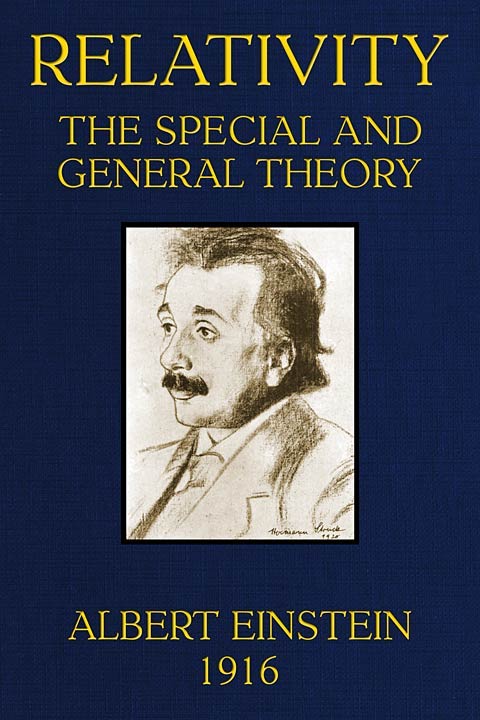
Relativity : the Special and General Theory cover

Relativity : the Special and General Theory

Chapter 2: Preface
Open in WeRead

Explore more books like this:

About This Book

The text introduces basic notions of space, time, and measurement and develops the special theory by examining simultaneity, coordinate systems, Lorentz transformations, and resulting effects such as time dilation and velocity addition, culminating in a four-dimensional spacetime view. It then formulates the general theory by presenting the equivalence of inertial and gravitational mass, a generalized relativity principle, and a geometric description of gravity using non-Euclidean spacetime and coordinate methods. Supplementary sections treat cosmological considerations, simple mathematical derivations, and empirical tests including the perihelion advance of Mercury, light deflection, and gravitational redshift.

The Project Gutenberg eBook of Relativity : the Special and General Theory

This ebook is for the use of anyone anywhere in the United States and most other parts of the world at no cost and with almost no restrictions whatsoever. You may copy it, give it away or re-use it under the terms of the Project Gutenberg License included with this ebook or online at www.gutenberg.org. If you are not located in the United States, you will have to check the laws of the country where you are located before using this eBook.

Title: Relativity : the Special and General Theory

Author: Albert Einstein

Translator: Robert W. Lawson

Release date: February 1, 2004 [eBook #5001]
Most recently updated: January 7, 2022

Language: English

Original publication: Methuen & Co Ltd,, 1920

Credits: Brian Basgen and Jeroen Hellingman
Revised by Richard Tonsing.

*** START OF THE PROJECT GUTENBERG EBOOK RELATIVITY : THE SPECIAL AND GENERAL THEORY ***

Albert Einstein.

Relativity
The Special and General Theory
A Popular Exposition

1916

Table of Contents

Preface
I. The Special Theory of Relativity
I. Physical Meaning of Geometrical Propositions
II. The System of Co-ordinates
III. Space and Time in Classical Mechanics
IV. The Galileian System of Co-ordinates
V. The Principle of Relativity in the Restricted Sense
VI. The Theorem of the Addition of Velocities Employed in Classical Mechanics
VII. The Apparent Incompatibility of the Law of Propagation of Light with the Principle of Relativity
VIII. On the Idea of Time in Physics
IX. The Relativity of Simultaneity
X. On the Relativity of the Conception of Distance
XI. The Lorentz Transformation
XII. The Behaviour of Measuring-Rods and Clocks in Motion
XIII. Theorem of the Addition of Velocities. The Experiment of Fizeau
XIV. The Heuristic Value of the Theory of Relativity
XV. General Results of the Theory
XVI. Experience and the Special Theory of Relativity
XVII. Minkowski’s Four-Dimensional Space
II. The General Theory of Relativity
XVIII. Special and General Principle of Relativity
XIX. The Gravitational Field
XX. The Equality of Inertial and Gravitational Mass as an Argument for the General Postulate of Relativity
XXI. In What Respects Are the Foundations of Classical Mechanics and of the Special Theory of Relativity Unsatisfactory?
XXII. A Few Inferences from the General Principle of Relativity
XXIII. Behaviour of Clocks and Measuring-Rods on a Rotating Body of Reference
XXIV. Euclidean and Non-Euclidean Continuum
XXV. Gaussian Co-Ordinates
XXVI. The Space-Time Continuum of the Special Theory of Relativity Considered as a Euclidean Continuum
XXVII. The Space-Time Continuum of the General Theory of Relativity is Not a Euclidean Continuum
XXVIII. Exact Formulation of the General Principle of Relativity
XXIX. The Solution of the Problem of Gravitation on the Basis of the General Principle of Relativity
III. Considerations on the Universe as a Whole
XXX. Cosmological Difficulties of Newton’s Theory
XXXI. The Possibility of a “Finite” and yet “Unbounded” Universe
XXXII. The Structure of Space According to the General Theory of Relativity
I. Simple Derivation of the Lorentz Transformation [Supplementary to Section XI]
II. Minkowski’s Four-Dimensional Space (“World”) [Supplementary to Section XVII]
III. The Experimental Confirmation of the General Theory of Relativity
(a). Motion of the Perihelion of Mercury
(b). Deflection of Light by a Gravitational Field
(c). Displacement of Spectral Lines Towards the Red
IV. The Structure of Space According to the General Theory of Relativity [Supplementary to Section XXXII]

Preface

The present book is intended, as far as possible, to give an exact insight into the theory of Relativity to those readers who, from a general scientific and philosophical point of view, are interested in the theory, but who are not conversant with the mathematical apparatus of theoretical physics. The work presumes a standard of education corresponding to that of a university matriculation examination, and, despite the shortness of the book, a fair amount of patience and force of will on the part of the reader. The author has spared himself no pains in his endeavour to present the main ideas in the simplest and most intelligible form, and on the whole, in the sequence and connection in which they actually originated. In the interest of clearness, it appeared to me inevitable that I should repeat myself frequently, without paying the slightest attention to the elegance of the presentation. I adhered scrupulously to the precept of that brilliant theoretical physicist L. Boltzmann, according to whom matters of elegance ought to be left to the tailor and to the cobbler. I make no pretence of having withheld from the reader difficulties which are inherent to the subject. On the other hand, I have purposely treated the empirical physical foundations of the theory in a “step-motherly” fashion, so that readers unfamiliar with physics may not feel like the wanderer who was unable to see the forest for the trees. May the book bring some one a few happy hours of suggestive thought!

December, 1916

A. EINSTEIN