
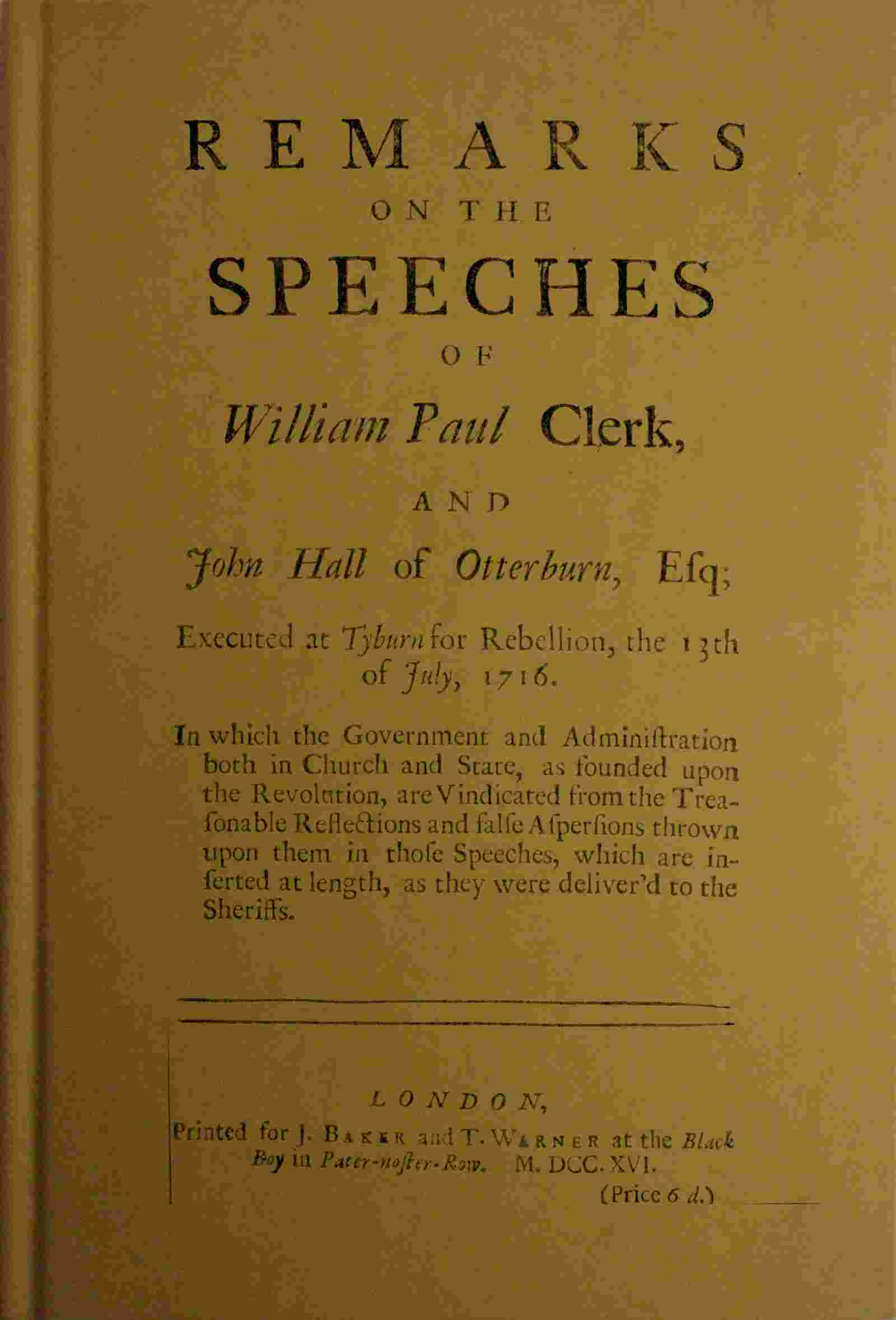
INTRODUCTION.
ANY Judicious Man, who will be at the pains attentively to read the following Speeches, and compare them with the Papers left by Lord Derwentwater, Colonel Oxburgh, and the other Rebels lately executed, must soon be convinc’d, That they all proceed from the same Mint, and are fram’d on purpose to spirit up the Faction to a New Rebellion.
There’s such an Uniformity in the Stile, Matter, and Way of Arguing, as sufficiently proves this; so that instead of being the Speeches of the deceas’d Rebels, they plainly appear to be the Composure of others, who endeavour to serve the Cause not only at the Expence of those poor Mens Reputation, but even of their Souls, by prevailing upon them to deliver such Papers as their dying Sentiments, and the Result of their own Thoughts.
This is very plain in the Case of Mr. Hall, who being ask’d at the Place of Execution, if the Paper he deliver’d was writ by himself, he avoided giving a direct Answer, and only said it contain’d his Sentiments; tho ’tis highly probable he never carefully read it, if we consider the notorious Falshood which he is made to assert, That the Rebels conquer’d the King’s Troops at Preston.
Besides, he and Mr. Paul were so far from being stedfast to the Pretender’s Interest, as is given out in the Speeches, and so little fond of what they call Martyrdom, that ’tis very well known they us’d all possible Endeavours to save their Lives, would have disown’d the Pretender’s Claim, and renew’d their Oaths to the Government, could they have obtain’d their Pardon on that Condition. The Speech-makers were not ignorant of this, but they resolv’d to delude the unthinking Populace, and to make those Men pass for Valiant and Glorious Martyrs; tho, in truth, they liv’d and dy’d the most hateful Dissemblers, both with God and Man, that ever were heard of.
But to come to the Speeches themselves.
Mr. PAUL’s SPEECH.
Good People, I am just going to make my Appearance in the other World, where I must give an Account of all the Actions of my past Life: and tho I have endeavour’d to make my Peace with God, by sincerely repenting of all my Sins, yet forasmuch as several of them are of a Publick Nature, I take it to be my Duty to declare here, in the Face of the World, my hearty Abhorrence and Detestation of them.
REMARKS.
’Tis easy to perceive that this Paragraph is calculated to gain Credit to what he was afterwards to say; but the judicious Reader will discover the Artifice, and that the Author is far from being ingenuous. ’Tis very odd, in a Protestant Divine, to talk of making his Peace with God, by a sincere Repentance of all his Sins, and not say one Word of Faith in the Merits of Jesus Christ; without which, Repentance can neither be sincere nor perfect. This looks so like the Popish Doctrine, that Penance is a sufficient Atonement for Sin, as gives every one just Cause to suspect the Author’s Religion.
He takes notice, that several of his Sins were of a Publick Nature, and that he thought it his Duty to declare his hearty Abhorrence and Detestation of them in the Face of the World; but how much he juggled in this Matter, will be evident by the two following Paragraphs, and the Reflections upon them.
The SPEECH.
And first, I ask Pardon of God and the King, for having violated my Loyalty, by taking most abominable Oaths in Defence of Usurpation, against my Lawful Sovereign King James the Third.
And as I ask Pardon of all Persons whom I have injur’d or offended, so I do especially desire Forgiveness of all those whom I have scandaliz’d by pleading Guilty. I am sensible that it is a Base and Dishonourable Action; that it is inconsistent with my Duty to the King, and an entire Surrender of my Loyalty. Human Frailty, and too great a Desire of Life, together with the Persuasions of several who pretended to be my Friends, were the Occasion of it. I trust God of his infinite Mercy, upon my sincere Repentance, has forgiven me; and I hope all good Christians will.
REMARKS.
Since the Author owns, that several of his Sins were of a Publick Nature, he ought to have been very particular and exact in the Enumeration of them; but he mentions only two, viz. his taking what he calls most abominable Oaths in Defence of Usurpation, and his pleading Guilty to his Indictment.
He must be a very superficial Reader, who does not observe, that these things, which Mr. Paul calls Sins, were attended with others of as heinous and publick a Nature; of which he says not one Word. For his taking the Oaths, if he thought them abominable, was not only a Crime against his pretended Lawful Sovereign, King James III. but a dreadful mocking of God, and treacherous Imposition upon the present Government, and his Country; and so much the more, that he continu’d in this abominable Practice till the time the Rebellion broke out: and it was aggravated by this heinous Circumstance, That he went from the very Pulpit in which he preach’d by the Authority of the present Government, to join those who rose in Arms against it. Had he been a sincere Penitent, such hateful Prevarication with God and Man must have star’d him in the Face, and call’d for an express and humble Acknowledgment of it; whereas he confines his Repentance to what he did against the Loyalty which he fancies he ow’d the Pretender.
One might have expected, from a true and ingenuous Penitent, an Account of the Reasons why he calls the present Government an Usurpation: for tho perhaps he might think, that the Word of a dying Priest was Authority enough for the Bigots of his Party, he ought to have consider’d, that others would expect very strong and convincing Arguments to prove, that his single Judgment should be prefer’d not only to that of our present Legislature, but of all our Parliaments; who, ever since we were a Nation, have asserted it to be their indisputed Right to dethrone Tyrants, and to settle the Succession in such a manner as they thought most conducible to preserve the Liberties of the People. Nothing can be more evident than this in all our Histories and Acts of Parliament before the Reformation; and he must have been prodigiously ignorant, if he did not know that. It has been the Practice, as well as the Principle of the Church of England since she became Protestant: For all the World knows, that in the beginning of the Reformation, under Henry VIII. she own’d the Power of Parliaments, in settling the Succession, about which there were several Acts made in his Reign. In that of his Son, King Edward VI. it appears plain enough that the leading Protestants were of the same mind, when they agreed to set aside his Popish Sister Queen Mary, and to settle the Crown on Lady Jane Grey. And ’tis as well known, that the famous Martyr, Bishop Ridley, did openly preach against Queen Mary’s Title, at Paul’s-Cross.
In Queen Elizabeth’s Reign it appears, by the Records of Parliament, that the Bishops of the Church of England did unanimously agree not only to set aside the Title of Mary the Popish Queen of Scots, who was next Heiress to the English Crown; but also to take off her Head, because of her Plots against Queen Elizabeth. ’Tis no less evident, from the History of that Reign, That the Bishops and Clergy of England enabled the Queen, by their Purses and otherwise, to support the Protestants of France and the Netherlands, who had taken Arms against their Tyrannical Sovereigns; and also those of Scotland, who had dethron’d the Mother, and set up the Son. In the Reign of King James I. the Church of England concurred in like manner to support the Protestants of the United Netherlands and Germany against their Tyrannical Princes; and they continu’d the same Endeavours in the Reign of King Charles I. when even Archbishop Laud, the Idol of our High-Church Clergy, concurred in granting Subsidies for the Support of the French Protestants, who were in Arms against their persecuting Sovereign. What the Church of England did towards dethroning King James II. for his Tyranny, is too late to be forgot; and Mr. Paul cannot but know, that she annually thanks God in her Office on the 5th of November, for bringing over the Prince of Orange, and making all Opposition fall before him, till he became our King and Governour. This, no doubt, he frequently concurred in; and had his Jacobite Repentance been sincere, he ought to have acknowledg’d that as publickly as the other things, which he thought it his Duty to declare in the Face of the World.
Upon the whole, it appears to be of too great Importance for the Speech-makers to think, that Mr. Paul’s bare Assertion, without any Argument, was sufficient to weigh down such a Train of Authorities.
His begging Pardon of those whom he has scandaliz’d by pleading Guilty, is the Form which the Ghostly Fathers of the Rebels have put into all their Mouths; as appears by Lord Derwentwater’s Speech, &c. But since he calls this a base and dishonourable Action, inconsistent with his Duty to the King, and an entire Surrender of his Loyalty; it deserv’d a greater Act of Contrition, than to ascribe it barely to human Frailty, a too great Desire of Life, and the Persuasion of pretended Friends. Here again he shews himself a very loose Protestant, when he relies upon his own Repentance, without one word of our Saviour’s Merits for a Pardon at the hands of God.
The SPEECH.
You see, my Countrymen, by my Habit, that I die a Son, tho a very unworthy one, of the Church of England: but I would not have you think that I am a Member of the Schismatical Church, whose Bishops set themselves up in opposition to those Orthodox Fathers, who were unlawfully and invalidly depriv’d by the Prince of Orange. I declare that I renounce that Communion, and that I die a Dutiful and Faithful Member of the Nonjuring Church; which has kept it self free from Rebellion and Schism, and has preserv’d and maintain’d true Orthodox Principles, both as to Church and State. And I desire the Clergy, and all Members of the Revolution-Church, to consider what Bottom they stand upon, when their Succession is grounded upon an Unlawful and Invalid Deprivation of Catholick Bishops; the only Foundation of which Deprivation, is a pretended Act of Parliament.
REMARKS.
Here’s a new Discovery, for which the World is oblig’d to the Speech-makers, that the Habit makes a Son, or a Priest, of the Church. It had been well for the She-Comedian, who acted Roxellana, that this Doctrine had obtain’d in the Reign of King Charles II. for then she might have been a Countess without Dispute, and her Son Heir to an antient Earldom, because she was marry’d to an Earl by his Coachman in a Priest’s Habit. Parson Paul might also have been better inform’d by his good Friends the Papists, among whom ’tis a common Proverb, Cuculla non facit Monachum, That the Coul does not make a Monk: but the plain Design of this Paragraph is to incense the Mob against the Government, as if they were going to hang up the Church. That was the Reason why Mr. Paul went to Tyburn in his Priest’s Vestments, which he needed not have done. We know the time when the Clergy took a great deal of Care to prevent such a Scandal to their Cloth, and that was when they degraded the Reverend Mr. Sam. Johnson, before he was whipt, for writing against Popery and Tyranny; tho he had more Honesty, and a better Title to his Orders, than any of those who pretended to take them from him. But this lets us see where the Blame lies, if carrying Mr. Paul to Tyburn in his Priest’s Vestments was a Disgrace to the Church. There are some in the World, who think the Character of a Jacobite Priest indelible, tho they did not think so of that Brave and Learned Patriot, Mr. Johnson. But however that is, ’tis no more Reflection upon the Government, that Priests should be hang’d in their Habit, than kill’d in the Field for Rebellion; and this we may venture to say, that Parson Paul dishonour’d the Habit more by wearing it in the Pulpit, than at the Gallows.
At the same time his Friends have a very good way to make themselves amends, by laying up his Vestments with those of St. Garnet and Faux, where the Bigots may adore them as precious Relicks; and perhaps this was the reason why the Parson would not die in a Lay-Habit, tho he was disguis’d in one, when taken up for his Treason.
The World is farther oblig’d to this Priest, for another important Discovery; to wit, that he was not a Member of the Schismatical Church, but dy’d a dutiful and faithful Member of the Nonjuring Church of England, which has kept it self free from Rebellion and Schism, and has preserv’d and maintain’d true Orthodox Principles, both as to Church and State. The Folly and Inconsistency of this Declaration is evident at first View, and the Malice of it is what ill became a dying Man. ’Tis well enough known that he liv’d a Priest, tho he did not die a Member, of what he call’d the Schismatical Church; and he continu’d in her Communion till he went to join the Rebels at Preston. This is another of his publick Sins, which he forgot in his Enumeration of ’em in the beginning of his Speech; but he thinks to atone for that, by renouncing her Communion at Death.
’Tis pleasant to hear his Reasons for calling the Establish’d Church Schismatical, and that is, because her Bishops set themselves up in opposition to those Orthodox Fathers, who were unlawfully and invalidly depriv’d by the Prince of Orange. So that according to him the Church of England is Schismatical, Republican, and Antimonarchical, as well as Dissenters: but had the Speech-maker’s Head been cool, he would have consider’d, that his Argument, were it conclusive, could not make all the Establish’d Church Schismaticks, but only those Bishops who came in place of his depriv’d Orthodox Fathers, and such as liv’d under them; now all those Bishops being dead, the Schism, according to Mr. Dodwell, the grand Champion of the Party, ceas’d with them. By this we see, that the Party has no fix’d Principle; for tho they applauded that Author, and look’d upon him as their Oracle, yet now they differ from him: so that we find it to be true of this Set of People, That evil Men and Seducers grow worse and worse.
The Parson equally discovers his Malice and Ignorance, by finding fault with that Deprivation; for had he ever read the Statute of Provisors, made in the 25th of King Edward III. he might thereby have known, ‘That the Church of England was founded in the Estate of Prelacy, by the Kings, Earls, Barons, and other Nobles of this Realm, to inform them and the People of the Law of God, &c. And that certain Possessions, as well in Fees, Lands, Rents, as in Advowsons, which do extend to a great Value, were assign’d by the said Founders to the Prelates, &c.’ And since it is so, ’tis a known Maxim in Law and Reason, That they who have a power to make, have a power to unmake: and it will be acknowledg’d as a very good reason all over the World, to deprive such Prelates as refuse to swear or give Allegiance to the Government, that founded their Prelacys, and protects their Persons.
He might also have seen, by the 5th of the 25th of Henry VIII. that the Bishops of Salisbury and Worcester were depriv’d, because not regarding their Duties to Almighty God, nor the Cures of their Bishopricks, they dwelt at Rome, and other Parts beyond Sea, &c. And the Reason given for this Power, then exercis’d by the King and Parliament, is the same with that already mention’d in the Statute of Provisors. Besides, every one knows, that in King Henry VIII. and King Edward VI’s Time, the Bishops held their Commissions only during the Pleasure of the Prince, and as his Delegates.
If the Speech-maker’s Friends object, that this relates only to the Temporalities of the Bishops, ’tis answer’d, that in the Commission taken out by Archbishop Cranmer for his Archbishoprick, his Power of ordaining and turning out Presbyters, is also deriv’d from the King. The Commission is at large in Dr. Burnet’s History of the Reformation, Collection of Records, p. 90.
But perhaps the Example of that Excellent Primate and Martyr won’t have much weight with the High-Church Party; therefore I shall give them one of Bishop Bonner, who was as Bloody and High a Churchman as any of themselves. He took out a Commission from King Henry VIII. in the Preamble of which ’tis asserted, ‘That since all Jurisdiction, both Ecclesiastical and Civil, flow’d from the King as Supreme Head, and he was the Foundation of all Power; it became those who exercis’d it only at the King’s Courtesy, gratefully to acknowledg that they had it only of his Bounty, and declare that they would deliver it up again when it should please him to call for it.’ The Commission is exhibited at large in Dr. Burnet’s History of the Reformation, Vol. 1. Collection of Records, No 14.
’Tis true, that the way of giving Temporary Commissions to Bishops for the Exercise of their Episcopal Power, is now laid aside: but since that Power is still deriv’d from the Sovereign, by virtue of a Conge d’Eslire, ’tis impudent in our High Church Priests to complain of the Deprivation of the Nonjurant Bishops by King William and his Parliament; especially if we consider, that Bishops were antiently chosen in Parliament, till the time of Henry I. and that ’tis by Act of Parliament our Princes were impower’d to erect and confer Bishopricks; as appears by 31 H. VIII. c. 9. & 13. and by the 37th of his Reign, c. 17. ’tis declar’d, ‘That Archbishops, Bishops, Archdeacons, and other Ecclesiastical Persons, have no manner of Jurisdiction Ecclesiastical, but by and under the King, the only undoubted Supreme Head of the Church of England.’
By the 25th Henry VIII. c. 20. the Chapter is oblig’d in twelve Days to chuse the Person nam’d by the King in the Conge d’Eslire; if they do not, his Nomination is sufficient: and the Archbishop and Bishops, to whom the King’s Signification is directed, are oblig’d to consecrate the Elect within twenty Days, as well as the Chapter is to present him, on pain of a Premunire.
Yet tho the English Prelacy is so plainly a Creature of the State, and enjoys all its Power and Revenues from it; our High Church Priests are so traitorous and unconscionable, that they would have the Bishops to enjoy part of the Legislature as an Estate by themselves, and be capable of Posts of State, and of Ecclesiastical and Civil Power, without any Dependence on the State: which, instead of one Pope over Christendom, is to set up twenty six Independent Popes in England, and run both Church and State into Anarchy and Confusion.
It is in vain for them to alledg, that they dispute King William’s Power, because he was not a Lawful King; for we have heard already, that by the antient Constitution of England, our Parliaments always asserted their Power to dethrone Tyrants, and to set up such in their stead as would maintain the Nation’s Privileges.
The Speech enumerates so many sorts of Churches of England, that it will be hard to tell, according to the Notions of the Faction, how many they will come to at last. Here’s a Schismatical Church of England, a Nonjuring Church of England, a Revolution Church of England; he might have added a Perjuring Church of England, of which he himself, and his Fellow Criminal Mr. Hall were noted Members. ’Tis ridiculous to assert, that the Nonjuring Church has kept it self free from Rebellion; for all the World knows, that the Men of that Stamp begun what he calls the Rebellion against the late King James, and they have been Rebels to all our Sovereigns ever since: so that if any Set of Men in the Island deserve to be call’d Rebellious and Antimonarchical, ’tis they. Was it not for Rebellion, that Mr. Paul and others of his Party have lost their Lives? We know indeed, that not only the Nonjurors, but even some others of the Church of England, are shy of calling it Rebellion; yet ’tis so in the Eye of the Law, and in the Opinion of all those Powers in Europe, who have own’d his Majesty’s Title. Then let the World judg, whether Parson Paul’s Authority or theirs, is most to be rely’d on.
’Tis perfectly ridiculous then to alledg, that the Nonjuring Church has kept it self free from Rebellion and Schism, when they have not only been in a Course of Rebellion ever since the Revolution, but separated from their Brethren, and set up private Conventicles, as well as disown’d the Head of the Church: which certainly makes them Schismaticks in the highest sense. Nor is there a Protestant Church in the World at this day, whose Communion they don’t reject. They may talk then of being Catholick as long as they please, but they can be so in no other sense than that they are for a Roman Catholick Prince, and for such an Union with the Church of Rome, as is betwixt her and the Church of France; which Mr. Lesley, the Pretender’s Chaplain, and one of his Bishops, propos’d long ago in his Pontificate and Regale.
Mr. Paul seems miserably to have forgot himself, in saying that he dy’d a dutiful and faithful Member of the Nonjuring Church, when the World knows that he continu’d a Member of the Establish’d Church till the Rebellion begun; and it can be prov’d, that he wou’d have been glad to have continu’d so, and to have own’d the present Government a very little before his Death, tho the Speech calls it a Usurpation, could the Promises and Oaths of such a perfidious Wretch been rely’d upon, or thought worthy of being accepted.
The SPEECH.
Having ask’d Forgiveness for my self, I come now to forgive others. I pardon those, who under the Notion of Friendship persuaded me to plead Guilty. I heartily forgive all my most inveterate Enemies, especially the Elector of Hannover, my Lord Townshend, and all others who have been instrumental in promoting my Death. Father, forgive them! Lord Jesus, have mercy upon them, and lay not this Sin to their Charge.
REMARKS.
After he has rail’d at the Church and State, he pretends that he has ask’d Forgiveness for himself, and comes to forgive others; and first, those who under the Notion of Friendship persuaded him to plead guilty. ’Tis common, we see, for those who are false themselves, to call others False Brethren; yet ’tis evident by the Clemency shew’d to others who pleaded guilty, that those who advis’d him to do so, were his best Friends: but since there were such Aggravations in his Case and Character, as made him unworthy of the like Favour, his Blood lies on his own Head.
His way of forgiving others is very extraordinary, when he calls them with his dying Breath his most inveterate Enemies; and among those, he points out the King, under the Title of Elector of Hannover, and my Lord Townshend. This smells of so much Rancour, that it is not reconcilable with the Spirit of Christianity, and at the same time it shews the height of Prevarication with God and Man; since in his Applications for Mercy he gave the King his Royal Titles (which he now denies him) and him whom he call’d his King at the Gallows, he thought fit to call a Pretender in his Petitions. His pointing at my Lord Townshend in such a particular manner, is to mark out that Noble Lord to the Fury of the Jacobite Mobs; a piece of Revenge that is abominable in any Man, but execrable in a dying Minister, who knew that my Lord Townshend could not in Faithfulness to the King behave himself any otherwise than he did, or become an Intercessor for a Man of so vile a Character, as Mr. Paul appears to have been, to all that know him. But the Spirit of Rage and Malice, by which the Parson was acted to the last, will further appear by the following Paragraph, and the Reflections upon it.
The SPEECH.
The next thing I have to do, Christian Friends, is to exhort you all to return to your Duty. Remember that King James the Third is your only Rightful Sovereign, by the Laws of the Land, and the Constitution of the Kingdom. And therefore if you would perform the Duty of Justice to him, which is due to all Mankind, you are oblig’d in Conscience to do all you can to restore him to his Crown: For it is his Right, and no Man in the World besides himself can lawfully claim a Title to it. And as it is your Duty to serve him, so it is your Interest; for till he is restor’d, the Nation can never be happy. You see what Miseries and Calamities have befallen these Kingdoms by the Revolution; and I believe you are now convinc’d, by woful Experience, that swerving from God’s Laws, and thereby putting your selves out of his Protection, is not the way to secure you from those Evils and Misfortunes which you are afraid of in this World. Before the Revolution, you thought your Religion, Liberties, and Properties in Danger; and I pray you to consider how you have preserv’d them by Rebelling. Are they not ten times more precarious than ever? Who can say he is certain of his Life or Estate, when he considers the Proceedings of the present Administration? And as for your Religion, is it not evident that the Revolution, instead of keeping out Popery, has let in Atheism? Do not Heresies abound every day; and are not the Teachers of false Doctrines patroniz’d by the Great Men in the Government? This shews the Kindness and Affection they have for the Church. And to give you another Instance of their Respect and Reverence for it, you are now going to see a Priest of the Church of England murder’d for doing his Duty. For it is not me they strike at so particularly, but it is thro me that they would wound the Priesthood, bring a Disgrace upon the Gown, and a Scandal upon my Sacred Function. But they would do well to remember, that he who despises Christ’s Priests, despises Christ; and he who despises him, despises him that sent him.
REMARKS.
After profaning the Name of our Saviour, by seeming to pray that he would forgive those who had been instrumental in promoting Mr. Paul’s Death; the Speech-maker gives himself the lye, by exciting his Auditors to a new Rebellion: and the Motives he uses for it are only a parcel of vulgar Topicks and bold Assertions, suited to the Taste of the Jacobite Mob, without one word of Argument to support his Propositions; for he knew the Credulity of the High-Church Faction, and that if he cou’d prevail upon them to exert themselves for the Pretender, they wou’d not fail in their usual brutish manner to attempt a Revenge on those, whom he points out as his own and the Pretender’s Enemies.
’Tis remarkable however, that he does not offer one Law or Text to justify the Pretender’s Claim, which he so positively asserts, but goes on with a pitiful Declamation, to persuade them to a new Rebellion, from the Topicks of Interest. And he insists upon the Calamities that have befallen these Kingdoms by the Revolution, without giving one Instance of those Calamities. We may see the Hand of the Jesuit in this way of Reasoning; for crafty and knavish Men always betake themselves to Generals. In this he follows the Example of the Holborn Doctor, who did what he cou’d to blacken the Revolution, and the Methods made use of to effect it, by general Slanders, without offering at one particular Instance to justify what he says.
Nothing can more demonstrate the Infatuation of Mr. Paul, or those who made his Speech, than his telling the People that before the Revolution they thought their Religion, Liberties, and Properties in danger; and that instead of preserving them by Rebellion, they are now become ten times more precarious than ever. Had Satan appear’d in a visible Form, he cou’d not have utter’d any thing more deceitful and false. By this Instance ’tis plain, that the great Accuser of the Brethren triumphs in the Weakness, as well as the Wickedness of those he has deluded: For even the late Archbishop Sancroft, and other Patrons of the Nonjurant Party, give Mr. Paul the lye, as to the first part of his Proposition, and common Sense falsifies the latter. To prove this, we need only to observe, that Sancroft and the rest of the Bishops, who refus’d to read K. James II’s Declaration for Liberty of Conscience, alledg’d that it was an Invasion upon our Civil and Religious Liberties. And because they set forth this in their Petition to that Prince, they were committed to the Tower, and brought to a Tryal as traitorous Criminals: but to their good fortune, the Law, which they had formerly too much run down, prevail’d against that Arbitrary Power of the Prince, which they had so long preach’d up; and the Arguments which were made use of by the late Lord Chief Justice Pollexfen, Lord Sommers, and other Whigs, in behalf of the Constitution, prevail’d so far, that they were honourably acquitted. Upon which, Dr. Sancroft and his Brethren did so much resent these Tyrannical Proceedings of King James II. that they concur’d with others in the Happy Revolution: and Archbishop Sancroft himself, tho afterwards the Head of the Nonjuring Party, did take the Keys of the Tower from Skelton, K. James’s Lieutenant, and join’d, with other Bishops afterwards Nonjurors, in a Declaration for applying to the Prince of Orange, on the 11th of December 1688, after King James had run away, to obtain a Parliament for securing our Laws, Liberties, Properties, and the Church of England in particular.
This is enough to shew, that the Heads of the Nonjurant Party were then convinc’d that our Religion, Liberties, and Properties were in Danger; which sufficiently confutes Mr. Paul’s Insinuation, that they were not.
And as to the other part of his bold Assertion, that they are ten times more precarious now than ever, common Sense and Experience give him the Lye; for Thanks to God, we have now a Protestant, whereas we then had a Popish King on the Throne: and Malice itself can’t say, that profess’d Papists are contrary to Law made Members of the Privy Council, Commanders in the Army, and obtruded upon our Universities, instead of Protestants illegally turn’d out, as was the Case in those days.
Besides, by the Revolution, which Mr. Paul thinks fit to call a Rebellion, we have obtain’d an irrevocable Law, that none who has been a Papist, is a Papist, or marries a Papist, shall from henceforth sit on our Throne; but that they shall always be of the Communion of the Church of England, as by Law establish’d. This is such a Security for our Religion, as England never had before. And as to our Civil Rights, Liberties, and Properties, we have, by the Declaration of Rights, enacted into a Law, such a Security, as our Ancestors never enjoy’d a better, nor can any Nation in Europe shew the like. With what face then could this dying Traitor say, that our Religion, Liberties, and Properties are ten times more precarious than ever? Certainly a Man who could thus appear before the Tribunal of Heaven, with such a Lye in his Mouth, must have been judicially harden’d, and given up to a reprobate Sense.
As to his Question, Who can say he is certain of his Life or Estate, when he considers the Proceedings of the present Administration; it is brimful of the greatest Malice and Falshood, and utter’d on purpose to expose the Ministry to the Rage of the Jacobite Mobs; which shews us how sincere Mr. Paul was in his Professions to forgive his Enemies. But it is our Happiness that none of the Party can say, that the present Ministry pack Juries, or suborn Evidence, to swear Men out of their Lives and Estates, as the Tories always did when they sat at the Helm. Nor can Malice charge the present Ministry with bringing Quo Warranto’s, to deprive Corporations of their Charters, on pretence of having forfeited them by Tumults; as was practis’d in the Reigns of King Charles and King James II. notwithstanding the just occasion which the Faction has given for doing it every where, by such groundless and barbarous Tumults and Rebellions, as were never heard of in England before. As to the Security of our Lives and Estates, the Rebels themselves, who have been brought to Tryal, can bear Witness, that they have had the Benefit of the 7th of William III. which is more favourable and indulgent to Traitors, than the Laws of England before the Revolution; for by this Act they are allow’d a Copy of their Indictment five days, and a Copy of the Pannel two days before Trial, to make their Defence by Counsel, and Proof by Witnesses upon Oath. And the Court is oblig’d, on the Request of the Prisoners, to assign them Counsel, who are to have free Access to them; besides which, none can be try’d according to that Act, but on the Oath of two lawful Witnesses, either both to the same Overt-Act, or one to one Overt-Act, and the other to the other: which are all such Privileges as Englishmen never enjoy’d before the Revolution.
Since all this is evident by our Statute-Books, and by Matter of Fact, it plainly shews the Ignorance and Malice of Mr. Paul and his Speech-makers.
As to his other Insinuation, that the Revolution, instead of keeping out Popery, has let in Atheism, nothing but unparallel’d Impudence could have utter’d it. The late Bishop of Sarum did justly observe at Sacheverel’s Trial, that nothing had so much contributed to the Growth of Atheism in the Nation, as the Clergy’s playing fast and loose with Oaths: and as this was the avow’d Practice of Mr. Paul and his Party, to take Oaths to the Government, on purpose to undermine it, and to abjure the Pretender, while at the same time they carry’d on his Interests; the Growth and Patronage of Atheism; is justly ascrib’d to his own Faction. There can be no stronger proof of this, than their Breach of solemn Leagues and Oaths, and making the late Queen Anne so notoriously contradict her self from the Throne. Besides, does not all the World know, that her Tory Ministry, and particularly two of her Secretaries of State, were guilty of the most avow’d Perjury? Were not the Generals of the Rebels, as well as he who betray’d the Confederate Armies to France, guilty of wilful Perjury? And were not many of the High-Church Members of the House of Commons, and the High-Church Clergy guilty of the like? Can any thing be a greater Proof of Atheism than wilful Perjury? Does it not deny the very Being, and all the Attributes of God Almighty? With what face then could this dying Traitor charge others with Atheism, of which he and his Party are so demonstrably guilty?
He seems to make a Distinction betwixt Atheism and Popery, and to give the latter the Preference, which is another Proof of his Ignorance and Malice; for every Man who has read the Casuistical Divinity of the Jesuits, which is the very Soul and Support of Popery, must needs know, that the whole Scheme of that Divinity is Atheistical: and therefore it has a long time been the Opinion of some of the ablest Protestant Divines, that it is next to impossible for a Man of Learning and Knowledg of the World to be a Papist, and not be an Atheist at the same time.
For Mr. Paul’s other Insinuation, that Heresies abound every day, and that the Teachers of false Doctrines are patroniz’d by the Great Men now in the Government, he ought to have given some well-known Instances to support his Assertion; but his Business was to slander: so that this needs no other Answer, than that it ill becomes those who preach and maintain the abominable Doctrines of Popery and Slavery, Heresies destructive to the Bodies and Souls of Men, to charge the Ministry with patronizing the Teachers of false Doctrines, merely because they won’t break thro Law to gratify the persecuting Humour of High-Church, against Men who differ from their Brethren in some Matters of Speculation, or mere Circumstantials of Religion.
But the true Cause of all this Malice is, that Mr. Paul was now for his Rebellion brought to the Gallows, which he calls the Murder of a Priest of the Church of England for doing his Duty. We have heard before, that the Practice for which he was condemn’d to be hang’d, is directly contrary to the Doctrine of the Liturgy of the Church of England; so that ’tis ridiculous as well as hateful for him to call a due Course of Law Murder. Faux and Garnet, when they were hang’d for the Gunpowder-Plot, and those who suffer’d in King William’s time for the Assassination, went out of the World with the like Reflections upon the Government; so that these being only Words of course from Rebels at the Gallows, they deserve no further regard.
Nothing can be more villanous and profane than the last part of this Paragraph, where he falsly asserts, that the Priesthood was struck at thro him, &c. How he could reckon himself a Priest, since he was ordain’d by a Schismatical Bishop in 1709, I can’t tell; but be that how it will, ’tis never reckon’d a Disgrace to the Clergy in a Protestant Country, when any of that Order are justly executed for capital Crimes: nor was it reckon’d so even among his Brethren the Papists in Spain and Catalonia, where Priests were hang’d for Rebellion on both sides by the Houses of Bourbon and Austria, according as either prevail’d; but more especially by King Philip, since Mr. Paul’s Friends, the late Tory Ministry, betray’d the Catalans: and I suppose that no body will doubt that those two Royal Families have as great a Respect for the Order of the Priesthood, as our High Churchmen. It is true indeed, that the Pope, the Great High Priest, has always claim’d the sole Power of animadverting upon the Clergy, as his own proper Sons; but one of the most Christian Kings, who took a Bishop in Rebellion, with a Coat of Mail upon him, knew very well how to distinguish betwixt the Priest and the Rebel; and when the Pope demanded the Bishop to be set at liberty as one of his Sons, the French King sent his Holiness the Bishop’s Armour, and bid him see whether that was his Son’s Coat or no; making use of the vulgar Latin Translation in the Case of Joseph’s Coat that was sent to his Father, Vide an hæc sit tunica filii tui? Had Parson Paul gone to the Gallows with the Lay-Habit in which he rebell’d in Lancashire, and was taken up in London, it might have sav’d the Honour of the Gown, but it would have been no Argument for the Honesty of the Priest.
The Conclusion of this Paragraph is so very profane and blasphemous, that it can’t be repeated without Horror. The Text here, misapply’d by Mr. Paul, was spoke with relation to our Saviour’s Apostles, so that the Missionaries of Popery and Slavery have nothing to do with it. Our Saviour is represented by St. John the Divine, to walk in the midst of the seven Golden Candlesticks; but those of Brass, like Parson Paul, who rebel against Christianity, in behalf of Antichristian Idolatry, have their Mission from the Pope and the Devil: so that a Man cannot be a good Christian, without despising them and him that sent them.
The SPEECH.
And now, Beloved, if you have any Regard to your Country, which lies bleeding under these dreadful Extremities, bring the King to his just and undoubted Right. That is the only Way to be freed from these Misfortunes, and to secure all those Rights and Privileges which are in Danger at present. King James has promis’d to protect and defend the Church of England; He has given his Royal Word to consent to such Laws, which you your selves shall think necessary to be made for its Preservation. And his Majesty is a Prince of that Justice, Vertue and Honour, that you have no manner of Reason to doubt the Performance of his Royal Promise. He studies nothing so much as how to make you all Easy and Happy; and whenever he comes to his Kingdom, I doubt not but you will be so.
REMARKS.
This Paragraph continues Parson Paul’s rebellious Declamation, which is very well adapted to the Cause he dy’d for. ’Tis the Encomium of a false Prophet upon a spurious and counterfeit Prince, who stands attainted by our Laws as an Impostor. But were it otherwise, the Parson dies with a Lye in his right hand as to the Character of his pretended King: for the World knows, that instead of giving that Security which the Parson promises in his Name for the Church of England, he would not so much as take an Oath for supporting the Traitor’s dear Brethren, the Nonjuring Episcopal Party in Scotland; in which perhaps he was right, since a Nonjuring Church ought to have a Nonjuring King. Nay, he would not so much as countenance the Church-of-England Liturgy with his Presence, because he lik’d the Mass in Latin better. In short, there wanted nothing to make this Paragraph a compleat intelligible Lye, but that the Parson, to the Qualities of Justice, Vertue and Honour, which he ascribes to his King, should have added Valour; a Quality as applicable to a finish’d Coward, as those of Vertue, Honour, and Justice are to one bred up in the Idolatry of Rome, and the Tyrannical Maxims of France: and that this is the Pretender’s Character, we can prove by Queen Anne’s Speech to Parliament in 1708.
The SPEECH.
I shall be heartily glad, good People, if what I have said has any effect upon you, so as to be instrumental in making you perform your Duty. It is out of my power now to do any thing more to serve the King, than by employing some of the few Minutes I have to live in this World, in praying to Almighty God to shower down his Blessings Spiritual and Temporal upon his Head, to protect him and restore him, to be favourable to his Undertaking, to prosper him here, and to reward him hereafter. I beseech the same Infinite Goodness to preserve and defend the Church of England, and to restore it to all its just Rights and Privileges: and lastly, I pray God have mercy upon me, pardon my Sins, and receive my Soul into his everlasting Kingdom; that with the Patriarchs, Prophets, Apostles and Martyrs, I may praise and magnify him for ever and ever. Amen.
REMARKS.
Had not the High-Church Faction been bred up in as much Ignorance by their Priests, as those of Rome, the Parson could never have hop’d that his pitiful Rhapsody would be any way instrumental to make them perform what he calls their Duty; which in plain English (as the Act to oblige Papists to register their Persons and Estates, well expresses it) is ‘to dethrone and murder his Sacred Majesty, to destroy our present happy Establishment, to settle a Popish Pretender on the Throne, to destroy the Protestant Religion, and cruelly to murder and massacre its Professors.’ None but such barbarous Priests as Mr. Paul could exhort them to do this, and none but such ignorant Bigots could swallow the Suggestions of Hell as Christian Doctrine: and since this is the way in which the High Church Party, when brought to the Gallows, pretend to forgive their Enemies, we may easily guess at their Clemency, had Heaven, for our Sins, have suffer’d their Arms to prevail.
The Prayers of the Parson’s last Minutes for the Pretender, are answerable to Mr. Paul’s Behaviour during the Course of his Life. It would seem however, that he had forgot the Order of the Toasts, which was follow’d by his Brethren in the last Reign, to put the Church before the Queen; for here he has put his King before his Church. But his Prayers are like to be equally effectual in both respects; for God will not hear the Petitions of those who regard Iniquity in their Hearts, as ’tis plain this Parson did.
He should however have told us what those Just Rights and Privileges are, to which he prays the Church of England might be restor’d, or he could not expect our Amen. ’Tis certain she enjoys as many Privileges now, and is as well secur’d in them, as she has been at any time since the Reformation. But if he meant that she should be restor’d to all the Church-Lands, which were enjoy’d by the Secular and Regular Clergy in time of Popery; that the Clergy should be Independent on the State, as they pretended to be then, but could never obtain it; that the High-Church Writ, de Hæretico Comburendo, should be reviv’d; that some of the Inferior Clergy should sit in the House of Commons, instead of the Popish Priors; that others should sit in the House of Lords, instead of the Mitred Abbots; or, in a word, that it should be in the power of the High-Church Clergy to King and Unking, to Christen and Unchristen whom they pleas’d. If these are the Privileges and Liberties he wants to have restor’d, his Prayers will never be granted by God, because they are contrary to his reveal’d Will, nor listen’d to by Englishmen, till they put off human Nature, and degenerate into Brutes.
The Clergyman at last comes to take some Care of his own Soul, and prays that his Sins may be pardon’d, and that he may be receiv’d into the Everlasting Kingdom, among Patriarchs, Prophets, Apostles, and Martyrs: but ’tis observable, that in his whole Speech he does not pray for any one thing thro the Merits of Christ; which shew’d how little he understood the Gospel that he pretended to preach, and gives us too just Ground to conclude, that as he did not live like a Christian, he did not die one.
The SPEECH.
As to my Body, Brethren, I have taken no manner of Care of it: for I value not the barbarous Part of the Sentence, of being cut down and quartered. When I am once gone, I shall be out of the reach of my Enemies; and I wish I had Quarters enough to send to every Parish in the Kingdom, to testify that a Clergyman of the Church of England was martyr’d for being Loyal to his King.